Chapter 5 · Biodiversity · 3 questions in the paper · 38 min read
Angiosperms and Economic Botany
What the syllabus asks for 4
- Morphology of root, stem, leaf, inflorescence, flower and fruit
- Diagnostic characters, floral formulae and floral diagrams of Brassicaceae, Solanaceae, Fabaceae and Liliaceae
- Economic importance of viruses, bacteria, blue-green algae, fungi, algae, bryophytes, pteridophytes, gymnosperms and angiosperms of Nepal
- Medicinal plants of Nepal: neem, sarpagandha, yarsagumba, tulasi and ginger
Angiosperms and economic botany close the Biodiversity unit and carry about 3 of the 40 Botany questions — the most of any Biodiversity chapter. The questions come from four places: plant morphology (which organ a potato, an onion or a pea tendril really is; inflorescence, placentation, fruit types); the four prescribed families (read a floral formula, name the family, give its fruit); the economic importance of every plant group in Nepal; and the five medicinal plants named in the syllabus — neem, sarpagandha, yarsagumba, tulasi and ginger — with their scientific names, parts used and active compounds.
- Modified organs by origin — potato, ginger, onion, Colocasia (stems); sweet potato, carrot, radish (roots); pea tendril, Opuntia spine (leaves); Opuntia pad, Asparagus "leaf", Citrus thorn (stems).
- Inflorescence — racemose (acropetal) vs cymose (basipetal); special types: verticillaster (tulasi), cyathium (Euphorbia), hypanthodium (fig), capitulum (sunflower).
- Flower terms — symmetry, ovary position, aestivation, cohesion of stamens (monadelphous, diadelphous, syngenesious), tetradynamous and didynamous, placentation.
- Fruits — simple, aggregate, composite; true and false; legume, siliqua, berry, capsule, pome.
- Four families — Brassicaceae K₂₊₂ C₄ A₂₊₄ G₍₂₎; Fabaceae K₍₅₎ C₁₊₂₊₍₂₎ A₍₉₎₊₁ G₁; Solanaceae K₍₅₎ C₍₅₎ A₅ G₍₂₎; Liliaceae P₃₊₃ A₃₊₃ G₍₃₎ — with one diagnostic character each.
- Economic botany of Nepal — biofertilisers, fermented foods (gundruk, kinema), antibiotics, lokta paper, sal timber, pine resin, invasive weeds.
- Medicinal plants — Azadirachta indica, Rauwolfia serpentina, Ophiocordyceps sinensis, Ocimum sanctum, Zingiber officinale.
5.1 Morphology of root, stem, leaf, inflorescence, flower and fruit
Root
The tap root system grows from the radicle (dicots); the fibrous root system of monocots replaces the short-lived primary root with many roots from the base of the stem; adventitious roots arise from any part other than the radicle.
| Modification | Function | Examples |
|---|---|---|
| Conical / fusiform / napiform tap roots | storage | carrot / radish / turnip and beet |
| Tuberous (adventitious) root | storage | sweet potato |
| Fasciculated roots | storage | Dahlia, Asparagus |
| Prop roots (from branches) | support | banyan (Ficus benghalensis) |
| Stilt roots (from lower nodes) | support | maize, sugarcane, Pandanus |
| Climbing roots | climbing | betel, money plant (Pothos) |
| Pneumatophores (negatively geotropic) | breathing in swamps | mangroves — Rhizophora, Avicennia |
| Velamen roots | absorbing moisture from air | epiphytic orchids (Vanda) |
| Haustoria (sucking roots) | parasitism | dodder (Cuscuta, total stem parasite); mistletoes (Loranthus, Viscum, partial) |
| Root nodules | nitrogen fixation | legumes (Rhizobium); alder, uttis (Frankia) |
Stem
The stem bears nodes, internodes and buds, grows towards light, and in its modified forms can always be recognised by these — a structure with nodes, buds or scale leaves is a stem, however root-like it looks.
| Modification | Recognise it by | Examples |
|---|---|---|
| Rhizome | horizontal underground stem with nodes, scale leaves, buds | ginger, turmeric, banana |
| Stem tuber | swollen tip of an underground branch; "eyes" are nodes with buds | potato |
| Corm | short, upright, swollen underground stem | Colocasia (pindalu), Amorphophallus, Crocus, Gladiolus |
| Bulb | reduced disc-like stem with fleshy scale leaves | onion (tunicated), garlic (compound bulb of cloves), lily (scaly) |
| Runner, stolon, offset, sucker | sub-aerial branches that root and form new plants | Cynodon (dubo grass), strawberry (runners); jasmine, mint (stolons); Pistia, water hyacinth (offsets); Chrysanthemum, banana, pineapple (suckers) |
| Stem tendril | from an axillary or terminal bud | grape vine, cucurbits |
| Thorn | from an axillary bud; has vascular supply | Citrus, Bougainvillea, pomegranate |
| Phylloclade | flattened green stem of many internodes; leaves reduced to spines | Opuntia, Euphorbia |
| Cladode | green stem only one internode long | Asparagus, Ruscus |
| Bulbil | fleshy axillary bud that drops and grows | Dioscorea, Agave |
A thorn is a modified stem (axillary branch — Citrus, Bougainvillea). A spine is a modified leaf or part of a leaf (Opuntia, Berberis; stipular spines of Zizyphus). A prickle is only an epidermal outgrowth with no vascular tissue (rose). Thorn and spine have the same function but different origins — they are analogous.
Leaf
A leaf has a leaf base (swollen into a pulvinus in legumes, sheathing in grasses), a petiole and a lamina; many have a pair of stipules.
- Venation: reticulate in dicots and parallel in monocots (exceptions: Smilax and Dioscorea are monocots with reticulate venation; Calophyllum is a dicot with parallel venation).
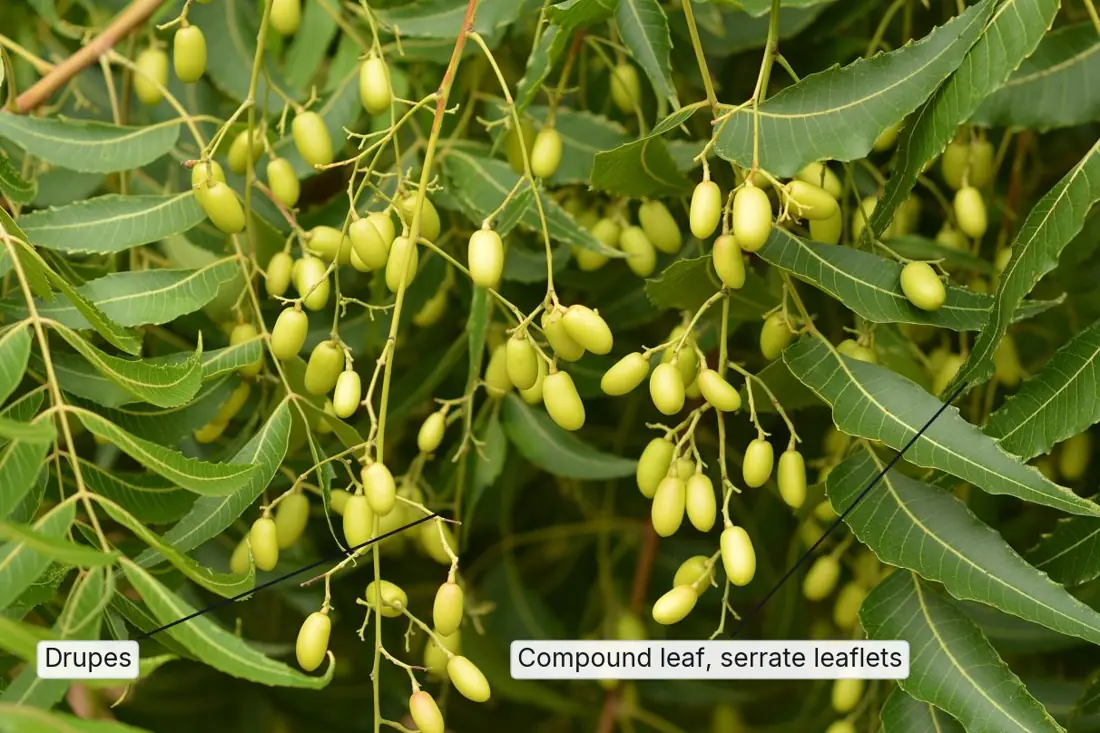
- Compound leaves: pinnate — leaflets on a rachis (neem and rose, imparipinnate; tamarind, paripinnate; Mimosa, bipinnate; Moringa, tripinnate); palmate — leaflets from one point (unifoliate Citrus, trifoliate Aegle (bel) and Oxalis, quadrifoliate Marsilea, multifoliate silk cotton, simal). A compound leaf has a bud in its axil; a leaflet has none.
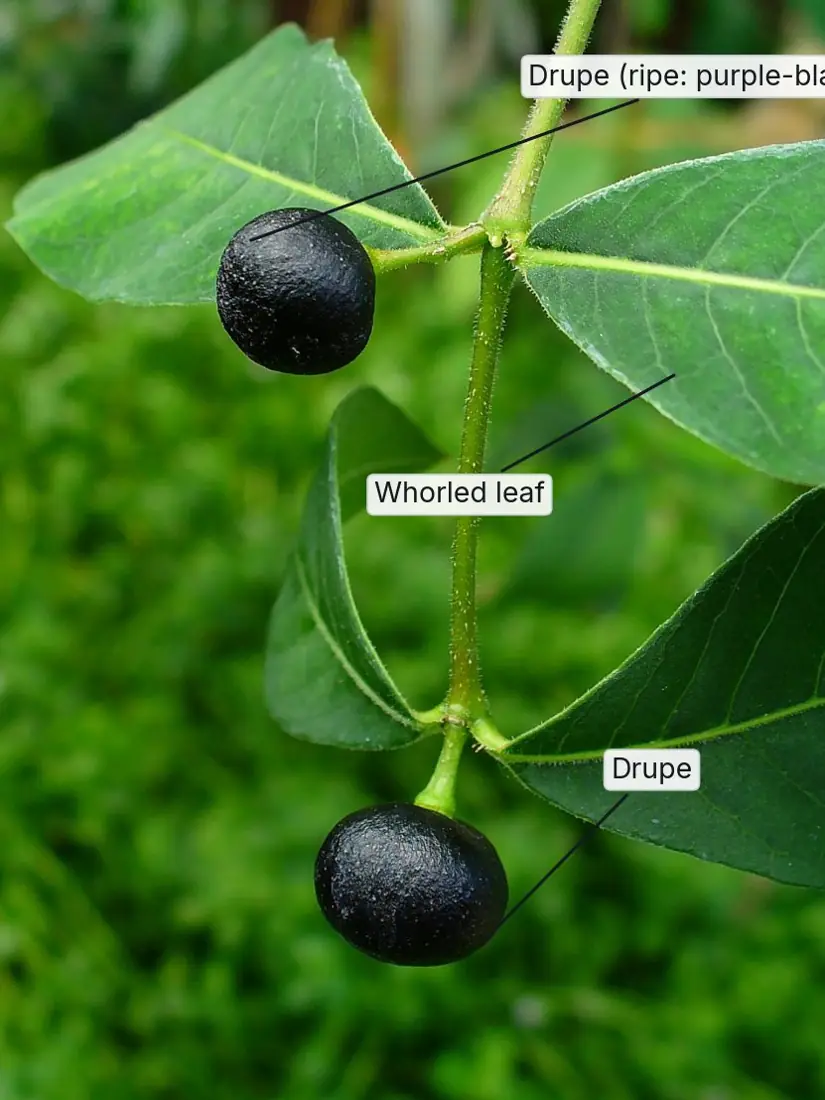
- Phyllotaxy: alternate (one leaf per node — mustard, China rose), opposite (two per node — guava, Calotropis (decussate)), whorled (more than two — Alstonia (chhatiwan), Nerium).
| Leaf modification | Examples |
|---|---|
| Leaf tendril | pea (terminal leaflets); Lathyrus aphaca (whole leaf; the stipules become leaf-like) |
| Leaf spines | Opuntia, cacti, Berberis |
| Phyllode (flattened green petiole) | Australian Acacia |
| Pitcher / bladder (insect traps) | Nepenthes / Utricularia |
| Fleshy storage leaves | onion bulb scales, Aloe |
| Heterophylly (different leaves on one plant) | Sagittaria, Ranunculus aquatilis, Limnophila |
Inflorescence
| Feature | Racemose (indefinite) | Cymose (definite) |
|---|---|---|
| Main axis | grows on indefinitely | ends in a flower |
| Order of flowers | acropetal — oldest at the base, youngest at the tip | basipetal — oldest at the tip |
| Opening | centripetal (outside → in) | centrifugal (inside → out) |
| Racemose type | Character | Examples |
|---|---|---|
| Raceme | long axis, pedicellate flowers | mustard, radish |
| Spike | long axis, sessile flowers | Achyranthes, Amaranthus |
| Spikelet | small spikes with glumes | wheat, rice (grasses) |
| Catkin | pendulous spike of unisexual flowers | mulberry, willow, birch |
| Spadix | fleshy axis enclosed by a large bract, the spathe | Colocasia, banana, maize (female) |
| Corymb | lower pedicels longer, flowers at one level | candytuft (Iberis) |
| Umbel | pedicels from one point, with an involucre of bracts | coriander, carrot (compound umbel), Centella |
| Capitulum (head) | flat receptacle with sessile ray and disc florets, involucre | sunflower, marigold, Tridax |
Cymose types: monochasial (one branch below the terminal flower — helicoid or scorpioid), dichasial (two — jasmine), polychasial (several — Calotropis). Special types: cyathium (a cup of bracts with one female flower surrounded by male flowers — Euphorbia, poinsettia); verticillaster (a pair of cymes at each node, looking like a whorl — tulasi, Leucas, Lamiaceae); hypanthodium (a hollow, flask-shaped receptacle with flowers inside and a small pore, the ostiole — fig, peepal, banyan).
Flower
The flower is a modified shoot for sexual reproduction. On the thalamus (receptacle) sit four whorls: calyx (sepals) and corolla (petals) are the accessory whorls; androecium (stamens) and gynoecium (carpels) are the essential whorls. When calyx and corolla look alike they are called a perianth of tepals (lily, onion).
| Term | Meaning | Examples |
|---|---|---|
| Actinomorphic ⊕ | can be cut into equal halves in any vertical plane | mustard, Datura, chilli |
| Zygomorphic % | only one plane gives equal halves | pea, bean, gulmohur, Cassia |
| Monoecious / dioecious | male and female flowers on one plant / on separate plants | maize, cucurbits / papaya, date palm |
| Hypogynous (superior ovary) | other whorls arise below the ovary | mustard, China rose, brinjal |
| Perigynous (half-inferior) | other whorls on the rim of a cup-shaped thalamus | plum, rose, peach |
| Epigynous (inferior ovary) | thalamus fuses with the ovary wall; other whorls above it | guava, cucumber, sunflower ray florets, apple |
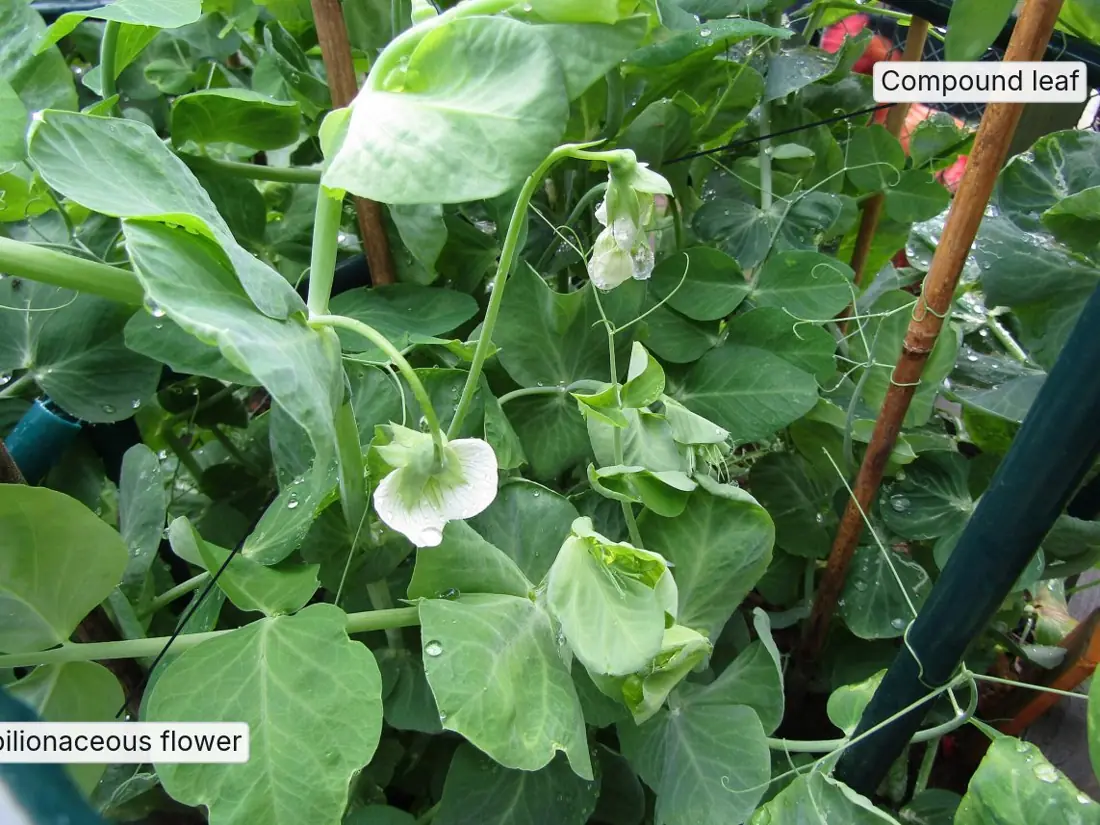
Aestivation (arrangement of sepals or petals in the bud): valvate — margins only touch (Calotropis); twisted — each overlaps the next (China rose, cotton, lady's finger); imbricate — irregular overlapping (Cassia, gulmohur); vexillary (descending imbricate) — the large standard covers the two wings, which cover the keel (pea, bean).
| Androecium term | Meaning | Example |
|---|---|---|
| Monadelphous | filaments united into one bundle | China rose (Hibiscus) |
| Diadelphous | two bundles | pea, (9) + 1 |
| Polyadelphous | more than two bundles | Citrus, castor |
| Syngenesious | anthers united, filaments free | sunflower (Asteraceae) |
| Epipetalous | stamens attached to petals | brinjal, Datura (Solanaceae) |
| Epiphyllous | stamens attached to the perianth | lily |
| Didynamous | 4 stamens, 2 long + 2 short | tulasi (Lamiaceae) |
| Tetradynamous | 6 stamens, 4 long + 2 short | mustard (Brassicaceae) |
Gynoecium. Carpels free (apocarpous — lotus, rose, Michelia) or fused (syncarpous — mustard, tomato). Placentation is the arrangement of ovules inside the ovary:
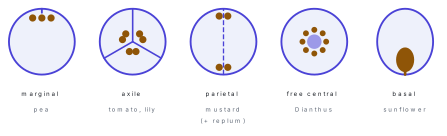
Marginal — along one suture of a single carpel (pea, legumes). Axile — on the central axis of a multilocular ovary (tomato, China rose, lemon, Liliaceae). Parietal — on the ovary wall of a unilocular ovary (cucumber, Argemone; mustard, where a false septum, the replum, later divides it). Free central — on a central column with no septa (Dianthus, Primula). Basal — one ovule at the base (sunflower, marigold).
Fruit
A fruit is a ripened ovary. A true fruit develops from the ovary alone (mango, tomato); a false fruit has other parts too — the thalamus in apple and pear (pome), strawberry and cashew. A fruit formed without fertilisation is parthenocarpic (seedless banana, pineapple).
| Kind | Definition | Examples |
|---|---|---|
| Simple fruit | from one ovary of one flower | mango, tomato, pea |
| Aggregate (etaerio) | from many free carpels of one flower | strawberry, custard apple (Annona), raspberry, lotus |
| Composite (multiple) | from a whole inflorescence | jackfruit and pineapple (sorosis), mulberry (sorosis), fig (syconus) |
| Simple fruit | Type | Examples |
|---|---|---|
| Legume (pod) | dry, monocarpellary, splits along both sutures | pea, bean, gram |
| Siliqua / silicula | dry, bicarpellary, long / short, splits from below leaving the replum | mustard / Capsella |
| Capsule | dry, multicarpellary, splits by many valves | cotton, lady's finger, Datura |
| Caryopsis | dry, one seed, seed coat fused with fruit wall | wheat, rice, maize |
| Cypsela | dry, one seed, from inferior ovary, often with pappus | sunflower, marigold |
| Nut | dry, hard, one-seeded | litchi, cashew |
| Drupe | fleshy; stony endocarp | mango, plum, coconut (fibrous mesocarp) |
| Berry | fleshy throughout, many seeds | tomato, brinjal, chilli, grape, banana, guava |
| Hesperidium | berry with juicy hairs from the endocarp | orange, lemon |
| Pome | false fruit; fleshy thalamus | apple, pear |
| Pepo | berry from an inferior ovary, hard rind | cucumber, pumpkin |
5.2 Brassicaceae, Solanaceae, Fabaceae and Liliaceae
Writing a floral formula
Br = bracteate, Ebr = ebracteate; ⊕ actinomorphic, % zygomorphic; ⚥ bisexual, ♂ male, ♀ female; K calyx, C corolla, P perianth, A androecium, G gynoecium. The number after the letter is the number of members; brackets mean the members are united; + separates whorls or groups. A line under G means a superior ovary, a line over it an inferior ovary — in this book the ovary position is written in words. All four families below have a superior ovary (hypogynous flowers).
| Character | Brassicaceae (Cruciferae) | Fabaceae (Papilionaceae) | Solanaceae | Liliaceae |
|---|---|---|---|---|
| Habit | herbs, pungent juice | herbs, shrubs, trees, climbers; root nodules | herbs, shrubs; rich in alkaloids | monocot herbs with bulbs, rhizomes or corms |
| Leaves | simple, alternate, exstipulate | pinnately compound, stipulate, pulvinate base; leaflets may be tendrils | simple, alternate, exstipulate | mostly basal, linear, parallel venation |
| Inflorescence | raceme (corymbose raceme) | raceme | solitary or axillary cymes | raceme, spike or umbellate cyme (onion) |
| Flower | ebracteate, ⊕, ⚥, tetramerous | bracteate, %, ⚥, pentamerous | ⊕, ⚥, pentamerous | bracteate, ⊕, ⚥, trimerous |
| Calyx | 4, free, in two whorls (2 + 2) | 5, united, odd sepal anterior | 5, united, persistent | — |
| Corolla | 4, free, cruciform (cross-shaped, clawed) | 5, papilionaceous: 1 standard, 2 wings, 2 united keel petals; vexillary | 5, united, rotate or funnel-shaped, valvate | perianth of 6 tepals in two whorls (3 + 3), free or united, petaloid |
| Androecium | 6, tetradynamous (2 short outer + 4 long inner) | 10, diadelphous (9) + 1 | 5, epipetalous, alternate with the petals | 6 in two whorls (3 + 3), epiphyllous |
| Gynoecium | bicarpellary, syncarpous; parietal placentation; unilocular, made bilocular by the replum | monocarpellary, unilocular, marginal placentation | bicarpellary, syncarpous, ovary oblique (septum at 45°); bilocular; axile, swollen placentae | tricarpellary, syncarpous, trilocular, axile |
| Fruit | siliqua or silicula | legume (pod) | berry (tomato, brinjal, chilli) or capsule (Datura, tobacco) | capsule (berry in Asparagus) |
| Seed | non-endospermic | non-endospermic | endospermic | endospermic |
| Floral formula | Ebr ⊕ ⚥ K₂₊₂ C₄ A₂₊₄ G₍₂₎ | Br % ⚥ K₍₅₎ C₁₊₂₊₍₂₎ A₍₉₎₊₁ G₁ | ⊕ ⚥ K₍₅₎ C₍₅₎ A₅ G₍₂₎ (stamens epipetalous) | Br ⊕ ⚥ P₃₊₃ A₃₊₃ G₍₃₎ — P₍₃₊₃₎ when the tepals are united (onion) |
| Diagnostic character | cruciform corolla + tetradynamous stamens + siliqua | papilionaceous corolla + diadelphous stamens + legume | epipetalous stamens + oblique bicarpellary ovary | trimerous perianth (3 + 3) + six stamens + trilocular ovary |
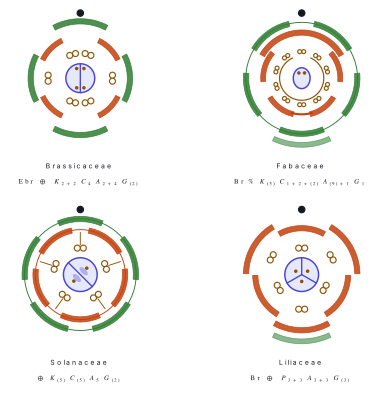
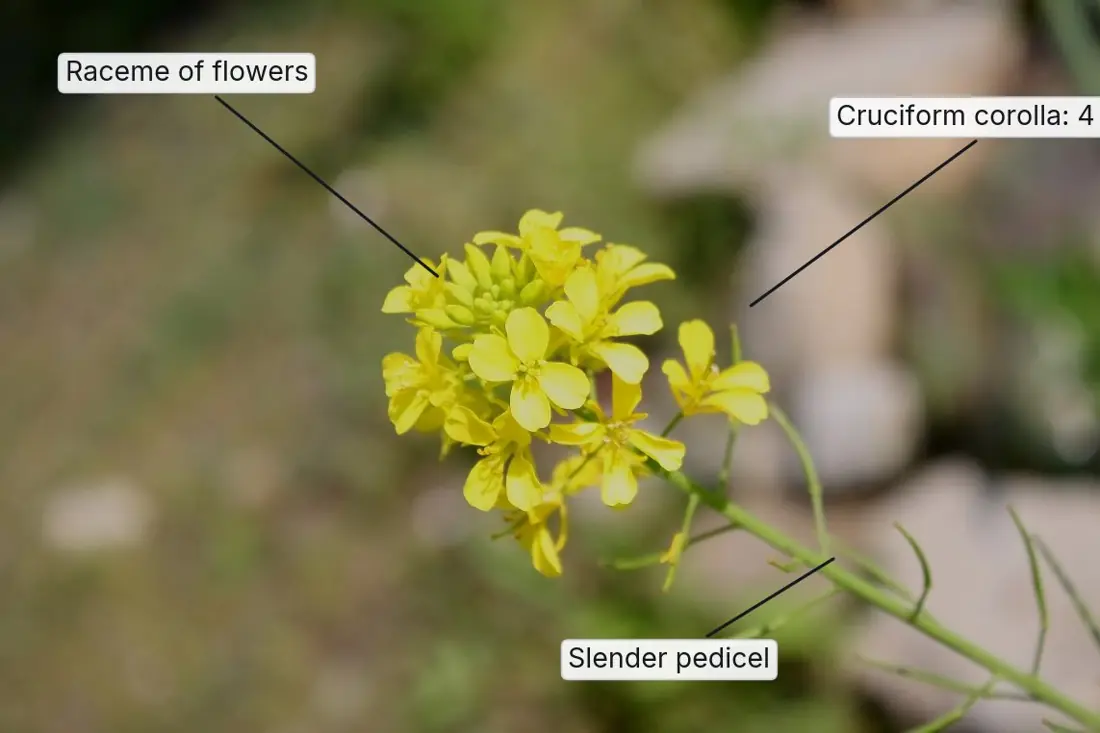
- Tetradynamous (6: 4 long + 2 short) is Brassicaceae; didynamous (4: 2 long + 2 short) is Lamiaceae (tulasi). Do not swap them.
- In Fabaceae the standard is posterior and the keel anterior; the free stamen is the one opposite the standard. The odd sepal is anterior — the reverse of most families.
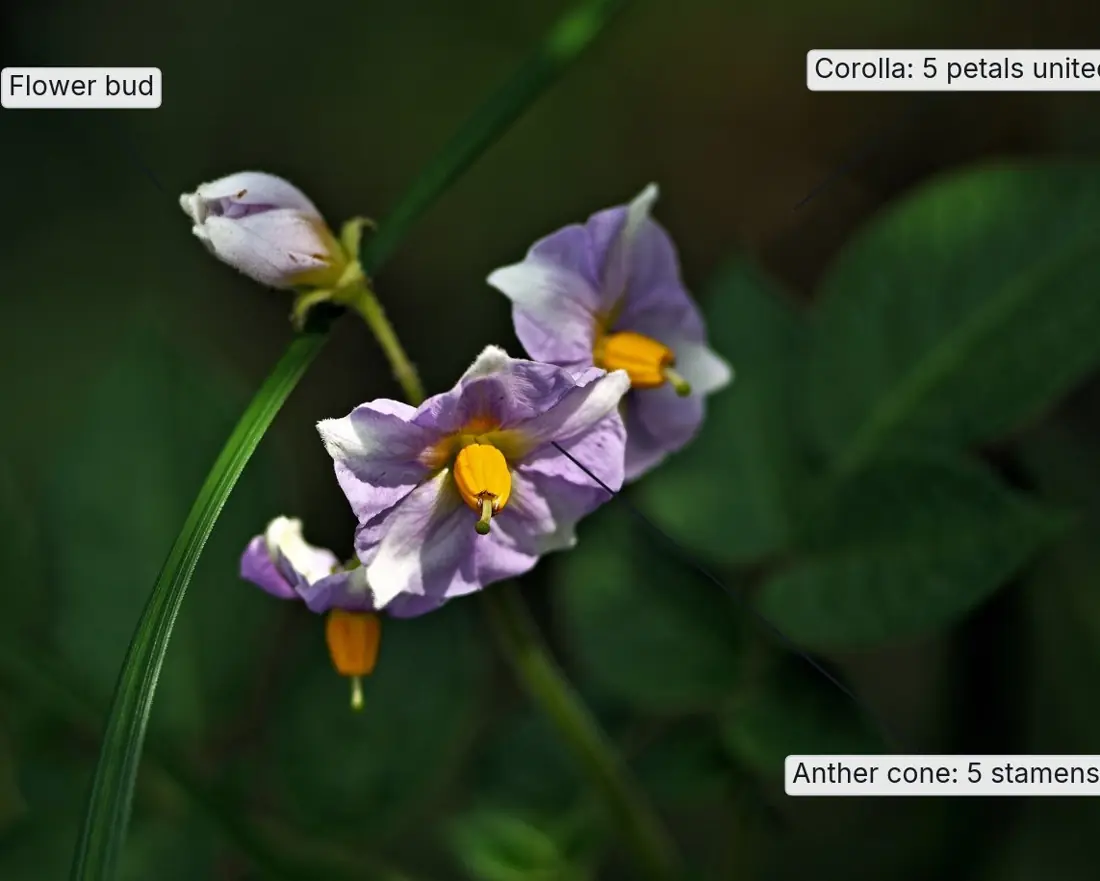
- The Solanaceae ovary is oblique — its septum lies at 45° to the median plane — and the placentae are swollen. The calyx is persistent on the fruit (brinjal, tomato) and enlarges into a bladder in Physalis.
- Liliaceae is the only monocot of the four; "perianth" (not calyx and corolla) and the number three identify it. Modern classification moves onion and garlic to Amaryllidaceae and Aloe and Asparagus to other families, but the CEE syllabus keeps them in Liliaceae.
- Pea, gram and lentil are Fabaceae, but this family has two older names — Papilionaceae and Leguminosae; mustard's old family name is Cruciferae.
| Family | Food and other crops | Medicines, drugs, others |
|---|---|---|
| Brassicaceae | mustard and rapeseed oil (Brassica campestris — tori; B. juncea — rayo saag); cabbage, cauliflower, knol-khol, broccoli (varieties of B. oleracea); radish; turnip | Arabidopsis thaliana, the model plant of genetics; Capsella (shepherd's purse), a weed; Iberis (candytuft), ornamental |
| Fabaceae | pulses — lentil (masuro), chickpea (chana), black gram (maas), pigeon pea (rahar), soybean (bhatmas), pea; groundnut | timber — sisau (Dalbergia sissoo); green manure (Sesbania, dhaincha); fodder (clover, lucerne); indigo dye; Abrus; root nodules enrich soil |
| Solanaceae | potato (Solanum tuberosum), tomato, brinjal (S. melongena), chilli and capsicum (Capsicum) | tobacco (Nicotiana, nicotine); Datura (hyoscine, also called scopolamine; atropine); Atropa belladonna (atropine, dilates the pupil); Withania (ashwagandha); Petunia, ornamental |
| Liliaceae | onion (Allium cepa), garlic (A. sativum), Asparagus racemosus (kurilo, also medicinal) | Aloe vera (ghiukumari; burns, skin); colchicine from Colchicum and Gloriosa (induces polyploidy, treats gout); Smilax (sarsaparilla); lilies and tulips, ornamental |
5.3 Economic importance of plant groups in Nepal
| Group | Useful | Harmful |
|---|---|---|
| Viruses | vaccines (attenuated viruses); bacteriophages for phage therapy and as cloning vectors (λ, M13); nuclear polyhedrosis virus (baculovirus) as a biopesticide | plant diseases — tobacco mosaic, citrus tristeza (one cause of the decline of Nepal's mandarin orchards), potato leaf roll, bunchy top of banana, yellow vein mosaic of okra, rice tungro; human diseases — polio, rabies, measles, hepatitis, HIV/AIDS, influenza, dengue, COVID-19; foot-and-mouth disease and bird flu of livestock |
| Bacteria | nitrogen fixation (Rhizobium in legumes; free-living Azotobacter, Clostridium); nitrification; decomposition and biogas (methanogens in gobar-gas plants); curd (dahi) by Lactobacillus; Nepali fermented foods — gundruk (lactic acid bacteria in leafy greens) and kinema (soybean fermented by Bacillus subtilis); vinegar (Acetobacter); antibiotics from Streptomyces (streptomycin, tetracycline, chloramphenicol); retting of jute fibre; Bacillus thuringiensis (Bt) toxin; E. coli making human insulin; Agrobacterium in genetic engineering | human diseases — typhoid, cholera, tuberculosis, leprosy, pneumonia, tetanus, diphtheria; plant diseases — bacterial wilt of potato and tomato (Ralstonia), bacterial blight of rice and citrus canker (Xanthomonas), crown gall (Agrobacterium), black rot of crucifers; food poisoning (Clostridium botulinum); denitrification lowers soil fertility |
| Blue-green algae | nitrogen fixation in rice fields (Anabaena, Nostoc, Aulosira, Tolypothrix); Azolla–*Anabaena biofertiliser; Spirulina* as protein-rich food (single-cell protein); reclaiming alkaline soils | toxic water blooms (Microcystis, Anabaena) that kill fish and taint drinking water |
| Fungi | mushrooms — oyster (Pleurotus, the most widely grown in Nepal), button (Agaricus), shiitake; wild morels (Morchella, guchchi chyau, a high-value export); yeast for bread, beer, jaand and raksi (murcha starter); penicillin (Penicillium notatum, Fleming, 1928), griseofulvin, cephalosporin; citric acid (Aspergillus niger); cyclosporin A (Trichoderma polysporum, used in organ transplants); statins (Monascus purpureus); ergot alkaloids (Claviceps); gibberellin (Gibberella fujikuroi); Trichoderma as a biocontrol agent; mycorrhizae; yarsagumba | crop diseases — late blight of potato (Phytophthora), rice blast, rusts and smuts of wheat, white rust of mustard; aflatoxin (Aspergillus flavus) in stored maize and groundnut (liver cancer); poisonous mushrooms (Amanita) — deaths every monsoon in Nepal; ringworm and athlete's foot; candidiasis; rotting of timber and food |
| Algae | food (Porphyra, Laminaria, Ulva, Chlorella); agar (Gelidium, Gracilaria) for culture media, jellies, ice cream; algin (Laminaria) and carrageenan (Chondrus) as thickeners; iodine and potash from kelps; oxygen and food for every pond and lake; Chlorella in space research | water blooms; red rust of tea caused by the parasitic green alga Cephaleuros; slimy growth clogs water tanks |
| Bryophytes | pioneers of succession on rock (after lichens); bind soil and prevent erosion on slopes; peat (Sphagnum) as fuel and potting medium; Sphagnum as packing material and absorbent dressing because it holds many times its weight of water; moss for decoration | few; some grow as weeds in nurseries |
| Pteridophytes | niuro (Diplazium esculentum) and Marsilea as vegetables; Azolla biofertiliser; Dryopteris rhizome (filicin, a vermifuge for tapeworm); Lycopodium spores (dusting powder, coating pills); Equisetum (silica, scouring); ornamental ferns (Adiantum, Nephrolepis); fossil ferns formed coal in the Carboniferous | bracken (Pteridium) is a weed poisonous to cattle; Salvinia chokes ponds |
| Gymnosperms | timber — chir pine (Pinus roxburghii), blue pine (P. wallichiana), deodar (Cedrus), fir (Abies), spruce; resin tapped from chir pine → rosin and turpentine; taxol (Taxus wallichiana, Himalayan yew) against cancer; ephedrine (Ephedra, trans-Himalaya) for asthma; dhupi (Juniperus) burnt as incense; Cycas (sago), ornamentals (Thuja, Araucaria); paper pulp | pine pollen allergy; pine needle litter feeds forest fires |
| Angiosperms | cereals — rice, maize, wheat, millet (kodo), barley; buckwheat (phapar); pulses and oilseeds (mustard, soybean, sesame); vegetables; fruits (mandarin orange — suntala, apple, banana, mango); spices — large cardamom (alaichi, Nepal is the world's leading producer), ginger, turmeric, timur, cinnamon leaf (tejpat); beverages — tea (Ilam), coffee; fibres — jute, cotton, lokta (Daphne, for handmade Nepali paper), allo (Girardinia, nettle fibre); timber — sal (Shorea robusta), sisau, khayer (Acacia catechu, katha), uttis (Alnus nepalensis); medicinal plants (§5.4, chiraito, jatamansi, kutki, satuwa); rudraksha beads; rhododendron (lali gurans, national flower) and orchids | invasive weeds — Mikania micrantha (banmara, in Chitwan National Park), Ageratina (kalo banmara), Chromolaena, Lantana, Parthenium (allergy), water hyacinth (Eichhornia) in lakes; parasites — dodder (Cuscuta, akashbeli), mistletoe (Loranthus, ainjeru), Orobanche, Striga; poisonous and narcotic plants — Aconitum (bikh), Datura, Cannabis, opium poppy |
Most questions pair a product with its source. Learn these pairs cold: penicillin — Penicillium; streptomycin — Streptomyces; agar — Gelidium; algin — Laminaria; taxol — Taxus; ephedrine — Ephedra; turpentine — Pinus; colchicine — Colchicum; atropine — Atropa; reserpine — Rauwolfia; azadirachtin — neem; eugenol — tulasi; gingerol — ginger; cordycepin — yarsagumba; filicin — Dryopteris; citric acid — Aspergillus niger; kinema — Bacillus subtilis; lokta paper — Daphne.
5.4 Medicinal plants of Nepal: neem, sarpagandha, yarsagumba, tulasi and ginger
| Neem | Sarpagandha | Yarsagumba | Tulasi (holy basil) | Ginger (aduwa) | |
|---|---|---|---|---|---|
| Scientific name | Azadirachta indica | Rauwolfia serpentina (also spelt Rauvolfia) | Ophiocordyceps sinensis (formerly Cordyceps sinensis) | Ocimum sanctum (= O. tenuiflorum) | Zingiber officinale |
| Family / group | Meliaceae (angiosperm tree) | Apocynaceae (angiosperm undershrub) | Ophiocordycipitaceae — an ascomycete fungus | Lamiaceae (angiosperm herb) | Zingiberaceae (monocot herb) |
| Where in Nepal | Terai and inner Terai | Terai and Siwalik sal forests (now rare; CITES Appendix II) | alpine meadows, 3,000–5,000 m (Dolpa, Darchula, Manang, Mustang, Rukum) | grown in courtyards everywhere | mid-hills (Ilam, Salyan, Palpa, Syangja) |
| Part used | leaves, bark, twigs, seed oil | roots | the dead larva with the fungal stroma | leaves (also seeds, whole plant) | rhizome (underground stem) |
| Active compounds | azadirachtin, nimbin, nimbidin | reserpine, serpentine, ajmaline | cordycepin, cordycepic acid (mannitol), adenosine, polysaccharides | eugenol (essential oil), ursolic acid | gingerols (fresh), shogaols (dried), zingiberene (aroma) |
| Main uses | antiseptic, antibacterial and antifungal — skin diseases, boils, scabies; twigs as tooth brush (datiwan) for gum health; blood purifier; fever and malaria; seed oil (margosa) for soap and as a spermicide; natural pesticide and neem cake manure | high blood pressure (reserpine); sedative and tranquilliser for anxiety, insomnia and mental illness; folk remedy for snake bite and scorpion sting (hence sarpa-gandha) | tonic for vigour and stamina, aphrodisiac ("Himalayan Viagra"); kidney and lung disorders; immune booster; anti-fatigue; studied as anti-tumour | cough, cold, sore throat, bronchitis, asthma (leaf juice with honey); fever; stress (adaptogen); antibacterial; mosquito repellent; sacred plant | indigestion, flatulence (carminative), appetite; nausea and vomiting, motion sickness; cough and cold; anti-inflammatory for joint pain; spice and tea |
Notes on each plant
Neem (Azadirachta indica). A large evergreen tree with imparipinnate compound leaves. Azadirachtin, a limonoid concentrated in the seeds, repels insects and stops them feeding and moulting — the basis of neem biopesticides and neem-coated urea. Leaves are stored with grain and clothes to keep insects away.
Sarpagandha (Rauwolfia serpentina). A small undershrub with whorled leaves and white-pink flowers. Its root alkaloid reserpine depletes noradrenaline at nerve endings, lowering blood pressure and calming the mind; it was one of the first modern antihypertensive drugs (1950s). Over-collection for its roots has made it rare in the wild.
Yarsagumba (Ophiocordyceps sinensis). An ascomycete fungus that parasitises the caterpillars of ghost moths (Thitarodes) living in the soil of high alpine meadows. Spores infect the larva in late summer; the fungus fills and mummifies it during winter (the "winter worm"); in spring a slender, dark, club-shaped stroma grows from the larva's head above the ground (the "summer grass") and bears perithecia with ascospores. Its Tibetan name, yartsa gunbu, means "summer grass, winter worm". Collection in May–June is a major cash income for mountain households; the price runs to millions of rupees per kilogram, and over-harvesting has made the species Vulnerable on the IUCN Red List.
Tulasi (Ocimum sanctum). An aromatic herb of the mint family with a square stem, opposite decussate leaves, verticillaster inflorescence, bilabiate corolla and didynamous stamens. Its leaf oil is rich in eugenol (also in clove). It is worshipped in Hindu homes and planted in a tulasi math in the courtyard.
Ginger (Zingiber officinale). A monocot herb whose edible part is a rhizome — a modified underground stem with nodes, scale leaves and buds, not a root. Fresh ginger owes its pungency to gingerols; on drying (sutho) they turn into the even more pungent shogaols. Nepal is among the world's largest ginger producers and exports much of it to India.
- Yarsagumba is a fungus (Ascomycetes), not a plant or an insect — the "worm" is the dead host larva. Its current genus is Ophiocordyceps.
- Ginger is a stem (rhizome); sweet potato and carrot are roots.
- Reserpine is from sarpagandha; azadirachtin is from neem — the two are often swapped in options.
- Tulasi is in Lamiaceae (didynamous, verticillaster), not Solanaceae.
Problem. A flower is actinomorphic, bisexual, hypogynous, has 5 fused sepals that persist in the fruit, 5 fused petals, 5 epipetalous stamens, and a bicarpellary syncarpous superior ovary with an obliquely placed septum and swollen axile placentation. Name the family.
Solution. Persistent calyx K_{(5)}, epipetalous C_{(5)} A_5, and bicarpellary syncarpous superior ovary G_{(2)} with an obliquely placed septum and swollen placenta are diagnostic of Solanaceae (e.g., Solanum nigrum, Datura).
Problem. How many stamens and what arrangement occur in a single flower of (a) Brassica campestris and (b) Pisum sativum?
Solution. Brassica (Brassicaceae) has 6 stamens in a tetradynamous 2 + 4 arrangement (2 outer short, 4 inner long). Pisum (Fabaceae) has 10 stamens in a diadelphous (9) + 1 arrangement (9 fused into a staminal tube, 1 posterior stamen free).
Problem. Match the active principle and the plant part harvested in Nepal for Rauwolfia serpentina (sarpagandha) and Ophiocordyceps sinensis (yarsagumba).
Solution. Rauwolfia serpentina yields the indole alkaloid reserpine (antihypertensive) from its dried roots. Ophiocordyceps sinensis is an ascomycete entomopathogenic fungus fruiting from the caterpillar of Thitarodes in alpine meadows (3{,}500\text{–}5{,}000\text{ m}), valued for cordycepin; the whole stroma + mycosed larva is collected.
Formula and fact sheet
| Item | Fact |
|---|---|
| Stem modifications | rhizome (ginger, turmeric), stem tuber (potato), corm (Colocasia), bulb (onion, garlic); phylloclade (Opuntia), cladode (Asparagus), thorn (Citrus), stem tendril (grape, cucurbits) |
| Root modifications | sweet potato (tuberous), carrot (conical), radish (fusiform), turnip (napiform); prop (banyan), stilt (maize), pneumatophores (Rhizophora), velamen (Vanda), haustoria (Cuscuta) |
| Leaf modifications | tendril (pea), spines (Opuntia), phyllode (Acacia), pitcher (Nepenthes), bladder (Utricularia) |
| Venation exceptions | Smilax, Dioscorea (reticulate monocots); Calophyllum (parallel dicot) |
| Inflorescence | raceme (mustard), spike (Achyranthes), catkin (mulberry), spadix (Colocasia, maize), corymb (Iberis), umbel (coriander), capitulum (sunflower), cyathium (Euphorbia), verticillaster (tulasi), hypanthodium (fig) |
| Aestivation | valvate (Calotropis), twisted (China rose, cotton), imbricate (Cassia), vexillary (pea) |
| Stamens | monadelphous (Hibiscus), diadelphous (pea), polyadelphous (Citrus), syngenesious (sunflower), epipetalous (brinjal), tetradynamous (mustard), didynamous (tulasi) |
| Placentation | marginal (pea), axile (tomato, lily), parietal (mustard, cucumber), free central (Dianthus), basal (sunflower) |
| Ovary position | superior (mustard, brinjal), half-inferior (rose, plum), inferior (guava, cucumber, apple) |
| Fruits | legume (pea), siliqua (mustard), capsule (cotton, Datura), caryopsis (rice), cypsela (sunflower), drupe (mango), berry (tomato), hesperidium (orange), pome (apple), pepo (cucumber) |
| Aggregate / composite | strawberry, custard apple / jackfruit, pineapple, mulberry, fig |
| Brassicaceae | Ebr ⊕ ⚥ K₂₊₂ C₄ A₂₊₄ G₍₂₎ — cruciform, tetradynamous, parietal + replum, siliqua |
| Fabaceae | Br % ⚥ K₍₅₎ C₁₊₂₊₍₂₎ A₍₉₎₊₁ G₁ — papilionaceous, vexillary, diadelphous, marginal, legume |
| Solanaceae | ⊕ ⚥ K₍₅₎ C₍₅₎ A₅ G₍₂₎ — epipetalous, oblique ovary, swollen axile placentae, berry or capsule |
| Liliaceae | Br ⊕ ⚥ P₃₊₃ A₃₊₃ G₍₃₎ — trimerous monocot, epiphyllous stamens, axile, capsule |
| Nepali fermented foods | gundruk (lactic acid bacteria), kinema (Bacillus subtilis), dahi (Lactobacillus), jaand and raksi (murcha: moulds + yeasts) |
| Products and sources | penicillin Penicillium; streptomycin Streptomyces; agar Gelidium; algin Laminaria; taxol Taxus; ephedrine Ephedra; turpentine Pinus; colchicine Colchicum; filicin Dryopteris; lokta paper Daphne |
| Neem | Azadirachta indica, Meliaceae; leaves, bark, twigs, oil; azadirachtin; antiseptic, skin, teeth, pesticide |
| Sarpagandha | Rauwolfia serpentina, Apocynaceae; roots; reserpine; hypertension, sedative, snake bite |
| Yarsagumba | Ophiocordyceps sinensis, ascomycete on ghost-moth larvae, 3,000–5,000 m; cordycepin; tonic, aphrodisiac; IUCN Vulnerable |
| Tulasi | Ocimum sanctum, Lamiaceae; leaves; eugenol; cough, cold, fever |
| Ginger | Zingiber officinale, Zingiberaceae; rhizome; gingerols, shogaols; indigestion, nausea, cold |
Chapter summary
- A modified organ is identified by its origin, not its looks: nodes, buds or scale leaves mean stem (potato, ginger, onion, Colocasia, Opuntia pad, Asparagus cladode, Citrus thorn); sweet potato, carrot and radish are roots; pea tendrils and Opuntia spines are leaves.
- Racemose inflorescences grow on and open acropetally; cymose ones end in a flower and open basipetally; tulasi has a verticillaster, Euphorbia a cyathium, the fig a hypanthodium and the sunflower a capitulum.
- Flower terms the paper uses: actinomorphic or zygomorphic; hypo-, peri- or epigynous; valvate, twisted, imbricate or vexillary aestivation; monadelphous, diadelphous, syngenesious, epipetalous, tetradynamous and didynamous stamens.
- Placentation is marginal (pea), axile (tomato, lily), parietal (mustard), free central (Dianthus) or basal (sunflower).
- Fruits are simple, aggregate (many free carpels of one flower) or composite (a whole inflorescence); false fruits such as the apple include the thalamus.
- Brassicaceae: Ebr ⊕ ⚥ K₂₊₂ C₄ A₂₊₄ G₍₂₎, siliqua. Fabaceae: Br % ⚥ K₍₅₎ C₁₊₂₊₍₂₎ A₍₉₎₊₁ G₁, legume. Solanaceae: ⊕ ⚥ K₍₅₎ C₍₅₎ A₅ G₍₂₎ with epipetalous stamens and an oblique ovary, berry. Liliaceae: Br ⊕ ⚥ P₃₊₃ A₃₊₃ G₍₃₎, capsule.
- Every group matters in Nepal: nitrogen-fixing bacteria and blue-green algae, gundruk and kinema, mushrooms and yeast, agar, Sphagnum, Azolla, pine resin and timber, taxol, lokta paper and sal timber — and the harm done by plant viruses, late blight, aflatoxin, poisonous mushrooms and invasive weeds.
- The five named medicinal plants: neem (Azadirachta indica, azadirachtin), sarpagandha (Rauwolfia serpentina, reserpine, roots), yarsagumba (Ophiocordyceps sinensis, an ascomycete on ghost-moth larvae, cordycepin), tulasi (Ocimum sanctum, eugenol, leaves) and ginger (Zingiber officinale, rhizome, gingerols).
Practice questions
Set A — Recall (25 questions)
- Prop roots that grow down from the branches to support a wide crown are found inabanyanbmaizecRhizophoradcarrot
- The edible part of the potato isaa tuberous rootba rhizomeca stem tuberda bulb
- The spines of Opuntia and the tendrils of pea are modifications ofathe stembthe leafcthe rootdthe inflorescence
- A flattened green stem of many internodes that does the work of leaves, as in Opuntia, is aacladodebphyllodecbulbildphylloclade
- In a racemose inflorescence the flowers are borneain basipetal order, the main axis ending in a flowerbin acropetal order, the main axis growing oncinside a cup of bractsdinside a flask-shaped receptacle
- The inflorescence of tulasi is aaverticillasterbcyathiumchypanthodiumdcapitulum
- In a hypogynous flower the ovary isainferiorbhalf-inferiorcabsentdsuperior
- The stamens of China rose are united by their filaments into a single tube. They areadiadelphousbsyngenesiouscmonadelphousdpolyadelphous
- Axile placentation is found inapeabmustardctomatodsunflower
- A fruit that develops from one flower with many free carpels isaa composite fruitban aggregate fruitca simple dry fruitda caryopsis
- Jackfruit and mulberry areacomposite (multiple) fruitsbaggregate fruitscsimple dry fruitsdberries
- The androecium of Brassicaceae isadidynamousbdiadelphouscsyngenesiousdtetradynamous
- The fruit of mustard is aalegumebberryccapsuledsiliqua
- The corolla of Fabaceae (Papilionaceae) consists ofaa standard, two wings and two keel petalsbfour free petals in the form of a crosscfive united petals in two lipsdfive united petals forming a wheel
- The ovary of Solanaceae isamonocarpellary with marginal placentationbtricarpellary and trilocularcbicarpellary and oblique, with swollen axile placentaedbicarpellary with a replum
- The floral formula Br ⊕ ⚥ P₃₊₃ A₃₊₃ G₍₃₎ belongs toaBrassicaceaebLiliaceaecSolanaceaedFabaceae
- Which crop belongs to Solanaceae?apotatobmustardcpeadonion
- Colchicine, used to induce polyploidy, is obtained from a member ofaSolanaceaebFabaceaecBrassicaceaedLiliaceae
- The Nepali fermented soybean food kinema is made by the bacteriumaLactobacillusbBacillus subtiliscAcetobacterdRhizobium
- Red rust of tea is caused byaa virusba bacteriumcthe parasitic green alga Cephaleurosdthe rust fungus Puccinia
- Handmade Nepali paper is made from the bark fibre ofaShorea robustabDaphne (lokta)cDalbergia sissoodAlnus nepalensis
- Penicillin, the first antibiotic, was obtained fromaStreptomyces griseusbBacillus subtiliscAspergillus nigerdPenicillium notatum
- The scientific name of sarpagandha isaRauwolfia serpentinabAzadirachta indicacOcimum sanctumdZingiber officinale
- Yarsagumba (Ophiocordyceps sinensis) grows onathe roots of rhododendronbthe bark of pinecghost-moth larvae in alpine meadowsdrotting wood in Terai forests
- The alkaloid of sarpagandha used to lower blood pressure isaazadirachtinbeugenolcgingeroldreserpine
Answers and explanations — Set A
1. (a) — Banyan's prop roots hang from horizontal branches like pillars. Maize has stilt roots from the lower nodes; Rhizophora has pneumatophores; carrot is a storage tap root.
2. (c) — The potato is a stem tuber: its "eyes" are nodes with axillary buds. Sweet potato is a tuberous root.
3. (b) — Opuntia spines are modified leaves (its green pad is the stem); pea tendrils are modified terminal leaflets.
4. (d) — A phylloclade has many nodes and internodes. A cladode is only one internode long (Asparagus); a phyllode is a flattened petiole.
5. (b) — Racemose = indefinite growth with acropetal succession. Option (a) describes a cyme; (c) and (d) are cyathium and hypanthodium.
6. (a) — Tulasi (Lamiaceae) has a pair of small cymes at each node that look like a whorl — a verticillaster. The cyathium belongs to Euphorbia, the hypanthodium to the fig.
7. (d) — Hypogynous means the other whorls arise below the ovary, so the ovary is superior.
8. (c) — One bundle = monadelphous (Malvaceae). Diadelphous is two bundles (pea); syngenesious means anthers fused (sunflower).
9. (c) — Tomato has ovules on a central axis in a multilocular ovary. Pea is marginal, mustard parietal, sunflower basal.
10. (b) — Many free carpels of one flower give an aggregate fruit (strawberry, custard apple). A composite fruit comes from a whole inflorescence.
11. (a) — Each develops from an entire inflorescence (sorosis). Aggregate fruits come from a single flower.
12. (d) — Six stamens, four long and two short = tetradynamous. Didynamous (four: two long, two short) belongs to Lamiaceae.
13. (d) — The siliqua is a long bicarpellary pod that splits from below, leaving the seeds on the replum. A legume is the fruit of Fabaceae.
14. (a) — The papilionaceous corolla has one posterior standard, two lateral wings and two anterior petals fused into the keel. Option (b) is cruciform (mustard).
15. (c) — The Solanaceae ovary is bicarpellary with its septum oblique and the placentae swollen. Option (d), with a replum, is Brassicaceae.
16. (b) — A perianth of 3 + 3 tepals, six stamens and a tricarpellary ovary describe the trimerous monocot family Liliaceae.
17. (a) — Potato (Solanum tuberosum) is Solanaceae; mustard is Brassicaceae, pea Fabaceae, onion Liliaceae.
18. (d) — Colchicine comes from Colchicum autumnale and Gloriosa superba, placed in Liliaceae in the syllabus; it blocks spindle formation and doubles chromosome sets.
19. (b) — Kinema is soybean fermented by Bacillus subtilis. Lactobacillus makes curd and gundruk sour; Acetobacter makes vinegar.
20. (c) — Cephaleuros is one of the few parasitic algae; it forms rusty patches on tea leaves. Puccinia causes rust of wheat.
21. (b) — Lokta (Daphne bholua, D. papyracea) bark fibre makes the strong handmade Nepali paper. Sal and sisau are timber trees; uttis is an N-fixing alder.
22. (d) — Alexander Fleming discovered penicillin from Penicillium notatum in 1928. Streptomyces griseus gives streptomycin.
23. (a) — Sarpagandha is Rauwolfia serpentina; the other three are neem, tulasi and ginger.
24. (c) — The fungus parasitises and mummifies ghost-moth caterpillars in the soil of meadows at 3,000–5,000 m; its stroma grows from the larva's head.
25. (d) — Reserpine from sarpagandha roots lowers blood pressure. Azadirachtin is neem's, eugenol tulasi's, gingerol ginger's.
Set B — Understanding (15 questions)
- Potato and sweet potato both store food underground, but sweet potato is a root because itastores starchbhas no nodes, buds or scale leavescgrows in the soildhas eyes
- The thorn of Citrus and the spine of Opuntia are analogous organs because theyaboth come from leavesbboth come from stemscdiffer in both origin and functiondhave the same function but different origins
- In Asparagus the small, green, needle-like "leaves" are reallyacladodes — stems one internode longbphyllodesctrue leavesdstipules
- Onion is a modified stem becauseait grows undergroundbit stores foodcits disc-like stem bears fleshy scale leaves and a buddit has adventitious roots
- A sunflower "flower" is really an inflorescence becauseait is a head of many florets on a flat receptaclebit has many yellow petalscit turns to face the sundit has a large involucre only
- In the pea flower the standard overlaps the two wings, which overlap the keel. This aestivation isavalvatebvexillaryctwisteddascending imbricate
- The ovary of mustard is unilocular at first but becomes two-chambered becauseathe carpels fuse completelybthe placentation becomes axilecthe ovules divide itda false septum, the replum, grows between the placentae
- In brinjal and tomato the stamens are epipetalous. This means that the stamens areafree from every other whorlbattached to the sepalscattached to the petalsdattached to the ovary
- Which character separates Fabaceae from the other three prescribed families?aa superior ovaryba monocarpellary ovary with marginal placentationcbisexual flowersdfive sepals
- Which feature of the Liliaceae flower shows that it is a monocot?aparts in threes, with a perianth instead of calyx and corollaba superior ovarycbisexual flowersdaxile placentation
- Rhizobium and Anabaena are both valued in Nepal's farming because theyacause crop diseasesbproduce antibioticscdecompose cellulosedfix atmospheric nitrogen
- Gundruk, a Nepali fermented leafy vegetable, becomes sour becauseayeasts produce alcoholbmoulds produce citric acidclactic acid bacteria ferment its sugarsdAcetobacter makes vinegar
- Neem is widely used as a natural pesticide because azadirachtinarepels insects and blocks their feeding and moultingbkills bacteria in the soilcfixes nitrogendis an antibiotic for humans
- Fresh ginger tastes pungent mainly because ofareserpinebeugenolcgingerolsdcordycepin
- Sphagnum is valued commercially mainly because of itsatimberbhigh water-holding capacity and peat formationcedible fruitsdantibiotic production
Answers and explanations — Set B
1. (b) — Stems carry nodes, buds and scale leaves (the potato's eyes); the sweet potato tuber has none, so it is a swollen adventitious root. Storage and position do not decide the organ.
2. (d) — Both protect the plant, but the thorn is a modified branch and the spine a modified leaf: same function, different origin = analogous.
3. (a) — The true leaves of Asparagus are tiny scales; in their axils arise green cladodes, each one internode long. A phyllode is a flattened petiole (Acacia).
4. (c) — The flat disc at the base of the bulb is the true stem; the onion layers are fleshy leaf bases. Growing underground or storing food does not make an organ a stem.
5. (a) — The capitulum has outer ray florets and inner disc florets on a flattened receptacle, ringed by an involucre of bracts. Each "petal" is a ray floret.
6. (b) — Vexillary (descending imbricate) aestivation is the mark of the papilionaceous corolla.
7. (d) — Brassicaceae ovaries have parietal placentation; a false septum (replum) grows across between the two placentae.
8. (c) — Epipetalous stamens have their filaments fused to the corolla tube. Stamens attached to tepals are epiphyllous (lily).
9. (b) — Only Fabaceae has a single carpel with ovules along one margin. The other three have superior ovaries and bisexual flowers too, and Solanaceae also has five sepals.
10. (a) — Trimerous flowers with an undifferentiated perianth are typical monocot features. A superior ovary, bisexuality and axile placentation also occur in dicots.
11. (d) — Rhizobium fixes N₂ in legume nodules; Anabaena fixes it in rice fields and inside Azolla. Both reduce the need for urea.
12. (c) — Gundruk is made by natural lactic acid fermentation (Lactobacillus, Pediococcus), which also preserves the greens. No alcohol or vinegar is involved.
13. (a) — Azadirachtin is an antifeedant and insect growth regulator. It is not an antibiotic for humans and does not fix nitrogen.
14. (c) — Gingerols give fresh ginger its bite; drying converts them to shogaols. Eugenol is tulasi's oil; reserpine and cordycepin belong to sarpagandha and yarsagumba.
15. (b) — Sphagnum holds many times its weight of water, so it is used for packing and as dressings, and it accumulates into peat used as fuel. It has no timber or fruit.
Set C — Application (10 questions)
- A flower has five united sepals, five united petals, five stamens attached to the petals, and a bicarpellary superior ovary placed obliquely. Its floral formula isaBr % ⚥ K₍₅₎ C₁₊₂₊₍₂₎ A₍₉₎₊₁ G₁bEbr ⊕ ⚥ K₂₊₂ C₄ A₂₊₄ G₍₂₎c⊕ ⚥ K₍₅₎ C₍₅₎ A₅ G₍₂₎dBr ⊕ ⚥ P₃₊₃ A₃₊₃ G₍₃₎
- A plant has tetradynamous stamens, a cruciform corolla and a siliqua. It belongs to the same family asamustard and radishbpea and gramcpotato and tomatodonion and garlic
- A flower has a large posterior petal, two lateral petals and two anterior petals joined into a boat, and ten stamens of which nine are united. Its fruit will be aasiliquabberryccapsuledlegume
- In apple the fleshy edible part develops from the thalamus around an inferior ovary. Such a fruit isaa true fruitba false fruit (pome)can aggregate fruitda composite fruit
- A plant in a Kavre field bears umbels of flowers; each flower has six tepals in two whorls, six stamens and a three-chambered superior ovary. Its family, as named in the syllabus, isaLiliaceaebBrassicaceaecSolanaceaedFabaceae
- Which pair of product and source is correctly matched?ataxol — Ephedrabagar — Laminariacturpentine — Pinus roxburghiidpenicillin — Streptomyces
- A patient with high blood pressure is given a drug made from the roots of a Terai plant also used in folk medicine for snake bite. The plant isaOcimum sanctumbZingiber officinalecAzadirachta indicadRauwolfia serpentina
- A dried "caterpillar" sold in Dolpa has a dark, club-shaped stalk growing from its head. The stalk isaa plant root that grew into the larvabthe stroma (fruiting body) of an ascomycete funguscthe larva's own antennadthe basidiocarp of a mushroom
- A villager chews neem twigs to clean the teeth, takes tulasi with honey for cough, and adds ginger to tea for indigestion. The plant parts used are, in order,aroot, flower, fruitbleaf, root, stem tubercstem, seed, rootdtwig (stem), leaf, rhizome
- An inflorescence has a long axis bearing sessile flowers, the oldest at the base. It isaa spikeba racemeca corymbda cyme
Answers and explanations — Set C
1. (c) — Five united sepals and petals, five stamens and an oblique bicarpellary ovary is Solanaceae. The formula cannot show epipetaly, but the oblique ovary settles it.
2. (a) — Cruciform corolla, tetradynamous stamens and siliqua are the three marks of Brassicaceae — mustard, radish, cabbage.
3. (d) — Standard, wings and keel with (9) + 1 stamens mean Fabaceae, whose monocarpellary ovary ripens into a legume (pod).
4. (b) — A fruit with non-ovarian tissue (the thalamus) is a false fruit; in apple and pear it is a pome. It comes from one flower with one ovary, so it is neither aggregate nor composite.
5. (a) — Trimerous perianth (3 + 3), six stamens and a trilocular superior ovary: onion, which the CEE syllabus keeps in Liliaceae.
6. (c) — Resin tapped from chir pine is distilled into turpentine and rosin. Taxol is from Taxus, agar from Gelidium, penicillin from Penicillium.
7. (d) — Reserpine from the roots of sarpagandha lowers blood pressure; the plant's name ("snake-smell") recalls its folk use for snake bite.
8. (b) — The stalk is the stroma of Ophiocordyceps sinensis, which bears perithecia with asci; the larva is the dead host filled with fungal mycelium.
9. (d) — Neem twigs are stems, tulasi is used for its leaves, and ginger's rhizome is an underground stem.
10. (a) — Sessile flowers in acropetal order on an elongated axis make a spike. A raceme has stalked flowers; a cyme has the oldest flower at the tip.