Chapter 3 · Biodiversity · 2 questions in the paper · 28 min read
Fungi, Lichens and Algae
What the syllabus asks for 3
- Phycomycetes, Ascomycetes, Basidiomycetes and Deuteromycetes; structure and reproduction of yeast and Mucor
- Lichens: introduction and types
- Algae: Chlorophyceae, Rhodophyceae and Phaeophyceae; structure and reproduction of Spirogyra
This chapter of the Biodiversity unit carries about 2 of the 40 Botany questions. They come from three short lists: the four classes of fungi (their mycelium, spores and fruiting bodies, and which disease each causes); the partners and growth forms of lichens; and the three classes of algae told apart by pigment, stored food and flagella. On top of these, the paper expects the life histories of three type organisms — yeast, Mucor and Spirogyra — in enough detail to answer "which spore", "which stage is diploid" and "how many filaments come from one zygospore".
- Fungal classes by spore — Phycomycetes zygospore or oospore, Ascomycetes ascospores (endogenous, 8), Basidiomycetes basidiospores (exogenous, 4), Deuteromycetes no sexual spore.
- Disease ↔ fungus — late blight of potato (Phytophthora), white rust of mustard (Albugo), rust of wheat (Puccinia), smut (Ustilago), ergot (Claviceps), red rot of sugarcane (Colletotrichum).
- Yeast — budding, zymase, C₆H₁₂O₆ → 2C₂H₅OH + 2CO₂, ascus with 4 ascospores, haplo-diplontic cycle.
- Mucor — coenocytic mycelium, sporangium with columella, heterothallic conjugation, zygospore as the only diploid stage.
- Lichens — mycobiont + phycobiont; crustose, foliose, fruticose; soredia and isidia; pollution indicators and pioneers.
- Algae — green (chl a, b; starch), brown (chl a, c, fucoxanthin; laminarin, mannitol; algin), red (chl a, phycoerythrin; floridean starch; agar; no flagella).
- Spirogyra — spiral chloroplasts with pyrenoids, scalariform and lateral conjugation, zygotic meiosis, one filament per zygospore.
3.1 Fungi: the four classes; yeast and Mucor
General characters
Fungi are eukaryotic, achlorophyllous, heterotrophic thallophytes. They digest food outside the body and absorb it — as saprophytes (on dead matter), parasites (on living hosts) or symbionts (in lichens and mycorrhizae). The body is a mycelium, a mass of thread-like hyphae that are either aseptate and coenocytic (multinucleate, no cross walls) or septate. The wall contains chitin (fungal cellulose) with glucans, and the reserve food is glycogen and oil — never starch. The study of fungi is mycology.
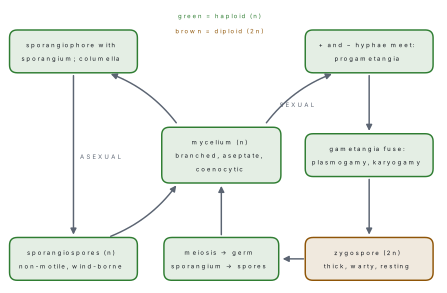
Sexual reproduction has three steps: plasmogamy (fusion of protoplasts), karyogamy (fusion of nuclei) and meiosis. In Ascomycetes and Basidiomycetes karyogamy is delayed, so the hyphae pass through a dikaryotic (n + n) stage with two nuclei per cell.
| Feature | Phycomycetes (algal fungi) | Ascomycetes (sac fungi) | Basidiomycetes (club fungi) | Deuteromycetes (fungi imperfecti) |
|---|---|---|---|---|
| Mycelium | aseptate, coenocytic | septate, branched (yeast unicellular) | septate, with clamp connections; long dikaryotic phase | septate, branched |
| Asexual spores | endogenous sporangiospores (Mucor) or motile zoospores (Albugo, Phytophthora) | exogenous conidia on conidiophores; budding in yeast | rare (conidia, oidia); fragmentation common | conidia only |
| Sexual spores | zygospore (isogamous fusion of gametangia) or oospore (oogamy) | ascospores, usually 8, formed endogenously in a sac, the ascus | basidiospores, 4, formed exogenously on a club-shaped basidium; no sex organs — two vegetative hyphae fuse (somatogamy) | not known |
| Fruiting body | none | ascocarp — cleistothecium (closed), perithecium (flask), apothecium (cup) | basidiocarp — mushroom, bracket fungus, puffball | none |
| Examples | Mucor, Rhizopus, Albugo, Phytophthora, Pythium | Saccharomyces, Penicillium, Aspergillus, Claviceps, Neurospora, Morchella, Ophiocordyceps | Agaricus, Pleurotus, Ganoderma, Puccinia, Ustilago, Amanita, Lycoperdon | Alternaria, Colletotrichum, Trichoderma, Fusarium, Cercospora, Helminthosporium |
| Diseases | late blight of potato (Phytophthora infestans — the Irish famine), white rust of crucifers (Albugo candida, on mustard and radish), damping-off (Pythium) | ergot of rye (Claviceps purpurea), powdery mildew (Erysiphe) | black stem rust of wheat (Puccinia graminis), loose smut of wheat (Ustilago) | early blight of potato (Alternaria solani), red rot of sugarcane (Colletotrichum falcatum), tikka of groundnut (Cercospora), brown spot of rice (Helminthosporium), ringworm |
Zygo-Asco-Basidio-None: PhycoZ, Asco = sac with 8 inside, Basidio = club with 4 outside, Deutero = none known. "Asco inside, Basidio outside" settles most spore questions.
- When the sexual stage of a deuteromycete is found, it is moved to Ascomycetes or Basidiomycetes; most fungi imperfecti turn out to be ascomycetes.
- Phytophthora, Albugo and Pythium (Oomycetes) have cellulose walls and are no longer counted as true fungi, but the CEE syllabus still lists them under Phycomycetes — answer accordingly.
- Yarsagumba (Ophiocordyceps sinensis) is an ascomycete that parasitises a caterpillar — see Chapter 5.
Yeast (Saccharomyces cerevisiae)
Structure. Yeast is a unicellular ascomycete (no mycelium), with oval cells about 5–10 μm long. Each cell has a thin wall (glucans and mannans with a little chitin), a plasma membrane, a large central vacuole with volutin granules, one nucleus beside it, mitochondria, and reserve food as glycogen and oil droplets. It is a facultative anaerobe: with oxygen it respires completely; without oxygen it ferments sugar with the enzyme complex zymase (Buchner, 1897):
C₆H₁₂O₆ → 2C₂H₅OH + 2CO₂ + energy (2 ATP per glucose)
Reproduction.
| Method | What happens |
|---|---|
| Budding (main vegetative method) | a small outgrowth (bud) appears; the nucleus divides and one daughter nucleus enters the bud, which enlarges and breaks off, leaving a bud scar. In rich sugar medium buds stay attached in chains — a pseudomycelium |
| Fission | the cell divides into two by a septum — in fission yeast, Schizosaccharomyces |
| Ascospore formation (sexual) | two haploid cells of opposite mating type fuse (plasmogamy + karyogamy) → a diploid cell; it may bud as a diploid, and later turns into an ascus: meiosis gives 4 haploid ascospores, which are released and bud as haploid cells |
Because both haploid and diploid cells of S. cerevisiae bud and grow, its life cycle is haplo-diplontic. (Schizosaccharomyces octosporus is haplontic, with 8 ascospores; Saccharomycodes ludwigii is diplontic.)
Uses. Baking (CO₂ raises the dough), brewing of beer and wine, and in Nepal the murcha (marcha) starter used for jaand and raksi, in which moulds such as Mucor and Rhizopus break starch into sugar and yeasts ferment it; vitamin B complex and single-cell protein; recombinant hepatitis B vaccine; and the model eukaryote of genetics (first eukaryotic genome sequenced, 1996). Candida albicans, a yeast-like fungus, causes candidiasis.
Mucor (pin mould)
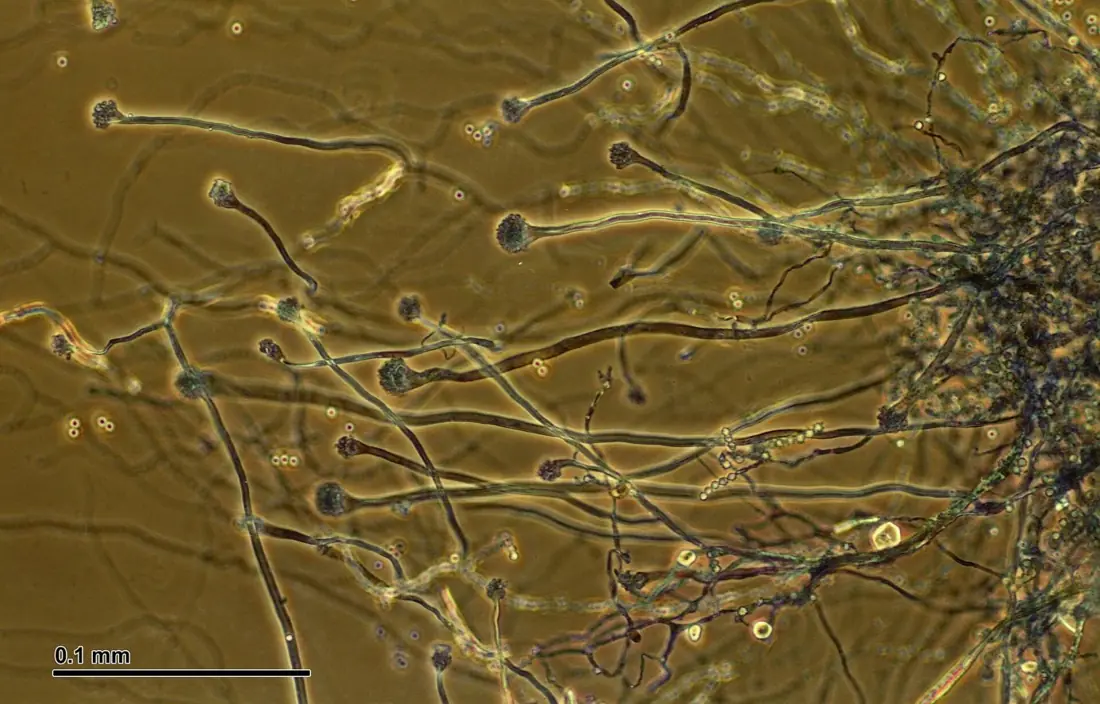
Structure. Mucor (Phycomycetes, class Zygomycetes in newer books) grows as a white cottony mycelium on moist bread, cow dung, rotting fruit and vegetables. The hyphae are branched, aseptate and coenocytic (septa form only to cut off reproductive organs), with chitin walls and glycogen and oil as food. Unlike Rhizopus, Mucor has no rhizoids and no stolons; its sporangiophores arise singly from the mycelium.
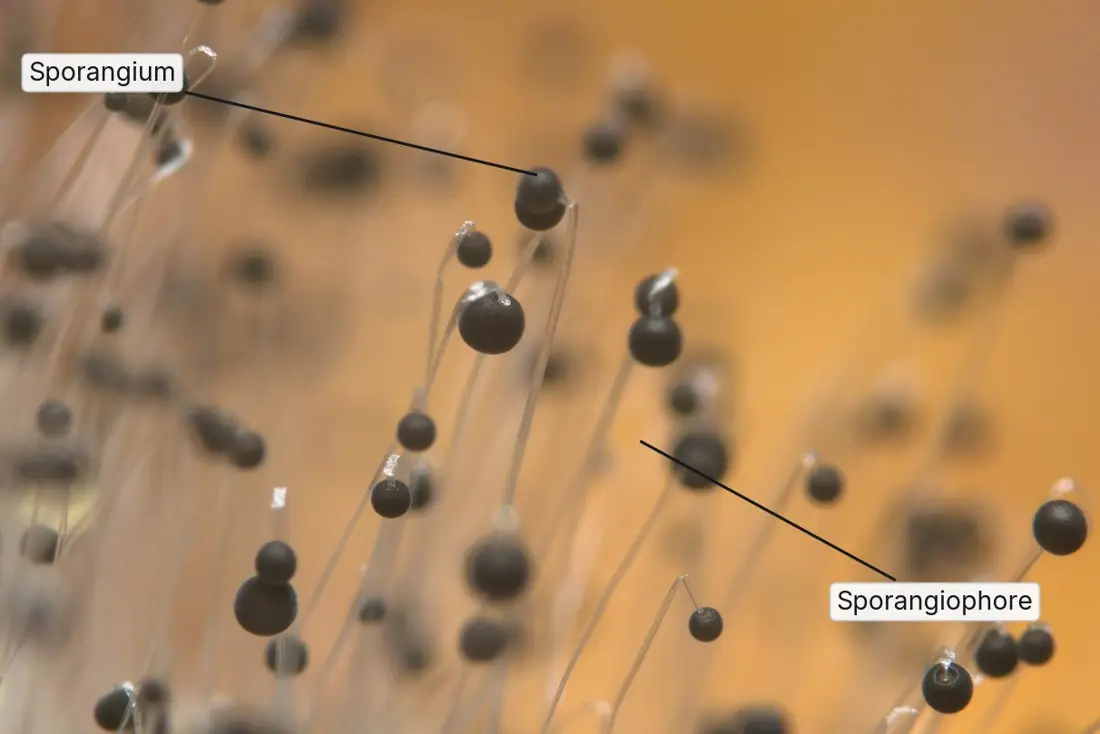
Asexual reproduction. Erect, aerial sporangiophores each end in a round, black sporangium. Its central sterile dome is the columella; around it are many non-motile sporangiospores (aplanospores). The sporangial wall dissolves or breaks, the spores are blown away and each germinates into a new mycelium. In poor conditions Mucor also forms thick-walled, intercalary chlamydospores; in sugary liquid it buds into yeast-like oidia.
Sexual reproduction (conjugation). Most species are heterothallic — zygospores form only when hyphae of two compatible strains, + and −, meet (Blakeslee, 1904, discovered heterothallism in Mucor mucedo). The steps:
- Short side branches of + and − hyphae grow towards each other and touch — progametangia.
- Each tip is cut off by a septum as a multinucleate gametangium; the stalk behind it is the suspensor.
- The wall between the two gametangia dissolves and their contents fuse (plasmogamy); + and − nuclei pair and fuse (karyogamy).
- The fused cell becomes a thick, black, warty-walled resting zygospore (2n) — the only diploid stage.
- On germination, meiosis occurs and the zygospore puts out a germ sporangium (promycelium + sporangium). In M. mucedo only one meiotic nucleus survives, so all spores of one germ sporangium are of one strain (+ or −).
A zygospore that forms without fusion is an azygospore (parthenospore). Since the only diploid structure is the zygote, the life cycle is haplontic with zygotic meiosis.
| Feature | Mucor | Rhizopus | Yeast |
|---|---|---|---|
| Class | Phycomycetes | Phycomycetes | Ascomycetes |
| Body | coenocytic mycelium | coenocytic mycelium with rhizoids and stolons | single cells |
| Asexual | sporangiospores; chlamydospores; oidia | sporangiospores (sporangiophores in tufts over rhizoids) | budding, fission |
| Sexual spore | zygospore | zygospore | ascospores (4) in an ascus |
| Diploid stage | zygospore only | zygospore only | zygote, and diploid budding cells |
3.2 Lichens: introduction and types
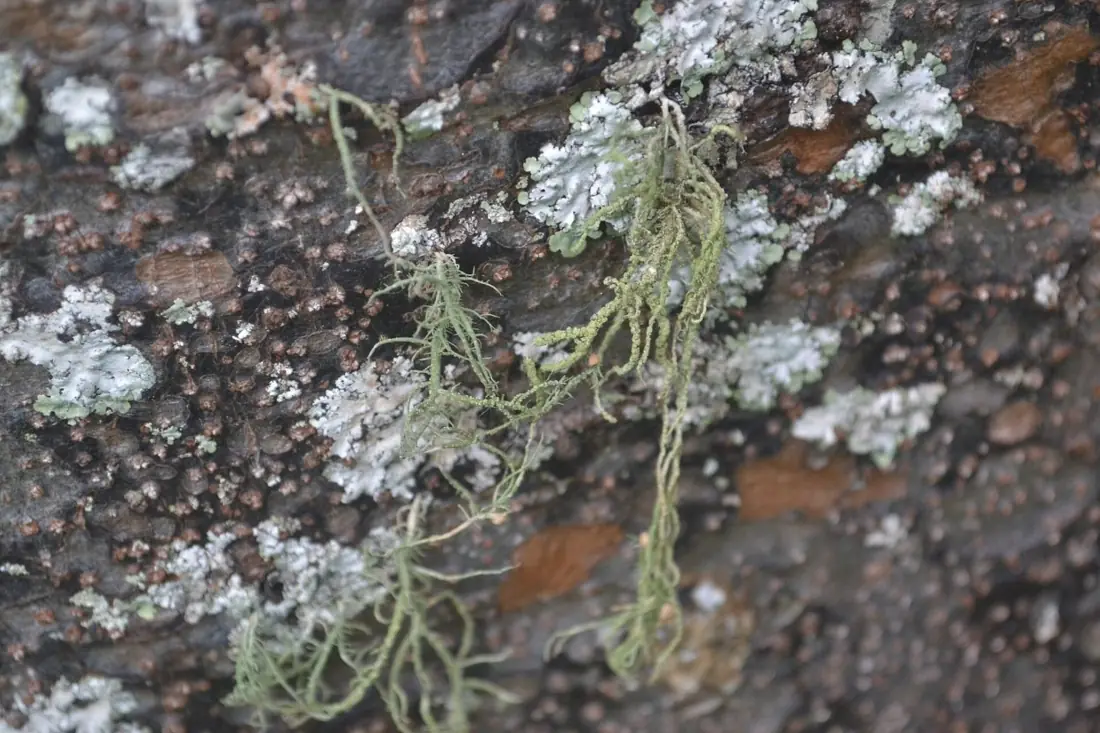
A lichen is a composite organism: a stable, self-supporting symbiotic association between a fungus (the mycobiont) and an alga or a cyanobacterium (the phycobiont or photobiont). The fungus forms most of the body, absorbs water and minerals and shelters the alga; the alga photosynthesises and feeds both. (Because the fungus gains more and can penetrate the algal cells, some authors call it controlled parasitism, or helotism.) The mycobiont is usually an ascomycete; the phycobiont is usually a green alga (Trebouxia, Trentepohlia) or a cyanobacterium (Nostoc). Lichenology is the study of lichens.
| Basis | Types | Examples |
|---|---|---|
| Growth form | crustose — a thin crust tightly glued to rock or bark, cannot be removed whole | Graphis, Lecanora, Rhizocarpon |
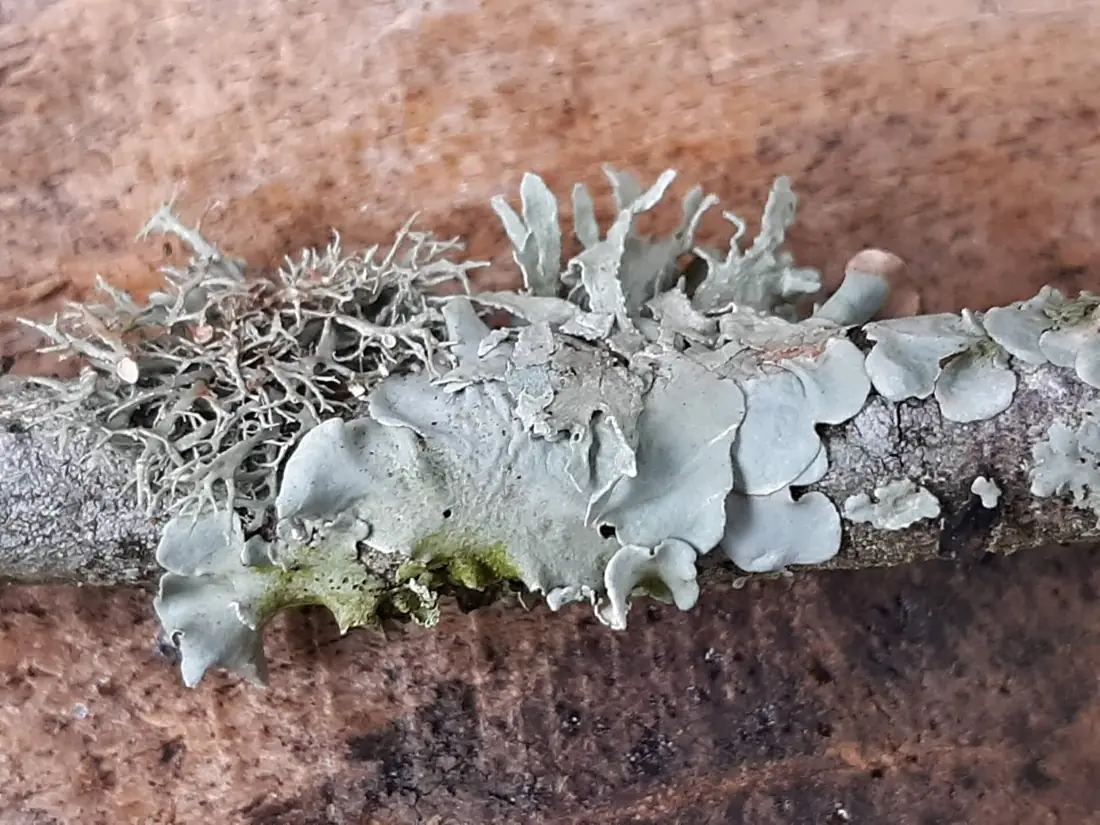
| foliose — flat, lobed, leaf-like; attached loosely by rhizines | Parmelia, Peltigera, Physcia | |
| fruticose — shrubby, branched, erect or hanging; attached by a basal disc | Usnea (old man's beard), Cladonia (reindeer moss), Ramalina | |
| Internal structure | homoiomerous — algal cells scattered evenly among hyphae | Collema, Leptogium |
| heteromerous — algal cells in a distinct layer: upper cortex, algal zone, medulla, lower cortex | Parmelia, Physcia, Usnea | |
| Fungal partner | ascolichens (most), basidiolichens, deuterolichens | Parmelia; Cora |
Reproduction. Vegetatively by fragmentation, by soredia (tiny granules of a few algal cells wrapped in hyphae, dispersed by wind) and by isidia (coral-like outgrowths of the thallus that break off); the fungus alone reproduces sexually, forming apothecia or perithecia, and its spores must find a suitable alga to form a new lichen.
Importance. - Pioneers: crustose lichens are the first colonisers of bare rock in a xerosere; their acids (oxalic acid, lichen acids) weather the rock and start soil formation. - Air-pollution indicators: they are very sensitive to SO₂, so they disappear from polluted city air. - Food and trade: reindeer moss (Cladonia rangiferina) feeds reindeer; in Nepal, lichens (jhyau, mostly of the family Parmeliaceae) are collected in the hills and exported to India for spice mixes, dyes and perfume resins. - Dyes and chemicals: litmus (from Roccella), orchil dye; oak moss (Evernia) in perfumes; usnic acid of Usnea is antibacterial.
3.3 Algae: green, red and brown; Spirogyra
General characters
Algae are simple, chlorophyll-bearing, thalloid, autotrophic and mostly aquatic eukaryotes. They have no roots, stems, leaves or vascular tissue; their sex organs are usually unicellular and not covered by a jacket of sterile cells, and the zygote does not grow into an embryo. They range from unicellular (Chlamydomonas, Chlorella) and colonial (Volvox) to filamentous (Spirogyra, Ulothrix) and large parenchymatous thalli (Ulva, Laminaria). Sexual reproduction is isogamous (gametes alike), anisogamous (unlike in size) or oogamous (a large non-motile egg and a small motile sperm — Volvox, Fucus). Their study is phycology.
| Feature | Chlorophyceae (green algae) | Phaeophyceae (brown algae) | Rhodophyceae (red algae) |
|---|---|---|---|
| Main pigments | chlorophyll a, b, carotenoids | chlorophyll a, c, fucoxanthin | chlorophyll a (d in some), r-phycoerythrin, phycocyanin |
| Stored food | starch (around pyrenoids) | laminarin and mannitol | floridean starch |
| Cell wall | cellulose | cellulose + algin (alginic acid) | cellulose, pectin and sulphated polysaccharides (agar, carrageenan) |
| Flagella | 2–8, equal, apical | 2, unequal, lateral | none — no motile cells |
| Habitat | fresh water, brackish and sea water, moist soil | mostly marine, cool seas | mostly marine, often in deep water |
| Body | unicellular to parenchymatous | filaments to giant kelps with holdfast, stipe and frond; air bladders | filaments to complex thalli |
| Sexual reproduction | iso-, aniso- or oogamous | iso-, aniso- or oogamous | oogamous, with complex post-fertilisation stages |
| Examples | Chlamydomonas, Volvox, Ulothrix, Spirogyra, Chara, Ulva, Chlorella | Ectocarpus, Dictyota, Laminaria, Fucus, Sargassum | Polysiphonia, Porphyra, Gelidium, Gracilaria, Batrachospermum (fresh water) |
Green — a, b, starch. Brown — a, c, fucoxanthin; laminarin, mannitol; algin. Red — a, phycoerythrin; floridean starch; agar; no flagella. Red algae live deepest because phycoerythrin absorbs the blue-green light that penetrates furthest into the sea.
Products to remember: agar (Gelidium, Gracilaria) for culture media and jellies; carrageenan (Chondrus) and algin (Laminaria, Macrocystis) as thickeners; Porphyra (nori) and Laminaria (kombu) as food; Chlorella and Spirulina (a cyanobacterium) as protein supplements; kelps as a source of iodine and potash.
Spirogyra — structure
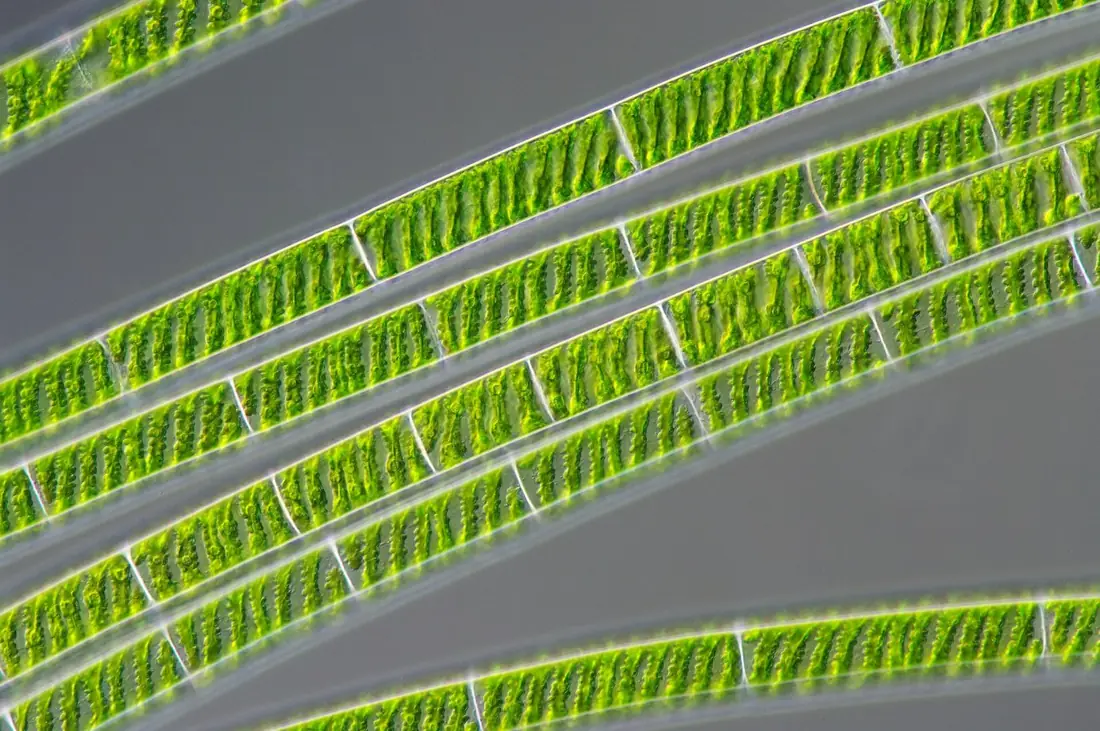
Spirogyra ("water silk", "pond scum") is a free-floating, unbranched, filamentous green alga of still fresh water — ponds, ditches and paddy fields. Its slimy feel comes from a mucilage sheath of pectin outside the cellulose wall. All cells of the filament are alike and each can divide: there is no division of labour.
Each cylindrical cell has: - a two-layered wall (inner cellulose, outer pectin); - a thin lining layer of cytoplasm and a large central vacuole; - a single nucleus suspended in the centre of the vacuole by cytoplasmic strands; - one to several ribbon-shaped, spirally coiled chloroplasts with smooth or wavy margins, each carrying a row of pyrenoids (centres of starch formation).
The filament is haploid (n).
Spirogyra — reproduction
- Vegetative: fragmentation — the filament breaks and each piece grows by cell division. This is the commonest method.
- Asexual (rare): akinetes (thick-walled vegetative cells), aplanospores, and azygospores (parthenospores — formed from a gamete that fails to fuse).
- Sexual: by conjugation. The gametes are non-flagellate and amoeboid (aplanogametes). They look alike (morphologically isogamous), but one — called male, the + strain — moves into the other, which stays put: the process is physiologically anisogamous.
| Scalariform conjugation | Lateral conjugation | |
|---|---|---|
| Between | cells of two filaments lying side by side | adjacent cells of the same filament |
| Thallus | heterothallic | homothallic |
| How | papillae from opposite cells meet and form conjugation tubes, giving a ladder-like look; the contents of each male cell round off and pass through the tube | indirect (chain-forming): a tube forms beside the septum between neighbouring cells; direct: the gamete passes through a pore in the septum |
| After it | one filament empty (male), the other with a zygospore in each cell (female) | alternate cells empty and alternate cells with zygospores |
The zygospore and meiosis. The zygote secretes a thick three-layered wall (exospore, mesospore, endospore) and becomes a resting zygospore (2n) that survives drought and cold. On germination its diploid nucleus divides by meiosis into four haploid nuclei; three degenerate and one survives, so each zygospore gives only one new filament. Meiosis is zygotic and the life cycle is haplontic — the zygospore is the only diploid cell.
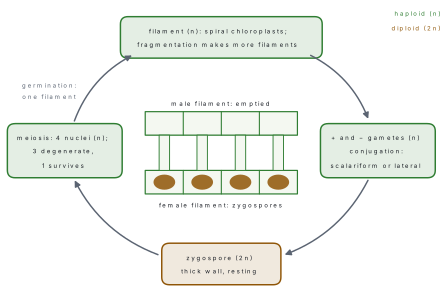
One zygospore of Spirogyra → meiosis → 4 haploid nuclei → 3 degenerate → 1 new filament. Options of "4 filaments" (forgetting the degeneration) or "2 filaments" are the standard distractors. In Mucor, by contrast, one zygospore gives a germ sporangium with many spores.
Problem. Two filaments of Spirogyra, each composed of 40 cells, undergo complete scalariform conjugation. How many zygospores are formed, and how many new filaments will germinate from them?
Solution. Each conjugation tube pairs one cell from the male-acting filament with one cell from the female-acting filament, producing 40 zygospores (whereas lateral conjugation in a single 40-cell filament yields 20 zygospores). Each zygospore undergoes meiosis to form 4 haploid nuclei, of which 3 degenerate and 1 survives, so 40 haploid filaments germinate.
Problem. A marine thalloid alga collected from the subtidal zone contains chlorophyll a, chlorophyll d, and r-phycoerythrin, stores floridean starch, and lacks flagellated stages throughout its life cycle. Assign its class.
Solution. Chlorophyll a + d, phycoerythrin, floridean starch, and complete absence of motile flagellated cells uniquely identify Rhodophyceae (red algae) such as Polysiphonia or Gelidium.
Problem. In Mucor, two compatible (+) and (-) hyphae fuse to form a zygospore (2n = 16). What is the chromosome number in a vegetative coenocytic hypha, a sporangiospore, and a germ-sporangium spore?
Solution. The vegetative mycelium of Mucor is haploid (n = 8). Asexual sporangiospores are mitospores (n = 8), and the zygospore undergoes meiosis before forming the germ sporangium, so germspores are also haploid (n = \mathbf{8}).
Formula and fact sheet
| Item | Fact |
|---|---|
| Fungal wall / food | chitin / glycogen and oil |
| Phycomycetes | aseptate coenocytic; sporangiospores or zoospores; zygospore or oospore — Mucor, Rhizopus, Albugo, Phytophthora, Pythium |
| Ascomycetes | septate; conidia; 8 endogenous ascospores in an ascus; ascocarp — yeast, Penicillium, Aspergillus, Claviceps, Neurospora, Morchella, yarsagumba |
| Basidiomycetes | septate, clamp connections; 4 exogenous basidiospores; somatogamy; basidiocarp — Agaricus, Puccinia, Ustilago, Amanita |
| Deuteromycetes | conidia only, sexual stage unknown — Alternaria, Colletotrichum, Trichoderma, Fusarium |
| Ascocarps | cleistothecium (closed: Penicillium, Erysiphe), perithecium (flask: Neurospora, Claviceps), apothecium (cup: Peziza, Morchella) |
| Diseases | late blight of potato — Phytophthora infestans; white rust of mustard — Albugo candida; ergot — Claviceps purpurea; black rust of wheat — Puccinia graminis; loose smut — Ustilago; early blight of potato — Alternaria solani; red rot of sugarcane — Colletotrichum falcatum; tikka of groundnut — Cercospora; brown spot of rice — Helminthosporium oryzae |
| Yeast | unicellular ascomycete; budding (pseudomycelium), fission (Schizosaccharomyces); 4 ascospores; haplo-diplontic; zymase |
| Fermentation | C₆H₁₂O₆ → 2C₂H₅OH + 2CO₂; 180 g glucose → 92 g ethanol + 88 g CO₂ |
| Mucor | no rhizoids or stolons; sporangium with columella; sporangiospores, chlamydospores, oidia; heterothallic (Blakeslee, 1904); zygospore = only 2n stage; haplontic |
| Lichen | mycobiont (usually ascomycete) + phycobiont (green alga or Nostoc) |
| Lichen forms | crustose (Graphis), foliose (Parmelia, rhizines), fruticose (Usnea, Cladonia) |
| Lichen structure | homoiomerous (Collema) vs heteromerous (Parmelia) |
| Lichen propagules | soredia (alga + hyphae), isidia (outgrowths) |
| Lichen uses | pioneers on rock; SO₂ indicators; litmus (Roccella); reindeer moss; jhyau trade in Nepal |
| Green algae | chl a, b; starch; cellulose; 2–8 equal apical flagella |
| Brown algae | chl a, c, fucoxanthin; laminarin, mannitol; algin; 2 unequal lateral flagella; holdfast, stipe, frond |
| Red algae | chl a, phycoerythrin; floridean starch; agar, carrageenan; no flagella; deep water |
| Spirogyra | unbranched, free-floating; mucilage sheath; spiral ribbon chloroplasts with pyrenoids; nucleus suspended in the vacuole; haploid |
| Conjugation | scalariform (two filaments, ladder; heterothallic) or lateral (one filament; homothallic); physiologically anisogamous aplanogametes |
| Zygospore | 2n; meiosis → 4 nuclei, 3 degenerate → 1 filament; zygotic meiosis, haplontic cycle |
Chapter summary
- Fungi are eukaryotic, achlorophyllous absorptive heterotrophs with chitin walls and glycogen and oil as food; their sexual cycle is plasmogamy, karyogamy, meiosis.
- Phycomycetes have coenocytic hyphae and zygospores or oospores; Ascomycetes form 8 endogenous ascospores in an ascus; Basidiomycetes form 4 exogenous basidiospores on a basidium; Deuteromycetes have no known sexual stage.
- Phytophthora (late blight), Albugo (white rust), Claviceps (ergot), Puccinia (rust), Ustilago (smut), Alternaria (early blight) and Colletotrichum (red rot) are the classic disease fungi.
- Yeast is a unicellular ascomycete that buds, ferments sugar with zymase to ethanol and CO₂, and forms 4 ascospores; its cycle is haplo-diplontic.
- Mucor has a coenocytic mycelium without rhizoids, sporangia with a columella, heterothallic conjugation and a zygospore that is its only diploid stage.
- A lichen is a fungus (mycobiont) living with an alga or cyanobacterium (phycobiont); its forms are crustose, foliose and fruticose, and it spreads by soredia and isidia.
- Lichens are pioneers on bare rock and sensitive indicators of SO₂ pollution.
- Green algae store starch and have chl a, b; brown algae store laminarin and mannitol and have fucoxanthin and algin; red algae store floridean starch, have phycoerythrin and agar, and never have flagella.
- Spirogyra is a haploid unbranched filament with spiral chloroplasts; it reproduces by fragmentation and by scalariform or lateral conjugation; one zygospore gives one filament after zygotic meiosis.
Practice questions
Set A — Recall (20 questions)
- The reserve food of fungi isastarchbcellulosecglycogen and oildfloridean starch
- Fungi with an aseptate, coenocytic mycelium belong toaPhycomycetesbAscomycetescBasidiomycetesdDeuteromycetes
- Ascospores are formedaexogenously on sterigmatabinside sporangia by mitosiscat the tips of conidiophoresdendogenously in an ascus, usually eight
- Deuteromycetes are called fungi imperfecti becauseathey lack a cell wallbtheir sexual stage is not knowncthey have no myceliumdthey cannot form spores
- The edible fruiting body of the mushroom Agaricus isaan ascocarpba basidiocarpca sporangiumda cleistothecium
- Which disease is caused by a member of Phycomycetes?ablack rust of wheatbred rot of sugarcanecloose smut of wheatdlate blight of potato
- Yeast reproduces vegetatively mainly byabuddingbfragmentationczoosporesdconidia
- The enzyme complex of yeast that ferments sugar into alcohol isadiastasebinvertaseczymasedurease
- In Mucor, the dome-shaped sterile central part of the sporangium is theaapophysisbsuspensorcstolondcolumella
- The sexual spore of Mucor is theaoosporebascosporeczygosporedbasidiospore
- The fungal partner of a lichen is called theaphycobiontbmycobiontcphotobiontdholdfast
- Usnea, the "old man's beard" lichen, isafruticosebcrustosecfoliosedhomoiomerous
- Lichens are good indicators of air pollution because they are very sensitive toacarbon dioxideboxygencsulphur dioxidednitrogen
- Small granules of a few algal cells wrapped in fungal hyphae, by which lichens spread, are calledaisidiabrhizinescapotheciadsoredia
- The photosynthetic pigments of Chlorophyceae areachlorophyll a and bbchlorophyll a, c and fucoxanthincchlorophyll a and phycoerythrindchlorophyll a and phycocyanin only
- The stored food of brown algae isastarchblaminarin and mannitolcfloridean starchdglycogen
- Agar is obtained fromaGelidium and GracilariabLaminaria and FucuscChlamydomonas and VolvoxdSargassum and Ectocarpus
- Red algae have noachlorophyll abcell wallcflagellated cells at any stagedsexual reproduction
- The chloroplast of Spirogyra isacup-shapedbribbon-shaped and spiralcstellatedgirdle-shaped
- One zygospore of Spirogyra gives rise toafour new filamentsbtwo new filamentsceight new filamentsdone new filament
Answers and explanations — Set A
1. (c) — Fungi store glycogen and oil; starch is the store of plants and green algae, floridean starch of red algae.
2. (a) — Phycomycetes (Mucor, Rhizopus, Albugo) have aseptate, multinucleate hyphae; the other three classes have septate hyphae.
3. (d) — Ascospores form inside the ascus after meiosis (usually followed by one mitosis, giving 8). Exogenous spores on sterigmata are basidiospores.
4. (b) — "Imperfect" means the perfect (sexual) stage is unknown; they reproduce only by conidia.
5. (b) — The mushroom is a basidiocarp bearing gills lined with basidia. Ascocarps and cleistothecia belong to Ascomycetes.
6. (d) — Late blight of potato is caused by Phytophthora infestans (an oomycete, listed under Phycomycetes). Rust and smut are basidiomycetes; red rot is a deuteromycete.
7. (a) — Budding is the usual method; fission occurs only in fission yeasts, and yeast has no zoospores.
8. (c) — Zymase (Buchner, 1897) converts glucose to ethanol and CO₂. Invertase splits sucrose; diastase splits starch.
9. (d) — The columella is the sterile dome inside the sporangium. The apophysis is the swelling below the sporangium in Rhizopus; the suspensor supports a gametangium.
10. (c) — Mucor forms a zygospore by fusion of two gametangia. Oospores belong to oogamous Phycomycetes such as Albugo.
11. (b) — The mycobiont is the fungus; the phycobiont (photobiont) is the alga or cyanobacterium.
12. (a) — Usnea is a shrubby, hanging fruticose lichen; its internal structure is heteromerous, so (d) is wrong.
13. (c) — Lichens absorb everything from rain and air and cannot excrete it; SO₂ destroys their chlorophyll, so they vanish from polluted towns.
14. (d) — Soredia contain both partners and are blown away. Isidia are outgrowths of the thallus; rhizines attach a foliose lichen.
15. (a) — Green algae have the same pigments as land plants: chlorophyll a and b. Option (b) is brown algae, (c) red algae, (d) cyanobacteria.
16. (b) — Brown algae store laminarin (a polysaccharide) and mannitol (a sugar alcohol).
17. (a) — Agar comes from the red algae Gelidium and Gracilaria. Laminaria and Fucus are brown algae that yield algin.
18. (c) — Red algae have no flagellated stage at all; even their male gametes (spermatia) are non-motile. They do have chlorophyll a, walls and oogamous sex.
19. (b) — One or more ribbon-shaped chloroplasts coil spirally round each cell. Cup-shaped is Chlamydomonas; girdle-shaped is Ulothrix.
20. (d) — Meiosis gives four haploid nuclei, three degenerate, and the one survivor grows into one filament.
Set B — Understanding (12 questions)
- Mucor can be told from Rhizopus because only Rhizopus hasaa columellabrhizoids and stolonsccoenocytic hyphaedzygospores
- The life cycle of Mucor is called haplontic becauseathe mycelium is diploidbmeiosis occurs in the sporangiumcits gametes are diploiddthe zygospore is its only diploid stage
- Mucor mucedo forms zygospores only when hyphae of two different strains meet. This condition is calledaheterothallismbhomothallismcparthenogenesisdapogamy
- Yeast makes bread dough rise becauseait secretes starchbthe ethanol it produces expandscits fermentation releases carbon dioxidedit absorbs water from the flour
- Basidiomycetes differ from Ascomycetes in that Basidiomycetesahave aseptate hyphaebform spores endogenously in sacscform four exogenous spores on a club-shaped celldnever form fruiting bodies
- Penicillium is placed in Ascomycetes and not in Deuteromycetes becauseaits ascus-forming sexual stage is knownbit forms conidiacit has septate hyphaedit produces an antibiotic
- In a lichen the alga and fungus help each other, becauseathe alga absorbs minerals and the fungus photosynthesisesbboth partners photosynthesisecthe fungus fixes nitrogen for the algadthe alga makes food; the fungus gives shelter, water and minerals
- Crustose lichens can colonise bare rock first, because theyaneed a thick layer of soilbsecrete acids that weather the rock and begin soil formationcgrow only under waterdhave deep roots that split the rock
- Red algae can grow deeper in the sea than green algae, becauseaphycoerythrin absorbs the blue-green light that reaches deep waterbthey need no lightcthey have chlorophyll bdfloridean starch makes them sink
- Spirogyra is called physiologically anisogamous because its gametesadiffer in size and shapebbear flagella of unequal lengthcare a large egg and a small spermdlook alike, but one moves into the other
- After scalariform conjugation in Spirogyra,aboth filaments contain zygosporesbone filament is empty and the other has the zygosporescalternate cells of each filament are emptydthe zygospores lie in the conjugation tubes
- Meiosis in Spirogyra is zygotic. This means thatathe filament is diploidbthe gametes are formed by meiosiscthe zygospore nucleus divides by meiosis, so the filament is haploiddmeiosis never occurs
Answers and explanations — Set B
1. (b) — Rhizopus has root-like rhizoids and creeping stolons, with sporangiophores in tufts; Mucor has neither. Both have a columella, coenocytic hyphae and zygospores.
2. (d) — Only the zygospore is 2n; meiosis happens when it germinates, so the mycelium, spores and gametangia are all haploid.
3. (a) — Heterothallism (Blakeslee, 1904): fusion needs + and − strains. Homothallic species form zygospores within one mycelium.
4. (c) — Fermentation of sugar by zymase gives CO₂ bubbles that are trapped in the dough. The ethanol evaporates during baking.
5. (c) — Basidia bear four basidiospores outside, on sterigmata. Ascomycetes form spores inside asci; both have septate hyphae and both form fruiting bodies.
6. (a) — Classification by sexual stage: once asci are found, the fungus is an ascomycete. Conidia, septa and antibiotics occur in deuteromycetes too.
7. (d) — The phycobiont is the only partner with chlorophyll; the mycobiont forms the body, holds water and absorbs minerals. Only cyanobacterial partners fix nitrogen.
8. (b) — Lichen acids slowly corrode rock and dead lichen adds organic matter, starting the soil that mosses need next. Lichens have no roots.
9. (a) — Red and violet light are absorbed near the surface; the blue-green light that penetrates deepest is absorbed by phycoerythrin. Red algae lack chlorophyll b.
10. (d) — The two gametes are identical in form (isogamous) but behave differently: one is active (male, + strain), the other passive. Spirogyra gametes have no flagella.
11. (b) — All male cells empty into the female filament, which then holds a zygospore in each cell. Option (c) describes lateral conjugation.
12. (c) — Zygotic meiosis means the zygote divides by meiosis; every other cell in the cycle is haploid.
Set C — Application (8 questions)
- A Spirogyra zygospore germinates. How many haploid nuclei does meiosis produce, and how many survive?a2 formed, 2 surviveb4 formed, 4 survivec8 formed, 1 survivesd4 formed, 1 survives
- A fungus has septate hyphae with clamp connections and forms four spores on the outside of a club-shaped cell; no sex organs are seen. It belongs toaPhycomycetesbBasidiomycetescAscomycetesdDeuteromycetes
- A fungus known only by its conidia is studied for years until asci with ascospores are found. It should now be placed inaAscomycetesbBasidiomycetescPhycomycetesdDeuteromycetes, where it was
- A yeast ferments 18 g of glucose completely to ethanol and CO₂ (C = 12, H = 1, O = 16). The mass of CO₂ released isa4.4 gb9.2 gc8.8 gd17.6 g
- A lichen on a rock at Phulchoki is leaf-like and lobed, loosely attached by rhizines, with a distinct algal layer below the upper cortex. It isacrustose and homoiomerousbfoliose and heteromerouscfruticose and homoiomerousdcrustose and heteromerous
- A marine alga has a holdfast, stipe and frond, stores laminarin and mannitol, and its zoospores bear two unequal lateral flagella. It belongs toaChlorophyceaebRhodophyceaecCyanophyceaedPhaeophyceae
- A pond alga is green, unbranched and slimy; each cell has spiral chloroplasts with pyrenoids; during reproduction the cells of one filament empty into another. It is most likelyaUlothrixbOedogoniumcSpirogyradCladophora
- Each cell of a Spirogyra filament has 12 chromosomes. The numbers in the zygospore nucleus and in a cell of the new filament area24 and 12b12 and 24c24 and 24d12 and 12
Answers and explanations — Set C
1. (d) — Meiosis of the 2n nucleus gives 4 haploid nuclei; three degenerate and one survives to form a single filament.
2. (b) — Clamp connections and four exogenous spores on a club-shaped basidium mark a basidiomycete such as Agaricus; the missing sex organs fit somatogamy. The basidium is the sexual stage, so (d) is wrong.
3. (a) — Asci and ascospores are the sexual stage of Ascomycetes; once it is known the fungus leaves the "imperfect" group.
4. (c) — 18 g ÷ 180 g mol⁻¹ = 0.1 mol glucose → 0.2 mol CO₂ × 44 g mol⁻¹ = 8.8 g. Option (b), 9.2 g, is the ethanol (0.2 × 46).
5. (b) — Leaf-like lobes on rhizines = foliose; a separate algal zone = heteromerous (as in Parmelia).
6. (d) — Holdfast–stipe–frond, laminarin and mannitol, and two unequal lateral flagella are the marks of brown algae (Laminaria).
7. (c) — Spiral chloroplasts, a mucilage sheath and scalariform conjugation identify Spirogyra. Ulothrix has a girdle chloroplast, Oedogonium a reticulate one, and Cladophora is branched.
8. (a) — The filament is haploid (n = 12); fusion of two gametes gives a 2n = 24 zygospore; zygotic meiosis restores n = 12 in the new filament.