Chapter 6 · Ecology and Vegetation · 4 questions in the paper · 42 min read
Ecology and Vegetation
What the syllabus asks for 4
- Pond and forest ecosystems: structure and function; biotic interactions
- Carbon and nitrogen cycles; greenhouse effect, acid rain, ozone-layer depletion and climate change
- Forest types of Nepal; biological invasion
- Ecological succession: hydrosere and xerosere; ecological adaptation
Ecology and Vegetation carries 4 of the 40 Botany questions, spread evenly over four blocks: ecosystem structure and biotic interactions, the carbon and nitrogen cycles with their named bacteria, Nepal's forest belts and invasive plants, and succession. Almost nothing here needs calculation; almost everything needs a name attached to the right process. Learn the tables and the two cycle figures and this unit is free marks.
- Trophic structure — producer, consumer, decomposer; grazing and detrital chains; the 10 % law (Lindeman) and why the pyramid of energy is never inverted.
- Biotic interactions — the six named relationships with their signs (+ +, + 0, + −, − −, 0 −) and a Nepali example for each.
- Nitrogen cycle names — Rhizobium, Azotobacter, Clostridium, Anabaena (fixation); Nitrosomonas (NH₄⁺ → NO₂⁻); Nitrobacter (NO₂⁻ → NO₃⁻); Pseudomonas and Clostridium (denitrification).
- Carbon cycle — the four fluxes and the reservoirs in order of size.
- Pollution — greenhouse gases and the mechanism, acid rain (pH 5.6), CFC → Cl → ozone, and Nepal's climate exposure.
- Forest belts of Nepal — species against altitude, from sal below 1 000 m to cushion plants above 4 000 m.
- Invasive plants — Lantana, Mikania, water hyacinth and Parthenium, and why each is a problem.
- Succession — the hydrosere and xerosere sequences in order, pioneer and climax, and the trends in biomass and diversity.
6.1 Pond and forest ecosystems: structure and function
What an ecosystem is
An ecosystem is a self-regulating unit in which a community of organisms interacts with its physical environment, energy flowing through it one way and matter cycling within it (Tansley, 1935). Its abiotic half is light, temperature, water, air, soil, pH and the inorganic nutrients; its biotic half is producers (autotrophs), consumers (heterotrophs) and decomposers (saprotrophs — bacteria and fungi, with earthworms and termites as detritivores). Structure is who is there and in what layers; function is productivity, decomposition, energy flow and nutrient cycling.
Structure of a pond ecosystem
A pond is a small freshwater standing (lentic) ecosystem. Its abiotic part is the water itself — temperature, dissolved O₂ and CO₂, pH, light penetration, nitrates and phosphates. Its biotic part is arranged in four zones:
| Zone | Position | Producers | Consumers |
|---|---|---|---|
| Littoral | shallow margin, light reaches the bottom | emergent Typha, Phragmites; floating Nymphaea, Pistia | snails, insects, tadpoles, small fish |
| Limnetic | open water, well lit | phytoplankton — Chlorella, Scenedesmus, diatoms | zooplankton — Daphnia, Cyclops, Rotifera; fish |
| Profundal | deep water, little light | none | fish and large crustaceans on falling detritus |
| Benthic | bottom mud | none | bacteria and fungi (decomposers), chironomid larvae, mussels |
Submerged plants (Hydrilla, Vallisneria) root in the littoral mud and reach into the limnetic zone. The decomposers sit in the mud and take everything that sinks, so a pond recycles its nutrients fast — a nutrient spill can choke it with algae within days.
Structure of a forest ecosystem
A forest is terrestrial, and its structure is vertical. A sal forest in Chitwan has five layers:
| Layer | What is there |
|---|---|
| Canopy | Shorea robusta (sal), 25–35 m, closing overhead |
| Understorey | Syzygium cumini, Semecarpus anacardium, Bauhinia |
| Shrub | Lantana, Clerodendrum, saplings of the canopy trees |
| Herb | fodder grasses, ferns, a dense monsoon ground flora |
| Litter and root | fallen leaves, and the soil fungi, bacteria, termites and earthworms |
Consumers are layered too: deer and insects below, monkeys and birds in the canopy, tiger and leopard through all of them; the decomposers work in the litter.
Function: energy flow and the 10 % law
Photosynthesis is the only route by which new energy enters an ecosystem. The total fixed by the producers is the gross primary productivity (GPP); what is left after they pay for their own respiration is the net primary productivity (NPP):
Energy passes along a food chain, and at every transfer most of it is lost as heat in respiration, plus what is not eaten, not digested or excreted. Raymond Lindeman (1942) measured this and stated the 10 % law: only about 10 % of the energy of one trophic level reaches the next, the other 90 % being lost, mostly as heat.
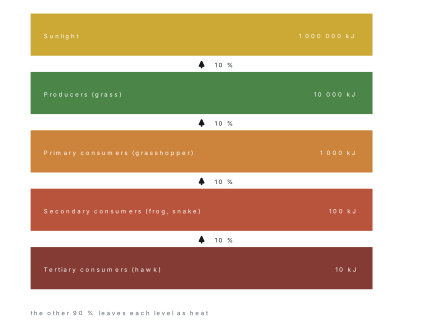
Two consequences follow. Energy flow is unidirectional — once degraded to heat it is useless to a producer, whereas matter cycles. And food chains are short, because only a tenth survives each transfer.
Types of food chain. A grazing (predator) chain starts from a living plant: grass → grasshopper → frog → snake → hawk. A detrital (decomposer) chain starts from dead organic matter: leaf litter → earthworm → bird. In a forest most energy travels through the detrital chain. Real chains interlock into a food web, which is what makes an ecosystem stable — if one prey disappears, a predator can switch to another.
Solution. Producers = level 1 = 50 000 kJ. Primary consumers (level 2) receive 10 % = 5 000 kJ. Secondary consumers (level 3) receive 10 % of that = 500 kJ m⁻² yr⁻¹. Each step is one multiplication by 0.1, so from level 1 to level n the energy is 50\,000 \times 0.1^{\,n-1}. Working backwards, multiply by 10 for each step down the chain.
Ecological pyramids
An ecological pyramid plots the numbers, biomass or energy at each trophic level, producers at the base.
| Type | What is plotted | Unit | Shape | Inverted when |
|---|---|---|---|---|
| Pyramid of numbers | number of individuals per level | count | usually upright | a single large tree supports thousands of insects; many small parasites on one host |
| Pyramid of biomass | mass of living matter per level | g m⁻² or kg ha⁻¹ | usually upright | in a pond, where the standing crop of phytoplankton is smaller than that of the zooplankton feeding on it |
| Pyramid of energy | energy passing a level per unit time | kJ m⁻² yr⁻¹ | always upright | never |
- A pyramid of biomass can be inverted; a pyramid of energy cannot. Phytoplankton are eaten as fast as they divide, so a small standing crop supports a larger mass of zooplankton. Energy is still lost at every transfer, so the energy pyramid stays upright. "Inverted energy pyramid" is a favourite distractor.
- Decomposers are not a trophic level of the standard pyramid. They draw energy from every level — leaves, dung, corpses — so they cannot be stacked above the carnivores; they form a separate detritus pathway. Where do they belong? "At every level", not "the top".
Biotic interactions
The relationship between two species is classified by its effect on each partner: + benefited, − harmed, 0 unaffected.
| Interaction | Signs | What happens | Nepali example |
|---|---|---|---|
| Mutualism | + + | both benefit; often obligate | lichen — alga feeds the fungus, fungus gives shelter and minerals (Phulchoki rocks); Rhizobium in lentil (masuro) and chickpea nodules fixes N₂ for sugar |
| Commensalism | + 0 | one benefits, the other unaffected | cattle egret (Bubulcus ibis) follows buffalo in the Terai and catches the insects they flush; epiphytic orchids (Vanda) on sal branches |
| Parasitism | + − | one lives on or in the other and draws food from it | Cuscuta (amarbel) sends haustoria into host stems; Scurrula (liwang) on mango; liver fluke in sheep and goats |
| Predation | + − | one animal kills and eats another | tiger on chital in Chitwan; leopard on livestock; ladybird on aphids in mustard |
| Competition | − − | both need the same limited resource | sal and Terminalia seedlings for light and water; Mikania against fodder grasses |
| Amensalism | 0 − | one harmed, the other unaffected | Penicillium releases penicillin and kills bacteria around it; a large tree shading out herbs below |
Mutualism + +, Commensalism + 0, Parasitism + −, Predation + −, Competition − −, Amensalism 0 −. A parasite lives on or in its host and usually does not kill it at once; a predator kills its prey.
6.2 Carbon and nitrogen cycles; greenhouse effect, acid rain, ozone depletion and climate change
The carbon cycle
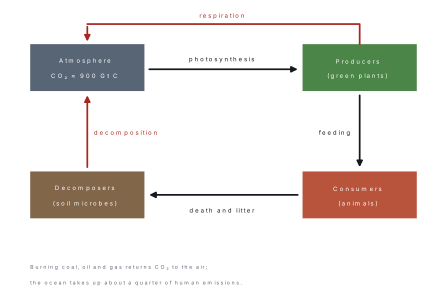
Carbon is exchanged between four reservoirs: the atmosphere (as CO₂, about 900 Gt C), living organisms and soil (about 2 000 Gt C), the oceans (about 38 000 Gt C of dissolved inorganic carbon) and fossil fuels. Carbonate rock holds far more, but exchanges only over millions of years.
- Photosynthesis removes CO₂ and fixes it into carbohydrate — the only large biological sink.
- Respiration by plants, animals and microbes returns CO₂ to the air.
- Decomposition of litter and humus is, globally, the largest single return flux.
- Feeding moves carbon from plants to animals as organic matter.
- Combustion of fossil fuel and firewood returns carbon locked away for millions of years.
- Ocean exchange — the sea absorbs roughly a quarter of the CO₂ humans release.
The nitrogen cycle
Nitrogen is 78 % of the air, but as N₂ it is almost inert: the two atoms are held by a triple bond no plant or animal can break. The nitrogen cycle is the story of how that bond is broken and how nitrogen passes from one form to another.
| Step | Change | Organisms that do it |
|---|---|---|
| Nitrogen fixation | N₂ → NH₃ / NH₄⁺ | symbiotic: Rhizobium in legume root nodules, Frankia in alder; free-living aerobic: Azotobacter, Beijerinckia; free-living anaerobic: Clostridium pasteurianum; cyanobacteria: Anabaena, Nostoc (in heterocysts); also lightning and the Haber–Bosch process |
| Ammonification | organic N (dead plants, animals, dung) → NH₄⁺ | Bacillus, Clostridium, fungi and other saprotrophs |
| Nitrification | NH₄⁺ → NO₂⁻ | Nitrosomonas (also Nitrosococcus) |
| NO₂⁻ → NO₃⁻ | Nitrobacter (also Nitrospira) | |
| Assimilation | NO₃⁻ and NH₄⁺ → plant protein | plants (nitrate is first reduced to nitrite by nitrate reductase, then to ammonia) |
| Denitrification | NO₃⁻ → NO₂⁻ → N₂O → N₂ | Pseudomonas, Clostridium, Thiobacillus |
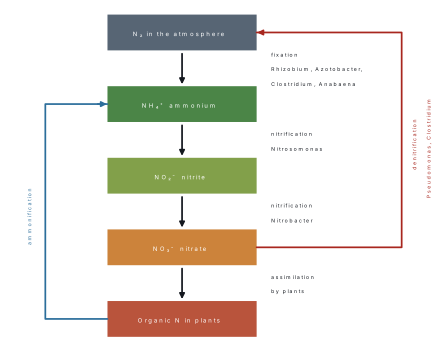
- Nitrosomonas makes nitrite, Nitrobacter makes nitrate. The order is ammonium → nitrite → nitrate; reversing them is the commonest error in the unit.
- Nitrogen fixation is not nitrification. Fixation joins N₂ into ammonia; nitrification only shuffles ammonia up to nitrate.
- Denitrification is a loss, not a gain. It returns nitrogen to the air. A drained paddy loses nitrogen this way; a flooded one keeps it as ammonium, which is why paddy fields are kept flooded.
- Rhizobium is symbiotic; Azotobacter and Clostridium are free-living. "Free-living aerobic" means Azotobacter.
The greenhouse effect
Short-wave radiation from the Sun passes almost unchanged through the atmosphere and is absorbed by the surface, which warms. The warm surface re-emits energy as long-wave infrared, and greenhouse gases absorb this infrared and re-radiate it in all directions, so part of it returns to the surface instead of escaping. The surface therefore settles at about +15 °C instead of −18 °C. That natural greenhouse effect makes life possible; adding gases to it — the enhanced greenhouse effect — drives current climate change.
| Gas | Main source | Relative contribution | Notes |
|---|---|---|---|
| Water vapour | evaporation from oceans | largest share of the natural effect | rises with warming (a positive feedback) |
| Carbon dioxide | fossil fuel, deforestation, cement | about three-quarters of the human contribution | reference gas, GWP = 1 |
| Methane | paddy fields, cattle, landfill | second largest | GWP ≈ 28 over 100 years |
| Nitrous oxide | fertiliser, manure, industry | small but long-lived | GWP ≈ 265 |
| CFCs and HFCs | refrigerants, aerosols | tiny in amount, very powerful | GWP of CFC-12 ≈ 10 900 |
Solution. \Delta F = 5.35 \ln(560/280) = 5.35 \ln 2 = 5.35 \times 0.693 = 3.71 W m⁻². A doubling of CO₂ always gives this figure, whatever the starting concentration, because the formula depends on the ratio.
Acid rain
Normal rain is already slightly acidic, pH ≈ 5.6, because it dissolves atmospheric CO₂ to form weak carbonic acid. Rain is called acid rain when its pH falls below about 5.0, which happens when it dissolves sulphur dioxide and nitrogen oxides:
- SO₂ + H₂O → H₂SO₃, which oxidises to H₂SO₄ (sulphuric acid)
- 2NO₂ + H₂O → HNO₃ + HNO₂, giving HNO₃ (nitric acid)
The sources are coal and oil burning (SO₂) and vehicle and power-station exhausts (NOₓ). The damage is indirect as well as direct: acid water dissolves aluminium from the soil, and the Al³⁺ reaching a lake is what kills fish. It also leaches calcium and magnesium from soil and eats into limestone and marble. Nepal's emissions are small, but Kathmandu Valley brick kilns and traffic make local acid aerosols, and Himalayan lakes are poorly buffered.
Depletion of the ozone layer
Ozone (O₃) forms in the stratosphere (15–35 km up) when UV light splits O₂ and the free oxygen atoms recombine with O₂. This layer absorbs most of the Sun's UV-B, which would otherwise damage DNA and cause skin cancer and cataracts. Its thickness is measured in Dobson units (DU); the normal column is about 300 DU.
The CFC mechanism, step by step:
- Chlorofluorocarbons (CFCl₃, CF₂Cl₂) — refrigerants, propellants, foam-blowing agents — are chemically inert, so they drift up into the stratosphere without being destroyed.
- There UV-C light breaks the C–Cl bond, releasing a chlorine radical: CF₂Cl₂ --UV--> CF₂Cl• + Cl•.
- The chlorine radical attacks ozone: Cl• + O₃ → ClO• + O₂.
- The chlorine monoxide then takes an oxygen atom from another ozone molecule: ClO• + O₃ → Cl• + 2O₂ — and the chlorine atom is regenerated.
- Because it is not used up, one atom can destroy about 100 000 ozone molecules before it is removed. Chlorine is a catalyst.
The Antarctic "ozone hole" is a spring phenomenon. In the extreme cold of the polar night, polar stratospheric clouds of ice form, and reactions on their surfaces convert the inactive reservoir forms (HCl, ClONO₂) into active chlorine; when sunlight returns, ozone is destroyed very fast. The Montreal Protocol (1987) phased out CFCs, and stratospheric chlorine is now falling, though full recovery will take decades.
Climate change and Nepal's exposure
The enhanced greenhouse effect has raised the global mean surface temperature by about 1.1–1.2 °C above the pre-industrial value. Nepal is exposed in four ways:
- Glacier retreat. Meltwater first increases, then falls away, so glacier-fed rivers swell and later run low in the dry season.
- Glacial lake outburst floods (GLOF). Meltwater collects behind a loose moraine dam; when it breaks, a wall of water and debris runs down the valley. Imja and Tsho Rolpa are the classic examples, and Thame in Solukhumbu was damaged in 2024.
- A shifting monsoon. Longer dry spells inside the season, then very heavy rain in a few days — drought at transplanting, floods at harvest.
- Upward migration of the belts. As the tree line climbs, alpine species lose the ground above them and the highest ones are lost first.
The consequences are already visible: more landslides, winter water shortage in mid-hill towns and a longer dengue season in the Terai. Adaptation means community forest management, GLOF early-warning systems and check dams on fragile slopes.
6.3 Forest types of Nepal; biological invasion
Forest belts by altitude
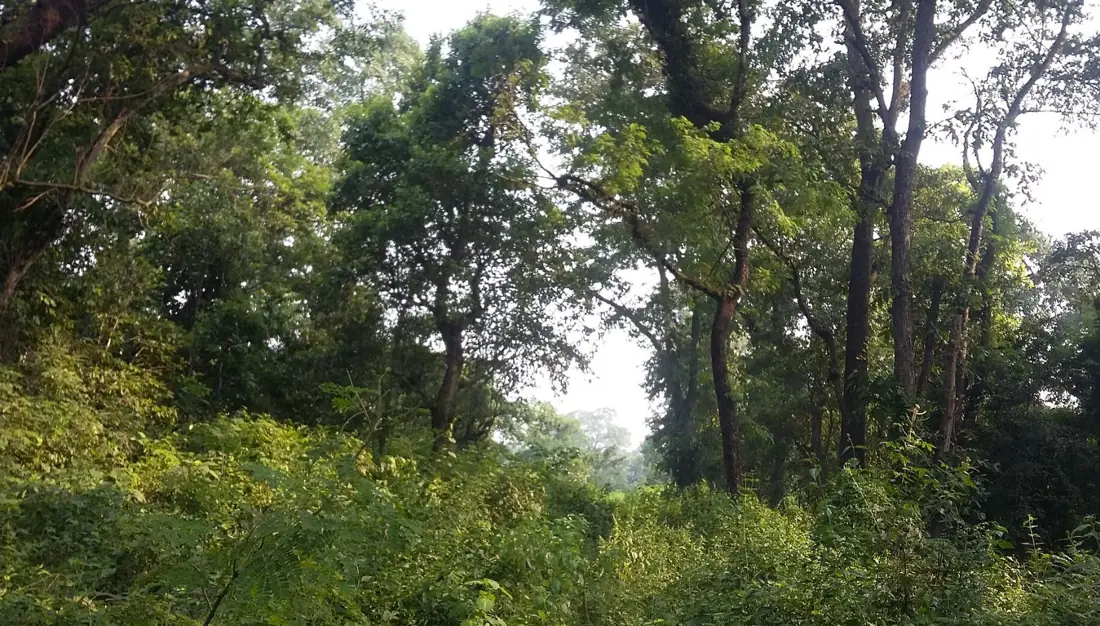
Nepal spans only 147 000 km², but rises from about 60 m in the Terai to 8 848 m at Sagarmatha, so a day's walk uphill passes the belts of a whole continent. About 45 % of the land is forest or other wooded land. Temperature falls by roughly 0.6 °C for every 100 m of ascent, and the monsoon is heaviest in the east.
| Belt | Altitude | Climate | Characteristic species |
|---|---|---|---|
| Tropical | below 1 000 m — Terai, inner Terai, Chitwan, Bardia | hot, monsoon 1 500–2 500 mm, mean above 24 °C | sal Shorea robusta, sissoo Dalbergia sissoo, khair Acacia catechu, simal Bombax ceiba, tall elephant grass (Saccharum–Phragmites) |
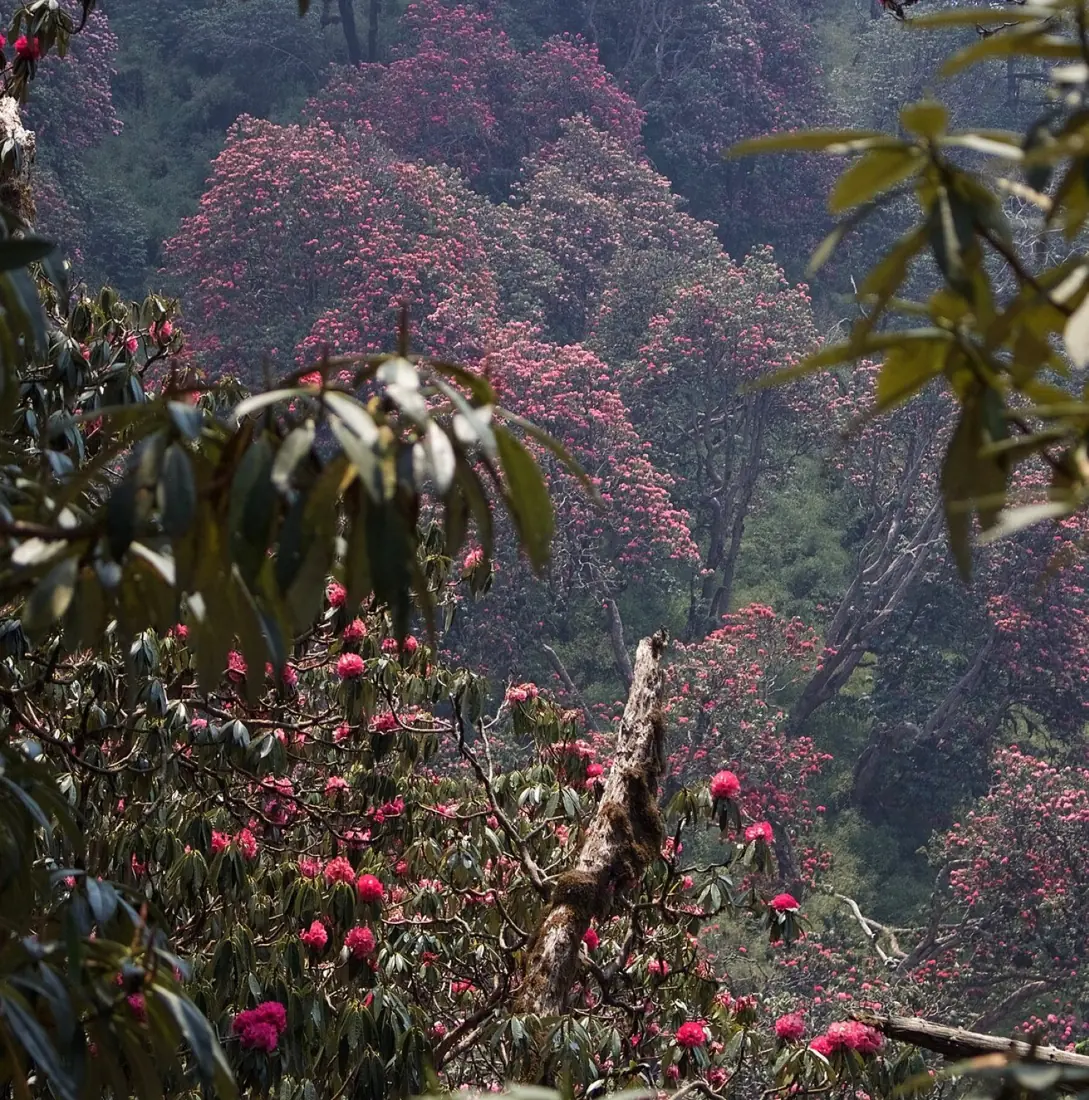
| Subtropical | 1 000–2 000 m — mid-hills, Kathmandu, Pokhara | warm, 1 000–2 000 mm | chir pine Pinus roxburghii, chilaune Schima wallichii, katus Castanopsis indica, utis Alnus nepalensis, lali gurans Rhododendron arboreum |
| Temperate | 2 000–3 000 m | cool, winter snow | oak Quercus semecarpifolia and Q. lamellosa, rhododendron, spruce Picea smithiana, hemlock Tsuga dumosa, maple Acer |
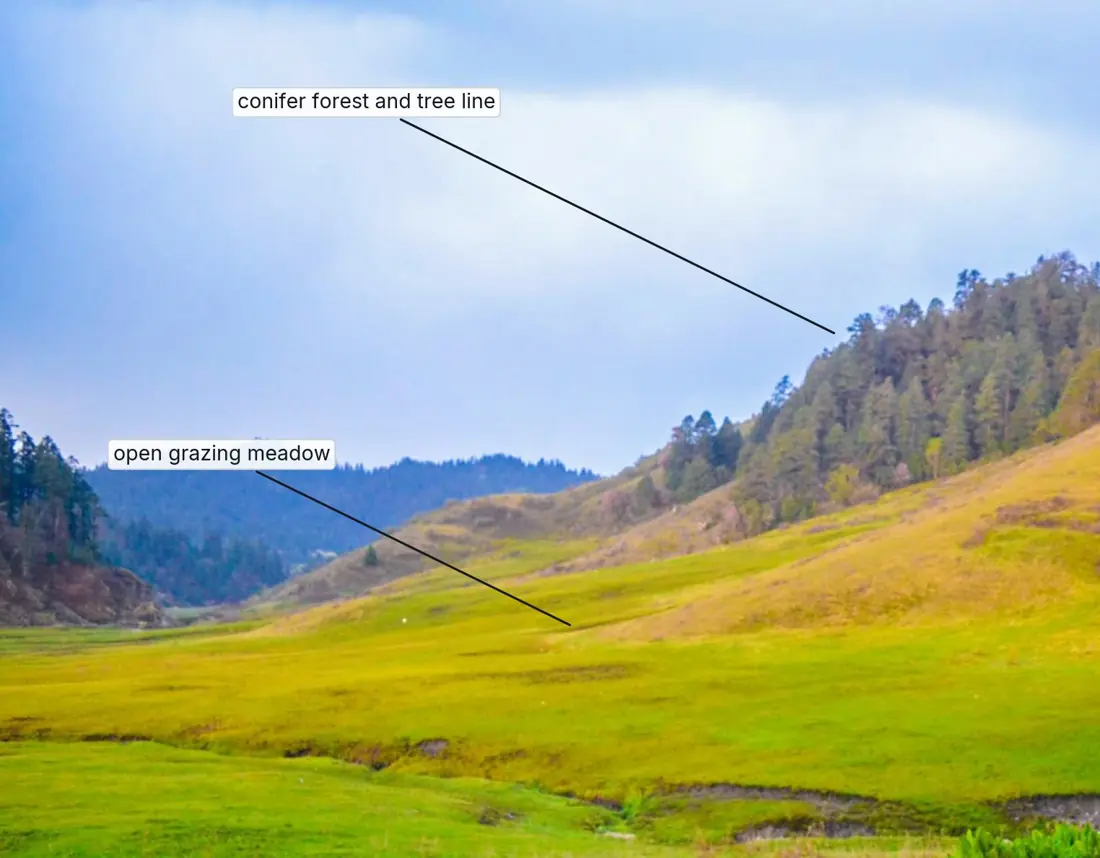
| Subalpine | 3 000–4 000 m | cold, long snow cover | fir Abies spectabilis, birch Betula utilis (bhojpatra), Rhododendron campanulatum, juniper |
| Alpine | 4 000–5 000 m, above the tree line | very cold, short growing season, strong UV | dwarf juniper, cushion plants, tussock grasses, mosses, lichens; no trees |
| Nival | above 5 000 m | permanent snow and ice | snow algae, lichens on rock; no vascular plants |
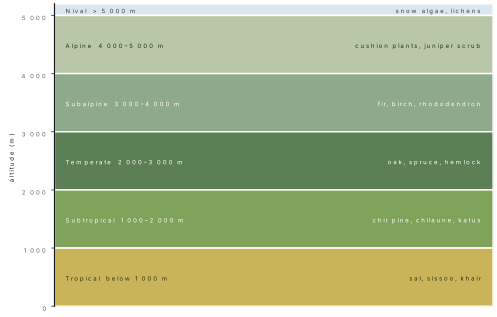
Sal in the Terai, chir pine on the lower hills, oak and rhododendron in the middle, fir and birch above, cushion plants at the top.
Biological invasion
An invasive alien species is a plant or animal moved by humans outside its natural range that then spreads on its own and causes harm. Nepal's roads and disturbed riverbanks give invaders the bare, sunny ground they need, and without their natural enemies they outgrow the native flora.
| Species | Nepali name | Origin | Where it has spread | Why it is a problem |
|---|---|---|---|---|
| Lantana camara | banmara ("forest killer") | tropical America | Chitwan, Bardia, most Terai forests | thorny thickets block sal regeneration; toxic to livestock; replaces fodder |
| Mikania micrantha | mikaniya, "mile-a-minute" | Central and South America | eastern and central Terai, Chitwan | grows centimetres a day, smothers shrubs and saplings |
| Eichhornia crassipes | jal kumbhi | Amazon basin | Phewa, Rupa, Begnas, Terai ponds | mats block boats and nets, cut light and oxygen, kill fish, breed mosquitoes |
| Parthenium hysterophorus | congress grass | tropical America | roadsides, wasteland, Terai fields | pollen and leaf hairs cause dermatitis and rhinitis; allelopathy suppresses crops |
Control is manual removal before flowering, biological control with host-specific insects against Mikania and water hyacinth, and above all keeping the ground covered so invaders cannot establish.
6.4 Ecological succession: hydrosere and xerosere; ecological adaptation
The idea of succession
Ecological succession is the directional change in species composition at one place over time, until a stable community — the climax — is reached. The sequence of communities is a sere; each intermediate community is a seral stage; the first is the pioneer community.
- Primary succession starts on a surface that has never carried vegetation and has no soil — bare rock, a new lava flow, a retreating glacier's moraine, a fresh landslide scar.
- Secondary succession starts where a community has been destroyed but soil and seeds remain — an abandoned field (khoriya), a burnt forest, a cleared hillside. It is much faster because the soil is already made.
A succession that begins in water is a hydrosere; one that begins on dry rock is a xerosere.
The hydrosere, stage by stage
| Stage | Community | What happens |
|---|---|---|
| 1. Phytoplankton | Chlorella, diatoms | open water is colonised; dead cells build an ooze on the bottom |
| 2. Rooted submerged | Hydrilla, Vallisneria | rooted plants trap sediment; the bottom rises |
| 3. Rooted floating | Nymphaea, Nelumbo | broad leaves shade the submerged plants; more humus forms |
| 4. Reed swamp | Typha, Phragmites | water is shallow; tall emergents fill the margin and their litter raises the bed |
| 5. Sedge meadow | Carex, Juncus | the water table falls below the surface; marsh becomes wet meadow |
| 6. Woodland | Salix, Alnus | shrubs and fast-growing trees invade the meadow |
| 7. Climax forest | sal in the Terai, oak in the hills | a closed canopy forms; the community is in equilibrium with the climate |
The xerosere, stage by stage
| Stage | Community | What happens |
|---|---|---|
| 1. Crustose lichen | Graphis, Lecanora | lichens dissolve rock with organic acids and trap wind-blown dust — the first soil |
| 2. Foliose lichen | Parmelia | a deeper mat of organic matter holds moisture |
| 3. Moss stage | Grimmia, Tortula | mosses hold water and add humus; a thin soil forms |
| 4. Herb stage | annual grasses, Selaginella, ferns | roots break the rock further; soil deepens |
| 5. Shrub stage | Berberis, Rubus, Lantana | woody plants shade out the herbs |
| 6. Tree / climax stage | sal, oak or pine according to climate | trees close the canopy; the climax forest is reached |
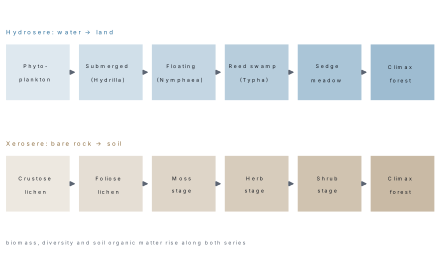
Trends during succession, and the climax
| Feature | Direction from pioneer to climax |
|---|---|
| Biomass and standing crop | increases, then levels off |
| Species diversity | increases, then levels off or falls slightly in a very dense climax |
| Soil depth and organic matter | increases |
| Nutrient cycling | becomes tighter — less leakage, more internal recycling |
| Food webs | become more complex, with more specialised niches |
| Net production | rises at first, then falls; at climax gross production ≈ respiration |
| Stability | increases |
The climax community is the end point: a community in equilibrium with the regional climate, whose species composition stays roughly constant from year to year. F. E. Clements held that every region has one climax set by climate (the monoclimax theory); A. G. Tansley held that soil, fire and grazing can produce several stable end points in one climate (polyclimax). Climate sets the potential; local factors decide which climax is reached.
- Primary succession has no soil at the start. If the stem mentions soil, seeds or a plough, it is secondary.
- The pioneer of a hydrosere is phytoplankton, not a reed. Typha comes at stage 4.
- The pioneer of a xerosere is a crustose lichen, not a moss.
Ecological adaptation
An adaptation is an inherited feature that helps an organism survive in its environment. The examinable sets are the ones named by their habitat:
| Group | Habitat | Adaptations | Examples |
|---|---|---|---|
| Hydrophytes | wholly or partly in water | air spaces (aerenchyma); thin cuticle; stomata on the upper surface or none; weak roots; flexible stems | Hydrilla, Nymphaea, Eichhornia |
| Xerophytes | dry habitats | thick waxy cuticle; sunken stomata; leaves reduced to spines; succulent water-storing stems; deep roots; rolled leaves | Opuntia, Acacia, Euphorbia |
| Epiphytes | on other plants, not parasitic | aerial roots with a velamen that absorbs rain; water-holding leaves; CAM photosynthesis | Vanda, Dendrobium, ferns, mosses on sal trees |
| Halophytes | salty soil | salt glands, succulent leaves, high internal osmotic pressure | mangroves (not in Nepal) |
| Alpine plants | cold, strong UV, short season | cushion or rosette habit, woolly hairs, dark UV-screening pigments, long taproots, rapid flowering | Rhododendron campanulatum, Saussurea |
The Himalayan belt adds dwarf and cushion forms that stay close to the warm ground, hairy or waxy surfaces that cut water loss in the dry winter, and early flowering in the brief snow-free window. Betula utilis at the tree line grows as a stunted, twisted shrub — the same species, a different shape, because the environment sets the form.
Problem. In a Terai fishpond, phytoplankton fix 20{,}000\text{ kJ m}^{-2}\text{ yr}^{-1} of net primary production. In the chain phytoplankton \rightarrow zooplankton \rightarrow small fish \rightarrow kingfisher, how much energy reaches the kingfisher under the 10 % law?
Solution. Three transfers of 10\% (0.1^3 = 10^{-3}) leave 20{,}000 \times 10^{-3} = \mathbf{20\text{ kJ m}^{-2}\text{ yr}^{-1}} at the fourth trophic level (tertiary consumer).
Formula and fact sheet
| Item | Fact |
|---|---|
| GPP, NPP | NPP = GPP − R |
| 10 % law | Lindeman (1942); about 10 % of energy passes to the next level |
| Energy pyramid | always upright; biomass pyramid inverted in a pond; number pyramid inverted on one tree |
| Decomposers | act at every trophic level; not a level of the standard pyramid |
| Mutualism | + + — lichen, Rhizobium–legume, fig–fig wasp |
| Commensalism | + 0 — cattle egret with cattle, epiphytic orchid on a tree |
| Parasitism | + − — Cuscuta (amarbel), Scurrula (liwang) on mango, liver fluke |
| Predation | + − — tiger on chital, ladybird on aphid |
| Competition | − − — two grass species; sal versus Terminalia seedlings |
| Amensalism | 0 − — Penicillium killing bacteria |
| Carbon reservoirs, large to small | carbonate rocks ≫ ocean (≈ 38 000 Gt C) > fossil fuels > soil and biota (≈ 2 000 Gt C) > atmosphere (≈ 900 Gt C) |
| N₂ fixation | Rhizobium (symbiotic), Azotobacter (free-living aerobic), Clostridium (anaerobic), Anabaena/Nostoc (heterocysts), Frankia (alder) |
| Ammonification | Bacillus, Clostridium, fungi |
| Nitrification | NH₄⁺ → NO₂⁻ by Nitrosomonas; NO₂⁻ → NO₃⁻ by Nitrobacter |
| Denitrification | Pseudomonas, Clostridium → N₂ |
| Greenhouse gases | water vapour (largest natural share), CO₂, CH₄ (GWP ≈ 28), N₂O (≈ 265), CFC-12 (≈ 10 900) |
| Natural greenhouse effect | surface at about +15 °C instead of −18 °C |
| Radiative forcing of doubling CO₂ | \Delta F = 5.35\ln 2 = 3.71 W m⁻² |
| Clean rain | pH ≈ 5.6 (dissolved CO₂); acid rain below about 5.0 |
| Acid rain acids | H₂SO₄ from SO₂, HNO₃ from NOₓ |
| Ozone | stratosphere 15–35 km; absorbs UV-B; measured in Dobson units (~300 DU) |
| CFC → ozone | UV splits C–Cl → Cl•; Cl• + O₃ → ClO• + O₂; ClO• + O₃ → Cl• + 2O₂; one Cl destroys ~100 000 O₃ |
| Montreal Protocol | 1987, phase-out of ozone-depleting substances |
| Nepal forest cover | about 45 % of the land |
| Nepal belts | tropical < 1 000 m; subtropical 1 000–2 000 m; temperate 2 000–3 000 m; subalpine 3 000–4 000 m; alpine 4 000–5 000 m; nival above 5 000 m |
| Belt species | sal, sissoo, khair (tropical); chir pine, chilaune, katus (subtropical); oak, spruce, hemlock (temperate); fir, birch (subalpine); cushion plants (alpine) |
| Lapse rate | about 0.6 °C per 100 m of ascent |
| Invasive plants | Lantana camara (banmara), Mikania micrantha, Eichhornia crassipes (jal kumbhi), Parthenium hysterophorus |
| Hydrosere order | phytoplankton → submerged → floating → reed swamp → sedge meadow → woodland → climax forest |
| Xerosere order | crustose lichen → foliose lichen → moss → herb → shrub → tree (climax) |
| Primary vs secondary | no soil, slow / soil and seeds present, fast |
| Climax theories | monoclimax (Clements); polyclimax (Tansley) |
| Succession trends | biomass ↑, diversity ↑, soil organic matter ↑, P/R → 1 at climax |
| Adaptations | hydrophytes (aerenchyma), xerophytes (sunken stomata, spines, succulence), epiphytes (velamen), alpine (cushion habit, hairs) |
Chapter summary
- An ecosystem has a structure (abiotic factors plus producers, consumers and decomposers) and a function (productivity, decomposition, energy flow, nutrient cycling).
- A pond is zoned into littoral, limnetic, profundal and benthic; a forest is layered from canopy to litter.
- Energy flow is unidirectional and follows Lindeman's 10 % law, so food chains are short; the energy pyramid is always upright while number and biomass pyramids can invert.
- Decomposers work at every trophic level and form a detrital pathway, not the apex of the pyramid.
- The six interactions: mutualism (+ +), commensalism (+ 0), parasitism (+ −), predation (+ −), competition (− −), amensalism (0 −).
- In the nitrogen cycle Rhizobium, Azotobacter, Clostridium and Anabaena fix N₂; Nitrosomonas makes nitrite; Nitrobacter makes nitrate; Pseudomonas and Clostridium denitrify.
- Greenhouse gases absorb outgoing infrared; doubling CO₂ forces the climate by 3.71 W m⁻². Acid rain (pH below 5) comes from SO₂ and NOₓ; ozone loss is a chlorine-catalysed chain started by CFCs.
- Nepal runs from tropical sal below 1 000 m through subtropical chir pine, temperate oak and subalpine fir to alpine cushion plants; the four named invaders are Lantana, Mikania, water hyacinth and Parthenium.
- Succession is primary (no soil) or secondary (soil present); the hydrosere begins with phytoplankton and the xerosere with crustose lichens, and both end in a climax forest with high biomass, high diversity and production balanced by respiration.
Practice questions
Set A — Recall (30 questions)
- The law that only about 10 % of the energy at one trophic level passes to the next was proposed byaE. P. OdumbA. G. TansleycR. L. LindemandF. E. Clements
- Organisms that break down dead organic matter into inorganic nutrients are calledadecomposersbprimary consumerscproducersdtertiary consumers
- Which ecological pyramid can never be inverted?apyramid of numbersbpyramid of biomasscpyramid of numbers in a grasslanddpyramid of energy
- The association between the fungus and the alga in a lichen is an example ofacommensalismbmutualismcparasitismdamensalism
- Cattle egrets that follow grazing buffalo in the Terai to catch the insects they disturb showacommensalismbmutualismcpredationdamensalism
- Cuscuta (amarbel) growing over a host shrub is an example ofaepiphytismbsaprophytismcparasitismdcommensalism
- The free-living aerobic nitrogen-fixing bacterium of soil isaNitrosomonasbAzotobactercNitrobacterdPseudomonas
- The conversion of ammonium to nitrite in the nitrogen cycle is carried out byaNitrobacterbRhizobiumcAzotobacterdNitrosomonas
- Nitrate is reduced step by step to nitrogen gas mainly byaNitrosomonasbPseudomonascRhizobiumdNitrobacter
- Among the reservoirs that exchange carbon quickly with the atmosphere, the largest isathe atmospherebliving organismscsoil organic matterdthe ocean
- The gas that contributes the largest share of the natural greenhouse effect isawater vapourbcarbon dioxidecmethanedCFC-12
- Clean rain is slightly acidic, with a pH of about 5.6, mainly because it dissolvesasulphur dioxidebammoniaccarbon dioxidednitrogen oxides
- The thickness of the ozone layer is expressed inapascalsbsievertscdecibelsdDobson units
- Chlorofluorocarbons destroy stratospheric ozone because ultraviolet light releases from themafluorine atomsbchlorine atomsccarbon atomsdhydrogen atoms
- The Montreal Protocol (1987) is an international agreement toareduce greenhouse gas emissions from industrybprotect wetlands of international importancecphase out ozone-depleting substancesdcontrol trade in endangered species
- In Nepal, sal (Shorea robusta) forests are characteristic of theatropical zone below about 1 000 mbtemperate zone at 2 000–3 000 mcalpine zone above 4 000 mdsubalpine zone at 3 000–4 000 m
- Chir pine (Pinus roxburghii) is a characteristic tree of Nepal'saalpine zonebtropical Teraicsubtropical zonednival zone
- Water hyacinth (Eichhornia crassipes), which chokes Nepali lakes, was introduced fromaAfricabSouth AmericacAustraliadEurope
- The pioneer community of a hydrosere isareed swampbsedge meadowcsubmerged plantsdphytoplankton
- The pioneer organisms of a xerosere on bare rock areacrustose lichensbmossescannual herbsdshrubs
- The final stable community of a succession, in equilibrium with the climate, is called theaseral communitybclimax communitycpioneer communitydedaphic community
- Succession that begins on a bare surface with no soil and no seeds isasecondary successionbautogenic successioncprimary successiondallogenic succession
- Lantana camara, called banmara in Nepali, is an example ofaan invasive alien speciesban endemic speciesca rare medicinal plantda nitrogen-fixing tree
- The decomposers of a pond ecosystem are chieflyaphytoplanktonbzooplanktoncfishdbacteria and fungi
- In a forest food chain, the herbivores form theafirst trophic levelbthird trophic levelcsecond trophic leveldfourth trophic level
- The "mile-a-minute" weed that smothers regeneration in Chitwan's forests isaLantana camarabMikania micranthacParthenium hysterophorusdEichhornia crassipes
- Nepal's alpine zone, above the tree line, is dominated byasal and sissoobchir pine and chilaunecoak and spruceddwarf shrubs, cushion plants and grasses
- The greenhouse gas with the highest global warming potential per molecule among these isaCFC-12bcarbon dioxidecmethanednitrous oxide
- Amensalism is a relationship in whichaboth species benefitbone species is harmed and the other is unaffectedcboth species are harmeddone benefits and the other is unaffected
- In a food chain, the proportion of energy transferred from one trophic level to the next is abouta1 %b50 %c10 %d90 %
Answers and explanations — Set A
1. (c) — Lindeman's trophic-dynamic concept (1942) gives the 10 % law. Odum popularised energy-flow diagrams, Tansley coined "ecosystem", Clements gave the monoclimax theory.
2. (a) — Decomposers (saprotrophs) are bacteria and fungi that digest dead matter outside their bodies and release inorganic nutrients. Consumers eat living or recently dead material; producers make their own food.
3. (d) — The energy pyramid is always upright because energy is lost as heat at every transfer. Number and biomass pyramids can invert (many insects on one tree; phytoplankton smaller than zooplankton).
4. (b) — The alga photosynthesises and the fungus supplies water, minerals and shelter; both benefit, so the signs are + +. Neither is harmed, so it is not parasitism.
5. (a) — The egret gains food (+); the buffalo is neither helped nor harmed (0). This is the standard + 0 example of commensalism.
6. (c) — Cuscuta has no chlorophyll and draws food through haustoria pushed into the host's vascular tissue; the host loses, the parasite gains.
7. (b) — Azotobacter is a free-living aerobic fixer. Rhizobium is symbiotic, Clostridium is anaerobic, and Nitrosomonas nitrifies rather than fixes.
8. (d) — Nitrosomonas oxidises NH₄⁺ to NO₂⁻. Nitrobacter carries out the next step, NO₂⁻ to NO₃⁻.
9. (b) — Pseudomonas (with Clostridium) reduces nitrate through nitrite and N₂O to N₂. This is denitrification, a loss of nitrogen from the soil.
10. (d) — The ocean holds about 38 000 Gt C as dissolved inorganic carbon, against about 900 Gt C in the atmosphere and about 2 000 Gt C in soil and living matter.
11. (a) — Water vapour accounts for the largest share of the natural greenhouse effect, though it is not directly controlled by human emissions.
12. (c) — CO₂ dissolves to form weak carbonic acid, giving a natural pH near 5.6. SO₂ and NOₓ push it below about 5.0 in polluted air.
13. (d) — One Dobson unit is 0.01 mm of ozone at standard temperature and pressure; the normal column is about 300 DU.
14. (b) — UV-C breaks the C–Cl bond and releases a chlorine radical, which then attacks ozone catalytically. The C–F bond is too strong to break at these wavelengths.
15. (c) — Montreal (1987) phased out CFCs and other ozone-depleting substances. The climate treaty is Kyoto/Paris, the wetland treaty is Ramsar, and species trade is CITES.
16. (a) — Sal is the dominant tree of the Terai and inner Terai below about 1 000 m, where the monsoon is heavy and the winter mild.
17. (c) — Chir pine dominates the warm, dry slopes of the mid-hills between about 1 000 and 2 000 m, often on south-facing slopes.
18. (b) — Water hyacinth is native to the Amazon basin and was spread worldwide as an ornamental. It now mats the surfaces of Phewa, Rupa and Begnas.
19. (d) — Open water is first colonised by phytoplankton; their dead cells start the ooze that eventually fills the pond.
20. (a) — Crustose lichens are the only organisms that can hold on to bare rock and begin to dissolve it; mosses need the thin soil the lichens create.
21. (b) — The climax community is stable and in equilibrium with the regional climate. A seral community is any intermediate stage.
22. (c) — Primary succession starts where no soil exists. Secondary succession starts after a disturbance that leaves soil and seeds behind.
23. (a) — Lantana was brought from tropical America as an ornamental and has become a thicket-forming invader of Terai forests; "banmara" means forest killer.
24. (d) — Bacteria and fungi in the bottom mud break down the organic matter that settles. Phytoplankton are producers and zooplankton are consumers.
25. (c) — Producers occupy the first trophic level and herbivores the second. The third level holds the carnivores that eat the herbivores.
26. (b) — Mikania micrantha can grow several centimetres a day, hence "mile-a-minute"; it blankets shrubs and young trees. Lantana is a thorny shrub, not a vine.
27. (d) — Above the tree line the growing season is too short for trees, so the flora is dwarf juniper, cushion plants, tussock grasses, mosses and lichens.
28. (a) — CFC-12 has a 100-year global warming potential of about 10 900, against about 265 for N₂O, 28 for methane and 1 for CO₂.
29. (b) — In amensalism one partner is harmed and the other is unaffected (0 −), as when Penicillium kills bacteria with penicillin.
30. (c) — Lindeman's figure is about 10 %; the other 90 % is lost mainly as heat in respiration, which is why food chains are short.
Set B — Understanding (18 questions)
- A pyramid of numbers is inverted inaa grasslandba single large tree carrying thousands of insectsca pond full of phytoplanktonda maize field
- Energy flow in an ecosystem is described as unidirectional becauseaenergy is recycled by decomposersbenergy passes only through herbivorescenergy is stored as biomassdheat lost at each level cannot be used again by producers
- Decomposers are not placed at the top of an energy pyramid because theyatake energy from every level and release it as heat by a detrital pathwaybare too small to countcare producersddo not respire
- Two grass species in one field need the same light, water and nitrogen. Their relationship isamutualismbcommensalismccompetitiondparasitism
- A Penicillium mould releases a substance that kills bacteria around it while the mould is unaffected. This isaparasitismbpredationccommensalismdamensalism
- Lentil and chickpea enrich the soil because Rhizobium in their root nodulesadecomposes dead rootsbreduces atmospheric N₂ to ammonia using nitrogenasecoxidises nitrate to nitrogen gasdconverts ammonia to nitrite
- A farmer keeps a paddy field flooded instead of draining it. This reduces nitrogen loss because floodingaincreases nitrogen fixationbprevents ammonificationcstops the conversion of ammonium to nitrate, which would then be denitrifieddstops nitrate uptake by rice
- Greenhouse gases warm the surface because theyaabsorb outgoing long-wave infrared radiation and re-radiate part of it backbabsorb incoming ultraviolet radiationcreflect short-wave radiation from the Sundstop conduction from the ground
- Acid rain kills fish in poorly buffered mountain lakes mainly byaheating the waterbadding nutrients that cause algal bloomsclowering the pH and releasing toxic aluminium ions from the soildraising the dissolved oxygen
- One chlorine atom can destroy thousands of ozone molecules because chlorine acts asaa reactant that is used upba catalyst that is regenerated in the cycleca solventdan oxidising agent that is consumed
- The Antarctic ozone hole appears in spring becauseathe Sun is brightest over the pole thenbmost CFCs are made in Antarcticacvolcanic ash destroys ozonedice crystals in polar clouds turn stored chlorine into active forms
- A glacier-fed river in Nepal now peaks earlier in summer than it did fifty years ago. The most likely cause isaearlier snowmelt and glacier retreat under a warming climateban increase in winter snowfallca decrease in monsoon rainfalldtectonic uplift of the Himalaya
- After a landslide strips a Himalayan slope to bare rock, the first colonists are likely to beasal seedlingsblichens and mossesctall grassesdoak saplings
- During succession from an open pond to a forest, total biomass and species diversity generallyaboth decreasebstay constantcboth increasedrise and then fall to zero
- Mikania micrantha threatens Chitwan's sal forest mainly because itagrows over and smothers native shrubs and regenerationbis a root parasite of salcpoisons the soil with heavy metalsdattracts elephants that fell trees
- The biomass of phytoplankton in a pond is often less than that of the zooplankton feeding on it. This is possible becauseazooplankton also photosynthesisebphytoplankton are decomposerscthe energy pyramid is inverteddphytoplankton divide fast, so a small crop supports a large consumer biomass
- Forests matter in the carbon cycle mainly because theyarelease CO₂ during photosynthesisbprevent nitrogen fixationcstore carbon in wood and soil and remove CO₂ from the airdconvert carbon into nitrogen
- A xerosere differs from a hydrosere in that a xerosereastarts dry and soil-less, and depends on lichens to make the first soilbstarts in open waterchas no pioneer stagedalways ends in a grassland
Answers and explanations — Set B
1. (b) — One tree, a single producer, supports thousands of herbivores, so the base is narrow. Option (c) is an inverted biomass pyramid, not a numbers one.
2. (d) — Heat cannot be captured again by a producer; matter cycles because it is not degraded in this way.
3. (a) — They feed on litter, dung and corpses from every level, so they cannot be stacked in one tier.
4. (c) — Both lose (− −) because each takes what the other needs.
5. (d) — Bacteria harmed (−), mould unaffected (0): amensalism.
6. (b) — Nitrogenase in the nodule reduces N₂ to NH₃, which the plant then assimilates.
7. (c) — Nitrification needs oxygen, so in a flooded field ammonium is not converted to nitrate; with little nitrate present, the denitrifiers have nothing to reduce. Draining lets ammonium nitrify, and the nitrate is then lost as N₂ or by leaching.
8. (a) — The gases absorb the surface's infrared and re-radiate part of it downwards; they do not reflect sunlight.
9. (c) — H⁺ displaces Al³⁺ from soil particles, and the aluminium coating the gills kills the fish.
10. (b) — Cl is regenerated each cycle (Cl• + O₃ → ClO• + O₂; ClO• + O₃ → Cl• + 2O₂), so one atom destroys about 100 000 molecules.
11. (d) — Polar stratospheric clouds form only in the polar night; reactions on them free active chlorine, which acts when sunlight returns.
12. (a) — Warmer air melts the snowpack earlier and shrinks the glaciers, so the peak arrives sooner and late-summer flow falls.
13. (b) — A landslide scar has no soil and no seeds: a primary site, where lichens and mosses must make the first soil.
14. (c) — Biomass accumulates and more niches appear, so both rise and then level off.
15. (a) — It is a fast vine that blankets shrubs and saplings and cuts their light; it is not a parasite.
16. (d) — Phytoplankton are eaten as fast as they divide, so a small standing crop supports a larger biomass of longer-lived zooplankton.
17. (c) — Growing trees remove CO₂ and lock the carbon in wood and soil, so a standing forest is a carbon sink.
18. (a) — A xerosere starts on dry, soil-less rock and is built by lichens; a hydrosere starts in water.
Set C — Application (12 questions)
- In a grassland the producers fix 20 000 kJ of energy in a year. If the 10 % law holds at each step, the energy available to the secondary consumers isa2 000 kJb1 000 kJc100 kJd200 kJ
- A food chain is grass → grasshopper → frog → snake → hawk. If the hawk receives 10 kJ, the energy fixed by the grass was abouta10 000 kJb100 000 kJc1 000 kJd1 000 000 kJ
- A lake beside farmland receives heavy fertiliser runoff. Algae bloom, then die, and fish die. The oxygen sequence isaoxygen rises in the bloom by day, then falls as decomposers use itboxygen falls at once and stays lowcoxygen is unchangeddoxygen rises permanently
- A student counts 1 000 000 phytoplankton, 200 000 zooplankton, 2 000 small fish and 5 large fish in a pond. The pyramid of numbers from these data isainverted at the basebspindle-shapedcuprightdinverted at the top
- In a legume field Rhizobium fixes 20 kg of N₂ per hectare per year; 5 kg is lost by denitrification and 3 kg by leaching. The nitrogen added to the soil isa28 kgb12 kgc20 kgd8 kg
- A forest is cleared and then abandoned. Forty years later a young forest stands on the site. This isaprimary successionba hydrosereca xeroseredsecondary succession
- In a pond the sequence phytoplankton → zooplankton → small fish → kingfisher is aagrazing food chainbdetrital food chaincfood webdparasitic chain
- The Terai lies below 300 m, the mid-hills reach 2 500 m and the tree line is near 4 000 m. A forest of oak, rhododendron and spruce at 2 600 m belongs to theatropical zonebalpine zonectemperate zonedsubtropical zone
- Using \Delta F = 5.35\ln(C/C_0), the radiative forcing when CO₂ rises from 280 ppm to 560 ppm isa5.35 W m⁻²b1.50 W m⁻²c7.40 W m⁻²d3.71 W m⁻²
- A 1 000 ha forest stores 120 t of carbon per hectare. If a fire destroys half of it, the CO₂ released is about (1 t C = 3.67 t CO₂)a220 000 tb120 000 tc60 000 td440 000 t
- A river receives effluent at pH 3; downstream its pH is 5. The hydrogen-ion concentration hasaincreased 100 timesbdecreased 2 timescdecreased 100 timesddecreased 1 000 times
- A crop field is abandoned. Annual weeds appear in year 1, grasses dominate by year 3, shrubs by year 10 and a sal forest by year 40. Biomass and soil organic matteraboth fallbboth risecbiomass rises while soil organic matter fallsdbiomass falls while soil organic matter rises
Answers and explanations — Set C
1. (d) — 20 000 → 2 000 (primary) → 200 kJ (secondary). Two steps multiply by 0.01.
2. (b) — Four transfers separate grass from hawk: 10 × 10⁴ = 100 000 kJ. Option (a) allows only three.
3. (a) — The bloom raises oxygen by day, but when the algae die the bacteria decomposing them strip it and the fish suffocate — eutrophication.
4. (c) — Each level has fewer individuals (10⁶ > 2 × 10⁵ > 2 000 > 5), so the pyramid is upright.
5. (b) — 20 − 5 − 3 = 12 kg N per hectare per year.
6. (d) — Soil and a seed bank survived, so recolonisation is fast; primary succession on bare rock takes centuries.
7. (a) — The chain begins with a living producer: a grazing (predator) chain. A detrital chain begins with dead matter.
8. (c) — 2 600 m is in the temperate belt (2 000–3 000 m), where oak, rhododendron and spruce dominate.
9. (d) — \Delta F = 5.35 \ln 2 = 5.35 \times 0.693 = 3.71 W m⁻²; the forcing depends on the ratio, not the absolute concentrations.
10. (a) — 1 000 × 120 × 0.5 = 60 000 t C; × 3.67 ≈ 220 000 t CO₂.
11. (c) — pH 3 is 10⁻³ mol L⁻¹ and pH 5 is 10⁻⁵ mol L⁻¹: a fall by a factor of 100.
12. (b) — Biomass accumulates in the trees and soil organic matter from litter, so both rise.