Chapter 13 · Plant Physiology · 1 question in the paper · 23 min read
Plant Growth, Germination and Dormancy
What the syllabus asks for 2
- Auxins, gibberellins and cytokinins: roles and applications
- Seed germination and its types; seed dormancy
The smallest chapter in the Botany paper — 1 of the 40 Botany questions — and a gift for the prepared student, because its territory is tightly fenced: the three growth promoters (auxins, gibberellins, cytokinins) with their discovery stories and farm applications, the types of seed germination (epigeal, hypogeal, vivipary), and the causes and cures of seed dormancy. One question, drawn from a short list of named people, named chemicals and named examples — learn the list below and the mark is banked.
- Auxin — IAA (from tryptophan; shoot apex, young leaves); Darwin → Boysen-Jensen → Paál → Went experiments; Avena curvature bioassay; polar basipetal transport; elongation, apical dominance, rooting, parthenocarpy; IBA/NAA rooting, 2,4-D dicot-selective weedicide; bell-shaped dose–response (shoot optimum inhibits roots).
- Gibberellin — bakanae (foolish seedling) disease, Gibberella fujikuroi, Kurosawa; internode elongation (dwarf rescue), bolting, dormancy breaking, aleurone α-amylase in malting, grape enlargement.
- Cytokinin — kinetin (Miller and Skoog, 1955, autoclaved herring sperm DNA); zeatin (Letham, 1963, maize); root apex source, xylem transport; cell division (with auxin), lateral buds, Richmond–Lang delay of senescence; auxin : cytokinin ratio decides roots vs shoots in culture.
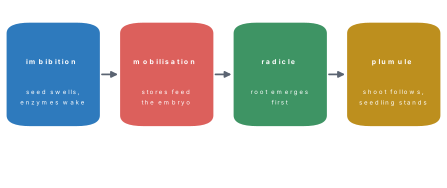
- Germination — imbibition first, then enzyme activation, radicle out before plumule; needs water, oxygen, suitable temperature (light for photoblastic seeds); GA → aleurone → α-amylase mobilises endosperm.
- Types — epigeal (hypocotyl lifts cotyledons: bean, castor, sunflower); hypogeal (cotyledons stay below: pea, maize, mango); vivipary (mangroves: Rhizophora).
- Dormancy vs quiescence — dormant seeds fail even under favourable conditions; causes: hard impermeable coat, immature embryo, ABA/inhibitors, light requirement; cures: scarification, stratification (moist chilling), light, gibberellin, leaching; controlled by the ABA : GA balance.
13.1 Auxins, gibberellins and cytokinins: roles and applications
A plant hormone (phytohormone, growth regulator) is an organic substance made in tiny amounts in one part of the plant and transported to act elsewhere. The syllabus names the three great promoters; the inhibitor abscisic acid (ABA) enters through dormancy, where it belongs.
Auxins
The principal natural auxin is indole-3-acetic acid (IAA), made from the amino acid tryptophan mainly in the shoot apical meristem, young leaves and developing seeds. Its discovery is a chain of four classic experiments the paper loves:
- Charles and Francis Darwin (1880) — a covered coleoptile tip no longer bends towards light: the tip perceives light, bending happens below, so an "influence" travels down.
- Boysen-Jensen (1913) — the tip replaced on gelatin still works: the influence is a diffusible chemical.
- Paál (1918) — an off-centre tip in darkness still bends the stump: the chemical itself causes curvature.
- Went (1926–28) — the chemical collected into agar blocks bends decapitated Avena coleoptiles in proportion to concentration: he named it auxin, and the Avena curvature test became its bioassay.
Auxin travels by polar (basipetal) transport, cell to cell from tip to base. Roles: cell elongation (acid growth in coleoptiles and young stems); apical dominance — auxin from the apex suppresses axillary buds, which is why pinching out a tea bush's tip makes it branch; root initiation on cuttings; preventing premature leaf and fruit fall; and, at fruit set, parthenocarpy (seedless fruit without fertilisation). Applications: the synthetics IBA and NAA as rooting powders, NAA sprays to stop pre-harvest fruit drop, auxin-induced seedless cucumbers and tomatoes, and 2,4-D as a selective weedicide that kills broad-leaved dicots while sparing cereals.
Auxin's dose–response is bell-shaped and roots are about a thousand times more sensitive than shoots: the concentration that best elongates a stem (about 10⁻⁵ M) inhibits roots, which are promoted only near 10⁻¹⁰–10⁻⁸ M. "Auxin promotes growth" is only half a sentence — and it is why over-applied 2,4-D twists and kills.
Gibberellins
Over 130 are known; gibberellic acid (GA₃) is the famous one. The story starts with bakanae, the "foolish seedling" disease of rice — infected plants shoot up tall, pale and spindly, then collapse. Kurosawa (1926) showed a cell-free filtrate of the fungus Gibberella fujikuroi reproduced the symptoms; Yabuta and Sumiki (1938) crystallised the active substance.
Roles: internode elongation — a GA-sprayed dwarf pea reaches normal height, the classic proof it replaces a missing hormone; bolting, the sudden stem elongation of rosette plants (cabbage, beet) before flowering; breaking seed and bud dormancy; switching on the aleurone in germinating barley (below); delaying senescence in citrus. Applications: spraying Thompson Seedless grapes to enlarge berries and loosen bunches; boosting α-amylase in the malting of barley for beer and jaand chhyang-type fermentations; uniform germination of dormant seed lots.
Cytokinins
Miller and Skoog (1955) isolated kinetin from autoclaved herring sperm DNA — an artefact of DNA breakdown, not a natural plant product. The first true natural cytokinin was zeatin, from the milky endosperm of maize (Letham, 1963). Cytokinins are adenine derivatives made chiefly in the root apex and carried up in the xylem.
Roles: promotion of cell division (cytokinesis) — but only together with auxin; breaking bud dormancy and releasing lateral buds from apical dominance (the counterweight to auxin); and delaying leaf senescence, the Richmond–Lang effect (a detached leaf with a cytokinin-treated patch stays green there while the rest yellows). Applications: tissue culture media, keeping cut greens and flowers fresh, and promoting branching.
In culture, the auxin : cytokinin ratio (Skoog and Miller, 1957) decides the callus's fate — high auxin → roots; high cytokinin → shoots; balanced → callus. It is the most commonly inverted fact in the chapter; do not be the student who inverts it.
| Hormone | Chemical nature | Main source | Signature functions |
|---|---|---|---|
| Auxin (IAA) | indole (from tryptophan) | shoot apex, young leaves | elongation, apical dominance, rooting |
| Gibberellin (GA₃) | diterpenoid acid | embryo, young leaves, roots | internode elongation, bolting, germination |
| Cytokinin (zeatin) | adenine derivative | root apex | cell division, bud release, anti-senescence |
| Abscisic acid | apocarotenoid | leaves, roots, seeds | dormancy, stomatal closure (Unit 11) |
Match the horticultural task to the treatment, asking what each hormone does:
- Root this rose cutting quickly — an auxin (IBA/NAA) dip: auxins initiate adventitious roots.
- Get seedless (parthenocarpic) grapes with larger berries — gibberellin spray at flowering (auxins also help set parthenocarpic fruit, e.g. tomato).
- Keep harvested leafy vegetables green longer — cytokinin: it delays senescence by holding back protein/chlorophyll breakdown.
- Make a "dwarf" rosette cabbage bolt and flower — gibberellin, which overcomes genetic dwarfism by elongating internodes.
- Kill broad-leaved weeds in a wheat field without harming the wheat — a high dose of the synthetic auxin 2,4-D: dicot weeds over-grow and die; the monocot crop is little affected.
Each answer falls out of the hormone's basic action — never memorise the pairings blindly.
Auxin is a growth promoter at low concentration and a herbicide (2,4-D) at high concentration — the dose decides. Two more swaps to guard: ethylene ripens fruit and promotes abscission, while ABA is the stress/dormancy hormone that closes stomata and antagonises gibberellin in seeds.
Problem. In a germination trial, 80 of 100 sown seeds produce seedlings. A seedling's dry mass rises from 0.5 g to 4.0 g over six days of feeding itself on reserves. What is the germination percentage, and how many doublings does the mass curve represent? Solution. Germination = 80 ÷ 100 = 80 % — the trial's headline number. Mass ratio = 4.0 ÷ 0.5 = 8 = 2³, so three doublings in six days: a doubling time of two days, the geometric signature of growth by cell division — arithmetic growth (a constant addition per day) would look linear instead of explosive, and seedlings are exponential until reserves or space say otherwise.
13.2 Seed germination and its types; seed dormancy
Germination is the resumption of active growth of the embryo, ending when the seed coat ruptures and a root and shoot emerge. It runs in three steps. First, imbibition — the dry seed drinks by matric force (Unit 11) and swells. Then activation: respiration climbs, enzymes are switched on and stored food is mobilised. Finally the radicle emerges first (anchoring and drinking), protected by the coleorhiza in grasses, and the plumule follows, hooded by the coleoptile in monocots. Given viability, germination needs water, oxygen (for the aerobic respiration that powers growth — rice is the famous partial exception, its coleoptile elongating under floodwater) and a suitable temperature. Some seeds additionally need light — positive photoblastic seeds such as lettuce (red light via phytochrome promotes, far-red inhibits) — and a few, such as Nigella, need darkness.
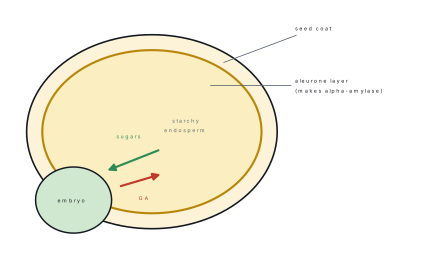
The star mechanism is hormonal. The hydrated cereal embryo releases gibberellin, which diffuses to the living aleurone layer around the starchy endosperm; there it switches on synthesis of α-amylase and other hydrolases, which digest the endosperm's starch to sugars that feed the growing embryo. Gibberellin here is the embryo's messenger to its pantry — and ABA blocks the message, which is the chemistry of dormancy.
Types of germination
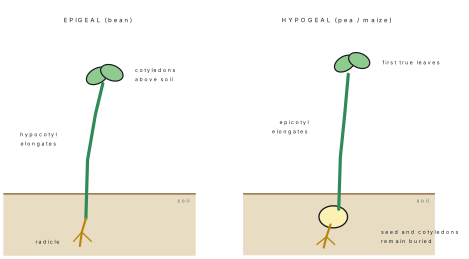
- Epigeal germination — the hypocotyl elongates and hoists the cotyledons above the soil, where they may green and photosynthesise briefly: bean (Phaseolus), castor, sunflower, mustard.
- Hypogeal germination — the epicotyl elongates and the cotyledons stay below ground, still inside the seed: pea, maize, gram, mango.
- Vivipary (viviparous germination) — the seed germinates while the fruit is still on the parent, the radicle growing out before the propagule drops: the mangroves Rhizophora and *Ceriops*, so the seedling spears into the tidal mud already rooted.
Seed dormancy
A quiescent seed is merely waiting for water and warmth. A dormant seed fails to germinate even under favourable conditions because of a block inside itself. The causes:
- Hard, impermeable seed coat barring water or oxygen (many legumes, lotus).
- Immature embryo that must finish developing after shedding (morphological dormancy; many orchids, Ginkgo).
- Physiological inhibition — ABA and other inhibitors (coumarin, ferulic acid) hold the embryo back; the seed needs after-ripening — time, often moist cold, during which the ABA : GA balance tips towards GA.
- Light or temperature requirements (photoblastic seeds; species needing winter chill).
The corresponding cures, all used in nurseries and seed testing:
- Scarification — nicking, abrading or brief acid treatment of hard coats.
- Stratification — weeks of moist chilling (apple, peach and many temperate seeds).
- Light exposure (or darkness) for photoblastic seeds; alternating temperatures for others.
- Gibberellin application, which can substitute for the cold or light requirement; leaching inhibitors out with running water.
Dormancy is not failure — it is timing. It stops seeds germinating on the parent or in a brief warm spell before winter, spreads germination across years (the soil seed bank), and lets seeds survive dispersal and drought; sacred lotus seeds have germinated after an estimated thousand years. In agriculture the balance matters both ways: too little dormancy gives wheat sprouting in the ear during a wet monsoon harvest; too much gives uneven nursery stands.
If the cotyledons rise above the soil (hypocotyl elongates), germination is epigeal: bean, castor, sunflower, mustard. If they stay below ground (epicotyl elongates), it is hypogeal: pea, gram, maize, mango. The classic wrong pairing is bean — students invert it. Two neighbours: vivipary is germination while still on the mother plant (mangroves, e.g. Rhizophora), and dormancy is broken by scarification (hard coat), stratification (cold requirement) or gibberellin treatment.
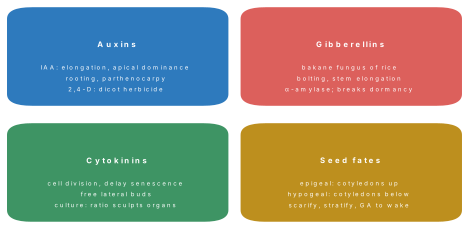
Four pairs the paper swaps: auxin elongates cells and holds apical dominance; gibberellin elongates stems and bolts rosettes — both "elongate", different actors; epigeal lifts cotyledons (hypocotyl grows), hypogeal leaves them below (epicotyl grows); dormancy refuses suitable conditions, quiescence merely lacks them; and in tissue culture auxin makes roots, cytokinin makes shoots — the ratio, inverted in every student's first answer.
Problem. Lettuce seeds receive a sequence of flashes: R – FR – R – FR – R, then are kept in the dark. Do they germinate? And in a callus medium, what auxin-to-cytokinin ratio induces shoot buds?
Solution. Germination depends only on the last flash: because the final flash is red (R, 660 nm), P_r is converted to active P_{fr} and the seeds germinate. In Skoog–Miller callus culture, a low auxin : high cytokinin ratio induces shoot morphogenesis (caulogenesis).
Formula and fact sheet
- Auxin chain: Darwin (tip senses light) → Boysen-Jensen (diffusible) → Paál (chemical bends in dark) → Went (auxin, Avena curvature bioassay). IAA from tryptophan; polar basipetal transport.
- Auxin jobs: elongation, apical dominance, rooting (IBA, NAA), parthenocarpy, prevent fruit drop; 2,4-D kills dicot weeds in cereals; shoot optimum ≈10⁻⁵ M inhibits roots.
- GA: bakanae disease, Gibberella fujikuroi, Kurosawa 1926, Yabuta and Sumiki 1938; bolting, dwarf rescue, dormancy breaking, aleurone α-amylase, grapes/malting.
- Cytokinin: kinetin (Miller and Skoog 1955, herring sperm DNA), zeatin (Letham 1963, maize); root apex → xylem; division with auxin; Richmond–Lang anti-senescence.
- Culture ratio: high auxin = roots, high cytokinin = shoots, balanced = callus (Skoog and Miller 1957).
- Germination: imbibition → activation → radicle out first; needs water, O₂, suitable temperature; lettuce needs red light; embryo GA → aleurone → α-amylase → sugars.
- Types: epigeal = hypocotyl lifts cotyledons (bean, castor, sunflower); hypogeal = epicotyl rises, cotyledons buried (pea, maize, mango); vivipary = Rhizophora.
- Dormancy: dormant ≠ quiescent; causes hard coat, immature embryo, ABA/inhibitors, light/chill demands; cures scarification, stratification, light, GA, leaching; ABA : GA balance decides.
Rapid-revision tables and high-yield facts
| Item | Value |
|---|---|
| Natural auxin | IAA; Went's Avena test |
| Synthetic auxin herbicide | 2,4-D (dicot-selective) |
| Gibberellin source | Gibberella fujikuroi, bakane disease of rice |
| GA signatures | bolting, α-amylase in aleurone, breaks dormancy |
| Cytokinins | cell division, delay senescence; culture ratio |
| Culture ratio | high auxin → roots; high cytokinin → shoots |
| Germination needs | water, O₂, temperature, viable seed |
| First out | radicle |
| Epigeal / hypogeal | hypocotyl lifts cotyledons / epicotyl rises alone |
| Vivipary | Rhizophora: germination on the parent |
| Breaking dormancy | scarification, stratification (0–5 °C), light, GA |
| Brake and accelerator | ABA holds dormancy, GA releases it |
Chapter summary
- Auxin (IAA) was hunted down through the Darwin–Boysen-Jensen–Paál–Went experiments; it elongates cells, enforces apical dominance, roots cuttings and, as 2,4-D, selectively kills dicot weeds — always with a bell-shaped, tissue-specific dose response.
- Gibberellins, discovered through the bakanae fungus, elongate internodes (curing genetic dwarfs), bolt rosettes, break dormancy and order the aleurone to make α-amylase.
- Cytokinins (kinetin, then natural zeatin from maize) drive cell division with auxin, free lateral buds, and delay senescence; the auxin : cytokinin ratio steers tissue culture between roots, shoots and callus.
- Germination begins with imbibition, is powered by aerobic respiration, and is fed when embryo gibberellin switches on the aleurone; the radicle leads the way out.
- Hypocotyl growth lifts the cotyledons in epigeal species (bean, castor), epicotyl growth leaves them buried in hypogeal ones (pea, maize), and mangroves skip the wait by vivipary.
- Dormant seeds refuse even perfect conditions because of impermeable coats, unfinished embryos or ABA-based inhibition; scarification, stratification, light, gibberellin and leaching remove the blocks nature uses to time germination.
Practice questions
Set A — Recall (20 questions)
- The principal natural auxin in plants isa2,4-Dbindole-3-acetic acid (IAA)cNAAdkinetin
- Auxin is synthesised in largest amounts in theamature leavesbshoot apex and young leavescroot capdbark
- The Avena coleoptile curvature bioassay for auxin was developed byaDarwinbBoysen-JensencWentdKurosawa
- Apical dominance — suppression of lateral buds by the shoot tip — is maintained byacytokininbgibberellincabscisic aciddauxin
- 2,4-D is widely used as aaselective weedicide against broad-leaved dicot weedsbfungicidecfertiliserdripening agent
- Gibberellins were discovered through the study of which disease?alate blight of potatobbakanae (foolish seedling) disease of ricecrust of wheatdmosaic of tobacco
- The rapid stem elongation of rosette plants before flowering, induced by gibberellin, is calledavernalisationbabscissioncetiolationdbolting
- Kinetin, the first cytokinin found, was isolated by Miller and Skoog fromacoconut milkbmaize endospermcautoclaved herring sperm DNAdrice seedlings
- The first natural cytokinin, zeatin, was isolated fromacoconutbmaizectobaccodyeast
- Cytokinins are synthesised mainly in thearoot apexbmature seedcflowerdold leaves
- The Richmond–Lang effect is the delay of leaf senescence caused byaauxinbABAcethylenedcytokinin
- The first physical step in seed germination isaimbibition of waterbphotosynthesiscfloweringdfruit ripening
- During germination, the part of the embryo that emerges first is theaplumulebcotyledonccoleoptiledradicle
- Epigeal germination, in which cotyledons come above the soil, is shown byapeabmaizecmangodbean
- Hypogeal germination, in which cotyledons remain underground, is shown byacastorbsunflowercpeadmustard
- Viviparous germination is characteristic ofaRhizophorabpeacwheatdmustard
- In a germinating barley grain, α-amylase is produced by the aleurone layer in response toaauxinbgibberellinccytokinindABA
- Seed dormancy is primarily induced and maintained byagibberellinbcytokinincabscisic acid (ABA)dauxin
- Dormancy due to a hard, impermeable seed coat is broken byascarificationbvernalisationcphotoperioddpruning
- The moist-chilling treatment used to break dormancy of temperate seeds is calledascarificationbstratificationcvernalisationdafter-ripening in sun
Answers and explanations — Set A
1. (b) — IAA, derived from tryptophan; 2,4-D and NAA are synthetics, kinetin a cytokinin.
2. (b) — Young apical tissues and developing seeds are the auxin factories; transport is polar, downwards.
3. (c) — Went (1926–28) collected the growth substance in agar and measured curvature against dose.
4. (d) — Auxin exported from the apex holds axillary buds in check; removing the tip releases them.
5. (a) — At herbicide doses the synthetic auxin forces fatal, disorganised growth in dicots while cereals tolerate it.
6. (b) — Gibberella fujikuroi makes infected rice grow foolishly tall; Kurosawa traced it to a fungal chemical.
7. (d) — Gibberellin-driven internode extension lifts the flowers of cabbage and beet out of the rosette.
8. (c) — Kinetin is a breakdown artefact of heated DNA; it revealed the cytokinin class.
9. (b) — Letham (1963) isolated zeatin from immature maize kernels — hence Zea in the name.
10. (a) — Root tips are the main source; xylem sap carries cytokinins up to the shoot.
11. (d) — Cytokinin keeps treated leaf areas green and synthesising protein long after controls yellow.
12. (a) — Matric imbibition rehydrates the seed before metabolism can restart.
13. (d) — The radicle anchors and drinks first; the plumule follows under protection.
14. (d) — In bean the hypocotyl hook pulls the cotyledons into the air.
15. (c) — In pea the epicotyl grows and the cotyledons stay within the buried seed.
16. (a) — Mangrove propagules germinate on the parent and drop ready to spear into the mud.
17. (b) — Embryo-derived GA is the signal; ABA antagonises it, the molecular seesaw of dormancy.
18. (c) — ABA imposed during seed maturation enforces dormancy until conditions or time remove it.
19. (a) — Nicking or abrading the coat admits the water it was excluding.
20. (b) — Stratified (layered in moist cold medium) apple and peach seeds then germinate promptly.
Set B — Understanding (12 questions)
- A concentration of auxin that strongly promotes stem elongation inhibits root growth becausearoots lack auxin receptorsbauxin cannot enter rootscthe dose–response is bell-shaped and roots have a far lower optimumdroots destroy auxin
- Pinching out the tip of a tea bush makes it bushy because removing the apex removes the source ofaauxin that was suppressing the lateral budsbcytokinincfood supplydgibberellin
- To regenerate shoots from a callus in tissue culture, the medium should containahigh auxin and low cytokininbhigh cytokinin and low auxincno hormonesdonly gibberellin
- A genetically dwarf pea sprayed with gibberellin grows to normal height, showing that the dwarf plant lacks the ability toamake (or respond with) sufficient gibberellin for internode elongationbabsorb watercphotosynthesisedmake auxin
- A dormant seed differs from a quiescent seed in that the dormant seedais deadblacks an embryocfails to germinate even when given favourable conditionsdhas no stored food
- Lettuce seeds kept in darkness fail to germinate until given red light; they are described asaviviparousbpositively photoblasticchypogealdrecalcitrant
- The aleurone layer secretes α-amylase during cereal germination because gibberellin from the embryoadigests the starch itselfbkills the aleurone cellscsupplies ATPdswitches on hydrolytic-enzyme synthesis in the aleurone
- Germination is epigeal in bean because theahypocotyl elongates and carries the cotyledons above the soilbepicotyl elongatescradicle grows upwarddseed coat is thin
- Whether a seed germinates is decided largely by the balance betweenaauxin and cytokininbstarch and proteinclight and gravitydabscisic acid (holding dormancy) and gibberellin (promoting germination)
- Rice is unusual among cereals in being able to start germination under floodwater because itsaseeds need no waterbembryo needs no foodccoleoptile can elongate under anaerobic conditionsdradicle performs photosynthesis
- Spraying harvested leafy vegetables with cytokinin keeps them marketable longer because cytokininaripens them fasterbdelays senescence and yellowingccloses their stomata permanentlydkills surface fungi
- Small seeds sown too deep often fail to emerge because the seedlingagets too much lightbis crushed by soil weight aloneclacks oxygen in all casesdexhausts its stored food before reaching the light
Answers and explanations — Set B
1. (c) — Optima differ by orders of magnitude (shoot about 10⁻⁵ M, root about 10⁻¹⁰ M): one dose, opposite effects.
2. (a) — With the auxin source gone, root-born cytokinin frees the axillary buds — the pruner's whole trick.
3. (b) — Skoog and Miller: cytokinin dominance → shoots, auxin dominance → roots.
4. (a) — Exogenous GA substitutes for the defective step — a hormone-replacement proof.
5. (c) — Quiescence is waiting for conditions; dormancy is an internal block despite them.
6. (b) — Red light converted phytochrome triggers germination; far-red reverses it.
7. (d) — GA induces de novo enzyme synthesis; the aleurone then exports amylase into the dead starchy endosperm.
8. (a) — The hypocotyl hook is the crane; in hypogeal seeds the epicotyl does the lifting instead.
9. (d) — ABA installs dormancy during maturation; GA after imbibition argues for germination; the ratio rules.
10. (c) — Rice coleoptiles extend by fermentation-supported growth to reach air — an adaptation to paddies.
11. (b) — The Richmond–Lang effect keeps chlorophyll and protein from being dismantled.
12. (d) — Emergence runs on reserves; a long dark climb bankrupts a small seed.
Set C — Application (8 questions)
- A nursery worker wants stem cuttings of rose to root quickly. The most suitable treatment isaspraying with GA₃bsoaking in ABAcdipping the cut ends in IBA rooting powderdapplying kinetin alone
- Broad-leaved weeds in a wheat field are best controlled without harming the crop by sprayinga2,4-Dbgibberellinczeatindethephon
- Larger, looser bunches of seedless grapes are commercially obtained by treating withaauxinbABAckinetindgibberellic acid (GA₃)
- A gardener removes the growing tip of a marigold plant and it becomes bushy. This works because the treatment removesathe auxin source maintaining apical dominancebcompetition for mineralscthe site of photosynthesisddormant buds
- Apple seeds sown fresh in Jumla refuse to germinate until they have spent weeks in moist cold sand. The treatment given is an example ofascarificationbstratificationcviviparydparthenocarpy
- A castor seedling is seen with its two cotyledons spread out above the soil surface. Its germination isahypogealbviviparouscanaerobicdepigeal
- Seeds of a hard-coated legume fail to germinate in a germination test although given water and warmth. The quickest remedy is toaadd more waterbexpose them to far-red lightcscarify the seed coatsdfreeze them dry
- In the malting industry, gibberellin is added to steeping barley in order toakill fungibincrease α-amylase production and starch conversioncstop germinationdcolour the malt
Answers and explanations — Set C
1. (c) — IBA (or NAA) at the base induces adventitious root initials — auxin's everyday job.
2. (a) — The synthetic auxin twists dicot weeds to death while the monocot crop tolerates it.
3. (d) — GA₃ enlarges Thompson Seedless berries and stretches the bunch — a textbook commercial use.
4. (a) — Decapitation ends auxin-mediated apical dominance; lateral buds, fed by cytokinin, grow out.
5. (b) — Moist chilling (stratification) lets the ABA : GA balance shift so the seeds can germinate.
6. (d) — Cotyledons carried aloft by the hypocotyl define the epigeal pattern.
7. (c) — The block is physical — water cannot enter — so breaching the coat is the direct cure.
8. (b) — Exogenous GA mimics the embryo signal, standardising amylase output across the batch.