Chapter 12 · Plant Physiology · 3 questions in the paper · 27 min read
Photosynthesis and Respiration
What the syllabus asks for 3
- Photosynthetic pigments; photosystems I and II; the light reactions
- Calvin cycle (C3), Hatch–Slack pathway (C4) and photorespiration; factors; bacterial photosynthesis
- Aerobic and anaerobic respiration: glycolysis, oxidative decarboxylation, Krebs cycle, electron transport and oxidative phosphorylation; factors
The two great energy pathways share this chapter and its 3 of the 40 Botany questions. The paper's habits here are predictable: it asks where each step happens (thylakoid vs stroma, cytoplasm vs mitochondrion), the first products and CO₂ acceptors of the C3, C4 and CAM pathways, the book-keeping of ATP, NADH and CO₂ through the Calvin cycle and through glycolysis–Krebs–electron transport, and the respiratory quotient for different substrates. Learn the numbers in the tables below and the chapter converts directly into marks.
- Pigments — chlorophyll a (primary, Mg centre) vs accessory b, carotenes, xanthophylls; absorption peaks in blue and red.
- Light reactions — PS II = P680 (acts first), PS I = P700; Z-scheme water → NADP⁺; photolysis at the oxygen-evolving complex (Mn₄CaO₅) releases O₂ from water into the lumen; non-cyclic makes ATP + NADPH + O₂; cyclic (PS I only) makes ATP alone, topping the ratio to 3 ATP : 2 NADPH.
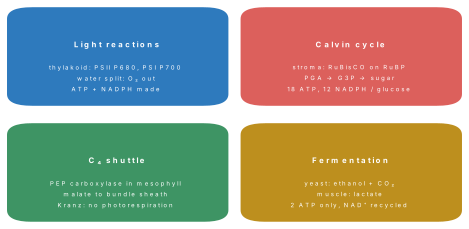
- Calvin cycle (C3) — stroma; RuBP + CO₂ by RuBisCO → 2 × 3-PGA (first stable product); per CO₂: 3 ATP + 2 NADPH; per glucose: 18 ATP + 12 NADPH.
- C4 (Hatch–Slack) — PEP carboxylase in mesophyll → oxaloacetate (4C) → malate → CO₂ released in bundle sheath (Kranz anatomy); spatial separation; 5 ATP per CO₂; maize, sugarcane.
- Photorespiration — RuBisCO oxygenase; chloroplast–peroxisome–mitochondrion; loses 1 CO₂ per 2 oxygenations; worse when hot and stomata shut.
- Factors — Blackman's law of limiting factors; light and CO₂ compensation points; airborne CO₂ is now about 0.043%, not 0.03%.
- Bacterial photosynthesis — bacteriochlorophyll, H₂S as donor, no O₂ evolved.
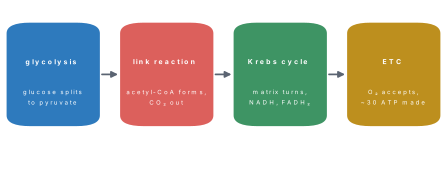
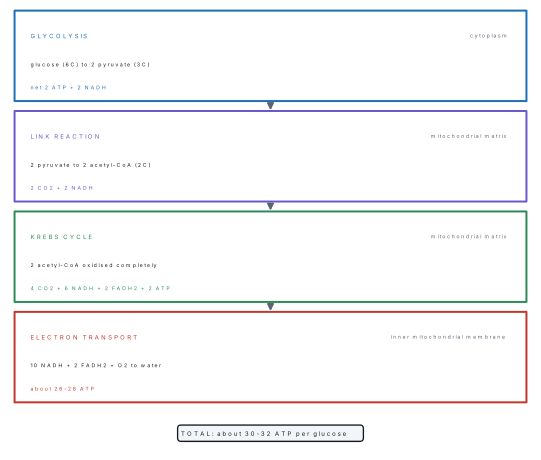
- Respiration — glycolysis (cytoplasm; net 2 ATP + 2 NADH → 2 pyruvate); link reaction (→ 2 acetyl-CoA + 2 CO₂ + 2 NADH); Krebs (matrix; per glucose 6 NADH + 2 FADH₂ + 2 ATP + 4 CO₂); ETS on cristae, O₂ the terminal acceptor, chemiosmosis (Mitchell).
- Totals and RQ — modern yield 30–32 ATP per glucose (classical 38); fermentation nets 2 ATP (all from glycolysis); RQ: carbohydrate 1.0, fat 0.7, protein 0.82, organic acids higher than 1; Pasteur effect.
12.1 Photosynthetic pigments; photosystems I and II; the light reactions
Photosynthesis reduces CO₂ to carbohydrate with water as the electron donor:
6 CO₂ + 12 H₂O → C₆H₁₂O₆ + 6 O₂ + 6 H₂O
Twelve waters stand on the left because all the released oxygen comes from water, not from CO₂ — predicted by van Niel from bacterial photosynthesis and proved with the heavy isotope ¹⁸O (Ruben and co-workers, 1941). The organelle is the chloroplast: pigments and electron carriers sit in the thylakoid membranes (stacked into grana, joined by stroma lamellae), protons are pumped into the lumen, and the carbon-fixing enzymes float in the stroma. Hold the rule: light reaction in the thylakoid, dark reaction in the stroma.
Of the pigments, only chlorophyll a — blue-green, with a magnesium atom at the centre of its porphyrin ring — can turn light into chemical energy: it is the primary pigment. Chlorophyll b, carotenes (orange) and xanthophylls (yellow) are accessory pigments: they harvest wavelengths chlorophyll a misses, pass the energy on, and (the carotenoids) protect against photo-oxidation. Chlorophyll absorbs strongly in the blue and red and reflects green — hence green leaves, and hence the action spectrum peaking in red and blue light.
Light is gathered by two antenna systems, each funnelling energy into a special pair of chlorophyll a molecules: photosystem II, reaction centre P680 (absorbance peak 680 nm, mostly in grana) and photosystem I, P700 (700 nm, mostly in stroma lamellae). Both are chlorophyll a; the numbers are wavelengths. Despite the names, PS II acts first — it was only discovered second.
In non-cyclic photophosphorylation electrons flow one way from water to NADP⁺ along the Z-scheme: light excites P680, which feeds electrons through pheophytin, the plastoquinone pool, the cytochrome b₆f complex and plastocyanin to PS I; light excites P700, which feeds them through ferredoxin to NADP⁺, forming NADPH. The hole left in P680 is so oxidising (+1.2 V) that the oxygen-evolving complex (Mn₄CaO₅, needing Cl⁻) on the lumen side of PS II can strip electrons from water — photolysis:
2 H₂O → O₂ + 4 H⁺ + 4 e⁻
Those protons, plus more pumped by cytochrome b₆f, build the lumen gradient whose discharge through ATP synthase makes ATP — chemiosmosis. Net products: ATP + NADPH + O₂.
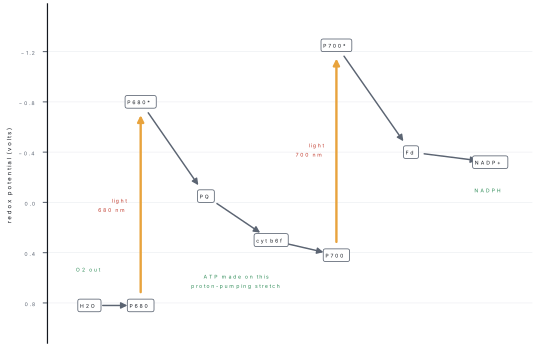
In cyclic photophosphorylation PS I works alone: its electron returns from ferredoxin to the plastoquinone pool and round again, pumping protons but splitting no water — ATP only, no NADPH, no O₂. Its purpose is exact: the Calvin cycle needs ATP and NADPH in the ratio 3 : 2, linear flow supplies about 1.28, and cyclic flow makes up the shortfall.
| Non-cyclic | Cyclic | |
|---|---|---|
| Photosystems | PS II and PS I | PS I only |
| Path | open: water → NADP⁺ | closed loop |
| Products | ATP + NADPH + O₂ | ATP only |
| Photolysis | yes | no |
| Main site | grana | stroma lamellae |
Problem. How many ATP and NADPH does the Calvin cycle spend to make one glucose? What is the RQ of tripalmitin (C₅₁H₉₈O₆ + 72.5 O₂ → 51 CO₂ + 49 H₂O)? And the modern ATP total per glucose respired? Solution. Per CO₂ fixed the cycle spends 3 ATP + 2 NADPH; ×6 = 18 ATP and 12 NADPH per glucose. RQ = 51 ÷ 72.5 ≈ 0.7 — the fat signature, hydrogen-rich fuel demanding extra oxygen. Respiration's ledger: 4 substrate-level ATP (2 glycolysis, 2 GTP) plus ~10 NADH × 2.5 and ~2 FADH₂ × 1.5 ≈ 25 + 3 = 28 oxidative → 30–32 ATP per glucose, against the 2 ATP of fermentation: oxygen is worth fifteen-fold.
12.2 Calvin cycle (C3), Hatch–Slack pathway (C4) and photorespiration; factors; bacterial photosynthesis
The Calvin cycle (Calvin, Benson, Bassham; Nobel 1961) runs in the stroma, light-independent but not nocturnal — it stops within minutes in the dark for want of ATP and NADPH.
- Carboxylation. The 5C acceptor ribulose-1,5-bisphosphate (RuBP) takes CO₂, catalysed by RuBisCO (the most abundant protein on Earth, and a slow one). The 6C intermediate splits into two 3-phosphoglycerate (3-PGA, 3C) — the first stable product, hence "C3 plants".
- Reduction. Each 3-PGA is phosphorylated by 1 ATP and reduced by 1 NADPH to glyceraldehyde-3-phosphate (G3P).
- Regeneration. Most G3P is reshuffled (costing 1 more ATP per CO₂) to rebuild RuBP; the surplus leaves to make sugars.
Book-keeping: per CO₂, 3 ATP + 2 NADPH; six turns give one glucose at 18 ATP + 12 NADPH, twelve G3P of which two exit and ten recycle.
Photorespiration. RuBisCO is also an oxygenase: in air it sometimes fixes O₂ instead of CO₂, yielding one 3-PGA and one useless 2-phosphoglycolate. Salvaging it tours three organelles — chloroplast → peroxisome → mitochondrion — burns ATP and releases one CO₂ for every two oxygenations, with no ATP gain. It worsens as temperature rises and as closed stomata let internal CO₂ fall.
C4 photosynthesis (Hatch and Slack, 1966) defeats photorespiration by concentrating CO₂ around RuBisCO, separating the two carboxylations in space. C4 leaves show Kranz anatomy: chloroplast-rich bundle-sheath cells wreathing the veins, ringed by mesophyll. In the mesophyll, PEP carboxylase (no oxygenase activity, high affinity) fixes bicarbonate onto PEP to give oxaloacetate (4C) — the first stable product — which is reduced to malate and shipped to the bundle sheath. There malate is decarboxylated, flooding RuBisCO with CO₂ at 10–20 times atmospheric levels, and the Calvin cycle runs almost free of oxygenation; pyruvate returns to regenerate PEP at a cost of two extra ATP equivalents per CO₂ (5 ATP + 2 NADPH total). Maize, sugarcane, sorghum and finger millet (kodo) are Nepal's C4 crops; rice and wheat are C3. CAM plants (pineapple, Aloe vera, Opuntia) achieve the same separation in time: stomata open at night, PEP carboxylase stores malic acid in the vacuole, and by day, behind closed stomata, the acid is decarboxylated for the Calvin cycle.
| C3 | C4 | CAM | |
|---|---|---|---|
| First stable product | 3-PGA (3C) | oxaloacetate (4C) | oxaloacetate (4C) |
| First CO₂ acceptor/enzyme | RuBP / RuBisCO | PEP / PEP carboxylase | PEP / PEP carboxylase |
| Separation | none | spatial (Kranz) | temporal (night/day) |
| Photorespiration | high | greatly suppressed | greatly suppressed |
| CO₂ compensation point | 40–100 ppm | 3–10 ppm | very low |
| ATP per CO₂ | 3 | 5 | 5–6 |
| Stomata open | day | day | night |
Bacterial photosynthesis (purple and green sulphur bacteria) uses bacteriochlorophyll, one photosystem, and donors such as H₂S instead of water — so it deposits sulphur and evolves no oxygen (anoxygenic). Comparing it with plant photosynthesis is what led van Niel to locate the oxygen's source in water.
Factors. Blackman's law of limiting factors (1905): the rate is set by whichever factor is nearest its minimum. The light compensation point is where photosynthesis exactly balances respiration (no net gas exchange); the CO₂ compensation point is the equivalent CO₂ level (40–100 ppm in C3, only 3–10 in C4). CO₂ in air is now about 427 ppm (0.043%) and is usually the field's limiting factor; red and blue light are most effective; temperature governs through enzyme kinetics (rate roughly doubling per 10 °C to an optimum, then crashing); water shortage acts by closing stomata.
12.3 Aerobic and anaerobic respiration: glycolysis, oxidative decarboxylation, Krebs cycle, electron transport and oxidative phosphorylation; factors
Respiration releases the energy of food in controlled packets, trapping much of it in ATP:
C₆H₁₂O₆ + 6 O₂ → 6 CO₂ + 6 H₂O + energy (ΔG ≈ −2870 kJ mol⁻¹)
1. Glycolysis (Embden–Meyerhof–Parnas pathway) runs in the cytoplasm of every cell, with or without oxygen. Glucose is phosphorylated twice — 2 ATP invested, at hexokinase and at the rate-limiting phosphofructokinase — then split into two triose phosphates, each oxidised (making NADH) and each yielding 2 ATP by substrate-level phosphorylation. Net: 2 ATP + 2 NADH + 2 pyruvate (3C) per glucose. No CO₂ yet.
2. Link reaction (oxidative decarboxylation). In the mitochondrial matrix the pyruvate dehydrogenase complex converts each pyruvate (3C) to acetyl-CoA (2C) + CO₂ + NADH: per glucose, 2 CO₂ + 2 NADH. It is irreversible, which is why fat cannot be turned back into sugar by reversing it.
3. Krebs cycle (citric acid/TCA cycle, Krebs 1937), also in the matrix. Acetyl-CoA (2C) joins oxaloacetate (4C) → citrate (6C) → α-ketoglutarate (5C) → succinyl-CoA (4C) → succinate → fumarate → malate → oxaloacetate again. Per turn: 3 NADH + 1 FADH₂ + 1 ATP + 2 CO₂; per glucose (two turns): 6 NADH + 2 FADH₂ + 2 ATP + 4 CO₂. Note that all six glucose carbons have now left as CO₂ and no O₂ has been used.
4. Electron transport and oxidative phosphorylation. The 10 NADH and 2 FADH₂ are cashed at the inner mitochondrial membrane (cristae): Complex I → ubiquinone → Complex III → cytochrome c → Complex IV → oxygen, the terminal electron acceptor, which with protons forms water. FADH₂ enters at Complex II, bypassing I — which is why it yields less. Complexes I, III and IV pump protons (10 H⁺ per NADH, 6 per FADH₂), and their return through ATP synthase drives ATP formation — Peter Mitchell's chemiosmotic hypothesis (Nobel 1978). With about 4 H⁺ spent per ATP, an NADH is worth 2.5 ATP and an FADH₂ 1.5, giving the modern total of 30–32 ATP per glucose (the shuttle used by the two cytoplasmic NADH decides between 30 and 32). The classical figure of 38 ATP assumed 3 per NADH and 2 per FADH₂; if a question specifies those ratios, use them.
Anaerobic respiration (fermentation). Without oxygen the chain stalls and NADH piles up; fermentation exists to regenerate NAD⁺ so glycolysis can continue. Alcoholic fermentation (yeast, flooded roots): pyruvate → acetaldehyde (pyruvate decarboxylase) → ethanol + CO₂. Lactic acid fermentation (muscle, Lactobacillus): pyruvate → lactate, no CO₂. Fermentation itself makes zero ATP — the whole anaerobic yield is glycolysis's 2 ATP, about 8% of the aerobic prize, which is why switching on oxygen sharply cuts glucose consumption (the Pasteur effect).
Respiratory quotient. RQ = CO₂ evolved ÷ O₂ consumed (Ganong's respirometer), and it betrays the substrate: carbohydrates 1.0, fats ≈ 0.7 (oxygen-poor, so they gulp external O₂), proteins ≈ 0.82, organic acids higher than 1 (malic 1.33, oxalic 4.0 — already oxygen-rich), fermenting tissue undefined (no O₂ taken up).
Problem. (a) How many ATP and NADPH does the Calvin cycle spend to export one net G3P? (b) Germinating seeds in a respirometer evolve 45 cm³ of CO₂ while taking up 50 cm³ of O₂. Find the RQ and comment.
Solution. (a) A net G3P contains 3 carbons, so three turns fix 3 CO₂. At 3 ATP + 2 NADPH per CO₂:
(One glucose, two G3P, doubles this to 18 ATP + 12 NADPH.)
(b)
Below 1 but above the fat value of 0.7: the seeds are respiring a mixture — largely fat or protein with some carbohydrate — as oily seeds (mustard, castor) do while converting their stores.
Factors affecting respiration. Oxygen: below a few percent the rate falls and fermentation takes over. Temperature: rate roughly doubles per 10 °C (Q₁₀ ≈ 2) up to about 35–40 °C, then enzyme damage cuts it. Water: dry seeds respire almost imperceptibly (why grain stores safely), and imbibition switches respiration on. CO₂: high concentrations depress respiration — exploited in controlled-atmosphere fruit storage. Light acts only indirectly, through temperature and photosynthate supply.
Count carefully, stage by stage, per glucose molecule:
- Glycolysis (cytoplasm): 4 ATP made by substrate-level phosphorylation, 2 spent → net 2 ATP, plus 2 NADH in the cytoplasm (worth about 1.5–2.5 ATP each depending on the shuttle used).
- Oxidative decarboxylation (per glucose: two pyruvates) → 2 mitochondrial NADH.
- Krebs cycle (two turns) → 2 ATP (GTP) directly, 6 NADH, 2 FADH₂.
- Electron transport at roughly 2.5 ATP per mitochondrial NADH and 1.5 per FADH₂ gives a grand total of about 30–32 ATP — the modern figure. (Older books quote 36–38 using 3 and 2 ATP per NADH/FADH₂; if an MCQ lists 38 as an option, the paper is using the traditional accounting.)
The robust facts are the net numbers per stage — learn those, and either total can be reconstructed.
Isotope experiments settled it: the oxygen released in photosynthesis comes from splitting water (photolysis) at photosystem II, not from carbon dioxide. Pairs with a second swap: cyclic photophosphorylation makes ATP only (PS I alone, no NADPH, no O₂), while non-cyclic flow (PS II + PS I) makes ATP + NADPH + O₂.
Four pairs the paper swaps: the evolved O₂ comes from water, not CO₂ (¹⁸O labelling settled it); PSII acts first in the chain though named second — numbering follows discovery, electrons follow energy; the Calvin cycle sits in the stroma, not on the thylakoid, and needs light only via ATP and NADPH; and photorespiration consumes, it does not produce — CO₂ out, ATP spent, no sugar, which is exactly why C₄ exists.
Formula and fact sheet
- Sites: light reactions thylakoid (grana/lamellae), O₂ from water (¹⁸O proof); Calvin stroma; glycolysis cytoplasm; link + Krebs matrix; ETS cristae.
- Photosystems: PS II P680 acts first, PS I P700; order H₂O → PS II → PQ → cyt b₆f → plastocyanin → PS I → ferredoxin → NADP⁺.
- Products: non-cyclic ATP + NADPH + O₂; cyclic ATP only (ratio repair to 3 : 2).
- Calvin: RuBP acceptor, RuBisCO, first product 3-PGA; 3 ATP + 2 NADPH per CO₂; 18 ATP + 12 NADPH per glucose.
- C4: PEP/PEP carboxylase → OAA → malate → bundle sheath (Kranz); 5 ATP per CO₂; compensation 3–10 ppm. CAM: same chemistry by night, stomata shut by day.
- Photorespiration: RuBisCO oxygenase; chloroplast–peroxisome–mitochondrion; 1 CO₂ lost per 2 oxygenations; hot + closed stomata worsens it.
- Bacterial photosynthesis: bacteriochlorophyll, H₂S donor, no O₂.
- Respiration tallies per glucose: glycolysis net 2 ATP + 2 NADH; link 2 NADH + 2 CO₂; Krebs 6 NADH + 2 FADH₂ + 2 ATP + 4 CO₂; carriers total 10 NADH + 2 FADH₂.
- Yields: NADH ≈ 2.5 ATP, FADH₂ ≈ 1.5 → 30–32 per glucose (classical 3/2 gives 38); fermentation 2 (glycolysis only, regenerates NAD⁺).
- RQ: glucose 1.0, fat 0.7, protein 0.82, malic acid 1.33, oxalic 4.0; measured by Ganong's respirometer.
- People: van Niel and Ruben (O₂ from water), Calvin (cycle), Hatch and Slack (C4), Krebs (cycle), Mitchell (chemiosmosis), Blackman (limiting factors).
Rapid-revision tables and high-yield facts
| Quantity | Value |
|---|---|
| Chl a peaks | ~430 nm and ~662 nm |
| PSII / PSI | P680 / P700 |
| O₂ source | water (photolysis) |
| Calvin per glucose | 6 CO₂, 18 ATP, 12 NADPH |
| C₄ first enzyme | PEP carboxylase (mesophyll) |
| Photorespiration organs | chloroplast, peroxisome, mitochondrion |
| Glycolysis | cytosol; net 2 ATP + 2 NADH |
| Krebs per turn | 3 NADH, 1 FADH₂, 1 GTP, 2 CO₂ |
| Terminal acceptor | O₂ → H₂O |
| Total aerobic | ~30–32 ATP; fermentation 2 ATP |
| RQ | carbs 1, fats ≈ 0.7, proteins ≈ 0.8–0.9 |
| Bacterial photosynthesis | H₂S donor, no O₂ |
Chapter summary
- Chlorophyll a (Mg-centred) alone converts light energy; accessory pigments widen the catch and protect the reaction centres P680 (PS II, acting first) and P700 (PS I).
- The Z-scheme drags electrons from water (photolysis at the Mn₄CaO₅ complex, O₂ and protons into the lumen) to NADP⁺, minting ATP chemiosmotically on the way; cyclic flow around PS I adds ATP only, balancing the 3 : 2 budget.
- The stromal Calvin cycle carboxylates RuBP via RuBisCO into 3-PGA and, at 3 ATP + 2 NADPH per CO₂, builds glucose for 18 ATP + 12 NADPH.
- Photorespiration — RuBisCO fixing O₂ — wastes carbon through a three-organelle salvage loop; C4 plants suppress it spatially (Kranz anatomy, PEP carboxylase pump, 5 ATP per CO₂) and CAM plants temporally.
- Blackman's limiting-factor law and the two compensation points govern how light, CO₂ (now 0.043%), temperature and water set the photosynthetic rate; bacteria photosynthesise with H₂S and release no O₂.
- Glycolysis (cytoplasm) nets 2 ATP + 2 NADH; the link reaction and Krebs cycle (matrix) strip the six carbons out as CO₂, loading 10 NADH and 2 FADH₂ in all.
- The cristae electron-transport chain, ending at oxygen, converts those carriers into most of the modern 30–32 ATP per glucose (38 classically).
- Without oxygen, fermentation merely regenerates NAD⁺ for glycolysis's 2 ATP (Pasteur effect), and the RQ — 1.0, 0.7, 0.82, above 1 — reports the substrate being burned.
Practice questions
Set A — Recall (25 questions)
- The only pigment that can convert light energy into chemical energy isachlorophyll bbcarotenecchlorophyll adxanthophyll
- The metallic atom at the centre of the chlorophyll molecule isaironbmagnesiumccopperdmanganese
- The reaction centre of photosystem II isaP680bP700cP720dP650
- The oxygen released in photosynthesis comes fromawaterbcarbon dioxidecchlorophylldglucose
- Water is split (photolysed) at the oxygen-evolving complex associated withaphotosystem I in the stromabthe Calvin cyclecphotosystem II on the lumen sidedATP synthase
- The products of non-cyclic photophosphorylation areaATP, NADPH and O₂bATP onlycNADPH onlydglucose and O₂
- Cyclic photophosphorylation involvesaboth photosystemsbphotosystem II onlycneither photosystemdphotosystem I only
- In non-cyclic electron flow, the final electron acceptor isaoxygenbNADP⁺cferredoxindplastoquinone
- The first stable product of the Calvin cycle isa3-phosphoglycerate (3-PGA)boxaloacetatecglucosedRuBP
- The CO₂ acceptor in a C3 plant isaphosphoenolpyruvatebmalatecribulose-1,5-bisphosphate (RuBP)dpyruvate
- The enzyme that fixes CO₂ in the Calvin cycle isaPEP carboxylasebhexokinasecATP synthasedRuBisCO
- The first stable product of the C4 pathway isa3-PGAboxaloacetatecmalatedaspartate
- Kranz anatomy is the diagnostic leaf structure ofaC3 plantsbCAM plantscC4 plantsdhydrophytes
- The three organelles involved in photorespiration are theanucleus, ribosome and Golgi bodybchloroplast, vacuole and lysosomecchloroplast, nucleus and mitochondriondchloroplast, peroxisome and mitochondrion
- The law of limiting factors in photosynthesis was given byaBlackmanbCalvincDixondKrebs
- Photosynthetic sulphur bacteria differ from green plants in that theyarelease more oxygenbuse chlorophyll acfix nitrogenduse H₂S as electron donor and evolve no oxygen
- Glycolysis takes place in theamitochondrial matrixbcytoplasmcchloroplast stromadnucleus
- The net gain of ATP from glycolysis of one glucose isa4b8c2d0
- The link reaction converts pyruvate intoacitrateblactatecacetyl-CoAdoxaloacetate
- The Krebs cycle operates in theacytoplasmbcristaecchloroplastdmitochondrial matrix
- The number of NADH molecules produced per turn of the Krebs cycle isaonebthreectwodfour
- The terminal electron acceptor in aerobic respiration isaNAD⁺boxygenccytochrome cdcarbon dioxide
- The chemiosmotic hypothesis of ATP synthesis was proposed byaKrebsbCalvincPeter MitchelldEmbden
- The end products of alcoholic fermentation of glucose arealactic acid onlybethanol onlycCO₂ and waterdethanol and CO₂
- The respiratory quotient (RQ) for glucose isa1.0b0.7c0.82d1.33
Answers and explanations — Set A
1. (c) — Chlorophyll a forms the reaction centres; the others only gather light and hand the energy over.
2. (b) — Mg²⁺ sits in the porphyrin ring; iron belongs to haem and cytochromes.
3. (a) — P680 and P700 name absorption maxima in nm; both centres are chlorophyll a.
4. (a) — Proved with ¹⁸O-labelled water by Ruben and co-workers (1941).
5. (c) — The Mn₄CaO₅ complex faces the lumen of PS II, so photolysis protons feed the ATP gradient.
6. (a) — Linear flow from water to NADP⁺ yields both currencies and oxygen.
7. (d) — Electrons cycle around PS I only: ATP without NADPH or O₂.
8. (b) — Ferredoxin–NADP⁺ reductase completes the Z-scheme by making NADPH.
9. (a) — The 6C addition product splits instantly into two 3-PGA — the "3" of C3.
10. (c) — The 5C RuBP is regenerated each turn to accept the next CO₂.
11. (d) — RuBisCO, the Earth's most abundant protein, carboxylates (and, unluckily, oxygenates) RuBP.
12. (b) — PEP carboxylase makes the 4C oxaloacetate first; malate is its reduced transport form.
13. (c) — The wreath of bundle-sheath cells around the veins houses the C4 Calvin cycle.
14. (d) — Phosphoglycolate salvage runs chloroplast → peroxisome → mitochondrion, leaking CO₂.
15. (a) — Blackman (1905): the scarcest factor sets the rate.
16. (d) — Anoxygenic photosynthesis with bacteriochlorophyll; sulphur is deposited instead of O₂ released.
17. (b) — Glycolysis is universal and cytoplasmic; only later stages enter the mitochondrion.
18. (c) — Four ATP made by substrate-level phosphorylation minus two invested = net 2.
19. (c) — Oxidative decarboxylation: 3C pyruvate → 2C acetyl-CoA + CO₂ + NADH.
20. (d) — The matrix holds the cycle; the cristae hold the electron transport chain.
21. (b) — Plus 1 FADH₂, 1 ATP and 2 CO₂ per turn.
22. (b) — Oxygen accepts the electrons and protons to form water; without it the chain stalls.
23. (c) — Peter Mitchell, Nobel Prize 1978; the same mechanism makes ATP in chloroplasts.
24. (d) — Glucose → 2 ethanol + 2 CO₂; lactic fermentation, by contrast, releases no CO₂.
25. (a) — Six CO₂ out for six O₂ in: RQ = 1.0 for carbohydrates.
Set B — Understanding (15 questions)
- Photosystem II acts before photosystem I in the Z-scheme; the numbering reflectsathe order in which they were discovered, not the order of actionbtheir sizesctheir wavelength orderda printing error
- The precise role of cyclic photophosphorylation is toatop up ATP to the 3 : 2 ratio the Calvin cycle needsbproduce extra oxygencfix CO₂ at nightdreplace PS II
- Calling the Calvin cycle the "dark reaction" is misleading because itaoccurs only at nightbneeds no enzymescis unaffected by light in any waydis light-independent but soon stops in darkness without ATP and NADPH
- C4 plants almost escape photorespiration because in their bundle sheathaRuBisCO is absentboxygen is absentcthe Calvin cycle is absentdCO₂ is concentrated 10–20 times around RuBisCO
- CAM plants open their stomata at night mainly toaabsorb dewbfix CO₂ when evaporative water loss is leastcrelease oxygendattract pollinators
- Photorespiration increases on a hot afternoon when stomata close because inside the leafalight intensity fallsbCO₂ falls and O₂ rises, favouring RuBisCO's oxygenase activitycPEP carboxylase stopsdchlorophyll breaks down
- At the light compensation point, a leaf shows no net gas exchange becauseaphotosynthesis has stoppedbrespiration has stoppedcstomata are closeddphotosynthesis exactly balances respiration
- The essential purpose of fermentation is toamake ATP directlybproduce alcohol for the cellcregenerate NAD⁺ so glycolysis can continuedrelease CO₂
- FADH₂ yields fewer ATP than NADH in the electron transport chain because itais made in the cytoplasmbenters at Complex II, bypassing the first proton-pumping complexccarries only one electrondcannot reach the membrane
- Cyanide kills cells by blocking Complex IV, which directly causesathe electron transport chain to halt and ATP synthesis to stopbglycolysis to reversecphotolysis to stopdfaster ATP production
- The RQ of fats is less than 1 because fats arearich in oxygenboxygen-poor, so oxidising them needs much external O₂cinsoluble in waterdstored only in seeds
- The Pasteur effect refers to the observation that supplying oxygen to fermenting yeastaincreases alcohol productionbkills the yeastchas no effectdgreatly decreases glucose consumption
- Cyclic electron flow is located chiefly in the stroma lamellae because these membranes are rich inaPS IIboxygen-evolving complexescPS IdRuBisCO
- Accessory pigments increase photosynthetic efficiency byaabsorbing extra wavelengths and passing energy to chlorophyll abreplacing chlorophyll a in reaction centrescreflecting green lightdfixing CO₂ themselves
- Anaerobic respiration yields so little energy because the glucose isafully oxidisedbconverted to waterconly partly oxidised, most energy remaining in ethanol or lactatedstored as starch
Answers and explanations — Set B
1. (a) — PS I was characterised first, though in the chain PS II feeds it.
2. (a) — Linear flow gives an ATP : NADPH ratio near 1.28; cyclic flow tops it up to the required 1.5.
3. (d) — No photon is used directly, but the substrates ATP and NADPH run out quickly in the dark.
4. (d) — The PEP-carboxylase pump swamps the oxygenase reaction by sheer CO₂ pressure.
5. (b) — Night air is cool and humid; CO₂ is banked as malic acid and spent behind closed stomata by day.
6. (b) — Trapped O₂ from photolysis plus dwindling CO₂ tips RuBisCO towards oxygenation.
7. (d) — CO₂ taken up in photosynthesis equals CO₂ released in respiration.
8. (c) — Reducing pyruvate re-oxidises NADH; the ATP all comes from glycolysis itself.
9. (b) — Skipping Complex I saves 4 of the 10 protons: about 1.5 ATP against NADH's 2.5.
10. (a) — With no electron flow to oxygen the proton gradient collapses and oxidative phosphorylation ends.
11. (b) — Tripalmitin gives 102 CO₂ per 145 O₂: RQ ≈ 0.7.
12. (d) — ATP and citrate from aerobic respiration inhibit phosphofructokinase, throttling glycolysis.
13. (c) — Stroma lamellae carry PS I and ATP synthase but little PS II.
14. (a) — Chlorophyll b and carotenoids broaden the absorbed spectrum; carotenoids also quench photo-damage.
15. (c) — Only about 8% of glucose's free energy is released; the rest stays in the incompletely oxidised product.
Set C — Application (10 questions)
- To synthesise one molecule of glucose, the Calvin cycle consumesa12 ATP and 18 NADPHb6 ATP and 6 NADPHc18 ATP and 12 NADPHd30 ATP and 12 NADPH
- The number of turns of the Calvin cycle needed to export one net G3P isaonebsixcthreedtwelve
- Before the electron transport chain, complete breakdown of one glucose to CO₂ has produced NADH totallinga10b6c8d4
- Respiring seeds evolve 45 cm³ CO₂ and consume 50 cm³ O₂ in the same time. The RQ isa1.0b0.9c0.7d1.1
- Using the classical values of 3 ATP per NADH and 2 ATP per FADH₂, the total ATP from one glucose (prokaryote-style accounting) isa32b38c30d40
- The ATP cost of fixing one CO₂ in a C4 plant such as maize isa5 ATPb3 ATPc2 ATPd1 ATP
- If 12 water molecules are photolysed at PS II, the number of O₂ molecules released isa12b3c24d6
- The number of CO₂ molecules released when one pyruvate passes through the link reaction and Krebs cycle isathreebonectwodsix
- Yeast fermenting one glucose molecule under anaerobic conditions netsa8 ATPb4 ATPc0 ATPd2 ATP
- Six turns of the Calvin cycle produce G3P molecules numberinga6, all exportedb12, of which 2 leave the cyclec2 onlyd18, of which 6 leave
Answers and explanations — Set C
1. (c) — Six CO₂ at 3 ATP + 2 NADPH each: 18 ATP and 12 NADPH.
2. (c) — Three CO₂ fixed give six G3P, five of which regenerate RuBP and one leaves net.
3. (a) — 2 (glycolysis) + 2 (link) + 6 (Krebs) = 10 NADH, besides 2 FADH₂.
4. (b) — RQ = 45/50 = 0.9, a mixed fat/carbohydrate substrate.
5. (b) — 4\ \text{(substrate-level)} + 10 \times 3 + 2 \times 2 = 38; modern P/O ratios give 30–32.
6. (a) — The Calvin cycle's 3 ATP plus 2 ATP-equivalents to regenerate PEP.
7. (d) — 2\,\text{H}_2\text{O} \to \text{O}_2 + 4\text{H}^+ + 4e^-, so 12 waters give 6 O₂.
8. (a) — One at the link reaction and two in the Krebs cycle: all three pyruvate carbons.
9. (d) — Only glycolysis pays out; fermentation itself yields no ATP.
10. (b) — Twelve G3P form; ten rebuild the six RuBP and two combine towards one glucose.