Chapter 9 · Genetics · 4 questions in the paper · 29 min read
Inheritance, Linkage, Mutation and Genetic Disorders
What the syllabus asks for 5
- Mendelian terminology and laws; incomplete dominance and co-dominance
- Linkage (complete and incomplete) and crossing over
- Sex-linked inheritance: colour blindness in humans, eye colour in Drosophila
- Gene and chromosomal mutations; polyploidy
- Down's, Turner's, Edwards' and Klinefelter's syndromes; albinism; haemophilia
This is the biggest chapter of the Genetics unit — about 4 of the 40 Botany questions — and the most "solvable": almost every question is a small cross, a ratio or a karyotype that can be worked in the margin. It covers Mendel's terminology and laws with their two great modifications, linkage and crossing over, sex-linked inheritance in humans and Drosophila, mutation and polyploidy, and the six human disorders the syllabus names. Learn the standard ratios by heart, learn to read a test cross as a direct printout of gametes, and the four marks are among the cheapest in the paper.
- Mendel — Pisum sativum, seven characters, pure lines, counting; father of genetics; rediscovered 1900 by de Vries, Correns and Tschermak.
- The words — gene, allele, locus, dominant/recessive, homo-/heterozygous, genotype/phenotype, back cross vs test cross.
- The ratios — monohybrid F₂ 3 : 1 (genotypic 1 : 2 : 1); dihybrid F₂ 9 : 3 : 3 : 1; test crosses 1 : 1 and 1 : 1 : 1 : 1; incomplete dominance 1 : 2 : 1.
- The laws — dominance; segregation (purity of gametes, cytological basis anaphase I); independent assortment.
- Incomplete dominance (Mirabilis pink) vs co-dominance (AB blood group, roan cattle); multiple alleles (ABO: I^A^, I^B^, i).
- Linkage — Bateson and Punnett (sweet pea); Morgan's explanation; complete vs incomplete; linkage groups = haploid number; crossing over between non-sister chromatids; 1 cM = 1% recombination.
- Sex linkage — hemizygous males; criss-cross inheritance; colour blindness and haemophilia (X-recessive); Morgan's white-eyed Drosophila.
- Mutation — de Vries; point (substitution, frameshift) vs chromosomal (structural and numerical); mutagens; non-disjunction → aneuploidy.
- Polyploidy — colchicine; autopolyploid (banana, potato) vs allopolyploid (bread wheat, Triticale, Raphanobrassica); triploid sterility.
- Disorders — Down (trisomy 21), Edwards (trisomy 18), Turner (45, XO), Klinefelter (47, XXY), albinism (autosomal recessive, no tyrosinase), haemophilia (X-recessive, factor VIII).
9.1 Mendelian terminology and laws; incomplete dominance and co-dominance
Gregor Johann Mendel (1822–1884), an Austrian monk, worked on the garden pea Pisum sativum from 1856 to 1863 and published in 1866; the work was ignored until de Vries, Correns and Tschermak rediscovered it in 1900. He succeeded because he studied one pair of contrasting characters at a time, started from pure (true-breeding) lines, counted large numbers of offspring, and followed crosses through several generations. The pea helped: naturally self-pollinating, easily crossed by hand after emasculation, short-lived, and offering seven clear-cut character pairs — tall/dwarf stem, axial/terminal flowers, violet/white flowers, inflated/constricted pods, green/yellow pods, round/wrinkled seeds, yellow/green cotyledons.
Gene — a unit of inheritance, a DNA segment at a fixed locus on a chromosome. Allele — one of the alternative forms of a gene (T and t). Dominant — the allele expressed in the heterozygote; recessive — the one masked in it. Homozygous (TT, tt) — both alleles alike; heterozygous (Tt) — alleles different. Genotype — the genetic constitution; phenotype — the visible character. Monohybrid cross — follows one character; dihybrid — two. Back cross — F₁ crossed with either parent; test cross — F₁ (or any dominant-looking individual) crossed with the homozygous recessive.
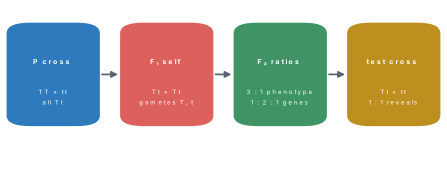
Crossing pure tall (TT) with pure dwarf (tt) gave an F₁ of all tall plants (Tt). Selfing the F₁ gave an F₂ of 3 tall : 1 dwarf (genotypes 1 TT : 2 Tt : 1 tt). The dwarf allele had survived the F₁ unchanged — only hidden. From this, Mendel's first two laws:
Dominance. When two contrasting alleles meet in a hybrid, only the dominant one is expressed; the recessive remains unexpressed but unchanged.
Segregation (purity of gametes). The two alleles of a pair separate during gamete formation, so every gamete carries only one of them — a gamete is never hybrid. Its cytological basis is anaphase I of meiosis, when homologues part.
A tall plant may be TT or Tt — indistinguishable by eye. A test cross with a dwarf (tt) reveals it: TT gives all tall offspring, Tt gives 1 tall : 1 dwarf. The test cross works because the recessive parent contributes only recessive alleles, so the offspring ratio is a direct copy of the gamete ratio of the plant being tested. That one idea — test-cross progeny display the gametes of the heterozygous parent — drives every linkage calculation later in this chapter.
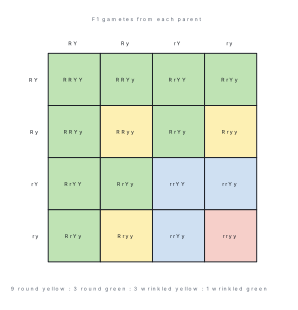
With two characters at once (round/wrinkled seeds × yellow/green cotyledons) the F₂ gave 9 : 3 : 3 : 1 — the two 3 : 1 ratios combined freely. Hence the law of independent assortment: alleles of different genes separate into gametes independently of one another (because different chromosome pairs orient independently at metaphase I). A dihybrid test cross accordingly gives 1 : 1 : 1 : 1.
Incomplete dominance and co-dominance
Mendel's peas happened to show complete dominance; many genes do not.
Incomplete dominance — neither allele fully dominates, so the heterozygote is intermediate. In Mirabilis jalapa (four-o'clock) and Antirrhinum (snapdragon), red (RR) × white (rr) gives pink (Rr) F₁; selfing gives 1 red : 2 pink : 1 white — the phenotypic ratio equals the genotypic ratio. Note that red and white reappear pure in F₂: the alleles never blended, they merely dosed the pigment.
Co-dominance — both alleles express themselves side by side in the heterozygote, not as a blend. The human AB blood group carries both A and B antigens; roan cattle have red and white hairs mixed, not pink hairs.
Multiple alleles — a gene may have more than two alleles in the population (though any one person carries only two). The ABO system is controlled by gene I with three alleles I^A^, I^B^ and i: I^A^ and I^B^ are co-dominant with each other and both dominant over i, giving four blood groups (A, B, AB, O) from six genotypes.
Problem. A dihybrid test cross yields 850 offspring, of which 170 are recombinant. How far apart are the two genes? Separately: a carrier mother (X^H X^h) and a normal father (X^H Y) plan a family — what is the chance a son has haemophilia, and the chance that any child is an affected son? A colour-blind man marries a homozygous normal woman — what are their daughters? Solution. 170 ÷ 850 = 20 % recombination = 20 map units apart. Sons receive the mother's X: half of them get X^h → 1/2 of sons affected; an affected son is one of four equally likely child types → 1/4 of all children. Every daughter receives the father's only X, which carries the colour-blindness allele, plus a normal X from mother: all daughters carriers, none affected — and every son normal, taking the Y.
9.2 Linkage (complete and incomplete) and crossing over
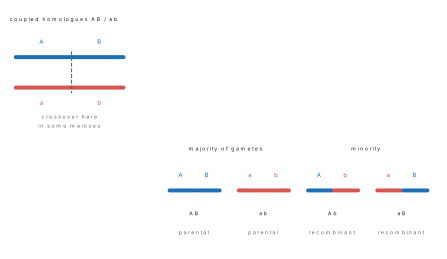
Independent assortment fails for genes that sit on the same chromosome: they tend to travel together into gametes. This is linkage. Bateson and Punnett (1906) first saw it in sweet pea, where parental combinations in a dihybrid test cross far outnumbered new ones; they spoke of coupling (dominant alleles entering together on one chromosome, the cis arrangement AB/ab) and repulsion (entering apart, trans, Ab/aB). T. H. Morgan (1910), using Drosophila, showed coupling and repulsion are just two arrangements of linked genes, and that the strength of linkage depends on the distance between the genes — the closer, the stronger. All the genes on one chromosome form a linkage group, so the number of linkage groups equals the haploid chromosome number (4 in Drosophila, 23 in humans).
- Complete linkage — genes so close (or in an organism/sex with no crossing over, such as male Drosophila and female silkworm) that only parental gametes form; a test cross gives just the two parental classes, 1 : 1.
- Incomplete linkage — the usual case: crossing over in some meioses produces a minority of recombinant gametes; a test cross gives two large parental classes and two small recombinant classes.
Crossing over is the exchange of corresponding segments between non-sister chromatids of homologues at pachytene of prophase I, visible later as chiasmata. Its frequency between two genes rises with the distance between them and is also affected by sex, age, temperature, radiation and nearness to the centromere (where it is suppressed). Because the recombinant classes in a test cross reveal recombinant gametes directly,
and Sturtevant (1913) turned this into a map: 1% recombination = 1 map unit = 1 centimorgan (cM). Frequencies never exceed 50% — at 50% the genes assort as if unlinked (they may be far apart on one chromosome or on different chromosomes).
Problem. A dihybrid plant AaBb (in coupling phase) is test-crossed with aabb. The progeny are: AaBb 415, aabb 405, Aabb 92, aaBb 88. Are the genes linked? If so, how far apart are they?
Solution. In a test cross the progeny phenotypes display the gametes of the heterozygous parent. Two classes are large (415, 405) and two small (92, 88), instead of the 1 : 1 : 1 : 1 expected for unlinked genes — so the genes are linked. The small classes are the recombinants:
The genes are 18 map units (18 cM) apart. Identify recombinants by frequency (the two smallest classes), never by whether they "look" parental.
9.3 Sex-linked inheritance: colour blindness in humans, eye colour in Drosophila
Genes on the X chromosome (outside the small region shared with Y) have no partner allele in the male. A male is therefore hemizygous: a single recessive allele on his one X expresses itself. That is why red–green colour blindness and haemophilia are far commoner in men: a woman needs the allele on both X chromosomes to be affected, whereas one copy makes her a phenotypically normal carrier.
The transmission pattern is criss-cross inheritance: an affected father passes his X (and the allele) to all his daughters (carriers) and to none of his sons (they get his Y); a carrier mother passes the allele to half her sons, who are affected, and half her daughters, who become carriers. The character thus hops from grandfather, through carrier daughters, to grandsons.
Eye colour in Drosophila. Morgan (1910) found a white-eyed male in his red-eyed cultures. White proved recessive and X-linked: red-eyed female × white-eyed male gave all red F₁, and the F₂ showed 3 red : 1 white with all the whites male; the reciprocal cross (white female × red male) gave red daughters and white sons in F₁ itself — the textbook criss-cross, and the first gene ever assigned to a chromosome. Remember the logic of reciprocal crosses: if the two reciprocal crosses give different results, the gene is sex-linked (autosomal genes give identical reciprocal results).
(Y-linked or holandric genes — e.g. the SRY sex-determining region — pass only from father to son; sex-influenced genes such as human pattern baldness are autosomal but dominant in one sex and recessive in the other.)
9.4 Gene and chromosomal mutations; polyploidy
A mutation is a sudden, heritable change in the genetic material (the term is Hugo de Vries', from his work on Oenothera). Mutations may be spontaneous (replication errors) or induced by mutagens — physical (X-rays, gamma rays, UV), chemical (nitrous acid, EMS, mustard gas, base analogues such as 5-bromouracil, acridine dyes, colchicine) or biological (transposons, some viruses). Somatic mutations are not inherited (unless the plant is propagated vegetatively); gametic mutations pass to offspring.
Gene (point) mutations change one or a few base pairs:
- Substitution — one base pair replaced: a transition (purine ↔ purine) or transversion (purine ↔ pyrimidine). Effects range from none (silent, thanks to degeneracy) through a changed amino acid (missense — sickle-cell anaemia, one base) to a premature stop (nonsense).
- Frameshift — insertion or deletion of bases in a number that is not a multiple of three shifts the reading frame, garbling every codon downstream; usually the most damaging point mutation.
Chromosomal mutations change structure or number. Structural: deletion (lost segment), duplication (repeated segment), inversion (segment reversed 180°) and translocation (segment moved to another chromosome). Numerical: euploidy changes whole sets (n, 3n, 4n — polyploidy below), while aneuploidy adds or loses individual chromosomes (2n + 1 trisomy, 2n − 1 monosomy, 2n + 2 tetrasomy, 2n − 2 nullisomy). Aneuploidy arises by non-disjunction — homologues (meiosis I) or sister chromatids (meiosis II) failing to separate, producing n + 1 and n − 1 gametes.
Polyploidy — more than two complete chromosome sets — is a major engine of plant evolution and breeding. It is induced artificially with colchicine (an alkaloid from Colchicum), which blocks spindle formation so a replicated nucleus does not divide and the chromosome number doubles.
| Autopolyploidy | Allopolyploidy (amphidiploidy) | |
|---|---|---|
| Sets come from | one species, multiplied (AAAA) | two species, then doubled (AABB) |
| Examples | potato, banana (3n), seedless watermelon (3n) | bread wheat (6n), Triticale, Raphanobrassica |
| Notes | larger cells and organs (gigas); odd ploidies sterile | doubling restores fertility to sterile hybrids by giving every chromosome a partner |
A triploid (3n) is sterile because three sets cannot pair evenly in meiosis — exactly why seedless bananas and watermelons are seedless. Karpechenko's Raphanobrassica (radish × cabbage, 1928) and the man-made cereal Triticale (wheat × rye) are the classic allopolyploids; bread wheat Triticum aestivum is a natural allohexaploid (6n = 42).
9.5 Down's, Turner's, Edwards' and Klinefelter's syndromes; albinism; haemophilia
| Disorder | Karyotype / gene | Sex and key features |
|---|---|---|
| Down syndrome | trisomy 21 (47, +21), maternal non-disjunction | either sex; short stature, round face, epicanthal fold, single palmar (simian) crease, intellectual disability; risk rises steeply with mother's age |
| Edwards syndrome | trisomy 18 (47, +18) | either sex, mostly female survivors; clenched overlapping fingers, rocker-bottom feet, severe heart defects; usually fatal in infancy |
| Turner syndrome | 45, XO — monosomy of X | female; short, webbed neck, underdeveloped ovaries (streak gonads), sterile, no Barr body |
| Klinefelter syndrome | 47, XXY | male (Y decides sex); tall, long limbs, small testes, sterile, some breast development (gynaecomastia), one Barr body |
| Albinism | autosomal recessive — no functional tyrosinase, so tyrosine is not converted to melanin | either sex equally; white skin and hair, pink eyes, photophobia; normal parents can have albino children (both carriers) |
| Haemophilia | X-linked recessive — deficient clotting factor VIII (type A; factor IX in type B) | almost always males; wounds bleed long, bleeding into joints; "royal disease" of Queen Victoria's descendants |
Three exam habits with this table: (1) count chromosomes — 45, 46 or 47 sorts Turner from normal from the trisomies/XXY at a glance; (2) the Y chromosome decides maleness, so XXY is male and XO is female; (3) autosomal recessive disorders (albinism) strike both sexes equally and skip generations through carriers, while X-linked recessives (haemophilia, colour blindness) strike mostly males and never pass father-to-son.
Problem. A woman whose father was haemophilic marries a normal man. What is the probability that (a) her son is haemophilic, (b) her daughter is a carrier, (c) a child of hers is haemophilic?
Solution. Her father was X^h^Y; every daughter receives his only X, so the woman is an obligate carrier X^H^X^h^ (she got X^H^ from her mother and is herself normal). Her husband is X^H^Y.
| X^H^ (father) | Y (father) | |
|---|---|---|
| X^H^ | X^H^X^H^ normal girl | X^H^Y normal boy |
| X^h^ | X^H^X^h^ carrier girl | X^h^Y haemophilic boy |
(a) Of her sons, half receive X^h^: 1/2 (50%). (b) Of her daughters, half receive X^h^: 1/2 carriers (none haemophilic). (c) One of the four equally likely children is haemophilic: 1/4 (25%). Always state whether the probability is among sons, among daughters or among all children — the paper tests exactly that distinction.
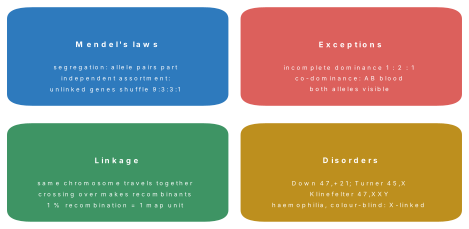
Four pairs the paper swaps: incomplete dominance blends the phenotype (pink), co-dominance shows both (AB) — both give 1 : 2 : 1 F₂, so the example, not the ratio, names them; linkage defeats independent assortment, and crossing over defeats linkage; Turner is 45,X and female, Klinefelter 47,XXY and male — the Y, not the X count, decides sex; and translocation moves segments between non-homologues, while crossing over exchanges between homologues.
Formula and fact sheet
- Mendel: Pisum sativum, 1856–63, published 1866, rediscovered 1900 (de Vries, Correns, Tschermak); seven characters, pure lines, counted F₂.
- Ratios: monohybrid F₂ 3 : 1 (1 : 2 : 1 genotypic); dihybrid F₂ 9 : 3 : 3 : 1; monohybrid test cross 1 : 1; dihybrid test cross 1 : 1 : 1 : 1; incomplete dominance 1 : 2 : 1.
- Laws: dominance; segregation = purity of gametes (anaphase I); independent assortment (metaphase I orientation) — fails for linked genes.
- Incomplete dominance: Mirabilis/Antirrhinum pink; co-dominance: AB blood, roan; multiple alleles: I^A^, I^B^, i → 4 phenotypes, 6 genotypes.
- Linkage: Bateson and Punnett (sweet pea, 1906); Morgan's chromosomal explanation; linkage groups = haploid number; cis = coupling, trans = repulsion.
- Crossing over: non-sister chromatids, pachytene; RF = recombinants ÷ total × 100; 1% = 1 cM; RF caps at 50%; absent in male Drosophila (complete linkage).
- Sex linkage: males hemizygous; criss-cross (father → daughters → grandsons); reciprocal crosses differ; white eye in Drosophila (Morgan, 1910).
- Mutation: de Vries; substitution (transition/transversion) vs frameshift (not a multiple of 3); structural: deletion, duplication, inversion, translocation; numerical: euploidy vs aneuploidy; non-disjunction.
- Mutagens: X-rays, UV, nitrous acid, EMS, 5-bromouracil, acridines (frameshifts), colchicine (ploidy, anti-spindle).
- Polyploidy: autopolyploid — banana, potato, seedless watermelon (3n sterile); allopolyploid — bread wheat 6n = 42, Triticale, Raphanobrassica; colchicine doubles sets.
- Disorders: Down 47,+21; Edwards 47,+18; Turner 45,XO (female); Klinefelter 47,XXY (male); albinism autosomal recessive (no tyrosinase → no melanin); haemophilia X-recessive (factor VIII).
Rapid-revision tables and high-yield facts
| Quantity | Value |
|---|---|
| Monohybrid F₂ | 3 : 1 phenotype, 1 : 2 : 1 genotype |
| Dihybrid F₂ / test cross | 9 : 3 : 3 : 1 / 1 : 1 : 1 : 1 |
| Incomplete dominance F₂ | 1 : 2 : 1 |
| Map distance | recombinants ÷ total × 100 (cM) |
| Sex-linked pattern | mother → son (criss-cross); never father → son |
| Down / Edwards | trisomy 21 / trisomy 18 |
| Turner / Klinefelter | 45,X / 47,XXY |
| Albinism / haemophilia | autosomal recessive / X-linked recessive |
| Frameshift | indel not a multiple of 3 |
| Polyploidy agent | colchicine (spindle poison) |
Chapter summary
- Mendel's pea crosses gave genetics its language (allele, dominant, genotype) and its first two laws: dominance, and segregation — alleles part into gametes unaltered, which meiosis I explains physically.
- The signature ratios flow from gamete combinations: 3 : 1 and 9 : 3 : 3 : 1 in F₂, and test-cross ratios that print out the gametes of the heterozygote directly.
- Incomplete dominance (pink Mirabilis, 1 : 2 : 1) and co-dominance (AB blood group) modify expression, never segregation — pure types reappear in F₂.
- Genes on one chromosome are linked; their recombination frequency (test-cross minority classes) measures distance in centimorgans, capped at 50%.
- Sex-linked recessives (colour blindness, haemophilia, white eye in Drosophila) hit hemizygous males, travel criss-cross through carrier females, and betray themselves by unequal reciprocal crosses.
- Mutations change bases (substitutions, frameshifts), chromosome structure, or chromosome number; non-disjunction produces the aneuploid syndromes.
- Polyploidy multiplies whole sets: triploids are sterile (seedless fruit), doubled hybrids are fertile new species (bread wheat, Triticale).
- Count the karyotype to name the syndrome: 45,XO Turner (female), 47,XXY Klinefelter (male), +21 Down, +18 Edwards; albinism is autosomal recessive (no tyrosinase), haemophilia X-linked recessive (no factor VIII).
Practice questions
Set A — Recall (25 questions)
- The father of genetics isaHugo de VriesbT. H. MorgancCharles DarwindGregor Johann Mendel
- Mendel performed his hybridisation experiments onaDrosophila melanogasterbPisum sativumcMirabilis jalapadOenothera lamarckiana
- The alternative forms of a gene are calledalocibphenotypescallelesdgenomes
- The phenotypic ratio in the F₂ of a monohybrid cross isa1 : 2 : 1b3 : 1c1 : 1d9 : 3 : 3 : 1
- The F₂ phenotypic ratio of a dihybrid cross with unlinked genes isa3 : 1b9 : 3 : 3 : 1c1 : 1 : 1 : 1d1 : 2 : 1
- A test cross is a cross between the individual to be tested and aahomozygous dominantbheterozygouscpure tall parentdhomozygous recessive
- The law of segregation is also called the law ofapurity of gametesbindependent assortmentcdominancedlinkage
- The classic example of incomplete dominance is flower colour inagarden peabMirabilis jalapacmaizedsweet pea
- In incomplete dominance the F₂ ratio of phenotypes isa3 : 1b1 : 1c1 : 2 : 1d9 : 7
- The AB blood group, in which both antigens appear together, is an example ofaincomplete dominancebco-dominancecrecessivenessdepistasis
- Genes located on the same chromosome and inherited together are calledalinked genesballelescmultiple allelesdlethal genes
- Linkage was first observed by Bateson and Punnett inasweet pea (Lathyrus)bDrosophilacmaizedgarden pea
- The concept of linkage and the chromosome theory of linkage were developed byaHugo de VriesbT. H. MorgancSturtevantdKarpechenko
- The number of linkage groups in an organism equals itsadiploid chromosome numberbtotal gene numbercgenome sizedhaploid chromosome number
- Crossing over takes place betweenasister chromatids of one chromosomebnon-homologous chromosomescnon-sister chromatids of homologuesda chromatid and the centromere
- One centimorgan (map unit) equalsa10% recombinationb1% recombinationc50% recombinationd0.1% recombination
- White eye colour in Drosophila, studied by Morgan, isaautosomal dominantbY-linkedcautosomal recessivedX-linked recessive
- Colour blindness is much commoner in men than in women because men are, for X-linked genes,ahemizygousbhomozygouscheterozygousdtriploid
- The term "mutation" was introduced byaHugo de VriesbMendelcMorgandBateson
- Insertion of a single extra base into a gene produces aasilent mutationbsubstitutionctransitiondframeshift mutation
- Which of the following is a chemical mutagen?anitrous acidbvisible lightcwaterdcarbon dioxide
- Colchicine induces polyploidy byabreaking chromosomesbstopping DNA replicationcpreventing spindle formationddissolving the cell wall
- Down syndrome is caused byatrisomy of chromosome 18bmonosomy of Xcan extra Y chromosomedtrisomy of chromosome 21
- Turner syndrome has the karyotypea47, XXYb47, +21c45, XOd46, XX
- Haemophilia results from a deficiency of blood-clottingafactor IIbfibrinogencfactor VIIIdvitamin K
Answers and explanations — Set A
1. (d) — Mendel's 1866 pea experiments founded genetics; de Vries was one of its rediscoverers in 1900.
2. (b) — Pisum sativum (garden pea), 1856–63, seven pairs of contrasting characters.
3. (c) — Alleles occupy the same locus on homologous chromosomes.
4. (b) — TT and Tt look alike, so 1 TT : 2 Tt : 1 tt appears as 3 tall : 1 dwarf.
5. (b) — Two independent 3 : 1 ratios combine as (3 : 1)² = 9 : 3 : 3 : 1.
6. (d) — Only the homozygous recessive partner lets the tested parent's gametes show directly in the progeny.
7. (a) — Each gamete carries just one allele of a pair, uncontaminated by the other.
8. (b) — Red × white Mirabilis gives pink F₁ (also Antirrhinum).
9. (c) — 1 red : 2 pink : 1 white; phenotype matches genotype because the heterozygote looks distinct.
10. (b) — Both I^A^ and I^B^ express fully side by side; nothing is blended.
11. (a) — Linked genes sit on one chromosome and tend to enter gametes together.
12. (a) — Bateson and Punnett (1906), sweet pea flower colour and pollen shape; they called it coupling and repulsion.
13. (b) — T. H. Morgan (1910) explained linkage chromosomally using Drosophila; Hugo de Vries was his student.
14. (d) — One linkage group per chromosome type: Drosophila 4, humans 23.
15. (c) — Exchange is between non-sister chromatids of the two homologues at pachytene.
16. (b) — Sturtevant's map unit: 1% recombinant offspring in a test cross.
17. (d) — Morgan, 1910: white eye is recessive and carried on the X — the first gene placed on a chromosome.
18. (a) — With only one X, a single recessive allele is enough to express the trait in males.
19. (a) — Hugo de Vries coined it for sudden variations in Oenothera (worked example of history questions).
20. (d) — Adding one base shifts every downstream codon: a frameshift.
21. (a) — Nitrous acid (also EMS, mustard gas, 5-bromouracil) chemically alters bases.
22. (c) — Colchicine blocks spindle microtubules, so the replicated chromosomes stay in one nucleus and the sets double.
23. (d) — An extra chromosome 21 (usually from maternal non-disjunction), karyotype 47, +21.
24. (c) — A single X and no second sex chromosome: 45, XO, a sterile female.
25. (c) — Haemophilia A, the common type, lacks factor VIII; type B lacks factor IX.
Set B — Understanding (15 questions)
- The reappearance of dwarf plants in the F₂, after an all-tall F₁, shows that the recessive alleleawas created anew in F₂bhad mutated backcsurvived unchanged in the heterozygotedhad blended with the dominant
- A test-cross ratio tells us the genotype of the tested parent because the offspring phenotypes copy itsagamete types and their frequenciesbchromosome numbercsomatic mutationsdparent's phenotype
- Incomplete dominance does not contradict Mendel because in the F₂athe pink plants breed truebno white plants appearcdominance returnsdthe pure parental types reappear and the ratio is 1 : 2 : 1
- A blood-group A father and B mother can have an O child only if both parents areahomozygous for their allelesbblood group ABcyounger than 30dheterozygous, carrying the i allele
- In complete linkage, a dihybrid test cross givesaa 9 : 3 : 3 : 1 ratiobonly the two parental combinations in equal numberscfour combinations equallydonly recombinant offspring
- The strength of linkage between two genes increases asathe distance between them increasesbcrossing over increasescthe distance between them decreasesdthe chromosome shortens
- Male Drosophila show complete linkage for genes on the same chromosome becauseathey are haploidbcrossing over does not occur in malescthey have no X chromosomedtheir chromosomes do not pair
- Inheritance is called criss-cross when an X-linked character passes fromafather to daughters and through them to grandsonsbfather directly to sonscmother to daughters onlydgrandfather to grandfather
- A carrier woman for haemophilia is herself normal becauseathe gene is on the Y chromosomebhaemophilia needs two X chromosomescher normal allele on the other X is dominantdthe allele is deleted in women
- Trisomy in a child is most directly explained byacrossing over in the fatherbnon-disjunction during meiosis in a parentcpolyploidy in the zygoteda frameshift mutation
- An allopolyploid differs from an autopolyploid in that its chromosome sets come fromatwo different speciesbone species onlycbacteriadthe same parent cell twice
- A frameshift mutation is usually more harmful than a substitution because itachanges the chromosome numberbaffects only one amino acidcchanges every codon after the mutation siteddeletes a whole chromosome
- Triploid (3n) bananas are seedless because in meiosis the three chromosome setsafail to replicatebcannot pair and separate evenly, so gametes are unbalancedcare all recessivedfuse into one set
- Two normally pigmented parents have an albino child. Albinism must be inherited as anaautosomal dominantbX-linked dominantcY-linked traitdautosomal recessive, both parents being carriers
- A person with karyotype 47, XXY is male because sex in humans is determined by theapresence of a Y chromosomebnumber of X chromosomescnumber of autosomesdmother
Answers and explanations — Set B
1. (c) — Segregation: the t allele was masked in Tt plants, not altered, and sorts cleanly into gametes.
2. (a) — The recessive tester contributes only recessive alleles, so each offspring's phenotype displays one gamete from the tested parent.
3. (d) — Red and white return pure in a 1 : 2 : 1 F₂: alleles segregated exactly as Mendel required; only dominance is incomplete.
4. (d) — An O child is ii, so each parent must carry i: I^A^i × I^B^i.
5. (b) — No crossing over means only parental gametes (AB and ab), giving two progeny classes equally.
6. (c) — Nearer genes are less often separated by a crossover, so linkage is stronger.
7. (b) — Crossing over is absent in male Drosophila (and in female silkworms), a favourite named exception.
8. (a) — The father's X goes to his daughters, who pass it to their sons: grandfather → daughter → grandson.
9. (c) — X^H^X^h^ makes enough factor VIII from the normal allele; only X^h^X^h^ females are haemophilic.
10. (b) — Failure of homologues or chromatids to part gives an n + 1 gamete; fertilisation yields 2n + 1.
11. (a) — Amphidiploids combine whole genomes of two species and then double; autopolyploids multiply one genome.
12. (c) — The reading frame shifts, so the entire downstream amino-acid sequence — and usually a premature stop — follows.
13. (b) — Three homologues cannot split 1 : 1; near all gametes are aneuploid and inviable, so no seeds form.
14. (d) — Affected child from unaffected parents is the signature of recessive inheritance; both parents are Aa.
15. (a) — The Y (SRY region) imposes maleness whatever the X count: XXY male, XO female.
Set C — Application (10 questions)
- A monohybrid cross Tt × Tt produces 640 F₂ plants. The expected number of dwarf plants isa480b320c160d64
- A dihybrid F₂ (RrYy × RrYy) contains 1600 seeds. The expected number of wrinkled green (double recessive) seeds isa300b100c900d400
- A test cross gives 800 progeny, of which 85 + 75 are of the two recombinant types. The distance between the genes isa10 cMb16 cMc20 cMd40 cM
- Selfing pink Mirabilis gives 200 offspring. The expected number of pink-flowered plants isa50b150c100d200
- A carrier woman (X^C^X^c^) marries a normal man. The probability that her son is colour blind isa50%b25%c100%d0%
- Both parents are carriers (Aa) for albinism. Their normally pigmented child has what probability of being a carrier?a1/4b1/2c1/3d2/3
- A man of genotype I^A^i marries a woman of genotype I^B^i. The probability of an AB child isa1/2b1/4c3/4d0
- A carrier woman for haemophilia marries a haemophilic man. The probability that a daughter is haemophilic isa0%b25%c100%d50%
- In the cross Tt × Tt, the probability that an offspring is both tall and heterozygous isa1/2b1/4c3/4d2/3
- In a dihybrid test cross the parental combinations together make 83% of the progeny. The genes are separated bya17 cMb83 cMc34 cMd8.5 cM
Answers and explanations — Set C
1. (c) — Dwarfs are 1/4 of the F₂: 640 \times \tfrac{1}{4} = 160.
2. (b) — The double recessive is 1/16 of a 9 : 3 : 3 : 1 F₂: 1600/16 = 100.
3. (c) — RF = (85 + 75)/800 \times 100 = 20\%, so 20 cM.
4. (c) — Incomplete dominance gives 1 red : 2 pink : 1 white; half of 200 = 100 pink.
5. (a) — Sons get their X from their mother, who passes X^c^ to half of them.
6. (d) — Normal children of Aa × Aa are 1 AA : 2 Aa, so 2 out of 3 normals are carriers.
7. (b) — AB needs I^A^ from father (1/2) and I^B^ from mother (1/2): 1/2 \times 1/2 = 1/4.
8. (d) — Daughters all receive X^h^ from their haemophilic father; half also receive X^h^ from their carrier mother and are X^h^X^h^.
9. (a) — Tt genotypes are 2/4 of the progeny, and all of them are tall: 1/2.
10. (a) — Recombinants = 100 - 83 = 17\%, which is the map distance, 17 cM.