Unit 11 · Units · 26 min read
Unit 11: Ethics and Morality
What the syllabus asks for 3
- Wisdom of Little Girls
- World Record
- Grammar and writing tasks of the unit
Ethics is the study of right and wrong; morality is how we behave in daily life because of it. This unit gives you two very different texts on the theme. "Wisdom of Little Girls" is a short, gentle story in which two children teach the adults of a village how to forgive. "World Record" is a comic drama in which a television show turns the idea of "record-breaking" into a joke. In grammar you will learn how to make negative and affirmative sentences and how to make a verb agree with its subject. In writing you will practise a story with a moral, a message of condolence and a letter of sympathy.
Retell a story in your own words with a clear moral. Answer questions about characters in full sentences. In grammar, change a sentence from positive to negative (and back) and choose the correct verb form in tricky subjects such as a number of, the number of, either … or and none. In writing, use the right layout and a warm, polite tone for condolence and sympathy letters.
11.1 Wisdom of Little Girls
About the text and the author
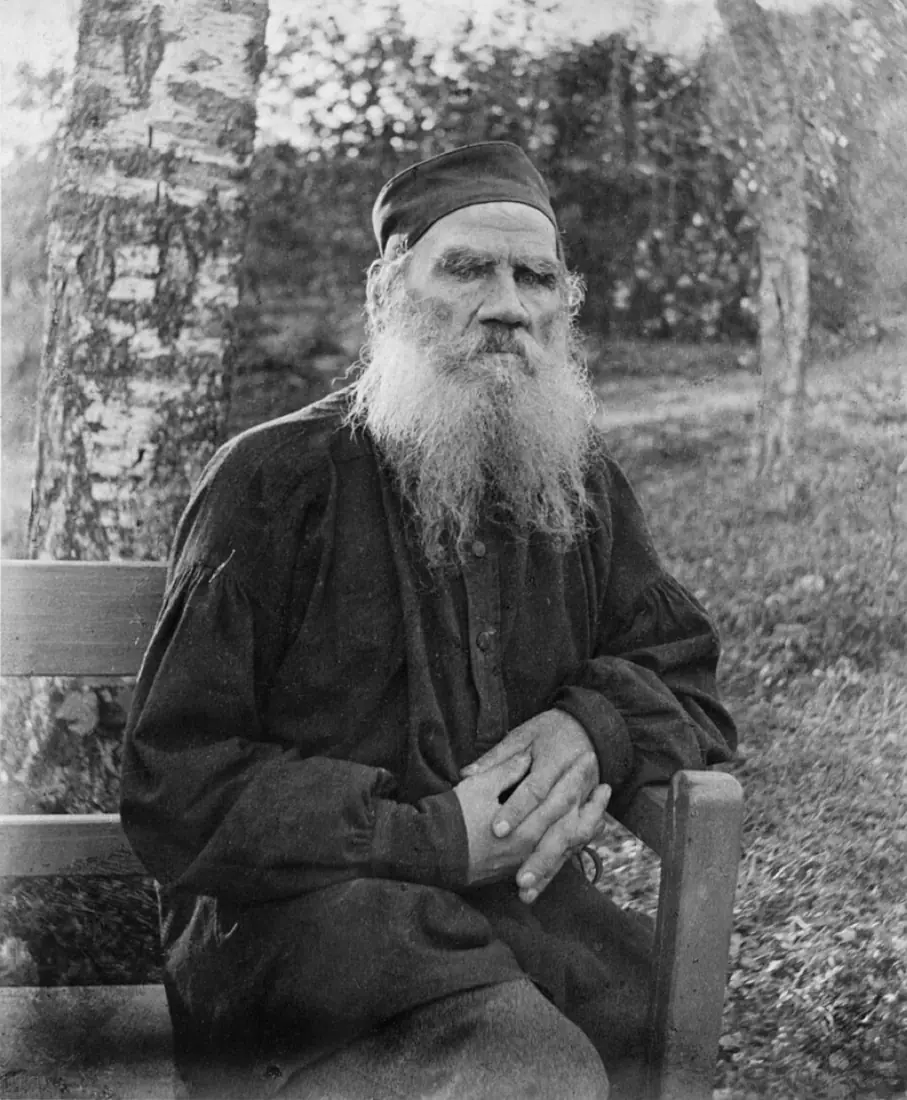
This story is a version of a famous folk-style tale by the Russian writer Leo Tolstoy (1828–1910), whose own title in English is usually "Little Girls Wiser than Men" (written in the 1880s). Tolstoy is best known for the huge novels War and Peace and Anna Karenina, but in his later life he also wrote very short, simple stories for peasant readers. These stories have plain language, very little description and a clear moral. Tolstoy believed that goodness, forgiveness and love of neighbour were the real basis of a good life. (The textbook edition may adapt the original wording; the main events below follow the textbook.)
Summary
Two little friends. On a festival day, two village girls, Akoulya and Malasha, have been dressed in brand-new clothes. One wears a blue dress, the other a yellow printed one, and both have red scarves round their heads. They are on their way to church, and the clothes are the pride of the day, but the children cannot resist playing on the way. Their game begins in a narrow lane between two houses, where muddy water from the farmyards has formed a large puddle.
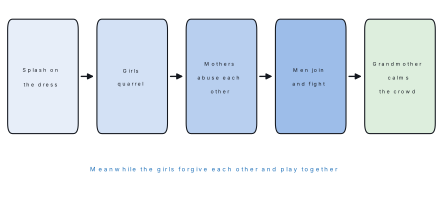
The puddle. Malasha, delighted by the water, is about to splash into it in her shoes and stockings. Akoulya warns her to take them off first, and they walk through the puddle toward each other. Malasha splashes Akoulya's dress by accident. Akoulya is furious and, forgetting her own advice, scolds her friend. Malasha begins to cry. Akoulya's mother and Malasha's mother hear the noise and come out. Each takes her own child's side, and the two women begin to abuse each other.
From children's quarrel to street fight. The quarrel grows. Neighbours come out; the husbands join in; soon the men are shouting and fighting in the street while a crowd gathers. Meanwhile the little girls are forgotten.
The grandmother. Akoulya's grandmother pushes into the crowd and talks to the men. She reminds them that it is a holiday, a time for joy and not for fighting, and asks them to think about what they are doing. Her calm and reasonable words slowly bring the crowd to its senses.
The girls' wisdom. While the grown-ups were quarrelling, the two girls had already forgotten the splash. They had gone off together and were playing a game, laughing as though nothing had happened. The men and women, seeing this, felt ashamed. They saw that the children were wiser than the adults, who had made a big quarrel out of a trivial matter.
Glossary
| Word | Meaning | Example |
|---|---|---|
| lassies | young girls (Scottish/old-fashioned) | The lassies ran to school. |
| finery | fine, expensive clothes | The guests came in their finery. |
| fancy (v.) | to imagine or want | Do you fancy a cup of tea? |
| scrambled | climbed or moved quickly with hands and feet | The cat scrambled up the wall. |
| folly | foolish behaviour | It was folly to cross the river in flood. |
| abusing | speaking to someone in a rude, hurtful way | The drivers were abusing each other. |
| chip | a small piece broken off | A chip of paint fell from the wall. |
| rejoicing | showing great joy | The village was rejoicing at the news. |
Characters
| Character | Qualities |
|---|---|
| Akoulya | A little girl, quick to anger but quicker to forgive; first to give advice, then to scold |
| Malasha | Playful and innocent; cries easily, forgives easily |
| Akoulya's grandmother | Wise, calm, respected; uses reason, not shouting |
| The mothers | Over-protective, quick to take sides; they turn a small thing into a large one |
| The men and neighbours | Hot-tempered; they copy the quarrel; in the end ashamed of themselves |
Themes
Forgiveness and innocence. Children quarrel and make up within minutes. Adults hold grudges. The title calls the girls "wise" because they have the one skill adults often lack: letting go of anger.
How quarrels grow. The fight began with a few drops of mud. Each person who joins adds his own feelings and none of them remembers what it was about. The story is a small model of how families, villages and even nations drift into conflict.
Peace-making through reason. The grandmother does not shout or take sides. She appeals to the common feeling of the festival. In a moral story, the wise person is the one who calms others.
Comprehension questions with model answers
A. Objective questions (1 mark each)
- The two girls were probably dressed in new frocks because [1]athey were going to schoolbthey had to go to churchcit was rainingdthey were going to a wedding
- The girls were caught while running home by [1]aa policemanbAkoulya's grandmothercthe priestdthe farmers
- While the men were busy fighting, the girls [1]acried loudlybran away from the villagecplayed a game togetherdwent back to church
- Write True or False: In the end the men were proud of their fight. [1]
Answers — objective
1. (b) they had to go to church.
2. (b) Akoulya's grandmother.
3. (c) played a game together.
4. False. They were ashamed and saw that they had been guilty.
B. Short questions (2 marks each)
- How were the girls dressed? [2]
- Where did the girls begin to play? [2]
- Why did Akoulya get angry with Malasha? [2]
- Why did the crowd gather in the street? [2]
- How did Akoulya's grandmother try to calm the crowd? [2]
Answers — short
1. They wore brand-new dresses, one blue and the other yellow with a print, and both had red scarves tied round their heads.
2. They began to play in a narrow lane between two houses, where muddy water from the farmyards had made a big puddle.
3. Malasha splashed muddy water on Akoulya's dress while they were walking through the puddle toward each other.
4. The mothers of the girls started to quarrel and abuse each other. The men joined, and the noise and fighting drew a crowd.
5. She pushed into the crowd and spoke to the men, reminding them that it was a holiday, a time for joy and not for quarrelling, and appealing to their good sense.
C. Long questions (4 marks each)
- Why are the girls called wiser than men? [4]
- What lesson do you learn from the story? [4]
Answers — long
1. The girls are called wiser than the men because they solved their problem in the best way. When Malasha splashed Akoulya's dress, both cried for a moment, but they soon forgot it. While their parents and neighbours were shouting and fighting, the girls forgave each other and began to play together happily. The adults, on the other hand, turned a tiny matter into a street fight and had to be calmed by an old woman. The children showed that anger is foolish and forgiveness is wise.
2. The story teaches us that we should forgive and forget small offences. A quarrel that begins with a trivial matter can grow into a serious fight if more people join it with their pride and anger. Children, with their simple hearts, understand this better than adults. We should learn from them to settle disagreements quickly, to avoid carrying grudges, and to value peace and friendship above pride.
11.2 World Record
About the text
"World Record" is a drama — a short play meant to be spoken or acted. It is a comedy set in a television studio, with a presenter, studio audience and contestants. In the story the contest is silly, and the humour comes from irony: people take a pointless contest very seriously. The text introduces a series of comic characters: Mabel Phillips, who tries to break a record for leaning on a brush; Albert Hargreaves, who tries to break the record for standing on one leg in a bucket of boiling soup; Albert's wife, who keeps the soup hot by topping it up; and a man who loses his trousers while taking a bath. The textbook does not name the playwright in the passages I could check; treat it as an unattributed comic sketch.
Summary
The programme is a comedy show in which contestants try to break world records, however odd. Two contestants are performing today. Mabel Phillips is trying to set a record for leaning on a brush. Albert Hargreaves is standing on one leg in a bucket of scalding soup. His wife, Mrs Hargreaves, comes at intervals and pours in fresh boiling soup to keep it hot. Albert has now been standing for seven hours and two minutes; the world record is seven hours and three minutes, so only one minute remains. At this very moment, Mabel pushes him. The comic effect depends on timing: a minute from success, Albert's chance is gone. Other small stories in the show, including that of the man who took off his trousers for a bath and found them gone when he came out, add to the nonsense. The play makes fun of our hunger for fame and our habit of calling silly things "achievements".

Vocabulary and word families
| Verb | Noun | Adjective | Adverb |
|---|---|---|---|
| charm | charm | charming | charmingly |
| scorch | scorcher | scorching | scorchingly |
| sizzle | sizzler | sizzling | sizzlingly |
| beautify | beauty | beautiful | beautifully |
| purify | purity | pure | purely |
| taste | tastiness | tasty | tastefully (or tastily) |
| surprise | surprise | surprising | surprisingly |
sizzling (making a hissing sound as it cooks; very hot) and scorching (burning hot) are close in meaning. Irony means saying or showing the opposite of what is expected, often for a funny or sad effect.
Themes and ideas
Humour and satire. The play laughs at a society that rewards silly stunts with fame. A serious voice describing a foolish act is the main joke.
The value of effort and the role of luck. Albert endured seven hours of pain and loses by one minute. The audience laughs, but the moral side is real: record-breaking can make people take needless risks, and success can be ruined by one small thing.
Ethics of entertainment. Is it right to risk a person's health for a laugh? The drama invites us to think about what is truly worth celebrating.
Comprehension questions with model answers
A. True / False (1 mark each)
- Two people are going to try to break a world record today. [1]
- Michael is one of the contestants. [1]
- Albert broke the world record for standing in a bucket of hot soup. [1]
- The programme is a comedy show. [1]
Answers
1. True.
2. False.
3. False; he was one minute short.
4. True.
B. Short questions (2 marks each)
- Who is Mabel Phillips? [2]
- How do they keep the soup hot? [2]
- How far was Albert from breaking the record? [2]
- How did the man lose his trousers? [2]
- Why do you think Mabel pushed Albert? [2]
Answers — short
1. Mabel Phillips is a contestant in the television studio who is trying to break a world record, by leaning on a brush.
2. Albert's wife, Mrs Hargreaves, comes from time to time and pours more boiling soup into the bucket.
3. He was one minute short. He had stood on one leg for seven hours and two minutes, and the record was seven hours and three minutes.
4. He took off his trousers to have a bath, and when he got out of the bath they were gone.
5. Mabel's push is part of the comedy of the show. It adds a surprise and a laugh at the worst possible moment. (Another valid answer: she wanted to prevent a rival from beating her own record.)
C. Long questions (4 marks each)
- Why is the play called a comedy? Explain with examples. [4]
- Do you think people should risk their health to set world records? Give reasons. [4]
Answers — long
1. The play is a comedy because it treats silly things as very serious. Mabel tries to break a record by leaning on a brush and Albert stands on one leg in boiling soup while his wife keeps the soup hot. The audience is amused by the contrast between the serious attitude and the foolish task. The best joke is that Albert is only one minute short of the record when Mabel pushes him. Funny stories such as the man who lost his trousers in the bath add to the humour.
2. (Open answer.) I do not think people should risk their health for records. A record lasts only for a little time but an injury may last for life. Albert could have burnt his foot badly for no real benefit. Records of skill, such as in athletics or mountaineering, can inspire others, but they should be attempted with training and safety. A sensible person weighs the danger against the benefit.
11.3 Grammar and writing tasks
Grammar I — Positive and negative sentences
An affirmative (positive) sentence says something is true. A negative sentence says something is not true. Changing between them is a common SEE grammar task.
| Tense / form | Affirmative | Negative |
|---|---|---|
| Simple present (be) | She is at home. | She is not at home. |
| Simple present (other verbs) | Ram knows the answer. | Ram does not know the answer. |
| Simple past | He ate many mangoes. | He did not eat many mangoes. |
| Present perfect | I have seen it. | I have not seen it. |
| Modal | They can help her. | They cannot help her. |
| Imperative | Pour much water. | Do not pour much water. |
Rules
- With do/does/did, the main verb goes back to its base form: did not eat, not did not ate.
- Some → any, somebody → anybody, something → anything, always → never, already → yet, too → either in negative sentences. He has something in his bag → He does not have anything in his bag.
- Everybody / all → nobody / not all; both → neither; either … or → neither … nor.
- Words such as never, nobody, nothing, none, hardly, rarely are already negative. Do not add not: He never drinks (not he doesn't never drink).
- All the students did not have to sit is the negative of All the students had to sit (in the textbook sense none had to sit). Didn't have to means "was not required to".
Problem. (a) Change to negative: "Ram visits me often." (b) Change to affirmative: "There is not anyone in the locality living in luxury."
Solution. (a) Visits needs does. Often becomes rarely or not often. Answer: Ram does not visit me often (or Ram rarely visits me). (b) Not any one ↔ someone. Answer: There is someone in the locality living in luxury.
I don't know nothing means "I know something" in strict grammar. Write I don't know anything or I know nothing.
Exercise 1. Change into negative sentences.
- My sister lives with my parents.
- Ram knows the answer.
- The boy killed the cockroach with his shoe.
- He ate many mangoes.
- We made much money.
- The rich are always happy.
- Everybody can help her.
- She has already finished her work.
- He apologised for his misconduct.
- Ram bought some books.
1. My sister does not live with my parents.
2. Ram does not know the answer.
3. The boy did not kill the cockroach with his shoe.
4. He did not eat many mangoes.
5. We did not make much money.
6. The rich are not always happy.
7. Nobody can help her (or Not everybody can help her).
8. She has not finished her work yet.
9. He did not apologise for his misconduct.
10. Ram did not buy any books.
Exercise 2. Change into affirmative sentences.
- Ram does not perform well.
- The dog did not bite Ram.
- He never drinks wine.
- Don't pour much water in the curry.
- Nobody came to me.
- She does not have anything in her bag.
- Neither the boy nor the man goes to school.
- He does not work with us.
1. Ram performs well.
2. The dog bit Ram.
3. He always drinks wine.
4. Pour a little water in the curry.
5. Somebody came to me.
6. She has something in her bag.
7. Either the boy or the man goes to school.
8. He works with us.
Grammar II — Subject–verb agreement
The verb must agree with its subject in number: a singular subject takes a singular verb; a plural subject takes a plural verb. Most mistakes occur with unusual subjects.
| Rule | Example |
|---|---|
| A number of + plural noun → plural verb | A number of soldiers were injured. |
| The number of + plural noun → singular verb | The number of deceased soldiers is not recorded. |
| Collective noun as one unit → singular | A pack of lions is approaching. The team is ready. |
| Words with two parts (pants, scissors, trousers, glasses) → plural | His pants were torn. |
| The + adjective meaning a group → plural | The truthful are trustworthy. |
| Infinitive or gerund as subject → singular | To cry is no solution. Walking is good exercise. |
| Here / there + verb: the verb agrees with the noun that follows | Here lies the tomb. There are two books. |
| Either … or / neither … nor: verb agrees with the nearer subject | Either she or her friends are responsible. Neither she nor I am getting lunch. |
| Each, every, everyone, everything, nobody → singular | Each of the dancers twirls. Everything is fine. |
| None → plural (or singular if "not one") | None are under the sun. |
| Subjects joined by and → plural | Ram and Hari are friends. |
| Subject + with / together with / as well as → verb agrees with the first subject | The teacher, with her students, is on the trip. |
| Quantity or amount as a whole → singular | Ten kilometres is a long walk. |
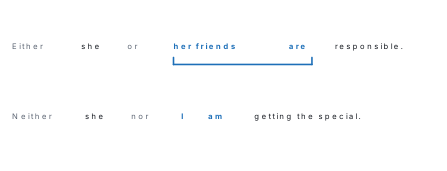
A number behaves like several (plural). The number behaves like the total (singular). Replace the phrase mentally and the right verb is obvious.
Problem. "Either the sculpture or the paintings ______ (was / were) in the museum today."
Solution. With either … or, the verb agrees with the nearer subject, paintings (plural). Answer: were.
In "The box of chocolates is on the table", the subject is box, not chocolates. Find the real subject and ignore the phrase between subject and verb.
Exercise 3. Choose the correct verb.
- A number of students (was / were) absent today.
- The number of tigers in Nepal (has / have) increased.
- A flock of birds (is / are) flying over the lake.
- My shorts (was / were) too small.
- The poor (needs / need) our help.
- Learning new words (is / are) fun.
- Here (lie / lies) the remains of an ancient temple.
- Neither the teacher nor the students (was / were) late.
- Each of the boys (has / have) a book.
- Everyone (is / are) happy.
- The captain, together with his players, (is / are) at the ground.
- Two hours (is / are) enough for this test.
1. were
2. has
3. is
4. were
5. need
6. is
7. lies
8. were
9. has
10. is
11. is
12. is
Writing I — A story with a moral
A story has a beginning (characters and setting), a middle (a problem and how it grows), an end (the result) and a moral — the lesson. Use the past tense and time-linkers: once upon a time, one day, suddenly, after that, at last. Keep it to one clear problem and give the characters names.
| Part | What to write |
|---|---|
| Opening | who, where, when |
| Problem | what goes wrong |
| Climax | the most exciting moment |
| Ending | how it is resolved |
| Moral | one-sentence lesson |
Model story — The sparrow and the farmer.
Once upon a time in a village in the hills of Gorkha lived an old farmer named Dhan Bahadur, who was hard-working and kind. One day, while working in the field, he found a small sparrow with a broken wing. He carried it home, bound its wing carefully and gave it food and water. In a few weeks the sparrow was strong again, and it stayed near his house, singing every morning.
One morning a flock of crows attacked the fresh seeds in his field. Dhan Bahadur shouted and waved his arms, but the crows would not go. Then the sparrow rose into the sky, chirping loudly. Other sparrows from the trees joined it, and together they drove the crows away. The farmer saved his crop.
From that day on he never forgot that a small kindness can come back in a great way.
Moral: No act of kindness, however small, is ever wasted.
Writing II — Message of condolence
A condolence message expresses sorrow after a death. It is short, sincere and respectful. Do not describe the death in detail. Include: the sad news, praise of the person, sympathy with the family and a wish for peace.
Task. Write a message of condolence on the death of a senior folk singer and actor, using these clues: passed away at his residence — incredible loss for the Nepali art sector — super-hit folk songs — acted in over a hundred movies — heartfelt condolences.
Model.
Heartfelt Condolences
We are deeply saddened to learn that the senior folk singer and actor passed away at his residence yesterday. His death is an incredible loss for the Nepali art sector.
Through his super-hit folk songs he carried the voice of our villages into every home. He also acted in more than a hundred movies, and his warm presence on the screen will not be forgotten.
In this hour of grief we extend our heartfelt condolences to his family, friends and admirers. May his soul rest in peace, and may his art continue to inspire us.
Principal and students, Sunrise Secondary School
Writing III — Letter of sympathy
A sympathy letter is written to a friend or relative who is ill, injured or has suffered a loss. Use the layout of an informal letter: address and date at top right, salutation (Dear Ram,), body, subscription (Yours sincerely, / Your friend,) and name.
Task. You and your friend Ram work in a factory. He broke his hand at work on 20 October 2022. Write a letter of sympathy.
Model.
Birgunj 25 October 2022
Dear Ram,
I was very sorry to hear that a machine failure broke your hand on 20 October. I felt shocked when I heard the news.
We have worked together for three years, and I have always known you as a regular and dutiful colleague. Accidents can happen to anyone, but it is hard to see it happen to a friend. I hope you are being well looked after in hospital and that the pain is easing.
Please do not worry about your work. I shall try to cover your duties until you return. If you need anything from home or the market, tell me and I shall bring it.
I wish you a speedy recovery. Take good rest, follow the doctor's advice and come back stronger.
Your friend, Hari
Be gentle and practical. Avoid long philosophy. Offer one clear help. End with a wish for recovery.
Chapter summary
- "Wisdom of Little Girls" (a version of Tolstoy's tale): a splash in a puddle leads to a street fight; the girls forgive, the adults are ashamed; the grandmother calms the crowd. Moral: forgive and forget; avoid pride.
- "World Record" is a comic drama; Albert stands one-legged in hot soup for 7 h 2 min against a record of 7 h 3 min; Mabel pushes him. It satirises the craze for records.
- Negative: do/does/did + base verb, not after be/have/modal; some→any, always→never, either→neither.
- Agreement: a number of → plural; the number of → singular; either/neither … or/nor → nearer subject; each, everyone → singular; the + adjective → plural; gerund/infinitive subject → singular.
- A story has opening, problem, climax, ending and moral.
- A condolence message expresses sorrow, praises the person and wishes peace; a sympathy letter uses informal letter layout.
Practice questions
Reading comprehension
Once a poor boy found a purse with five hundred rupees on the road. He looked round, but nobody was near. He was hungry, and the money could have bought food for a month. Still, he took the purse to the police station. The owner, a shopkeeper, came the next day and, with tears in his eyes, thanked the boy and offered a reward. The boy refused at first but accepted a school bag, because he had none.
- What did the boy find? [1]
- Where did he take the purse? [1]
- Write True or False: The boy kept the money. [1]
- Why did the boy hesitate to take a reward? [2]
- What did he accept in the end, and why? [2]
- What does the story teach us? Write in about 50 words. [4]
Answers
1. A purse with five hundred rupees.
2. To the police station.
3. False.
4. He had only done his duty and thought honesty should not be paid for.
5. A school bag, because he did not have one.
6. Honesty is more valuable than money. The boy was poor and hungry yet did not take what belonged to someone else. His honesty was rewarded, and the story shows that doing right brings respect and peace of mind.
Grammar
- Make negative: "The dog barked at the stranger." [1]
- Make affirmative: "Nobody was present at the meeting." [1]
- Choose: "The news (is / are) true." [1]
- Choose: "A number of books (is / are) missing." [1]
- Choose: "Neither Hari nor his brothers (has / have) arrived." [1]
- Make negative: "She has already left." [1]
- Correct: "The number of students are increasing." [1]
- Choose: "Mathematics (is / are) my favourite subject." [1]
- Make affirmative: "He never tells a lie." [1]
- Correct: "Each of the girls have a prize." [1]
Answers
1. The dog did not bark at the stranger.
2. Somebody was present at the meeting.
3. is
4. are
5. have
6. She has not left yet.
7. The number of students is increasing.
8. is
9. He always tells a lie.
10. Each of the girls has a prize.
Writing
- Write a story of about 150 words on the proverb "Honesty is the best policy". [5]
- Write a message of condolence on the death of a respected teacher of your school. [5]
- Your friend has been ill for two weeks. Write a letter of sympathy to him/her. [5]
Outline for answers
1. A poor woodcutter's axe falls in the river; he is honest and gets a golden axe in return, while his greedy neighbour loses his own. Moral: honesty is the best policy.
2. State news and date, praise the teacher's care and teaching, sympathise with the family, wish peace.
3. Informal letter: sorry to hear, hope for recovery, offer to share notes, wish well.
Practise more: English question bank