Unit 3 · Units · 21 min read
Unit 3: Health and Wellness
What the syllabus asks for 3
- A Letter from a Patient
- A Healthy Diet for a Healthy Life
- Grammar and writing tasks of the unit
Health is not only about doctors and medicine; it is also about kindness, communication and the food we eat. In this unit a worried mother complains, in a letter, about the way a hospital treated her sick baby, and a European speaker explains why healthy eating needs research and teamwork. You will practise reporting commands and requests, using a wider range of reporting verbs, writing an apology email and drafting a speech.
Reading: matching words and meanings, true/false, short answers about the writer's complaint and the speaker's message. Grammar: reported commands, requests and advice (told, asked, requested, advised + person + to / not to). Writing: an email, a speech, or a formal letter.
3.1 A Letter from a Patient
About the text
"A Letter from a Patient" is a personal letter from the mother of a very sick baby to the people who looked after her in hospital. Its purpose is not to attack health workers but to remind them how their behaviour feels to a frightened family. It is written in the first person and in an emotional but controlled voice. It is useful as a model of a letter of complaint that wants improvement, not revenge.
What the text says
The writer's nightmare begins when her baby, only a few weeks old, develops a very high fever and has to be admitted to the paediatric (children's) ward. She is exhausted and frightened and needs help, but she finds that the staff are more concerned with their own affairs than with the child.
She lists the weaknesses she saw.
- Bad-mouthing. Staff of different departments and units spoke ill of one another in front of patients' families instead of working harmoniously as a team.
- Lack of priority. When she asked for help, a nurse said she was "so busy today". The nurse did not say, "Your daughter is not a priority", but the writer felt exactly that.
- Repeated questions and careless paperwork. She was asked the same questions again and again ("Was the delivery normal?" "Was the baby premature?"), which showed that nobody read the chart; the chart even confused the baby's gender, and people referred to her daughter by the wrong sex.
- No human warmth. Staff talked about their own problems and wishes but did not show interest in her feelings.
Even so, the writer ends with respect. She knows that health work is a noble, precious career. Patients and their families, she says, are vulnerable; they trust health workers to be honest, serious and caring. She asks the hospital staff to remember that, for the family, each patient is the most important person in the world.
Vocabulary
| Word | Meaning | Example |
|---|---|---|
| nightmare | a very unpleasant or frightening experience | The long night in the ward was a nightmare. |
| paediatric | relating to the medical care of children | The paediatric ward was full of toys. |
| intravenous | into or connected to a vein | An intravenous drip gave the baby fluids. |
| priority | something regarded as more important than other things | A patient in danger is a priority. |
| medication | treatment using drugs | She gave the baby her medication on time. |
| confidante | a person with whom private matters are discussed | The nurse became her confidante. |
| deprivation | lack of something considered a necessity | Sleep deprivation made her weak. |
| vulnerable | in need of special care, support or protection | Newborn babies are vulnerable. |
| dreadful | very bad or unpleasant | The waiting room was dreadful. |
Themes and ideas
- Empathy. Health workers must care about how patients feel, not only about treatment.
- Teamwork and professionalism. Staff who gossip about colleagues lose the trust of families.
- Accuracy. Careless records are dangerous: a wrong chart can mean a wrong treatment.
- Vulnerability. A frightened parent notices every word and tone.
Questions and model answers
Objective questions (1 mark each)
- Write True or False: The writer was happy with the service of the health workers. [1]
- Write True or False: The hospital chart was unclear about the baby's gender. [1]
- "Vulnerable" means [1]aangrybin need of special carecrichdhealthy
- "Intravenous" means [1]agiven by mouthbinto a veincon the skindin the ear
Answers
1. False.
2. True.
3. (b).
4. (b).
Short-answer questions (2 marks each)
- What was the nightmare for the author? [2]
- According to the author, what was the main weakness of the hospital staff? [2]
- Did the nurses really say, "Your daughter is not a priority"? Why did the author think so? [2]
- List the questions the author was asked frequently in the hospital. [2]
- What do patients and their families expect from health workers? [2]
Model answers
1. Her baby had a very high fever and had to be admitted to hospital; this fear and exhaustion, together with the poor treatment, was her nightmare.
2. The staff did not work as a harmonious team and did not show care for the patient's family; they spoke badly about other staff and units instead.
3. No, the nurses did not say it in words. The writer felt it because the nurse said she was too busy, which showed that her daughter was not treated as a priority.
4. "Was the delivery normal?" and "Was the baby premature?"
5. They expect health workers to be honest, serious and caring, and to give each patient's needs the first place.
Long-answer questions (4 marks each)
- What is the main purpose of the letter, and does it succeed? [4]
- If you become a health worker in the future, what would be your priority? How would you treat patients and their families? [4]
Model answers
1. The purpose is to make health workers aware of how careless behaviour hurts patients and their families, and to ask them to improve. It succeeds because the writer is specific: she names bad-mouthing, a busy nurse, repeated questions and a wrong chart. She does not insult anyone and she closes by praising the work. Such a respectful complaint is more likely to be listened to.
2. My first priority would be the patient's life and comfort. I would treat every patient equally, whether rich or poor, listen carefully and explain things in simple words. I would read the chart before I spoke so that no family had to repeat the story. I would treat families kindly because they are frightened, and I would never gossip about colleagues. I would also keep records accurate. In this way I would earn trust and give good care.
3.2 A Healthy Diet for a Healthy Life
About the text
This text is a speech, not an essay. It was delivered to an audience of European officials and researchers at a conference about a research-and-innovation programme called the Joint Programming Initiative "A Healthy Diet for a Healthy Life". The speaker's aim is to persuade the member states of the European Union (EU) to cooperate. Notice the typical features of a speech: it greets the audience, uses we and you, repeats key ideas, asks for action and ends by thanking the listeners.
What the speaker says
She begins with a subject that is "never out of the media": food and health. Obesity is, she says, the greatest public-health challenge today. Poor diet and low physical activity are on the rise, and the trend among children in the EU has been getting worse for three decades. Poor diet leads to diseases such as type 2 diabetes, cardiovascular diseases, some cancers and, later in life, neurological disorders. People can prevent many of these by adopting better lifestyles and healthier diets.
Research is the key to this. Scientists must learn how diet affects health, how to measure it (through biomarkers), and how to change people's habits. Because the problem has many sides — biology, food industry, economics, psychology — a multidisciplinary approach is necessary. The speaker explains that the innovation chain begins with researchers, goes through companies and ends with consumers and patients.
The Joint Programming Initiative brings together the knowledge of member states so that they do not repeat each other's work. Europe's research programme Horizon 2020, worth about 80 billion euros, can fund top-level research on nutrition, health, diet-related diseases and ageing. If it is used effectively, the results will be new products, treatments, services and strategies, healthier citizens and opportunities for competitive European businesses. She ends by saying she expects the conference to take this work forward and thanks the audience.
Vocabulary
| Word | Meaning | Example |
|---|---|---|
| wonderfood | a food thought to be very good for health | Many people call blueberries a wonderfood. |
| cardiovascular | relating to the heart and blood vessels | Walking reduces cardiovascular disease. |
| bioeconomy | the part of the economy that uses renewable biological resources | Farming is part of the bioeconomy. |
| demographic change | change in the structure of a population | Demographic change means more old people. |
| multidisciplinary | involving people from different subjects | The team is multidisciplinary. |
| inequality | difference in income or wealth | Economic inequalities affect diet. |
| neurological | relating to the brain, spine and nerves | Epilepsy is a neurological disorder. |
| biomarker | a measurable sign of a biological condition | Blood sugar is a biomarker for diabetes. |
| unprecedented | never known or done before | Unprecedented floods hit the town. |
| dramatically | suddenly and very greatly | Prices rose dramatically. |
| diagnosis | identification of a disease | Early diagnosis saves lives. |
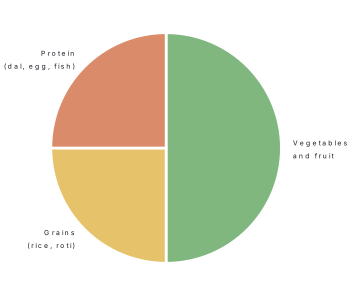
A healthy plate
Nutrition experts commonly advise that half of every meal should be vegetables and fruit, about a quarter whole grains and about a quarter protein (pulses, eggs, fish, meat), with little sugar, salt and fried food and plenty of water.
Questions and model answers
Objective questions (1 mark each)
- The greatest public health challenge at present, according to the speaker, is [1]amalariabobesitycaccidentsdpollution
- Horizon 2020 is [1]aa hospitalbEurope's research and innovation programmeca food brandda medicine
- The healthcare innovation chain begins with [1]aresearchersbpatientscshopkeepersdlawyers
- The speech is meant to [1]asell foodbappeal to EU members to collaborate in researchcpraise doctorsdtell a story
Answers
1. (b).
2. (b).
3. (a).
4. (b).
Short-answer questions (2 marks each)
- According to the speaker, what is the cause of obesity among children in the EU? [2]
- What should people do to prevent diseases like type 2 diabetes? [2]
- What is Horizon 2020? [2]
- Why is research important in the fight against health challenges? [2]
- What result can Horizon 2020 bring if it is used effectively? [2]
Model answers
1. Poor diet and low physical activity, which have been getting worse over the last three decades.
2. They should adopt healthier lifestyles — better food and more activity.
3. It is Europe's research and innovation programme with a budget of about 80 billion euros.
4. Research gives the knowledge to prevent and manage long-term illnesses and to design products and policies that work.
5. It can bring excellent progress in research and innovation for healthy diets and healthy lives: new products, treatments, services and strategies.
Long-answer question (4 marks)
- Do you think people of the EU will benefit from this conference? Give reasons. [4]
Model answer
1. Yes, I think they will. The conference is meant to bring the knowledge of many countries together so that research is not repeated. With the funding of Horizon 2020, scientists can find out how food affects diseases such as diabetes and heart disease. This knowledge can be turned into healthier food products, better treatments and good advice for citizens. It will also give European companies new business, creating jobs. In the long run, people will live healthier and longer lives.
3.3 Grammar and writing tasks of the unit
Grammar I: Reported commands, requests and advice
A command or request in direct speech uses the imperative mood (Do it!, Please help me.). In reported speech it becomes reporting verb + person + to-infinitive (positive) or + not to + infinitive (negative). There is no backshift because there is no tense to shift.
| Direct | Reported |
|---|---|
| "Do your homework!" | The teacher told me to do my homework. |
| "Don't make a mess!" | My mother told me not to make a mess. |
| "Please help me fix this machine." | She requested me to help her fix the machine. |
| "Don't switch on the fan, please." | The electrician requested me not to switch on the fan. |
| "You should stop smoking." / "Don't smoke!" | The doctor advised him not to smoke. |
| "Be not afraid, noble prince," said the Guru. | The Guru told the prince not to be afraid. |
| "Let me do my work." | He asked/requested me to let him do his work. |
| "Let's play a friendly football match," said the coach. | The coach suggested/proposed playing a friendly football match. |
Choose the verb that matches the tone
| Direct sentence has | Reporting verb |
|---|---|
| a strong order | ordered, commanded, told |
| please, would you, could you | requested, asked, begged |
| advice (you should, if I were you) | advised, suggested, urged |
| a warning | warned |
| Let's... | suggested / proposed + -ing |
Do not write told that with a command (He told that I go). Do not keep please (use requested instead). With a negative, write not to + verb (told me not to run), never to not.
Problem. Report: Madan said to his friend, "Please help me with money."
Solution. The word please shows a request, so use requested; the person helped is his friend; positive imperative → to help. Madan requested his friend to help him with money.
Problem. Report: The teacher said to the boys, "Read silently."
Solution. A plain command → told. The teacher told the boys to read silently.
Problem. Report: My teacher said to me, "Don't look behind."
Solution. Negative command → told + person + not to. My teacher told me not to look behind.
Exercise A — Change into reported speech
- "Please help me fix this machine," she said to me.
- "Don't switch on the fan, please," the electrician said to me.
- "Lend me some money, please," she said to him.
- "Do your homework!" the teacher said to me.
- "Don't smoke!" the doctor said to him.
- The General said to his troops, "Guard the fort."
- Aaswin said to the teacher, "Please excuse me, madam."
- The guide said to the visitors, "Follow me carefully."
- Mother said to the daughter, "Get ready to receive the guests."
- Father said to me, "Do not tell a lie."
- The monk said to us, "Give up bad habits."
- The coach said, "Let's play a friendly football match."
1. She requested me to help her fix the machine.
2. The electrician requested me not to switch on the fan.
3. She requested him to lend her some money.
4. The teacher told me to do my homework.
5. The doctor advised him not to smoke.
6. The General ordered his troops to guard the fort.
7. Aaswin requested the teacher to excuse him.
8. The guide told the visitors to follow him carefully.
9. Mother told the daughter to get ready to receive the guests.
10. Father told me not to tell a lie.
11. The monk advised us to give up bad habits.
12. The coach suggested playing a friendly football match.
Grammar II: Reporting verbs in different kinds of sentences
Real reports mix statements, questions and commands. The right reporting verb tells the reader what the speaker was doing.
| Sentence type | Typical reporting verbs and patterns |
|---|---|
| statement | said / told + that; explained, replied, added, announced, admitted |
| question | asked / wanted to know / inquired + if, whether, wh-word |
| command, request | told, ordered, requested, asked + object + to |
| advice | advised, suggested, urged + object + to |
| warning | warned + object + (not) to |
| promise, offer, refusal | promised, offered, refused + to |
| thanks, apology, congratulation | thanked / apologised / congratulated + object + for -ing |
Said is followed by that or to someone (said to me); told needs an object (told me). Use advised, warned and told with an object.
Exercise B — Circle the correct word
- The doctor (told / said) me to do some exercise every day.
- My mother (asked / told) me whether I had finished my homework.
- The pilot (warned / advised) the passengers not to leave their seats.
- He (apologised / promised) for losing my book.
- The headteacher (said / told) that the school would remain closed on Friday.
1. told.
2. asked.
3. warned.
4. apologised.
5. said.
Exercise C — Report using the verb in brackets
- "You should drink more water," the doctor said to me. (advised)
- "I will help you with the project," said Rina to me. (promised)
- "Well done, Binod! You have won the match," said the coach. (congratulated)
- "Don't touch the wire," said the electrician. (warned)
- "Shall I carry your bag?" said the boy to the old woman. (offered)
1. The doctor advised me to drink more water.
2. Rina promised to help me with the project.
3. The coach congratulated Binod on winning the match.
4. The electrician warned us not to touch the wire.
5. The boy offered to carry the old woman's bag.
Writing I: An email of apology
An email has a subject line, a salutation, a short body and a closing. Formal emails are polite, use full sentences and say clearly why you are writing. An apology email should (1) say sorry plainly, (2) state what went wrong, (3) say what you will do to put it right, and (4) end politely.
Task. Imagine you are one of the hospital staff. Write an email to the patient's mother apologising for your behaviour and assuring her of improvement.
To: the patient's mother Subject: Our sincere apology and our promise to improve
Dear Madam,
I am writing on behalf of the staff of the children's ward. We have read your letter with great concern, and I want to apologise sincerely for the way you and your baby were treated.
You were right to expect honesty, patience and care. Instead, our staff were too busy to help you quickly, asked you the same questions repeatedly, recorded your baby's details wrongly and spoke badly of one another in front of you. This was unprofessional, and we are deeply sorry for the worry it caused you at such a difficult time.
We have taken the following steps. We are training all staff in communication and patient care. Each patient's chart will be checked by two people. Team meetings will be held every week so that departments cooperate. A nurse will be appointed to speak to every family each day.
We wish your baby a speedy recovery. If you would like to talk to us about any other matter, please contact me directly.
Yours sincerely, A member of staff, Children's Ward
Writing II: A speech
A speech is written to be heard. Open with a greeting and a hook; state the topic; use short, clear sentences, repetition and rhetorical questions; give two or three main points; close with a summary or appeal and a thank-you.
Task. Obesity has become a matter of concern. Draft a speech on obesity answering: What are its primary causes? What are its consequences? What should an individual do to avoid it?
Respected principal, teachers and dear friends,
Good morning. Today I want to talk about a quiet problem that is growing in our country and in the world: obesity.
What causes it? Mainly two things: eating too much unhealthy food, such as fast food, sweets and fried snacks, and moving too little. Many of us sit for hours with mobile phones and travel even short distances by motorbike.
What are the consequences? Obesity can lead to diabetes, high blood pressure and heart disease. It makes us tired, lowers self-confidence and costs families a great deal in medical bills.
What can each of us do? First, eat a balanced diet with more vegetables, fruit and pulses and fewer sugary drinks. Second, play or walk for at least thirty minutes every day. Third, sleep well and drink enough water.
Friends, a healthy body is the first wealth. Let us start today. Thank you.
Chapter summary
- A Letter from a Patient: a mother's respectful complaint about a hospital — bad-mouthing between staff, a busy nurse who made the baby feel "not a priority", repeated questions and a wrong chart. Message: health workers must be honest, serious and caring.
- A Healthy Diet for a Healthy Life: a speech asking EU member states to cooperate on research; obesity is the greatest public-health challenge; Horizon 2020 (about 80 billion euros) can fund the research; a multidisciplinary approach is needed.
- Reported commands: reporting verb + object + (not) to + infinitive; no backshift; choose told, ordered, requested, advised, warned, suggested by tone.
- Said + that; told + object + that; asked + if/whether.
- An apology email: sorry, what went wrong, what you will do, polite close. A speech: greeting, topic, main points, appeal, thanks.
Practice questions
Objective questions (1 mark each)
- The word "priority" means [1]asomething done lastbsomething regarded as more importantca dutyda bill
- The healthcare innovation chain begins with [1]apatientsbresearcherscshopsdschools
- "Don't smoke!" the doctor said to him. → The doctor ____ him not to smoke. [1]asaidbadvisedcasked thatdanswered
- Which one is a feature of a speech? [1]aa headlineba greeting to the audienceca datelineda by-line
Answers
1. (b).
2. (b).
3. (b).
4. (b).
Short answer questions (2 marks each)
- Why did the writer feel that her daughter was not a priority? [2]
- Why is a multidisciplinary approach needed? [2]
- Report: "Please open the window," Rohan said to Sita. [2]
- Report: The nurse said to the patient, "Don't eat anything before the test." [2]
Answers
1. Because a nurse said she was too busy, so help for the baby did not come quickly.
2. Because health problems such as obesity have biological, social, economic and psychological sides, so experts from several subjects must work together.
3. Rohan requested Sita to open the window.
4. The nurse told the patient not to eat anything before the test.
Long answer questions (4 marks each)
- Write an email to a friend who is unwell, suggesting how to stay healthy. [4]
- Draft a short speech (about 120 words) on "The Importance of Exercise for a Healthy Life". [4]
Answers
1. Outline: subject (Get well soon); greeting; sympathy; three pieces of advice (rest, healthy food, medicines on time and a doctor visit); a wish to see him soon; closing.
2. Outline: greeting; hook (a healthy mind lives in a healthy body); three benefits (strong heart and muscles, better sleep and mood, lower risk of diabetes and obesity); a call to action (thirty minutes a day); thanks.
Practise more: English question bank