Unit 18 · Units · 26 min read
Unit 18: Media and Entertainment
What the syllabus asks for 3
- Hachi: A Dog's Tale
- Interesting Social Media Stories
- Grammar and writing tasks of the unit
Films, television, music and social media fill a large part of our free time, and they shape what we think and feel. This last unit of the book looks at both sides of the media. The first text, "Hachi: A Dog's Tale", is a review of a film based on the true story of a dog who waited for his dead master for ten years. The second, "Interesting Social Media Stories", shows the good that social media can do. In grammar you will study how to ask questions and causative verbs (have, get, make, let). In writing you will compose a film review and an essay on the impact of social media.
From the review: facts about the film (director, story, themes, strengths and weaknesses) and your own opinion. From the social-media text: the four or five stories and what each shows. In grammar: correct word order in questions and the right causative construction. In writing: a review with a title, rating, summary, evaluation and recommendation, and a balanced essay that gives both advantages and disadvantages.
18.1 Hachi: A Dog's Tale
About the text
"Hachi: A Dog's Tale" is a film review: a piece of writing in which a critic describes a film, judges it and tells readers whether it is worth watching. The film is the 2009 American drama Hachi: A Dog's Tale, directed by Lasse Hallström and starring Richard Gere as a college professor. It is an American remake of a Japanese film, Hachikō Monogatari (1987), and both films are based on a true story.
The true story behind the film
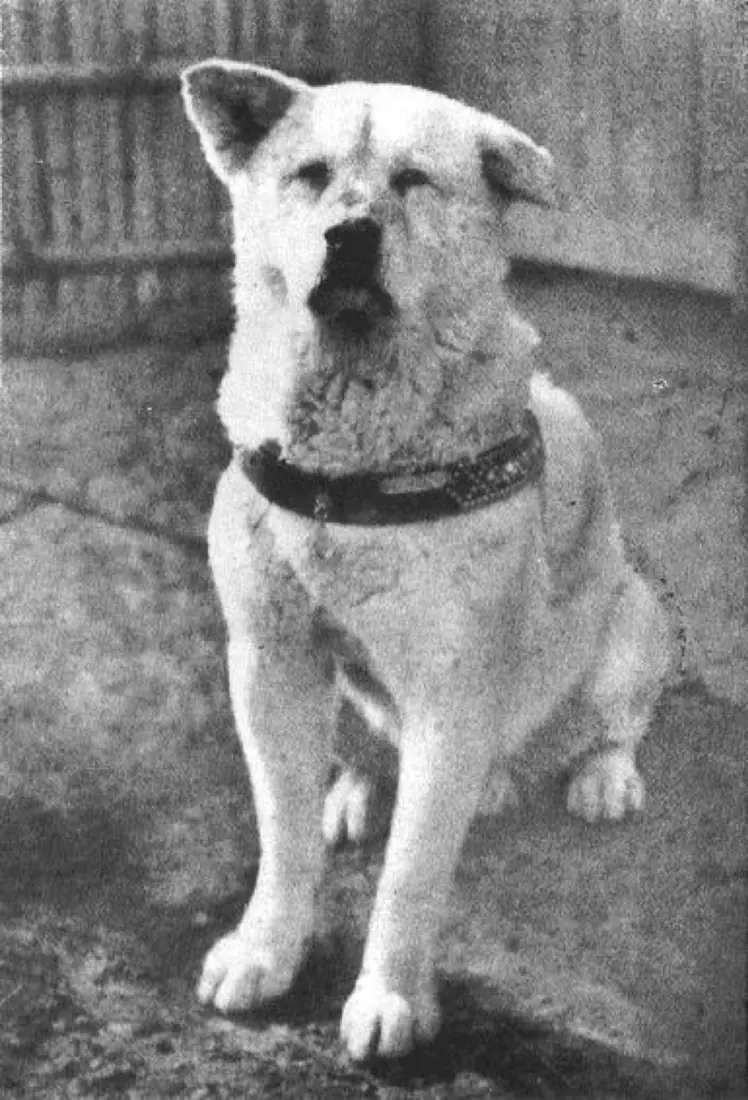
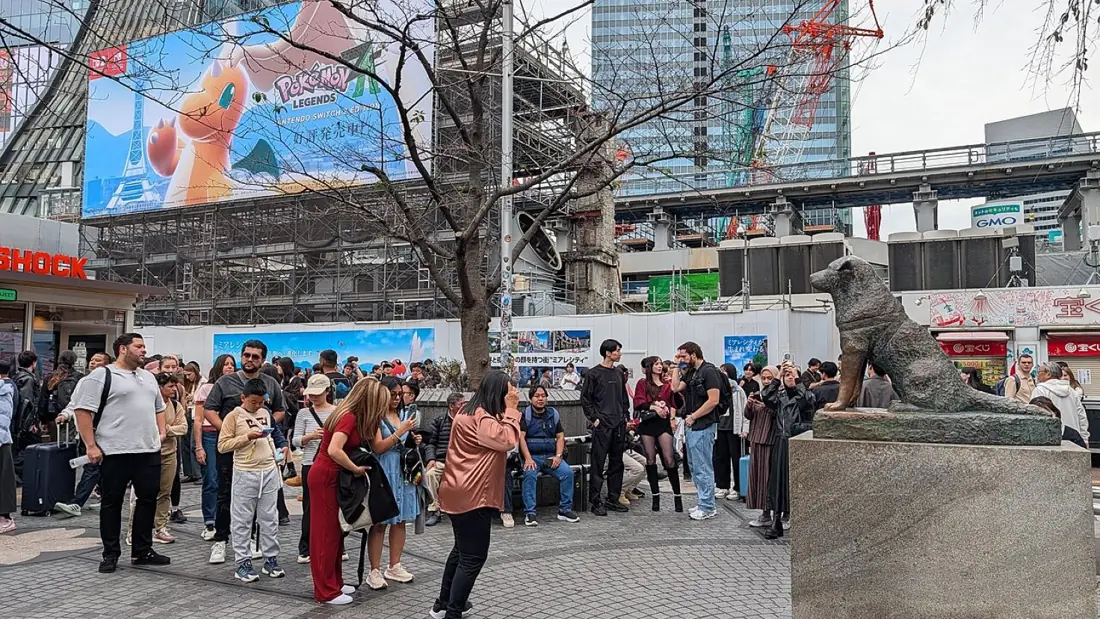
Hachikō (1923–1935) was an Akita dog in Tokyo, owned by Professor Hidesaburō Ueno of the University of Tokyo. Each day the dog accompanied his master to Shibuya Station in the morning and met him there when his train returned in the evening. In May 1925 the professor died suddenly at work and never came back. Hachikō kept returning to the station every evening for nearly ten years, until he died in March 1935. His loyalty touched the people of Tokyo, who fed him. In 1934, during his lifetime, a bronze statue of Hachikō was erected at the station. The present statue, made in 1948, stands there today, and Shibuya's "Hachikō exit" is a popular meeting point.
Summary of the review
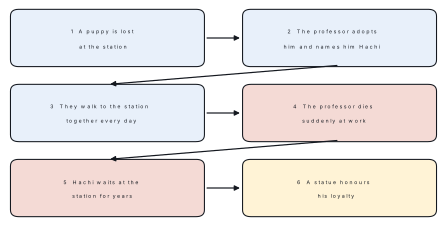
The story. In the film, Parker Wilson, a college professor, finds a lost Akita puppy at a railway station in a small American town. Nobody comes to claim the dog, and Parker, although his wife is at first reluctant, adopts him. He names the dog Hachi, the Japanese word for "eight", a lucky number. The two become inseparable. Every day the dog goes with Parker to the station and waits for him to return, and every evening they walk home together. One day the professor dies suddenly at the college. Hachi waits at the station that evening, and the next, and for years after, in rain, snow and sun, until the day he himself dies.
What the reviewer admires. The reviewer praises the strong bond between the dog and his master, which touches the hearts of the audience, and the faithfulness that the dog shows. The film is an emotional story that deals with love, devotion and loyalty, shown through a dog. It is a family film, yet it is different from other family films because it avoids cheap comedy and builds its power from quiet scenes. The reviewer also admires the way the film upholds traditional values of marriage and family.
What the reviewer dislikes. The reviewer criticises a few details of the film, such as the exchanges of kisses between adult characters and the sipping of champagne, which some parents may not want their children to see.
Conclusion. The statue of Hachikō was made to show faithfulness and loyalty, and the film honours that message. Overall, the review treats the film as a moving, family-friendly story whose strengths outweigh its small faults.
Glossary
| Word | Meaning | Example |
|---|---|---|
| unwavering | never changing or growing weaker | He showed unwavering support. |
| devotion | great love and loyalty | Her devotion to her family is clear. |
| commuter | a person who travels regularly to work | Commuters crowd the train each morning. |
| vendor | a person who sells goods | A vendor sold tea outside the station. |
| adaptation | a film or play made from another work | The film is an adaptation of a novel. |
| reinforce | to strengthen | The story reinforces the value of loyalty. |
| passionate | showing strong feeling | A passionate speech. |
| cinematic | connected with films | Cinematic techniques. |
| secular | not connected with religion | A secular state. |
Characters and themes
| Character | Role |
|---|---|
| Hachi | The Akita dog; symbol of love, devotion and loyalty |
| Parker Wilson | The professor who adopts him; kind, calm, devoted |
| The wife and family | Show family life and the traditional values of marriage |
| Station staff and vendors | The community that comes to care for Hachi |
Themes: loyalty beyond death; the bond between humans and animals; grief and memory; the values of family and community.
Comprehension questions with model answers
A. True / False (1 mark each)
- Laura Busch is one of the characters in the movie. [1]
- The dog is a symbol of love, devotion and loyalty. [1]
- The story of the movie is based on a real incident. [1]
- Showing the traditional values of marriage is a weakness of the movie. [1]
- The strong bond between the dog and his master makes everyone emotional. [1]
Answers
1. False.
2. True.
3. True.
4. False; it is a strength.
5. True.
B. Short questions (2 marks each)
- What is the name of the dog in the movie? [2]
- Who directed the movie? [2]
- How was the relationship between the dog and his master? [2]
- Why was the statue of the dog made? [2]
- Write any two weaknesses of the film. [2]
- What things in the movie touch the hearts of the audience? [2]
Answers — short
1. The dog's name is Hachi.
2. The film was directed by Lasse Hallström.
3. The relationship was very close and affectionate, stronger than the ordinary relationship between a pet and an owner.
4. The statue was made to honour the dog's faithfulness and loyalty.
5. Two weaknesses are the exchanges of kisses and the sipping of champagne in some scenes.
6. The strong emotional bond between the dog and the people, especially his master, touches the audience.
C. Long questions (4 marks each)
- Why is Hachi: A Dog's Tale different from other family films? Explain. [4]
- If you had a chance to ask the screenwriter of the film one question, what would you ask? Discuss. [4]
Answers — long
1. Hachi: A Dog's Tale is different from other family films because it is based on a true story and deals with deep emotions such as love, devotion and loss. Most family films are full of comedy and action, but this film builds its power from quiet scenes of a dog waiting at a railway station. The strong bond between the dog and his master moves the audience and shows loyalty that continues even after death. It also upholds the traditional values of marriage and family.
2. (Open answer.) I would ask the screenwriter: "What made you choose to move the story from Japan to an American town, and how did you decide which parts of the true story to keep?" This is interesting to me because the film is a remake of a Japanese story, and the writer must have made many choices to make the story touch viewers in a different culture.
18.2 Interesting Social Media Stories
About the text
This is an informative article that gives several short real stories to support one idea: social media can bring good results. Each story shows a different benefit: fame, kindness, entertainment, fundraising and rescue. It is a reply to the many articles that blame social media for all kinds of harm. The language is simple and the stories are written in the past tense, with direct, newspaper-style facts.
Summary of the stories
| Story | What happened | Lesson |
|---|---|---|
| Nathan Apodaca | In 2020 this American man recorded a video of himself skateboarding, drinking Ocean Spray cranberry juice and lip-syncing to a popular song. The video went viral, and the juice company gave him a truck, loaded with his favourite drink. | Ordinary people can become famous overnight; kindness from companies |
| Charlie's birthday | A post on Facebook about a child's lonely birthday brought her cards and parcels from people around the world. | Strangers can share joy and make a day special |
| The somersaulting children | A video of two school children somersaulting went viral. Without social media, nobody would have known of their talent. | Talent can be discovered and shared |
| We Rate Dogs | The founder of the Twitter page We Rate Dogs used its large following to raise money. About 700 US dollars was spent on a wheelchair for a dog. | Social media can raise funds for good causes |
| The New York hawk | A hawk in New York was rescued with the help of Twitter, as people shared information and coordinated the rescue. | Social media can save lives, even animals' lives |
Overall point. Social media has given ordinary people a voice and a way to help others. During the pandemic, when people were separated, it also kept friends and families connected. The writer does not say that social media has no problems, but the article's purpose is to show its positive power.
Glossary
| Word | Meaning |
|---|---|
| lip-syncing | moving the lips silently to the words of a recording |
| platform | a website or app on which a service is provided |
| pandemic | the spread of a disease across the world |
| overwhelm | to have a very strong emotional effect on |
| somersaulting | turning head over heels in the air |
| accumulate | to gather more and more over time |
| voicemail | a recorded phone message |
| sanctuary | a place where animals are protected |
| viral | spreading very quickly on the internet |
Comprehension questions with model answers
A. Fill in the blanks (1 mark each)
- The text is about the ______ results brought by social media.
- Nathan Apodaca was gifted a truck of his favourite drink because he had been drinking ______ in his viral video.
- If there were no social media, people would have no idea about the ______ of two schoolchildren.
- The social media platform ______ was used for the rescue of the hawk.
Answers
1. positive.
2. Ocean Spray cranberry juice.
3. somersaulting.
4. Twitter.
B. Short questions (2 marks each)
- What did Nathan Apodaca record in his video? [2]
- Was a truck of Ocean Spray a much-deserved reward? Why? [2]
- How did social media help Charlie celebrate her birthday? [2]
- What was the money (700 US dollars) spent on? How was the money collected? [2]
- How was the hawk in New York rescued? [2]
Answers — short
1. He recorded himself skateboarding, drinking cranberry juice and lip-syncing to a song.
2. Yes, because his video went viral and it showed his love for that drink, so it was a fair and happy reward.
3. People from around the world saw a post about her on social media and sent her cards and parcels, making her birthday special.
4. It was spent on a wheelchair for a dog. The money was collected through the Twitter page We Rate Dogs.
5. The hawk was rescued with the help of Twitter, where people shared information and organised the rescue.
C. Long questions (4 marks each)
- Show with examples that social media can be a force for good. [4]
- Share an interesting social media story you have read or heard. [4]
Answers — long
1. Social media can be a force for good in many ways. It can bring reward and fame to ordinary people, as with Nathan Apodaca, whose cheerful skateboarding video won him a truck of his favourite drink. It brings kindness: a girl's birthday became special when strangers sent cards. It raises money for good causes, as the We Rate Dogs page did for a dog's wheelchair. It can even save lives, as in the rescue of a hawk in New York using Twitter. These examples show that, used responsibly, social media can connect people and help them to help one another.
2. (Open answer.) A story I heard was about a poor student in a village who posted a video of himself solving maths problems on a broken blackboard. It went viral. Many people sent him books and a laptop, and a well-known college offered him a scholarship. The story shows how a single video can change a life when people who care are watching.
18.3 Grammar and writing tasks
Grammar I — Asking questions
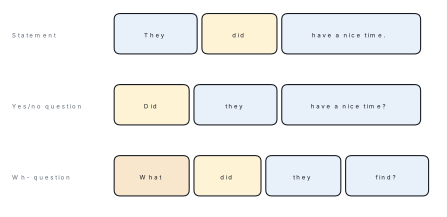
There are three main kinds of question in English.
| Type | Answer | Word order | Example |
|---|---|---|---|
| Yes/no question | yes or no | auxiliary + subject + verb | Did they have a nice time? Was the hotel near the beach? |
| Wh- question | information | wh-word + auxiliary + subject + verb | What did he find on the beach? |
| Subject question | the subject itself | wh-word + verb (no auxiliary) | Who found the dog? |
The wh-words
| Word | Asks about | Example |
|---|---|---|
| what | thing, action | What are the kids doing? |
| who / whom | person | Who lives here? Whom did you meet? |
| whose | possession | Whose bag is this? |
| which | choice | Which school do you go to? |
| where | place | Where does Ram live? |
| when | time | When did it happen? |
| why | reason | Why didn't you phone me? |
| how | manner | How did you feel? |
| how many / how much | number / amount | How many books do you have? |
| how often | frequency | How often does she cook? |
| how long / how old / how far | duration / age / distance | How old are you? |
Rules to remember
- In a question the auxiliary comes before the subject: What are the kids doing? not What the kids are doing?
- If there is no auxiliary in the statement (simple present or past), add do / does / did and put the main verb back to its base form: Why didn't you phone me?
- In subject questions (the wh-word is the subject), do not use do/does/did: Who called you? not Who did call you?
- Polite requests use may, could, would, shall: May I sit here? Shall we go to a movie?
- In indirect (embedded) questions the word order is that of a statement: Do you know where he lives? not where does he live?
Problem. Make a question to ask your friend how often her father cooks.
Solution. Frequency is asked with how often. The auxiliary does comes next, then the subject, then the base verb: How often does your father cook?
Problem. Arrange: did / find / what / he / on the beach?
Solution. wh-word, auxiliary, subject, verb, the rest: What did he find on the beach?
Did you went there? is wrong. After did the verb is in the base form: Did you go there?
Exercise 1. Put the words in the correct order to make questions.
- did / feel / how / you / on the plane?
- doing / the kids / what / are?
- phone / why / me / you / didn't?
- have / what / your parents / for breakfast / do?
- be like / the weather / will / what / tomorrow?
- a nice time / they / have / did?
- the hotel / near the beach / was?
- he / did / where / go?
1. How did you feel on the plane?
2. What are the kids doing?
3. Why didn't you phone me?
4. What do your parents have for breakfast?
5. What will the weather be like tomorrow?
6. Did they have a nice time?
7. Was the hotel near the beach?
8. Where did he go?
Exercise 2. Write the question you would ask in each situation.
- You want to suggest going to a movie.
- You want to know where Ram lives.
- You are inviting a friend to your home.
- You are asking permission to sit on a bus seat.
- You are looking for your pet dog and ask a neighbour.
- You want to know the number of books Ram has.
- You want to know how frequently your friend's father cooks.
- You are asking your teacher about the weather tomorrow.
1. Shall we go to a movie?
2. Where does Ram live?
3. Will you come to my home tomorrow?
4. May I sit here?
5. Have you seen my dog?
6. How many books do you have, Ram?
7. How often does your friend's father cook?
8. What will the weather be like tomorrow?
Grammar II — Causative verbs
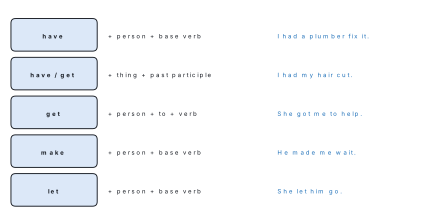
A causative verb shows that the subject causes something to happen rather than doing it directly. The main causative verbs are have, get, make, let.
| Verb | Pattern | Meaning | Example |
|---|---|---|---|
| have (active) | have + person + base verb | arrange for someone to do something | I had a plumber fix the pipe. |
| have (passive) | have + thing + past participle | arrange for something to be done | Ram is having his house painted. |
| get (active) | get + person + to + verb | persuade someone to do | My friend got me to help her. |
| get (passive) | get + thing + past participle | arrange for something to be done | I got my hair trimmed. |
| make | make + person + base verb | force or cause | The police made him pay. |
| let | let + person + base verb | allow | I don't let my children play video games. |
| be made to | passive of make | was forced | I was made to wash the dishes. |
| be allowed to | passive of let | was permitted | They were allowed to leave. |
Rules to remember
- After make and let, use the base verb (no to): She made me cry. In the passive, to appears: I was made to cry.
- After get (+ person), use to + verb: I got him to repair it.
- After have (+ person), use the base verb: I had him repair it.
- For a service done by someone else, the thing is followed by the past participle: I had my car washed. Compare I washed my car (I did it myself).
- The tense is shown by the causative verb: is having, had, will get.
I cut my hair → I did it. I had my hair cut → someone else did it. The causative with a past participle tells us the action was done for us.
Problem. "Ram is having his house ______ (paint) next weekend."
Solution. The house will be painted by someone else, so have + thing + past participle: painted. Answer: Ram is having his house painted next weekend.
She made me to go is wrong. Write She made me go. But I was made to go.
Exercise 3. Complete with the correct form of the verb in brackets.
- I don't let my children ______ (play) video games.
- The police made him ______ (pay) for the damage.
- Ram is having his house ______ (paint) next weekend.
- Ram got his friend ______ (buy) him a ring.
- Ram gets me ______ (deliver) the groceries every weekend.
- Please try not to make her ______ (cry).
- I had a plumber ______ (fix) the plumbing this morning.
- I had my hair ______ (trim) once a month.
- After the party, I was made ______ (wash) all the dishes.
- My friend got me ______ (help) her with her CV.
- We had the TV ______ (repair) yesterday.
- The teacher made the class ______ (rewrite) the essay.
1. play
2. pay
3. painted
4. to buy
5. to deliver
6. cry
7. fix
8. trimmed
9. to wash
10. to help
11. repaired
12. rewrite
Exercise 4. Write a few sentences (using have, get, make, let) about what you were made or allowed to do at a holiday camp.
Sample answer
At the camp we were made to wake up at five o'clock and to run two kilometres before breakfast. The leaders made us cook our own food, and they got us to clean the camp every evening. They had a doctor check our health on the first day. However, they let us swim in the river on Saturdays and let us sing around the campfire at night.
Writing I — A film review
A review gives information about a film (or book) and your judgement. Be fair: mention strengths and weaknesses.
| Part | What to write |
|---|---|
| Title and rating | name of the film, director, main actors, a rating (e.g. ★★★★☆) |
| Introduction | type of film, year, a one-line summary |
| Summary | the main story (without telling the ending) |
| Evaluation | acting, story, music, photography, message — strengths and weaknesses |
| Conclusion | your opinion and whom you recommend it to |
Useful words: gripping, moving, predictable, well-directed, breathtaking cinematography, memorable performance, powerful message, a must-see.
Model review.
Title: Hachi: A Dog's Tale (2009) Rating: ★★★★☆ (4/5)
Hachi: A Dog's Tale is a moving family drama directed by Lasse Hallström, based on the true story of an Akita dog in Japan who waited for his master at a railway station for years. The film follows a college professor who adopts a lost puppy, and the deep friendship that grows between them.
The film's greatest strength is its emotional honesty. Richard Gere plays the professor with warmth and restraint, and the dog's patient waiting at the station scenes are unforgettable. The photography of the small town through the four seasons is beautiful, and the music is gentle and never forces our feelings. The story upholds the values of family and loyalty. On the other hand, the film is slow in places and some viewers may find the ending very sad.
Overall, this is a film that proves that love and loyalty need no words. I recommend it to all families, but keep a handkerchief ready.
Writing II — An essay on the impact of social media
Many people say that social networking sites have a negative effect on individuals and society. Others believe that they have connected the world. An essay on this topic should give both sides and then your own opinion.
| Part | Content |
|---|---|
| Introduction | what social media is; the debate |
| Advantages | communication, information, education, business, awareness |
| Disadvantages | time-wasting, addiction, false news, cyber-bullying, loss of privacy |
| Opinion | balanced view: depends on how it is used |
| Conclusion | a strong closing sentence |
Model essay — The Impact of Social Media
Social media, such as Facebook, TikTok, YouTube and Instagram, has become a part of everyday life. People of all ages use it to talk to friends, to share photos and to follow the news. Some say that it brings the world together; others say that it harms individuals and society. In my opinion it has both good and bad effects.
Social media has many advantages. It lets us keep in touch with family members living abroad, which is very valuable for a country like Nepal where so many people work overseas. It spreads information quickly, so people learn about disasters, health warnings and government announcements within minutes. Students use it for learning, teachers share lessons online, and small businesses sell their products to customers across the country. Stories like that of a skateboarder who became famous through one video, or a dog that received a wheelchair thanks to donations, show how powerful social media can be for good.
However, there are also serious disadvantages. Many users waste hours scrolling and become addicted, which harms their studies and sleep. False news and rumours spread faster than the truth. Cyber-bullying and the sharing of private photos can damage people's lives, and hackers and cheats find victims online. Comparing ourselves with the perfect lives of others can also make us unhappy.
In my view, social media is like a knife: it can be used to cut vegetables or to hurt someone. The harm comes from careless use, not from the tool itself. We should limit our time, check news before sharing, protect our passwords, be polite online and use social media for learning and help.
In conclusion, social media is a gift when used wisely and a danger when used badly. The choice is ours.
Chapter summary
- "Hachi: A Dog's Tale" (2009), directed by Lasse Hallström, starring Richard Gere, is based on the true story of Hachikō in Tokyo (1923–1935); themes: love, devotion, loyalty; strengths: the bond between dog and master, traditional values; weaknesses (as the review lists): kissing and champagne scenes.
- "Interesting Social Media Stories": Nathan Apodaca (viral video, truck of Ocean Spray), Charlie's birthday cards, the somersaulting school children, We Rate Dogs (700 US dollars for a wheelchair), the New York hawk rescued via Twitter — social media can do good.
- Questions: yes/no (auxiliary + subject + verb); wh- (wh-word + auxiliary + subject + verb); subject questions have no auxiliary.
- Causatives: have + person + base verb; get + person + to + verb; make / let + person + base verb; have / get + thing + past participle; be made to.
- A review: title and rating, introduction, summary without the ending, evaluation, conclusion.
- An opinion essay: introduction, advantages, disadvantages, your view, conclusion.
Practice questions
Reading comprehension
Many teenagers spend over four hours a day on their phones. They watch videos, play games and chat with friends. Some experts say that this habit harms sleep and concentration. Others argue that phones also give access to free lessons and help students to find information quickly. A survey of one school found that students who used phones for study scored higher than those who used them only for games. The experts agree on one point: it is not the phone but the way it is used that matters.
- How many hours a day do many teenagers spend on phones? [1]
- What do some experts say about this habit? [1]
- Write True or False: All experts say that phones are harmful. [1]
- What positive use of phones does the passage mention? [2]
- What did the school survey find? [2]
- What is the experts' point of agreement? Write in about 50 words. [4]
Answers
1. Over four hours.
2. That it harms sleep and concentration.
3. False.
4. Phones give access to free lessons and help students find information quickly.
5. Students who used phones for study scored higher than those who used them only for games.
6. The experts agree that the harm or benefit depends on how the phone is used, not on the phone itself. A phone used for study, research and learning helps a student, while one used only for games and endless chatting wastes time and harms sleep and concentration.
Grammar
- Make a question: "She lives in Pokhara." (Where …?) [1]
- Make a question: "They went to the cinema yesterday." (When …?) [1]
- Make a subject question: "Hari broke the window." (Who …?) [1]
- Fill in: "I ______ (have) my bike repaired yesterday." [1]
- Fill in: "The teacher made us ______ (write) the essay again." [1]
- Fill in: "He got his sister ______ (lend) him a pen." [1]
- Correct: "Did you went to school?" [1]
- Correct: "Her parents didn't let her to go." [1]
- Make a question: "He has two sisters." (How many …?) [1]
- Rewrite using have: "Someone cut my hair." [1]
Answers
1. Where does she live?
2. When did they go to the cinema?
3. Who broke the window?
4. had
5. write
6. to lend
7. Did you go to school?
8. Her parents didn't let her go.
9. How many sisters does he have?
10. I had my hair cut.
Writing
- Write a review of a film you have recently watched, in about 150 words. [5]
- "Social media does more harm than good." Write an essay of about 200 words giving your opinion. [5]
Outline for answers
1. Title and rating; type of film; short summary; two strengths and one weakness; recommendation.
2. Introduction; harms (addiction, false news, bullying, privacy); benefits (communication, learning, help); your opinion; conclusion.
Practise more: English question bank