Unit 15 · Units · 26 min read
Unit 15: People and Places
What the syllabus asks for 3
- Me at the Beginning of Life
- Sugarloaf Mountain: 5 Interesting Facts
- Grammar and writing tasks of the unit
Every place has a story and every story has people in it. This unit moves from a deeply personal text about a Nepali writer's struggle to a lively factual text about one of the world's most famous mountains. "Me at the Beginning of Life" is an extract from the autobiography of Jhamak Kumari Ghimire, one of Nepal's best-loved writers. "Sugarloaf Mountain: 5 Interesting Facts" introduces a landmark in Rio de Janeiro, Brazil. In grammar you will learn relative clauses (who, whom, whose, which, where, when) and prepositions. In writing you will compose a biography and an email or letter inviting a foreign friend to a place in Nepal.
From the first text: the writer's feelings, the people around her, and how she answers the unkindness of others. From the second: five clear facts about the mountain with correct figures. In grammar: relative pronouns that fit the noun they follow, and the right preposition. In writing: a biography built from notes (birth, education, works, contribution, awards), and a friendly invitation with interesting facts.
15.1 Me at the Beginning of Life
About the author and the text
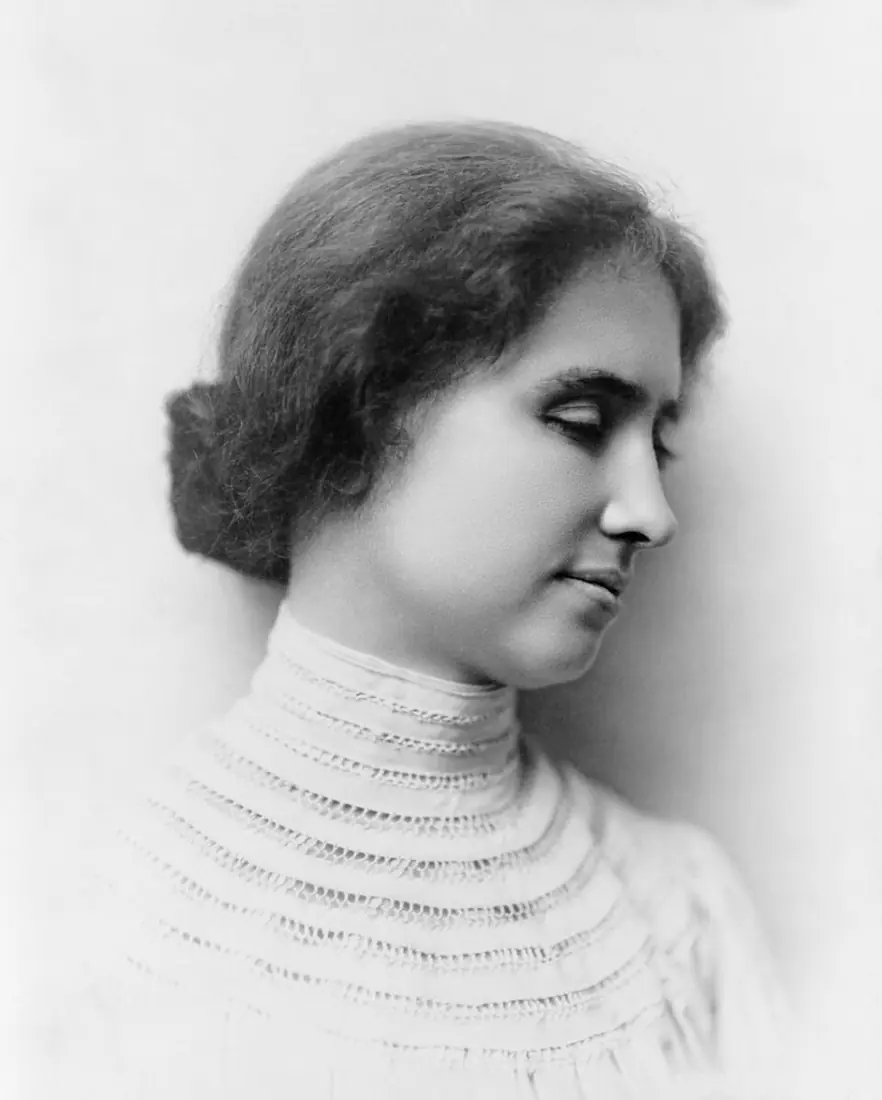
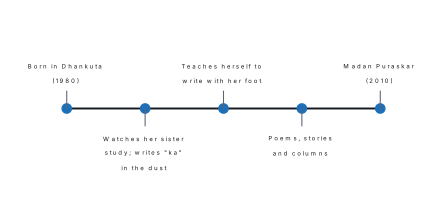
Jhamak Kumari Ghimire was born on 4 July 1980 in Dhankuta in eastern Nepal. She was born with cerebral palsy, a condition that affects movement and speech, and she cannot speak clearly or use her hands. She writes with her left foot. She never went to school: she learned the alphabet by watching her younger sister study and by scratching the first letter, ka, in the dust with a stick. Though she was scolded and even mocked for trying to write, she kept practising until she could hold a pen between her toes. She became a poet, short-story writer, essayist and columnist. Her autobiography, Jiwan Kada Ki Phool ("Is Life a Thorn or a Flower?"), won the Madan Puraskar, Nepal's most famous literary prize, in 2010. Her poetry includes Sankalpa ("Vow").
"Me at the Beginning of Life" is an extract from the first part of that autobiography, written in the first person in Nepali and translated into English for your textbook. It is a short, honest, poetic account of her own birth and childhood.
Summary
Fate and the sixth day. Jhamak begins with a Nepali belief: on the sixth day after a baby's birth, the goddess of fate draws the line of a person's destiny on the forehead. She feels that her own line was drawn cruelly. She was born unable to do anything by herself, and she describes her life as a burden, for herself and for her family.
What people said. Villagers blamed her. They said that her condition was "the fruit of the sins of her former life". She was hurt by this, but there was no one to answer for her. Her family was poor and sometimes had too little to eat, so she sees her childhood as full of hunger and difficulty rather than as a happy time.
Her inner world. As she grew, her mind awoke. She understood what was happening around her, but she had no voice to say it and no legs to walk. For her, awareness became a curse, because she could think and feel like anyone else but could not act. She compares herself with two famous people who overcame great disabilities: the Russian writer Nikolai Ostrovsky (1904–1936), who became blind and paralysed but dictated a famous novel, and the American Helen Keller, who was deaf and blind. They were different from her, she says, because before they died they had already written history, while she is only at the beginning of her life. The Greek poet Homer, traditionally said to have been blind, shows that physical weakness does not make a person incomplete.
The grandmother. Her grandmother cared for her, but the old woman has since passed away, and the writer cannot even please her with her voice. The thought of this loss adds to her sorrow.
The message. The extract ends with the writer determined to live and write. She does not define her life as a "beautiful flower of creation". She sees it as something to be shaped by effort, not by fortune.
Glossary
| Word | Meaning | Example |
|---|---|---|
| insipid | lacking taste or interest | The soup was insipid. |
| inscribed | wrote or carved words on something | The name was inscribed on the stone. |
| tangled | twisted together | Her hair was tangled. |
| suffocating | making it hard to breathe | The room was hot and suffocating. |
| perspective | a particular way of thinking about something | Try to see it from my perspective. |
| offspring | a person's or animal's child or children | The parents cared for their offspring. |
| misfortune | bad luck | He bore his misfortune bravely. |
| burdensome | heavy and hard to bear | A burdensome task. |
| restless | unable to rest; always moving | The restless child could not sit still. |
| pollute | to make dirty or harmful | Smoke pollutes the air. |
Themes
Courage against disability. Jhamak's account is not self-pity; it is a declaration that she will not be defined by her body. The passage shows how society's prejudice, such as "the fruit of former sins", does more harm than the disability itself.
The power of words. She has no voice, yet she becomes a writer. Writing is her way of speaking to the world.
Family, poverty and love. The grandmother's care and the hunger of the household show the family's love in a harsh setting.
Society's attitude. The text asks readers to treat disabled people with respect and give them education and opportunity.
Comprehension questions with model answers
A. True / False (1 mark each)
- Jhamak defines her life as a beautiful flower of creation. [1]
- According to her, fortune decides how our life will be. [1]
- The author was happy with how she spent her childhood. [1]
- People blamed Jhamak herself for her physical disability. [1]
- Homer is described as incomplete because he was physically incapable. [1]
Answers
1. False.
2. False.
3. False.
4. True.
5. False.
B. Short questions (2 marks each)
- Why does Jhamak think of her life as a burdensome life? [2]
- When does fortune draw the line of fate? [2]
- How did people respond to her life? Was she happy with their behaviour? [2]
- Whom does Jhamak compare herself with? What made them different from her? [2]
- Did achieving awareness become a curse for her? Why? [2]
- How does Jhamak describe the economic condition of her family in her childhood? [2]
Answers — short
1. She thinks her life is a burden because she could not do anything by herself and depended on others for everything.
2. Fortune draws the line of fate on the sixth day after a child's birth.
3. People said that her condition was the result of the sins of her previous life. No, she was not happy with their behaviour because it was cruel and unfair.
4. She compares herself with Nikolai Ostrovsky and Helen Keller. They were different because they had already written history before they died, whereas she felt she had done nothing yet.
5. Yes. As she grew up she understood everything around her, but she had no voice to speak and no strength to walk, so her awareness made her suffer more.
6. Her family was poor and did not have enough food to eat.
C. Long questions (4 marks each)
- Narrate the story of Jhamak's life in your own words. [4]
- Why do you think the writer calls her awareness a curse? What does the extract teach us about attitudes to disability? [4]
Answers — long
1. Jhamak Kumari Ghimire was born in 1980 in Dhankuta, with cerebral palsy. She could not speak clearly or use her hands. Her family was poor and she did not go to school, and some villagers said she was suffering for the sins of her past life. Yet she listened to her father reading the Ramayan and watched her sister study, and she taught herself to write the alphabet, first in the dust and then with a pen between the toes of her left foot. She became a poet, essayist and columnist, and her autobiography won the Madan Puraskar in 2010. Her life shows that courage and effort can overcome disability.
2. She calls awareness a curse because she could understand everything but could not speak or move to express herself, so her mind was imprisoned in her body. The extract teaches that people with disabilities have the same minds and feelings as others. Society should not blame them or treat them as sinners but should give them love, education and chances to develop.
15.2 Sugarloaf Mountain: 5 Interesting Facts
About the text
This is a tourist-style fact article. It presents five short topics about a famous mountain in Rio de Janeiro, Brazil, each with its own heading. The words are simple, with lots of adjectives such as spectacular, tranquil and bustling to attract tourists. It is a good example of descriptive and informative writing, and you can use it as a model for a short report or a brochure.
Summary: the five facts
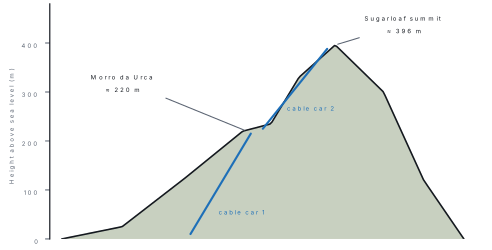
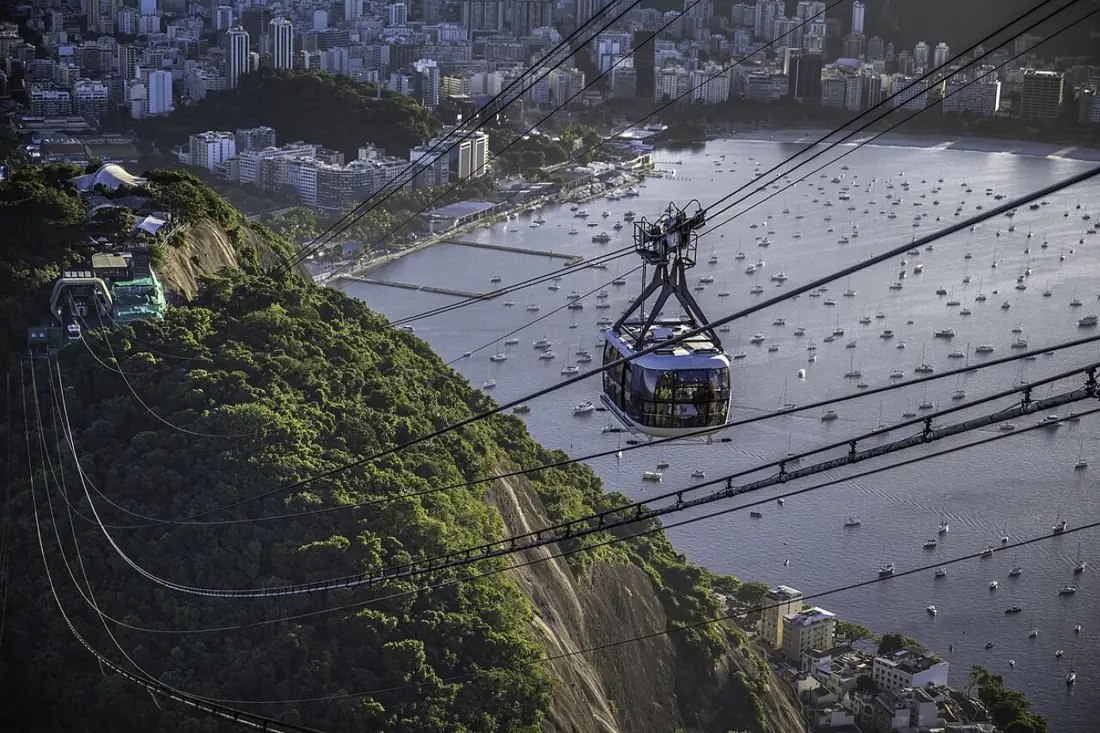
1. Awesome cable car ride. Sugarloaf Mountain (Pão de Açúcar in Portuguese) is a granite peak about 396 metres high at the entrance to Guanabara Bay in south-eastern Brazil. Two cable cars take visitors to the summit: the first goes to Morro da Urca (about 220 m), a smaller mountain, and the second goes on to the top of Sugarloaf. The cable car, opened in 1912, was one of the first in the world. From the summit one can see the whole city.
2. Guanabara Bay. The bay in front of the mountain is dotted with more than 130 islands and surrounded by beautiful natural scenery. It is historic because the colonial government built several fortifications (forts) there in the sixteenth century to defend the harbour.
3. Rock climbing. The mountain is a favourite for climbers: there are about 270 different routes, so many people can climb at the same time. Beginners and experts can both find routes.
4. Neighbouring mountains. Next to Sugarloaf are other hills and peaks, such as Morro da Urca, which also has a play area that children enjoy, and, nearby, the Corcovado peak with the statue of Christ the Redeemer.
5. Hollywood star. The mountain has appeared in many films, or blockbusters. The first film to feature it was Now, Voyager (1942), and it was later seen in the James Bond film Moonraker (1979).
Why "Sugarloaf"? The name comes from the mountain's shape, which looks like the traditional cone-shaped loaf of refined sugar used in the sixteenth to nineteenth centuries.

Glossary
| Word | Meaning |
|---|---|
| landmark | a structure easy to see and recognise from far away |
| spectacular | very impressive |
| sprawling | spread out over a large area, often untidily |
| tranquil | calm and peaceful |
| blockbuster | a very successful film |
| fortification | a wall or fort built for defence |
| peninsula | land almost surrounded by water |
| bustling | full of busy activity |
-ing and -ed adjectives. A feeling that something causes uses -ing (a boring film, a surprising result); the feeling someone has uses -ed (bored students, surprised people).
Comprehension questions with model answers
A. Objective questions (1 mark each)
- Sugarloaf Mountain is in [1]aArgentinabBrazilcPerudChile
- The first film in which it appeared was [1]aMoonrakerbNow, VoyagercTitanicdCasablanca
- The number of climbing routes is about [1]a27b70c170d270
- Write True or False: Guanabara Bay has fortifications from the sixteenth century. [1]
Answers — objective
1. (b) Brazil.
2. (b) Now, Voyager.
3. (d) 270.
4. True.
B. Short questions (2 marks each)
- Where is Sugarloaf Mountain located? [2]
- How did the mountain get its name? [2]
- Can many people do rock-climbing at the same time? Why? [2]
- What is historic about Guanabara Bay? [2]
- What should you do to enjoy the best view of the bay? [2]
Answers — short
1. It is at the entrance to Guanabara Bay in south-eastern Brazil, in the city of Rio de Janeiro.
2. It was named after its shape, which resembles the traditional cone-shaped loaf of refined sugar.
3. Yes, because there are about 270 different climbing routes on the mountain.
4. The bay was home to several forts built by the colonial government in the sixteenth century.
5. I should take the two cable cars to the summit, from where I can see the whole bay and the city.
C. Long questions (4 marks each)
- Which of the five facts interested you most? Give reasons. [4]
- Do you think visitors should ride the cable cars? Why? [4]
Answers — long
1. (Open answer.) The fact that interested me most is the cable car ride. The cable car was opened in 1912, which makes it one of the oldest in the world. It carries visitors in two stages, first to Morro da Urca and then to the top of Sugarloaf. From the summit I could see the whole of Rio, the bay and the beaches. Such a ride lets even children and old people enjoy a view that only climbers could see before.
2. Yes, visitors should ride the cable cars. They are a safe and comfortable way of reaching the top, so people of all ages can enjoy the view. During the ride they see the city, sea and beaches from the air. At the first station they can rest, eat and visit the play area, and at the top they can enjoy the best views of Guanabara Bay. Climbing is possible only for the fit, but the cable car is for everyone.
15.3 Grammar and writing tasks
Grammar I — Relative clauses
A relative clause gives more information about a noun. It begins with a relative pronoun or adverb.
| Word | Refers to | Example |
|---|---|---|
| who | people (subject) | I admired the player who scored the goal. |
| whom | people (object) | He is a liar whom you should not trust. |
| whose | possession (people or things) | I saw a soldier whose bravery impressed everyone. |
| which | things / animals | We had juice which was in the fridge. |
| that | people or things (defining clauses only) | The book that I bought is excellent. |
| where | place | This is the road where the accident took place. |
| when | time | It was in 2015 when the earthquake hit Nepal. |
| with whom / in which … | preposition + relative | You are the friend with whom I want to sit. |
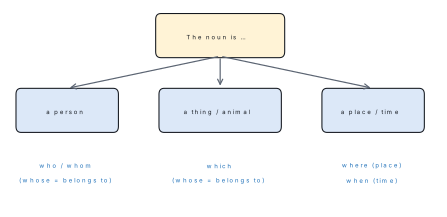
Defining and non-defining clauses
| Defining | Non-defining | |
|---|---|---|
| Job | tells which person or thing | adds extra information |
| Commas | none | commas on both sides |
| that allowed? | yes | no |
| Example | The girl who won the race is my sister. | My mother, who is a farmer, grows vegetables. |
Rules to remember
- The relative clause comes right after the noun it describes: The letter which my friend sent from abroad reached me this morning.
- Whom is used when the pronoun is the object; in modern use who is often accepted, but SEE keys use whom after a preposition (with whom, to whom).
- In a defining clause, who/which/that can be dropped when it is the object: The book (that) I bought. It cannot be dropped as a subject.
- Do not repeat the object: The man whom I met him is wrong. Write The man whom I met.
- Joining two sentences: find the repeated noun, change it to the relative pronoun in the second sentence, and put the clause next to the noun.
Problem. Join: "The boy committed a cybercrime. The judge sent him to jail."
Solution. The repeated noun is the boy (a person; in the second sentence it is the object him). Write: The judge sent the boy who committed a cybercrime to jail. (Here who is the subject of committed, so it is who, not whom.)
Problem. "I want to help those children ______ economic condition is very poor."
Solution. The condition belongs to the children, so we need whose: … children whose economic condition is very poor.
Whose shows ownership, who acts, whom receives the action. Test: if you can put he/she in the clause, use who; if him/her, use whom.
Exercise 1. Fill in who, whom, whose, which, where or when.
- I admired the player ______ performance was fantastic.
- We had some juice ______ was in the fridge.
- My mother, ______ is a farmer, grows a lot of vegetables.
- You are my friend with ______ I want to sit.
- This is the road ______ the accident took place.
- The phone, ______ I bought six years ago, still works.
- It was in 2015 ______ the earthquake hit Nepal badly.
- Ram is a wonderful man ______ everyone can trust.
- I want to help those children ______ economic condition is very bad.
- She is the teacher ______ taught me English.
1. whose
2. which
3. who
4. whom
5. where
6. which
7. when
8. whom (or who/that)
9. whose
10. who
Exercise 2. Join the pairs with a relative pronoun.
- The letter reached me this morning. My friend sent it from abroad.
- This is the palace. Ram built it.
- He is a liar. You should not believe him.
- I know an artist. He moves with an artificial leg.
- Bring me the file. It is about our new project.
- We met a girl. She had lost her way.
- I saw a soldier. His bravery impressed everyone.
- The dog took away the ball. The kids were playing with it.
1. The letter which my friend sent from abroad reached me this morning.
2. This is the palace which Ram built.
3. He is a liar whom you should not believe.
4. I know an artist who moves with an artificial leg.
5. Bring me the file which is about our new project.
6. We met a girl who had lost her way.
7. I saw a soldier whose bravery impressed everyone.
8. The dog took away the ball which the kids were playing with. (or with which the kids were playing (formal))
Grammar II — Prepositions
A preposition shows the relationship of a noun or pronoun to another word: time, place, direction, means, cause.
| Use | Preposition | Example |
|---|---|---|
| Time: clock times, meals | at | at 9:15 pm, at noon, at night |
| Time: days and dates | on | on Friday, on 2 November |
| Time: months, years, seasons, parts of the day | in | in March, in 2002, in the morning |
| Time: duration | for / during / since | for two years, since 2070 |
| Place: point | at | at the bus stop, at a university |
| Place: enclosed area, town, country | in | in a city, in Nepal |
| Place: surface | on | on the table |
| Position | across, beside, between, beneath, behind, opposite | across the street |
| Movement | to, from, into, out of, through, along, up, down | walk up to the edge |
| Means | by (vehicle, agent), with (tool) | by plane, with a knife |
| Cause | from | died from injury |
Dependent prepositions (fixed combinations)
| Word | Preposition |
|---|---|
| afraid / scared / terrified | of |
| pleased / satisfied | with |
| good / bad / clever | at |
| interested | in |
| depend / rely | on |
| angry | with (a person), at/about (a thing) |
| die | of (disease), from (injury) |
| similar / different | to / from |
| responsible / famous | for |
| married / engaged | to |
| listen / belong | to |
Problem. "The bus leaves __ 9:15 pm ____ Friday."
Solution. A clock time takes at; a day takes on. Answer: at 9:15 pm on Friday.
in the morning but at night; on Monday morning (day + part of day takes on). At the university names the institution; in the university names the building.
Exercise 3. Fill in the correct preposition.
- Ram visited Lumbini ______ 2002.
- My best friend lives ______ the street from me.
- We walked up ______ the edge of the desert.
- The Prime Minister died ______ a head injury.
- I am very pleased ______ meet you.
- He is a tall boy ______ long brown hair.
- ______ November 2 we will start our new semester.
- She has been waiting ______ two hours.
- I am afraid __ travelling ____ plane.
- The bus will arrive __ 5:30 ____ the morning.
- I love your house ______ the river.
- She is good ______ drawing.
1. in
2. across
3. to
4. from
5. to
6. with
7. On
8. for
9. of … by
10. at … in
11. by
12. at
Writing I — A biography
A biography tells the life story of a real person, written by someone else. It is written in the third person and mostly in the past tense. Use notes (birth, family, education, works, contribution, awards) and arrange them in order.
| Part | What to write |
|---|---|
| Title | the person's name or a phrase such as A Life of Courage |
| Introduction | who the person is; why he or she is famous |
| Early life | birth, family, education |
| Career | works, struggles, achievements |
| Contribution / awards | what he or she gave to the society; honours |
| Conclusion | the lesson or inspiration |
Model biography — Jhamak Kumari Ghimire.
Jhamak Kumari Ghimire is one of the most admired writers of Nepal. She was born on 4 July 1980 in Dhankuta, in a poor farming family. From birth she had cerebral palsy, which left her unable to speak clearly or use her hands. She never went to school. Instead she learned the alphabet by watching her younger sister study and by scratching the letter ka in the dust with a stick. Despite scolding and mockery from people who could not understand her, she taught herself to write with a pen held between the toes of her left foot.
Jhamak became a poet, short-story writer and essayist, and she also writes columns for a national newspaper. Her poetry collections include Sankalpa, and her autobiography Jiwan Kada Ki Phool ("Is Life a Thorn or a Flower?") won the Madan Puraskar, Nepal's most prestigious literary prize, in 2010. Her work has made readers rethink how society treats people with disabilities.
Jhamak's life shows that determination can overcome even the hardest circumstances, and she remains a source of inspiration to young Nepalis.
Writing II — An email or letter inviting a foreign friend
An email (or informal letter) to a friend uses a friendly, conversational tone. An email has a To, From, Subject and a short greeting. A letter has an address, date, greeting, body and closing.
Task. Write an email to a foreign friend with interesting facts about a tourist destination in Nepal. Invite him or her to visit.
Model email.
To: emily.carter@example.com From: anita.sharma@example.com Subject: Come and see Pokhara with me!
Dear Emily,
I hope you are well. I am writing to invite you to visit Pokhara, the city I told you about, during your winter holiday.
Pokhara is one of the largest cities of Nepal and lies about 200 km west of Kathmandu by road, at roughly 820 metres above sea level. It sits on the shore of Phewa Lake, and on a clear morning you can see the snow-capped Annapurna range and the fish-tail peak of Machhapuchhre reflected in the water. You can go boating, try paragliding from Sarangkot or walk to the World Peace Pagoda. There are caves, waterfalls and a museum of mountaineering. The local food, especially momos and fresh lake fish, is delicious.
You can stay with my family, and my parents would love to cook dal bhat for you. October and November are the best months, with clear skies and pleasant weather. Please tell me the dates, and I shall arrange everything.
I can't wait to show you around!
With love, Anita
Subject line, warm greeting, a reason for writing, 3–4 interesting facts, a clear invitation (when, where, who), warm closing.
Chapter summary
- "Me at the Beginning of Life": an extract from Jhamak Ghimire's autobiography Jiwan Kada Ki Phool (Madan Puraskar 2010). She writes with her left foot, was blamed by society, felt awareness a curse, and compares herself with Ostrovsky and Helen Keller. Themes: courage, the power of writing, social prejudice, family poverty.
- Sugarloaf Mountain: about 396 m high at the entrance to Guanabara Bay, Rio de Janeiro; two cable cars (via Morro da Urca); about 270 climbing routes; bay with 130+ islands and sixteenth-century forts; first film Now, Voyager.
- Relative pronouns: who (people), whom (object, after prepositions), whose (possession), which (things), that (defining), where (place), when (time). Defining clauses have no commas; non-defining have commas and cannot use that.
- Prepositions: at (clock, point), on (days, surfaces), in (months, years, enclosed areas); dependent prepositions (afraid of, pleased with, good at).
- A biography: third person, past tense, in order: introduction, early life, career, contribution and awards, conclusion.
- An email invitation: subject, friendly tone, facts, clear invitation.
Practice questions
Reading comprehension
Mahendra Gurung was born in a poor family in a village in Lamjung. His father died when he was ten, and he had to leave school to work as a porter. At night he studied by the light of an oil lamp. Years later, he passed the SLC examination and became a teacher in the same village school. He now runs a free evening class for children who cannot afford tuition. Many of his former students are doctors, engineers and teachers.
- Where was Mahendra born? [1]
- Why did he leave school? [1]
- Write True or False: He now charges high fees. [1]
- How did he study as a porter? [2]
- What does he do for poor children now? [2]
- What qualities of Mahendra do you admire? Write in about 50 words. [4]
Answers
1. In a village in Lamjung.
2. His father died and he had to work as a porter.
3. False.
4. He studied at night by the light of an oil lamp.
5. He runs a free evening class for children who cannot pay for tuition.
6. I admire his determination and generosity. Though he was poor and had to leave school, he did not give up but studied at night and became a teacher. Instead of forgetting his past, he now helps poor children to study free of charge, and many of his students have become successful.
Grammar
- Fill in: "The man ______ car was stolen called the police." [1]
- Join: "This is the school. I studied here." [1]
- Fill in: "She is the girl ______ won the prize." [1]
- Fill in the preposition: "He was born __ 5 May ____ 2010." [1]
- Fill in: "The film, ______ I saw yesterday, was boring." [1]
- Fill in the preposition: "She is afraid ______ dogs." [1]
- Correct: "The book which I read it was interesting." [1]
- Fill in: "Pokhara, ______ is famous for its lake, attracts many tourists." [1]
- Fill in the preposition: "We arrived __ the airport ____ noon." [1]
- Join: "I met a woman. Her son is a doctor." [1]
Answers
1. whose
2. This is the school where I studied.
3. who
4. on … in
5. which
6. of
7. The book which I read was interesting.
8. which
9. at … at
10. I met a woman whose son is a doctor.
Writing
- Using the notes below, write a short biography: Born 1951, Dharan — educated at Tri-Chandra College — poet and novelist — pioneer of a literary movement — Chairman of the Nepal Academy — several national awards. [5]
- Write an email to a foreign friend inviting him or her to visit Lumbini or Chitwan. [5]
Outline for answers
1. Name; introduction; birth in 1951 in Dharan; studied at Tri-Chandra College; works; the movement; Academy chairmanship; awards; conclusion on inspiration.
2. Subject line; greeting; the reason for writing; three facts (e.g. rhino, tiger, jungle safari, Tharu culture for Chitwan); best season; offer of hospitality; closing.
Practise more: English question bank