Unit 9 · Units · 25 min read
Unit 9: History and Culture
What the syllabus asks for 3
- Pratap Malla
- Flowers in Russian Culture
- Grammar and writing tasks of the unit
History tells us who we were; culture shows who we are. This unit pairs a Nepali king who left his mark on Kathmandu with a Russian custom — the language of flowers. In grammar you will practise narrating the past with the simple past, past continuous and past perfect; in writing you will write about historical events, give an opinion and tell a story from an outline.
Reading: completing sentences with words from the text, multiple-choice questions, short answers on facts, compound words, "single word for a meaning". Grammar: simple past vs past continuous; past perfect; narrating a story with correct tenses. Writing: a paragraph from a list of events, an opinion essay (about 200 words), and a story from outlines with a moral.
9.1 Pratap Malla
About the text
"Pratap Malla" is a short biographical text about one of the best-known kings of the Kathmandu Valley. It is arranged around the king's achievements: politics and diplomacy, trade, religion and architecture, and literature. A text like this is objective and factual; it uses the simple past and gives dates, names and places.
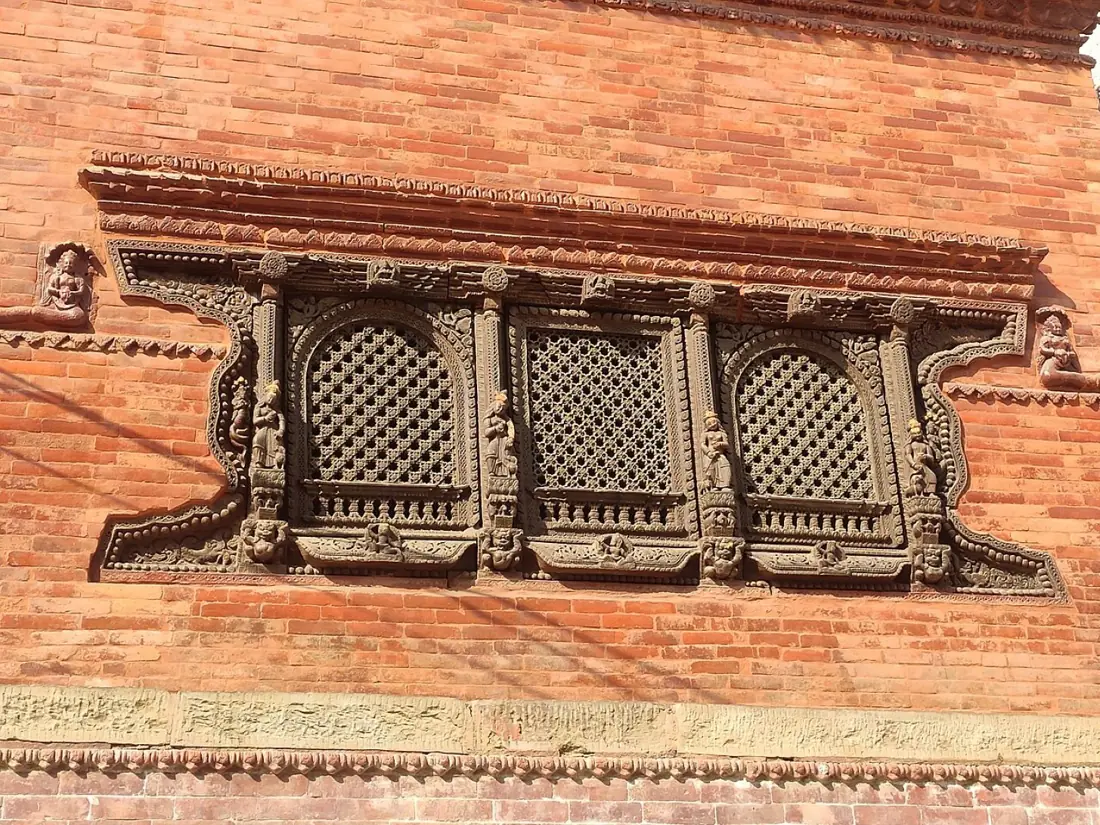
Who was Pratap Malla?
Pratap Malla (1624–1674) was the Malla king of Kantipur (Kathmandu), one of the three kingdoms of the Valley (the others were Lalitpur/Patan and Bhaktapur). He ruled from about 1641 to 1674, a reign of more than thirty years, and is remembered as a ruler who was at once a clever politician, a patron of art, a builder and a poet.
What the text says
1. Coming to power. The textbook tells us that Pratap Malla kept his own father in jail because he wanted to become king soon. (This is how the text presents it; historians have different views about how he succeeded his father, Laxmi Narasimha Malla.)
2. Politics and defence. Kantipur was a small state surrounded by two rivals, Lalitpur and Bhaktapur. Pratap Malla kept it strong and safe by diplomacy: he played the kings of the two other cities against each other, siding with one or the other to keep a balance of power and to deter attacks. During his reign, Kantipur was never invaded.
3. Trade. Kantipur lay on the trade route between Tibet and India. Pratap Malla used this position, trading with both, and the city became rich. Wealth paid for his buildings.
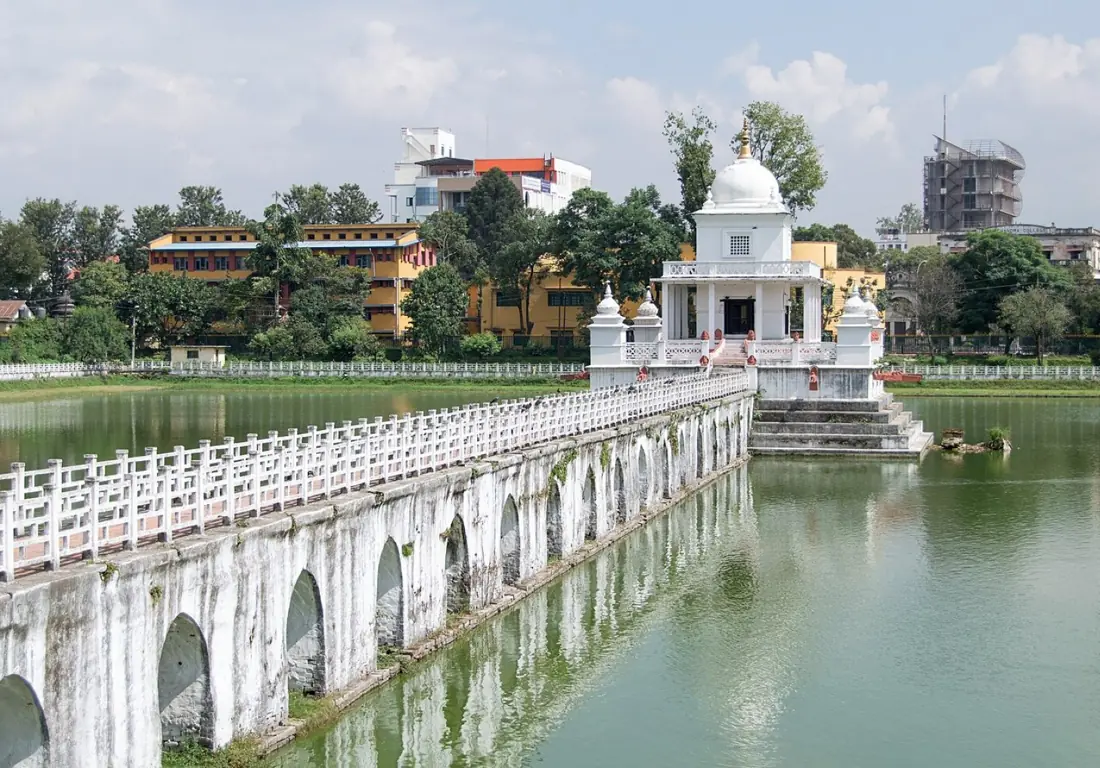
4. Religion and building. He repaired and rebuilt many temples and monuments. Among his projects are additions to the old palace — which he named Hanuman Dhoka after the image of the monkey god Hanuman that he placed beside the gate to ward off evil — and the Rani Pokhari, a large pond with a small temple in its middle, said to have been built in memory of his son. He also built or restored shrines at Swayambhunath and set up water spouts and ponds for the people. Many temples of his time had gold-covered pinnacles.
5. Literature and learning. Pratap Malla was a learned man, a poet and a dramatist. He wrote in many languages, among them Sanskrit, Newari (Nepal Bhasa), Maithili, Hindi and Bengali. On a wall of the palace is a famous inscription in many languages and scripts. He gave himself the title Kavindra (Kabindra), "king of poets", and invited scholars and musicians to his court, which shows his respect for knowledge.
Time line
| Year (CE) | Event |
|---|---|
| 1624 | Pratap Malla is born |
| about 1641 | He becomes king of Kantipur |
| 1640s–1650s | Develops trade with Tibet; strengthens the palace |
| 1670 | Rani Pokhari is built |
| 1674 | He dies |
(Dates are those commonly given by historians; use the dates in your textbook if it shows others.)
Vocabulary
| Word | Meaning | Example |
|---|---|---|
| regent | a person who rules in place of a king who is too young | The queen ruled as regent for her young son. |
| pinnacle | the pointed top of a roof; the highest point | The temple's pinnacle was gilded. |
| replica | an exact copy | They made a replica of the stolen trophy. |
| confer | to give a title, honour or degree | The title Rastrakavi was conferred on Madhav Prasad Ghimire. |
| honour | to show great respect or give an award | The government honoured her for her service. |
| invade | to enter another country in order to take it | Foreign armies tried to invade the Valley. |
| deter | to make someone decide not to do something | Strong forts deter enemies. |
| diplomacy | skilful dealing with other states without war | Diplomacy kept the kingdom safe. |
Themes and ideas
- Statecraft. A small state can survive by clever politics rather than force.
- Trade brings wealth. Position on trade routes built Kantipur's prosperity.
- Culture as legacy. Hanuman Dhoka, Rani Pokhari and the inscription still exist and still draw visitors.
- A complex ruler. He was ambitious, even ruthless, but also a poet and builder.
Questions and model answers
Objective questions (1 mark each)
- Pratap Malla ruled the state of [1]aBhaktapurbLalitpurcKantipurdGorkha
- Which kingdoms were Kantipur's neighbours in the Valley? [1]aLalitpur and BhaktapurbGorkha and TanahuncMustang and DolpadPalpa and Parbat
- The palace is called Hanuman Dhoka because of [1]aa temple of Hanuman in Indiaban image of Hanuman beside its gateca festivalda river
- "Kabindra" means [1]aking of poetsbking of warcking of golddking of trade
Answers
1. (c).
2. (a).
3. (b).
4. (a).
Short-answer questions (2 marks each)
- Name two countries that had trade with Kantipur. [2]
- How did Pratap Malla keep his kingdom safe from Lalitpur and Bhaktapur? [2]
- Where did Pratap Malla place the image of Hanuman? Why? [2]
- Pratap Malla gave himself the title "Kabindra". Do you think the title suits him? Why? [2]
- Pratap Malla used to invite scholars to his palace. What does it show about his personality? [2]
Model answers
1. Tibet and India.
2. He used diplomacy: he supported one of the two kings against the other, keeping a balance of power so that neither could attack him.
3. He placed it beside the gate of his palace, which became known as Hanuman Dhoka, to keep evil away.
4. Yes, it suits him, because he was a learned king who composed poems and plays in many languages and loved literature.
5. It shows that he respected knowledge and wanted to be surrounded by learned, cultured people.
Long-answer questions (4 marks each)
- Describe the contribution of Pratap Malla to Nepali culture. [4]
- Name some contributions of Pratap Malla that still exist today. [4]
Model answers
1. Pratap Malla was a great patron of culture. He enlarged the palace at Hanuman Dhoka, built Rani Pokhari and repaired or built many temples and shrines, so Kathmandu still has fine Malla architecture. He wrote poems and plays in several languages and brought scholars, poets and musicians to his court. He also put up a multilingual inscription that shows the variety of languages known in his time. Through trade and diplomacy he kept his kingdom peaceful and rich, which allowed art to grow.
2. The palace of Hanuman Dhoka, with the Hanuman image at its gate, still stands in Kathmandu Durbar Square. Rani Pokhari still lies in the middle of the city. The multilingual inscription on the palace wall, his stone column in the Durbar Square and the temples he repaired at Swayambhunath are visited by tourists, and his poems are studied.
9.2 Flowers in Russian Culture
About the text
This is an informative text about customs. It shows how people in Russia choose flowers for different occasions and why. Its central idea is that giving flowers is almost universal, but each culture adds its own rules — what the textbook calls flower etiquette. The writer groups the information flower by flower: carnation, poppy, lily, chamomile and others.
What the text says
Everywhere in the world people give flowers to express goodwill and affection, and receiving them is heart-warming. In many countries the receiver does not mind which flowers they are given, so long as they are beautiful and smell sweet. In Russia, however, flowers have meanings, and a wrong choice can offend. Following the flower etiquette therefore saves you from embarrassment.
| Flower | Meaning in Russian culture | Note |
|---|---|---|
| Red carnation | A symbol of patriotism; connected with the Soviet era and the Bolshevik party (and the 1917 revolution) | Given to veterans and on Victory Day (9 May) |
| White carnation | Believed to bring bad luck; it is not given to performers | Some Russians put one under the pillow in order to wake up inspired |
| Red poppy | A symbol of fragile, short-lived love and weakness, so it is not given to a beloved person | Poppy seeds are eaten at weddings as a symbol of happiness; in some traditions they are put in the shoes of the couple as a symbol of fertility |
| Yellow flowers | Often a sign of separation or break-up | Do not give them to someone you love |
| White lily | Linked with death; a white-lily bouquet at a wedding foreshadows a split in the newly-wed couple | Avoid at weddings |
| Chamomile | A healing flower with medicinal use; also symbol of love and purity | Used in teas and treatments |
General background (not necessarily in the textbook): in Russia, as in many countries of Eastern Europe, an odd number of flowers is given to the living and an even number is for funerals.
Vocabulary
| Word | Meaning | Example |
|---|---|---|
| aroma | a strong, usually pleasant smell | The aroma of fresh coffee filled the kitchen. |
| palette | a range of colours | The garden had a bright palette of reds and yellows. |
| immensely | to a very great degree | She was immensely happy. |
| procreation | the act of producing children or young animals | Poppy seeds are a symbol of procreation. |
| encapsulate | to express the essential parts of something briefly | The poem encapsulates the joy of spring. |
| aromatherapy | treatment using fragrant oils | She uses lavender oil for aromatherapy. |
| deter | to prevent or discourage | The lock deterred the thief. |
| foreshadow | to be a sign of something that will happen | Dark clouds foreshadowed a storm. |
Compound words in the text: gift-giving, heart-warming, cardboard, flower-gifting, flower etiquette, break-up, fortune-telling, newly-wed. A compound word is made of two words joined together (sometimes with a hyphen): classroom, sunflower, well-known.
Themes
- Symbols and meaning. A flower is more than a plant; it can carry history, belief and emotion.
- Cultural difference. What delights people in one country may offend in another, so travellers should learn local customs.
- Respect. Following etiquette shows respect for the receiver.
- Nature and tradition. Flowers connect every stage of life: birth, love, marriage, death and celebration.
Questions and model answers
Objective questions (1 mark each)
- In Russia, red poppies are NOT given to a loved one because they stand for [1]afragile lovebwealthchealthdpatriotism
- A white-lily bouquet at a wedding foreshadows [1]aa long marriagebthe split of the coupleca birthdgood luck
- Which is a compound word? [1]aflowersbcardboardcbeautifuldaroma
- "Aroma" means [1]aa strong, pleasant smellba colourca loud soundda plant
Answers
1. (a).
2. (b).
3. (b).
4. (a).
Short-answer questions (2 marks each)
- Mention any two reasons for which people gift flowers. [2]
- What decides the selection of flowers for gifting in Russia? [2]
- Which event in Russian history is reflected by the red carnation? [2]
- Why do Russians connect the red poppy with fragile love? [2]
- Why do Russians eat poppy seeds at weddings? [2]
Model answers
1. People give flowers to express goodwill and affection, and to celebrate or comfort on occasions such as birthdays, weddings and illness.
2. The flower etiquette — traditions that say which flowers suit which occasion and person.
3. The 1917 revolution (the red carnation was taken up by the Bolsheviks).
4. Because red poppies are seen as delicate and short-lived, they are connected with weakness and fleeting love.
5. The seeds are a symbol of happiness and fertility for the married couple.
Long-answer questions (4 marks each)
- Write about flowers that are commonly gifted in Nepal and the occasions on which they are gifted. [4]
- Do you prefer to grow chamomile in your garden? Why? [4]
Model answers
1. In Nepal marigold (sayapatri) garlands are offered to gods and given to guests at festivals such as Tihar. Garlands of roses and other flowers welcome guests, and in a swayambar/wedding ceremony the bride and groom exchange them. Red roses are given to a loved one on Valentine's Day, bouquets are given on birthdays and at graduation, and white flowers are placed at memorial services. Rhododendron, our national flower, is a symbol of pride, and people in the hills use it in festivals.
2. Yes, I would like to grow chamomile. It is a pretty plant with small white flowers and a sweet smell, and bees love it. Its flowers can be dried and used to make a soothing tea that helps one sleep, and it is also used in some skin treatments. It is easy to grow, so it would be both beautiful and useful in my garden.
9.3 Grammar and writing tasks of the unit
Grammar I: Simple past and past continuous
| Tense | Form | Use | Example |
|---|---|---|---|
| Simple past | verb-ed / irregular | a completed action at a definite past time; a series of actions | The alarm went off. We woke and saw the sun. |
| Past continuous | was/were + verb-ing | an action that was in progress at a past time | I was doing my homework. |
Using them together
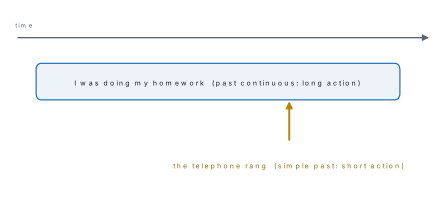
- A long action in the past continuous is interrupted by a short action in the simple past, usually with when or while:
- The alarm went while Trishna was sleeping.
- I was doing my homework when the telephone rang.
- While is followed by the continuous (the long action); when often introduces the short action.
- Two actions that happened one after another are both in the simple past: When the doors opened, the audience rushed into the stadium. As soon as the teacher asked the question, Brinda replied.
- Two long actions at the same time are both continuous: While I was cooking, my brother was watching TV.
Do not write While I walked, I was seeing him (mixed). Verbs of state (know, like, see, hear, want, be) are normally not used in the continuous: say I saw, not I was seeing. Do not use the past continuous for a completed action: He was writing three letters yesterday (wrong when the letters are all finished).
Problem. Fill in: "The alarm (go) while Trishna (sleep)."
Solution. The alarm is the short action; sleeping is the long one. The alarm went while Trishna was sleeping.
Problem. Fill in: "When we (wake), we (see) the sun shining brightly."
Solution. Two actions one after another → simple past. When we woke, we saw the sun shining brightly.
Problem. Make a sentence: Kamal / fall off / while / play on the verandah.
Solution. Kamal fell off while he was playing on the verandah.
Exercise A — Put the verbs in the correct form
- The alarm (go) _ while Trishna (sleep) _.
- As soon as the teacher (ask) _ the question, Brinda (reply) _.
- I (do) _ my homework when the telephone (ring) _.
- When the doors (open) _, the audience (rush) _ into the stadium.
- When we (wake) _, we (see) _ the sun shining brightly.
- When I arrived home, my dad (prepare) ____ snacks for me.
- We (travel) _ to Chitwan when the police (stop) _ us.
1. went; was sleeping.
2. asked; replied.
3. was doing; rang.
4. opened; rushed.
5. woke; saw.
6. was preparing.
7. were travelling; stopped.
Exercise B — Make sentences (simple past or past continuous)
- it / begin to snow / while we / return home
- Amit / wait for me / when I / reach the station
- what / you / do / yesterday when I / call you?
- I / break the glass / while I / wash it
- the teacher / enter the class / while some students / dance in the class
1. It began to snow while we were returning home.
2. Amit was waiting for me when I reached the station.
3. What were you doing yesterday when I called you?
4. I broke the glass while I was washing it.
5. The teacher entered the class while some students were dancing in the class.
Grammar II: Past simple and past perfect in narrative
The past perfect (had + past participle) shows an action that happened before another past action. The later event is in the simple past.
| Sentence | Order of events |
|---|---|
| Ram had bought the ticket before he went to the cinema. | bought first, then went |
| When I reached the station, the train had left. | train left first, then I reached |
| The children arrived five minutes ago. | one past event: simple past |
Signal words: before, after, by the time, already, just, never … before, when (+ earlier event), as soon as. After after, either tense may be used: After she had finished / finished the work, she went home.
Narrative tenses at a glance
| Tense | Role in a story |
|---|---|
| Simple past | the main events in order |
| Past continuous | background and actions in progress |
| Past perfect | events that happened earlier than the main story |
Problem. Complete: "Ram ____ (buy) the ticket before he went to the cinema."
Solution. The buying came first → had bought.
Problem. Complete the story: "A young woman entered a shop. She (put) food in a bag and (wait) until no one was looking. When the shopkeeper (check) the goods, she (give) him a thousand-rupee note."
Solution. She put food in a bag and waited until no one was looking. When the shopkeeper checked the goods, she gave him a thousand-rupee note. (a sequence of completed actions → simple past)
Exercise C — Complete with the correct form
- The children ____ (arrive) five minutes ago.
- Ram ____ (buy) the ticket before he went to the cinema.
- When I reached the station, the train ____ (already leave).
- By the time the doctor came, the patient ____ (die).
- She ____ (not / eat) anything before she took the medicine.
- After he ____ (finish) his homework, he went to bed.
1. arrived.
2. had bought.
3. had already left.
4. had died.
5. had not eaten.
6. had finished (finished is also acceptable).
Writing I: Writing about historical events and giving an opinion
(a) A paragraph from a list of events. Turn a list of dates into connected sentences. Use the simple past, time connectives (in, on, later, after that, meanwhile, finally) and linking words (as a result, however). Keep the order of time. Name people and places exactly.
Task. Write a couple of paragraphs about Nepal's journey from the Panchayat system to multiparty democracy, using the events 2017 BS to 2046 BS.
Nepal's journey from the Panchayat system to multiparty democracy was long and full of struggle. On 1 Poush 2017 BS, King Mahendra dismissed the elected government of Prime Minister B. P. Koirala, dissolved parliament, arrested the leaders and banned political parties. In 2019 BS a new constitution established the party-less Panchayat system, in which the king held the real power.
Opposition to the system continued. In 2036 BS student protests spread across the country, and King Birendra announced a national referendum. On 20 Baisakh 2037 BS the people were asked to choose between the reformed Panchayat system and a multiparty system, and a narrow majority voted to keep the reformed Panchayat. Dissatisfaction remained, however. In Falgun 2046 BS the Nepali Congress and the left parties started the People's Movement (Jana Andolan), and thousands of people went to the streets. After weeks of protest and many deaths, King Birendra lifted the ban on political parties in Chaitra 2046 BS. In this way, the party-less system ended and multiparty democracy returned to Nepal.
(The dates above are the widely accepted ones; if your textbook list gives different details, follow the list in your book.)
(b) An opinion essay (about 200 words). State your position in the first paragraph; give two or three reasons with examples; consider the opposite view briefly; and end with a strong conclusion.
Task. Some people think that studying history is a waste of time; others think it is essential. What do you think?
Why We Must Study History
Some people say that history is only a list of dead kings and old dates. I disagree. I believe that studying history is essential.
First, history teaches us lessons. By learning how people succeeded or failed in the past, we can avoid repeating their mistakes. The story of the Rana regime and the movements that ended it, for example, shows why freedom and equal rights matter.
Second, history gives us an identity. When we know who built Hanuman Dhoka or how Nepal became one country, we understand and respect our culture and we take pride in it. A person who does not know the past is like a tree without roots.
Third, history improves our thinking. It teaches us to compare evidence, to ask why things happened and to judge fairly.
It is true that some students find history boring when it is taught only by memorising dates. However, this is a problem of method, not of the subject. Visits to museums, old temples and stories make history live.
In conclusion, history is not a waste of time. It guides the present and helps to build a wiser future.
Writing II: A story from outlines
To write a story from outlines: (1) read all the cues and decide the order; (2) write in the past tense; (3) make a beginning (setting and characters), a middle (the problem and how it grows) and an end (the result); (4) use connectives (once upon a time, one day, then, soon, at last, in the end); (5) finish with a moral if the outline asks for it; (6) give the story a title.
Task. Write a story with the title "The Bat, the Birds and the Beasts" using the outline: a great conflict between the birds and the beasts … two armies collected … the bat refuses to join … says he is a beast … beasts request … says he is a bird … peace made, no battle … rejoicing … bat wishes to join … both turn against him … threaten to tear him to pieces … bat flies away … moral.
The Bat, the Birds and the Beasts
Once upon a time there was a great quarrel between the birds and the beasts. Neither side would give way, so both gathered their armies and prepared for a terrible war.
When the armies were ready, the bat was asked to join the birds. He refused and said, "I am a beast. I have fur and teeth." Later the beasts asked him to join them. "I am a bird," he said, "because I have wings and fly." In this way the bat kept out of the fight and waited to see who would win.
Before the battle began, however, wise leaders on both sides spoke to each other, and peace was made. There was great rejoicing, and the birds and beasts began to celebrate together.
The bat, seeing that both sides were happy, wished to join the celebration. But the birds remembered that he had refused to fight with them, and the beasts remembered that he had refused to join them. Both turned against him and threatened to tear him to pieces. The frightened bat flew away and hid in a dark cave. Since that day he has come out only at night.
Moral: A person who is false to both sides will be trusted by neither.
Chapter summary
- Pratap Malla (king of Kantipur, ruled about 1641–1674): kept the state safe by diplomacy between Lalitpur and Bhaktapur, gained wealth from Tibet–India trade, built and repaired temples and palaces (Hanuman Dhoka, Rani Pokhari), wrote in many languages and took the title Kabindra.
- Flowers in Russian Culture: flower etiquette — red carnation (patriotism), white carnation (bad luck for performers), red poppy (fragile love), yellow flowers (break-up), white lily at weddings (death/split), chamomile (healing).
- Compound words: gift-giving, heart-warming, cardboard, flower etiquette, break-up, fortune-telling, newly-wed.
- Simple past for completed actions and sequences; past continuous for actions in progress; while + continuous, when + short action.
- Past perfect (had + past participle) shows the earlier of two past actions.
- Writing: events paragraph in time order with connectives; opinion essay with position, reasons and conclusion; story with beginning, middle, end and moral.
Practice questions
Objective questions (1 mark each)
- Pratap Malla ruled Kantipur by playing the kings of ____ against each other. [1]aLalitpur and BhaktapurbGorkha and NuwakotcTibet and IndiadPokhara and Palpa
- "While I ____ , the phone rang." [1]acookbwas cookingchad cookeddcooked
- "When I reached the station, the train ____." [1]aleftbwas leavingchad leftdleaves
- Which is not a compound word? [1]abreak-upbheart-warmingccardboarddbeautiful
Answers
1. (a).
2. (b).
3. (c).
4. (d).
Short answer questions (2 marks each)
- Why did the white lily have a bad meaning in Russian weddings? [2]
- Name two buildings or places connected with Pratap Malla. [2]
- Combine: "It began to snow. We were returning home." (while) [2]
- Combine: "He finished his homework. Then he went to bed." (after, past perfect) [2]
Answers
1. Because the white lily is linked with death and so foreshadows the split of the newly-wed couple.
2. Hanuman Dhoka palace and Rani Pokhari.
3. It began to snow while we were returning home.
4. After he had finished his homework, he went to bed.
Long answer questions (4 marks each)
- Write a story using these outlines: a poor woodcutter … his axe falls into a river … a river-fairy appears … offers gold and silver axes … he refuses … fairy is pleased … gives him all three … a greedy neighbour copies … fairy punishes him … moral. [4]
- Write about 200 words on "The Importance of Preserving Our Cultural Heritage". [4]
Answers
1. Outline for answer: title; beginning — a poor, honest woodcutter beside a river; middle — axe lost, the fairy tests him, he says only the iron axe is his, the fairy rewards honesty; the greedy neighbour tries the trick, lies and loses his own axe; moral — honesty is the best policy. Past tense, connectives.
2. Outline: introduction (heritage = temples, art, festivals, languages); why it matters (identity, tourism, education); threats (earthquake damage, neglect, pollution, theft); what to do (repair using traditional methods, teach children, laws, volunteering); conclusion.
Practise more: English question bank