Unit 4 · Units · 22 min read
Unit 4: Work and Leisure
What the syllabus asks for 3
- Cabbage White
- Leave This Chanting and Singing
- Grammar and writing tasks of the unit
Work feeds a family and builds a country; leisure rests the mind. This unit asks what honest work really means. A short story shows two children whose first job goes comically wrong. A famous poem by Rabindranath Tagore says that the best form of worship is honest labour. In grammar you will study modal verbs and imperatives; in writing, a job application and a set of rules and regulations.
Reading: vocabulary matching, true/false/not given, short answers on character and plot; for the poem, meanings of words, archaic words, and what the poet advises. Grammar: functions of modal verbs and imperatives. Writing: job application, rules and regulations, notice.
4.1 Cabbage White
About the text
"Cabbage White" is a short humorous story adapted from Happy Days and Short Stories by the English-language teacher and writer Jake Allsop. Its title is the name of a common butterfly, Pieris rapae (the small white), whose caterpillars eat cabbage leaves. The tone is light and comic, but the story still carries a lesson about planning, patience and the way a hasty "clever idea" can wreck a job.

What the story says
Sarah (12) and her brother Jamie (11) stand on tiptoe to hand their school card to a tall man at a farm counter. He frowns: they should be at school. They explain that they are on holiday and want to earn money to support their parents. The man says the work is hard and he needs somebody big and strong, but Sarah pleads, and he asks whether they know what a Cabbage White is. Sarah answers correctly: a white butterfly that lays eggs on cabbages, which become caterpillars that eat the leaves. Jamie shouts the last part. Since neither is afraid of caterpillars, he offers them a job: check every cabbage and remove the caterpillars, putting them in a pail. He will decide the pay after he sees the work.
In the cabbage patch they are overwhelmed. Jamie thinks there must be a million cabbages; Sarah calculates that with ten caterpillars on each there must be a billion caterpillars. Picking is slow and disgusting: the caterpillars wriggle and the first row takes ages. Meanwhile cabbage-white butterflies fill the air and seem to mock them — however many caterpillars the children kill, the butterflies can lay millions more eggs. The children become desperate.
Then Sarah has a "brilliant" idea, "as brilliant as Einstein coming up with E = mc²". Caterpillars come from eggs and eggs come from butterflies, so if they kill the butterflies there will be no more. She pulls up two bamboo bean-poles (killing two bean plants), gives one to Jamie, and they rush about swinging the poles. Butterflies are hard to hit in the air but easy to hit when they settle on cabbages — and it is impossible to hit a butterfly on a cabbage without hitting the cabbage. At last, exhausted, they look at their work. Few butterflies are left, and hardly any cabbages: the field looks like a battlefield. Without a word they put down the poles and tiptoe away. Jamie says, "He knows our names," and Sarah answers, "But he doesn't know where we live."
Characters
| Character | Qualities | Evidence |
|---|---|---|
| Sarah | confident, quick, bossy, overconfident | Answers the man, leads the "plan", does the arithmetic |
| Jamie | younger, loyal, cheerful, less sure | Doubts her arithmetic "but knew better than to dispute"; follows her "game" |
| The farmer | strict, practical, fair-minded | Frowns at their age, but gives them a chance and promises fair pay |
Vocabulary
| Word | Meaning | Example |
|---|---|---|
| mock | to laugh at somebody in an unkind way | The boys mocked his accent. |
| hideous | very unpleasant | The smell was hideous. |
| wriggle | to twist and turn with quick short movements | Worms wriggle in wet soil. |
| gaily | in a cheerful way | The girls sang gaily. |
| open-mouthed | very surprised or shocked | He stood open-mouthed at the news. |
| plead | to ask for something in a serious, emotional way | She pleaded for a chance. |
| frown | to make a face showing disapproval | The teacher frowned at the noise. |
| dispute | to argue or disagree strongly | They disputed the score. |
Verbs of walking (the story uses tiptoe): sneak — to move quietly so as not to be noticed; stroll — to walk slowly for pleasure; lurch — to move unsteadily with sudden jerks; stagger — to walk unsteadily as if about to fall; stride — to walk with long, confident steps; stumble — to trip or lose balance while walking.
Themes
- Children and work. The children want to help their family. The story is gentle about it but shows that real work needs patience and skill.
- Shortcuts backfire. The "brilliant idea" solves the wrong problem; the cabbages are the farmer's real wealth.
- Humour from exaggeration. A million cabbages and a billion caterpillars are comic overstatement (hyperbole).
- Fear of consequences. The last lines turn a funny story into a small lesson about responsibility.
Questions and model answers
Objective questions (1 mark each)
- Write True, False or Not Given: Sarah and Jamie have never been to school. [1]
- Write True, False or Not Given: The man decides to pay them after the work is finished. [1]
- "Hideous" means [1]avery pleasantbvery unpleasantcvery smalldvery quiet
- The man gave them work because [1]athey were strongbthey were not afraid of caterpillarsctheir parents asked himdhe knew them
- Write True, False or Not Given: They were caught while running away. [1]
Answers
1. False — they are on holiday from school.
2. True — "Let me see how you get on, first."
3. (b).
4. (b).
5. False — they tiptoed away unseen.
Short-answer questions (2 marks each)
- Why do you think the man frowned when Sarah and Jamie gave him their school card? [2]
- Why were they looking for a job instead of going to school? [2]
- What work were they supposed to do at the farm? [2]
- Were there really a million or a billion caterpillars? What did Sarah and Jamie mean? [2]
- What was Sarah's "brilliant" idea? [2]
- Why did they run away from the farm secretly? [2]
Model answers
1. He frowned because they were young children who should have been at school, not looking for work.
2. It was their holiday and they wanted to earn money to support their parents.
3. They were to check every cabbage in the field and pick off all the caterpillars into pails.
4. No. They were exaggerating; they meant that the field was so big and the caterpillars so many that the job looked impossible.
5. Her idea was to kill the butterflies, which lay the eggs, instead of picking caterpillars, so that no new caterpillars would hatch.
6. They had destroyed almost all the cabbages and were afraid of the farmer's anger.
Long-answer questions (4 marks each)
- Describe how Sarah and Jamie ruined the cabbage field. [4]
- What lesson do you learn from the story? [4]
Model answers
1. The farmer asked the children to pick the caterpillars from every cabbage. They found the field huge and the work disgusting, and butterflies kept laying eggs. In desperation Sarah decided to kill the butterflies instead. She pulled two poles from a bean patch, killing two bean plants, and the children swung the poles at the butterflies. They hit the butterflies when they rested on the cabbages and so smashed the cabbages as well. After a long fight hardly a butterfly or cabbage was left. The field looked like a battlefield and the children crept away.
2. The story teaches that hasty "clever" ideas can do more harm than good. If the children had done the job patiently, as told, they would have earned their pay. Real work needs attention to instructions and to the purpose of the task: the farmer wanted healthy cabbages, not dead butterflies. It also shows that we should accept responsibility for our mistakes rather than run away.
4.2 Leave This Chanting and Singing
About the poem and the poet
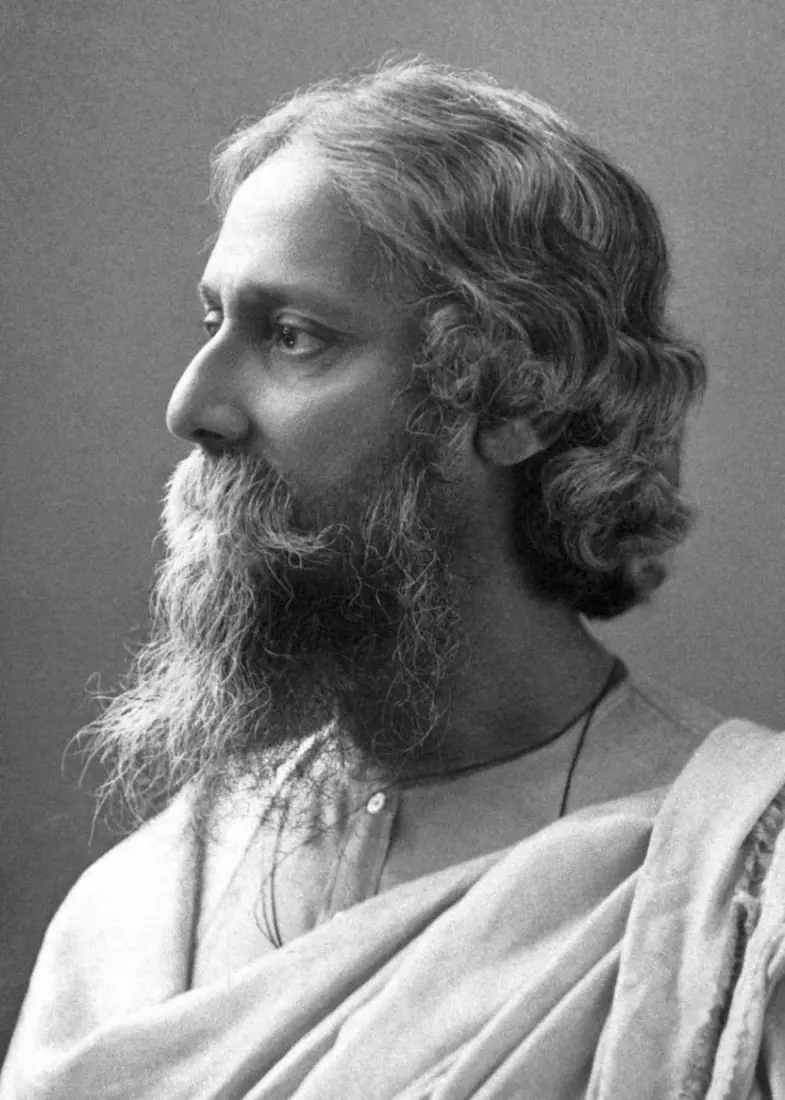
Rabindranath Tagore (1861–1941) was a poet, novelist, playwright, composer and painter from Bengal. He wrote Gitanjali ("Song Offerings"), and in 1913 he became the first non-European to win the Nobel Prize in Literature. He also wrote the words of the national anthems of India and Bangladesh. "Leave This Chanting and Singing" is poem number 11 in the English Gitanjali (1912), which Tagore translated himself from Bengali prose-poems.
The poem
Leave this chanting and singing and telling of beads! Whom dost thou worship in this lonely dark corner of a temple with doors all shut? Open thine eyes and see thy God is not before thee!
He is there where the tiller is tilling the hard ground and where the path-maker is breaking stones. He is with them in sun and in shower, and his garment is covered with dust. Put off thy holy mantle and even like him come down on the dusty soil!
Deliverance? Where is this deliverance to be found? Our master himself has joyfully taken upon him the bonds of creation; he is bound with us all for ever.
Come out of thy meditations and leave aside thy flowers and incense! What harm is there if thy clothes become tattered and stained? Meet him and stand by him in toil and in sweat of thy brow.
Meaning, stanza by stanza
- Stanza 1 — a sharp question. The speaker tells a worshipper to stop chanting, singing hymns and counting prayer beads in a shut, dark corner of a temple. The question "Whom dost thou worship?" suggests that a God who is not in the world is not really being met. "Open thine eyes": God is not in front of you in that dark corner.
- Stanza 2 — where God is. God is with the farmer ploughing hard ground and the road-builder breaking stones, in sun and rain, with dusty clothes. The worshipper must remove the "holy mantle" (the show of holiness) and join them on the dusty soil.
- Stanza 3 — deliverance. People seek deliverance (release from suffering) by leaving the world. But the Master has joyfully taken the "bonds of creation" on himself: He is tied to us for ever. So freedom is found within the world, not outside it.
- Stanza 4 — the call. Leave meditation, flowers and incense. Dirty or torn clothes do not matter. Meet God and stand with Him in toil, in "the sweat of thy brow".
Central idea
Honest labour is worship. God is found among working people, not only in temples; true devotion means joining in the world's work. The poem does not insult prayer; it criticises empty ritual that separates a person from other people.
Poetic devices
| Device | Example | Effect |
|---|---|---|
| Imperative | "Leave…", "Open…", "Put off…", "Come out…" | The tone is urgent, like a friend shaking you awake |
| Rhetorical question | "Whom dost thou worship…?" "Where is this deliverance…?" | Makes the reader think and doubt empty ritual |
| Contrast | dark closed temple / open dusty fields | Closed religion against open life |
| Imagery | tiller, path-maker, dust, sweat | Strong pictures of manual labour |
| Archaic language | dost, thou, thine, thy | Gives a solemn, prayer-like tone |
Vocabulary
| Word | Meaning |
|---|---|
| beads | small pieces of glass or stone threaded together, used to count prayers |
| tilling | preparing and using land for growing crops |
| mantle | a loose outer garment, a cloak |
| deliverance | being rescued from danger, evil or pain; liberation |
| incense | a substance that gives off a sweet smell when burnt |
| stained | marked with dirt or colour that is hard to remove |
| toil | hard, tiring work |
| tattered | old and torn |
Archaic words and their modern forms: dost → do; thou → you; thine → your; thy → your; thee → you.
Questions and model answers
Objective questions (1 mark each)
- The poet of "Leave This Chanting and Singing" is [1]aWalt WhitmanbRabindranath TagorecAmy LowelldLaxmi Prasad Devkota
- "Toil" means [1]arestbhard workcprayerdplay
- According to the poem, God is with [1]athe priestbthe tiller and the path-makercthe kingdthe temple guard
- "Thy" in modern English is [1]amybyourchisdtheir
Answers
1. (b).
2. (b).
3. (b).
4. (b).
Short-answer questions (2 marks each)
- Who is the poem addressed to? [2]
- Where do people try to find God, according to the poem? [2]
- Where does God actually live, according to the speaker? [2]
- What does the speaker advise the worshipper to do? [2]
- What do you understand by "bonds of creation"? [2]
Model answers
1. It is addressed to a worshipper — anyone who is chanting and counting beads in a temple.
2. They try to find Him in a lonely, dark corner of a temple with shut doors, through chanting, singing and telling beads.
3. He lives with the people who work hard — the farmer tilling hard ground and the road-builder breaking stones — in sun and rain.
4. To leave the rituals, put off the holy mantle, go down onto the dusty soil and work side by side with the labourers.
5. It means the ties of the world: duties, work and suffering. The poem says God has taken these on Himself and is bound to all people for ever.
Long-answer questions (4 marks each)
- What message does the poet give in this poem? [4]
- Do you believe in the existence of God? What do you do to please Him? Share your opinion. [4]
Model answers
1. The poet says that real worship is not found in rituals alone. People who chant and count beads in a closed temple miss God, who is with the farmer in his field and the labourer on the road. The poet asks them to leave ritual and join the workers, because honest work and service to others are the true forms of devotion. He also says that freedom comes through living bravely in the world, not by running away from it.
2. Many people, including me, believe in God. I try to please Him by being honest, helping others and respecting parents and teachers. I study carefully, do not waste food and water, and help neighbours when they are in trouble. I also pray, but I believe that good deeds matter more than ritual, which is the same message as Tagore's poem.
4.3 Grammar and writing tasks of the unit
Grammar I: Modal verbs and their functions
Modal verbs (can, could, may, might, must, should, would, will, shall) are helping verbs that show attitude: ability, permission, possibility, advice or obligation. They have no -s in the third person and are followed by the bare infinitive: She could swim (not She could to swim).
| Modal | Main functions | Example |
|---|---|---|
| can | ability; permission; possibility | I can swim. Can I go out? |
| could | past ability; polite request; weaker possibility | Could you tell me the way to the airport? |
| may | permission; possibility | May I come in? It may rain. |
| might | weak possibility | He might be in his office. |
| must | strong obligation; strong certainty (deduction) | You must wear a helmet. She must be tired. |
| can't | impossibility (negative deduction) | This can't be Safal's coat; it is too small. |
| should | advice; what is proper | You should see this film. |
| would | polite offer or invitation; habit in the past | Would you like to stay with us? |
| have to / had to | external compulsion | I had to wait for an hour. |
Degrees of certainty (deduction)
| Certainty | Modal |
|---|---|
| 100 % sure it is true | must |
| 100 % sure it is not true | can't / couldn't |
| about 50 % sure | may / might / could |
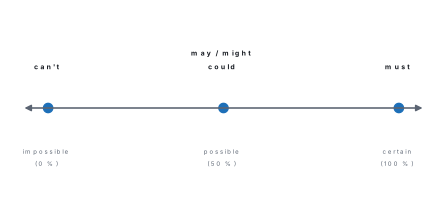
Do not write He can swims, She musts go or I should to go. Must has no past tense — use had to (I had to wait). Mustn't means forbidden; don't have to means not necessary.
Problem. Fill in with a modal: "Sanam has been working in the field all day. She ____ be tired."
Solution. The speaker is almost certain. Choose must. She must be tired.
Problem. Fill in with must or can't: "He is not a doctor; he has never studied medicine. He ____ be a doctor."
Solution. The speaker is sure it is not true. He can't be a doctor.
Problem. What does the modal show in "The poor Heron had to be content with a tiny snail"?
Solution. Had to shows compulsion — he had no choice.
Exercise A — Fill in with the best modal
(could, can't, must, may, should, might, would)
- This ____ be Safal's coat. It is too small for him.
- ____ you please tell me the way to the airport?
- ____ you like to stay with us at the weekend?
- Do you know where Jack is? He ____ be in his office.
- The sky is overcast. It ____ rain in the afternoon.
- Sanam has been working in the field all day. She ____ be tired.
- The film is really wonderful. You ____ see it at least once.
1. can't.
2. Could.
3. Would.
4. might.
5. may.
6. must.
7. should.
Exercise B — must or can't
- The man is looking all around. He ____ be lost.
- He ____ be a doctor. He has never studied medicine.
- There ____ be something wrong with the fan. It is making a strange noise.
- This ____ be Sumana's book. It has the library's stamp on it.
- He ____ have had hard times. He lost his job and supports his old parents.
1. must.
2. can't.
3. must.
4. can't.
5. must.
Grammar II: Imperatives
An imperative gives a command, instruction, request, advice, warning or invitation. It uses the base form of the verb and usually has no subject (Open the door.). The negative uses do not / don't (Don't run.). Tagore's poem is full of imperatives: Leave… Open… Put off… Come out….
| Function | Example |
|---|---|
| command / order | Stand up! Sit down. |
| request (with please) | Please help me with my homework. |
| instruction | Add two spoons of sugar and stir. |
| advice | Take care of your health. |
| warning | Mind your head! Don't touch the wire. |
| invitation | Come in and have some tea. |
| let forms | Let me help you. Let's go. |
Making imperatives negative
| Positive | Negative |
|---|---|
| Open the window. | Don't open the window. |
| Be quiet. | Don't be noisy. / Be not noisy (old style) |
| Let's play. | Let's not play. |
| Stand here. | Do not stand here. (more formal, for notices) |
Exercise C — Make negative
- Close the door. 2. Wait here. 3. Read aloud. 4. Be late. 5. Let's go now.
1. Don't close the door.
2. Don't wait here.
3. Don't read aloud.
4. Don't be late.
5. Let's not go now.
Exercise D — Name the function
- Please pass me the salt. 2. Take this medicine twice a day. 3. Watch out! 4. Come to my house for dinner. 5. Don't give up.
1. request.
2. instruction (or advice).
3. warning.
4. invitation.
5. advice (encouragement).
Writing I: A job application
A job application is a formal letter. Sender's address and date come at the top. The receiver's designation and address follow. The subject names the post. The body has three or four short paragraphs: (1) why you are writing and which advertisement you saw; (2) your qualifications and experience; (3) your skills and why you suit the post; (4) mention of enclosures, a request for an interview and thanks. End with Yours faithfully/sincerely, your signature and name.
Bhanu-10, Tanahun 18 August
The Headteacher Shree Janajagriti Secondary School Bhanu-10, Tanahun
Subject: Application for the post of School Secretary
Dear Sir,
I am writing to apply for the post of School Secretary advertised in The Tanahun Post.
I am twenty years old. After passing my SLC, I worked for a year as an office secretary at Himalayan Investment Company Limited, where I managed correspondence, files and accounts. I am confident in both Nepali and English and use a computer well.
I enjoy working with students and teachers, and I am punctual, honest and hard-working. I believe I can be a valuable member of your staff.
I have enclosed copies of my certificates. I would be grateful if you would call me for an interview.
Yours faithfully, Pabitra Nepali
Writing II: Rules and regulations
Rules and regulations tell people what they must, may and must not do in a place. Use a title, a numbered list, imperatives (Keep silence) and modals (Visitors must…, Visitors should not…). Make each rule short and clear.
Rules and Regulations of the School Library
- Keep silence in the library.
- Do not bring food or drink inside.
- Handle books carefully; do not write on or tear pages.
- Students may borrow two books at a time for a maximum of seven days.
- Return books on time; a fine of Rs 2 per day will be charged for late books.
- Switch off mobile phones.
- Put the books back on the shelves or on the reading table after use.
Rules and Regulations for Visitors
- Visit only during the visiting hours (4 pm to 6 pm).
- Only two visitors may see a patient at a time.
- Do not bring children under ten into the wards.
- Keep silence and switch phones to silent mode.
- Do not touch medical equipment or patients' files.
- Do not smoke or spit anywhere in the hospital.
- Follow the instructions of doctors and nurses.
Chapter summary
- Cabbage White (adapted from Jake Allsop): Sarah and Jamie get farm work picking caterpillars off cabbages, then destroy the field while trying to kill the butterflies, and slip away.
- Themes: shortcuts and rash plans backfire; exaggeration makes humour; children want to help their parents.
- Leave This Chanting and Singing is poem 11 of Rabindranath Tagore's Gitanjali (Nobel Prize 1913): God is with the tiller and the path-maker, so honest toil is worship.
- Archaic forms: dost, thou, thine, thy, thee.
- Modals: can, could, may, might (ability, permission, possibility), must / can't (certainty), should (advice), would (offers), have to / had to (compulsion).
- Imperatives give commands, requests, advice, warnings and invitations; negative with don't; let's not.
- A job application: heading, subject naming the post, paragraphs on qualification, skills and enclosures, polite close. Rules use a numbered list, imperatives and modals.
Practice questions
Objective questions (1 mark each)
- Who wrote the story adapted as "Cabbage White"? [1]aJake AllsopbAmy LowellcTagoredWhitman
- "Gaily" means [1]asadlybin a cheerful waycslowlydloudly
- "He ____ be at home; his lights are on." (certain) [1]acan'tbmustcshouldn'tdmustn't
- "Don't make a noise" is an example of [1]aa questionba negative imperativeca statementda promise
Answers
1. (a).
2. (b).
3. (b).
4. (b).
Short answer questions (2 marks each)
- Why did the children tiptoe out of the garden? [2]
- What does the poet mean by "Put off thy holy mantle"? [2]
- Make the sentence negative: "Open your books." [2]
- Fill in with must/can't: "This ____ be Ram's bag; his name is on it." [2]
Answers
1. They were afraid of the farmer because they had ruined the cabbages, and they wanted to escape without being seen.
2. He tells the worshipper to remove the show of holiness, the proud robe of ritual, and to join the workers in the dust as an equal.
3. Don't open your books.
4. must.
Long answer questions (4 marks each)
- Write a job application for the post of Science teacher advertised in Gorkhapatra on 5 Shrawan. [4]
- Write a set of rules for the school computer lab. [4]
Answers
1. Outline: your address and date; the Principal and school address; subject (Application for the post of Science teacher); paragraph on advertisement; qualification (e.g. B.Ed. in Science, two years' experience); skills; enclosures; request for interview; close.
2. Model: 1. Enter the lab only with the teacher. 2. Do not bring food or drink. 3. Switch on and off the computers correctly. 4. Do not install games or change settings. 5. Use the internet only for study. 6. Report any fault to the teacher at once. 7. Leave your seat tidy.
Practise more: English question bank