Unit 2 · Units · 24 min read
Unit 2: Festivals and Celebrations
What the syllabus asks for 3
- Battle of the Oranges
- Thanksgiving Around the World
- Grammar and writing tasks of the unit
Every society sets aside special days to remember its past, thank nature and enjoy life together. This unit takes you from an orange-throwing carnival in northern Italy to harvest thanksgivings on five continents. You will meet vivid travel writing and a clear piece of factual description, then learn how to report questions, and practise writing a festival essay and a news story.
Reading: true/false, matching words to meanings, "what does X symbolise / how does the narrator feel" short answers. Grammar: turning direct questions into reported questions (yes/no and wh-questions). Writing: an essay about a festival, and a news story from clues.
2.1 Battle of the Oranges
About the text
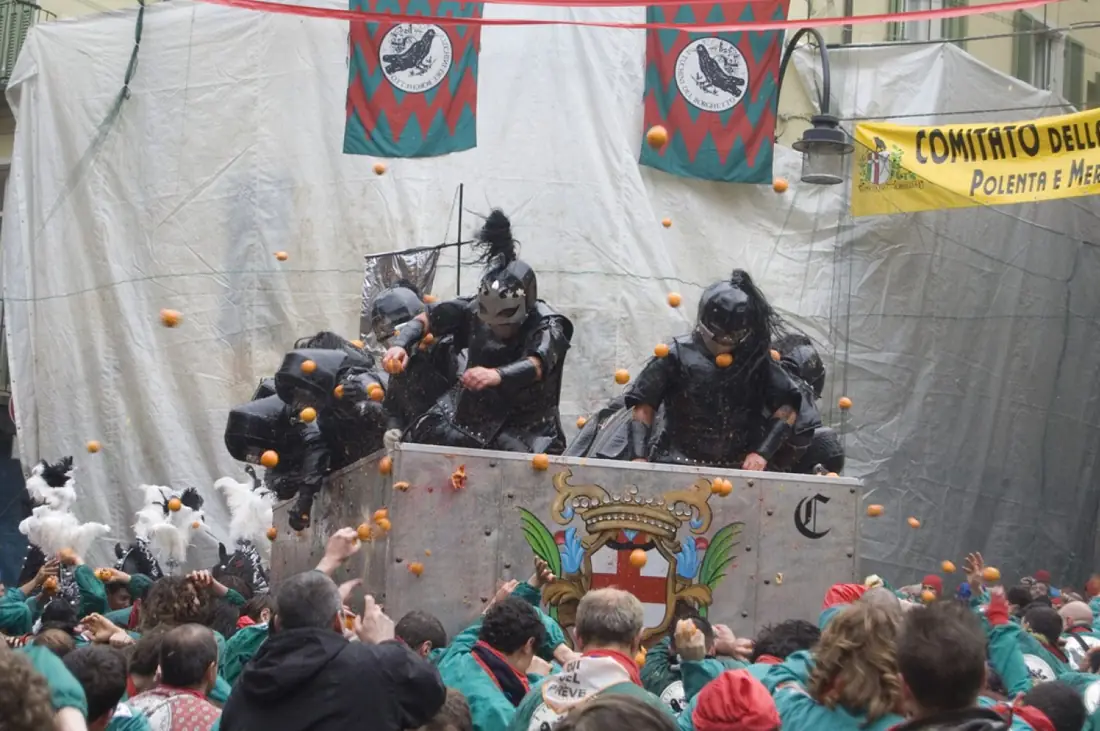
"Battle of the Oranges" is a first-person travel account by Margherita, published on the travel blog The Crowded Planet (the textbook adapts it). It describes the Carnevale di Ivrea, held every year in the town of Ivrea, about an hour north of Turin in northern Italy, on the last days of Carnival. The writer goes as a visitor and ends up a participant. It is a narrative of personal experience: it uses I, the present tense for immediacy, vivid sensory detail and dialogue.
What the text says
The narrator is hit in the chest by an orange and falls into a heap of orange mush. Her first thought is to check that her red hat is still on her head. During Carnival, public notices tell everyone, especially tourists, to wear the red hat; people without it count as "fair targets" for orange-throwing. The hat, the berretto frigio, is the symbol of the carnival itself and of freedom: in Roman times it was worn by freed slaves, and in the Middle Ages by peasants who rose against their feudal lords.
She is hit again on the forehead. When she wipes her face she is horrified to see red — she thinks it is blood and fears she will need stitches or has a concussion — then she remembers that some oranges are blood oranges. Relief follows the shock.
Retreating to the back of the square, she watches the battle: nine teams of aranceri (orange-throwers) on foot, in uniform, hurl oranges at opponents riding in horse-drawn carts, who wear padded costumes and leather helmets that remind her of the television hero Doctor Who. After an hour the square is covered with a sludge of orange pulp and horse manure that smells "sharp, sweet-and-sour". Whenever a cart approaches, the aranceri charge and bombard it; the horses halt for a moment, oranges explode, then the cart moves off and the aranceri chase it, throwing their last oranges. They wear no protection; some have broken noses or sore ribs, yet they hold their heads high and shout their team's war cry.
She talks to Silvia, who holds half an orange on her swollen eye. This, says Silvia, is "the moment we wait for all year"; she believes the carnival is good for psychological health because for three days people can "let it all out" — the frustrations of the year. The narrator wonders whether to join in. Volunteers advise visitors to stay behind protective nets, but Massi, an arancere of the Morte team, says "Forget the nets": to live the carnival, you must be in the middle of the battle, and a black eye is a small price for the rush. He invites her to throw away her hat and join him; she is tempted but declines.
At the end of the full article Silvia later hands her a bag of oranges, and she does throw — and feels light, free and "liberated" (this part is outside the textbook extract, so do not use it in an exam answer unless the question asks for it).
Background
The battle is said to re-enact a medieval revolt against a tyrant. According to local legend, a miller's daughter, Violetta, refused to submit to a feudal lord and killed him, which led the townspeople to burn his castle. In the battle the aranceri on foot stand for the people, and the carts stand for the lord's soldiers. Historians think the orange-throwing itself grew from a nineteenth-century custom of tossing oranges at parades as a sign of respect. Thousands of tonnes of oranges are used, and afterwards they are turned into compost. (Treat these background facts as extra information, not as textbook content.)
Vocabulary
| Word | Meaning | Example |
|---|---|---|
| mush | a soft, thick mass | She fell into a pile of orange mush. |
| jerk | to make something move with a sudden sharp movement | His head jerked back. |
| concussion | temporary loss of consciousness after a blow to the head | The boxer suffered a concussion. |
| hurl | to throw violently | Boys hurled stones into the river. |
| pulp | the soft inner part of fruit | The pulp of the orange was red. |
| clutch | to hold tightly | She clutched her bag. |
| sip | to drink in very small amounts | He sipped hot tea. |
| sludge | thick, soft, wet mud-like mixture | The square was covered in sludge. |
| charge | to rush forward to attack | The aranceri charge the carts. |
Themes and ideas
- Freedom and rebellion. The red hat and the story of the revolt make the festival a celebration of freedom from tyranny.
- Release of tension. Silvia treats it as a safety valve for frustration; the festival lets people be wild in a safe, agreed way.
- Insider and outsider. The narrator starts as a nervous observer; Massi and Silvia invite her to belong. Her decision to refuse shows how hard it is to cross that line.
- Danger and fun together. Broken noses and black eyes are accepted as "a small price".
Questions and model answers
Objective questions (1 mark each)
- Write True or False: Tourists are told by public notices to wear a red hat. [1]
- The aranceri are the [1]acart ridersborange-throwers on footcpolicedjudges
- After an hour of battle the square is covered with [1]asnowborange pulp and horse manurecpaperdwater
- Write True or False: The narrator accepts Massi's offer. [1]
- "Jerk" means [1]ato throwbto drinkcto move with a sudden sharp movementdto hold
Answers
1. True.
2. (b).
3. (b).
4. False — she declines.
5. (c).
Short-answer questions (2 marks each)
- What does the red hat symbolise? [2]
- How does the narrator feel when she wipes her face? [2]
- What does the square look like after an hour of battle? [2]
- How do the aranceri chase the cart? [2]
- Does Silvia enjoy the carnival? [2]
- Why does Massi say, "Forget the nets"? [2]
Model answers
1. The red hat symbolises the carnival itself and freedom. In Roman times freed slaves wore it, and in the Middle Ages peasants who rebelled against feudal lords wore it.
2. She feels shocked and frightened. She thinks the red liquid is blood and that she may have a concussion; then she realises it is only blood-orange juice and feels relieved.
3. It is covered with a thick sludge of orange pulp and horse manure, and it smells sharp and sweet-and-sour.
4. They run behind it and throw their last oranges at it as it moves away.
5. Yes. She calls it the moment they wait for all year and says she will be happy to have a black eye tomorrow, because the carnival is good for their mental health.
6. Massi thinks that anyone who wants to live the carnival must be in the middle of the battle, not safe behind nets.
Long-answer questions (4 marks each)
- Describe the Battle of the Oranges as the narrator saw it. [4]
- Collect information about one other unique festival and describe it briefly. [4]
Model answers
1. The narrator sees a fierce but joyful battle in the main square of Ivrea. Nine teams of aranceri on foot throw oranges at opponents who ride in horse-drawn carts and wear padded costumes and helmets. When a cart arrives, the aranceri charge and bombard it; the horses stop, oranges burst, then the cart moves on and is chased. The fighters wear no protection and some are hurt, but they proudly shout their war cries. After an hour the square is covered with a stinking sludge of pulp and manure. Visitors must wear a red hat, the symbol of freedom, or they become targets. The narrator is hit twice and, at first, thinks she is bleeding.
2. Bisket Jatra is celebrated in Bhaktapur at Nepali New Year in Baisakh. Two chariots carrying images of Bhairav and Bhadrakali are pulled through the streets in a tug-of-war between the eastern and western parts of the city. A tall wooden pole (yosin) is raised and, the next day, brought down. The festival lasts about nine days. People wear traditional dress, play music, eat special food and welcome visitors, so it keeps the culture of Bhaktapur alive.
2.2 Thanksgiving Around the World
About the text
This is an informative article. It shows that Thanksgiving, which many people think of as an American holiday, has cousins across the world: people everywhere thank nature or God for the harvest, enjoy food together and honour their ancestors. The text takes you country by country, giving for each the name of the festival, the date, its reason and its special food or activity. Such description by example is a common reading task.
What the text says
| Country | Festival | When / why | Special features |
|---|---|---|---|
| USA | Thanksgiving | Fourth Thursday of November; remembers the feast the Pilgrims held after the first harvest in 1621 (attended, the text says, by 90 Native Americans and 53 Pilgrims) | Family dinner; roast turkey (about 45 million eaten each year), mashed and sweet potatoes, corn; parades such as Macy's in New York with floats and giant balloons |
| South Korea | Chuseok (Harvest Moon Festival) | 15th day of the 8th lunar month; thanks for the fall harvest and respect for ancestors | People return to their hometowns; food and wine offered to ancestors; songpyeon (crescent-shaped rice cakes steamed on pine needles); visits to graves; games such as tug-of-war, archery and Korean wrestling; hanbok worn |
| Brazil | Dia de Ação de Graças | Started in 1949 by President Gaspar Dutra after he admired the American holiday | Mass of thanks, lively carnival, crowds go to the beach; turkey with a sauce of jabuticaba, the "Brazilian grape", since cranberries do not grow there |
| Liberia | Thanksgiving | Begun in the 19th century by freed American slaves, giving thanks for freedom | Church service; roast chicken, green-bean casserole and mashed cassava; an evening of dancing and singing |
| Barbados | Crop Over | May to August, ending with the Grand Kadooment; began in the 1780s to mark the sugar-cane harvest | Carnival, calypso bands, flamboyant dancers |
| Ghana | Homowo ("to hoot at hunger") | May to August–September; celebrates the end of a famine | Palm-nut soup with fish and kpokoi (corn-dough grits); a ban on drumming first, then a night of loud drumming and dancing |
| Iran | Mehregan | 196th day of the Iranian year; dates back at least to the 4th century BC; celebrates harvest and the goddess Mehr | New clothes, community blessings, a feast on a table with marjoram; sherbet; kohl rubbed round the eyes for luck; seeds thrown over each other |
Vocabulary
| Word | Meaning | Example |
|---|---|---|
| rejoice | to feel or show great happiness | The town rejoiced at the news. |
| bountiful | plentiful, abundant | A bountiful harvest fills the barns. |
| commemorate | to remind people of an important event or person from the past | The festival commemorates a great victory. |
| intermittently | at irregular intervals, not continuously | It rained intermittently all day. |
| typically | in a way that shows the usual qualities of a type | Typically, dinner is served at seven. |
| crescent | a curved shape wide in the middle, pointed at both ends | The moon was a thin crescent. |
| vibrant | full of life and energy | The market is vibrant on festival days. |
| reveller | a person having noisy fun, usually in a group | Revellers filled the streets. |
| exotic | from another country; exciting and unusual | Exotic fruits were on sale. |
| pervade | to spread through and be noticeable everywhere | The smell of incense pervades the temple. |
| flamboyant | brightly coloured and attention-seeking | The dancers wore flamboyant costumes. |
| frantic | done quickly and with a lot of activity, not well organised | The frantic drumming grew louder. |
Themes and ideas
- Gratitude is universal. Different foods and dates, one reason: thanks for harvest, food and survival.
- Remembering the past. Festivals recall history — freedom for Liberians, the end of famine for the Ga of Ghana, ancestors for Koreans.
- Food and family. Feasts, home-coming and sharing strengthen community.
- Borrowing and adapting. Brazil took the idea from the USA but changed the sauce; traditions travel and change.
Questions and model answers
Objective questions (1 mark each)
- In which country do people eat songpyeon on Chuseok? [1]aIranbSouth KoreacGhanadBrazil
- Homowo means [1]ato love the harvestbto hoot at hungercto honour ancestorsdto thank the moon
- Which festival is celebrated for 12 weeks and ends in Grand Kadooment? [1]aMehreganbCrop OvercChuseokdHomowo
- "Frantic" means [1]acalmbdone quickly with much activity but poorly organisedcbeautifuldsilent
Answers
1. (b).
2. (b).
3. (b).
4. (b).
Matching. Name the country: (a) families feast in the evening with dancing and singing; (b) new clothes and community blessings; (c) palm-nut soup, fish and kpokoi; (d) people return to their hometowns; (e) crowds go noisily to the beach; (f) parades in the streets; (g) food and wine offered to forefathers.
Answers
(a) Liberia; (b) Iran; (c) Ghana; (d) South Korea; (e) Brazil; (f) the USA; (g) South Korea.
Short-answer questions (2 marks each)
- What is the main feature of American Thanksgiving? [2]
- What do parades include in America? [2]
- When and why is Chuseok celebrated in Korea? [2]
- How did Thanksgiving begin in Brazil? [2]
- Who started Thanksgiving in Liberia, and why? [2]
- What is Homowo celebrated for in Ghana? [2]
Model answers
1. The main feature is the family dinner, with roast turkey and other foods native to America; Americans eat more on this day than on any other.
2. They include marching bands, floats and giant balloons, often cartoon characters, as in Macy's parade in New York.
3. It is celebrated on the 15th day of the eighth lunar month to thank nature for the fall harvest and to honour ancestors.
4. President Gaspar Dutra visited the USA, liked the holiday and started it in Brazil in 1949.
5. Freed American slaves founded it in the nineteenth century to give thanks for their freedom.
6. It celebrates the end of a long famine and mocks hunger with feasting, drumming and dancing.
Long-answer question (4 marks)
- How do people in your community show gratitude for food and harvest? [4]
Model answer
1. In my community, farmers thank the land when the rice is ripe. In Mangsir the first rice of the new harvest is cut and a small part is offered to the household gods and to cattle before the family eats. This is Nwagi among the Newars and Nabanna in the Tarai. Neighbours share newly harvested grain, and in Tihar we worship cows and oxen, which work in the fields. At the end of the harvest, villagers hold a feast with songs and dances. All of these customs show that we remember that our food depends on nature and on the labour of animals and neighbours.
2.3 Grammar and writing tasks of the unit
Grammar: Reported questions
A direct question becomes a statement-shaped clause when reported: no question mark, no auxiliary verb in front, no inversion.
Rules
- Use the reporting verb asked (or wanted to know, enquired, inquired), not said.
- Yes/No questions (those that begin with a verb such as is, are, do, did, have, can, will) take if or whether.
- Wh-questions (what, where, when, why, how, who) keep the question word.
- Use statement word order: subject first, then verb. Drop do/does/did.
- Backshift the tense and change pronouns, time and place words as for statements.
- End with a full stop, not a question mark.
| Direct question | Reported question |
|---|---|
| "Are you working tonight?" | She asked if/whether I was working that night. |
| "Is this the road to the station?" | He asked if/whether that was the road to the station. |
| "Did you do your homework?" | The teacher asked if/whether I had done my homework. |
| "Have you been to Paris?" | She asked if/whether I had been to Paris. |
| "Where will you stay tonight?" | He asked where I would stay that night. |
| "How long have you been working in this company?" | She asked how long I had been working in that company. |
| "What flavour ice cream did you have at the party?" | He asked what flavour ice cream I had had at the party. |
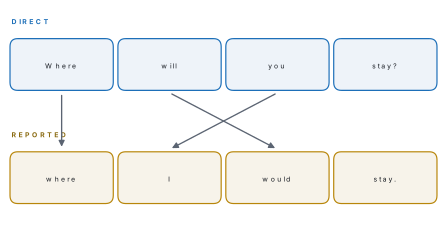
He asked me where did I live — wrong. Write He asked me where I lived. Do not use if with wh-questions (He asked if where I lived). Do not put a question mark at the end of a reported question.
Problem. Report: Kritika asked me, "Why did you go out last night?"
Solution. Wh-question → keep why; statement order: I went; backshift went → had gone; you → I; last night → the night before. Kritika asked me why I had gone out the night before.
Problem. Report: "Do you live in Patan?" said the Principal.
Solution. Yes/no question → if/whether; remove do; live → lived. The Principal asked me whether I lived in Patan.
Problem. Report: Anusha said to Melisha, "What were you doing when I saw you?"
Solution. were doing → had been doing; you → she; I → she. Anusha asked Melisha what she had been doing when she had seen her.
Exercise A — Change into reported questions
- "Are you working tonight?" (She asked me …)
- "Is this the road to the station?" (He asked …)
- "Did you do your homework?" (The teacher asked me …)
- "Have you been to Paris?" (She asked me …)
- "How long have you been working in this company?" (He asked her …)
- "Where will you stay tonight?" (I asked him …)
- "How many players were shown the yellow card by the referee?" (He wanted to know …)
- "Who was that beautiful woman, Usha?" said Sunita.
- "How is your mother?" said Gaurab to Yang Dolma.
- "How often do you go to the cinema?" said Krishna.
1. She asked me if/whether I was working that night.
2. He asked if/whether that was the road to the station.
3. The teacher asked me if/whether I had done my homework.
4. She asked me if/whether I had been to Paris.
5. He asked her how long she had been working in that company.
6. I asked him where he would stay that night.
7. He wanted to know how many players had been shown the yellow card by the referee.
8. Sunita asked Usha who that beautiful woman had been (or: was).
9. Gaurab asked Yang Dolma how her mother was.
10. Krishna asked how often I went to the cinema.
Exercise B — Choose the correct alternative
- Sujita asked her mother (when her father would come home / when will her father come home).
- The tourist inquired (whether I belonged / whether I am belonging) to Banepa.
- The little girl asked us what time (we were supposed / were we supposed) to come back.
- The head teacher asked her (whether she had filled out / whether had she filled out) the exam form the week before.
- Renuka asked me (if I had called / if had I called) her.
1. when her father would come home.
2. whether I belonged.
3. we were supposed.
4. whether she had filled out.
5. if I had called.
Exercise C — Find the direct question
A student interviewed her teacher about the Newar ritual Ihi and reported: "Nihar asked what Ihi was, why it was done, why it was started, what age group performed it, how long the ritual lasted and what things were done during the two days." Write the questions Nihar actually asked.
What is Ihi? Why is it done? Why was it started? What age group performs it? How long does the ritual last? What things are done during these two days?
Writing I: An essay on a festival
An essay has an introduction, a body of three or four paragraphs, and a conclusion. When describing a festival, plan your paragraphs around the points the task lists: history, people involved, main activities, religious or social importance, duration, and drawbacks.
Tihar: The Festival of Lights
Tihar, also called Deepawali, is the second biggest festival of Nepal after Dashain. It falls in Kartik (October–November) and is celebrated for five days by Hindus in all parts of the country.
The festival honours Yama, the god of death, and Lakshmi, the goddess of wealth. According to tradition, Yamaraj's sister Yamuna put a protective tika on his forehead, which is why sisters put tika on their brothers' foreheads on the last day.
Every family takes part. On the first day crows are fed, on the second dogs are worshipped, on the third cows are worshipped and Lakshmi puja is held at night, on the fourth day oxen are honoured and the Newars perform Mha Puja, and on the fifth day brothers and sisters celebrate Bhai Tika. Houses are cleaned, lit with oil lamps and candles and decorated with rangoli. Children and young people go from door to door singing Deusi and Bhailo and are given money and sweets.
Tihar is important because it teaches kindness to animals, thankfulness for wealth and love between brothers and sisters. It also brings families and neighbours together.
There are some drawbacks. Firecrackers cause noise and air pollution and sometimes injuries or fires, and gambling spoils the festival for some families. People should celebrate safely, with fewer crackers and more lamps.
In short, Tihar is a joyful festival of light, family and gratitude, and we must preserve it while avoiding its harmful habits.
Writing II: A news story from clues
A news story answers who, what, where, when, why and how in its first paragraph, then adds details in order of importance. It has a headline, a dateline, is written in the past tense and in the third person, and uses reported speech for quotations.
Task. Write a news story from these clues: Vitamin A capsules given to children — health assistants give Vitamin A capsules, 19–20 October — children from six months to five years — deworming tablets to children between 1 and 5 — announced by the Department of Health Services — programme continuing since 2050 BS.
Health Workers Give Vitamin A Capsules to Children
KATHMANDU, 21 October — Health assistants gave Vitamin A capsules to children across the country on 19 and 20 October.
The Department of Health Services announced that children from six months to five years received the capsules. Children between one and five years were also given deworming tablets.
Vitamin A protects the eyes and helps children fight disease. The department said that the programme had been running since 2050 BS and that it had greatly reduced night-blindness. Officials added that parents who had missed the camp could take their children to the nearest health post.
Chapter summary
- Battle of the Oranges (Margherita, The Crowded Planet) describes the Carnevale di Ivrea, Italy: orange-throwing teams (aranceri) fight carts, visitors wear the red hat, the symbol of freedom.
- The narrator's shock (blood or blood orange?), Silvia's view (a release of stress) and Massi's "Forget the nets" are the key moments.
- Thanksgiving Around the World describes harvest thanksgivings: USA (Thanksgiving), South Korea (Chuseok), Brazil (Dia de Ação de Graças), Liberia, Barbados (Crop Over), Ghana (Homowo) and Iran (Mehregan).
- Reported questions use asked/wanted to know, if/whether for yes/no questions, the same wh-word for wh-questions, statement word order, backshift, and a full stop.
- A festival essay covers history, people, activities, importance, duration and drawbacks; a news story answers who, what, when, where, why and how.
Practice questions
Objective questions (1 mark each)
- The red hat in Ivrea is called the [1]aberretto frigiobhanbokcturbandberet rouge
- Chuseok is also called the [1]aHarvest Moon FestivalbFestival of LightscCrop OverdMehregan
- In reported speech, "Where do you live?" is introduced by [1]asaidbaskedcshouteddadded
- Which word is used for yes/no reported questions? [1]athatbifcwhichdwhat
Answers
1. (a).
2. (a).
3. (b).
4. (b).
Short answer questions (2 marks each)
- Why did the narrator think she was bleeding? [2]
- Why is Liberia's Thanksgiving celebrated? [2]
- Report: "What are you going to do at the weekend?" my friend asked. [2]
- Report: "Did Phadindra arrive on time?" Niraj said to Luniva. [2]
Answers
1. An orange hit her on the forehead and, when she wiped her face, she saw red juice and thought it was blood; in fact it was from a blood orange.
2. It is celebrated to thank God for freedom, since it was started by freed American slaves who founded Liberia.
3. My friend wanted to know what I was going to do at the weekend.
4. Niraj asked Luniva if/whether Phadindra had arrived on time.
Long answer questions (4 marks each)
- Write an essay of about 200 words on "A Festival of My Community". [4]
- Write a news story: Students clean the river bank — Nepal Scouts, 5 June, World Environment Day — 300 students — 20 sacks of plastic collected — mayor praised. [4]
Answers
1. Use the plan in the Tihar model: introduction (name, date, who celebrates); history/belief; people and activities; importance; duration; drawbacks and conclusion.
2. Model: Students Clean the River Bank. BHAKTAPUR, 5 June — About 300 students and Scouts cleaned the river bank on World Environment Day. They collected 20 sacks of plastic waste. The mayor praised their effort and said that the municipality would put up bins along the river.
Practise more: English question bank