Unit 8 · Units · 22 min read
Unit 8: Hobbies and Interests
What the syllabus asks for 3
- Common Hobbies
- Climbing
- Grammar and writing tasks of the unit
What we do for pleasure in our free time says a good deal about us — and, as this unit shows, it can even shape our careers. The first text surveys popular hobbies and what each one gives you. The second is a short poem about a child climbing an apple tree, which turns out to be about never giving up. In grammar you will learn the passive voice; in writing, an essay, an advertisement and paraphrasing.
Reading: synonyms and antonyms, words in sentences, true/false/not given, short answers; for the poem, words from meanings, multiple choice, imagery and message. Grammar: active ↔ passive voice, including being and having forms. Writing: essay on hobbies, job advertisement, paraphrase.
8.1 Common Hobbies
About the text
"Common Hobbies" is an informative article with a lively, magazine-style voice. It lists hobbies popular around the world — reading, dancing, painting, collecting antiques, photography, writing and journaling, knitting — and for each tells you what you need, what you gain and how to start. Its underlying argument is that a hobby is not a waste of time: it relaxes the mind, builds skills and can lead to a career.
What the text says
- Why hobbies matter. A hobby is something we do for pleasure in our free time. It lets us let off steam, ignite a passion and give our life a new structure. Which hobbies are popular depends on individual taste and on culture.
- Reading. The most popular hobby, because it is fun and a way of improving yourself. You can choose among many kinds of books and need no special equipment.
- Dancing. Put on some music and let your body move to the beat. You can practise at home, join a dance studio or take an online course. Not only trained dancers choose dancing as a hobby.
- Painting. Visit an art-supply shop, buy paints and brushes and begin. Paintings let you express your feelings.
- Collecting and refurbishing antiques. Old objects can be refurbished and used for interior decoration, and they carry stories.
- Photography. Preserves memories and fills the walls with beautiful pictures. It does not need professional gear, and amateurs, not just professionals, enjoy it.
- Writing and keeping a journal. Writing down thoughts and plans helps people become more successful; a journal or a blog is a record and a way to think. (Many people also start a blog to share experiences.)
- Knitting. Its best feature is the flexibility of time and place; you can knit while hanging out with friends or travelling.
The article closes by saying that a hobby can change into a career: someone passionate about a hobby may become an in-demand professional.
Hobby table
| Hobby | What you need | Main benefit |
|---|---|---|
| Reading | books, a quiet place | learning, imagination, vocabulary |
| Dancing | music, space | fitness, joy, confidence |
| Painting | paints, brushes, paper | expressing feelings, creativity |
| Antiques | patience, interest in history | decoration, knowledge of the past |
| Photography | a camera or phone | memories, art |
| Journaling / blogging | notebook or computer | clear thinking, success, record of life |
| Knitting | wool, needles | calm, flexible hobby, handmade gifts |
Vocabulary
| Word | Meaning | Example |
|---|---|---|
| ignite | to catch fire; to start a feeling | A good book can ignite a love of science. |
| in-demand | wanted by many people | Skilled nurses are in demand. |
| let off (steam) | to release energy or tension | Football helps us let off steam. |
| a notch | a small V-shaped cut; one step | She turned the volume up a notch. |
| passionate | having strong feelings | He is passionate about music. |
| refurbish | to renovate, make like new | They refurbished an old house. |
| blog | a website where a person posts regular entries | She writes a travel blog. |
| hang out | to spend relaxed time with friends | They hang out at the café. |
Synonyms and antonyms from the text: unrevealed → hidden (synonym); sharpen → hone (synonym); boring ↔ exciting (antonym); unexcited ↔ enthusiastic (antonym); healing → curative (synonym); frame → structure (synonym).
Themes
- Hobbies enrich life. They give joy, calm and purpose.
- Different people, different choices. Culture and personality shape taste.
- From hobby to career. Passion can turn into profession.
- You don't need much. Many hobbies need only a little money and time.
Questions and model answers
Objective questions (1 mark each)
- Write True, False or Not Given: Outdoor hobbies are more popular than indoor hobbies. [1]
- Write True, False or Not Given: Only good dancers choose dancing as a hobby. [1]
- Write True, False or Not Given: Keeping a journal helps people become successful. [1]
- "Refurbishing" means [1]adestroyingbrenovatingcsellingdpainting
Answers
1. False (the text does not say this; reading, an indoor hobby, is called the most popular).
2. False.
3. True.
4. (b).
Short-answer questions (2 marks each)
- What aspects of our life influence the hobbies we choose? [2]
- What makes reading the most popular hobby? [2]
- How can people practise dancing? [2]
- What things are necessary for painting? [2]
- Write two benefits of photography. [2]
Model answers
1. Individual interests and personality, and the culture and community we live in.
2. Reading is fun and also a way to improve oneself; it offers many kinds of books and needs no special equipment.
3. By putting on music and moving to the beat at home, by joining a dance studio or by taking an online course.
4. Paints and brushes, bought from an art-supply store, and paper or canvas.
5. It preserves memories and gives us beautiful pictures to hang on the wall; it needs no professional equipment.
Long-answer questions (4 marks each)
- Do you think a person's hobby really helps in a professional career? Discuss. [4]
- Describe any two hobbies mentioned in the text and say which you prefer. [4]
Model answers
1. Yes, a hobby often helps a career. A hobby teaches skills that can be used at work. A person who likes writing may become a journalist; someone who likes photography may become a photographer or film maker; a chess player learns strategy and patience that help in business. Hobbies also reduce stress, so people work better. Some hobbies, such as painting or knitting, even become businesses. A hobby, therefore, is not a waste of time but a way of discovering one's talent.
2. Reading is the most popular hobby because it is fun and improves our knowledge and vocabulary; it needs only a book. Photography saves memories and, with a mobile phone, anyone can begin. I prefer reading because it takes me to new places and ideas without leaving home, and a library is free.
8.2 Climbing
About the poet and the poem
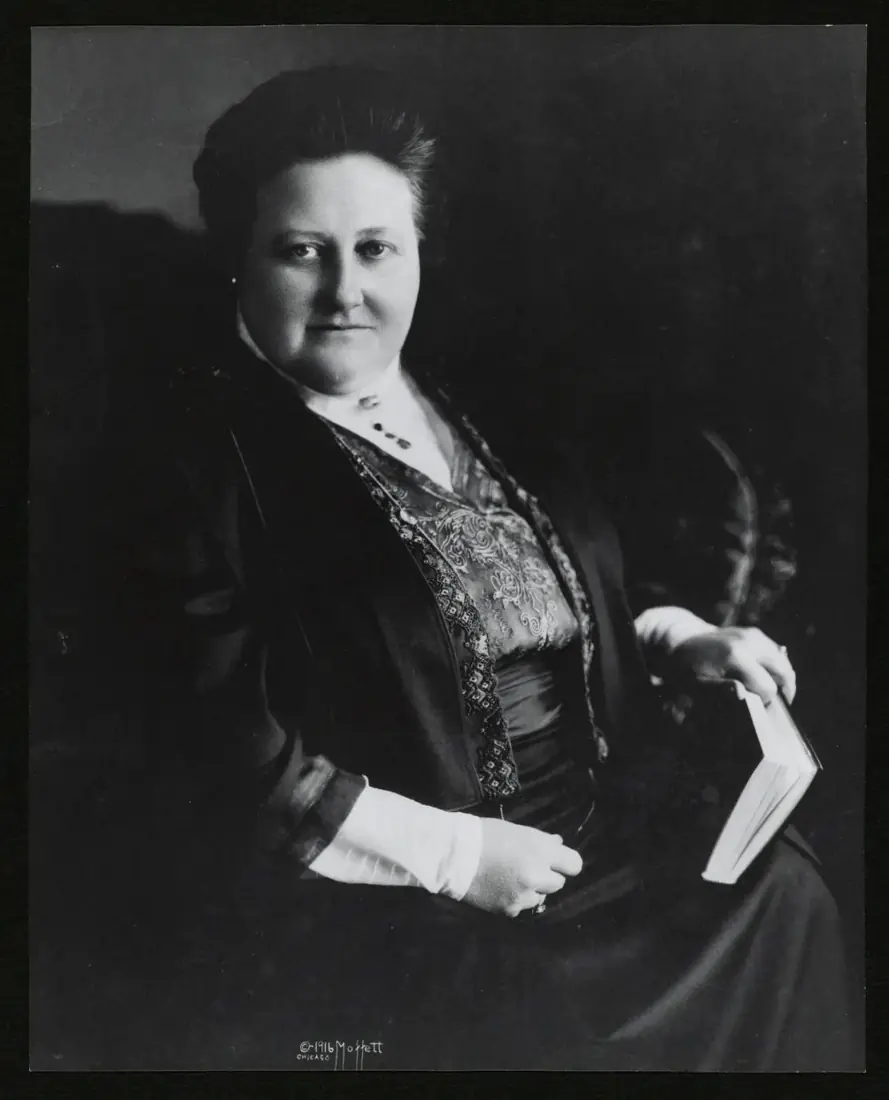
Amy Lowell (1874–1925) was an American poet from a famous Massachusetts family in Brookline, near Boston. She was a leader of the Imagist movement, which wanted clear, concrete pictures in short poems instead of vague, ornamental language. She also wrote and lectured widely about poetry; after her death she was awarded the Pulitzer Prize for Poetry (1926) for her collection What's O'Clock. "Climbing" is a short, simple poem for a young reader, written in four rhyming couplets.
The poem
High up in the apple tree climbing I go, With the sky above me, the earth below. Each branch is the step of a wonderful stair Which leads to the town I see shining up there.
Climbing, climbing, higher and higher, The branches blow and I see a spire, The gleam of a turret, the glint of a dome, All sparkling and bright, like white sea foam.
On and on, from bough to bough, The leaves are thick, but I push my way through; Before, I have always had to stop, But to-day I am sure I shall reach the top.
To-day to the end of the marvelous stair, Where those glittering pinnacles flash in the air! Climbing, climbing, higher I go, With the sky close above me, the earth far below.
Meaning, stanza by stanza
- Stanza 1. The speaker, a child, climbs an apple tree. Between sky above and earth below, each branch seems a step of a wonderful staircase leading to a shining town. The child imagines the tree as a way to a magic place.
- Stanza 2. As the child climbs, the wind moves the branches and the child glimpses a spire, a turret and a dome, bright "like white sea foam". The poem moves from the real tree to an imagined fairy-tale city.
- Stanza 3. The leaves are thick, but the child pushes through. In the past the child always stopped part-way. Today is different: "I am sure I shall reach the top".
- Stanza 4. The child imagines reaching the end of the staircase where pinnacles flash. Now the sky is "close above" and the earth is "far below". The climb has brought the child to a new height.
Message
Determination and imagination help us reach our goals. Failure in the past (Before, I have always had to stop) need not decide the future; if we keep going, we may succeed. The climb is also a symbol for any hobby or ambition. (A hobby like climbing a tree is also a way of enjoying nature and testing yourself.)
Poetic devices
| Device | Example | Effect |
|---|---|---|
| Rhyme (couplets) | go / below; stair / there; higher / spire | Musical, child-like rhythm |
| Repetition | "Climbing, climbing" | Shows long, steady effort and gives rhythm |
| Simile | "like white sea foam" | A picture of the bright domes |
| Metaphor | "Each branch is the step of a wonderful stair" | The tree becomes a staircase |
| Imagery (light) | gleam, glint, sparkling, glittering, flash | Makes the imagined town shine |
| Symbolism | sky = aspiration; earth = starting point | The climb stands for striving upwards |
| Contrast | sky above / earth below | Shows how far the child has come |
Vocabulary
| Word | Meaning |
|---|---|
| gleam | a soft, steady light (here, a reflection of light) |
| glint | a flash of light reflected from something shiny |
| turret | a small tower on a building or castle |
| stair | a set of steps between floors |
| marvellous | causing great wonder; extraordinary |
| bough | a main branch of a tree |
| spire | a tall pointed structure on a church tower |
| dome | a rounded roof |
| pinnacle | a pointed top of a tower or roof; the highest point |
Questions and model answers
Objective questions (1 mark each)
- The speaker views the town from [1]aa mountainba branch of the apple treecan aeroplaneda roof
- What helps the speaker go higher and higher? [1]aa ladderbthe branchesca ropeda friend
- The glow of the domes is compared to [1]athe moonbwhite sea foamcsnowdgold
- The message of the poem is [1]anever give up in the middle of a taskbtrees are dangerouscbe carefuldapples are sweet
Answers
1. (b).
2. (b).
3. (b).
4. (a).
Short-answer questions (2 marks each)
- Why does the speaker want to climb the tree? [2]
- What things shine brightly from above? [2]
- Is this the first time the speaker has climbed? How do you know? [2]
- Make a list of words in the poem that describe light. [2]
- What do the sky and the earth symbolise? [2]
Model answers
1. To reach the top and see the shining town above.
2. The spire, the turret, the dome and the pinnacles shine.
3. No. "Before, I have always had to stop" shows that the speaker had tried earlier and given up.
4. gleam, glint, sparkling, bright, glittering, flash, shining.
5. The sky stands for ambition and freedom; the earth stands for the starting point, the ordinary life we rise from.
Long-answer questions (4 marks each)
- Describe the speaker's climb and what it shows. [4]
- "The more determined you are, the better opportunity you will achieve." Do you agree? Discuss. [4]
Model answers
1. The speaker climbs an apple tree and imagines each branch to be a step of a wonderful staircase leading up to a shining town. Climbing higher, the speaker glimpses spires, turrets and domes sparkling like foam. The leaves are thick, but the speaker pushes through, because earlier attempts failed and this time victory seems certain. The poem shows the joy of effort and shows that imagination and determination can carry us beyond our earlier limits.
2. I agree. Determination keeps us trying when things are difficult. A student who fails a test but studies harder is more likely to succeed than one who gives up. Great people such as Mount Everest's first climbers, Tenzing Norgay and Edmund Hillary, reached the top after earlier failed expeditions. Of course, talent and planning also matter, but without determination even talent is wasted. So, the more determined we are, the more chance we have in life.
8.3 Grammar and writing tasks of the unit
Grammar I: The passive voice
In an active sentence the doer (agent) is the subject: Ram feeds the dogs. In a passive sentence the receiver of the action is the subject: The dogs are fed by Ram. Use the passive when the doer is unknown, unimportant or obvious, or when you want to stress the action or the receiver.
Formula: object of the active → subject; be (in the tense of the active verb) + past participle; subject of the active → by + agent (often dropped).
| Tense | Active | Passive |
|---|---|---|
| Simple present | Ram feeds the dogs. | The dogs are fed by Ram. |
| Present continuous | Ram is feeding the dogs. | The dogs are being fed by Ram. |
| Present perfect | Ram has fed the dogs. | The dogs have been fed by Ram. |
| Simple past | Ram fed the dogs. | The dogs were fed by Ram. |
| Past continuous | Ram was feeding the dogs. | The dogs were being fed by Ram. |
| Past perfect | Ram had fed the dogs. | The dogs had been fed by Ram. |
| Simple future | Ram will feed the dogs. | The dogs will be fed by Ram. |
| Modal | Ram can feed the dogs. | The dogs can be fed by Ram. |
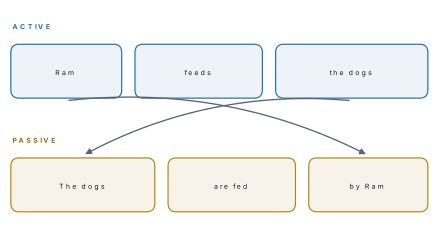
Use the past participle, not the past simple (was eaten, not was ate). Keep the tense of the active verb: Ram fed → were fed, not are fed. Do not use the passive with intransitive verbs (arrive, die, happen, go) because they have no object. The passive with by is often unnecessary: The thief was caught (not by the police) is natural.
Problem. Change into the passive: "The police catch a lot of criminals in a city."
Solution. Object a lot of criminals → subject; simple present → are caught; the agent the police may be dropped. A lot of criminals are caught in a city.
Problem. Change into the passive: "Someone has stolen my bicycle."
Solution. Present perfect → has been stolen. My bicycle has been stolen. (The agent someone is unknown, so it is omitted.)
Problem. Change into the passive: "They were repairing the road."
Solution. Past continuous → was being repaired. The road was being repaired.
Exercise A — Complete with the passive
- Ram feeds the dogs. → The dogs ____ by Ram.
- The police catch a lot of criminals. → A lot of criminals ____ in a city.
- Sita wrote this poem. → This poem ____ by Sita.
- They are building a new bridge. → A new bridge ____.
- The cook has prepared the dinner. → The dinner ____.
- The teacher will announce the result. → The result ____ by the teacher.
1. are fed.
2. are caught.
3. was written.
4. is being built.
5. has been prepared.
6. will be announced.
Exercise B — Change into the passive voice
- People speak English in many countries.
- The farmers grow rice in the Tarai.
- Somebody cleaned the room yesterday.
- The students are painting the wall.
- The government has built a new road.
- Raju will invite all the neighbours.
- Nobody can solve this problem.
- Hari broke the window.
1. English is spoken in many countries.
2. Rice is grown in the Tarai (by the farmers).
3. The room was cleaned yesterday.
4. The wall is being painted by the students.
5. A new road has been built by the government.
6. All the neighbours will be invited by Raju.
7. This problem cannot be solved.
8. The window was broken by Hari.
Grammar II: Passive with being and having; passive to active
The -ing forms of the passive are used after prepositions and verbs such as enjoy, avoid, mind, like: being + past participle (present) and having been + past participle (earlier action).
| Active | Passive |
|---|---|
| She hates people telling her what to do. | She hates being told what to do. |
| I remember my father taking me to the zoo. | I remember being taken to the zoo by my father. |
| He was angry because they had not invited him. | He was angry about not having been invited. |
| Having finished the work, the staff left. | The work having been finished, the staff left. |
Passive to active
To change a passive sentence back to active: make the by-agent the subject (add a suitable subject if the agent is missing: someone, people, they), keep the tense, and make the old subject the object.
| Passive | Active |
|---|---|
| The match was won by Nepal. | Nepal won the match. |
| A new school is being built. | They are building a new school. |
| The letter has been posted. | Someone has posted the letter. |
| English is spoken here. | People speak English here. |
Problem. Rewrite using being: "Nobody likes people laughing at them."
Solution. Nobody likes being laughed at.
Problem. Change into active: "The prize was given to Maya by the principal."
Solution. The principal gave the prize to Maya.
Exercise C — Rewrite with being or having been
- He doesn't like people criticising him.
- She was pleased because they had praised her work.
- The children enjoy people telling them stories.
- I remember somebody giving me a gift at that age.
1. He doesn't like being criticised.
2. She was pleased about having been praised (for her work) / at her work having been praised.
3. The children enjoy being told stories.
4. I remember being given a gift at that age.
Exercise D — Change into the active voice
- The poem was written by Devkota.
- The road is being repaired by workers.
- A letter has been sent to the headteacher.
- The window had been broken by the boys.
- A mistake was made.
1. Devkota wrote the poem.
2. Workers are repairing the road.
3. Someone has sent a letter to the headteacher.
4. The boys had broken the window.
5. Somebody made a mistake.
Writing I: An essay on hobbies and career
Task. People have different hobbies and interests, which may lead them to their careers. Write an essay on your hobbies explaining how they might influence your career.
A good essay has an introduction (state your hobby and the idea), body paragraphs (one point each, with examples), and a conclusion.
My Hobbies and My Future
A hobby is an activity we enjoy in our free time. My hobbies are reading and drawing, and I believe they will influence my career.
Reading is my first hobby. I read story books, newspapers and science magazines. It has improved my vocabulary and my writing and has made me curious about the world. If I become a teacher or a journalist, these skills will help me explain things clearly.
My second hobby is drawing. I draw buildings, trees and houses in my village. Drawing has taught me patience, careful observation and the use of shapes and proportion. If I become an engineer or an architect, I will use these skills to design buildings that are useful and beautiful.
My hobbies also help me relax after hard study, so I do my school work with a fresh mind. A relaxed person works better in any job.
In conclusion, hobbies are not a waste of time. Mine have shown me what I enjoy, and I would like to choose a career in which I can use them.
Writing II: An advertisement and paraphrasing
An advertisement (vacancy announcement) is short and formal. It gives: name of the institution, the post and number of vacancies, qualifications, experience, age/other conditions, how to apply and the deadline, and contact details. Use a box or a bold heading and a list.
VACANCY ANNOUNCEMENT
Shree Saraswati Secondary School, Pokhara-9
Applications are invited from qualified Nepali citizens for the following post:
Post: Secondary-level English Teacher (1 vacancy)
Qualifications: Bachelor's degree in English Education (B.Ed.) or Master's degree in English; teaching licence preferred.
Experience: At least two years of teaching experience at secondary level.
Other: Good command of spoken and written English; computer skills.
How to apply: Send a written application with copies of your citizenship, academic certificates and experience letters and two passport-size photographs to the school office.
Deadline: 15 Ashwin 2082 (5 pm). Only shortlisted candidates will be called for an interview.
Phone: 061-000000 — Headteacher
Paraphrasing
To paraphrase is to say the same thing in your own words, keeping the meaning but changing the words and the structure. A paraphrase is not a summary (it is usually about as long as the original). Steps: (1) read and understand; (2) replace key words by synonyms; (3) change the order or the structure (active ↔ passive, join or split sentences); (4) compare with the original to check that the meaning is the same.
| Original | Paraphrase |
|---|---|
| Hobbies help us to relax after a hard day. | Doing something we love in our spare time helps us to rest our minds after tiring work. |
| Reading is a fun way of improving yourself. | Books entertain us and make us wiser at the same time. |
| The more determined you are, the better your chances. | If you are very determined, you will have a greater likelihood of success. |
Do not change only one or two words, and do not change the meaning. Do not copy whole phrases without quotation marks.
Chapter summary
- Common Hobbies describes reading, dancing, painting, antiques, photography, journaling and knitting; hobbies relax us, build skills and can become careers.
- Climbing by Amy Lowell (American Imagist poet): a child climbs an apple tree; the staircase of branches leads to a shining imagined town; message — determination can carry us to the top.
- Devices in the poem: rhyming couplets, repetition, simile, metaphor, light imagery, symbolism.
- Passive: be + past participle in the same tense as the active verb; use by + agent only when it matters; being / having been for -ing forms.
- An essay has an introduction, body paragraphs and a conclusion; an advertisement gives post, qualifications, experience, how to apply and the deadline; a paraphrase says the same in your own words.
Practice questions
Objective questions (1 mark each)
- The poem "Climbing" was written by [1]aTagorebAmy LowellcWhitmandKipling
- "Pinnacle" means [1]aa rootba pointed top or highest pointca branchda leaf
- The passive of "Ram feeds the dogs" is [1]aThe dogs fed RambThe dogs are fed by RamcThe dogs were fed by RamdThe dogs is fed
- Which is a passive sentence? [1]aHari broke the cup.bThe cup was broken by Hari.cHari is breaking the cup.dHari will break the cup.
Answers
1. (b).
2. (b).
3. (b).
4. (b).
Short answer questions (2 marks each)
- What does the speaker say about earlier attempts to reach the top? [2]
- Why can a hobby become a career? [2]
- Change into the passive: "They have built a new hospital." [2]
- Change into the active: "The match was watched by thousands of fans." [2]
Answers
1. The speaker says that before, she had always had to stop, but today she is sure she will reach the top.
2. Because hobbies build skills and passion, and people who are passionate and skilled may become in-demand professionals.
3. A new hospital has been built.
4. Thousands of fans watched the match.
Long answer questions (4 marks each)
- Write an advertisement for a vacancy of a computer operator in your school. [4]
- Write an essay of about 150 words on "The Importance of Hobbies". [4]
Answers
1. Outline: school name and address; VACANCY ANNOUNCEMENT; post and number; qualification (e.g. a diploma in computer science); experience; skills (typing, office software); documents to submit; deadline; contact.
2. Outline: introduction (what a hobby is); body 1 (relaxation and health); body 2 (skills and talent); body 3 (friends and social life, possible career); conclusion.
Practise more: English question bank