Unit 12 · Units · 23 min read
Unit 12: Nature and Development
What the syllabus asks for 3
- Kathmandu-Terai/Madhesh Fast Track
- Composed Upon Westminster Bridge
- Grammar and writing tasks of the unit
Human beings change nature in order to live better: they cut roads through hills, build cities and plant farms. Poets, on the other hand, often stop to admire what nature and cities look like when they are calm. This unit puts both views side by side. The first text is a factual article on the Kathmandu–Terai/Madhesh Fast Track, one of Nepal's biggest development projects. The second is a famous poem by William Wordsworth, "Composed upon Westminster Bridge", in which a great city looks as peaceful as a field. The grammar of the unit is talking about the future: will, be going to, the future continuous and the future perfect. The writing tasks are a report on a development work and a notice.
From the article: facts (distance, benefits, challenges) and your opinion in a full-sentence discussion. From the poem: the speaker's feeling, the figures of speech and the central theme. From grammar: the right future form for plans, predictions, schedules and actions that will be in progress or complete. From writing: a report with a title, introduction, findings and conclusion, and a notice with all the necessary details.
12.1 Kathmandu–Terai/Madhesh Fast Track
About the text
This is an informative article about a mega project: a new expressway meant to link Kathmandu to the Terai (Madhesh) plains in much less time. The writer describes what the project is, how long it is, who will gain from it and what could go wrong. It is a good example of the kind of formal, factual prose that appears in the unseen reading section of the SEE paper.
Summary
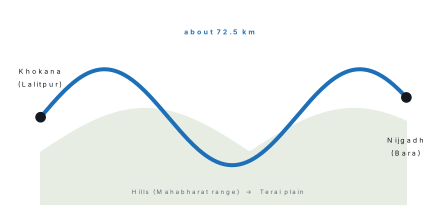
What it is. The Kathmandu–Terai/Madhesh Fast Track (KTFT) is a high-speed expressway being built from Khokana in Lalitpur to Nijgadh in Bara district, a length of about 72.5 kilometres. It is being built under the supervision of the Nepal Army and is regarded as a project of national pride. Until now the journey from the capital to the Terai has depended on old hill highways with sharp curves, landslides and traffic jams. The fast track will replace many of these hours with a short, direct drive through the hills and forest of the Mahabharat range.
Benefits. The article lists several advantages.
- Shorter travel time and less fuel. Because travel time falls, Nepal will use less petrol and diesel, which are imported, and save foreign money.
- Cheaper transport and trade. Goods can be carried between India, the Terai and Kathmandu faster and at lower cost, reducing the congestion on the older roads.
- Tourism. Travel becomes cheaper, so Indian tourists, among others, can reach Kathmandu more easily than now.
- Skilled people. The project gives engineers, technicians and workers chances to practise and sharpen their skills.
- Regional development. People of the eastern Terai gain better access to health, education, jobs and markets in Kathmandu.
Challenges. The writer says the main challenge after completion will be to build link roads connecting the fast track to towns and highways, so that its benefits reach ordinary people. The writer also says that the success of the project depends chiefly on technology: the track needs bridges, tunnels, cuttings and careful engineering in a young, landslide-prone mountain range. The text also points to environmental risk, as the clearing of forests and hills may cause erosion, landslides and loss of biodiversity.
Glossary
| Word | Meaning | Example |
|---|---|---|
| vulnerable | weak and open to harm | Hill roads are vulnerable to landslides. |
| deficit | the amount by which something is less than what is needed | Nepal has a trade deficit. |
| accommodation | a place to live or stay | The hostel offers accommodation to 100 students. |
| calamity | a disaster causing great harm | The earthquake was a national calamity. |
| innovative | using new ideas or methods | An innovative design cut costs. |
| constraints | things that limit what you can do | Lack of money is a major constraint. |
| facilitate | to make easier | Good roads facilitate trade. |
| congestion | crowding, especially of traffic | Congestion in Kathmandu wastes hours. |
| shipping | moving goods from one place to another | Shipping costs rose. |
| accumulate | to gather or increase gradually | Dust accumulated on the shelves. |
Pros and cons at a glance
| Benefits | Possible costs |
|---|---|
| Less travel time and less fuel imported | Felling of trees; loss of biodiversity |
| Cheaper goods and more trade | Soil erosion and landslides during construction |
| More tourists | Noise and air pollution from more vehicles |
| Jobs and skills | Displacement of people and land acquisition |
| Better access to health, school, markets | Heavy cost of the project |
Comprehension questions with model answers
A. Objective questions (1 mark each)
- The total length of the Fast Track from Khokana to Nijgadh is [1]a52.5 kmb62.5 kmc72.5 kmd82.5 km
- Nepal can reduce petroleum consumption because the project [1]ashortens travel timebcloses old roadscbans vehiclesdlowers taxes
- The main challenge after completion is [1]alack of touristsbestablishing link roadsclack of fueldshortage of labour
- According to the writer, success depends on [1]atechnologybtouristscweatherddonors
Answers — objective
1. (c) 72.5 km.
2. (a) shortens travel time.
3. (b) establishing link roads.
4. (a) technology.
B. Short questions (2 marks each)
- What type of project is the Kathmandu–Terai/Madhesh Fast Track? [2]
- How is the project going to reduce the consumption of petrol in Nepal? [2]
- Will this project help promote tourism? How? [2]
- How does the project help in the development of high-skill human resources? [2]
- How does the project help the people living in the eastern Terai? [2]
Answers — short
1. It is a mega highway (expressway) project, one of the largest in Nepal.
2. It shortens the travel time between Kathmandu and the Terai, so vehicles burn less petrol and diesel.
3. Yes. Travel becomes cheaper and quicker, so Indian and other tourists can reach Kathmandu more easily than at present.
4. Engineers, technicians and workers get the chance to work on a large, modern project and so sharpen their skills.
5. The people of the eastern Terai will have easier access to health services, education, jobs and markets.
C. Long question (4 marks)
- How is the Kathmandu–Terai Fast Track likely to affect the environment? Discuss. [4]
Answer
1. The fast track will affect the environment in both good and bad ways. On the good side, a shorter route means less time on the road, so each vehicle may produce less pollution, and trade and tourism can grow. On the bad side, the construction needs the felling of trees, the cutting of hills and sometimes blasting. These may cause soil erosion, landslides and loss of habitat for wild animals. Later, more vehicles may increase air and noise pollution. Therefore the builders should carry out an environmental impact assessment, replant trees, protect rivers and consult local people so that development does not destroy the nature it passes through.
12.2 Composed Upon Westminster Bridge, September 3, 1802
The poet
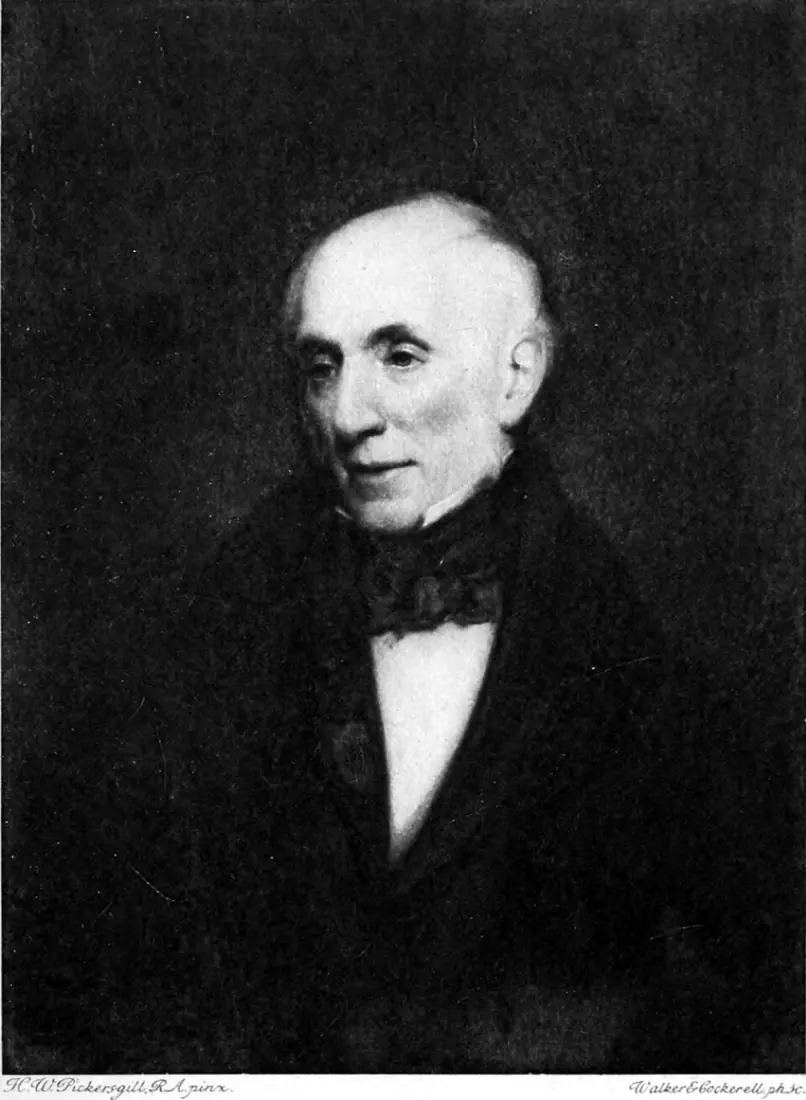
William Wordsworth (1770–1850) was an English poet born in Cockermouth in the Lake District. With his friend Samuel Taylor Coleridge he published Lyrical Ballads (1798), which started the Romantic movement in English poetry. Romantic poets valued feeling, imagination and nature over formal, artificial language. Wordsworth's best-known long poem is The Prelude, and among his short poems are "Daffodils" ("I wandered lonely as a cloud") and "Tintern Abbey". He became Poet Laureate in 1843. He believed that poetry should use "the real language of men" and that nature is a teacher of goodness.
The poem
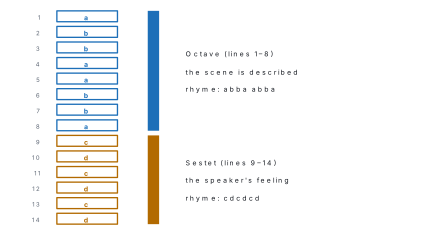
"Composed upon Westminster Bridge" is a sonnet: a poem of fourteen lines, with a fixed rhyme scheme. Wordsworth wrote it in 1802 while crossing the Thames in the early morning on his way to France; the title gives 3 September, though his sister Dorothy's journal suggests that the view was actually seen in July, so the date in the title may be inaccurate. The poem was published in 1807.
Earth has not anything to show more fair: … Ne'er saw I, never felt, a calm so deep! The river glideth at his own sweet will: … And all that mighty heart is lying still!
Summary and explanation
Lines 1–3: a challenge. The speaker says that the earth has nothing more beautiful to show than this view. Anyone who could pass such a touching sight without feeling it would be "dull of soul".
Lines 4–8: the city dressed in morning. The city wears the beauty of the morning like a garment. At that early hour it is silent and bare: ships, towers, domes, theatres and temples lie open to the fields and the sky. Because it is dawn, there is no coal smoke, and everything shines in the clear air.
Lines 9–11: the sun and the calm. The sun has never so beautifully spread his first light over valley, rock or hill. The speaker has never seen or felt a calm so deep.
Lines 12–14: the sleeping heart. The river glides at its own sweet will. The very houses seem asleep. And "that mighty heart", the whole great city, lies still.
Glossary
| Word | Meaning |
|---|---|
| doth | does (old English) |
| majesty | grandeur; royal dignity |
| domes | rounded roofs |
| glittering | shining with bright points of light |
| splendour | great brilliance and beauty |
| glideth | glides; flows smoothly (old English) |
| mighty | very powerful |
| steep | to soak or fill with (here: to flood with light) |
Figures of speech
| Device | Example | Effect |
|---|---|---|
| Simile | "like a garment" | The city wears the morning, the way a person wears clothes. |
| Personification | "the river glideth at his own sweet will"; "houses seem asleep"; "mighty heart" | The river, the houses and the city seem alive. |
| Metaphor | "mighty heart" for London | The city is the heart of the nation, now at rest. |
| Apostrophe | "Dear God!" | A sudden cry that shows deep emotion. |
| Inversion | "Ne'er saw I" | Unusual word order that gives a dignified tone. |
| Imagery | "bright and glittering in the smokeless air" | Visual images make the morning bright. |
Theme and tone
The central idea is that beauty is not found only in the countryside: a city, too, can be beautiful and peaceful when seen at sunrise, before the noise begins. The tone is calm, reverent and full of wonder. Wordsworth, who normally celebrates fields and mountains, is surprised and moved to find that "man-made" London can please him as much as nature does. The poem also suggests that nature and human works can live in harmony when pollution and bustle are absent.
The poem is set in a city. Its point is that the city shares in the beauty of the fields and the sky. Students who write "the poet praises the countryside" lose the marks.
Comprehension questions with model answers
A. Objective questions (1 mark each)
- The poem is a [1]aballadbsonnetcodedepic
- In the poem, the city wears the beauty of the morning like a [1]acrownbgarmentcmaskdmirror
- The "mighty heart" refers to [1]athe riverbthe suncthe city of Londondthe poet
- Write True or False: The speaker saw the city at midday. [1]
Answers — objective
1. (b) sonnet.
2. (b) garment.
3. (c) London.
4. False. It is early morning.
B. Short questions (2 marks each)
- Why does the poet say that "Earth has not anything to show more fair"? [2]
- What does the poet mean by "the very houses seem asleep"? [2]
- Why is the air "smokeless"? [2]
- Which figure of speech is "like a garment"? Explain. [2]
- What does "the river glideth at his own sweet will" suggest? [2]
Answers — short
1. Because the poet is overcome by the sight of London at dawn. Everything is calm, bright and clear, so he thinks it is the loveliest sight on earth.
2. It means that the houses are silent and still because the people inside are still sleeping. The poet imagines the houses as sleeping persons (personification).
3. It is very early in the morning, before the factories and houses have lit their fires, so no coal smoke is polluting the air.
4. It is a simile, because "like" compares two different things. The city wears the beauty of the morning as a person wears clothes.
5. It suggests that the river flows freely and peacefully, like a person doing exactly what he wishes, with nothing to disturb it.
C. Long questions (4 marks each)
- What is the main theme of the poem? Explain with references. [4]
- Does your city or village look like London in the early morning? Tell your friends. [4]
Answers — long
1. The main theme is the beauty of a peaceful city at dawn, and the harmony between human creations and nature. Wordsworth begins by saying that nothing on earth is more beautiful. He describes ships, towers, domes and temples lying open to the fields and sky, bright in the smokeless air. The sun floods the valley, rock and hill with light, and the river glides freely. The calm is so deep that the houses seem asleep and the city's "mighty heart" lies still. Through these images the poet shows that nature's beauty is not limited to the countryside, and that even a great city is beautiful when it is quiet and clean.
2. (Open answer.) My village in the morning is as beautiful as London in the poem. The sun rises over the hills and lights the green terraces. The air is clean; mist hangs in the valley and birds sing. The streets are quiet and smoke rises gently from the kitchens. Like Wordsworth I feel a deep calm. In fact, I think a morning in the hills of Nepal is even more beautiful because the Himalayas stand in the distance.
12.3 Grammar and writing tasks
Grammar I and II — Talking about the future
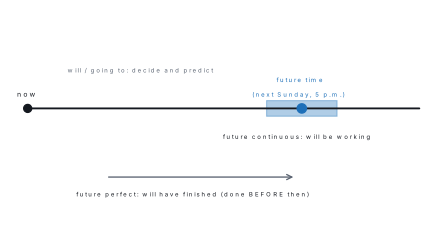
English has no single future tense. It has several ways to talk about the future, and the right one depends on the meaning.
| Form | Structure | Use | Example |
|---|---|---|---|
| Present simple | V1 / V1+s | timetables, schedules | The exam starts at 11 o'clock. |
| Present continuous | am/is/are + V-ing | firm personal arrangements | We are leaving in ten minutes. |
| be going to | am/is/are going to + V1 | plans made before; predictions from present evidence | I am going to visit my uncle. Look at those clouds! It is going to rain. |
| will + V1 | will / won't + V1 | instant decisions, offers, promises, predictions from opinion | The phone is ringing. I will answer it. I think he will be rich one day. |
| Future continuous | will be + V-ing | an action in progress at a given future time | At this time next week we will be flying to Dubai. |
| Future perfect | will have + V3 | an action completed before a future time | We will have arrived home by Sunday. |
| Future perfect continuous | will have been + V-ing | how long an activity will have lasted by a future time | By June I will have been living here for ten years. |
Rules to remember
- After if, when, as soon as, before, after, until, use the present form, not will: If you touch the stove, you will burn yourself.
- Will is used for sudden decisions; going to for decisions made earlier.
- State verbs (know, like, want) are rarely continuous: will know, not will be knowing.
- The future perfect needs a deadline: by tomorrow, by 2030, by the time you arrive.
- The continuous future gives a polite question: Will you be using the car tonight?
Problem. Fill in: "Tennis practice starts at 10 and we plan to play for two hours. By 12 o'clock we ______ (practise) for two hours."
Solution. The sentence looks at a future deadline (12 o'clock) and describes the length of an activity up to that point, so the answer is will have practised (or will have been practising).
Problem. (a) "Look at those clouds. It __ rain." (b) "The phone is ringing. I ____ answer it."
Solution. (a) There is present evidence (clouds), so is going to rain. (b) A sudden decision made at the moment, so will answer.
If it will rain, we will stay home is wrong. Write If it rains, we will stay home.
Exercise 1. Complete the sentences with the correct future form of the verb.
- As per the schedule, the exam ______ (start) at exactly 11 o'clock.
- See you at the airport! I ______ (carry) an orange suitcase.
- Don't worry! I ______ (not leave) without you.
- We definitely ______ (not finish) all the work by this week.
- Ram has decided that he ______ (invite) some of his friends for dinner.
- __ the receptionist ____ (remember) to call the students this afternoon?
- What __ you ____ (do) at the weekend? (a plan)
- I ______ (not work) tomorrow, so we can go shopping.
- If you touch the stove, you ______ (burn) yourself.
- Next week at this time we ______ (fly) to Dubai.
- By the end of this year she ______ (study) English for ten years.
- The bus ______ (leave) at 6.15 tomorrow morning.
1. will start (or starts, for a fixed timetable)
2. will be carrying
3. won't leave
4. won't have finished
5. is going to invite
6. Will … remember
7. are … going to do
8. will not be working
9. will burn
10. will be flying
11. will have been studying
12. leaves
Exercise 2. Match each beginning (1–5) with its ending (a–e).
| Beginnings | Endings |
|---|---|
| 1. Hurry up! | (a) We will have arrived home by this time on Sunday. |
| 2. They'll be watching a movie | (b) We're leaving in ten minutes. |
| 3. We're not at home now, but | (c) in a theatre at this time next week. |
| 4. It's definite. | (d) My friends and I are going to travel next winter. |
| 5. I think he | (e) will be rich and famous one day. |
1–(b) (arrangement: present continuous). 2–(c) (future continuous, in progress at a time). 3–(a) (future perfect, finished before a time). 4–(d) (going to, a definite plan). 5–(e) (will, a prediction from opinion).
Writing I — A report
A report gives an organised account of something you have observed or studied. It is formal, in the third person and usually in the present or past tense. A report on a development work in your community should follow this layout:
| Part | Content |
|---|---|
| Title | e.g. Report on the Construction of the Ward Road |
| Introduction | what, where, when, who is doing it |
| Findings / body | details: progress, cost, workers, methods; benefits and problems |
| Conclusion / recommendations | your judgement and suggestions |
| Writer, date | name, position and date |
Model report.
Report on the Construction of the Ward Road in Our Locality
By: Sita Gurung, Secretary, Green Child Club — 12 Poush 2081
Introduction. The local government of Ward 5 has been constructing a 2-kilometre blacktopped road linking our village to the main highway. Work began in Kartik and is about 60 per cent complete. As a member of the Child Club, I visited the site on three days and spoke to the engineer and some villagers.
Findings. About 40 local workers are employed. Stones and gravel are brought from the nearby river, and a roller levels the surface. Villagers say that earlier the muddy track was impassable in the rainy season. Drainage ditches are being dug, and trees cut during the work are being replaced with new saplings. However, the dust is troubling the school children and there is no fence to protect them from the road.
Conclusion and recommendations. The road will save time, make it easier for patients to reach the hospital and help farmers to sell vegetables. The contractor should water the road to reduce dust, put up signs near the school, and complete the work before the monsoon.
Writing II — A notice
A notice is a short public message. It must be brief and complete: name of issuing body, the word NOTICE, date, heading, body (what, when, where, who), name and designation of the writer. Use no salutation or long sentences.
Task. As Secretary of your school's Child Club, write a notice about a programme you will organise soon.
Model.
Sunrise Secondary School Child Club
NOTICE
Date: 15 Magh 2081
Clean Community Awareness Programme
All students and teachers are informed that the Child Club will organise a community cleanliness and hygiene awareness programme on Saturday, 25 Magh 2081 at 8:00 a.m. in the school ground. The programme will include a rally, group discussion and a demonstration on handwashing and waste disposal. Students of Grades 6–10 are requested to attend in school uniform and to bring a pair of gloves.
Interested students may give their names to the Club Secretary by Thursday.
Sunita Rai Secretary, Child Club
Issuer — heading — date — event — time — place — who should attend — contact — signature. If any of these is missing, you lose marks.
Chapter summary
- The Kathmandu–Terai/Madhesh Fast Track is a 72.5 km expressway from Khokana to Nijgadh; benefits: less travel time and fuel, trade, tourism, skills, regional development; challenges: link roads, technology, environmental damage.
- Wordsworth's sonnet (1802): a calm London dawn; simile like a garment; personification of houses and river; metaphor mighty heart; theme: beauty in a peaceful city and harmony of man and nature.
- A Petrarchan sonnet: 14 lines, octave abbaabba + sestet cdcdcd.
- Future forms: present simple (timetable), present continuous (arrangement), going to (plan, evidence), will (decision, prediction), will be + -ing (in progress), will have + V3 (completed before), will have been + -ing (duration up to).
- After if / when / before / until use the present tense.
- A report: title, introduction, findings, conclusion/recommendation, writer and date.
- A notice: issuer, heading, date, event details, writer with designation.
Practice questions
Reading comprehension
The new suspension bridge across the Karnali has brought great changes to the villages on both banks. Earlier, people crossed the river in small boats, which often capsized in the monsoon. Now children walk to school, farmers carry vegetables to the market, and an ambulance can reach the health post within minutes. However, some boatmen have lost their income, and the old trees along the bank were cut to make way for the approach road.
- What was the earlier way of crossing the river? [1]
- Name any two changes the bridge has brought. [1]
- Write True or False: Nobody has been harmed by the bridge. [1]
- Why were the boats dangerous in the monsoon? [2]
- What problems has the bridge caused? [2]
- In about 50 words, say whether the bridge is good for the villagers. [4]
Answers
1. Small boats.
2. Children can walk to school; farmers can reach the market (also ambulances reach the health post).
3. False.
4. The river was in flood, so the boats often capsized.
5. Boatmen lost their income and old trees were cut.
6. Yes, overall. The bridge makes travel safe, saves time and gives access to school, markets and health care. The loss of boatmen's jobs and trees is regrettable, but the boatmen can find new work and new trees can be planted.
Grammar
- Fill in: "By next June I ______ (finish) my SEE." [1]
- Fill in: "This time tomorrow, we ______ (sit) in the exam hall." [1]
- Correct: "If it will rain, we will stay home." [1]
- Fill in: "Look at that boy on the roof! He ______ (fall)." [1]
- Fill in: "The film ______ (begin) at 6 o'clock tonight." (timetable) [1]
- Fill in: "I ______ (call) you as soon as I reach home." [1]
- Fill in: "Next month Hari ______ (work) in this office for five years." [1]
- Choose: "I've bought tickets. We (will / are going to) visit Lumbini." [1]
Answers
1. will have finished
2. will be sitting
3. If it rains, we will stay home.
4. is going to fall
5. begins
6. will call
7. will have been working
8. are going to
Writing
- Write a report (150 words) on the problem of waste in your locality. [5]
- As Secretary of the school's Eco Club, write a notice about a tree-plantation programme. [5]
Outline for answers
1. Title, introduction (where and when you studied), findings (types and sources of waste, how it is managed), problems (smell, disease), recommendations (separate waste, composting, recycling, penalties).
2. Eco Club heading, NOTICE, date, "Tree Plantation Programme", date/time/place, who should come and what to bring (saplings, tools), name and designation.
Practise more: English question bank