Unit 6 · Units · 20 min read
Unit 6: Food and Cuisine
What the syllabus asks for 3
- Strange Food from Around the World
- You Inspire Others by Learning, Not Teaching
- Grammar and writing tasks of the unit
Food is more than fuel: it is memory, culture and sometimes courage. This unit takes you on a tour of the world's strangest dishes, then to the story of a Nepali boy who became a celebrated chef in Britain. In grammar you will study how to give reasons and purposes and how to use the present continuous; in writing you will write a recipe and an opinion paragraph.
Reading: matching words, idioms and meanings; completing sentences from the text; true/false/not given; short answers. Grammar: connectives of reason and purpose (because, as, since, so that, in order to), present continuous with time expressions. Writing: a recipe or process, and an argument paragraph (To what extent do you agree?).
6.1 Strange Food from Around the World
About the text
"Strange Food from Around the World" is an informal, personal essay about eating unusual dishes while travelling. The writer begins with a general idea — food can be an adventure and even a challenge — and then gives examples country by country, mixing description with personal reactions ("delicious", "disappointing", "too much"). It uses a friendly, conversational voice, short opinions and an idiom, a bridge too far.
What the text says
Travel gives us the chance to try foods we would never think of eating at home, and for some people eating something unfamiliar is a kind of challenge: you take a risk, and if you enjoy the food you feel you have won. The writer then describes a number of dishes.
| Dish | Country / region | What it is | The writer's view |
|---|---|---|---|
| Haggis | Scotland | The parts of a sheep that people usually do not want — heart, liver and lungs — ground up, mixed with mutton fat, oatmeal and spices, packed in a sheep's stomach and boiled for a few hours | A traditional dish; surprising ingredients, but tasty |
| Shiokara | Japan | Raw squid mixed with salted, fermented squid guts | Strong, salty; you may begin to like it once you are used to it, especially when eating with friends |
| Bush food (witchetty grubs, bush plants) | Australia | Foods from the "bush": large wood-eating larvae, native plants | Nutty-tasting; can be enjoyed in Australia |
| Fermented horse milk | Central Asia (Mongolia, Kazakhstan) | Milk from mares that has fermented into a sour, slightly alcoholic drink | The writer was disappointed; it was really bad |
| Jellyfish | China | A sea animal that scares many people, turned into a crunchy dish | Eaten in China as a normal dish |
| Snails (escargots) | France | Served as a main dish, fried or baked with plenty of garlic and butter | Very tasty |
| Bún riêu | Vietnam | A noodle soup made with crab | A well-liked noodle dish |
| Large insects | Many countries | Fried or roasted insects | The writer finds the larger ones hard because they cannot be eaten in one bite |
(Some details of where the writer drank the horse milk are not clear from the textbook extract; "Central Asia" is general background.)
Vocabulary
| Word | Meaning | Example |
|---|---|---|
| ferment | to go through a chemical change (often into alcohol or acid) | Yoghurt and gundruk are fermented foods. |
| squid | a sea creature with a long soft body, eight arms and two tentacles | Fried squid is popular on the coast. |
| witchetty | a large whitish larva that eats wood (an Australian bush food) | Aboriginal people eat witchetty grubs. |
| myrtle | a bush with shiny leaves, pink or white flowers, blue-black berries | Myrtle berries have a spicy taste. |
| congeal | to change from a fluid to a solid state | The fat congealed in the cold. |
| nutty | tasting like nuts | The bread has a nutty flavour. |
Idioms (the text uses a bridge too far: something that goes beyond what is acceptable):
| Idiom | Meaning |
|---|---|
| get out of hand | to become difficult to control |
| miss the boat | to be too late to get what you want |
| break the ice | to say or do something to make people feel comfortable |
| cry over spilt milk | to worry over past events that cannot be changed |
| look before you leap | to think about the possible bad results before acting |
Themes
- Food as challenge and adventure. Trying a strange dish is a small act of courage.
- Culture decides taste. What disgusts one person is a delicacy to another — jellyfish in China, snails in France.
- Opinion and honesty. The writer is honest even when the food is "really bad".
Questions and model answers
Objective questions (1 mark each)
- Haggis is made from the parts of a [1]acowbsheepcpigdfish
- Snails are served as a main dish in [1]aJapanbFrancecChinadAustralia
- "Ferment" means [1]ato cook in oilbto go through a chemical changecto freezedto dry
- Bún riêu is a [1]aVietnamese crab noodle soupbScottish puddingcJapanese rice cakedFrench cheese
Answers
1. (b).
2. (b).
3. (b).
4. (a).
Short-answer questions (2 marks each)
- Why does food become a challenge for people when they travel? [2]
- How is haggis prepared? [2]
- When do you start to like shiokara? [2]
- Where can people enjoy bush food? [2]
- Why does the writer find it difficult to eat larger insects? [2]
Model answers
1. Because they meet unfamiliar dishes and must decide whether to take the risk of eating them; liking the food feels like a small victory.
2. The heart, liver and lungs of a sheep are ground up and mixed with mutton fat, oatmeal and spices, packed into a sheep's stomach and boiled for a few hours.
3. We start to like it when we have become used to its strong taste, especially while eating it with friends.
4. In Australia.
5. Large insects cannot be eaten in one bite, so the writer has to chew them in several bites, which is harder.
Long-answer questions (4 marks each)
- Which of the dishes in the text is the strangest to you? Give reasons. [4]
- Write about a traditional Nepali food that a foreigner might find strange. [4]
Model answers
1. To me the strangest dish is shiokara, because it is made of raw squid mixed with the salty, fermented guts of the squid. The idea of eating raw sea animal with its fermented insides is unpleasant to me, and the writer also says the taste is strong. I think a person would need a lot of courage and practice to enjoy it.
2. Gundruk and sinki are fermented leaves and radish that many Nepalis love, yet foreigners may find the smell strange. Another example is kinema, soya beans fermented until they become sticky and strong-smelling, eaten by Limbus and Rais with rice. Sukuti (dried meat) or chhoyela (spiced grilled buffalo meat) may also surprise visitors. For Nepalis these are healthy, traditional foods that remind us of home.
6.2 You Inspire Others by Learning, Not by Teaching
About the text
This text is an interview with Santosh Shah, a chef born in Nepal who works in the United Kingdom and became widely known when he took part in MasterChef: The Professionals (2020) on BBC One. The title is his philosophy: a person inspires others not by lecturing but by never stopping learning. An interview is a question-and-answer text; its voice is spoken, direct and personal.
What the text says
- A humble start. Shah comes from a poor family. He did not have a normal childhood; he started working while still a boy, at about nine or ten, to support his family.
- From the kitchen floor to the top. He began in the lowest jobs in restaurant kitchens, learned by watching and practising, and rose step by step. He worked at the London restaurant Cinnamon Kitchen, and is very proud of what he learned there. He did not receive special favours; he took every task and asked for more.
- MasterChef. Appearing on the TV show raised his popularity.
- Experimenting with Nepali food. He wants to show the world that Nepali cuisine is unique and rich and not just "a copy of Indian food". He uses classic ideas with Nepali flavours — for example, he experimented with sukuti (dried meat), dehydrating it for different times to make it soft without losing its taste, and he cooked octopus in Nepali style.
- Philosophy. Two things make a person successful: asking "what is next?" and refusing to settle in a comfortable position; and continuous learning. He believes in learning from everyone, even junior staff.
- Dream. He hopes his restaurant Ayla will win a Michelin star, which, he believes, would raise the profile of Nepali food worldwide. He is hopeful about the Nepali food market because food trends are always changing.
(The interview was not held in Nepal. For other details such as the exact years of his career, rely only on what your textbook says.)
Vocabulary
| Word | Meaning | Example |
|---|---|---|
| tandoori | cooked in a cylindrical clay oven (tandoor) | Tandoori chicken is a popular dish. |
| executive (chef) | a person with power to manage an organisation | The executive chef plans the menu. |
| skewer | a long pin for holding meat while roasting | Chicken was grilled on skewers. |
| entirety | the whole of something | He read the book in its entirety. |
| nostalgia | a mixture of pleasure and sadness when remembering the past | The smell of dal bhat filled him with nostalgia. |
| elevate | to raise to a more important level | The chef wants to elevate Nepali food. |
| dehydrate | to remove water from food to preserve it | Sukuti is meat that has been dehydrated. |
Themes
- Humility and learning. Teaching impresses people only if the teacher is still a student.
- Perseverance. Shah rose through struggle and hard work, not privilege.
- Pride in identity. He wants Nepali food to be recognised on its own terms.
- Innovation and tradition together. New techniques (dehydrating, plating) with old flavours.
Questions and model answers
Objective questions (1 mark each)
- Write True, False or Not Given: The interview was taken in Nepal. [1]
- Write True, False or Not Given: Santosh Shah came from a well-to-do family. [1]
- Write True, False or Not Given: Shah is hopeful about the Nepali food market. [1]
- "Elevate" means [1]ato lowerbto raise to a higher levelcto cookdto share
Answers
1. False.
2. False — he came from a humble background.
3. True.
4. (b).
Short-answer questions (2 marks each)
- What heightened the popularity of Chef Shah? [2]
- Did Shah have a normal childhood? Why? [2]
- What does Shah want to show the world about Nepali food? [2]
- Write two things that Shah was careful about while experimenting with sukuti. [2]
- According to Shah, what two things make a person successful? [2]
- Why does Shah want a Michelin star for Ayla? [2]
Model answers
1. His participation in MasterChef: The Professionals (2020) on BBC One raised his popularity.
2. No. He came from a poor family and had to start working at about nine or ten years of age to support them.
3. He wants to show that Nepali cuisine is unique, rich and varied, not merely a copy of Indian food.
4. He wanted to make the meat soft but keep its original taste, and he tried drying it for different lengths of time.
5. Always asking "what is next?" and a belief in continuous learning (never settling in a comfort zone).
6. He believes it would raise the profile of Nepali food around the world.
Long-answer question (4 marks)
- What have you learnt from the life story of Santosh Shah? [4]
Model answer
1. I have learnt that success comes from hard work and a willingness to learn, not from a rich background. Santosh Shah was poor and started work as a child, but he kept asking "What is next?" and learned from every kitchen he worked in. I learnt that one should be proud of one's own culture and show it to the world with confidence, as he does with Nepali food. Finally, I learnt that a person inspires others more by learning humbly than by simply teaching.
6.3 Grammar and writing tasks of the unit
Grammar I: Reasons and purposes
Connectives link ideas. Reason connectives answer Why did it happen?; purpose connectives answer What for?
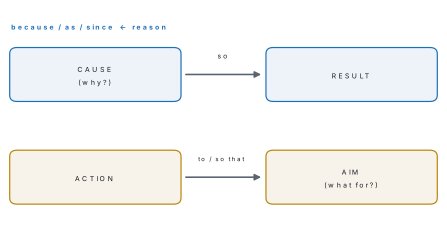
| Meaning | Connectives | Pattern | Example |
|---|---|---|---|
| reason | because | because + clause | I bought a raincoat because the monsoon started. |
| reason | as, since | as/since + clause (usually at the start; known reason) | As I am stuck in traffic, I won't reach school on time. |
| reason | because of, due to | + noun / noun phrase | The flight was delayed because of the bad weather. |
| purpose | to | to + base verb | The city planted trees to reduce traffic noise. |
| purpose | in order to, so as to | + base verb (more formal) | We queued in order to buy tickets. |
| purpose | so that | so that + clause (often with can/could/will/would) | We put a table in the room so that Samip can study in private. |
| result | so | clause, so clause | It rained, so we stayed home. |
Do not use because and so in the same sentence (Because it rained, so we stayed is wrong). Do not write because of + clause (because of it rained). Use so that before a full clause and to before a verb: He works hard so that he can pass / to pass.
Problem. Join the sentences with the connective given: "He ran fast. He wanted to catch the bus." (to)
Solution. He ran fast to catch the bus.
Problem. Fill in: "The flight was delayed ____ the bad weather." (because / because of)
Solution. A noun phrase follows → because of. The flight was delayed because of the bad weather.
Exercise A — Match the halves
(a) I bought a raincoat and an umbrella (b) I won't be able to get to school on time (c) The construction company has deployed more workers (d) The flight had been delayed (e) The metropolitan city has planted trees at the roadside (f) We have put a table and chair in the spare bedroom
(i) as I am stuck in traffic. (ii) because of the bad weather. (iii) because the monsoon started. (iv) so that they can complete the construction in time. (v) to reduce traffic noise. (vi) so that Samip can study in private.
(a)–(iii), (b)–(i), (c)–(iv), (d)–(ii), (e)–(v), (f)–(vi).
Exercise B — Choose the correct connective
- The fair closed early (because / so) the lights were failing.
- They stopped the machine (because of / so that) nobody could be hurt.
- She studies hard (to / because) get a scholarship.
- (As / Although) it was raining, we took umbrellas.
- We left early (because / because of) the traffic.
- He saved money (so that / since) he could buy a bicycle.
1. because.
2. so that.
3. to.
4. As.
5. because of.
6. so that.
Grammar II: The present continuous and time expressions
Form: am/is/are + verb-ing. Uses:
| Use | Time expressions | Example |
|---|---|---|
| an action happening now | now, at the moment, right now, currently, still | The boys are playing cricket now. |
| an action around now (temporary, not exactly this moment) | this week, this month, these days, nowadays | The local governments are announcing their policies this month. |
| a planned future action | tonight, tomorrow, later today, next week, on Wednesday | We're meeting Nabina later today. |
| a developing change | getting, becoming, growing | Prices are rising. |
Time words such as yesterday, last week, usually, sometimes do not go with the present continuous.
Problem. Choose: "What are you doing (this / last) afternoon?"
Solution. The present continuous looks ahead to a plan. this afternoon.
Problem. NOW, AROUND or FUTURE? "I'm sorry, I don't have time. I'm attending a meeting."
Solution. Happening at this moment → NOW.
Exercise C — Choose the correct time expression
- The boys are playing cricket (already / now).
- The doctors are preparing a report (last / this) week.
- The students are preparing for a test (at the moment / usually).
- (Currently / Sometimes) the economists are working on the country's financial crisis.
- The guard is ringing the bell (now / soon). It is time to go!
- She is (still / yet) mowing the lawn.
1. now.
2. this.
3. at the moment.
4. Currently.
5. now.
6. still.
Exercise D — Write NOW, AROUND or FUTURE
- The local governments are announcing their policies this month.
- I think Mr Rai is taking class at the moment.
- We're meeting Nabina later today.
- We're organising a programme on Wednesday.
- They are coming home right now.
- Mum is making dinner for us tonight.
1. AROUND.
2. NOW.
3. FUTURE.
4. FUTURE.
5. NOW.
6. FUTURE.
Writing I: A recipe and a process
A recipe has a title, a list of ingredients with quantities, and method steps in order. Use imperatives and sequence words (first, then, next, after that, finally) and give times (for seven minutes).
Ingredients: 1 kg grated carrots, 1 litre milk, 200 g sugar, 4 green cardamoms (powdered), 3 tablespoons ghee.
Method: 1. Switch on the stove and melt the ghee in a pan. 2. Add the grated carrots and fry for about seven minutes until slightly golden brown. 3. Pour in the milk and stir. 4. Cook until all the milk has dried up (about twenty minutes). 5. Add the sugar and cardamom powder and cook for four more minutes. 6. Turn off the stove. The halwa is ready to serve.
Ingredients: 2 cups flour, a little water and salt; for the filling: 2 cups finely chopped cabbage, 1 chopped onion, 1 carrot (grated), 1 teaspoon ginger-garlic paste, 1 teaspoon cumin powder, salt, 1 tablespoon oil.
Method: 1. Knead the flour with water and salt into a soft dough and rest it for twenty minutes. 2. Mix all the filling ingredients well. 3. Roll the dough into thin small circles. 4. Put one spoon of filling in the centre of each circle and fold into a half-moon or round shape, sealing the edges. 5. Grease a steamer and arrange the momos in it. 6. Steam for 10 to 15 minutes. Serve hot with tomato achar.
Writing II: An opinion paragraph
When asked To what extent do you agree or disagree?, state your position clearly, give two or three reasons with examples, mention the other side briefly, and end with a firm conclusion. Connectives: firstly, moreover, however, therefore, in conclusion.
Task. Many Nepalis now prefer fast food such as noodles, pizza and burgers to typical Nepali food. This harms their health. To what extent do you agree?
Model answer
I largely agree that the growing taste for fast food is harming the health of Nepalis. Firstly, fast food contains a great deal of oil, salt, sugar and refined flour but very little fibre or protein, so people who eat it often gain weight and are more likely to suffer from diabetes and heart disease. Moreover, children who fill up on noodles and fizzy drinks may not eat the vegetables, pulses and grains that they need. Traditional meals such as dal, bhat, tarkari and achar are balanced and fresh.
However, fast food is not bad when eaten occasionally, and some Nepali foods, such as deep-fried snacks, are also unhealthy. Therefore, the problem lies in eating too much of it rather than in the food itself. In conclusion, we should enjoy fast food rarely and make home-cooked Nepali meals our main diet.
Chapter summary
- Strange Food from Around the World describes haggis (Scotland), shiokara (Japan), bush food (Australia), fermented horse milk, jellyfish (China), snails (France), bún riêu (Vietnam) and large insects; food is an adventure and taste is cultural.
- Idiom: a bridge too far — too extreme.
- You Inspire Others by Learning, Not by Teaching is an interview with Nepali chef Santosh Shah (MasterChef: The Professionals 2020, BBC One): humble start, hard work, pride in Nepali food, ambition for a Michelin star for Ayla.
- Reasons: because, as, since + clause; because of, due to + noun. Purposes: to, in order to, so that.
- Present continuous: now (now, at the moment), around now (this week, these days) and planned future (tonight, tomorrow, next week).
- A recipe lists ingredients and numbered steps; an opinion paragraph states a view, gives reasons and concludes.
Practice questions
Objective questions (1 mark each)
- "Cry over spilt milk" means [1]aspill milkbworry about things that cannot be changedcdrink milkdbe thirsty
- He took a map ____ he would not lose the way. [1]aso thatbbecause ofcalthoughdunless
- "We are meeting the principal tomorrow." Here the present continuous shows [1]aa habitba planned future actionca past eventda general truth
- Santosh Shah wants a Michelin star for [1]aCinnamon KitchenbAylacMasterChefdBBC One
Answers
1. (b).
2. (a).
3. (b).
4. (b).
Short answer questions (2 marks each)
- Why did the writer feel disappointed with the fermented horse milk? [2]
- What is Shah's advice for success? [2]
- Join using so that: "She switched on the light. She wanted to read." [2]
- Complete: "The match was cancelled ____ heavy rain." (because / because of) [2]
Answers
1. Because the drink tasted really bad to the writer.
2. Keep asking "What is next?", never settle in comfort, and keep learning.
3. She switched on the light so that she could read.
4. because of.
Long answer questions (4 marks each)
- Write a recipe for dal bhat or sel roti with ingredients and method. [4]
- "Fast food is better than home-cooked food." Do you agree? Write a paragraph. [4]
Answers
1. Outline: title; ingredients with quantities; numbered steps with sequence words and times; serving suggestion.
2. Outline: disagree; reasons — nutrition, cost, hygiene; admit that fast food is convenient; conclusion.
Practise more: English question bank