Unit 10 · Compulsory Mathematics · 11 min read
Indices
What the syllabus asks for 2
- Indices: concepts, formulas and worked problems
- Exercises of the SEE type
When we write 2\times2\times2\times2\times2 we can shorten it to 2^5. The small raised number is the index (or exponent or power), and it tells us how many times the base is multiplied by itself. Indices make very large and very small numbers easy to write: the distance to the Sun, the mass of a dust grain, the growth of bacteria. In Grade 9 you met the laws of indices for whole-number powers. This chapter extends them to zero, negative and fractional indices, uses them to simplify expressions, prove identities and, above all, to solve exponential equations such as 2^{x+1}=32, which appear every year in the SEE.
Expect a 2- to 4-mark question such as: (i) simplify an expression using the laws of indices; (ii) evaluate a number with a fractional or negative index, e.g. (64)^{2/3}; (iii) solve an exponential equation by making the bases equal; (iv) prove that an expression such as \left(\frac{x^a}{x^b}\right)^{a+b}\cdots=1; (v) a "show that" with 2^x=3^y=6^{-z}. Master the laws and the step "same base, so equate the powers".
10.1 Indices: concepts, formulas and worked problems
Index notation
In a^n, a is the base and n is the index. For a positive whole number n,
Examples: 3^4=3\times3\times3\times3=81, (-2)^3=-8, (-2)^4=+16. A negative base raised to an odd power is negative; to an even power it is positive.
The laws of indices
For a\neq0, b\ne 0 and rational m,n:
| Law | Statement |
|---|---|
| Product | a^m\times a^n=a^{m+n} |
| Quotient | a^m\div a^n=a^{m-n} |
| Power of a power | (a^m)^n=a^{mn} |
| Power of a product | (ab)^n=a^nb^n |
| Power of a quotient | \left(\frac{a}{b}\right)^n=\frac{a^n}{b^n} |
| Zero index | a^0=1 |
| Negative index | a^{-n}=\frac{1}{a^n} |
| Fractional index | a^{1/n} = nth root of a, \quad a^{m/n}=\left(a^{1/n}\right)^m |
These laws hold only when the bases are the same (product, quotient) — you cannot combine 2^3\times3^2 using the product law.
We use the quotient law, which we already know is true for whole numbers with m>n, and ask that it keep working for all numbers.
Step 1 — zero index. Take any a\ne0 and divide a^n by itself. Any number divided by itself is 1, so
Step 2 — apply the quotient law. The same division gives
Result. Comparing the two answers, a^0=1.
Step 3 — negative index. Divide a^0 by a^n:
Result. a^{-n}=\frac{1}{a^n}.
What it means. A negative index does not make a number negative; it turns it upside down. 2^{-3}=\frac{1}{8}, not -8.
Setting up. We want a meaning for a^{1/2} that obeys the product law.
Step 1. Multiply a^{1/2} by itself:
Step 2. A number that multiplies itself to give a is \sqrt{a}. Hence a^{1/2}=\sqrt{a}.
Result. In the same way \left(a^{1/n}\right)^n=a, so a^{1/n} is the nth root of a, and by the power-of-a-power law a^{m/n}=\left(a^{1/n}\right)^m.
What it means. 8^{1/3}=2 because 2\times2\times2=8, and 8^{2/3}=2^2=4. Take the root first, then the power: the numbers stay small.
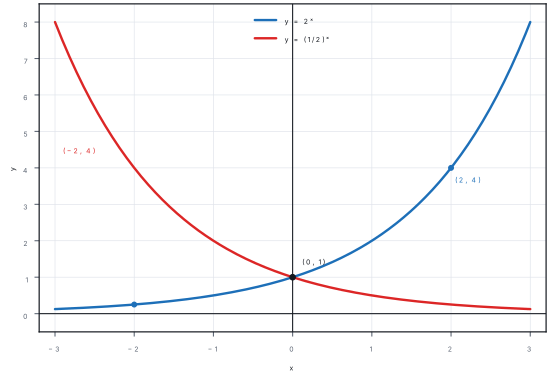
Simplifying expressions
Problem. Simplify (a) 2^5\times2^3, (b) \frac{3^7}{3^4}, (c) \frac{5^6\times5^{-2}}{5^3}.
Solution. (a) 2^5\times2^3=2^{5+3}=2^8=256.
(b) \frac{3^7}{3^4}=3^{7-4}=3^3=27.
(c) \frac{5^6\times5^{-2}}{5^3}=\frac{5^{6-2}}{5^3}=5^{4-3}=5^1=5.
Problem. Find the value of (a) 4^{-2}, (b) \left(\frac{2}{3}\right)^{-3}, (c) 7^0+3^{-1}.
Solution. (a) 4^{-2}=\frac{1}{4^2}=\frac{1}{16}.
(b) A negative index flips the fraction: \left(\frac{2}{3}\right)^{-3}=\left(\frac{3}{2}\right)^3=\frac{27}{8}.
(c) 7^0+3^{-1}=1+\frac{1}{3}=\frac{4}{3}.
Problem. Evaluate (a) 64^{2/3}, (b) \left(\frac{27}{8}\right)^{-2/3}, (c) (0.0016)^{3/4}.
Solution. (a) 64^{1/3}=4, so 64^{2/3}=4^2=16.
(b) First flip because the index is negative: \left(\frac{27}{8}\right)^{-2/3}=\left(\frac{8}{27}\right)^{2/3}. Now \left(\frac{8}{27}\right)^{1/3}=\frac{2}{3}, so the answer is \left(\frac{2}{3}\right)^2=\frac{4}{9}.
(c) 0.0016=\frac{16}{10000}=\left(\frac{2}{10}\right)^4, so (0.0016)^{3/4}=\left(\frac{2}{10}\right)^3=0.008.
Problem. Simplify \frac{(x^3)^2\times x^{-4}}{x^{5}} and write the answer with a positive index.
Solution. (x^3)^2=x^6. Then
Problem. Simplify \frac{2^{n+2}-2^{n}}{2^{n+1}}.
Solution. Take 2^n common in the numerator: 2^{n+2}=2^n\times2^2=4\cdot2^n. So
Problem. Simplify \frac{3^{n+1}+3^{n}}{3^{n+2}-3^{n}}.
Solution. Write every term with 3^n: numerator =3^n(3+1)=4\cdot3^n; denominator =3^n(9-1)=8\cdot3^n. The ratio is
- 2^3\times2^4=2^7, not 4^7 — the base does not change when you multiply.
- (a+b)^2\ne a^2+b^2; the power-of-a-product law works only for products, never for sums.
- -3^2=-9 but (-3)^2=+9. The bracket decides the base.
- a^{-n} is a reciprocal, not a negative number.
- 2^3+2^3=2\times2^3=2^4, not 2^6: only multiplication adds the indices.
Exponential equations
An equation in which the unknown is in the index, such as 3^{x}=81, is called an exponential equation. The rule that solves almost all of them is:
If a^x=a^y with a>0 and a\neq1, then x=y.
Procedure: (1) write every number as a power of the same base; (2) simplify each side with the laws; (3) equate the indices; (4) solve the resulting ordinary equation; (5) check in the original equation.
Problem. Solve 2^{x+1}=32.
Solution. 32=2^5, so 2^{x+1}=2^5. Equating the indices: x+1=5, hence x=4.
Check. 2^{4+1}=2^5=32. ✓
Problem. Solve 9^{x}=3^{x+2}.
Solution. 9=3^2, so 9^x=3^{2x}. The equation becomes 3^{2x}=3^{x+2}, so 2x=x+2 and x=2.
Check. 9^2=81 and 3^{4}=81. ✓
Problem. Solve \left(\frac{1}{2}\right)^{x}=8.
Solution. \frac{1}{2}=2^{-1}, so \left(\frac{1}{2}\right)^x=2^{-x}, and 8=2^3. Thus -x=3, x=-3.
Check. \left(\frac{1}{2}\right)^{-3}=2^3=8. ✓
Problem. Solve 3^{2x-1}=27.
Solution. 27=3^3, so 2x-1=3, 2x=4, x=2.
Problem. Solve 5^{x+1}+5^x=150.
Solution. 5^{x+1}=5\times5^x. So 5\cdot5^x+5^x=150. Taking 5^x common:
Check. 5^3+5^2=125+25=150. ✓
Problem. Solve 2^{x+2}-2^{x}=24.
Solution. 2^{x+2}=4\cdot2^x, so 4\cdot2^x-2^x=24, i.e. 3\cdot2^x=24 and 2^x=8=2^3. Hence x=3.
Problem. Solve 3^{x}\times3^{x+1}=81.
Solution. The product law gives 3^{x+x+1}=3^{2x+1}. Since 81=3^4, we have 2x+1=4, so x=\frac{3}{2}.
Problem. Solve 4^{x+1}=8^{x-1}.
Solution. 4=2^2 and 8=2^3. Therefore 2^{2(x+1)}=2^{3(x-1)}, so
Check. 4^6=4096 and 8^4=4096. ✓
Problem. Solve x^{3/2}=27.
Solution. Raise both sides to the power \frac{2}{3} (the reciprocal of the index):
Check. 9^{3/2}=(\sqrt{9})^3=27. ✓
Problem. Solve 4^x-5\cdot2^x+4=0.
Solution. Since 4^x=(2^x)^2, let y=2^x. The equation becomes
If 2^x=1=2^0 then x=0. If 2^x=4=2^2 then x=2. So x=0 or x=2.
Check. x=0: 1-5+4=0 ✓. x=2: 16-20+4=0 ✓.
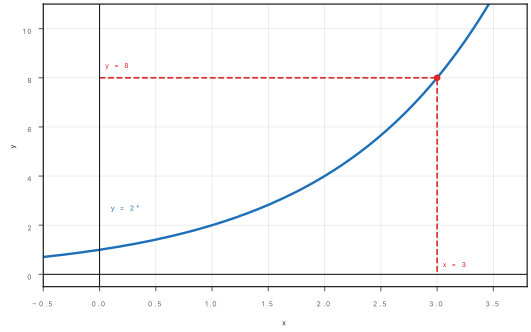
Proving identities with indices
Problem. Prove that \left(\frac{x^a}{x^b}\right)^{a+b}\times\left(\frac{x^b}{x^c}\right)^{b+c}\times\left(\frac{x^c}{x^a}\right)^{c+a}=1.
Solution. By the quotient law, \frac{x^a}{x^b}=x^{a-b} and so on. Then by the power law,
Using (p-q)(p+q)=p^2-q^2, the total index is
So LHS =x^0=1= RHS. Proved.
Problem. Show that \frac{1}{1+x^{a-b}}+\frac{1}{1+x^{b-a}}=1.
Solution. Let p=x^{a-b}. Then x^{b-a}=\frac{1}{p}, and
Proved.
Problem. If 2^x=3^y=6^{-z}, prove that \frac{1}{x}+\frac{1}{y}+\frac{1}{z}=0.
Solution. Let 2^x=3^y=6^{-z}=k. Take the xth, yth and (-z)th roots:
Since 6=2\times3,
The bases are equal, so the indices are equal: -\frac{1}{z}=\frac{1}{x}+\frac{1}{y}, that is \frac{1}{x}+\frac{1}{y}+\frac{1}{z}=0. Proved.
Problem. If a^{x}=b, b^{y}=c and c^{z}=a, prove that xyz=1.
Solution. Substitute step by step: a=c^z=(b^y)^z=b^{yz}=(a^x)^{yz}=a^{xyz}. So a^1=a^{xyz} and, equating indices, xyz=1. Proved.
Whatever the question, ask: "Can I write every number with one common base?" If yes, the laws collapse the question to an ordinary equation in the indices. If the bases are 4,8,16,32,64, use base 2; for 9,27,81 use base 3; for 25,125 use base 5.
10.2 Exercises of the SEE type
Method for any question
- Write every base as a power of one common prime (2, 3 or 5 usually). Remember \frac{1}{2^n}=2^{-n}.
- Use the laws to reach a single power on each side.
- Equate the indices and solve the linear (or quadratic) equation.
- For sums of powers like 5^{x+1}+5^x, take the smallest power as a common factor.
- For a proof, work from the left side only, show every law you use, and end with "= RHS. Proved."
- Check the answer by substituting back.
Problem. Simplify \frac{(25)^{3/2}\times(243)^{-1/5}}{5^{3}\times3^{-1}}.
Solution. 25^{3/2}=(5^2)^{3/2}=5^3=125. 243=3^5, so 243^{-1/5}=3^{-1}=\frac{1}{3}. The numerator is 125\times\frac{1}{3}; the denominator is 125\times\frac{1}{3}. The ratio is 1.
Problem. Solve 2^{x}+2^{x+1}+2^{x+2}=56.
Solution. 2^x(1+2+4)=56, so 7\cdot2^x=56, 2^x=8, x=3.
Problem. Solve \left(\frac{3}{5}\right)^{x-1}=\left(\frac{5}{3}\right)^{x+3}.
Solution. Write the right side as \left(\frac{3}{5}\right)^{-(x+3)}. Equating the indices: x-1=-(x+3), so 2x=-2 and x=-1.
Check. LHS =\left(\frac{3}{5}\right)^{-2}=\frac{25}{9}; RHS =\left(\frac{5}{3}\right)^{2}=\frac{25}{9}. ✓
Problem. Find the value of \left(\frac{1}{27}\right)^{-2/3}\times 16^{-3/4}\div 2^{-1}.
Solution. Take each factor separately.
- \left(\frac{1}{27}\right)^{-2/3}=27^{2/3}=(27^{1/3})^2=3^2=9.
- 16^{-3/4}=\frac{1}{16^{3/4}}=\frac{1}{(16^{1/4})^3}=\frac{1}{2^3}=\frac{1}{8}.
- Dividing by 2^{-1} is the same as multiplying by 2.
So the value is 9\times\frac{1}{8}\times2=\frac{9}{4}.
Problem. Solve 25^{x-1}=\frac{1}{125}.
Solution. 25=5^2 and \frac{1}{125}=5^{-3}. Then 5^{2(x-1)}=5^{-3}, so 2x-2=-3, 2x=-1 and x=-\frac{1}{2}.
Check. 25^{-3/2}=\frac{1}{25^{3/2}}=\frac{1}{5^3}=\frac{1}{125}. ✓
Problem. Solve 2^{x+1}\times 4^{x-1}=16.
Solution. 4^{x-1}=2^{2x-2}. By the product law the left side is 2^{(x+1)+(2x-2)}=2^{3x-1}. Since 16=2^4, we need 3x-1=4, so x=\frac{5}{3}.
Check. 2^{8/3}\times4^{2/3}=2^{8/3}\times2^{4/3}=2^{4}=16. ✓
Problem. Simplify \frac{(a^2b^{-1})^3\times(ab^2)^{-2}}{a^{2}b^{-3}}.
Solution. Open the brackets with the power-of-a-product law:
Multiply: a^{6-2}b^{-3-4}=a^4b^{-7}. Divide by a^2b^{-3}: a^{4-2}b^{-7+3}=a^2b^{-4}=\frac{a^2}{b^4}.
Problem. A culture of bacteria doubles every hour. At 8 a.m. there are 5 bacteria. After how many hours will there be 640 bacteria?
Solution. After t hours the number is 5\times2^t. Put 5\times 2^t=640, so 2^t=128=2^7 and t=7 hours, i.e. at 3 p.m.
Problem. Simplify \frac{\sqrt{x^{3}}\times x^{-1/2}}{x^{1/2}} for x>0.
Solution. \sqrt{x^3}=x^{3/2}. The expression is \frac{x^{3/2}\times x^{-1/2}}{x^{1/2}}=\frac{x^{1}}{x^{1/2}}=x^{1/2}=\sqrt{x}.
Write the given statement, then LHS = and one law per line (the markers love to see "by the law a^m\times a^n=a^{m+n}"). End with = RHS. Proved. A neat proof earns full marks even if one arithmetic slip happens in a side calculation.
Chapter summary
- a^m\times a^n=a^{m+n}, \ a^m\div a^n=a^{m-n}, \ (a^m)^n=a^{mn}, \ (ab)^n=a^nb^n.
- a^0=1 and a^{-n}=\frac{1}{a^n}; a negative index flips the base.
- a^{1/n} is the nth root of a and a^{m/n}=\left(a^{1/n}\right)^m: root first, then power.
- If a^x=a^y (a>0,\ a\ne1) then x=y.
- To solve an exponential equation: common base, simplify, equate indices, check.
- For sums like a^{x+k}\pm a^x take the smallest power as the common factor.
- Equations such as 4^x-5\cdot2^x+4=0: put y=2^x and solve the quadratic in y.
- To prove an identity: simplify one side with the laws until it equals the other.
Practice questions
Group A — Multiple choice (1 mark each)
- The value of a^0 (a\ne0) is [1]a0b1cadundefined
- 2^{-3} is equal to [1]a-8b-6c\frac{1}{8}d\frac{1}{6}
- 8^{2/3} is equal to [1]a2b4c16d64
- If 3^{x}=81 then x is [1]a3b4c27d5
- a^m\times a^n is equal to [1]aa^{mn}ba^{m-n}ca^{m+n}d(2a)^{m+n}
Answers to Group A
1. (b) — a^0=1.
2. (c) — 2^{-3}=\frac{1}{2^3}=\frac{1}{8}.
3. (b) — 8^{1/3}=2, then 2^2=4.
4. (b) — 81=3^4.
5. (c) — add the indices.
Group B — Short answer (2 marks each)
- Simplify \frac{2^{5}\times 2^{-2}}{2^{1}}. [2]
- Evaluate \left(\frac{16}{81}\right)^{3/4}. [2]
- Solve 5^{x-2}=125. [2]
- Solve 4^{x}=8^{x-1}. [2]
Answers to Group B
1. 2^{5-2-1}=2^2=4.
2. \frac{16}{81}=\left(\frac{2}{3}\right)^4, so the answer is \left(\frac{2}{3}\right)^3=\frac{8}{27}.
3. 125=5^3, so x-2=3 and x=5.
4. 2^{2x}=2^{3x-3}, so 2x=3x-3 and x=3.
Group C — Short answer (3 marks each)
- Solve 3^{x+1}+3^{x}=36. [3]
- Simplify \frac{2^{n+3}-2^{n+1}}{2^{n+2}}. [3]
- Solve x^{2/3}=16 (take x>0). [3]
- Prove that \frac{1}{1+x^{p-q}}+\frac{1}{1+x^{q-p}}=1. [3]
Answers to Group C
1. 3\cdot3^x+3^x=4\cdot3^x=36, so 3^x=9 and x=2.
2. Numerator =2^n(8-2)=6\cdot2^n; denominator =4\cdot2^n; ratio =\frac{3}{2}.
3. Raise to \frac{3}{2}: x=16^{3/2}=4^3=64.
4. Put t=x^{p-q}; the sum is \frac{1}{1+t}+\frac{t}{t+1}=1.
Group D — Long answer (4 marks each)
- Solve 4^{x}-6\cdot2^{x}+8=0. [4]
- Prove that \left(\frac{x^m}{x^n}\right)^{m+n}\times\left(\frac{x^n}{x^l}\right)^{n+l}\times\left(\frac{x^l}{x^m}\right)^{l+m}=1. [4]
- If 2^x=3^y=6^{-z}, show that xy+yz+zx=0. [4]
- Solve 2^{x+3}+2^{x+1}=40 and verify your answer. [4]
Answers to Group D
1. Let y=2^x: y^2-6y+8=0, (y-2)(y-4)=0, so y=2 or 4, giving x=1 or x=2.
2. The index sum is (m^2-n^2)+(n^2-l^2)+(l^2-m^2)=0, so the product is x^0=1.
3. Let the common value be k: 2=k^{1/x}, 3=k^{1/y}, 6=k^{-1/z}. From 6=2\times3 we get -\frac{1}{z}=\frac{1}{x}+\frac{1}{y}, i.e. \frac{1}{x}+\frac{1}{y}+\frac{1}{z}=0. Multiplying by xyz gives yz+xz+xy=0.
4. 8\cdot2^x+2\cdot2^x=10\cdot2^x=40, 2^x=4, x=2. Check: 2^5+2^3=32+8=40 ✓.
Practise more: Mathematics question bank