Unit 12 · Compulsory Mathematics · 12 min read
Equations
What the syllabus asks for 2
- Equations: concepts, formulas and worked problems
- Exercises of the SEE type
An equation is a statement that two expressions are equal; to solve it is to find the value of the unknown that makes the statement true. Shopkeepers, engineers and farmers all meet problems of the form "two numbers together make 9 and multiply to 20". This chapter covers two families you need for the SEE: pairs of linear equations in two unknowns (solved by substitution, elimination or by a graph) and quadratic equations in one unknown (solved by factorisation, completing the square or the quadratic formula). Then we use both to solve word problems about numbers, ages, money, rectangles, triangles and speed.
Expect: (i) solve a pair of linear equations, sometimes with fractions; (ii) a word problem that you must first turn into equations; (iii) solve a quadratic by factorising or by the formula; (iv) a word problem on area, consecutive numbers, right triangles or speed that leads to a quadratic, where one root is rejected. Every solution should show: let, form the equation, solve, check, answer in a sentence.
12.1 Equations: concepts, formulas and worked problems
Pairs of linear equations
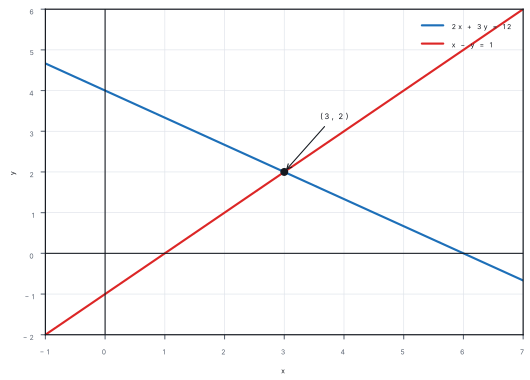
A linear equation in two unknowns, such as 2x+3y=12, has infinitely many solutions (x,y): each is a point on a straight line. Two such equations have, in general, exactly one common solution — the point where the two lines meet.
| Method | Idea | Best when |
|---|---|---|
| Substitution | express one unknown from one equation and put it in the other | one equation has x=\dots or a coefficient 1 |
| Elimination | multiply to make a coefficient equal, then add or subtract | both equations are in the form ax+by=c |
| Graph | draw both lines; read the crossing point | a picture is requested |
After finding one unknown, substitute back to find the other, then check in both equations.
Problem. Solve 2x+3y=12 and x-y=1.
Solution. From the second equation, x=y+1. Substitute into the first:
Then x=y+1=3. Check. 2(3)+3(2)=12 ✓ and 3-2=1 ✓. So x=3,\ y=2.
Problem. Solve 3x-2y=5 and 4x+3y=18.
Solution. Make the y-coefficients equal in size: multiply the first by 3 and the second by 2.
Add: 17x=51, so x=3. Put x=3 in the first equation: 9-2y=5, so y=2. Check. 4(3)+3(2)=18 ✓.
Problem. Solve \frac{x}{2}+\frac{y}{3}=4 and \frac{x}{6}+\frac{y}{3}=2.
Solution. Subtract the second from the first so that y disappears:
From the first equation, 3+\frac{y}{3}=4, so y=3. Check. \frac{6}{6}+\frac{3}{3}=2 ✓.
- Changing only one side when multiplying an equation: multiply every term on both sides.
- Sign errors when subtracting equations — if in doubt, change the signs of the whole second equation and add.
- Forgetting to find the second unknown. A pair of equations needs two values.
- Not checking in both original equations.
Word problems leading to linear equations
Choose letters for the two things you want to find, translate each sentence into an equation, solve, and reply in words.
Problem. Three pens and two copies cost Rs 70; two pens and three copies cost Rs 80. Find the price of one pen and of one copy.
Solution. Let a pen cost Rs p and a copy Rs c.
Multiply the first by 3 and the second by 2: 9p+6c=210 and 4p+6c=160. Subtract: 5p=50, so p=10. Then 30+2c=70 gives c=20.
A pen costs Rs 10 and a copy costs Rs 20. Check. 2(10)+3(20)=80 ✓.
Problem. The sum of the ages of a father and his son is 50 years. Five years ago the father was nine times as old as the son. Find their present ages.
Solution. Let the father be F and the son S. Then F+S=50 and F-5=9(S-5), i.e. F=9S-40. Substitute:
So F=41. Check. Five years ago: 36 and 4; 36=9\times4 ✓. The father is 41 and the son is 9.
Problem. The sum of the digits of a two-digit number is 9. If the digits are reversed, the number increases by 27. Find the number.
Solution. Let the tens digit be x and the units digit y; the number is 10x+y. Then x+y=9. The reversed number is 10y+x, so
Adding to x+y=9: 2y=12, y=6, x=3. The number is 36 (reversed: 63, and 63-36=27 ✓).
Quadratic equations
A quadratic equation has the standard form
A number that satisfies it is a root. A quadratic has at most two real roots.
If p\times q=0 then p=0 or q=0.
So after moving everything to one side and factorising, set each bracket equal to 0. The right-hand side must be 0 before you factorise.
Solving by factorisation
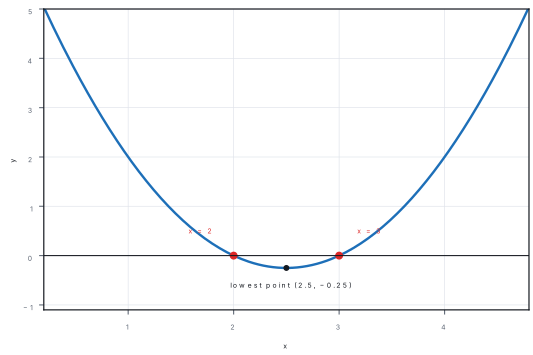
Problem. Solve x^2-5x+6=0.
Solution. Two numbers with product 6 and sum -5 are -2 and -3. So (x-2)(x-3)=0, giving x=2 or x=3.
Problem. Solve 2x^2-7x+3=0.
Solution. 2\times3=6; split -7x as -6x-x:
So x=3 or x=\frac{1}{2}.
Problem. Solve x(x+7)=60.
Solution. Expand and move all terms to the left: x^2+7x-60=0. Two numbers with product -60 and sum 7 are 12 and -5:
Problem. Solve 3x^2=12x.
Solution. 3x^2-12x=0, so 3x(x-4)=0 and x=0 or x=4. (Never divide both sides by x; you would lose the root x=0.)
Completing the square and the quadratic formula
When the quadratic does not factorise neatly we use a formula that works for every quadratic.
We turn ax^2+bx+c=0 into a perfect square on the left, then take square roots.
Step 1 — divide by a.
Step 2 — move the constant and add \left(\frac{b}{2a}\right)^2 to both sides.
Step 3 — left side is a perfect square; combine the right side.
Step 4 — take square roots.
Result.
What it means. D=b^2-4ac is the discriminant. If D>0 there are two real roots; if D=0 there is one repeated root; if D<0 there is no real root.
Problem. Solve x^2-4x+1=0 by completing the square.
Solution. Move the constant: x^2-4x=-1. Add \left(\frac{4}{2}\right)^2=4 to both sides:
So x=2+\sqrt{3} or x=2-\sqrt{3}.
Problem. Solve 2x^2+3x-1=0.
Solution. a=2,\ b=3,\ c=-1. The discriminant is b^2-4ac=9+8=17.
Numerically x\approx0.78 or x\approx-1.78.
Problem. Solve 3x^2-x-2=0 using the formula.
Solution. a=3,\ b=-1,\ c=-2. D=1+24=25.
Problem. Does x^2+2x+5=0 have real roots?
Solution. D=b^2-4ac=4-20=-16<0, so there is no real root.
Equations that reduce to quadratics
Problem. Solve x+\frac{1}{x}=\frac{10}{3}.
Solution. Multiply every term by 3x: 3x^2+3=10x, so 3x^2-10x+3=0. Then (3x-1)(x-3)=0 and x=\frac{1}{3} or x=3.
Problem. Solve \sqrt{x+6}=x.
Solution. Square both sides: x+6=x^2, so x^2-x-6=0, (x-3)(x+2)=0, giving x=3 or x=-2. Check each in the original equation: x=3: \sqrt{9}=3 ✓. x=-2: \sqrt{4}=2\ne-2, so -2 is rejected. Answer: x=3.
Problem. Solve x^4-13x^2+36=0.
Solution. Let y=x^2: y^2-13y+36=0, (y-4)(y-9)=0, so y=4 or 9. Therefore x=\pm2 or x=\pm3.
Word problems leading to quadratics
Problem. The product of two consecutive positive integers is 156. Find them.
Solution. Let the numbers be x and x+1: x(x+1)=156, so x^2+x-156=0. Factorise: (x+13)(x-12)=0, so x=12 (the root -13 is not positive). The numbers are 12 and 13.
Problem. The length of a rectangle is 7 m more than its breadth, and its area is 60 m². Find its dimensions.
Solution. Let the breadth be x m. Then x(x+7)=60, so x^2+7x-60=0 and (x+12)(x-5)=0. A length cannot be negative, so x=5. The rectangle is 5 m by 12 m.
Problem. The hypotenuse of a right-angled triangle is 13 cm and one side is 7 cm longer than the other. Find the sides.
Solution. Let the shorter side be x. By Pythagoras, x^2+(x+7)^2=13^2:
So x=5 and the other side is 12 cm. (Check: 25+144=169 ✓.)
Problem. A train travels 120 km at a steady speed. If its speed were 10 km/h more, the journey would take 1 hour less. Find its speed.
Solution. Let the speed be x km/h. Time =\frac{\text{distance}}{\text{speed}}, so
Multiply by x(x+10): 120(x+10)-120x=x(x+10), i.e. 1200=x^2+10x. Then x^2+10x-1200=0, (x+40)(x-30)=0. Speed cannot be negative, so x=30 km/h.
Problem. Two numbers add up to 9 and their product is 20. Find them.
Solution. Let one number be x; the other is 9-x. Then x(9-x)=20, so x^2-9x+20=0, (x-4)(x-5)=0. The numbers are 4 and 5.
Problem. Solve 2x+y=7 and x^2+y=10.
Solution. From the first, y=7-2x. Substitute into the second: x^2+7-2x=10, so x^2-2x-3=0, (x-3)(x+1)=0. If x=3, y=1; if x=-1, y=9. Solutions: (3,1) and (-1,9).
12.2 Exercises of the SEE type
Method for any question
- Read twice; underline what is asked. Write "Let …".
- Translate each sentence to an equation. Two unknowns need two equations.
- Solve: linear — elimination or substitution; quadratic — factorise, else use the formula.
- Reject roots that are impossible (negative length, age, speed).
- Check in the words of the problem and answer in a sentence with units.
Problem. The product of the ages of a boy and his sister is 80. The boy is 2 years older than his sister. Find their ages.
Solution. Let the sister's age be x. Then x(x+2)=80, x^2+2x-80=0, (x+10)(x-8)=0. So x=8; the sister is 8 and the boy is 10.
Problem. A shopkeeper sold 5 kg of rice and 3 kg of lentils for Rs 1,050 and 3 kg of rice and 5 kg of lentils for Rs 1,150. Find the price per kg of each.
Solution. Let rice cost Rs r per kg and lentils Rs l per kg: 5r+3l=1050 and 3r+5l=1150. Add: 8r+8l=2200, so r+l=275. Subtract: 2r-2l=-100, so r-l=-50. Hence r=112.5 and l=162.5.
Rice costs Rs 112.50 and lentils Rs 162.50 per kg. Check. 5(112.5)+3(162.5)=562.5+487.5=1050 ✓.
Chapter summary
- A pair of linear equations: solve by substitution, elimination or graph; check in both.
- Word problems: choose letters, form equations, solve, answer in words.
- Quadratic standard form ax^2+bx+c=0; zero product rule after factorising.
- Completing the square: add \left(\frac{b}{2a}\right)^2 to both sides.
- Quadratic formula x=\frac{-b\pm\sqrt{b^2-4ac}}{2a}; discriminant D=b^2-4ac: D>0 two roots, D=0 one root, D<0 no real root.
- Reject answers that are impossible in the context.
- When squaring an equation containing a square root, check every root in the original.
Practice questions
Group A — Multiple choice (1 mark each)
- The solution of x+y=5 and x-y=1 is [1]a(2, 3)b(3, 2)c(4, 1)d(1, 4)
- The roots of x^2-9=0 are [1]a9 onlyb3 onlyc\pm3d\pm9
- For x^2+4x+4=0 the discriminant is [1]a0b4c16d-16
- The quadratic formula is [1]a\frac{-b\pm\sqrt{b^2+4ac}}{2a}b\frac{-b\pm\sqrt{b^2-4ac}}{2a}c\frac{b\pm\sqrt{b^2-4ac}}{2a}d\frac{-b\pm\sqrt{b^2-4ac}}{a}
- How many real roots does x^2+1=0 have? [1]a0b1c2d4
Answers to Group A
1. (b) — adding gives 2x=6.
2. (c) — x^2=9.
3. (a) — 16-16=0.
4. (b).
5. (a) — D=-4<0.
Group B — Short answer (2 marks each)
- Solve x+y=7 and x-y=3. [2]
- Solve x^2-5x+6=0. [2]
- Find the discriminant of 2x^2-3x+5=0 and state whether it has real roots. [2]
- Two numbers add to 15 and differ by 3. Find them. [2]
Answers to Group B
1. 2x=10, x=5, y=2.
2. (x-2)(x-3)=0, x=2,3.
3. D=9-40=-31<0: no real roots.
4. x+y=15, x-y=3 gives x=9, y=6.
Group C — Short answer (3 marks each)
- Solve 3x-2y=5 and 4x+3y=18. [3]
- Solve 2x^2-7x+3=0. [3]
- Solve x^2-4x+1=0 using the quadratic formula. [3]
- The sum of two numbers is 9 and their product is 20. Find the numbers. [3]
Answers to Group C
1. x=3,\ y=2.
2. (x-3)(2x-1)=0: x=3 or \frac{1}{2}.
3. D=16-4=12, x=\frac{4\pm2\sqrt{3}}{2}=2\pm\sqrt{3}.
4. x(9-x)=20 gives x^2-9x+20=0: numbers 4 and 5.
Group D — Long answer (4 marks each)
- The length of a rectangle is 7 m more than its breadth and its area is 60 m². Find its perimeter. [4]
- A train covers 120 km at speed x km/h. At (x+10) km/h it would take 1 hour less. Find x. [4]
- The sum of the digits of a two-digit number is 9; reversing the digits adds 27 to the number. Find the number. [4]
- The hypotenuse of a right-angled triangle is 13 cm; one side is 7 cm longer than the other. Find its area. [4]
Answers to Group D
1. Breadth 5 m, length 12 m; perimeter 2(5+12)=34 m.
2. x^2+10x-1200=0, x=30 km/h.
3. 36.
4. Sides 5 cm and 12 cm; area \frac{1}{2}\times5\times12=30\text{ cm}^2.
Practise more: Mathematics question bank