Unit 13 · Compulsory Mathematics · 16 min read
Area of Triangles and Quadrilaterals
What the syllabus asks for 2
- Area of Triangles and Quadrilaterals: concepts, formulas and worked problems
- Exercises of the SEE type
In Chapter 5 you calculated areas with formulas. Here we ask a deeper question: when do two figures have equal areas without measuring them? The answer is a family of theorems about triangles and parallelograms standing on the same base and lying between the same parallel lines. These theorems explain why a triangle is exactly half of a parallelogram, why a median halves a triangle, and why a farmer can swap a crooked boundary for a straight one without changing the area of the field. In the SEE you must be able to prove the main theorems with a neat figure, and use them in numerical and "prove that" questions.
Expect: (i) prove that parallelograms on the same base and between the same parallels are equal in area (3–4 marks, figure required); (ii) prove that a triangle and a parallelogram on the same base and between the same parallels satisfy \Delta=\frac{1}{2}\,\text{parallelogram}; (iii) apply the theorems: "prove that the diagonals of a parallelogram divide it into four equal triangles", "a median divides a triangle into two equal parts", or find an area from a ratio; (iv) numerical problems with heights and bases. Write: Given, To prove, Construction, Proof and give a reason for every line.
13.1 Area of Triangles and Quadrilaterals: concepts, formulas and worked problems
Basic area formulas to remember
| Figure | Area |
|---|---|
| Rectangle | length \times breadth |
| Parallelogram | base \times perpendicular height |
| Triangle | \frac{1}{2}\times base \times height |
| Trapezium | \frac{1}{2}(a+b)\,h, where a,b are the parallel sides |
| Rhombus | \frac{1}{2}\times d_1\times d_2 |
| Quadrilateral with diagonal d and offsets h_1,h_2 | \frac{1}{2}\,d\,(h_1+h_2) |
Equal in area is written \text{area}(\Delta ABC)=\text{area}(\Delta PQR). Two figures can be equal in area without being congruent: a 12\times 5 rectangle and a 10\times 6 rectangle both have area 60 but have different shapes.
Same base, between the same parallels
Two figures are on the same base and between the same parallels if they share a base line, and their opposite vertices (or sides) lie on a single line parallel to that base. Then the perpendicular height is the same for both — this is the whole secret of the theorems.
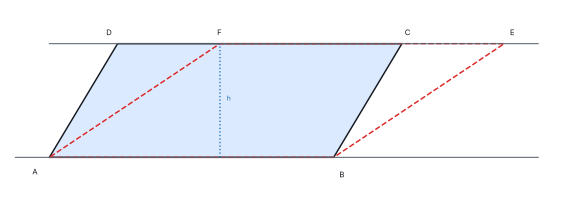
Theorem 1 — parallelograms on the same base
Given. Parallelograms ABCD and ABEF stand on the same base AB and lie between the same parallels AB and DF (as in the figure above).
To prove. \text{area}(\text{parallelogram }ABCD)=\text{area}(\text{parallelogram }ABEF).
Proof.
Step 1 — compare the triangles ADF and BCE. AD=BC (opposite sides of parallelogram ABCD) and AF=BE (opposite sides of parallelogram ABEF). Also DC=AB=FE, so DF=DC-FC=FE-FC=CE. Hence \Delta ADF\cong\Delta BCE by SSS, and \text{area}(\Delta ADF)=\text{area}(\Delta BCE).
Step 2 — add the same quadrilateral to each. Let ABCF be the quadrilateral common to both parallelograms. Then
Step 3 — equals added to equals. The triangles are equal in area, and ABCF is common, so the two right-hand sides are equal.
Result. \text{area}(\text{parallelogram }ABCD)=\text{area}(\text{parallelogram }ABEF). Proved.
What it means. Slide the top side of a parallelogram along the top parallel and the area does not change. Only the base and the height matter.
Problem. A rectangle ABEF has AB=10 cm and BE=6 cm. A parallelogram ABCD is on the same base AB and between the same parallels, with side BC=8 cm. Find the area of the parallelogram, and compare the perimeters.
Solution. Both figures are between the same parallels, so the height of the parallelogram is also 6 cm. Area =10\times6=60\text{ cm}^2 — equal to the rectangle.
Perimeters: rectangle 2(10+6)=32 cm; parallelogram 2(10+8)=36 cm. Equal area but unequal perimeters: of all parallelograms on the same base and between the same parallels, the rectangle has the least perimeter.
Problem. In parallelogram ABCD, AB=15 cm, AD=10 cm and the perpendicular distance between AB and DC is 8 cm. Find the distance between AD and BC.
Solution. Area =\text{base}\times\text{height}=15\times8=120\text{ cm}^2. Using AD as base, 10\times h=120 gives h=12 cm.
Theorem 2 — triangle and parallelogram
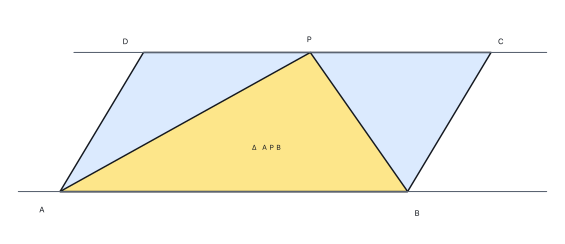
Given. Parallelogram ABCD and triangle ABP are on the same base AB and between the same parallels AB and DC (P lies on DC).
To prove. \text{area}(\Delta ABP)=\frac{1}{2}\,\text{area}(\text{parallelogram }ABCD).
Construction. Join AC.
Proof.
Step 1 — the diagonal halves the parallelogram. A diagonal of a parallelogram divides it into two congruent triangles, so
Step 2 — triangles on the same base and between the same parallels. \Delta ABC and \Delta ABP have the same base AB and the same height (the distance between AB and DC), so \text{area}(\Delta ABP)=\text{area}(\Delta ABC). (This is Theorem 3 below; here the result follows directly from \frac{1}{2}\times AB\times h for both.)
Result. \text{area}(\Delta ABP)=\frac{1}{2}\,\text{area}(\text{parallelogram }ABCD). Proved.
What it means. The area of a triangle is half the area of the parallelogram with the same base and height: \frac{1}{2}\times\text{base}\times\text{height} — the familiar triangle formula, now proved.
- Parallelograms on the same base and between the same parallels are equal in area.
- A triangle on the same base as a parallelogram, and between the same parallels, has half its area.
- Triangles on the same base and between the same parallels are equal in area.
- Triangles on equal bases and between the same parallels are equal in area.
- A median of a triangle divides it into two triangles of equal area.
- The diagonals of a parallelogram divide it into four triangles of equal area.
Theorem 3 — triangles on the same base
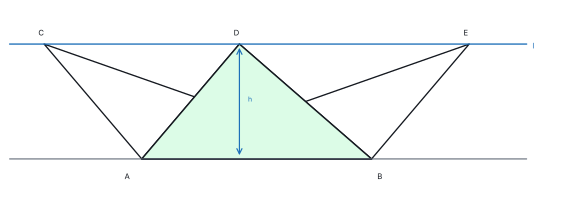
Given. Triangles ABC and ABD on the same base AB, with C and D on a line l\parallel AB.
To prove. \text{area}(\Delta ABC)=\text{area}(\Delta ABD).
Construction. Through A draw AE\parallel BC and through B draw BF\parallel AD, so that E and F lie on l (as parallelograms ABCE and ABFD are formed).
Proof.
Step 1. \text{parallelogram }ABCE and \text{parallelogram }ABFD are on the same base AB and between the same parallels, so by Theorem 1 their areas are equal.
Step 2. The diagonal AC halves \text{parallelogram }ABCE: \text{area}(\Delta ABC)=\frac{1}{2}\text{area}(\text{parallelogram }ABCE). The diagonal BD halves \text{parallelogram }ABFD: \text{area}(\Delta ABD)=\frac{1}{2}\text{area}(\text{parallelogram }ABFD).
Result. Halves of equal areas are equal, so \text{area}(\Delta ABC)=\text{area}(\Delta ABD). Proved.
What it means. A triangle's area does not change when the apex slides along a line parallel to the base — as the figure shows, C, D and E give the same area.
Problem. The base BC=10 cm and the apex A of \Delta ABC moves along a line parallel to BC at a distance of 6 cm. Find the area for every position of A.
Solution. The height is always 6 cm, so \text{area}=\frac{1}{2}\times10\times6=30\text{ cm}^2 for every position.
Problem. AD is a median of \Delta ABC with \text{area}(\Delta ABC)=60\text{ cm}^2. Find the area of \Delta ABD. Prove your answer.
Solution. D is the midpoint of BC, so BD=DC. \Delta ABD and \Delta ADC have equal bases BD=DC and the same height from A to BC, so their areas are equal. Each has area \frac{60}{2}=30\text{ cm}^2.
Problem. D is the midpoint of BC in \Delta ABC and E is the midpoint of AD. If \text{area}(\Delta ABC)=72\text{ cm}^2, find \text{area}(\Delta BED).
Solution. AD is a median, so \text{area}(\Delta ABD)=36. In \Delta ABD, BE is a median (E is the midpoint of AD), so \text{area}(\Delta BED)=\frac{36}{2}=18\text{ cm}^2.
Problem. D lies on BC with BD:DC=2:3. If \text{area}(\Delta ABC)=75\text{ cm}^2, find the areas of \Delta ABD and \Delta ADC.
Solution. The two triangles have the same height from A, so their areas are in the ratio of their bases, 2:3. Hence
Using the theorems
Problem. ABCD is a parallelogram with area 90\text{ cm}^2 and P is any point on DC. Find the area of \Delta APB.
Solution. \Delta APB and the parallelogram are on the same base AB and between the same parallels AB and DC, so \text{area}(\Delta APB)=\frac{1}{2}\times90=45\text{ cm}^2, wherever P is on DC.
Given. ABCD is a parallelogram; the diagonals AC and BD meet at O.
To prove. \text{area}(\Delta AOB)=\text{area}(\Delta BOC)=\text{area}(\Delta COD)=\text{area}(\Delta DOA).
Proof.
Step 1. The diagonals of a parallelogram bisect each other, so AO=OC and BO=OD.
Step 2. In \Delta ABC, BO is a median (as AO=OC), so \text{area}(\Delta AOB)=\text{area}(\Delta BOC). In \Delta BCD, CO is a median, so \text{area}(\Delta BOC)=\text{area}(\Delta COD). In \Delta CDA, DO is a median, so \text{area}(\Delta COD)=\text{area}(\Delta DOA).
Result. All four triangles are equal in area, each equal to \frac{1}{4}\text{area}(\text{parallelogram }ABCD). Proved.
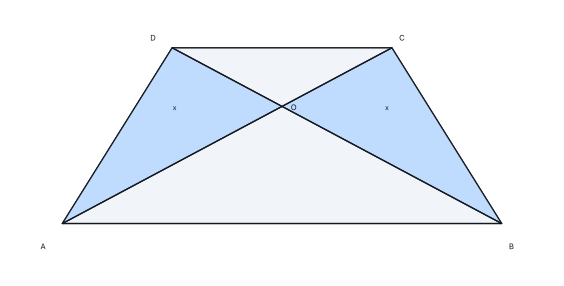
Problem. In trapezium ABCD, AB\parallel DC, AB=12 cm, DC=6 cm and the height is 4 cm. The diagonals meet at O. Find the area of the trapezium, show that \text{area}(\Delta AOD)=\text{area}(\Delta BOC) and find all four areas.
Solution. Trapezium area =\frac{1}{2}(12+6)\times4=36\text{ cm}^2.
\Delta ADC and \Delta BDC have the same base DC=6 and the same height 4, so each has area \frac{1}{2}\times6\times4=12\text{ cm}^2. Subtracting the common part \Delta DOC from both, \text{area}(\Delta AOD)=\text{area}(\Delta BOC).
Since \Delta AOB\sim\Delta COD with ratio of sides 12:6=2:1, AO:OC=2:1. So \Delta ABC (area \frac{1}{2}\times12\times4=24) splits as \Delta AOB=16 and \Delta BOC=8; \Delta ADC (area 12) splits as \Delta AOD=8 and \Delta COD=4. Check: 16+8+8+4=36 ✓.
Problem. In quadrilateral ABCD the diagonal AC=20 cm, and the perpendiculars from B and D to AC are 6 cm and 9 cm. Find its area.
Solution. \text{Area}=\frac{1}{2}\times AC\times(h_1+h_2)=\frac{1}{2}\times20\times(6+9)=150\text{ cm}^2.
Problem. A triangle has sides 13 cm, 14 cm, 15 cm. Find its area and the height on the side of 14 cm. A second triangle on the same base lies between the same parallels; what is its area?
Solution. s=\frac{13+14+15}{2}=21. Area =\sqrt{21\times8\times7\times6}=\sqrt{7056}=84\text{ cm}^2. Height on 14 cm: \frac{2\times84}{14}=12 cm. A triangle on the same base between the same parallels has the same area: 84\text{ cm}^2.
- Using the slant side instead of the perpendicular height in \text{base}\times\text{height}.
- Forgetting to say "between the same parallels" — the reason is half the marks of a proof.
- Claiming triangles are congruent when you only know they are equal in area.
- In a proof, leaving out Given, To prove, Construction. Draw a clear figure with all letters.
- Writing \text{area}(\Delta ABC)=\text{area}(\Delta ABD) without naming the common base and the parallels.
13.2 Exercises of the SEE type
Method for any question
- Draw a neat figure; mark equal sides and parallel lines.
- For a proof: Given – To prove – Construction – Proof; one reason per line.
- Identify the common base and the parallels — the height is then the same.
- For a numerical question: area =\text{base}\times\text{height} (parallelogram) or \frac{1}{2}\times\text{base}\times\text{height} (triangle), then use ratios of bases or equal heights.
- End with the stated conclusion ("Proved") or a sentence with units.
Problem. In the figure ABCD is a parallelogram, E is a point on BC and \text{area}(\Delta AED)=40\text{ cm}^2. Find the area of \text{parallelogram }ABCD and of \Delta ABE+\Delta DCE.
Solution. \Delta AED and \text{parallelogram }ABCD are on the same base AD and between the same parallels AD and BC, so \text{area}(\text{parallelogram }ABCD)=2\times40=80\text{ cm}^2. The remaining part is 80-40=40\text{ cm}^2, so \text{area}(\Delta ABE)+\text{area}(\Delta DCE)=40\text{ cm}^2.
Problem. Prove that a median of a triangle divides it into two triangles of equal area.
Solution. Given: AD is a median of \Delta ABC, so BD=DC. To prove: \text{area}(\Delta ABD)=\text{area}(\Delta ADC). Construction: draw AM\perp BC. Proof: \text{area}(\Delta ABD)=\frac{1}{2}\times BD\times AM and \text{area}(\Delta ADC)=\frac{1}{2}\times DC\times AM. Since BD=DC, the areas are equal. Proved.
Problem. ABCD is a parallelogram with area 64\text{ cm}^2 and diagonals meeting at O. Find \text{area}(\Delta AOB) and \text{area}(\Delta AOB)+\text{area}(\Delta COD).
Solution. Each of the four triangles has area \frac{64}{4}=16\text{ cm}^2, and the sum of two opposite ones is 32\text{ cm}^2.
Chapter summary
- Parallelograms on the same base and between the same parallels have equal area.
- A triangle on the same base as a parallelogram and between the same parallels has half its area.
- Triangles on the same base (or equal bases) and between the same parallels are equal in area.
- A median divides a triangle into two triangles of equal area; triangles with the same height have areas in the ratio of their bases.
- The diagonals of a parallelogram divide it into four triangles of equal area.
- Formulas: parallelogram bh; triangle \frac{1}{2}bh; trapezium \frac{1}{2}(a+b)h; rhombus \frac{1}{2}d_1d_2; quadrilateral \frac{1}{2}d(h_1+h_2).
- A proof always has Given, To prove, Construction, Proof with a reason for each step.
Practice questions
Group A — Multiple choice (1 mark each)
- A triangle and a parallelogram on the same base and between the same parallels: the area of the triangle is [1]aequalbhalfcdoubledone third of the parallelogram
- A median of a triangle divides it into two triangles which are [1]acongruentbsimilarcequal in areadin the ratio 1:2
- The diagonals of a parallelogram divide it into how many equal-area triangles? [1]a2b3c4d6
- A parallelogram has base 9 cm and height 4 cm. Its area is [1]a18 cm²b26 cm²c36 cm²d13 cm²
- Triangles on the same base and between the same parallels are [1]acongruentbequal in areacsimilardisosceles
Answers to Group A
1. (b) — Theorem 2.
2. (c) — equal bases, same height.
3. (c) — four.
4. (c) — 9\times4=36.
5. (b) — same base, same height.
Group B — Short answer (2 marks each)
- A parallelogram has area 48\text{ cm}^2. Find the area of a triangle on the same base and between the same parallels. [2]
- D is the midpoint of BC in \Delta ABC of area 50\text{ cm}^2. Find \text{area}(\Delta ABD). [2]
- A parallelogram has sides 12 cm and 8 cm and the height on the 12 cm side is 5 cm. Find the height on the 8 cm side. [2]
- The area of a rhombus is 96\text{ cm}^2 and one diagonal is 16 cm. Find the other diagonal. [2]
Answers to Group B
1. \frac{1}{2}\times48=24\text{ cm}^2.
2. 25\text{ cm}^2.
3. Area =12\times5=60; 8h=60 so h=7.5 cm.
4. \frac{1}{2}\times16\times d_2=96 so d_2=12 cm.
Group C — Short answer (3 marks each)
- Prove that triangles on the same base and between the same parallels are equal in area. [3]
- ABCD is a parallelogram of area 64\text{ cm}^2 and P is a point on DC. Find \text{area}(\Delta APB) and give a reason. [3]
- D lies on BC with BD:DC=3:5 and \text{area}(\Delta ABC)=96\text{ cm}^2. Find the area of \Delta ABD. [3]
- In quadrilateral ABCD the diagonal AC=16 cm and the perpendiculars to it from B and D are 5 cm and 7 cm. Find its area. [3]
Answers to Group C
1. See Theorem 3: complete the parallelograms ABCE and ABFD; they are equal (Theorem 1), and the triangles are their halves.
2. 32\text{ cm}^2 — same base AB, same parallels, triangle is half the parallelogram.
3. Same height, so area in ratio of bases: \frac{3}{8}\times96=36\text{ cm}^2.
4. \frac{1}{2}\times16\times(5+7)=96\text{ cm}^2.
Group D — Long answer (4 marks each)
- Prove that parallelograms on the same base and between the same parallels are equal in area. [4]
- Prove that the diagonals of a parallelogram divide it into four triangles of equal area. [4]
- In trapezium ABCD, AB\parallel DC, AB=12 cm, DC=6 cm and the height is 4 cm. Find its area and the areas of the four triangles formed by the diagonals. [4]
- D is the midpoint of BC and E is the midpoint of AD in \Delta ABC of area 72\text{ cm}^2. Find the area of \Delta BED and the total area of \Delta ABE and \Delta ACE. [4]
Answers to Group D
1. See Theorem 1 (congruent triangles ADF and BCE, then subtract from the same whole).
2. See the derivation: O is the midpoint of both diagonals, so each of the four triangles is half of a triangle with a median; each has area \frac{1}{4} of the parallelogram.
3. Area 36\text{ cm}^2; triangles AOB=16, BOC=8, COD=4, DOA=8 (\text{cm}^2).
4. AD is a median, so \text{area}(\Delta ABD)=\text{area}(\Delta ACD)=36. BE is a median of \Delta ABD, so \text{area}(\Delta BED)=18\text{ cm}^2. CE is a median of \Delta ACD and \Delta ABE=\frac{1}{2}\Delta ABD=18, \Delta ACE=\frac{1}{2}\Delta ACD=18, so together 36\text{ cm}^2.
Practise more: Mathematics question bank