Unit 2 · Compulsory Mathematics · 19 min read
Tax and Money Exchange
What the syllabus asks for 2
- Tax and Money Exchange: concepts, formulas and worked problems
- Exercises of the SEE type
Every time you buy a packet of biscuits in a shop in Kathmandu, part of the price goes to the government as tax. Every time a migrant worker in Qatar sends money home, one currency is changed into another at a rate fixed by the bank. This chapter turns both everyday ideas into arithmetic: value added tax (VAT), excise duty, income tax, and foreign currency exchange. All of it rests on one skill from earlier classes — finding a percentage of a quantity, and working backwards from a total to the original amount.
Almost every SEE paper has one 4-mark question from this unit and often a 3-mark one. The common types are: (i) a bill with discount and VAT; (ii) a price with excise duty and then VAT, sometimes worked backwards; (iii) income tax by slabs; (iv) converting currencies at a buying or selling rate, including gain or loss. Show the rate, the working and a final sentence with the unit (Rs, USD, INR).
2.1 Tax and Money Exchange: concepts, formulas and worked problems
Taxes: what they are and why we pay them
A tax is money that people and businesses must pay to the government. It pays for roads, schools, hospitals and the police. Taxes fall into two groups.
| Kind of tax | Who bears it | Examples |
|---|---|---|
| Direct tax | Paid straight to the government by the person whose income or property is taxed | Income tax, property tax |
| Indirect tax | Added to the price of goods or services; the buyer pays it through the seller | VAT, excise duty, customs duty |
In Nepal the standard rate of VAT is 13%. Rates and slabs are changed by the government each year in the Finance Act, so in an exam you must use the rate given in the question. If a question says nothing, the textbook rate is 13%.
Value added tax (VAT)
VAT is a tax on the value added at each stage of production and sale, collected by the seller from the buyer and paid to the government. The price before VAT is the taxable price; the price after adding VAT is the bill amount.
With VAT rate r\%:
For r=13: bill =1.13\times price, so price = bill \div\, 1.13.
Problem. A school bag is priced at Rs 2,500 without VAT. Find the VAT at 13% and the amount a customer pays.
Solution. VAT =\dfrac{13}{100}\times 2500 = \text{Rs } 325.
Bill amount =2500+325=\text{Rs } 2{,}825.
(Quick method: 2500\times 1.13=2825 ✓.)
Problem. A customer paid Rs 9,040 for a pair of shoes including 13% VAT. Find the price before VAT and the VAT amount.
Solution. Let the price without VAT be Rs x. Then
Price without VAT =\text{Rs } 8{,}000. VAT =9040-8000=\text{Rs } 1{,}040.
Check: 13\% of 8000=1040 ✓.
When the bill amount is given, the VAT is not 13\% of the bill. 13% of Rs 9,040 is Rs 1,175.20, which is wrong. The 13% is on the price without VAT, so divide the bill by 1.13 first.
Discount and VAT together
A shopkeeper first gives the discount on the marked price, and VAT is then charged on the discounted price (the actual selling price). The order matters.
Order: marked price → subtract discount → selling price → add VAT → bill amount.
Problem. The marked price of a jacket is Rs 15,000. The shopkeeper allows a 20% discount and charges 13% VAT. Find the amount the customer pays.
Solution. Discount =20\% of 15000=\text{Rs } 3{,}000.
Selling price =15000-3000=\text{Rs } 12{,}000.
VAT =13\% of 12000=\text{Rs } 1{,}560.
Bill amount =12000+1560=\text{Rs } 13{,}560.
Problem. A shopkeeper buys an article for Rs 8,000. He marks it 25% above the cost price, gives a 10% discount and then charges 13% VAT. How much does the customer pay?
Solution. Marked price =8000\times 1.25=\text{Rs } 10{,}000.
Discount =10\% of 10000=\text{Rs } 1{,}000, so selling price =\text{Rs } 9{,}000.
VAT =13\% of 9000=\text{Rs } 1{,}170.
Customer pays 9000+1170=\text{Rs } 10{,}170.
How VAT moves along the chain
VAT is called "value added" because each seller pays the government only the tax on the value he or she added. A seller collects VAT from the buyer, subtracts the VAT already paid to his own supplier, and pays the difference.
We start with a product that passes from a manufacturer to a wholesaler to a retailer to a customer. We show that the government's total receipts equal 13% of the final selling price, so the burden falls on the customer alone.
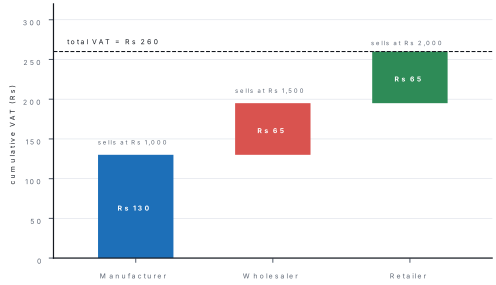
Setting up. Prices exclude VAT: manufacturer sells at Rs 1,000, wholesaler at Rs 1,500, retailer at Rs 2,000. VAT rate is 13%.
Step 1 — manufacturer. VAT collected =13\% of 1000=130. No earlier VAT to deduct, so pays Rs 130.
Step 2 — wholesaler. VAT collected =13\% of 1500=195. VAT already paid to the manufacturer =130. Pays 195-130=\text{Rs } 65.
Step 3 — retailer. VAT collected =13\% of 2000=260. VAT already paid to the wholesaler =195. Pays 260-195=\text{Rs } 65.
Step 4 — total to the government.
Result. The government receives exactly VAT on the final price. Each seller recovers the VAT paid on purchases, so the tax is finally paid by the customer.
What it means. Each person in the chain pays VAT only on his own profit margin: 13\% of (1500-1000)=65 and 13\% of (2000-1500)=65.
Problem. A shopkeeper buys goods for Rs 40,000 (without VAT) and sells them for Rs 50,000 (without VAT). VAT is 13%. How much VAT must he pay to the government?
Solution. VAT collected on sales =13\% of 50000=\text{Rs } 6{,}500.
VAT paid on purchases =13\% of 40000=\text{Rs } 5{,}200.
VAT payable =6500-5200=\text{Rs } 1{,}300.
Check: 13\% of the value added (50000-40000=10000) is 1300 ✓.
Excise duty
Excise duty is an indirect tax charged by the government on certain goods produced inside the country (for example cigarettes, alcohol, cars, TVs in many questions). It is charged on the factory price (the price at which the producer sells), before VAT.
When both apply, the order is fixed:
Order: factory price → add excise duty → price with excise → add VAT on this price → final price.
VAT is charged on the factory price plus the excise duty, not on the factory price alone. So excise is a tax on which VAT is also charged.
With excise rate e\% and VAT rate v\%:
For e=10, v=13: final price = factory price \times 1.1\times 1.13=1.243\times factory price.
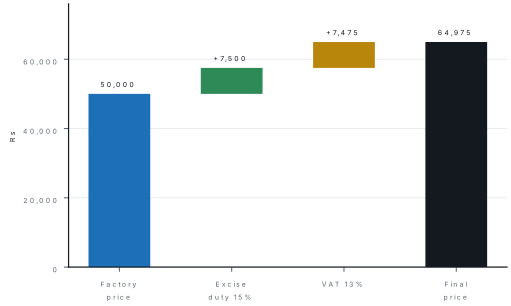
Problem. The factory price of a television is Rs 50,000. Excise duty of 15% is charged and then VAT of 13% is added. Find the price a customer pays.
Solution. Excise duty =15\% of 50000=\text{Rs } 7{,}500.
Price with excise duty =50000+7500=\text{Rs } 57{,}500.
VAT =13\% of 57500=\text{Rs } 7{,}475.
Final price =57500+7475=\text{Rs } 64{,}975.
Total tax paid =7500+7475=\text{Rs } 14{,}975.
Problem. A motorbike was bought for Rs 74,580 including 10% excise duty on the factory price and 13% VAT. Find the factory price, the excise duty and the VAT.
Solution. Let the factory price be Rs x.
With excise duty: 1.1x. After VAT: 1.1x\times 1.13=1.243x.
Factory price =\text{Rs } 60{,}000.
Excise duty =10\% of 60000=\text{Rs } 6{,}000, so price with excise =\text{Rs } 66{,}000.
VAT =13\% of 66000=\text{Rs } 8{,}580.
Check: 66000+8580=74580 ✓.
Income tax
Income tax is a direct tax on a person's yearly income. It is not charged on the whole income. Allowed deductions (for example life-insurance premium, provident fund or contributions allowed by the government) are first subtracted, and the remainder is the taxable income:
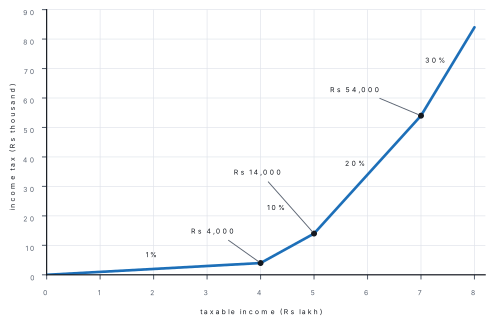
Income tax is charged by slabs: the first part of the taxable income is taxed at a low rate, the next part at a higher rate, and so on. Each rate applies only to the portion that lies inside its slab. The table below is an example of the kind a question gives. Always use the slabs stated in your question — they change with each year's Finance Act.
| Slab (taxable income) | Rate: unmarried | Rate: married (couple) |
|---|---|---|
| First Rs 4,00,000 (couple: Rs 4,50,000) | 1% | 1% |
| Next Rs 1,00,000 | 10% | 10% |
| Next Rs 2,00,000 | 20% | 20% |
| Next Rs 13,00,000 | 30% | 30% |
Problem. Mr. Thapa, an unmarried employee, earns Rs 45,000 every month and also receives one extra month's salary as Dashain allowance. He pays Rs 25,000 as life-insurance premium, which is allowed as a deduction. Using the slabs in the table above, find his income tax for the year.
Solution. Annual income =12\times 45000+45000=\text{Rs } 5{,}85{,}000.
Taxable income =585000-25000=\text{Rs } 5{,}60{,}000.
Slab by slab:
| Portion | Amount | Rate | Tax |
|---|---|---|---|
| First slab | Rs 4,00,000 | 1% | Rs 4,000 |
| Next slab | Rs 1,00,000 | 10% | Rs 10,000 |
| Remaining | Rs 60,000 | 20% | Rs 12,000 |
Total tax =4000+10000+12000=\text{Rs } 26{,}000.
Problem. A married couple has a combined taxable income of Rs 8,20,000. Using the "married" slabs (first Rs 4,50,000 at 1%, next Rs 1,00,000 at 10%, next Rs 2,00,000 at 20%, the rest at 30%), find the tax payable.
Solution.
- First Rs 4,50,000 at 1% =\text{Rs } 4{,}500.
- Next Rs 1,00,000 at 10% =\text{Rs } 10{,}000.
- Next Rs 2,00,000 at 20% =\text{Rs } 40{,}000.
- Remaining: 820000-(450000+100000+200000)=\text{Rs } 70{,}000 at 30% =\text{Rs } 21{,}000.
Total tax =4500+10000+40000+21000=\text{Rs } 75{,}500.
Problem. An unmarried person paid Rs 18,000 as income tax. Using the unmarried slabs, find his taxable income.
Solution. Tax on the first two slabs =4000+10000=\text{Rs } 14{,}000, for an income of Rs 5,00,000.
The tax is more than this, so the income enters the 20% slab. Remaining tax =18000-14000=\text{Rs } 4{,}000.
Income in the 20% slab =\dfrac{4000}{0.20}=\text{Rs } 20{,}000.
Taxable income =500000+20000=\text{Rs } 5{,}20{,}000.
Write the slabs in a column; subtract each full slab from the income, taking the remainder to the next slab; multiply each part by its rate; add. Stop when the remainder reaches zero. Never apply the highest rate to the whole income.
Foreign exchange
Each country has its own currency: Nepal the rupee (Rs or NPR), India the Indian rupee (INR), the USA the dollar (USD), the UK the pound (GBP), Qatar the riyal (QAR). Foreign exchange is the exchange of one currency for another. The exchange rate is the price of one unit of a foreign currency in the home currency.
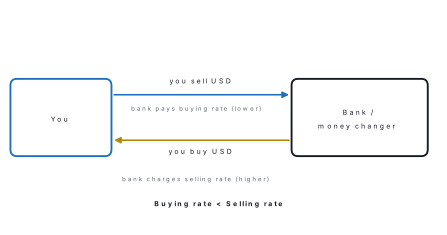
Banks and money changers buy foreign currency from you at a lower rate and sell it to you at a higher rate. The difference is their earning.
| Term | Meaning |
|---|---|
| Buying rate | Rate at which the bank buys foreign currency from you (you receive Nepali rupees) |
| Selling rate | Rate at which the bank sells foreign currency to you (you pay Nepali rupees) |
The selling rate is always higher than the buying rate.
- To change foreign currency into Nepali rupees: multiply by the rate.
- To change Nepali rupees into foreign currency: divide by the rate.
- To change one foreign currency into another: convert through Nepali rupees (A \to Rs \to B).
Use the buying rate when the bank is buying foreign currency from you; use the selling rate when you are buying foreign currency from the bank.
For India the rate is fixed: INR 1 = Rs 1.6, or Rs 100 = INR 62.50.
Problem. A bank's rates are: buying USD 1 = Rs 131.50; selling USD 1 = Rs 132.10. (a) Find how many rupees a tourist gets by selling USD 500. (b) How many dollars can be bought with Rs 66,050?
Solution. (a) The bank buys dollars, so the buying rate applies:
(b) The bank sells dollars, so the selling rate applies:
Problem. Using the rates above, Anita buys USD 2,000 and later sells all of them back. Find her loss.
Solution. She pays 2000\times 132.10=\text{Rs } 2{,}64{,}200.
She later receives 2000\times 131.50=\text{Rs } 2{,}63{,}000.
Loss =264200-263000=\text{Rs } 1{,}200.
(Check: Rs 0.60 difference per dollar \times\,2000=1200 ✓.)
Problem. USD 1 = Rs 132 and GBP 1 = Rs 165. How many pounds are equal to USD 1,000?
Solution. USD 1,000 =1000\times 132=\text{Rs } 1{,}32{,}000.
Pounds =\dfrac{132000}{165}=\text{GBP } 800.
Problem. A Nepali tourist takes Rs 48,000 to India and changes it into Indian currency (INR 1 = Rs 1.6). He spends INR 18,500 and changes the rest back into Nepali rupees. How many rupees does he get back?
Solution. INR received =\dfrac{48000}{1.6}=\text{INR } 30{,}000.
Left after spending =30000-18500=\text{INR } 11{,}500.
Rupees back =11500\times 1.6=\text{Rs } 18{,}400.
Problem. A laptop costs USD 800 in the USA and Rs 1,12,000 in Nepal. If USD 1 = Rs 133, in which country is it cheaper and by how much (in Nepali rupees)?
Solution. Price in the USA =800\times 133=\text{Rs } 1{,}06{,}400.
Price in Nepal =\text{Rs } 1{,}12{,}000.
Difference =112000-106400=\text{Rs } 5{,}600.
The laptop is cheaper in the USA by Rs 5,600.
Problem. A worker in Qatar sends QAR 1,500 each month. If QAR 1 = Rs 36.40, find the monthly amount and the yearly amount in Nepali rupees.
Solution. Monthly =1500\times 36.40=\text{Rs } 54{,}600.
Yearly =54600\times 12=\text{Rs } 6{,}55{,}200.
Commission. If a bank charges 1% commission on exchanging USD 600 at the buying rate Rs 131.50, the amount is 600\times 131.50=\text{Rs } 78{,}900. Commission =1\% of 78900=\text{Rs } 789, so he receives 78900-789=\text{Rs } 78{,}111.
- Using the selling rate when the bank is buying (or the reverse). Ask: who is buying the foreign currency? If the bank is, use the lower (buying) rate.
- Multiplying when you should divide. Rupees to dollars is divide; dollars to rupees is multiply.
- Forgetting the unit. Always write Rs, USD, INR or GBP.
2.2 Exercises of the SEE type
Checklist for tax problems
- Read the order of operations: marked price → discount → VAT, or factory price → excise → VAT.
- Excise duty is on the factory price; VAT is on the price including excise.
- For a backward problem, write final price = factory price \times 1.1\times 1.13 (or the given rates) and divide.
- For income tax, subtract deductions first, then fill the slabs in order.
Checklist for exchange problems
- Identify the rate and whether the bank is buying or selling.
- Foreign to Nepali: multiply. Nepali to foreign: divide.
- For two foreign currencies, go through Nepali rupees.
- For gain or loss, find the cost and the receipt, then subtract.
Chapter summary
- VAT =\frac{r}{100}\times price; bill = price \times(1+\frac{r}{100}); price = bill \div(1+\frac{r}{100}). Nepal's standard rate is 13%.
- Discount is allowed on the marked price first; VAT is charged on the selling price.
- Excise duty is charged on the factory price; VAT is then charged on factory price + excise.
- Final price with excise e\% and VAT v\%: factory \times(1+\frac{e}{100})(1+\frac{v}{100}).
- A seller pays VAT collected on sales minus VAT paid on purchases.
- Taxable income = total income - allowed deductions; tax is charged slab by slab at each slab's rate.
- Foreign to rupees: multiply by the rate; rupees to foreign: divide. The bank's buying rate is lower than its selling rate.
- INR 1 = Rs 1.6; convert one foreign currency to another through rupees.
Practice questions
Group A — Multiple choice (1 mark each)
- The bill for an article of price Rs 1,000 with 13% VAT is [1]aRs 1,013bRs 1,130cRs 1,300dRs 870
- A bill including 13% VAT is Rs 11,300. The price before VAT is [1]aRs 9,831bRs 10,000cRs 9,830dRs 10,300
- If USD 1 = Rs 132, then USD 50 equals [1]aRs 2,640bRs 6,600cRs 660dRs 13,200
- A tax charged by the government on goods produced in the country, on the factory price, is called [1]aincome taxbcustoms dutycexcise dutydproperty tax
- A bank's buying rate of foreign currency is [1]aequal to its selling rateblower than its selling ratechigher than its selling ratedalways Rs 100
Answers to Group A
1. (b) — 1000\times 1.13=1130.
2. (b) — 11300\div 1.13=10000.
3. (b) — 50\times 132=6600.
4. (c) — excise duty is charged on factory price.
5. (b) — banks buy low and sell high.
Group B — Short answer (2 marks each)
- Find the VAT at 13% on goods worth Rs 8,000. [2]
- The price of a radio including 13% VAT is Rs 6,780. Find its price without VAT. [2]
- Convert USD 250 into Nepali rupees if USD 1 = Rs 133. [2]
- Convert Rs 24,000 into Indian currency if INR 1 = Rs 1.6. [2]
Answers to Group B
1. VAT =\frac{13}{100}\times 8000=\text{Rs } 1{,}040.
2. Price =6780\div 1.13=\text{Rs } 6{,}000.
3. 250\times 133=\text{Rs } 33{,}250.
4. 24000\div 1.6=\text{INR } 15{,}000.
Group C — Short answer (3 marks each)
- The marked price of a watch is Rs 12,000. A discount of 15% is given and 13% VAT is charged. Find the amount to be paid. [3]
- A shopkeeper buys a fan for Rs 5,650 including 13% VAT and sells it at a price of Rs 6,000 without VAT. Find the VAT he pays to the government. [3]
- Using the unmarried slabs of this chapter (4,00,000 at 1%, next 1,00,000 at 10%, next 2,00,000 at 20%), find the income tax on a taxable income of Rs 6,00,000. [3]
- USD 1 = Rs 132.50. A man has Rs 53,000. How many dollars can he buy? [3]
Answers to Group C
1. Discount =15\% of 12000=1800, so selling price =10{,}200. VAT =13\% of 10200=1326. Amount =10200+1326=\text{Rs } 11{,}526.
2. Price without VAT of purchase =5650\div 1.13=5000, VAT paid =650. VAT collected on sale =13\% of 6000=780. VAT payable =780-650=\text{Rs } 130.
3. First Rs 4,00,000 at 1% =4000. Next Rs 1,00,000 at 10% =10000. Remaining Rs 1,00,000 at 20% =20000. Tax =4000+10000+20000=\text{Rs } 34{,}000.
4. 53000\div 132.50=\text{USD } 400.
Group D — Long answer (4 marks each)
- The factory price of a refrigerator is Rs 80,000. Excise duty of 10% is charged and then 13% VAT. Find the price a customer pays and the total tax. [4]
- A customer paid Rs 1,24,300 for a machine including 10% excise duty on the factory price and 13% VAT. Find the factory price, the excise duty and the VAT. [4]
- A married couple has a monthly salary of Rs 60,000 and pays Rs 20,000 yearly as insurance premium (allowed as deduction). Slabs: first Rs 4,50,000 at 1%, next Rs 1,00,000 at 10%, next Rs 2,00,000 at 20%. Find the yearly income tax. [4]
- A traveller changes Rs 3,30,000 into USD at the selling rate Rs 132 per USD. On returning, he has USD 400 left and sells them at the buying rate Rs 131 per USD. How much did the trip cost him (in Nepali rupees)? [4]
Answers to Group D
1. Excise =10\% of 80000=8000, price with excise =88{,}000. VAT =13\% of 88000=11440. Customer pays 88000+11440=\text{Rs } 99{,}440. Total tax =8000+11440=\text{Rs } 19{,}440.
2. Let factory price be x: 1.1x\times 1.13=1.243x=124300, so x=\text{Rs } 1{,}00{,}000. Excise =\text{Rs } 10{,}000, price with excise =1{,}10{,}000, VAT =13\% of 110000=\text{Rs } 14{,}300. Check: 110000+14300=124300 ✓.
3. Annual income =60000\times 12=7{,}20{,}000. Taxable =720000-20000=\text{Rs } 7{,}00{,}000. Tax: 4{,}50{,}000\times 1\%=4500; 1{,}00{,}000\times 10\%=10000; remaining 700000-550000=1{,}50{,}000 at 20\%=30000. Total =4500+10000+30000=\text{Rs } 44{,}500.
4. USD bought =330000\div 132=2500. He sells 400 USD for 400\times 131=\text{Rs } 52{,}400. Cost of trip =330000-52400=\text{Rs } 2{,}77{,}600.
Practise more: Mathematics question bank