Unit 9 · Compulsory Mathematics · 11 min read
Radical and Surd
What the syllabus asks for 2
- Radical and Surd: concepts, formulas and worked problems
- Exercises of the SEE type
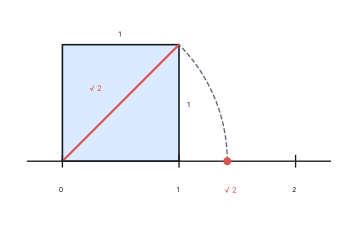
The diagonal of a square of side 1 cm is \sqrt{2} cm. No fraction and no terminating or repeating decimal equals \sqrt{2} exactly, so we leave it as a radical and calculate with it as a symbol. A surd is such an irrational root. This chapter shows how to classify roots, simplify them, add, subtract, multiply and divide them, and — the main skill for the exam — rationalise a denominator using a conjugate. These steps lead directly to the surds you meet later in trigonometry, coordinate geometry and quadratic equations.
Usual questions: (i) simplify an expression with surds (3 marks); (ii) rationalise the denominator of a fraction such as \frac{3}{\sqrt{7}-\sqrt{5}} and simplify; (iii) if x=2+\sqrt{3}, find x+\frac{1}{x}, x^2+\frac{1}{x^2} or x^3+\frac{1}{x^3} (4 marks); (iv) find a and b when \frac{3+\sqrt{2}}{3-\sqrt{2}}=a+b\sqrt{2}; (v) solve a simple equation containing a square root. Always check answers to radical equations in the original equation.
9.1 Radical and Surd: concepts, formulas and worked problems
Radicals and surds
An expression \sqrt[n]{a} is called a radical. Here n is the index (or order) of the radical, a is the radicand, and \sqrt{\;} is the radical sign. The radical \sqrt[n]{a} means the number whose n-th power is a, so \left(\sqrt[n]{a}\right)^n=a. When n=2 it is written \sqrt{a} (square root); \sqrt[3]{a} is the cube root.
A surd is a radical \sqrt[n]{a} where a is a positive rational number and the value of the root is irrational (it cannot be written as a fraction).
| Radical | Value | Surd? |
|---|---|---|
| \sqrt{16} | 4 | No — rational |
| \sqrt{18} | 3\sqrt{2} | Yes — irrational |
| \sqrt[3]{27} | 3 | No — rational |
| \sqrt[3]{5} | 1.7099\ldots | Yes |
| \sqrt{\frac{4}{9}} | \frac{2}{3} | No — rational |
| \sqrt{\pi} | irrational but radicand \pi is not rational | No — not a surd |
Every surd is a radical, but not every radical is a surd.
We assume that \sqrt{2} is rational and reach a contradiction. So \sqrt{2} cannot be rational.
Setting up. Suppose \sqrt{2}=\dfrac pq, where p and q are whole numbers with no common factor (the fraction is in its lowest terms).
Step 1 — square both sides.
Step 2 — p is even. p^2 equals 2q^2, which is even. A square is even only if the number itself is even, so p=2k for some whole number k.
Step 3 — substitute p=2k.
Step 4 — q is even too. By the same reasoning q is even.
Result. Both p and q are even, so they share the factor 2. This contradicts "no common factor". Hence \sqrt{2} is not rational.
What it means. \sqrt{2} is a non-terminating, non-repeating decimal 1.41421356\ldots. It can be located on the number line, but only by geometry (figure below), not as a fraction.
Laws of surds
Let a,b be positive rational numbers and m,n positive integers.
Note: \sqrt{a+b}\ne\sqrt{a}+\sqrt{b} and \sqrt{a-b}\ne\sqrt{a}-\sqrt{b}. For example \sqrt{9+16}=5, but \sqrt{9}+\sqrt{16}=7.
Types of surds
| Term | Meaning | Example |
|---|---|---|
| Pure (entire) surd | no rational factor outside the radical | \sqrt{18}, \sqrt[3]{24} |
| Mixed surd | a rational number times a surd | 3\sqrt{2}, 2\sqrt[3]{3} |
| Simple (monomial) surd | a single term | 5\sqrt{3} |
| Binomial surd | two terms, at least one a surd | 2+\sqrt{3}, \sqrt{5}-\sqrt{2} |
| Like (similar) surds | same radicand and same order | 2\sqrt{3} and 7\sqrt{3} |
| Unlike surds | different radicand or order | \sqrt{2} and \sqrt{3} |
Problem. Express as a mixed surd in simplest form: (a) \sqrt{72}, (b) \sqrt[3]{54}.
Solution. Take out the largest perfect square (or cube) factor.
(a) \sqrt{72}=\sqrt{36\times 2}=\sqrt{36}\times\sqrt{2}=6\sqrt{2}.
(b) \sqrt[3]{54}=\sqrt[3]{27\times 2}=\sqrt[3]{27}\times\sqrt[3]{2}=3\sqrt[3]{2}.
Problem. Express 3\sqrt{2} and 2\sqrt[3]{3} as entire (pure) surds.
Solution. Put the number inside the radical raised to the index.
3\sqrt{2}=\sqrt{3^2}\times\sqrt{2}=\sqrt{9\times 2}=\sqrt{18}.
2\sqrt[3]{3}=\sqrt[3]{2^3\times 3}=\sqrt[3]{24}.
Addition and subtraction
Only like surds can be added or subtracted: add or subtract the numbers in front, keep the surd. Unlike surds must first be simplified; if they are still unlike, leave the expression as it is.
Problem. Simplify (a) \sqrt{50}+\sqrt{18}-\sqrt{8}, (b) 3\sqrt{12}-\sqrt{27}.
Solution. (a) \sqrt{50}=5\sqrt{2}, \sqrt{18}=3\sqrt{2}, \sqrt{8}=2\sqrt{2}.
(b) 3\sqrt{12}=3\times 2\sqrt{3}=6\sqrt{3} and \sqrt{27}=3\sqrt{3}.
- \sqrt{2}+\sqrt{3}=\sqrt{5} is wrong. Unlike surds cannot be combined: \sqrt{2}+\sqrt{3}\approx 3.146 but \sqrt{5}\approx 2.236.
- \sqrt{a+b}=\sqrt{a}+\sqrt{b} is wrong. Square roots do not split over addition.
- Stopping at \sqrt{72} when the answer should be 6\sqrt{2}. Always simplify to the mixed form.
- Forgetting to simplify before adding: \sqrt{50} and \sqrt{18} look unlike but are both multiples of \sqrt{2}.
Multiplication and division
For like orders, multiply the numbers outside together and the numbers inside together.
Problem. Simplify (a) \sqrt{6}\times\sqrt{15}, (b) (2\sqrt{3}+\sqrt{5})(2\sqrt{3}-\sqrt{5}), (c) (\sqrt{5}+\sqrt{3})^2.
Solution. (a) \sqrt{6}\times\sqrt{15}=\sqrt{90}=\sqrt{9\times 10}=3\sqrt{10}.
(b) Use (a+b)(a-b)=a^2-b^2 with a=2\sqrt{3}, b=\sqrt{5}:
(c) Use (a+b)^2=a^2+2ab+b^2:
When a binomial surd is multiplied by its conjugate (the same two terms with the sign between them reversed), the surds disappear and the result is rational: (3+\sqrt{2})(3-\sqrt{2})=9-2=7.
Comparing surds of different order
To compare \sqrt[m]{a} and \sqrt[n]{b}, first write both with a common index (the LCM of m and n), then compare the radicands.
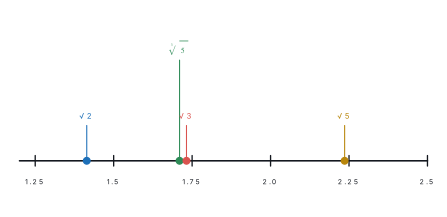
Problem. Which is greater, \sqrt{3} or \sqrt[3]{5}?
Solution. The orders are 2 and 3; their LCM is 6.
Since 27>25, \sqrt[6]{27}>\sqrt[6]{25}. Therefore \sqrt{3}>\sqrt[3]{5}.
(Check by decimals: \sqrt{3}=1.732 and \sqrt[3]{5}=1.710 ✓.)
Rationalisation
A denominator containing a surd is awkward to work with and to evaluate. Rationalising means multiplying the numerator and the denominator by a suitable surd so that the denominator becomes rational.
The conjugate of a+\sqrt{b} is a-\sqrt{b} (and the conjugate of \sqrt{a}+\sqrt{b} is \sqrt{a}-\sqrt{b}). The product of conjugates is always rational:
| Denominator | Multiply top and bottom by |
|---|---|
| \sqrt{a} | \sqrt{a} (since \sqrt{a}\times\sqrt{a}=a) |
| a+\sqrt{b} | its conjugate a-\sqrt{b} |
| \sqrt{a}+\sqrt{b} | its conjugate \sqrt{a}-\sqrt{b} |
| \sqrt{a}-\sqrt{b} | its conjugate \sqrt{a}+\sqrt{b} |
Multiplying numerator and denominator by the same non-zero number does not change the value of the fraction.
Problem. Rationalise the denominator: (a) \dfrac{1}{\sqrt{3}}, (b) \dfrac{6}{2\sqrt{3}}.
Solution. (a) \dfrac{1}{\sqrt{3}}\times\dfrac{\sqrt{3}}{\sqrt{3}}=\dfrac{\sqrt{3}}{3}.
(b) \dfrac{6}{2\sqrt{3}}=\dfrac{3}{\sqrt{3}}=\dfrac{3\sqrt{3}}{3}=\sqrt{3}.
Problem. Rationalise: (a) \dfrac{1}{\sqrt{5}-2}, (b) \dfrac{3}{\sqrt{7}-\sqrt{5}}, (c) \dfrac{5}{3+\sqrt{7}}.
Solution. (a) Multiply by the conjugate \sqrt{5}+2:
(b) Multiply by \sqrt{7}+\sqrt{5}:
(c) Multiply by 3-\sqrt{7}:
Problem. Simplify \dfrac{\sqrt{3}+1}{\sqrt{3}-1}.
Solution. Multiply top and bottom by \sqrt{3}+1:
Problem. Show that \dfrac{1}{2+\sqrt{3}}+\dfrac{1}{2-\sqrt{3}}=4.
Solution. \dfrac{1}{2+\sqrt{3}}=\dfrac{2-\sqrt{3}}{4-3}=2-\sqrt{3} and \dfrac{1}{2-\sqrt{3}}=\dfrac{2+\sqrt{3}}{4-3}=2+\sqrt{3}.
Sum =(2-\sqrt{3})+(2+\sqrt{3})=4. ✓
Problem. Given \sqrt{2}=1.414 and \sqrt{3}=1.732, find the value of \dfrac{1}{\sqrt{3}-\sqrt{2}} to 3 decimal places.
Solution. Rationalise first, because dividing by 0.318 would be awkward:
Values of expressions: x+\frac{1}{x} and its powers
If x=a+\sqrt{b} then \dfrac{1}{x} is its conjugate divided by a rational number, and often simply the conjugate. This makes the sum x+\frac{1}{x} a rational number, which can then be squared and cubed with the identities
Problem. If x=2+\sqrt{3}, find (a) \dfrac{1}{x}, (b) x+\dfrac{1}{x}, (c) x^2+\dfrac{1}{x^2}, (d) x^3+\dfrac{1}{x^3}.
Solution. (a) \dfrac{1}{x}=\dfrac{1}{2+\sqrt{3}}=\dfrac{2-\sqrt{3}}{4-3}=2-\sqrt{3}.
(b) x+\dfrac{1}{x}=(2+\sqrt{3})+(2-\sqrt{3})=4.
(c) x^2+\dfrac{1}{x^2}=\left(x+\dfrac{1}{x}\right)^2-2=4^2-2=14.
(d) x^3+\dfrac{1}{x^3}=\left(x+\dfrac{1}{x}\right)^3-3\left(x+\dfrac{1}{x}\right)=4^3-3\times 4=64-12=52.
Check of (c): x-\dfrac{1}{x}=2\sqrt{3}, so x^2+\dfrac{1}{x^2}=(2\sqrt{3})^2+2=12+2=14 ✓.
Problem. If \dfrac{3+\sqrt{2}}{3-\sqrt{2}}=a+b\sqrt{2} where a and b are rational, find a and b.
Solution. Multiply by the conjugate 3+\sqrt{2}:
Comparing rational and irrational parts: a=\dfrac{11}{7} and b=\dfrac{6}{7}.
Problem. Show that \dfrac{\sqrt{5}+2}{\sqrt{5}-2}-\dfrac{\sqrt{5}-2}{\sqrt{5}+2}=8\sqrt{5}.
Solution. Rationalise each fraction. The denominator in both is (\sqrt{5})^2-2^2=5-4=1.
Subtracting: (9+4\sqrt{5})-(9-4\sqrt{5})=8\sqrt{5}. ✓
Problem. Simplify \sqrt{3+2\sqrt{2}}.
Solution. Try to write 3+2\sqrt{2} as a perfect square (a+b)^2=a^2+b^2+2ab. We need a^2+b^2=3 and 2ab=2\sqrt{2}. Take a=1 and b=\sqrt{2}: then a^2+b^2=1+2=3 and 2ab=2\sqrt{2} ✓.
Problem. A rectangle has length (3+\sqrt{5}) cm and breadth (3-\sqrt{5}) cm. Find its area and perimeter.
Solution. Area =(3+\sqrt{5})(3-\sqrt{5})=9-5=4\text{ cm}^2.
Perimeter =2\left[(3+\sqrt{5})+(3-\sqrt{5})\right]=2\times 6=12 cm.
Both answers are rational, because the sides are conjugates.
Equations with square roots
To remove a square root, square both sides. This can introduce an extra (false) solution, so every answer must be checked in the original equation.
Problem. Solve (a) \sqrt{x+5}=7, (b) \sqrt{x+7}=x-5.
Solution. (a) Square both sides: x+5=49, so x=44. Check: \sqrt{44+5}=\sqrt{49}=7 ✓.
(b) Square both sides: x+7=(x-5)^2=x^2-10x+25.
Check x=9: LHS =\sqrt{16}=4, RHS =9-5=4 ✓.
Check x=2: LHS =\sqrt{9}=3, RHS =2-5=-3. These are not equal, so x=2 is rejected.
The solution is x=9.
A square root sign means the positive root. When you square an equation like \sqrt{x+7}=x-5, the false answer x=2 makes the right side negative. Substitute every answer back in; reject any that fail.
Surds in geometry
Surds appear whenever Pythagoras' theorem gives a non-perfect square.
Problem. (a) Find the diagonal of a square of side 5 cm. (b) Find the height of an equilateral triangle of side 6 cm.
Solution. (a) d=\sqrt{5^2+5^2}=\sqrt{50}=5\sqrt{2} cm \approx 7.07 cm.
(b) The height splits the base into 3 cm and 3 cm: h=\sqrt{6^2-3^2}=\sqrt{27}=3\sqrt{3} cm \approx 5.20 cm.
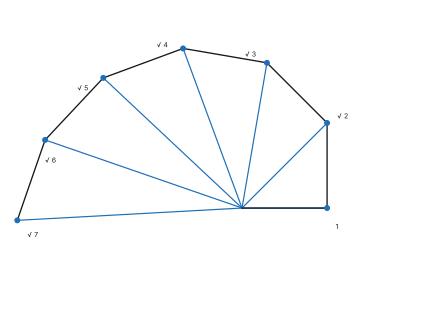
\sqrt{2}\approx 1.414, \sqrt{3}\approx 1.732, \sqrt{5}\approx 2.236, \sqrt{6}\approx 2.449, \sqrt{7}\approx 2.646. Rationalise before substituting a decimal value — it avoids dividing by a small number.
9.2 Exercises of the SEE type
Method
- Simplify each radical first: take out perfect-square factors.
- Add or subtract only like surds.
- Multiply conjugates with (a+b)(a-b)=a^2-b^2; expand squares with (a\pm b)^2.
- Rationalise by the conjugate of the denominator; simplify the numerator and cancel common factors.
- For x=a+\sqrt{b}: find \frac{1}{x}, then x+\frac{1}{x}, then use the identities for squares and cubes.
- For equations with a root: isolate the root, square, solve, and check.
Chapter summary
- A surd \sqrt[n]{a} (a rational) is irrational; \sqrt{16}, \sqrt[3]{27} are not surds; \sqrt{2}, \sqrt[3]{5} are.
- \sqrt{a}\times\sqrt{b}=\sqrt{ab}; \frac{\sqrt{a}}{\sqrt{b}}=\sqrt{\frac ab}; (\sqrt{a})^2=a; but \sqrt{a+b}\ne\sqrt{a}+\sqrt{b}.
- Add and subtract only like surds after simplifying: 5\sqrt{2}+3\sqrt{2}=8\sqrt{2}.
- Conjugate of a+\sqrt{b} is a-\sqrt{b}; product =a^2-b (rational).
- Rationalise \frac{1}{\sqrt{a}} by \sqrt{a}; rationalise \frac{1}{\sqrt{a}\pm\sqrt{b}} by \sqrt{a}\mp\sqrt{b}, giving denominator a-b.
- If x=2+\sqrt{3} then \frac{1}{x}=2-\sqrt{3}, x+\frac{1}{x}=4, x^2+\frac{1}{x^2}=14, x^3+\frac{1}{x^3}=52.
- x^2+\frac{1}{x^2}=(x+\frac{1}{x})^2-2 and x^3+\frac{1}{x^3}=(x+\frac{1}{x})^3-3(x+\frac{1}{x}).
- Compare surds of different order by writing both with the LCM of the indices.
- Radical equations: square both sides and check each answer.
Practice questions
Group A — Multiple choice (1 mark each)
- Which of the following is a surd? [1]a\sqrt{16}b\sqrt{18}c\sqrt[3]{8}d\sqrt{\frac{9}{4}}
- The rationalising factor of \sqrt{5} is [1]a\sqrt{5}b5c\sqrt{5}-1d\frac{1}{5}
- The conjugate of 3+\sqrt{2} is [1]a-3-\sqrt{2}b3-\sqrt{2}c\sqrt{2}-3d3+\sqrt{2}
- The simplest form of \sqrt{50} is [1]a25\sqrt{2}b10\sqrt{5}c5\sqrt{2}d2\sqrt{5}
- The value of (\sqrt{3}+\sqrt{2})(\sqrt{3}-\sqrt{2}) is [1]a5b1c\sqrt{6}d1+2\sqrt{6}
Answers to Group A
1. (b) — \sqrt{18}=3\sqrt{2} is irrational; the others equal 4, 2, \frac{3}{2}.
2. (a) — \sqrt{5}\times\sqrt{5}=5.
3. (b) — change the sign between the terms.
4. (c) — \sqrt{25\times 2}=5\sqrt{2}.
5. (b) — 3-2=1.
Group B — Short answer (2 marks each)
- Simplify \sqrt{72}. [2]
- Simplify \sqrt{12}+\sqrt{27}. [2]
- Rationalise the denominator of \dfrac{6}{\sqrt{3}}. [2]
- Express 3\sqrt{2} as an entire surd. [2]
Answers to Group B
1. \sqrt{36\times 2}=6\sqrt{2}.
2. 2\sqrt{3}+3\sqrt{3}=5\sqrt{3}.
3. \frac{6}{\sqrt{3}}\times\frac{\sqrt{3}}{\sqrt{3}}=\frac{6\sqrt{3}}{3}=2\sqrt{3}.
4. 3\sqrt{2}=\sqrt{9\times 2}=\sqrt{18}.
Group C — Short answer (3 marks each)
- Rationalise the denominator of \dfrac{3}{\sqrt{7}-\sqrt{5}}. [3]
- Simplify (\sqrt{5}+\sqrt{3})^2 and (\sqrt{5}+\sqrt{3})(\sqrt{5}-\sqrt{3}). [3]
- If x=2+\sqrt{3}, find x+\dfrac{1}{x}. [3]
- Simplify \sqrt{50}+\sqrt{18}-\sqrt{8}. [3]
Answers to Group C
1. \frac{3(\sqrt{7}+\sqrt{5})}{7-5}=\frac{3(\sqrt{7}+\sqrt{5})}{2}.
2. (\sqrt{5}+\sqrt{3})^2=5+2\sqrt{15}+3=8+2\sqrt{15}. (\sqrt{5}+\sqrt{3})(\sqrt{5}-\sqrt{3})=5-3=2.
3. \frac{1}{x}=\frac{1}{2+\sqrt{3}}=\frac{2-\sqrt{3}}{4-3}=2-\sqrt{3}. x+\frac{1}{x}=(2+\sqrt{3})+(2-\sqrt{3})=4.
4. 5\sqrt{2}+3\sqrt{2}-2\sqrt{2}=6\sqrt{2}.
Group D — Long answer (4 marks each)
- If x=3+2\sqrt{2}, find x+\dfrac{1}{x}, x^2+\dfrac{1}{x^2} and x^3+\dfrac{1}{x^3}. [4]
- Simplify \dfrac{\sqrt{3}+1}{\sqrt{3}-1}+\dfrac{\sqrt{3}-1}{\sqrt{3}+1}. [4]
- If \dfrac{3+\sqrt{2}}{3-\sqrt{2}}=a+b\sqrt{2}, find the rational numbers a and b. [4]
- Solve \sqrt{x+7}=x-5. [4]
Answers to Group D
1. \frac{1}{x}=\frac{1}{3+2\sqrt{2}}=\frac{3-2\sqrt{2}}{9-8}=3-2\sqrt{2}. x+\frac{1}{x}=6. x^2+\frac{1}{x^2}=6^2-2=34. x^3+\frac{1}{x^3}=6^3-3\times 6=216-18=198.
2. \frac{(\sqrt{3}+1)^2+(\sqrt{3}-1)^2}{(\sqrt{3})^2-1}=\frac{(4+2\sqrt{3})+(4-2\sqrt{3})}{2}=\frac{8}{2}=4.
3. \frac{(3+\sqrt{2})^2}{9-2}=\frac{11+6\sqrt{2}}{7}, so a=\frac{11}{7} and b=\frac{6}{7}.
4. Square both sides: x+7=x^2-10x+25, so x^2-11x+18=0 and x=2 or 9. Check x=9: \sqrt{16}=4=9-5 ✓. Check x=2: \sqrt{9}=3\ne 2-5=-3 ✗. So x=9.
Practise more: Mathematics question bank