Unit 15 · Compulsory Mathematics · 16 min read
Circle
What the syllabus asks for 2
- Circle: concepts, formulas and worked problems
- Exercises of the SEE type
Wheels, coins, clocks, pizza and the Moon all show the circle, the most symmetrical of shapes. In earlier classes you measured circles (circumference and area) and met the language: centre, radius, diameter, chord, arc, segment and sector. In this chapter we study the geometry of the circle: how angles at the centre and at the circumference are related, why the angle in a semicircle is a right angle, why the opposite angles of a cyclic quadrilateral add to 180^\circ, and how tangents behave. Each result is a theorem that you must be able to prove with a figure, and then use to find unknown angles and lengths.
Expect: (i) prove a theorem: the angle at the centre is twice the angle at the circumference; angles in the same segment are equal; the angle in a semicircle is 90^\circ; the opposite angles of a cyclic quadrilateral are supplementary (4 marks, figure required); (ii) find unknown angles, often with algebra such as (2x+10)^\circ; (iii) problems with tangents: tangent \perp radius, two tangents from a point are equal, with Pythagoras; (iv) chord problems with a perpendicular from the centre. Always write Given, To prove, Construction, Proof and a reason beside every step.
15.1 Circle: concepts, formulas and worked problems
Vocabulary and chords
| Term | Meaning |
|---|---|
| Chord | a line segment joining two points of the circle |
| Diameter | a chord through the centre (the longest chord, 2r) |
| Arc | a part of the circumference; the minor arc is the shorter, the major the longer |
| Segment | the region between a chord and an arc |
| Angle at the centre | angle made at O by two radii, e.g. \angle AOB |
| Angle at the circumference | angle made at a point of the circle by two chords, e.g. \angle ACB |
| Cyclic quadrilateral | a quadrilateral whose four vertices lie on a circle |
| Tangent | a line that touches the circle at exactly one point |
- The perpendicular from the centre to a chord bisects the chord; the line from the centre to the midpoint of a chord is perpendicular to it.
- Equal chords are equally distant from the centre.
- For a chord of length 2c at distance d from the centre of a circle of radius r: \;r^2=c^2+d^2.
Problem. A chord of length 24 cm lies in a circle of radius 13 cm. Find its distance from the centre.
Solution. The perpendicular from the centre bisects the chord: half-chord =12 cm. The radius to an end of the chord, the half-chord and the perpendicular form a right triangle, so d^2=13^2-12^2=169-144=25 and d=5 cm.
Problem. A chord of length 16 cm is 6 cm from the centre. Find the radius.
Solution. Half-chord =8 cm. r^2=8^2+6^2=100, so r=10 cm.
Angle at the centre and at the circumference

Given. A circle with centre O; A and B are points on it; C is a point on the major arc AB.
To prove. \angle AOB=2\angle ACB.
Construction. Join CO and produce it to meet the circle at D.
Proof.
Step 1. In \Delta OAC, OA=OC (radii), so \angle OAC=\angle OCA. Let \angle OCA=\alpha, so \angle OAC=\alpha.
Step 2 — exterior angle. The exterior angle of \Delta OAC at O is \angle AOD, which equals the sum of the two opposite interior angles:
Step 3. In the same way in \Delta OBC with \angle OCB=\beta: \angle BOD=2\beta.
Step 4 — add.
Result. \angle AOB=2\angle ACB. Proved.
What it means. The angle at the centre is double any angle at the circumference on the same arc. A central angle of 100^\circ means an angle of 50^\circ at any point of the major arc.
Problem. O is the centre of a circle and \angle AOB=100^\circ. Find \angle ACB where C is on the major arc. Also find \angle ADB where D is on the minor arc.
Solution. \angle ACB=\frac{1}{2}\times100^\circ=50^\circ. Points C and D are on opposite arcs, so ACBD is a cyclic quadrilateral and \angle ADB=180^\circ-50^\circ=130^\circ.
Problem. OA and OB are radii and \angle OAB=25^\circ. Find \angle AOB and the angle at the circumference \angle ACB (C on the major arc).
Solution. OA=OB, so \angle OBA=25^\circ and \angle AOB=180^\circ-2\times25^\circ=130^\circ. Then \angle ACB=\frac{1}{2}\times130^\circ=65^\circ.
Angles in the same segment; angle in a semicircle
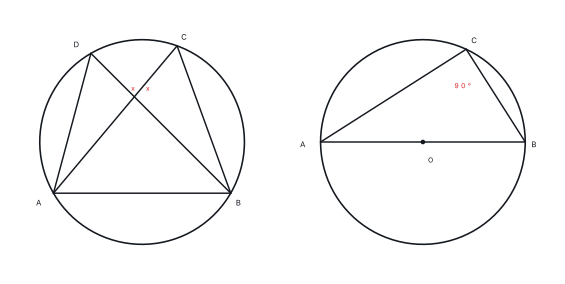
Given. C and D are points on the same arc of a circle standing on chord AB (in the same segment).
To prove. \angle ACB=\angle ADB.
Construction. Join OA and OB (O the centre).
Proof. The angle at the centre standing on arc AB is \angle AOB. By the previous theorem
Result. Both equal half of \angle AOB, so \angle ACB=\angle ADB. Proved.
Given. AB is a diameter of a circle with centre O; C is any point on the circle.
To prove. \angle ACB=90^\circ.
Proof.
Step 1. AB is a straight line through O, so the angle at the centre on arc AB is the straight angle \angle AOB=180^\circ.
Step 2. The angle at the circumference is half of it: \angle ACB=\frac{1}{2}\times180^\circ=90^\circ.
Result. \angle ACB=90^\circ. Proved.
What it means. Every triangle that has a diameter for one side and its third vertex on the circle is right-angled at that vertex. This is also why the converse is used to find the centre: the hypotenuse of a right triangle is a diameter of its circumcircle.
Problem. Chord AB subtends \angle ACB=35^\circ at point C of the major arc, and D is another point on the same arc. Find \angle ADB and \angle AOB.
Solution. \angle ADB=\angle ACB=35^\circ (same segment), and \angle AOB=2\times35^\circ=70^\circ.
Problem. AB is a diameter and C is a point on the circle with \angle CAB=35^\circ. Find \angle ABC.
Solution. \angle ACB=90^\circ (angle in a semicircle). In \Delta ABC: \angle ABC=180^\circ-90^\circ-35^\circ=55^\circ.
Problem. A right-angled triangle has sides 6 cm, 8 cm and 10 cm. Find the radius of the circle through its three vertices.
Solution. The right angle is at the circumference, so the hypotenuse is a diameter: 2r=10 and r=5 cm.
Cyclic quadrilaterals
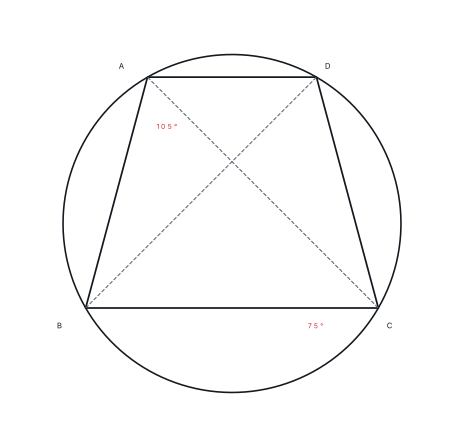
Given. ABCD is a cyclic quadrilateral in a circle with centre O.
To prove. \angle A+\angle C=180^\circ and \angle B+\angle D=180^\circ.
Construction. Join OB and OD.
Proof.
Step 1 — two central angles. The arc BCD and the arc DAB together make the whole circle, so the angles at the centre on them add up to a full turn:
Step 2 — halve each. The angle at the circumference is half the angle at the centre on the same arc: \angle A=\frac{1}{2}\angle BOD (arc BCD) and \angle C=\frac{1}{2}\,\text{reflex}\angle BOD (arc DAB).
Step 3 — add.
Result. \angle A+\angle C=180^\circ. Similarly \angle B+\angle D=180^\circ. Proved.
Corollary. Extend BC to E. Then \angle DCE=180^\circ-\angle BCD=\angle A: the exterior angle of a cyclic quadrilateral equals the interior opposite angle.
Problem. In a cyclic quadrilateral ABCD, \angle A=105^\circ and \angle B=75^\circ. Find \angle C and \angle D.
Solution. \angle C=180^\circ-105^\circ=75^\circ and \angle D=180^\circ-75^\circ=105^\circ.
Problem. The opposite angles of a cyclic quadrilateral are (2x+10)^\circ and (3x-5)^\circ. Find x and the two angles.
Solution. They are supplementary: (2x+10)+(3x-5)=180, so 5x+5=180 and x=35. The angles are 2(35)+10=80^\circ and 3(35)-5=100^\circ. Check: 80+100=180 ✓.
Problem. ABCD is cyclic and the side BC is produced to E. If \angle DCE=78^\circ, find \angle A. If also \angle B=64^\circ, find \angle D.
Solution. The exterior angle equals the interior opposite angle: \angle A=\angle DCE=78^\circ. Opposite angles add to 180^\circ: \angle D=180^\circ-64^\circ=116^\circ.
Problem. In quadrilateral PQRS, \angle P=98^\circ and \angle R=82^\circ. Can a circle pass through all four vertices?
Solution. 98^\circ+82^\circ=180^\circ: opposite angles are supplementary, so PQRS is cyclic (converse of the theorem). Yes.
Tangents
A tangent touches the circle at one point, the point of contact. Two facts are used constantly.
- The tangent at a point is perpendicular to the radius through the point of contact.
- The two tangents drawn to a circle from an external point are equal in length, and the line from the point to the centre bisects the angle between them.
- Alternate segment theorem: the angle between a tangent and a chord at the point of contact equals the angle in the alternate segment.
- Tangent–secant: PT^2=PA\times PB, where PT is a tangent and PAB a secant through P.
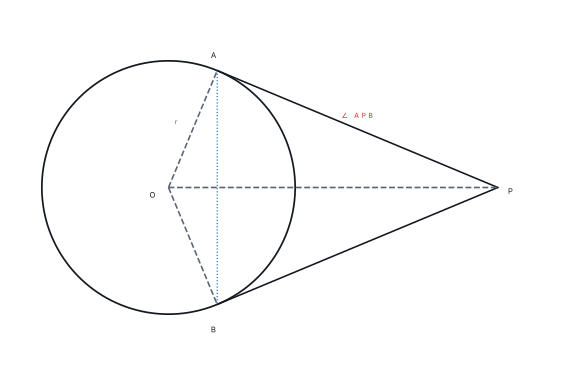
Given. PA and PB are tangents from P to a circle with centre O, touching at A and B.
To prove. PA=PB and \angle APO=\angle BPO.
Construction. Join OA, OB and OP.
Proof. In \Delta OAP and \Delta OBP:
- \angle OAP=\angle OBP=90^\circ (tangent \perp radius),
- OA=OB (radii of the same circle),
- OP is common (hypotenuse).
So \Delta OAP\cong\Delta OBP by RHS. Therefore PA=PB and \angle APO=\angle BPO. Proved.
Problem. P is 13 cm from the centre of a circle of radius 5 cm. Find the length of the tangent from P.
Solution. OA\perp PA, so in right-angled \Delta OAP: PA^2=OP^2-OA^2=169-25=144, hence PA=12 cm.
Problem. Tangents PA and PB meet at P with \angle APB=50^\circ. Find \angle PAB and \angle AOB.
Solution. PA=PB, so \Delta PAB is isosceles: \angle PAB=\frac{180^\circ-50^\circ}{2}=65^\circ. In the quadrilateral OAPB: \angle OAP=\angle OBP=90^\circ, so \angle AOB=360^\circ-90^\circ-90^\circ-50^\circ=130^\circ (equivalently 180^\circ-50^\circ).
Problem. From a point P, 10 cm from the centre of a circle of radius 6 cm, two tangents PA and PB are drawn. Find the length PA and the area of the quadrilateral OAPB.
Solution. PA=\sqrt{10^2-6^2}=8 cm. The quadrilateral is two right triangles, each of area \frac{1}{2}\times6\times8=24, so the area is 48\text{ cm}^2.
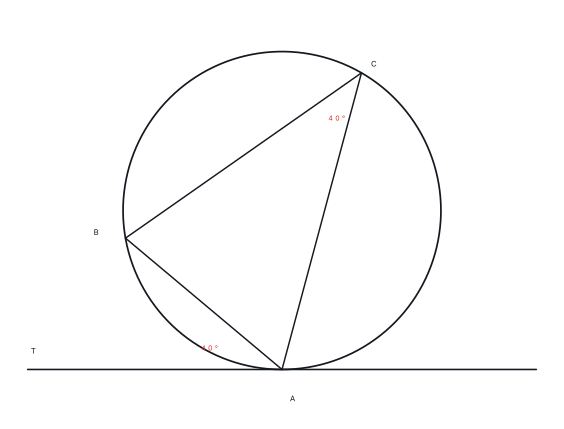
Problem. TA is a tangent at A and AB is a chord with \angle TAB=40^\circ. Find the angle \angle ACB at a point C of the alternate segment and the central angle \angle AOB.
Solution. \angle ACB=\angle TAB=40^\circ (alternate segment theorem). Then \angle AOB=2\times40^\circ=80^\circ. Since OA=OB, \angle OAB=\frac{180-80}{2}=50^\circ, and \angle TAB+\angle OAB=40+50=90^\circ=\angle TAO, which agrees with tangent \perp radius. ✓
Problem. From P a tangent PT=6 cm and a secant PAB are drawn, with PA=4 cm. Find PB and the chord AB.
Solution. PT^2=PA\times PB, so 36=4\times PB and PB=9 cm. Then AB=PB-PA=9-4=5 cm.
- Calling an angle "at the centre" when its vertex is on the circle (or the opposite).
- Using the theorem on the wrong arc: the angle at the circumference is half the central angle on the same arc.
- Writing a statement without a reason; each line of a proof needs "because …".
- Forgetting that the tangent is perpendicular to the radius, not the chord.
- Taking PA^2=OP^2+OA^2 — it is a difference, since OP is the hypotenuse.
15.2 Exercises of the SEE type
Method for any question
- Draw a large clear figure; mark the centre O and every given angle.
- List the facts available: radii equal; angle at centre =2\times angle at circumference; same segment; semicircle 90^\circ; cyclic quadrilateral supplementary; tangent \perp radius.
- Work step by step, writing the reason beside each angle ("angle in a semicircle", "isosceles triangle").
- For a proof, state Given, To prove, Construction, Proof and finish with "Proved".
- For algebraic angles, form an equation, solve it, and check that all angles are positive.
Problem. AB is a diameter of a circle and C is a point on the circle. D is a point on the arc so that ABCD is cyclic and \angle ABC=50^\circ. Find \angle BAC and \angle ADC.
Solution. \angle ACB=90^\circ (semicircle), so \angle BAC=180^\circ-90^\circ-50^\circ=40^\circ. In the cyclic quadrilateral ABCD, opposite angles B and D add to 180^\circ: \angle ADC=180^\circ-50^\circ=130^\circ.
Problem. Prove that the tangents drawn to a circle from an external point are equal in length.
Solution. Draw the figure with O,A,B,P; join OA, OB, OP. In \Delta OAP and \Delta OBP, \angle OAP=\angle OBP=90^\circ (tangent \perp radius), OA=OB (radii), and OP is common. So the triangles are congruent (RHS) and PA=PB. Proved.
Problem. Tangents PA and PB are drawn from P to a circle with centre O and radius 8 cm. If \angle AOB=120^\circ, find \angle APB and the length OP.
Solution. In quadrilateral OAPB two angles are 90^\circ, so \angle APB=180^\circ-120^\circ=60^\circ. OP bisects \angle AOB so \angle AOP=60^\circ and in right-angled \Delta OAP, \cos60^\circ=\frac{OA}{OP}. Hence OP=\frac{8}{0.5}=16 cm.
Chapter summary
- Angle at the centre =2\times angle at the circumference on the same arc.
- Angles in the same segment are equal.
- Angle in a semicircle =90^\circ; the hypotenuse of a right triangle is a diameter of its circumcircle.
- Cyclic quadrilateral: opposite angles add to 180^\circ; exterior angle = interior opposite angle.
- Tangent \perp radius; tangent length =\sqrt{OP^2-r^2}; two tangents from a point are equal.
- Alternate segment theorem; tangent–secant PT^2=PA\times PB.
- Chord of length 2c at distance d: r^2=c^2+d^2.
- A good proof: Given, To prove, Construction, Proof, with a reason for each step.
Practice questions
Group A — Multiple choice (1 mark each)
- The angle at the centre of a circle is 80^\circ. The angle at the circumference on the same arc is [1]a160^\circb80^\circc40^\circd20^\circ
- The angle in a semicircle is [1]a45^\circb60^\circc90^\circd180^\circ
- In a cyclic quadrilateral ABCD, \angle A=70^\circ. Then \angle C is [1]a70^\circb110^\circc20^\circd140^\circ
- A tangent is perpendicular to the [1]achordbradius at the point of contactcdiameter parallel to itdsecant
- The length of the tangent from a point 5 cm from the centre of a circle of radius 3 cm is [1]a2 cmb4 cmc8 cmd34 cm
Answers to Group A
1. (c) — half of 80^\circ.
2. (c).
3. (b) — 180-70.
4. (b).
5. (b) — \sqrt{25-9}=4.
Group B — Short answer (2 marks each)
- \angle AOB=130^\circ at the centre. Find \angle ACB at the circumference (major arc). [2]
- The opposite angles of a cyclic quadrilateral are (x+30)^\circ and (2x+15)^\circ. Find x. [2]
- A chord 10 cm long is 12 cm from the centre of a circle. Find the radius. [2]
- PT is a tangent of length 12 cm from P, and OP=13 cm. Find the radius. [2]
Answers to Group B
1. 65^\circ.
2. (x+30)+(2x+15)=180, 3x=135, x=45.
3. Half-chord 5; r=\sqrt{25+144}=13 cm.
4. r=\sqrt{13^2-12^2}=5 cm.
Group C — Short answer (3 marks each)
- Prove that the angle in a semicircle is a right angle. [3]
- In a circle with centre O, \angle OAB=25^\circ, where AB is a chord. Find \angle AOB and the angle at the major arc. [3]
- PA and PB are tangents from P and \angle APB=50^\circ. Find \angle PAB and \angle AOB. [3]
- A tangent PT=6 cm and a secant PAB with PA=4 cm are drawn. Find AB. [3]
Answers to Group C
1. The angle at the centre on a diameter is 180^\circ; the angle at the circumference is half: 90^\circ.
2. \angle AOB=180-50=130^\circ; angle at circumference 65^\circ.
3. \angle PAB=65^\circ, \angle AOB=130^\circ.
4. PB=\frac{36}{4}=9, AB=9-4=5 cm.
Group D — Long answer (4 marks each)
- Prove that the angle at the centre of a circle is twice the angle at the circumference on the same arc. [4]
- Prove that the opposite angles of a cyclic quadrilateral are supplementary. [4]
- Prove that the two tangents from an external point to a circle are equal. [4]
- P is 10 cm from the centre of a circle of radius 6 cm. Tangents PA and PB are drawn. Find PA, the area of quadrilateral OAPB, and \angle APB (to the nearest degree). [4]
Answers to Group D
1. See the derivation (join CO produced to D; exterior angles of the isosceles triangles OAC and OBC).
2. See the derivation (the two angles at the centre make 360^\circ).
3. See the derivation (RHS congruence of \Delta OAP and \Delta OBP).
4. PA=\sqrt{100-36}=8 cm; area =2\times\frac{1}{2}\times6\times8=48\text{ cm}^2; \sin(\frac{1}{2}\angle APB)=\frac{6}{10}=0.6, so \frac{1}{2}\angle APB\approx36.87^\circ and \angle APB\approx74^\circ.
Practise more: Mathematics question bank