Unit 18 · Compulsory Mathematics · 13 min read
Probability
What the syllabus asks for 2
- Probability: concepts, formulas and worked problems
- Exercises of the SEE type
Will it rain tomorrow? Will the coin land heads? Will a ticket win the lottery? Probability is the branch of mathematics that measures how likely an event is, using a number from 0 (impossible) to 1 (certain). Insurance companies, weather forecasters, doctors and game designers all rely on it. In this chapter we build the idea from simple experiments with coins, dice, cards and bags of coloured balls; list sample spaces (using tables and tree diagrams); use the addition rule for "or" and the multiplication rule for "and"; and learn the difference between mutually exclusive and independent events, and between drawing with and without replacement.
Expect: (i) write the sample space and find a probability for coins, dice or cards (2–3 marks); (ii) a probability with the complement ("at least one", "not"); (iii) balls drawn from a bag with or without replacement, with a tree diagram (4 marks); (iv) a Venn-diagram or "like football / like cricket" problem using P(A\cup B)=P(A)+P(B)-P(A\cap B); (v) an algebra question ("find x if P(\text{blue})=\frac{3}{5}"). Always write the favourable outcomes, the total outcomes, and a fraction in lowest terms.
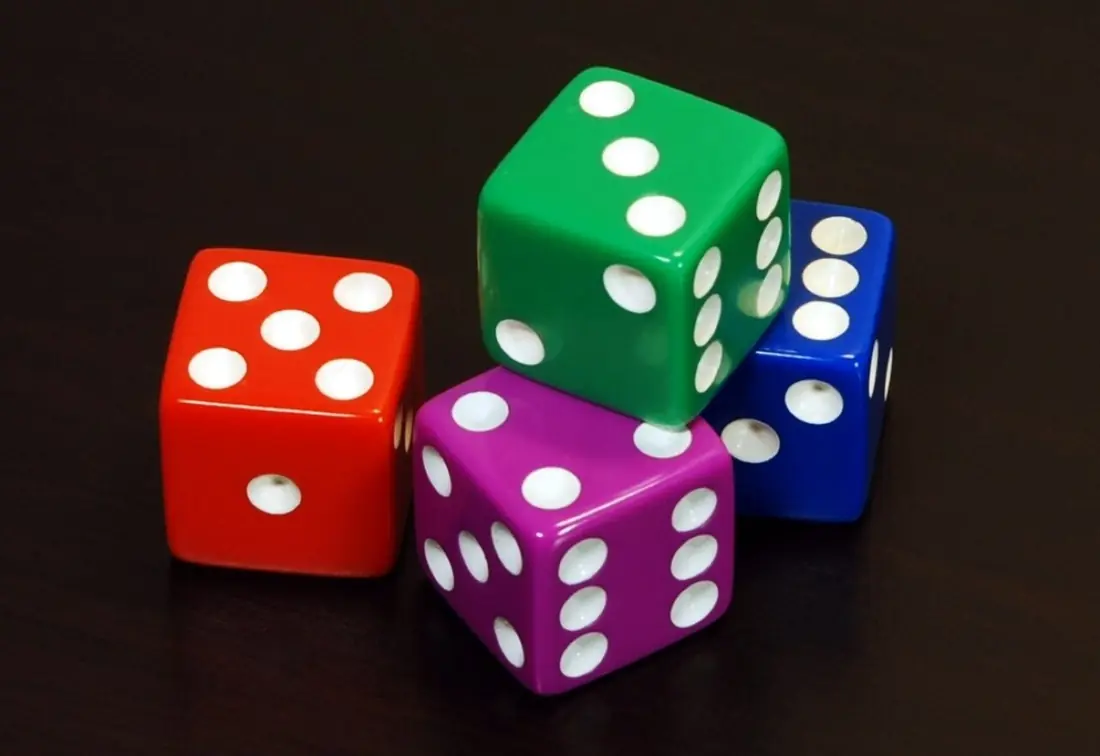
18.1 Probability: concepts, formulas and worked problems
Key terms
| Term | Meaning | Example |
|---|---|---|
| Experiment (trial) | an action whose result is uncertain | tossing a coin, rolling a die |
| Outcome | one possible result of a trial | Head; 5 |
| Sample space S | the set of all possible outcomes | die: S=\{1,2,3,4,5,6\}; n(S)=6 |
| Event E | a subset of the sample space we are interested in | "even number" =\{2,4,6\} |
| Equally likely | each outcome has the same chance | a fair coin or fair die |
| Complement E' (not E) | the outcomes that are not in E | not even =\{1,3,5\} |
The probability of an event
For equally likely outcomes,
- 0\leq P(E)\leq1; P(E)=0 for an impossible event, P(E)=1 for a certain event.
- P(E)+P(E')=1, so P(E')=1-P(E).
- The sum of the probabilities of all the outcomes in the sample space is 1.
- Expected number of times E occurs in N trials =N\times P(E).
Problem. A fair die is rolled once. Find the probability of (a) an even number, (b) a prime number, (c) a number greater than 4, (d) a number that is not a multiple of 3.
Solution. S=\{1,2,3,4,5,6\}, n(S)=6.
(a) \{2,4,6\}: P=\frac{3}{6}=\frac{1}{2}. (b) Primes \{2,3,5\} (1 is not prime): P=\frac{3}{6}=\frac{1}{2}. (c) \{5,6\}: P=\frac{2}{6}=\frac{1}{3}. (d) Multiples of 3 are \{3,6\}, so "not a multiple of 3" has \{1,2,4,5\}: P=\frac{4}{6}=\frac{2}{3}, or 1-\frac{2}{6}=\frac{2}{3}.
Problem. Two fair coins are tossed. Write the sample space and find the probability of (a) two heads, (b) at least one head, (c) exactly one head.
Solution. S=\{HH,HT,TH,TT\}, so n(S)=4.
(a) P(HH)=\frac{1}{4}. (b) At least one head: \{HH,HT,TH\}, P=\frac{3}{4} (or 1-P(TT)=1-\frac{1}{4}). (c) \{HT,TH\}: P=\frac{2}{4}=\frac{1}{2}.
Problem. Three coins are tossed. Find P(\text{exactly two heads}).
Solution. There are 2\times2\times2=8 outcomes: HHH, HHT, HTH, HTT, THH, THT, TTH, TTT. Two heads: HHT, HTH, THH. P=\frac{3}{8}.
Two dice: the sample-space table
When two dice are rolled there are 6\times6=36 equally likely outcomes. A grid shows them all at once.
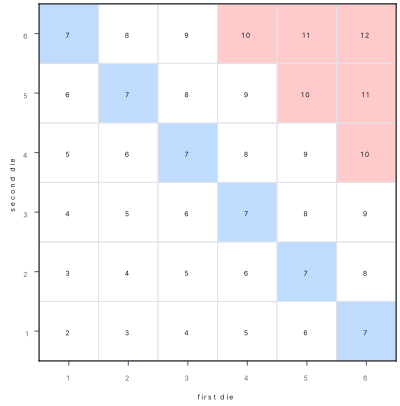
Problem. Two fair dice are rolled. Find the probability that (a) the sum is 7, (b) the sum is at least 10, (c) both dice show the same number, (d) the sum is 8.
Solution. n(S)=36.
(a) Pairs with sum 7: (1,6),(2,5),(3,4),(4,3),(5,2),(6,1): 6 outcomes, P=\frac{6}{36}=\frac{1}{6}. (b) Sum 10: (4,6),(5,5),(6,4); sum 11: (5,6),(6,5); sum 12: (6,6). Total 6, P=\frac{1}{6}. (c) Doubles: (1,1),\dots,(6,6): 6 outcomes, P=\frac{1}{6}. (d) (2,6),(3,5),(4,4),(5,3),(6,2): 5 outcomes, P=\frac{5}{36}.
Playing cards
A standard pack has 52 cards: 4 suits (spades ♠, clubs ♣ black; hearts ♥, diamonds ♦ red) of 13 cards each (A, 2–10, J, Q, K). The face cards are J, Q, K: 12 in all. There are 4 kings, 4 aces, 26 red cards and 26 black cards.
Problem. One card is drawn from a well-shuffled pack of 52. Find the probability of (a) a king, (b) a heart, (c) a red king, (d) a face card, (e) neither a king nor a queen.
Solution. n(S)=52.
(a) \frac{4}{52}=\frac{1}{13}. (b) \frac{13}{52}=\frac{1}{4}. (c) \frac{2}{52}=\frac{1}{26}. (d) \frac{12}{52}=\frac{3}{13}. (e) Kings and queens number 8, so P=\frac{52-8}{52}=\frac{44}{52}=\frac{11}{13}.
Complementary events and "at least one"
Problem. A bag has 5 red, 3 blue and 2 green balls. One ball is drawn. Find P(\text{red}), P(\text{not red}) and P(\text{blue or green}).
Solution. n(S)=10. P(\text{red})=\frac{5}{10}=\frac{1}{2}. P(\text{not red})=1-\frac{1}{2}=\frac{1}{2}. "Blue or green" is the same as "not red": \frac{3+2}{10}=\frac{1}{2}.
Problem. A bag has 4 red balls and x blue balls. If P(\text{blue})=\frac{3}{5}, find x.
Solution. Total balls =4+x.
Check. \frac{6}{10}=\frac{3}{5} ✓.
Problem. The probability that it rains on a day in July is 0.3. On about how many of the 31 days of July would you expect rain? A fair coin is tossed 200 times: how many heads are expected?
Solution. Expected rainy days =31\times0.3=9.3\approx9 days. Expected heads =200\times\frac{1}{2}=100.
Addition rule for "or"
Two events are mutually exclusive if they cannot happen together (e.g. rolling a 2 and rolling a 5 on one die).
For any two events A and B:
For mutually exclusive events P(A\cap B)=0, so P(A\cup B)=P(A)+P(B).
A\cup B means "A or B (or both)"; A\cap B means "A and B".
Problem. One card is drawn from a pack. Find P(\text{king or heart}).
Solution. P(K)=\frac{4}{52}, P(H)=\frac{13}{52} and P(K\cap H)=\frac{1}{52} (the king of hearts). By the addition rule
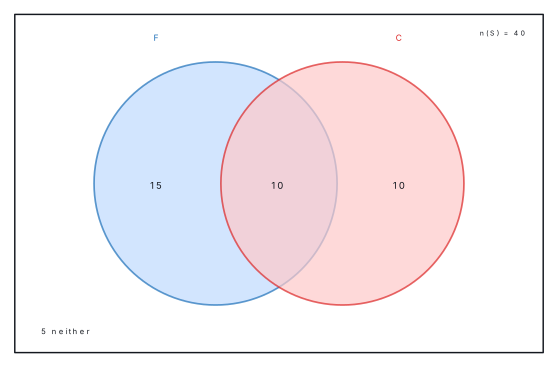
Problem. In a class of 40 students, 25 like football, 20 like cricket and 10 like both. A student is chosen at random. Find the probability that the student likes (a) football or cricket, (b) neither, (c) only cricket.
Solution. n(S)=40.
(a) n(F\cup C)=25+20-10=35, so P=\frac{35}{40}=\frac{7}{8}. (b) P(\text{neither})=1-\frac{7}{8}=\frac{1}{8} (that is 5 students). (c) Only cricket: 20-10=10 students, P=\frac{10}{40}=\frac{1}{4}.
Problem. A die is rolled. Find P(\text{a 2 or a 5}) and P(\text{an even number or a multiple of 3}).
Solution. "2" and "5" are mutually exclusive: \frac{1}{6}+\frac{1}{6}=\frac{1}{3}. For the second, even =\{2,4,6\}, multiples of 3 =\{3,6\}; the overlap is \{6\}, so P=\frac{3}{6}+\frac{2}{6}-\frac{1}{6}=\frac{4}{6}=\frac{2}{3} (the outcomes are \{2,3,4,6\}).
Independent events and the multiplication rule
Two events are independent if the occurrence of one does not change the probability of the other (a coin toss and a die roll, or two draws with replacement).
For independent events A and B:
For dependent events (for example drawing without replacement) the second probability changes: P(A\cap B)=P(A)\times P(B\text{ after }A).
Problem. P(A)=0.6 and P(B)=0.5 for independent events. Find P(A\cap B) and P(A\cup B).
Solution. P(A\cap B)=0.6\times0.5=0.3. P(A\cup B)=0.6+0.5-0.3=0.8.
Problem. A coin is tossed and a die is rolled. Find P(\text{head and a 6}).
Solution. The events are independent: \frac{1}{2}\times\frac{1}{6}=\frac{1}{12}. (Check: 12 equally likely outcomes, one is H6.)
Tree diagrams: drawing without replacement
A tree diagram shows each stage of an experiment as branches, with the probability written on each branch. Multiply along a path to get the probability of that outcome; add the paths that belong to the event.
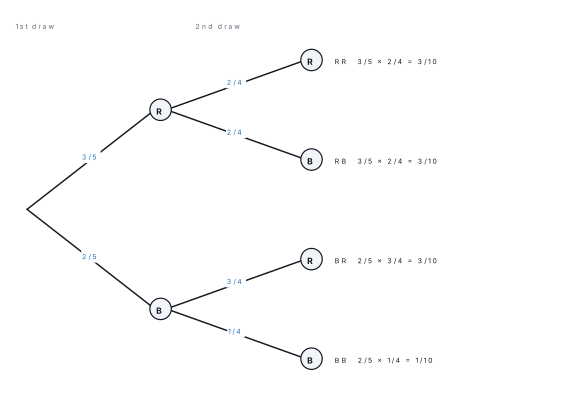
Problem. A bag contains 3 red and 2 blue balls. Two balls are drawn one after another without replacement. Find the probability that (a) both are red, (b) both are the same colour, (c) at least one is blue.
Solution. Use the tree above.
(a) P(RR)=\frac{3}{5}\times\frac{2}{4}=\frac{3}{10}. (b) P(RR)+P(BB)=\frac{3}{10}+\frac{1}{10}=\frac{4}{10}=\frac{2}{5}. (c) At least one blue is the complement of "both red": 1-\frac{3}{10}=\frac{7}{10}.
Problem. A bag has 5 red, 3 blue and 2 green balls. Two balls are drawn, the first being replaced before the second is drawn. Find the probability that both are red.
Solution. With replacement the draws are independent and P(\text{red})=\frac{5}{10} each time: \frac{1}{2}\times\frac{1}{2}=\frac{1}{4}.
Without replacement: \frac{5}{10}\times\frac{4}{9}=\frac{20}{90}=\frac{2}{9}. Notice the probability is smaller: after one red ball is removed, fewer red balls remain.
Problem. From the same bag (5 red, 3 blue, 2 green) two balls are drawn without replacement. Find the probability that they are of different colours.
Solution. Find the probability that both have the same colour and subtract from 1.
Problem. A bag has 4 red and 6 white balls. Two are drawn without replacement. Find P(\text{same colour}) and P(\text{different colours}).
Solution. P(\text{RR})=\frac{4}{10}\times\frac{3}{9}=\frac{12}{90} and P(\text{WW})=\frac{6}{10}\times\frac{5}{9}=\frac{30}{90}. Same colour: \frac{42}{90}=\frac{7}{15}. Different: 1-\frac{7}{15}=\frac{8}{15}.
Problem. A lottery has 100 tickets, 5 of which win a prize. Ali buys 2 tickets. Find the probability that he wins at least one prize.
Solution. P(\text{no prize})=\frac{95}{100}\times\frac{94}{99}=\frac{8930}{9900}. So P(\text{at least one prize})=1-\frac{8930}{9900}=\frac{970}{9900}=\frac{97}{990}\approx0.098.
- Writing the sample space incompletely: for two coins there are four outcomes (HT and TH are different), not three.
- Treating dice sums as equally likely: the sum 7 is much more likely than the sum 2 (6 ways against 1).
- Using the same probability for both draws without replacement; the denominator drops by 1.
- Adding probabilities for "and" or multiplying for "or": and means multiply (independent), or means add.
- Forgetting to subtract the overlap in P(A\cup B) when the events are not mutually exclusive.
- Leaving the answer as "6 out of 36" — give a fraction in lowest terms (\frac{1}{6}) or a decimal.
18.2 Exercises of the SEE type
Method for any question
- Decide the experiment and write the sample space (a list, a table or a tree). State n(S).
- Write the favourable outcomes and n(E).
- P(E)=\frac{n(E)}{n(S)}; reduce the fraction.
- "At least one": use 1-P(\text{none}).
- For two stages, decide with or without replacement, draw a tree and multiply along branches.
- Check that all branch probabilities in a tree add to 1.
Problem. A coin is tossed and a die is rolled together. Write the sample space and find (a) P(\text{head and an even number}), (b) P(\text{tail and a number less than 3}).
Solution. S=\{H1,H2,H3,H4,H5,H6,T1,T2,T3,T4,T5,T6\}, n(S)=12.
(a) H2, H4, H6: P=\frac{3}{12}=\frac{1}{4}. (b) T1, T2: P=\frac{2}{12}=\frac{1}{6}.
Problem. Two dice are thrown. Find the probability that the sum is (a) less than 4, (b) a multiple of 5, (c) the numbers differ by 2.
Solution. n(S)=36.
(a) Sum 2: (1,1); sum 3: (1,2),(2,1). Total 3, P=\frac{3}{36}=\frac{1}{12}. (b) Sum 5: (1,4),(2,3),(3,2),(4,1) — 4; sum 10: (4,6),(5,5),(6,4) — 3. Total 7, P=\frac{7}{36}. (c) Pairs with |a-b|=2: (1,3),(3,1),(2,4),(4,2),(3,5),(5,3),(4,6),(6,4) — 8, P=\frac{8}{36}=\frac{2}{9}.
Problem. A card is drawn at random from a pack of 52. Find the probability that it is (a) a black card, (b) an ace or a spade, (c) neither a heart nor a king.
Solution. (a) \frac{26}{52}=\frac{1}{2}. (b) Aces 4, spades 13, overlap 1: \frac{4+13-1}{52}=\frac{16}{52}=\frac{4}{13}. (c) Hearts or kings: 13+4-1=16 cards, so neither =\frac{52-16}{52}=\frac{36}{52}=\frac{9}{13}.
Chapter summary
- P(E)=\frac{n(E)}{n(S)} for equally likely outcomes; 0\leq P(E)\leq1.
- Complement: P(E')=1-P(E). "At least one" =1-P(\text{none}).
- Addition rule: P(A\cup B)=P(A)+P(B)-P(A\cap B); for mutually exclusive events P(A\cap B)=0.
- Multiplication rule for independent events: P(A\cap B)=P(A)\times P(B).
- Without replacement the second probability changes; use a tree diagram and multiply along each path.
- Two dice: 36 outcomes; two coins: 4; three coins: 8; pack of cards: 52.
- Expected frequency =N\times P(E).
Practice questions
Group A — Multiple choice (1 mark each)
- The probability of an impossible event is [1]a0b\frac{1}{2}c1d-1
- A fair die is rolled. P(\text{an even number}) is [1]a\frac{1}{6}b\frac{1}{3}c\frac{1}{2}d\frac{2}{3}
- P(E)+P(E') equals [1]a0b\frac{1}{2}c1dP(E)
- The number of outcomes when two dice are rolled is [1]a12b18c36d6
- The probability of drawing a king from a pack of 52 cards is [1]a\frac{1}{52}b\frac{1}{13}c\frac{1}{4}d\frac{4}{13}
Answers to Group A
1. (a).
2. (c) — 3 of 6.
3. (c).
4. (c) — 6\times6.
5. (b) — \frac{4}{52}.
Group B — Short answer (2 marks each)
- Two coins are tossed. Find the probability of at least one head. [2]
- A die is rolled. Find P(\text{a prime number}). [2]
- A bag has 5 red and 3 blue balls. Find P(\text{blue}). [2]
- If P(E)=0.35, find P(E'). [2]
Answers to Group B
1. \frac{3}{4}.
2. Primes \{2,3,5\}: \frac{3}{6}=\frac{1}{2}.
3. \frac{3}{8}.
4. 1-0.35=0.65.
Group C — Short answer (3 marks each)
- Two dice are thrown. Find the probability that the sum is 7. [3]
- A card is drawn from a pack of 52. Find P(\text{king or heart}). [3]
- A bag has 4 red balls and x blue balls. If P(\text{blue})=\frac{3}{5}, find x. [3]
- In a class of 40, 25 like football, 20 like cricket and 10 like both. Find P(\text{neither}). [3]
Answers to Group C
1. \frac{6}{36}=\frac{1}{6}.
2. \frac{4+13-1}{52}=\frac{4}{13}.
3. \frac{x}{4+x}=\frac{3}{5}, x=6.
4. 1-\frac{35}{40}=\frac{1}{8}.
Group D — Long answer (4 marks each)
- A bag contains 3 red and 2 blue balls. Two are drawn without replacement. Draw a tree diagram and find P(\text{both red}) and P(\text{at least one blue}). [4]
- A bag has 5 red, 3 blue and 2 green balls. Two balls are drawn without replacement. Find the probability that both are red and the probability that they are of different colours. [4]
- Two dice are thrown. Find the probability that the sum is at least 10, and the probability that the numbers on the two dice are equal. [4]
- A bag has 4 red and 6 white balls. Two are drawn without replacement. Find P(\text{same colour}) and P(\text{different colours}). [4]
Answers to Group D
1. P(RR)=\frac{3}{5}\times\frac{2}{4}=\frac{3}{10}; P(\text{at least one blue})=1-\frac{3}{10}=\frac{7}{10}.
2. P(RR)=\frac{5}{10}\times\frac{4}{9}=\frac{2}{9}; P(\text{different})=1-\frac{14}{45}=\frac{31}{45}.
3. \frac{6}{36}=\frac{1}{6} and \frac{6}{36}=\frac{1}{6}.
4. \frac{12}{90}+\frac{30}{90}=\frac{7}{15}; different =\frac{8}{15}.
Practise more: Mathematics question bank