Unit 8 · Compulsory Mathematics · 12 min read
Highest Common Factor and Lowest Common Multiple
What the syllabus asks for 2
- Highest Common Factor and Lowest Common Multiple: concepts, formulas and worked problems
- Exercises of the SEE type
The highest common factor (HCF) is the biggest thing that divides every given expression; the lowest common multiple (LCM) is the smallest thing that every given expression divides. You already know both for numbers. In Grade 10 the same two ideas are applied to algebraic expressions — and they are needed in the next chapters, because adding or simplifying algebraic fractions means finding a common denominator, which is an LCM. The key skill throughout is factorisation: once each expression is written as a product of factors, the HCF and LCM can be read off almost without calculation.
The usual questions: (i) find the HCF and LCM of two or three expressions after factorising (3 or 4 marks); (ii) use \text{HCF}\times\text{LCM}= product of the two expressions to find the missing expression; (iii) a small word problem on numbers (bells, ropes, tiles). Factorise every expression completely first, and write the final answer in factor form.
8.1 Highest Common Factor and Lowest Common Multiple: concepts, formulas and worked problems
Revision with numbers
A factor divides exactly. A multiple is what you get by multiplying. The factors of 12 are 1, 2, 3, 4, 6, 12; the multiples of 12 are 12, 24, 36, … A prime number has exactly two factors, 1 and itself.
- The HCF (or GCD, greatest common divisor) of given numbers is the greatest number that divides each of them exactly.
- The LCM of given numbers is the least number that is exactly divisible by each of them.
Prime factorisation gives both at once.
Write each number as a product of prime powers.
- HCF = product of the primes that are common to all, each with its lowest power.
- LCM = product of all the primes that appear, each with its highest power.
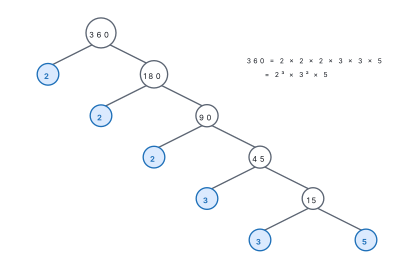
Problem. Find the HCF and LCM of 24, 36 and 60.
Solution. Prime factorisation:
24=2^3\times 3, \quad 36=2^2\times 3^2, \quad 60=2^2\times 3\times 5.
Common primes: 2 and 3. Lowest powers: 2^2 and 3^1, so
All primes: 2, 3, 5. Highest powers: 2^3, 3^2, 5^1, so
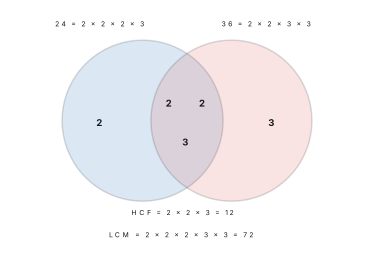
For any two numbers a and b: \text{HCF}(a,b)\times\text{LCM}(a,b)=a\times b.
Check with 24 and 36: HCF =12, LCM =72, and 12\times 72=864=24\times 36 ✓.
Problem. Find the HCF of 252 and 198 by long division.
Solution. Divide the larger by the smaller, then divide the divisor by the remainder, and continue until the remainder is zero. The last divisor is the HCF.
The HCF is 18.
Problem. Three ropes of lengths 36 m, 48 m and 60 m are to be cut into pieces of equal length, as long as possible. Find the length of each piece and the number of pieces.
Solution. The longest equal piece is the HCF of 36, 48 and 60. 36=2^2\times 3^2, 48=2^4\times 3, 60=2^2\times 3\times 5, so
Number of pieces =\dfrac{36}{12}+\dfrac{48}{12}+\dfrac{60}{12}=3+4+5=12.
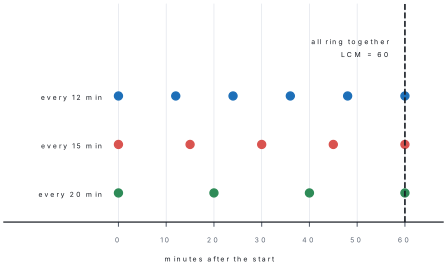
Problem. Three bells ring at intervals of 18, 24 and 30 minutes. They ring together at 6:00 a.m. When will they next ring together?
Solution. The bells ring together after the LCM of 18, 24 and 30 minutes.
18=2\times 3^2, 24=2^3\times 3, 30=2\times 3\times 5, so
They next ring together at 12:00 noon.
Ask: am I cutting or splitting into the biggest equal parts? — HCF (largest tile, longest rope, most students per group). Am I waiting for events to coincide, or finding the smallest number that all will divide? — LCM (bells, traffic lights, common denominator).
Problem. A hall is 8 m 40 cm long and 5 m 25 cm wide. It is to be paved with identical square tiles, as large as possible, with no cutting. Find the side of each tile and the number of tiles.
Solution. Change to centimetres: length =840 cm, width =525 cm. The largest square tile has side =\text{HCF}(840,525).
HCF =105 cm. Tiles along the length =\dfrac{840}{105}=8; along the width =\dfrac{525}{105}=5.
Number of tiles =8\times 5=40.
Problem. Find the smallest number which, when divided by 12, 15 and 20, leaves a remainder 5 each time.
Solution. A number that is exactly divisible by 12, 15 and 20 is a multiple of their LCM. 12=2^2\times 3, 15=3\times 5, 20=2^2\times 5, so LCM =2^2\times 3\times 5=60.
The required number is the LCM plus the remainder: 60+5=65.
Check: 65=12\times 5+5, 65=15\times 4+5, 65=20\times 3+5 ✓.
Factorisation: the toolkit
To find the HCF and LCM of expressions, each must first be broken into factors that cannot be broken further. These are the types you need.
| Type | Rule | Example |
|---|---|---|
| Common factor | take out the common factor | 6x^2-6=6(x^2-1) |
| Grouping | group in pairs, take out common factors | ax+ay+bx+by=(a+b)(x+y) |
| Difference of squares | a^2-b^2=(a+b)(a-b) | x^2-9=(x+3)(x-3) |
| Perfect square | a^2\pm 2ab+b^2=(a\pm b)^2 | x^2+4x+4=(x+2)^2 |
| Trinomial x^2+px+q | find two numbers with sum p and product q | x^2-5x+6=(x-2)(x-3) |
| Trinomial ax^2+bx+c | split b into two numbers whose product is ac | 2x^2+7x+3=(2x+1)(x+3) |
| Sum / difference of cubes | a^3\pm b^3=(a\pm b)(a^2\mp ab+b^2) | x^3+8=(x+2)(x^2-2x+4) |
Problem. Factorise 2x^2+7x+3.
Solution. Here a\cdot c=2\times 3=6. We need two numbers with product 6 and sum 7: they are 6 and 1.
Check: (2x+1)(x+3)=2x^2+6x+x+3=2x^2+7x+3 ✓.
- Stopping early: x^4-16=(x^2-4)(x^2+4) is not finished, since x^2-4=(x-2)(x+2) factorises further.
- Treating x^2+y^2 as factorisable. It does not factorise over real numbers.
- Forgetting the numerical factor: 6x^2-6=6(x-1)(x+1), not (x-1)(x+1).
- Sign errors: x^2-x-6=(x-3)(x+2) since the numbers with product -6 and sum -1 are -3 and +2.
HCF and LCM of algebraic expressions
- Factorise each expression completely.
- HCF = product of the factors common to all the expressions (with the lowest power), including the HCF of the numerical coefficients.
- LCM = product of all the different factors (with the highest power), including the LCM of the numerical coefficients.
- Leave the answer in factor form (multiplying out is optional unless asked).
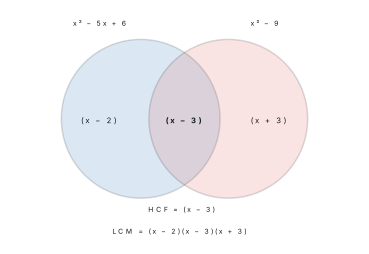
Problem. Find the HCF and LCM of x^2-5x+6 and x^2-9.
Solution. Factorise:
x^2-5x+6=(x-2)(x-3) and x^2-9=(x-3)(x+3).
Common factor: (x-3).
Problem. Find the HCF and LCM of 12a^3b^2, 18a^2b^3c and 30ab^4c^2.
Solution. Numerical parts: \text{HCF}(12,18,30)=6 and \text{LCM}(12,18,30)=180.
| Letter | Powers in the three terms | Lowest (HCF) | Highest (LCM) |
|---|---|---|---|
| a | 3,\ 2,\ 1 | a^1 | a^3 |
| b | 2,\ 3,\ 4 | b^2 | b^4 |
| c | 0,\ 1,\ 2 | none (c^0) | c^2 |
A letter that is missing from even one term (like c in the first term) does not appear in the HCF.
Problem. Find the HCF and LCM of a^3-b^3 and a^2-b^2.
Solution. a^3-b^3=(a-b)(a^2+ab+b^2) and a^2-b^2=(a-b)(a+b).
Problem. Find the HCF and LCM of 6x^2-6, 9x^2+9x-18 and 3x^2+6x+3.
Solution. Factorise:
6x^2-6=6(x^2-1)=6(x-1)(x+1).
9x^2+9x-18=9(x^2+x-2)=9(x-1)(x+2).
3x^2+6x+3=3(x^2+2x+1)=3(x+1)^2.
Numerical parts: \text{HCF}(6,9,3)=3 and \text{LCM}(6,9,3)=18.
Algebraic factors: (x-1) is not in the third; (x+1) is not in the second; (x+2) is only in the second. There is no algebraic factor common to all three.
(Highest power of (x+1) is 2, from the third expression.)
Problem. Find the HCF and LCM of x^3+8, x^2-4 and x^2+4x+4.
Solution. x^3+8=(x+2)(x^2-2x+4), x^2-4=(x-2)(x+2), x^2+4x+4=(x+2)^2.
Common to all three: (x+2), lowest power 1.
Problem. Find the HCF and LCM of ax+ay+bx+by and ax-ay+bx-by.
Solution. ax+ay+bx+by=a(x+y)+b(x+y)=(a+b)(x+y).
ax-ay+bx-by=a(x-y)+b(x-y)=(a+b)(x-y).
The relation between HCF, LCM and the expressions
We show that for two expressions A and B, the HCF and LCM multiply back to A\times B. This lets us find a missing expression.
Setting up. Let H be the HCF of A and B. Then we can write
where p and q have no common factor (we have taken out everything shared).
Step 1 — the LCM. The LCM must contain all of A and all of B with nothing repeated. The shared part H appears once, plus the leftover parts p and q:
Step 2 — multiply HCF by LCM.
Step 3 — recognise A and B.
Result. \text{HCF}\times\text{LCM}=A\times B (true for two expressions only, not for three).
What it means. If you know any three of A, B, HCF and LCM you can find the fourth: B=\dfrac{\text{HCF}\times\text{LCM}}{A}.
Problem. For p=x^2+3x+2 and q=x^2-1 find the HCF and LCM and verify that \text{HCF}\times\text{LCM}=p\times q.
Solution. p=(x+1)(x+2) and q=(x-1)(x+1).
HCF =x+1; LCM =(x+1)(x+2)(x-1)=x^3+2x^2-x-2.
HCF \times LCM =(x+1)(x^3+2x^2-x-2)=x^4+3x^3+x^2-3x-2.
p\times q=(x^2+3x+2)(x^2-1)=x^4+3x^3+2x^2-x^2-3x-2=x^4+3x^3+x^2-3x-2.
The two results are the same. ✓
Problem. The HCF of two expressions is x+2 and their LCM is x^3+3x^2-4x-12. If one expression is x^2-4, find the other.
Solution. \text{LCM}=x^3+3x^2-4x-12=x^2(x+3)-4(x+3)=(x+3)(x^2-4)=(x+3)(x-2)(x+2).
Other expression =\dfrac{\text{HCF}\times\text{LCM}}{\text{given expression}}=\dfrac{(x+2)(x+3)(x-2)(x+2)}{(x-2)(x+2)}=(x+2)(x+3).
Other expression =x^2+5x+6.
Check: HCF of (x-2)(x+2) and (x+2)(x+3) is x+2 ✓; LCM is (x-2)(x+2)(x+3) ✓.
Problem. Find the HCF and LCM of 2x^2+7x+3 and 2x^2-x-1.
Solution. 2x^2+7x+3=(2x+1)(x+3) and 2x^2-x-1=(2x+1)(x-1).
8.2 Exercises of the SEE type
Method
- Factorise every expression completely. Take out numerical factors too.
- Underline factors common to all expressions: their lowest powers multiply to the HCF.
- List every different factor at its highest power: the product is the LCM.
- For two expressions, check with \text{HCF}\times\text{LCM}=A\times B if the question asks you to verify.
- To find a missing expression: B=\dfrac{\text{HCF}\times\text{LCM}}{A}.
- Word problems: cutting into equal pieces \Rightarrow HCF; events together again \Rightarrow LCM.
Chapter summary
- HCF = common factors at lowest powers; LCM = all factors at highest powers (include the numerical parts).
- For two numbers or expressions: \text{HCF}\times\text{LCM}=A\times B. Not valid for three.
- Factorisation toolkit: common factor, grouping, a^2-b^2, perfect squares, x^2+px+q, ax^2+bx+c, a^3\pm b^3.
- a^3+b^3=(a+b)(a^2-ab+b^2) and a^3-b^3=(a-b)(a^2+ab+b^2).
- Euclid's method: divide, then divide the divisor by the remainder, until the remainder is 0; the last divisor is the HCF.
- Missing expression: B=\dfrac{\text{HCF}\times\text{LCM}}{A}.
- A letter missing from any one term is not in the HCF.
- Word problems: HCF for equal cutting; LCM for common times.
Practice questions
Group A — Multiple choice (1 mark each)
- The HCF of 12 and 18 is [1]a3b6c36d2
- The LCM of 4 and 6 is [1]a24b2c12d10
- The HCF of x^2-9 and x-3 is [1]ax+3bx-3cx^2-9d1
- The HCF of two expressions is 3, their LCM is 60 and one expression is 12. The other is [1]a5b15c20d30
- The LCM of a^2b and ab^2 is [1]aabba^2bca^2b^2da^3b^3
Answers to Group A
1. (b) — 12=2^2\cdot 3, 18=2\cdot 3^2, HCF =2\cdot 3=6.
2. (c) — 4=2^2, 6=2\cdot 3, LCM =2^2\cdot 3=12.
3. (b) — x^2-9=(x-3)(x+3), so (x-3) is common.
4. (b) — \frac{3\times 60}{12}=15.
5. (c) — highest powers: a^2 and b^2.
Group B — Short answer (2 marks each)
- Find the HCF and LCM of 12a^2b and 18ab^2. [2]
- Factorise x^2-7x+12. [2]
- Find the HCF of x^2-4 and x^2+4x+4. [2]
- Find the HCF of 36 and 48 by the division method. [2]
Answers to Group B
1. HCF of coefficients =6, LCM =36. a: lowest 1, highest 2; b: lowest 1, highest 2. HCF =6ab; LCM =36a^2b^2.
2. Numbers with product 12 and sum -7: -3 and -4. x^2-7x+12=(x-3)(x-4).
3. x^2-4=(x-2)(x+2) and x^2+4x+4=(x+2)^2. HCF =x+2.
4. 48=36\times 1+12; 36=12\times 3+0. HCF =12.
Group C — Short answer (3 marks each)
- Find the HCF and LCM of x^2-x-6 and x^2-9. [3]
- Find the HCF and LCM of 2x^2+7x+3 and 2x^2-x-1. [3]
- Three bells ring at intervals of 18, 24 and 30 minutes. They ring together at 6:00 a.m. When will they ring together next? [3]
- Find the HCF and LCM of a^3-b^3 and a^2-b^2. [3]
Answers to Group C
1. x^2-x-6=(x-3)(x+2) and x^2-9=(x-3)(x+3). HCF =x-3. LCM =(x-3)(x+2)(x+3).
2. (2x+1)(x+3) and (2x+1)(x-1). HCF =2x+1; LCM =(2x+1)(x+3)(x-1).
3. LCM of 18, 24, 30: 18=2\cdot 3^2, 24=2^3\cdot 3, 30=2\cdot 3\cdot 5, so LCM =2^3\cdot 3^2\cdot 5=360 min =6 hours. Next together at 12:00 noon.
4. (a-b)(a^2+ab+b^2) and (a-b)(a+b). HCF =a-b; LCM =(a-b)(a+b)(a^2+ab+b^2).
Group D — Long answer (4 marks each)
- Find the HCF and LCM of 6x^2-6, 9x^2+9x-18 and 3x^2+6x+3. [4]
- The HCF of two expressions is x+1 and their LCM is x^3+2x^2-x-2. If one expression is x^2+3x+2, find the other, and verify that \text{HCF}\times\text{LCM}= product of the expressions. [4]
- Find the HCF and LCM of x^3+8, x^2-4 and x^2+4x+4. [4]
- Find the HCF and LCM of ax+ay+bx+by and ax-ay+bx-by. [4]
Answers to Group D
1. 6(x-1)(x+1), 9(x-1)(x+2), 3(x+1)^2. Numerical HCF =3, LCM =18. No algebraic factor common to all three. HCF =3. LCM =18(x-1)(x+1)^2(x+2).
2. x^3+2x^2-x-2=x^2(x+2)-(x+2)=(x+2)(x^2-1)=(x+2)(x-1)(x+1). Other =\frac{(x+1)(x+2)(x-1)(x+1)}{(x+1)(x+2)}=(x+1)(x-1)=x^2-1. Verification: HCF \times LCM =x^4+3x^3+x^2-3x-2 and (x^2+3x+2)(x^2-1)=x^4+3x^3+x^2-3x-2 ✓.
3. (x+2)(x^2-2x+4), (x-2)(x+2), (x+2)^2. HCF =x+2; LCM =(x+2)^2(x-2)(x^2-2x+4).
4. (a+b)(x+y) and (a+b)(x-y). HCF =a+b; LCM =(a+b)(x+y)(x-y).
Practise more: Mathematics question bank