Unit 16 · Compulsory Mathematics · 12 min read
Trigonometry
What the syllabus asks for 2
- Trigonometry: concepts, formulas and worked problems
- Exercises of the SEE type
How tall is a tower you cannot climb? How wide is a river you cannot cross? Surveyors, pilots, architects and mountaineers answer these questions without measuring the distance directly: they measure an angle and one length, and use trigonometry — the study of the relationship between the sides and the angles of a right-angled triangle. This chapter defines the three basic ratios sine, cosine and tangent, finds their exact values for 30^\circ, 45^\circ and 60^\circ, shows how the ratios of complementary angles are linked, proves the key identities, and then applies everything to heights and distances.
Expect: (i) find all trigonometric ratios from one given ratio (e.g. \sin\theta=\frac{5}{13}); (ii) evaluate expressions with the standard values of 30^\circ,45^\circ,60^\circ; (iii) prove an identity such as (\sec\theta-\tan\theta)(\sec\theta+\tan\theta)=1; (iv) use complementary angles (\sin 25^\circ=\cos65^\circ); (v) a word problem on a tower, ladder or cliff using the angle of elevation or depression. Draw a clear figure, mark the right angle and the angle, and write the ratio you use.
16.1 Trigonometry: concepts, formulas and worked problems
The right-angled triangle and its sides
In a right-angled triangle, the side opposite the right angle is the hypotenuse (the longest side). For an acute angle \theta, the side facing \theta is the opposite (perpendicular, p) and the side touching \theta (other than the hypotenuse) is the adjacent (base, b). The names of the two shorter sides change if you move to the other acute angle, but the hypotenuse never changes.
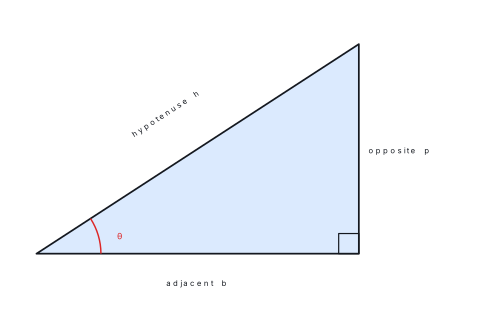
Their reciprocals are
A memory aid: SOH – CAH – TOA (Sine = Opposite/Hypotenuse, Cosine = Adjacent/Hypotenuse, Tangent = Opposite/Adjacent). Also \tan\theta=\frac{\sin\theta}{\cos\theta}.
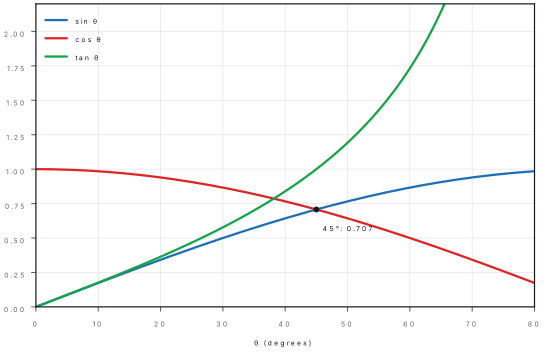
Because similar triangles have the same shape, the ratio depends only on the angle, not on the size of the triangle. The values of \sin\theta and \cos\theta are never greater than 1 for an acute angle; \tan\theta can be any positive number.
Problem. A right-angled triangle has sides 3 cm, 4 cm and 5 cm. Find the three ratios for the angle \theta opposite the side 3 cm.
Solution. Opposite =3, adjacent =4, hypotenuse =5.
Check: \sin^2\theta+\cos^2\theta=\frac{9}{25}+\frac{16}{25}=1 ✓.
Problem. If \sin\theta=\frac{5}{13}, find \cos\theta, \tan\theta and \sec\theta.
Solution. Draw a right triangle with opposite =5 and hypotenuse =13. By Pythagoras the adjacent side is \sqrt{13^2-5^2}=\sqrt{144}=12. Then
Problem. If \tan\theta=\frac{3}{4}, find \sin\theta and \cos\theta.
Solution. Opposite =3, adjacent =4, so the hypotenuse is \sqrt{9+16}=5. \sin\theta=\frac{3}{5} and \cos\theta=\frac{4}{5}. (This is the 3-4-5 triangle: \theta\approx36.9^\circ.)
Ratios of 30^\circ, 45^\circ and 60^\circ
We read the ratios off two special triangles.
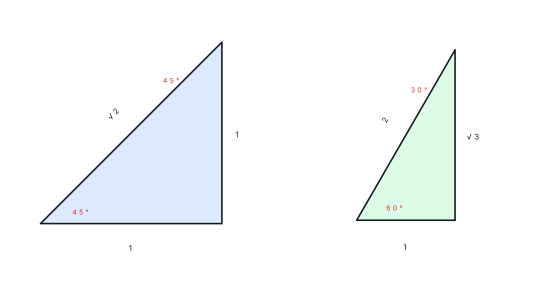
Step 1 — the isosceles right triangle. Take a right-angled triangle with the two equal sides 1, so the angles are 45^\circ,45^\circ,90^\circ. By Pythagoras the hypotenuse is \sqrt{1^2+1^2}=\sqrt{2}. For 45^\circ:
Step 2 — the half-equilateral triangle. Take an equilateral triangle of side 2 and draw an altitude. It bisects the base and the apex angle, giving a right-angled triangle with angles 30^\circ,60^\circ,90^\circ, hypotenuse 2, short side 1 and altitude \sqrt{2^2-1^2}=\sqrt{3}.
Step 3 — read the ratios. The side opposite 30^\circ is 1, the side opposite 60^\circ is \sqrt{3}:
What it means. These nine values are exact and must be memorised.
| \theta | 30^\circ | 45^\circ | 60^\circ |
|---|---|---|---|
| \sin\theta | \frac{1}{2} | \frac{1}{\sqrt{2}} | \frac{\sqrt{3}}{2} |
| \cos\theta | \frac{\sqrt{3}}{2} | \frac{1}{\sqrt{2}} | \frac{1}{2} |
| \tan\theta | \frac{1}{\sqrt{3}} | 1 | \sqrt{3} |
Memory trick: the sines are \frac{\sqrt{1}}{2},\frac{\sqrt{2}}{2},\frac{\sqrt{3}}{2} for 30^\circ,45^\circ,60^\circ; the cosines are the sines in reverse.
Problem. Find the value of \sin30^\circ\cos60^\circ+\cos30^\circ\sin60^\circ.
Solution. \frac{1}{2}\times\frac{1}{2}+\frac{\sqrt{3}}{2}\times\frac{\sqrt{3}}{2}=\frac{1}{4}+\frac{3}{4}=1.
Problem. Find 4\sin^260^\circ-3\tan^230^\circ.
Solution. \sin^260^\circ=\left(\frac{\sqrt{3}}{2}\right)^2=\frac{3}{4} and \tan^230^\circ=\left(\frac{1}{\sqrt{3}}\right)^2=\frac{1}{3}. So 4\times\frac{3}{4}-3\times\frac{1}{3}=3-1=2.
Problem. Simplify \frac{\tan60^\circ-\tan30^\circ}{1+\tan60^\circ\tan30^\circ}.
Solution. \tan60^\circ\tan30^\circ=\sqrt{3}\times\frac{1}{\sqrt{3}}=1, so the denominator is 2. The numerator is \sqrt{3}-\frac{1}{\sqrt{3}}=\frac{3-1}{\sqrt{3}}=\frac{2}{\sqrt{3}}. The result is \frac{2/\sqrt{3}}{2}=\frac{1}{\sqrt{3}}=\tan30^\circ.
Problem. Find the acute angle \theta if (a) 2\sin\theta=1, (b) \tan\theta=\sqrt{3}, (c) 2\cos^2\theta-1=0.
Solution. (a) \sin\theta=\frac{1}{2}, so \theta=30^\circ. (b) \theta=60^\circ. (c) \cos^2\theta=\frac{1}{2}, \cos\theta=\frac{1}{\sqrt{2}}, so \theta=45^\circ.
Complementary angles
Two angles are complementary if they add up to 90^\circ. In a right-angled triangle the two acute angles \theta and 90^\circ-\theta are complementary, and the side opposite one is the side adjacent to the other. So:
For example \sin25^\circ=\cos65^\circ and \tan15^\circ\times\tan75^\circ=\tan15^\circ\times\cot15^\circ=1.
Problem. Evaluate (a) \frac{\sin25^\circ}{\cos65^\circ}, (b) \tan15^\circ\tan75^\circ, (c) \cos20^\circ-\sin70^\circ.
Solution. (a) \cos65^\circ=\sin25^\circ, so the ratio is 1. (b) \tan75^\circ=\cot15^\circ, so the product is 1. (c) \sin70^\circ=\cos20^\circ, so the difference is 0.
Identities
Setting up. Take a right-angled triangle with opposite p, adjacent b and hypotenuse h for the angle \theta.
Step 1 — Pythagoras. p^2+b^2=h^2.
Step 2 — divide by h^2.
Step 3 — divide Step 1 by b^2.
Step 4 — divide Step 1 by p^2.
What it means. These hold for every angle, so we can replace \sin^2\theta+\cos^2\theta by 1, and so on, in any proof.
Problem. Prove that (1-\sin^2\theta)\sec^2\theta=1.
Solution. 1-\sin^2\theta=\cos^2\theta. So LHS =\cos^2\theta\times\frac{1}{\cos^2\theta}=1= RHS. Proved.
Problem. Prove that (\sec\theta-\tan\theta)(\sec\theta+\tan\theta)=1.
Solution. Use (a-b)(a+b)=a^2-b^2: LHS =\sec^2\theta-\tan^2\theta=1 (from 1+\tan^2\theta=\sec^2\theta) = RHS. Proved.
Problem. Prove that \frac{\sin\theta}{1+\cos\theta}+\frac{1+\cos\theta}{\sin\theta}=2\csc\theta.
Solution. Combine over the common denominator \sin\theta(1+\cos\theta):
Expand the numerator: \sin^2\theta+1+2\cos\theta+\cos^2\theta=2+2\cos\theta=2(1+\cos\theta). So
Proved.
Problem. Prove that \sin^4\theta-\cos^4\theta=\sin^2\theta-\cos^2\theta.
Solution. LHS =(\sin^2\theta-\cos^2\theta)(\sin^2\theta+\cos^2\theta)=(\sin^2\theta-\cos^2\theta)\times1= RHS. Proved.
Problem. Prove that \frac{1}{1+\sin\theta}+\frac{1}{1-\sin\theta}=2\sec^2\theta.
Solution. LHS =\frac{(1-\sin\theta)+(1+\sin\theta)}{(1+\sin\theta)(1-\sin\theta)}=\frac{2}{1-\sin^2\theta}=\frac{2}{\cos^2\theta}=2\sec^2\theta. Proved.
Problem. If \sin\theta+\cos\theta=\sqrt{2}, find \sin\theta\cos\theta.
Solution. Square both sides: \sin^2\theta+2\sin\theta\cos\theta+\cos^2\theta=2, so 1+2\sin\theta\cos\theta=2 and \sin\theta\cos\theta=\frac{1}{2}.
- \sin^2\theta means (\sin\theta)^2, not \sin(\theta^2).
- \sin(A+B)\ne\sin A+\sin B. For instance \sin30^\circ+\sin60^\circ\ne\sin90^\circ.
- Mixing up opposite and adjacent: they depend on which angle you are using.
- Calculator in the wrong mode — keep it in degrees.
- In an identity proof, do not move terms across the "=" sign; simplify one side until it equals the other.
Heights and distances
When you look up at an object, the angle between your horizontal line of sight and the line to the object is the angle of elevation. When you look down, it is the angle of depression. The angle of depression of an object from a point equals the angle of elevation of that point from the object (alternate angles).
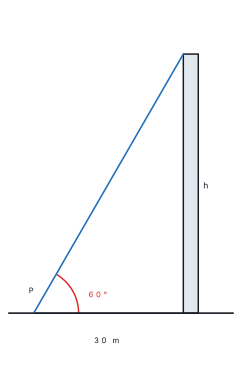
- Draw a figure: a vertical line (tower), a horizontal ground line, and the line of sight; mark the right angle and the angle of elevation or depression.
- Decide which two sides are involved: opposite and adjacent → tan; opposite and hypotenuse → sin; adjacent and hypotenuse → cos.
- Write the equation, solve for the unknown, and state the answer with units.
- Use \sqrt{3}\approx1.732 and \sqrt{2}\approx1.414 unless told otherwise.
Problem. The angle of elevation of the top of a tower from a point 30 m from its foot on level ground is 60^\circ. Find the height of the tower.
Solution. \tan60^\circ=\frac{h}{30}, so h=30\sqrt{3}=30\times1.732=51.96 m.
Problem. A 10 m ladder makes an angle of 60^\circ with the ground. How high up the wall does it reach, and how far is its foot from the wall?
Solution. Height =10\sin60^\circ=10\times\frac{\sqrt{3}}{2}=5\sqrt{3}=8.66 m. Distance from wall =10\cos60^\circ=5 m. Check: 5^2+(5\sqrt{3})^2=25+75=100 ✓.
Problem. A pole 6 m high casts a shadow on level ground when the Sun's elevation is 45^\circ. Find the length of the shadow.
Solution. \tan45^\circ=\frac{6}{\text{shadow}} and \tan45^\circ=1, so the shadow is 6 m long.
Problem. The angle of elevation of the top of a tower from a point 50 m from its foot is 30^\circ. Find the height of the tower.
Solution. \tan30^\circ=\frac{h}{50}, h=\frac{50}{\sqrt{3}}=28.87 m.
Problem. From the top of a cliff 40 m high, the angle of depression of a boat on the sea is 30^\circ. Find the distance of the boat from the foot of the cliff.
Solution. The angle of elevation of the top from the boat is also 30^\circ. \tan30^\circ=\frac{40}{d}, so d=\frac{40}{\tan30^\circ}=40\sqrt{3}=69.28 m.
Problem. A kite is flying at the end of a 100 m string, which makes an angle of 60^\circ with the ground. Find the height of the kite (assume the string is straight).
Solution. Height =100\sin60^\circ=50\sqrt{3}=86.6 m.
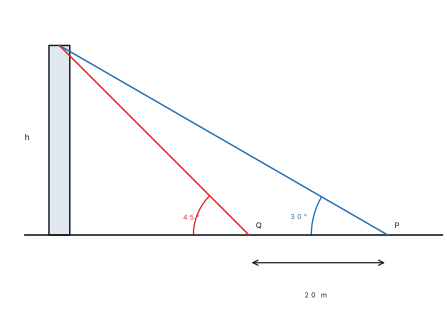
Problem. From a point P on level ground the angle of elevation of the top of a tower is 30^\circ. After walking 20 m towards the tower to Q the angle of elevation is 45^\circ. Find the height of the tower.
Solution. Let the height be h and let the distance from Q to the foot be x. From Q: \tan45^\circ=\frac{h}{x}, so x=h. From P (distance x+20): \tan30^\circ=\frac{h}{x+20}, so
So h=10\times2.732=27.32 m.
Check. From P the distance is 47.32 m and \tan30^\circ\times47.32=27.32 ✓.
Problem. In right-angled \Delta ABC, \angle B=90^\circ, \angle A=30^\circ and AC=8 cm. Find BC and AB.
Solution. BC=AC\sin30^\circ=8\times\frac{1}{2}=4 cm and AB=AC\cos30^\circ=8\times\frac{\sqrt{3}}{2}=4\sqrt{3}=6.93 cm.
16.2 Exercises of the SEE type
Method for any question
- For a "find the ratios" question, draw the triangle, find the third side by Pythagoras, then read each ratio.
- For an "evaluate" question, replace each ratio by its exact value and simplify step by step.
- For an identity, start with the more complicated side; use \sin^2\theta+\cos^2\theta=1, change everything to \sin and \cos, combine fractions.
- For heights and distances, draw a labelled figure first.
- Write a final sentence with units; keep \sqrt{3} exact until the last line.
Problem. If \cos\theta=\frac{8}{17}, find \sin\theta and \tan\theta.
Solution. Adjacent =8, hypotenuse =17; opposite =\sqrt{17^2-8^2}=\sqrt{225}=15. Hence \sin\theta=\frac{15}{17} and \tan\theta=\frac{15}{8}.
Problem. Find the value of \frac{\sin^245^\circ+\cos^245^\circ+\tan 45^\circ}{\sin60^\circ\cos30^\circ-\cos60^\circ\sin30^\circ}.
Solution. Numerator: \frac{1}{2}+\frac{1}{2}+1=2. Denominator: \frac{\sqrt{3}}{2}\cdot\frac{\sqrt{3}}{2}-\frac{1}{2}\cdot\frac{1}{2}=\frac{3}{4}-\frac{1}{4}=\frac{1}{2}. The value is 2\div\frac{1}{2}=4.
Problem. Prove that \frac{\cos\theta}{1-\sin\theta}=\frac{1+\sin\theta}{\cos\theta}.
Solution. Multiply the numerator and the denominator of the LHS by (1+\sin\theta):
Proved.
Problem. From a point on the ground 20 m from the foot of a building, the angles of elevation of the bottom and the top of a flagstaff on the roof are 30^\circ and 45^\circ. Find the height of the building and the length of the flagstaff.
Solution. Building: 20\tan30^\circ=\frac{20}{\sqrt{3}}=11.55 m. Building plus flagstaff: 20\tan45^\circ=20 m. Flagstaff =20-11.55=8.45 m.
Chapter summary
- \sin\theta=\frac{p}{h}, \cos\theta=\frac{b}{h}, \tan\theta=\frac{p}{b}=\frac{\sin\theta}{\cos\theta}; reciprocals \csc,\sec,\cot. Memory aid SOH-CAH-TOA.
- Standard values for 30^\circ,45^\circ,60^\circ come from the triangles with sides 1,1,\sqrt{2} and 1,\sqrt{3},2.
- Complementary angles: \sin(90^\circ-\theta)=\cos\theta, \cos(90^\circ-\theta)=\sin\theta, \tan(90^\circ-\theta)=\cot\theta.
- Identities: \sin^2\theta+\cos^2\theta=1; 1+\tan^2\theta=\sec^2\theta; 1+\cot^2\theta=\csc^2\theta.
- For one given ratio, draw the triangle and find the third side with Pythagoras.
- Angle of elevation = angle of depression (alternate angles); use \tan for height and ground distance, \sin for height and slant length.
- Prove identities by simplifying one side only.
Practice questions
Group A — Multiple choice (1 mark each)
- \sin30^\circ equals [1]a\frac{\sqrt{3}}{2}b\frac{1}{2}c1d\frac{1}{\sqrt{2}}
- \sin^2\theta+\cos^2\theta= [1]a0b\tan\thetac1d2
- \tan45^\circ= [1]a0b\sqrt{3}c\frac{1}{\sqrt{3}}d1
- \cos60^\circ equals [1]a\sin30^\circb\sin60^\circc\tan30^\circd1
- \tan\theta equals [1]a\frac{\cos\theta}{\sin\theta}b\frac{\sin\theta}{\cos\theta}c\sin\theta\cos\thetad\frac{1}{\sin\theta}
Answers to Group A
1. (b).
2. (c).
3. (d).
4. (a) — complementary: \cos60^\circ=\sin30^\circ=\frac{1}{2}.
5. (b).
Group B — Short answer (2 marks each)
- If \sin\theta=\frac{3}{5} find \cos\theta. [2]
- Evaluate \sin30^\circ\cos60^\circ+\cos30^\circ\sin60^\circ. [2]
- Evaluate \tan15^\circ\tan75^\circ. [2]
- A 10 m ladder makes 60^\circ with the ground. Find the height it reaches. [2]
Answers to Group B
1. \cos\theta=\frac{4}{5}.
2. \frac{1}{4}+\frac{3}{4}=1.
3. \tan75^\circ=\cot15^\circ; product =1.
4. 10\sin60^\circ=5\sqrt{3}\approx8.66 m.
Group C — Short answer (3 marks each)
- If \tan\theta=\frac{3}{4}, find \sin\theta and \cos\theta. [3]
- Find the value of 4\sin^260^\circ-3\tan^230^\circ. [3]
- Prove that (\sec\theta-\tan\theta)(\sec\theta+\tan\theta)=1. [3]
- The angle of elevation of the top of a tower from a point 30 m from its foot is 60^\circ. Find the height. [3]
Answers to Group C
1. \sin\theta=\frac{3}{5}, \cos\theta=\frac{4}{5}.
2. 3-1=2.
3. LHS =\sec^2\theta-\tan^2\theta=1.
4. 30\sqrt{3}\approx51.96 m.
Group D — Long answer (4 marks each)
- Prove that \frac{\sin\theta}{1+\cos\theta}+\frac{1+\cos\theta}{\sin\theta}=2\csc\theta. [4]
- From a point on level ground the angle of elevation of the top of a tower is 30^\circ; after walking 20 m towards the tower it is 45^\circ. Find the height of the tower. [4]
- From the top of a 40 m cliff the angle of depression of a boat is 30^\circ. Find the distance of the boat from the foot of the cliff. [4]
- Prove that \frac{1}{1+\sin\theta}+\frac{1}{1-\sin\theta}=2\sec^2\theta and find its value for \theta=30^\circ. [4]
Answers to Group D
1. See the worked example: the sum is \frac{2(1+\cos\theta)}{\sin\theta(1+\cos\theta)}=2\csc\theta.
2. h=10(\sqrt{3}+1)\approx27.32 m.
3. 40\sqrt{3}\approx69.28 m.
4. LHS =\frac{2}{1-\sin^2\theta}=2\sec^2\theta. For \theta=30^\circ: 2\times\frac{4}{3}=\frac{8}{3} (since \sec^230^\circ=\frac{4}{3}); directly, \frac{1}{1.5}+\frac{1}{0.5}=\frac{2}{3}+2=\frac{8}{3} ✓.
Practise more: Mathematics question bank