Unit 4 · Compulsory Mathematics · 14 min read
Population Growth and Depreciation
What the syllabus asks for 2
- Population Growth and Depreciation: concepts, formulas and worked problems
- Exercises of the SEE type
A town's population grows year after year, and a new motorbike loses value year after year. Both are the same mathematics as compound interest: the quantity changes by a fixed percentage of its present value every period. Growth multiplies by a number bigger than 1; depreciation multiplies by a number smaller than 1. In this chapter you will use the compound-interest idea to find a population after some years, the population in the past, the effect of births, deaths and migration, and the value of a machine, vehicle or house after several years of depreciation.
One 3- or 4-mark question, almost always in one of these forms: (i) population after 2 or 3 years at a given rate; (ii) population changing at different rates in different years; (iii) a rate made from birth, death and migration; (iv) the present population of a town given its population 2 years ago, or the reverse; (v) value of a machine/vehicle after depreciation, or the original cost from the present value. Write the formula, substitute, simplify, and answer in a sentence.
4.1 Population Growth and Depreciation: concepts, formulas and worked problems
Growth and decay are repeated multiplications
If a quantity increases by R\% it becomes \left(1+\dfrac{R}{100}\right) times itself. If it decreases by R\% it becomes \left(1-\dfrac{R}{100}\right) times itself. After T periods we multiply T times — the same argument as for compound interest in Chapter 3.
| Change | Factor | Example, R=10 |
|---|---|---|
| Increase by R\% (population growth) | 1+\dfrac{R}{100} | 1.10 |
| Decrease by R\% (depreciation) | 1-\dfrac{R}{100} | 0.90 |
Population growth
Let P_0 be the population at the beginning, R\% the yearly growth rate and P_T the population after T years.
Population T years ago: P_0 = \dfrac{P_T}{\left(1+\frac{R}{100}\right)^T}.
Increase in population =P_T-P_0.
If the rate is R_1\%, R_2\%, R_3\% in successive years:
Problem. The population of a village is 40,000. It increases at 5% every year. Find its population after 3 years.
Solution. P_0=40000, R=5, T=3.
The population after 3 years is 46,305. The increase is 46305-40000=6305.
Problem. The present population of a town is 24,200. If it has been increasing at 10% per year, what was its population 2 years ago?
Solution. 24200 = P_0(1.1)^2 = 1.21\,P_0.
The population 2 years ago was 20,000.
When the question asks for the population in the past, divide by the growth factor. Do not subtract 10% of the present population twice. 10% of 24,200 is 2,420, and 24200-2420-2420=19360, which is wrong.
Different rates in different years
Problem. The population of a municipality is 1,25,000. It increases by 8% in the first year and by 5% in the second year, and decreases by 2% in the third year. Find the population after 3 years.
Solution. After year 1: 125000\times 1.08=135000.
After year 2: 135000\times 1.05=141750.
After year 3 (a decrease): 141750\times(1-0.02)=141750\times 0.98=138915.
The population after 3 years is 1,38,915.
Birth, death and migration
A population changes for three reasons: people are born, people die, and people migrate (move in or out). Each can be given as a rate (% of the population per year). Net growth rate is the combined effect.
Immigration means people coming in; emigration means people going out. If a question says "migration out", subtract it.
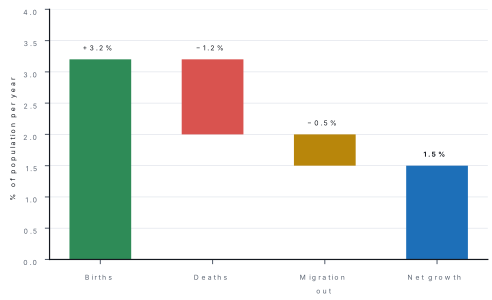
Problem. In a city of population 2,00,000, the birth rate is 3.2% and the death rate is 1.2% per year. Every year 0.5% of the population migrates out. Find the population after 2 years.
Solution. Net rate =3.2-1.2-0.5=1.5\% per year.
The population after 2 years is 2,06,045.
Sometimes a fixed number of people (not a percentage) migrates. Then you must apply the growth to the whole population and adjust the number at the time the migration happens.
Problem. A town has 50,000 people. In the first year the population grows by 4%; at the end of that year 2,000 people migrate out. In the second year it grows by 5%. Find the population at the end of the second year.
Solution. End of year 1 before migration: 50000\times 1.04=52000.
After 2,000 leave: 52000-2000=50000.
End of year 2: 50000\times 1.05=52500.
The population is 52,500.
Finding the rate or the time
Problem. The population of a village increases from 20,000 to 22,050 in 2 years. Find the yearly rate of growth.
Solution. 22050=20000\left(1+\dfrac{R}{100}\right)^2.
The rate of growth is 5% per year.
Problem. At what time will a population of 10,000, growing at 10% per year, become 13,310?
Solution. 13310=10000\times(1.1)^T, so (1.1)^T=1.331=(1.1)^3, giving T=3 years.
Depreciation
Depreciation is the decrease in the value of an article (a machine, vehicle, computer, building) with time and use. The rate of depreciation is the percentage by which the value falls each year. The new value is the present value, book value or depreciated value.
We start from the original cost and find the value after each year, and then generalise.
Setting up. Original cost (or value) =P; depreciation R\% per year, on the value at the beginning of the year; value after T years =V. Write r=\dfrac{R}{100}.
Step 1 — after 1 year. Depreciation =Pr, so
Step 2 — after 2 years. Depreciation in year 2 is charged on V_1 (not on P), so
Step 3 — after T years. Each year multiplies the value by (1-r), so
Result. V=P\left(1-\dfrac{R}{100}\right)^T and total depreciation =P-V.
What it means. The yearly loss in rupees gets smaller each year, because the percentage is taken on a smaller value. The depreciation in year 1 at 10% of Rs 5,00,000 is Rs 50,000; in year 2 it is 10% of Rs 4,50,000, which is only Rs 45,000.
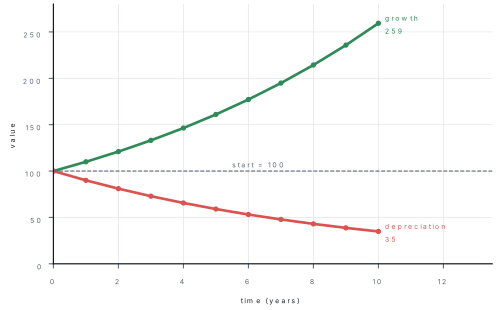
Problem. A machine costs Rs 5,00,000 and depreciates at 10% per year. Find its value after 3 years and the total depreciation.
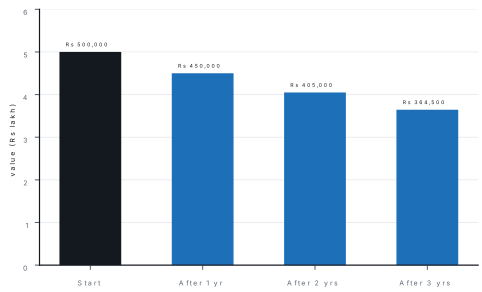
Solution. V=500000\left(1-\dfrac{10}{100}\right)^3=500000\times(0.9)^3=500000\times 0.729=\text{Rs } 3{,}64{,}500.
Total depreciation =500000-364500=\text{Rs } 1{,}35{,}500.
Year by year: 500000\to450000\to405000\to364500.
Problem. A car is bought for Rs 8,00,000. It depreciates by 15% in the first year and 10% in the second year. Find its value after 2 years.
Solution. After year 1: 800000\times(1-0.15)=800000\times 0.85=\text{Rs } 6{,}80{,}000.
After year 2: 680000\times(1-0.10)=680000\times 0.90=\text{Rs } 6{,}12{,}000.
The value after 2 years is Rs 6,12,000.
Problem. The value of a machine after 2 years is Rs 1,62,000. It depreciates at 10% per year. Find its original cost.
Solution. 162000=P(0.9)^2=0.81\,P.
Problem. A laptop bought for Rs 60,000 is worth Rs 38,400 after 2 years. Find the yearly rate of depreciation.
Solution. 38400=60000\left(1-\dfrac{R}{100}\right)^2.
So 1-\dfrac{R}{100}=0.8, giving R=20. The rate of depreciation is 20% per year.
Problem. A machine worth Rs 2,00,000 depreciates at 20% per year, the depreciation being calculated half-yearly. Find its value after 1 year.
Solution. Rate per half-year =\dfrac{20}{2}=10\% and number of half-years =2.
(Calculated yearly it would be 200000\times 0.8=1{,}60{,}000.)
Increase followed by decrease
A frequent trap: a rise of x\% followed by a fall of x\% does not return to the start.
Problem. The population of a town increases by 10% in one year and then decreases by 10% in the next year. If the present population is 1,98,000, find the original population and the net percentage change.
Solution. Factor over two years =1.1\times 0.9=0.99.
Net change =0.99-1=-0.01, i.e. a 1% decrease overall.
Why? The 10% rise is on 2,00,000 (a gain of 20,000), but the 10% fall is on the larger 2,20,000 (a loss of 22,000), so the town ends with 2,000 fewer people.
Ask one question: is the quantity getting larger or smaller? Larger — factor 1+\frac{R}{100}. Smaller — factor 1-\frac{R}{100}. Everything else (powers, finding P, R or T) works exactly as in compound interest.
- Using the original value for every year's change. The change in each year is on the value at the start of that year.
- Using 1+\frac{R}{100} for depreciation. A depreciation of 10% means factor 0.9, not 1.1.
- Adding the rates for several years (e.g. 5% and 10% make 15%). Multiply the factors 1.05\times 1.10=1.155.
- Subtracting the original population when the question asks for increase and giving the final population instead.
More practice in context
Problem. Town A has 1,00,000 people and grows at 4% per year. Town B has 1,20,000 people and its population falls by 1% per year. Find the difference in their populations after 2 years.
Solution. Town A: 100000\times(1.04)^2=100000\times 1.0816=108160.
Town B: 120000\times(0.99)^2=120000\times 0.9801=117612.
Difference =117612-108160=9452. Town B is still larger by 9,452 people, although it is shrinking and Town A is growing.
Problem. A school buys a computer for Rs 90,000. It depreciates at 10% per year. Find its value after 2 years and the loss in value.
Solution. V=90000\times(0.9)^2=90000\times 0.81=\text{Rs } 72{,}900.
Loss in value =90000-72900=\text{Rs } 17{,}100.
This is \dfrac{17100}{90000}\times 100=19\% of the cost, not 20\%, because the second year's 10% is charged on the smaller value.
Problem. A school has 1,250 students. The number increases by 8% every year. How many students will there be after 2 years, and what is the increase?
Solution. 1250\times 1.08=1350 and 1350\times 1.08=1458.
Students after 2 years =1{,}458. Increase =1458-1250=208 students.
4.2 Exercises of the SEE type
Method
- Decide: growth (factor 1+\frac{R}{100}) or depreciation (factor 1-\frac{R}{100}).
- If birth, death and migration are given, first find the net rate.
- Write P_T=P_0(\ldots)^T or V=P(\ldots)^T, substitute and compute the power step by step.
- For "past" values, divide by the factor.
- For "increase" or "depreciation amount", subtract the smaller value from the larger.
- State the answer with its unit (people, Rs).
Chapter summary
- Growth: P_T=P_0\left(1+\frac{R}{100}\right)^T. Past population: divide by the factor.
- Net rate = birth - death + immigration - emigration (all in % per year).
- For different yearly rates multiply the factors; for a fixed number of migrants add or subtract at the correct time.
- Depreciation: V=P\left(1-\frac{R}{100}\right)^T; total depreciation =P-V.
- Depreciation each year is charged on the value at the start of that year, so the yearly loss shrinks.
- Half-yearly: halve the rate and double the number of periods.
- Find R or T by matching A/P (or V/P) with a power such as 1.1^2=1.21, 0.9^2=0.81, 0.8^2=0.64.
- An increase of x\% followed by a decrease of x\% gives a net decrease.
Practice questions
Group A — Multiple choice (1 mark each)
- A population of 10,000 grows at 10% per year. After 1 year it is [1]a10,010b11,000c10,100d9,000
- The value of an article after T years of depreciation at R\% per year is [1]aP(1+\frac{R}{100})^TbP(1-\frac{RT}{100})cP(1-\frac{R}{100})^TdP(1-\frac{R}{100})^{2T}
- Birth rate 3%, death rate 1% and emigration 0.5% give a net growth rate of [1]a4.5%b2%c1.5%d3.5%
- A machine worth Rs 1,00,000 depreciates 10% in one year. Its value is [1]aRs 99,000bRs 90,000cRs 1,10,000dRs 80,000
- If a population decreases by 10% each year, the yearly factor is [1]a1.1b0.1c0.9d1.9
Answers to Group A
1. (b) — 10000\times 1.1=11000.
2. (c) — each year multiplies the value by 1-\frac{R}{100}.
3. (c) — 3-1-0.5=1.5\%.
4. (b) — 100000\times 0.9=90000.
5. (c) — 1-\frac{10}{100}=0.9.
Group B — Short answer (2 marks each)
- The population of a village is 50,000 and grows at 4% per year. Find the population after 2 years. [2]
- The present population of a town is 36,300. It has increased at 10% a year. What was it 2 years ago? [2]
- A scooter bought for Rs 1,00,000 depreciates at 10% per year. Find its value after 2 years. [2]
- A machine costs Rs 2,50,000 and loses 20% of its value in one year. Find its value after one year. [2]
Answers to Group B
1. 50000\times(1.04)^2=50000\times 1.0816=54{,}080.
2. P_0=\dfrac{36300}{(1.1)^2}=\dfrac{36300}{1.21}=30{,}000.
3. 100000\times(0.9)^2=100000\times 0.81=\text{Rs } 81{,}000.
4. 250000\times 0.8=\text{Rs } 2{,}00{,}000.
Group C — Short answer (3 marks each)
- The population of a town is 60,000. It grows by 5% in the first year and by 10% in the second year. Find the population after 2 years. [3]
- The population of a village increases from 25,000 to 30,250 in 2 years. Find the yearly rate of growth. [3]
- A car costing Rs 12,00,000 depreciates at 15% per year. Find its value after 2 years. [3]
- In a town of population 1,50,000, the birth rate is 3.5%, the death rate is 1% and 0.5% migrate out each year. Find the population after 2 years. [3]
Answers to Group C
1. 60000\times 1.05=63000; 63000\times 1.10=69{,}300.
2. \left(1+\frac{R}{100}\right)^2=\dfrac{30250}{25000}=1.21=(1.1)^2, so R=10\%.
3. 1200000\times(0.85)^2=1200000\times 0.7225=\text{Rs } 8{,}67{,}000.
4. Net rate =3.5-1-0.5=2\%. P_2=150000\times(1.02)^2=150000\times 1.0404=1{,}56{,}060.
Group D — Long answer (4 marks each)
- A city has a population of 2,00,000 and grows at 5% per year. At the end of the first year 5,000 people migrate out. Find the population at the end of the second year. [4]
- A machine bought for Rs 4,00,000 depreciates at 20% per year. Find its value after 2 years. If it is then sold at 10% above this value, find the selling price and the loss compared with the cost price. [4]
- The value of a machine after 3 years is Rs 3,64,500. It depreciates at 10% per year. Find its original cost and the total depreciation. [4]
- The population of a town increases by 10% in a year and decreases by 10% in the next year. If the present population is 1,98,000, find the original population. What is the net percentage change? [4]
Answers to Group D
1. End of year 1: 200000\times 1.05=210000; after migration 210000-5000=205000. End of year 2: 205000\times 1.05=2{,}15{,}250 people.
2. Value after 2 years =400000\times(0.8)^2=400000\times 0.64=\text{Rs } 2{,}56{,}000. Selling price =256000\times 1.1=\text{Rs } 2{,}81{,}600. Loss =400000-281600=\text{Rs } 1{,}18{,}400.
3. 364500=P(0.9)^3=0.729\,P, so P=\dfrac{364500}{0.729}=\text{Rs } 5{,}00{,}000. Total depreciation =500000-364500=\text{Rs } 1{,}35{,}500.
4. Factor =1.1\times 0.9=0.99. P_0=\dfrac{198000}{0.99}=2{,}00{,}000. Net change =0.99-1=-0.01, a 1% decrease.
Practise more: Mathematics question bank