Unit 14 · Compulsory Mathematics · 14 min read
Construction
What the syllabus asks for 2
- Construction: concepts, formulas and worked problems
- Exercises of the SEE type
A construction is a drawing made with only two tools: an unmarked ruler (straightedge) for straight lines and a compass for circles and arcs. A protractor may be used only when an angle is given in degrees. Constructions turn the theorems of the previous chapter into practice: since a triangle between the same parallels keeps its area, we can replace a quadrilateral by a triangle of exactly the same area, or change a triangle into a parallelogram or a rectangle with the same area. Surveyors do this to simplify the shape of a plot without changing its size. In the SEE, construction questions are worth 3 or 4 marks and are scored on accuracy, clear arcs, labelled letters, and a short statement of the steps.
Expect one of: (i) construct a triangle equal in area to a given quadrilateral; (ii) construct a parallelogram equal in area to a triangle with a given angle; (iii) construct a rectangle or a square equal in area to a given figure; (iv) construct a triangle or quadrilateral from the given sides and angles first, then do (i)–(iii). Always write Steps of construction in order, leave all compass arcs visible, and add a line of justification ("Proof") explaining why the areas are equal.
14.1 Construction: concepts, formulas and worked problems
Equipment and conventions
| Tool | Used for |
|---|---|
| Sharp pencil (HB / 2H) | thin, accurate lines and arcs |
| Ruler | straight lines, measuring given lengths |
| Compass | arcs of a given radius, copying a length |
| Protractor | drawing a given angle (e.g. 60^\circ) |
| Set squares | parallel lines and right angles (optional) |
Conventions: label every point; draw given figures with thin full lines; draw construction lines (parallels, perpendiculars) in light lines; keep arcs visible; the required figure should be drawn darker. Write the given data at the top of the page.
Basic constructions you need
- Perpendicular bisector of AB: arcs of the same radius (more than \frac{1}{2}AB) from A and from B meet at two points; join them.
- Bisector of an angle: arc cutting both arms; two equal arcs from those points meet; join the vertex to the intersection.
- Perpendicular from a point to a line: arc from the point cutting the line twice; then bisect the segment between the cut points.
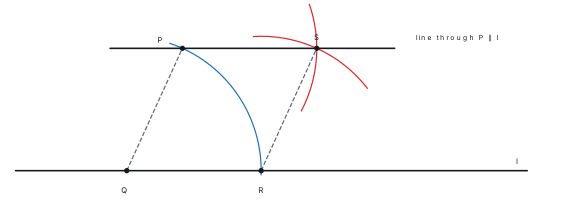
- Line through a point parallel to a given line — shown below, using a rhombus.
Parallel line through a point
Steps.
- Draw a line l and mark a point P not on it.
- Mark any point Q on l. Join PQ.
- With centre Q and radius QP draw an arc cutting l at R.
- With centres P and R and the same radius QP draw two arcs that cross at S.
- Join P and S and extend both ways. PS\parallel l.
Proof. PQ=QR=RS=SP (all equal to the radius), so PQRS is a rhombus; opposite sides of a rhombus are parallel, hence PS\parallel QR, that is PS\parallel l.
A triangle equal in area to a quadrilateral
The idea: the diagonal AC splits quadrilateral ABCD into \Delta ABC and \Delta ACD. We replace \Delta ACD by a triangle \Delta ACE with the same base AC and the apex E on a line through D parallel to AC. By the theorem of Chapter 13, \Delta ACE=\Delta ACD.
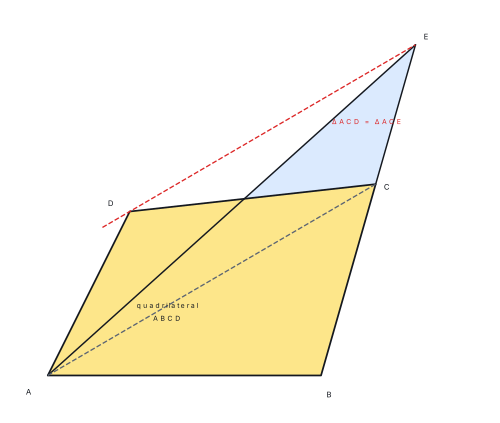
Problem. Construct a quadrilateral ABCD with AB=5 cm, BC=4 cm, CD=4 cm, DA=3.5 cm and \angle B=70^\circ, and construct a triangle equal in area to it.
Steps of construction.
- Draw AB=5 cm. At B construct \angle ABX=70^\circ and cut BC=4 cm along BX.
- With centre A radius 3.5 cm and centre C radius 4 cm draw arcs meeting at D. Join AD and CD. ABCD is the quadrilateral.
- Join the diagonal AC.
- Through D draw a line parallel to AC (use the rhombus method above).
- Produce BC to meet that line at E.
- Join AE. \Delta ABE is the required triangle.
Proof. \Delta ACD and \Delta ACE are on the same base AC and between the same parallels AC and DE, so \text{area}(\Delta ACD)=\text{area}(\Delta ACE). Adding \text{area}(\Delta ABC) to both:
Numerical check. For the quadrilateral A(0,0), B(5,0), C(6,3.5), D(1.5,3) of the figure, the shoelace formula gives area 15.125\text{ cm}^2, and the triangle ABE with E=(6.73,6.05) has area \frac{1}{2}\times5\times6.05=15.125\text{ cm}^2. ✓
- Rubbing out arcs. The examiner needs them as evidence of the method.
- A line through D that is only nearly parallel to AC — use the rhombus or set-square method carefully.
- Forgetting to produce (extend) BC far enough to meet the parallel line.
- Giving no steps or no proof: construction marks are usually split among figure, steps and justification.
- Measuring the given angle with the wrong scale on the protractor (70^\circ vs 110^\circ).
A parallelogram equal in area to a triangle
The idea: \text{area}(\Delta)=\frac{1}{2}\times\text{base}\times\text{height} and \text{area}(\text{parallelogram})=\text{base}\times\text{height}. So a parallelogram with half the base and the same height has the same area as the triangle.
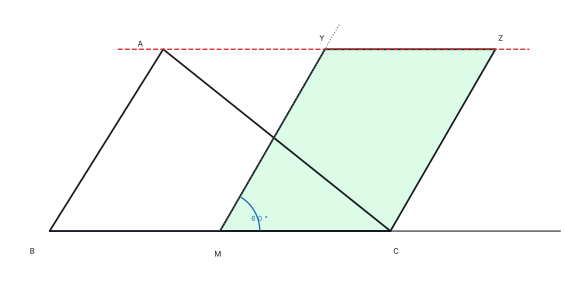
Problem. Construct \Delta ABC with BC=6 cm, AB=3.8 cm and \angle B=57^\circ. Then construct a parallelogram equal in area to it having one angle of 60^\circ.
Steps of construction.
- Construct \Delta ABC from the given data.
- Bisect BC (perpendicular bisector): M is the midpoint of BC.
- At M construct \angle CMX=60^\circ (the given angle).
- Through A draw a line parallel to BC meeting MX at Y.
- Through C draw a line parallel to MY meeting AY produced at Z.
- MCZY is the required parallelogram.
Proof. MC\parallel YZ and MY\parallel CZ, so MCZY is a parallelogram with \angle YMC=60^\circ. It stands on base MC=\frac{1}{2}BC and has the same height as \Delta ABC (the distance between the parallels BC and AY). So
Numerical check (figure: BC=6, height h=3.2): triangle \frac{1}{2}\times6\times3.2=9.6; parallelogram 3\times3.2=9.6. ✓
| Start with | Replace by | Key theorem |
|---|---|---|
| Triangle ACD | Triangle ACE (apex slid along a parallel to the base) | same base, same parallels |
| Quadrilateral | Triangle (one diagonal used) | as above, then add \Delta ABC |
| Triangle | Parallelogram on half the base (any angle) | triangle =\frac{1}{2} parallelogram |
| Triangle | Rectangle on half the base (angle 90^\circ) | special case of above |
| Pentagon | Quadrilateral, then triangle | apply the "slide the apex" step twice |
A rectangle equal to a triangle
Problem. Construct a rectangle equal in area to \Delta ABC (BC=6 cm, height 3.2 cm).
Steps. (1) Draw the triangle. (2) Bisect BC at M. (3) At M draw MX\perp BC. (4) Through A draw AY\parallel BC meeting MX at Y. (5) Through C draw CZ\perp BC meeting AY produced at Z. MCZY is a rectangle.
Proof. Its sides are MC=\frac{1}{2}BC=3 cm and MY=3.2 cm, so area =3\times3.2=9.6\text{ cm}^2=\frac{1}{2}\times6\times3.2=\text{area}(\Delta ABC).
A square equal to a rectangle
A square of side x equal to a rectangle a\times b needs x^2=ab, i.e. x=\sqrt{ab}: the geometric mean of the sides. The semicircle gives this length.
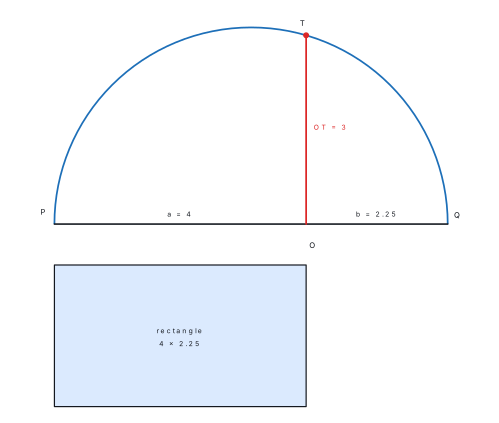
Problem. Construct a square equal in area to a rectangle of sides 4 cm and 2.25 cm.
Steps. (1) Draw PO=4 cm and produce it to Q so that OQ=2.25 cm. (2) Bisect PQ and draw a semicircle on PQ as diameter. (3) At O draw OT\perp PQ to meet the semicircle at T. (4) Construct a square on OT as a side.
Proof. The angle in a semicircle is a right angle: \angle PTQ=90^\circ. In the right triangle PTQ with altitude TO, the triangles POT and TOQ are similar, so \frac{PO}{OT}=\frac{OT}{OQ} and OT^2=PO\times OQ=4\times2.25=9. So OT=3 cm, and the square on OT has area 9\text{ cm}^2=4\times2.25. ✓
Constructing the triangle first
Many questions start with a triangle or quadrilateral described by lengths and angles. The standard cases are:
| Given | Method |
|---|---|
| SSS: three sides | base; two arcs from its ends |
| SAS: two sides and the included angle | base, angle at one end, cut off the side |
| ASA: two angles and the included side | base; two angles at its ends |
| Quadrilateral: 4 sides and 1 diagonal | two triangles on the diagonal |
| Quadrilateral: 4 sides and 1 angle | triangle from SAS, then arcs |
Problem. Construct \Delta PQR with PQ=7 cm, QR=5 cm and PR=6 cm. Find its area by Heron's formula and then construct a rectangle of the same area.
Solution. Area: s=\frac{7+5+6}{2}=9; \text{area}=\sqrt{9\times2\times4\times3}=\sqrt{216}=14.70\text{ cm}^2. Construct the triangle by drawing PQ=7 cm and arcs of radius 6 cm from P and 5 cm from Q. The rectangle has base \frac{1}{2}PQ=3.5 cm and height equal to the height of R above PQ: h=\frac{2\times14.70}{7}=4.20 cm. Check: 3.5\times4.20=14.7. ✓
14.2 Exercises of the SEE type
Method for any question
- Read the data and draw a rough sketch with all measurements.
- Construct the given figure accurately (SSS/SAS/ASA, etc.).
- Draw the diagonal or the median that the method needs, in a light line.
- Draw the parallel line through the vertex you are replacing; produce the side to meet it.
- Darken the required figure; label every vertex; keep the arcs.
- Write the steps and a two-line proof referring to "same base, same parallels".
Problem. Construct a quadrilateral ABCD with AB=4.5 cm, BC=3.5 cm, CD=4 cm, DA=3 cm and diagonal AC=5 cm. Construct a triangle equal in area to it.
Solution (outline). Triangle ABC from three sides (4.5, 3.5, 5). Triangle ACD on the other side of AC from sides AD=3 and CD=4 (arcs from A and C). Through D draw DE\parallel AC meeting BC produced at E. Join AE: \Delta ABE is the answer, because \Delta ACD=\Delta ACE.
Area check. \Delta ACD has sides 3,4,5, a right-angled triangle of area 6\text{ cm}^2. \Delta ABC: s=6.5, area =\sqrt{6.5\times2\times3\times1.5}=\sqrt{58.5}=7.65\text{ cm}^2. Quadrilateral area =13.65\text{ cm}^2, which equals \text{area}(\Delta ABE).
Problem. Construct \Delta ABC with AB=5 cm, BC=6 cm, CA=4.5 cm and a parallelogram equal in area to it with one angle of 45^\circ.
Solution (outline). \Delta ABC from SSS. Mark the midpoint M of BC. At M construct 45^\circ to MC. Through A draw AY\parallel BC meeting the new ray at Y. Through C draw CZ\parallel MY meeting AY produced at Z. MCZY is the parallelogram, with area MC\times h=\frac{1}{2}BC\times h=\text{area}(\Delta ABC).
Area check. s=7.75; area =\sqrt{7.75\times2.75\times1.75\times3.25}=\sqrt{121.2}=11.01\text{ cm}^2, height on BC is \frac{2\times11.01}{6}=3.67 cm; parallelogram 3\times3.67=11.01. ✓
Chapter summary
- Constructions use only a ruler and compass (a protractor only for a given angle); keep all arcs.
- Parallel through a point: rhombus method with equal radii.
- Triangle = quadrilateral: join diagonal AC; through D draw DE\parallel AC meeting BC produced at E; \Delta ABE has the same area.
- Parallelogram = triangle: bisect the base; draw the given angle at the midpoint; parallels through the apex and through the end of the base.
- Rectangle = triangle: same, with 90^\circ. Square = rectangle: semicircle on a+b; the perpendicular at the junction is \sqrt{ab}.
- The proofs rest on: triangles on the same base between the same parallels are equal in area; a triangle is half a parallelogram.
- Steps + figure + proof earns the full marks.
Practice questions
Group A — Multiple choice (1 mark each)
- Which tool may be used to draw an arc in a construction? [1]arulerbcompassccalculatordset square only
- To change a quadrilateral into a triangle of equal area we draw a line through a vertex parallel to [1]aa sidebthe diagonal that does not pass through that vertexcthe perpendicular bisectordthe angle bisector
- A parallelogram equal in area to a triangle is constructed on [1]athe full basebhalf the basecdouble the basedthe hypotenuse
- The side of a square equal in area to a rectangle 9\times4 is [1]a5b6c36d13
- The angle in a semicircle is [1]a60^\circb45^\circc90^\circd180^\circ
Answers to Group A
1. (b).
2. (b) — parallel to the diagonal AC through D.
3. (b) — base halves, height unchanged.
4. (b) — \sqrt{9\times4}=6.
5. (c).
Group B — Short answer (2 marks each)
- Describe how to draw a line through a point P parallel to a line l using only compass and ruler. [2]
- A triangle has base 8 cm and height 5 cm. What base and height does a rectangle of equal area have if its base is half the triangle's base? [2]
- Why are triangles ACD and ACE equal in area in the quadrilateral construction? [2]
- Find the side of a square equal in area to a rectangle 12\text{ cm}\times3\text{ cm}. [2]
Answers to Group B
1. Mark Q on l; arc centre Q radius QP cuts l at R; arcs of the same radius from P and R meet at S; line PS is parallel to l (rhombus PQRS).
2. Base 4 cm, height 5 cm: 4\times5=20=\frac{1}{2}\times8\times5.
3. Same base AC and same parallels AC, DE, hence the same height.
4. \sqrt{36}=6 cm.
Group C — Short answer (3 marks each)
- Construct \Delta ABC with AB=5 cm, BC=6 cm, \angle B=60^\circ. Bisect BC at M. [3]
- Construct a parallelogram equal in area to the triangle of question 1, having an angle of 60^\circ at M. [3]
- Construct a rectangle of sides 5 cm and 3.2 cm; state the steps to construct a square of equal area. [3]
- Show by calculation that a triangle with base 10 cm and height 7.2 cm equals a parallelogram of base 5 cm and height 7.2 cm. [3]
Answers to Group C
1. Draw BC=6, angle 60^\circ at B, cut BA=5; the perpendicular bisector of BC gives M.
2. As in the worked example: MY at 60^\circ to MC, AY\parallel BC, CZ\parallel MY.
3. Extend 5 to 5+3.2=8.2; semicircle; perpendicular at the junction gives \sqrt{5\times3.2}=\sqrt{16}=4 cm; square of side 4 cm (area 16 = 5\times3.2).
4. Triangle: \frac{1}{2}\times10\times7.2=36; parallelogram: 5\times7.2=36.
Group D — Long answer (4 marks each)
- Construct quadrilateral ABCD with AB=5 cm, BC=4 cm, CD=4 cm, DA=3.5 cm and \angle B=70^\circ, and construct a triangle equal in area to it. Give steps and proof. [4]
- Construct \Delta ABC with BC=6 cm, \angle B=57^\circ, AB=3.8 cm. Construct a parallelogram equal in area with one angle of 60^\circ. [4]
- Construct a square equal in area to a rectangle 6\text{ cm}\times 2\text{ cm} and prove that your square has the right area. [4]
- Construct \Delta PQR with sides 7, 5, 6 cm and a rectangle equal to it, giving the rectangle's dimensions. [4]
Answers to Group D
1. Follow the worked example; area check 15.125\text{ cm}^2 for the coordinates used there.
2. Follow the worked example; area of the triangle is \frac{1}{2}\times6\times3.8\times\sin57^\circ\approx9.56\text{ cm}^2.
3. \sqrt{6\times2}=\sqrt{12}\approx3.46 cm: semicircle on PQ=8 with the perpendicular at the junction of 6 and 2; OT^2=12.
4. Area \sqrt{216}\approx14.70\text{ cm}^2; rectangle 3.5\text{ cm}\times4.2\text{ cm}.
Practise more: Mathematics question bank