Unit 11 · Compulsory Mathematics · 9 min read
Algebraic Fraction
What the syllabus asks for 2
- Algebraic Fraction: concepts, formulas and worked problems
- Exercises of the SEE type
A fraction such as \frac{3}{4} has numbers on the top and bottom. An algebraic fraction has algebraic expressions there, for example \frac{x^2-9}{x^2+5x+6}. We add, subtract, multiply, divide and simplify algebraic fractions by exactly the same rules as ordinary fractions; the only new skill is factorisation, because we can cancel only factors, never terms. Algebraic fractions appear in formulae for speed, work and electricity, and in the SEE they give a dependable 3- or 4-mark question on simplification.
Expect: (i) reduce a fraction to its lowest terms by factorising; (ii) add or subtract two or three fractions with different denominators using the LCM; (iii) multiply or divide fractions and simplify to a single expression; (iv) a "simplify" or "prove" question combining all of these, often ending in a surprisingly simple answer like 1 or x+1. Factorise first, cancel second, and write every step.
11.1 Algebraic Fraction: concepts, formulas and worked problems
Factorisation toolkit
Everything in this chapter rests on these factorisations. Learn them until you can see them at a glance.
| Type | Method | Example |
|---|---|---|
| Common factor | take out the HCF | 6x^2+9x=3x(2x+3) |
| Difference of squares | a^2-b^2 | x^2-25=(x+5)(x-5) |
| Trinomial x^2+px+q | two numbers with sum p, product q | x^2+5x+6=(x+2)(x+3) |
| Trinomial ax^2+bx+c | split the middle term | 2x^2+7x+3=(2x+1)(x+3) |
| Grouping | pair the terms | ax+ay+bx+by=(a+b)(x+y) |
| Sum / difference of cubes | the two formulas above | x^3-8=(x-2)(x^2+2x+4) |
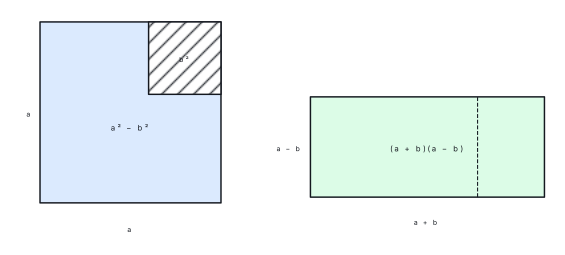
Problem. Factorise (a) x^2-7x+12, (b) 3x^2-x-2, (c) a^3+27.
Solution. (a) We need two numbers with product 12 and sum -7: -3 and -4. So x^2-7x+12=(x-3)(x-4).
(b) 3\times(-2)=-6; split -x as -3x+2x: 3x^2-3x+2x-2=3x(x-1)+2(x-1)=(x-1)(3x+2).
(c) a^3+27=a^3+3^3=(a+3)(a^2-3a+9).
Reducing to lowest terms
You may cancel only a common factor of the whole numerator and the whole denominator. Never cancel a term that is added or subtracted: \frac{x+3}{x+5} is already in lowest terms, and it is not \frac{3}{5}.
Problem. Simplify \frac{x^2-9}{x^2+5x+6}.
Solution. Factorise both parts: x^2-9=(x+3)(x-3) and x^2+5x+6=(x+2)(x+3). Then
Check with x=1. Original: \frac{1-9}{1+5+6}=\frac{-8}{12}=-\frac{2}{3}. Answer: \frac{1-3}{1+2}=-\frac{2}{3}. ✓
Problem. Simplify \frac{a^2-a-6}{a^2-9}.
Solution. a^2-a-6=(a-3)(a+2) and a^2-9=(a-3)(a+3). Cancel (a-3):
Problem. Simplify \frac{x^3-8}{x^2-4}.
Solution. x^3-8=(x-2)(x^2+2x+4) and x^2-4=(x-2)(x+2). So the fraction is \frac{x^2+2x+4}{x+2}.
- Cancelling terms: \frac{x+3}{x+5}\ne\frac{3}{5} and \frac{x^2+4}{x+4}\ne x.
- Forgetting a bracket when subtracting a fraction: \frac{1}{a}-\frac{b-c}{a}=\frac{1-(b-c)}{a}, not \frac{1-b-c}{a}.
- Cancelling before factorising — if you cannot see a common factor, factorise first.
- Writing "=0" when numerators cancel: \frac{x}{x}=1, not 0.
HCF and LCM of expressions
To add fractions you need a common denominator, and the best one is the lowest common multiple (LCM) of the denominators. As in Chapter 8, factorise first. The HCF takes each common factor with its smallest power; the LCM takes every factor that appears, with its largest power.
| Expressions | Factorised | HCF | LCM |
|---|---|---|---|
| x^2-4 and x^2+4x+4 | (x-2)(x+2) and (x+2)^2 | x+2 | (x-2)(x+2)^2 |
| x^2-x-6 and x^2-9 | (x-3)(x+2) and (x-3)(x+3) | x-3 | (x-3)(x+2)(x+3) |
| 6x^2y and 9xy^2 | 2\cdot3\cdot x^2y and 3^2\cdot xy^2 | 3xy | 18x^2y^2 |
Problem. Add \frac{1}{x^2-4}+\frac{1}{x^2+4x+4}.
Solution. From the table the LCM is (x-2)(x+2)^2. Multiply the first fraction's top and bottom by (x+2) and the second's by (x-2):
Check with x=3. \frac{1}{5}+\frac{1}{25}=\frac{6}{25}, and the answer gives \frac{6}{1\times25}=\frac{6}{25} ✓.
Multiplication and division
To divide, invert the second fraction and multiply. Factorise everything and cancel before multiplying out.
Problem. Simplify \frac{x^2-5x+6}{x^2-4}\times\frac{x+2}{x-3}.
Solution. x^2-5x+6=(x-2)(x-3) and x^2-4=(x-2)(x+2). Thus
Every factor cancels, leaving 1.
Problem. Simplify \frac{a^2-b^2}{a^2+2ab+b^2}\div\frac{a-b}{a+b}.
Solution. Factorise: \frac{(a+b)(a-b)}{(a+b)^2}\times\frac{a+b}{a-b}. The factors (a+b) and (a-b) cancel completely:
Problem. Simplify \frac{x^2+3x+2}{x^2+x-2}\times\frac{x^2-1}{x^2+2x}.
Solution. x^2+3x+2=(x+1)(x+2), x^2+x-2=(x+2)(x-1), x^2-1=(x+1)(x-1), x^2+2x=x(x+2). So
Cancel (x+2) once and (x-1) once:
Addition and subtraction
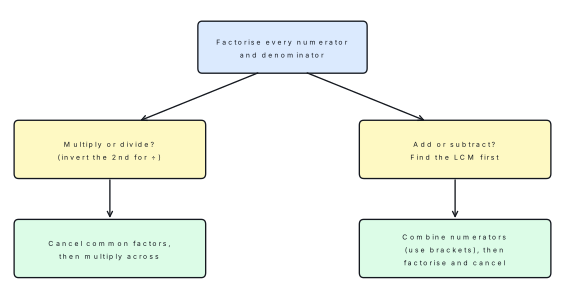
- Factorise every denominator.
- Find the LCM of the denominators: each different factor once, with its highest power.
- Rewrite each fraction with the LCM as denominator (multiply top and bottom by the missing factors).
- Add or subtract the numerators — put brackets round numerators that are subtracted.
- Simplify the numerator; factorise and cancel if possible.
Problem. Simplify \frac{x}{x^2-y^2}-\frac{y}{x^2-y^2}.
Solution. The denominators are equal, so \frac{x-y}{x^2-y^2}=\frac{x-y}{(x-y)(x+y)}=\frac{1}{x+y}.
Problem. Simplify \frac{1}{x-1}+\frac{1}{x+1}.
Solution. The LCM is (x-1)(x+1).
Problem. Simplify \frac{x}{x-2}-\frac{2}{x+2}.
Solution. LCM =(x-2)(x+2).
The numerator x^2+4 does not factorise, so this is the final answer.
Problem. Simplify \frac{2}{x^2-1}+\frac{1}{x+1}-\frac{1}{x-1}.
Solution. x^2-1=(x+1)(x-1), so the LCM is (x+1)(x-1):
Problem. Simplify \frac{1}{x-2}-\frac{1}{x-1}-\frac{1}{(x-1)(x-2)}.
Solution. The LCM is (x-1)(x-2).
Problem. Simplify \frac{x+2}{x-2}-\frac{x-2}{x+2}.
Solution. LCM =(x-2)(x+2). Numerator: (x+2)^2-(x-2)^2=(x^2+4x+4)-(x^2-4x+4)=8x.
Fractions inside fractions
Problem. Simplify \frac{x^2-\frac{1}{x^2}}{x-\frac{1}{x}}.
Solution. Put p=x and q=\frac{1}{x}. Then the numerator is p^2-q^2 and the denominator is p-q. Therefore
Problem. Simplify \frac{1}{1-\frac{1}{1+\frac{1}{x}}}.
Solution. Work from the inside out.
- 1+\frac{1}{x}=\frac{x+1}{x}, so its reciprocal is \frac{x}{x+1}.
- 1-\frac{x}{x+1}=\frac{(x+1)-x}{x+1}=\frac{1}{x+1}.
- The reciprocal of \frac{1}{x+1} is x+1.
The answer is x+1.
Problem. Simplify \left(x+\frac{1}{x}\right)^2-\left(x-\frac{1}{x}\right)^2.
Solution. Use a^2-b^2=(a+b)(a-b): here a+b=2x and a-b=\frac{2}{x}. The product is 2x\times\frac{2}{x}=4.
A fraction is undefined when its denominator is 0. In \frac{x-3}{x+2} we need x\ne-2. In the SEE you are rarely asked to state this, but you must never put a value in that makes a denominator zero when you check an answer.
Equations with algebraic fractions
Multiply every term by the LCM of the denominators to clear the fractions, solve the resulting equation, and reject any answer that makes a denominator zero.
Problem. Solve \frac{1}{x-1}+\frac{1}{x+1}=\frac{4}{3}.
Solution. The left side is \frac{2x}{x^2-1} (done above). Then
Factorise: (2x+1)(x-2)=0, so x=-\frac{1}{2} or x=2. Neither makes a denominator zero, so both are valid.
Check x=2. \frac{1}{1}+\frac{1}{3}=\frac{4}{3}. ✓
Problem. Solve \frac{3}{x-1}-\frac{2}{x+1}=1.
Solution. Multiply by (x-1)(x+1):
So x^2-x-6=0, (x-3)(x+2)=0 and x=3 or x=-2.
More patterns to practise
Problem. Simplify \frac{x^2+x-12}{x^2-16}.
Solution. x^2+x-12=(x+4)(x-3) and x^2-16=(x+4)(x-4). Cancel (x+4):
Check with x=5. Original: \frac{25+5-12}{25-16}=\frac{18}{9}=2. Answer: \frac{5-3}{5-4}=2. ✓
Problem. Simplify \frac{2x^2+5x-3}{2x^2-5x+2}.
Solution. For the top, 2\times(-3)=-6 and 5=6-1: 2x^2+6x-x-3=2x(x+3)-1(x+3)=(2x-1)(x+3). For the bottom, 2\times2=4 and -5=-4-1: 2x^2-4x-x+2=2x(x-2)-1(x-2)=(2x-1)(x-2). Cancel (2x-1):
Problem. Simplify \frac{a^2-4a+4}{a^2-4}\times\frac{a+2}{a-2}.
Solution. a^2-4a+4=(a-2)^2 and a^2-4=(a-2)(a+2). So
Problem. Simplify \frac{x}{x-3}-\frac{x+3}{x^2-9}.
Solution. x^2-9=(x-3)(x+3), so the second fraction reduces first: \frac{x+3}{(x-3)(x+3)}=\frac{1}{x-3}. Now the denominators are equal:
Always look for a fraction that can be reduced before you find the LCM; it saves work.
Problem. Simplify \frac{1}{x-3}+\frac{1}{x+3}+\frac{6}{x^2-9}.
Solution. LCM =(x-3)(x+3).
Problem. Simplify \frac{x^2-9}{x^2-4x+3}\div\frac{x+3}{x-1}.
Solution. x^2-4x+3=(x-1)(x-3) and x^2-9=(x-3)(x+3). Invert the divisor:
Problem. Simplify \frac{x^2}{x-y}-\frac{y^2}{x-y}.
Solution. \frac{x^2-y^2}{x-y}=\frac{(x-y)(x+y)}{x-y}=x+y.
Problem. Simplify \frac{a^3-b^3}{a^2-b^2}\times\frac{a+b}{a^2+ab+b^2}.
Solution. a^3-b^3=(a-b)(a^2+ab+b^2) and a^2-b^2=(a-b)(a+b). Hence
Problem. Simplify \frac{\frac{1}{x}-\frac{1}{y}}{\frac{1}{x^2}-\frac{1}{y^2}}.
Solution. The numerator is \frac{y-x}{xy}. The denominator is \frac{y^2-x^2}{x^2y^2}=\frac{(y-x)(y+x)}{x^2y^2}. Dividing,
Problem. Solve \frac{x}{x-2}+\frac{x-2}{x}=\frac{5}{2}.
Solution. Multiply by 2x(x-2): 2x^2+2(x-2)^2=5x(x-2). Expand: 2x^2+2x^2-8x+8=5x^2-10x, so x^2-2x-8=0 and (x-4)(x+2)=0. Hence x=4 or x=-2.
Check x=4. \frac{4}{2}+\frac{2}{4}=2.5 ✓. Check x=-2. \frac{-2}{-4}+\frac{-4}{-2}=0.5+2=2.5 ✓.
Problem. Solve \frac{x-2}{x-3}+\frac{x-4}{x-5}=\frac{10}{3}.
Solution. Multiply by 3(x-3)(x-5): 3(x-2)(x-5)+3(x-4)(x-3)=10(x-3)(x-5). Expanding, 3(x^2-7x+10)+3(x^2-7x+12)=10(x^2-8x+15), i.e. 6x^2-42x+66=10x^2-80x+150, which gives 4x^2-38x+84=0 or 2x^2-19x+42=0. Then (2x-7)(x-6)=0 and x=\frac{7}{2} or x=6.
11.2 Exercises of the SEE type
Method for any question
- Factorise each numerator and denominator completely.
- For \times,\div: invert the divisor, cancel common factors, multiply what remains.
- For +,-: LCM of denominators, bracket every numerator being subtracted.
- Check by substituting a small number (such as x=2 or x=3) in the question and the answer. They must agree.
- Present the answer in lowest terms.
Problem. Simplify \frac{a}{a-b}-\frac{b}{a+b}-\frac{2ab}{a^2-b^2}.
Solution. LCM =(a-b)(a+b)=a^2-b^2.
The numerator is (a-b)^2, so the expression equals \frac{(a-b)^2}{(a-b)(a+b)}=\frac{a-b}{a+b}.
Problem. Simplify \frac{1}{x+1}+\frac{2}{x+2}-\frac{3}{x+3}.
Solution. The LCM is (x+1)(x+2)(x+3). The numerator is
Expand each part: x^2+5x+6, 2x^2+8x+6 and 3x^2+9x+6. So the numerator is (x^2+2x^2-3x^2)+(5x+8x-9x)+(6+6-6), which equals 4x+6. Hence
Check with x=1. Left: \frac{1}{2}+\frac{2}{3}-\frac{3}{4}=\frac{5}{12}. Right: \frac{2\times5}{2\times3\times4}=\frac{5}{12}. ✓
Problem. Show that \frac{x^2+3x+2}{x+1}+\frac{x^2-x-6}{x-3}=2(x+2).
Solution. x^2+3x+2=(x+1)(x+2), so the first fraction is x+2. x^2-x-6=(x-3)(x+2), so the second fraction is x+2. The sum is (x+2)+(x+2)=2(x+2). Proved.
Problem. A rectangle has area x^2+7x+12 and length x+4. Find its breadth, and the ratio of the breadth to the length.
Solution. Breadth =\frac{\text{area}}{\text{length}}=\frac{x^2+7x+12}{x+4}=\frac{(x+3)(x+4)}{x+4}=x+3. The ratio is \frac{x+3}{x+4}.
Chapter summary
- Factorisation formulas: a^2-b^2=(a+b)(a-b); (a\pm b)^2; a^3\pm b^3=(a\pm b)(a^2\mp ab+b^2); trinomials by sum and product or by splitting the middle term.
- Cancel only factors, never added terms.
- \frac{p}{q}\times\frac{r}{s}=\frac{pr}{qs}; \frac{p}{q}\div\frac{r}{s}=\frac{p}{q}\times\frac{s}{r}.
- To add or subtract: factorise the denominators, take the LCM, rewrite, combine numerators with brackets, simplify.
- Complex fractions: simplify the inside first; x^2-\frac{1}{x^2}=\left(x+\frac{1}{x}\right)\left(x-\frac{1}{x}\right).
- Fractional equations: multiply by the LCM; reject roots that zero a denominator.
- Always check with a small number such as x=2.
Practice questions
Group A — Multiple choice (1 mark each)
- Factorise x^2-16. [1]a(x-4)^2b(x+4)(x-4)c(x+8)(x-2)dx(x-16)
- \frac{x^2-1}{x-1} in its simplest form is [1]ax+1bx-1cxd1
- The LCM of x-2 and x^2-4 is [1]ax-2bx+2cx^2-4d(x-2)(x^2-4)
- \frac{3}{x}+\frac{2}{x}= [1]a\frac{5}{2x}b\frac{5}{x}c\frac{6}{x}d\frac{5}{x^2}
- \frac{a}{b}\div\frac{c}{d}= [1]a\frac{ac}{bd}b\frac{ad}{bc}c\frac{bc}{ad}d\frac{ab}{cd}
Answers to Group A
1. (b) — difference of squares.
2. (a) — \frac{(x+1)(x-1)}{x-1}=x+1.
3. (c) — x^2-4=(x-2)(x+2) already contains x-2.
4. (b) — same denominator, add numerators.
5. (b) — invert the divisor.
Group B — Short answer (2 marks each)
- Factorise x^2+5x+6. [2]
- Simplify \frac{x^2-9}{x^2+6x+9}. [2]
- Simplify \frac{x}{x+1}+\frac{1}{x+1}. [2]
- Simplify \frac{x+2}{x-3}\times\frac{x-3}{x^2-4}. [2]
Answers to Group B
1. (x+2)(x+3).
2. \frac{(x+3)(x-3)}{(x+3)^2}=\frac{x-3}{x+3}.
3. \frac{x+1}{x+1}=1.
4. \frac{x+2}{x-3}\times\frac{x-3}{(x-2)(x+2)}=\frac{1}{x-2}.
Group C — Short answer (3 marks each)
- Simplify \frac{1}{x-1}+\frac{1}{x+1}. [3]
- Simplify \frac{x^2-5x+6}{x^2-4}\div\frac{x-3}{x+2}. [3]
- Simplify \frac{x}{x-2}-\frac{2}{x+2}. [3]
- Simplify \left(x+\frac{1}{x}\right)^2-\left(x-\frac{1}{x}\right)^2. [3]
Answers to Group C
1. \frac{2x}{x^2-1}.
2. \frac{(x-2)(x-3)}{(x-2)(x+2)}\times\frac{x+2}{x-3}=1.
3. \frac{x^2+4}{x^2-4}.
4. 4.
Group D — Long answer (4 marks each)
- Simplify \frac{a}{a-b}-\frac{b}{a+b}-\frac{2ab}{a^2-b^2}. [4]
- Simplify \frac{x^2+3x+2}{x^2+x-2}\times\frac{x^2-1}{x^2+2x}. [4]
- Simplify \frac{1}{1-\frac{1}{1+\frac{1}{x}}}. [4]
- Solve \frac{3}{x-1}-\frac{2}{x+1}=1. [4]
Answers to Group D
1. \frac{a-b}{a+b}.
2. \frac{(x+1)^2}{x(x+2)}.
3. x+1.
4. x=3 or x=-2.
Practise more: Mathematics question bank