Unit 7 · Compulsory Mathematics · 13 min read
Prism and Pyramid
What the syllabus asks for 2
- Prism and Pyramid: concepts, formulas and worked problems
- Exercises of the SEE type
A room, a water tank, a tent, a roof, a Toblerone box and a temple spire are all prisms or pyramids. A prism has the same cross-section all along its length; a pyramid narrows from a flat base to a single point. This chapter gives the surface area and volume of the cuboid, cube, triangular and other prisms, the square pyramid, and — as a close relative — the cone. You will also learn to find the slant height from the height using Pythagoras, because almost every pyramid question needs it.
Typical 3- or 4-mark questions: (i) surface area and volume of a triangular prism or a prism with a trapezium base; (ii) area of the four walls of a room and the cost of painting; (iii) a square pyramid where the height is given and you must find the slant height (or the reverse) before finding the surface area and volume; (iv) volume of a pyramid and finding the missing height; (v) a tent (pyramid or cone) and the cloth needed. Unit conversions: 1 dm³ =1 litre, 1 m³ =1000 litres.
7.1 Prism and Pyramid: concepts, formulas and worked problems
Prisms
A prism is a solid whose two ends are equal, parallel polygons (the bases) and whose side faces are rectangles (in a right prism). The prism is named after its base: triangular prism, rectangular prism (cuboid), hexagonal prism. The height (or length) h of the prism is the distance between the two bases.
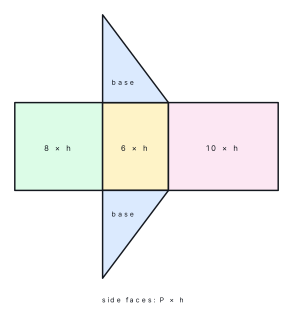
The lateral surface is the sides only (not the bases). Because the side faces are rectangles of height h whose widths are the sides of the base, they unroll into one big rectangle of length equal to the perimeter of the base.
Let P be the perimeter of the base, A the area of the base and h the height.
- Lateral surface area (LSA) is also called the area of the four walls for a cuboid.
- Volume = area of the cross-section \times length.
Cuboid and cube
For a cuboid of length l, breadth b and height h the general formulas become:
| Solid | LSA | TSA | Volume | Diagonal |
|---|---|---|---|---|
| Cuboid | 2h(l+b) | 2(lb+bh+hl) | lbh | \sqrt{l^2+b^2+h^2} |
| Cube (side a) | 4a^2 | 6a^2 | a^3 | a\sqrt{3} |
Problem. A cuboid has length 12 cm, breadth 4 cm and height 3 cm. Find its lateral surface area, total surface area, volume and diagonal.
Solution. \text{LSA}=2h(l+b)=2\times 3\times(12+4)=96\text{ cm}^2.
\text{TSA}=2(lb+bh+hl)=2(48+12+36)=192\text{ cm}^2.
V=lbh=12\times 4\times 3=144\text{ cm}^3.
Diagonal =\sqrt{12^2+4^2+3^2}=\sqrt{144+16+9}=\sqrt{169}=13 cm.
Problem. A hall is 10 m long, 8 m wide and 4 m high. It has one door 2.5\text{ m}\times 1.2\text{ m} and two windows each 1.5\text{ m}\times 1\text{ m}. Find the cost of painting the four walls at Rs 15 per m².
Solution. Area of four walls =2h(l+b)=2\times 4\times(10+8)=144\text{ m}^2.
Door =2.5\times 1.2=3\text{ m}^2; two windows =2\times 1.5\times 1=3\text{ m}^2. Total opening =6\text{ m}^2.
Area to be painted =144-6=138\text{ m}^2.
Cost =138\times 15=\text{Rs } 2{,}070.
Problem. A rectangular water tank is 2.5 m long, 2 m wide and 1.2 m deep. How many litres does it hold? How much sheet metal is needed for the tank, if it is open at the top?
Solution. V=2.5\times 2\times 1.2=6\text{ m}^3=6\times 1000=6000 litres.
Open tank: base + four walls =lb+2h(l+b)=2.5\times 2+2\times 1.2\times(2.5+2)=5+10.8=15.8\text{ m}^2.
Triangular and other prisms
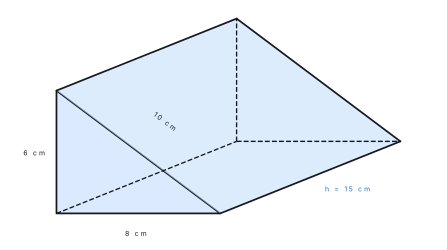
Problem. The base of a prism is a right-angled triangle with sides 6 cm, 8 cm and 10 cm. The length of the prism is 15 cm. Find its lateral surface area, total surface area and volume.
Solution. Perimeter of base P=6+8+10=24 cm.
Area of base A=\dfrac12\times 6\times 8=24\text{ cm}^2.
\text{LSA}=P\times h=24\times 15=360\text{ cm}^2.
\text{TSA}=360+2\times 24=408\text{ cm}^2.
V=A\times h=24\times 15=360\text{ cm}^3.
Problem. A water trough has a trapezium cross-section with parallel sides 10 dm and 6 dm, the distance between them 4 dm, and slanting sides 5 dm each. The trough is 20 dm long. Find its volume in litres and its total surface area.
Solution. Area of base A=\dfrac12(10+6)\times 4=32\text{ dm}^2.
Volume =A\times h=32\times 20=640\text{ dm}^3=640 litres (1 dm³ =1 litre).
Perimeter of base =10+6+5+5=26 dm, so \text{LSA}=26\times 20=520\text{ dm}^2.
\text{TSA}=520+2\times 32=584\text{ dm}^2.
- Using the slant side of a trapezium or triangle as the height in the area formula. The base area needs the perpendicular height.
- Adding the two bases to the lateral surface area. LSA is the sides only.
- Writing the volume in cm² or the area in cm³. Area is square units; volume is cubic units.
- For an open tank, counting the top face as well.
Pyramids
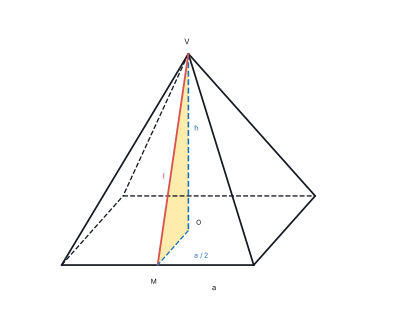
A pyramid has a polygon as its base and triangular side faces that meet at a point called the apex (vertex). In a right regular pyramid the base is a regular polygon and the apex is directly above its centre. Two lengths matter:
- the height h — perpendicular distance from the apex to the base;
- the slant height l — the height of one triangular face, from the apex to the middle of a base edge.
We show the rule for a special pyramid, using a cube; the rule is the same for every pyramid with the same base area and height.
Setting up. Take a cube of side a. Join its centre O to the 8 vertices. The cube is cut into six identical square pyramids, each with a face of the cube as its base and O as its apex.
Step 1 — volume of the cube. V_{\text{cube}}=a^3.
Step 2 — volume of each pyramid. The six pyramids are equal, so
Step 3 — the base and height of one of them. Base area =a^2 and the height (from O to the face) =\dfrac a2.
Step 4 — compare.
Result. V=\dfrac13\times(\text{area of base})\times(\text{height}).
What it means. A pyramid is exactly one third of the prism with the same base and height: three pyramids fill that prism. (Likewise a cone is one third of the cylinder.)
Problem. A square pyramid has base side 10 cm and slant height 13 cm. Find its height, lateral surface area, total surface area and volume.
Solution. Half the base side =5 cm.
\text{LSA}=2al=2\times 10\times 13=260\text{ cm}^2.
\text{TSA}=260+10^2=360\text{ cm}^2.
V=\dfrac13\times 10^2\times 12=400\text{ cm}^3.
Problem. A square pyramid has base side 16 cm and height 6 cm. Find the slant height, TSA and volume.
Solution. Half the side =8 cm.
\text{LSA}=2al=2\times 16\times 10=320\text{ cm}^2; \text{TSA}=320+16^2=576\text{ cm}^2.
V=\dfrac13\times 256\times 6=512\text{ cm}^3.
Problem. The volume of a square pyramid is 1,125 cm³ and its base side is 15 cm. Find its height.
Solution. V=\dfrac13a^2h:
Problem. A tent is in the shape of a square pyramid with base side 6 m and height 4 m. Find the cloth needed for its four sides (the floor is not covered), the cost at Rs 120 per m², and the volume of air inside.
Solution. l=\sqrt{4^2+3^2}=\sqrt{25}=5 m.
Cloth =\text{LSA}=2al=2\times 6\times 5=60\text{ m}^2.
Cost =60\times 120=\text{Rs } 7{,}200.
Volume of air =\dfrac13\times 6^2\times 4=48\text{ m}^3.
Problem. A metal cube of side 6 cm is melted and recast into square pyramids of base side 6 cm and height 6 cm. How many pyramids are made?
Solution. Volume of cube =6^3=216\text{ cm}^3. Volume of one pyramid =\dfrac13\times 6^2\times 6=72\text{ cm}^3.
Number =\dfrac{216}{72}=3 pyramids.
The cone: a round pyramid
A right circular cone has a circular base of radius r, height h and slant height l along the surface from the apex to the rim of the base.
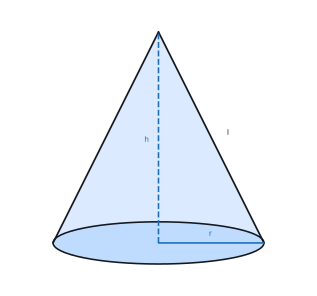
Problem. A cone has radius 7 cm and height 24 cm. Find its slant height, curved surface area, total surface area and volume.
Solution. l=\sqrt{r^2+h^2}=\sqrt{49+576}=\sqrt{625}=25 cm.
\text{CSA}=\pi rl=\dfrac{22}{7}\times 7\times 25=550\text{ cm}^2.
\text{TSA}=\pi r(r+l)=\dfrac{22}{7}\times 7\times 32=704\text{ cm}^2.
V=\dfrac13\pi r^2h=\dfrac13\times\dfrac{22}{7}\times 49\times 24=1232\text{ cm}^3.
In a pyramid or a cone, the height, the slant height and the half-base (or radius) form a right-angled triangle with the slant height as hypotenuse. Sketch it and apply Pythagoras before anything else. The usual Pythagorean triples are (3,4,5), (5,12,13), (8,15,17), (7,24,25) and their multiples.
7.2 Exercises of the SEE type
Method
- Identify the solid (prism, pyramid, cone). Draw it and mark every length.
- Prism: find the base area A and base perimeter P; then LSA =Ph, TSA =Ph+2A, V=Ah.
- Pyramid or cone: find l by Pythagoras from h (or h from l).
- Use the formula; keep fractions such as \frac13 until the end.
- For cost questions multiply the area by the rate; for capacity convert to litres.
- Write each answer with the correct unit (square for area, cube for volume).
Chapter summary
- Right prism: LSA =Ph, TSA =Ph+2A, V=Ah (P base perimeter, A base area).
- Cuboid: LSA =2h(l+b), TSA =2(lb+bh+hl), V=lbh, diagonal =\sqrt{l^2+b^2+h^2}.
- Cube: TSA =6a^2, V=a^3.
- Square pyramid: l^2=h^2+(\frac a2)^2, LSA =2al, TSA =2al+a^2, V=\frac13a^2h.
- A pyramid is one third of the prism with the same base and height.
- Cone: l^2=r^2+h^2, CSA =\pi rl, TSA =\pi r(r+l), V=\frac13\pi r^2h.
- 1 dm³ =1 litre; 1 m³ =1000 litres.
- The four walls of a room: 2h(l+b) minus the doors and windows.
Practice questions
Group A — Multiple choice (1 mark each)
- The volume of a prism is [1]aperimeter of base \times heightbarea of base \times heightc\frac13\times area of base \times heightd2\times area of base \times height
- The volume of a pyramid is [1]abase area \times heightb\frac12\times base area \times heightc\frac13\times base area \times heightd\frac14\times base area \times height
- The area of the four walls of a room of length l, breadth b and height h is [1]albhb2(lb+bh+hl)c2h(l+b)d2lb
- The slant height of a square pyramid of base side 10 cm and height 12 cm is [1]a11 cmb13 cmc15 cmd22 cm
- The total surface area of a cube of side 6 cm is [1]a36 cm²b144 cm²c216 cm²d72 cm²
Answers to Group A
1. (b) — V=A\times h.
2. (c) — one third of the matching prism.
3. (c) — LSA of a cuboid.
4. (b) — \sqrt{12^2+5^2}=13.
5. (c) — 6\times 36=216.
Group B — Short answer (2 marks each)
- Find the volume of a cuboid 10 cm by 6 cm by 4 cm. [2]
- The base of a prism has area 24 cm² and the prism is 15 cm long. Find its volume. [2]
- Find the volume of a square pyramid of base side 6 cm and height 4 cm. [2]
- Find the slant height of a square pyramid of base side 24 cm and height 9 cm. [2]
Answers to Group B
1. 10\times 6\times 4=240\text{ cm}^3.
2. 24\times 15=360\text{ cm}^3.
3. \frac13\times 36\times 4=48\text{ cm}^3.
4. l=\sqrt{9^2+12^2}=\sqrt{225}=15 cm.
Group C — Short answer (3 marks each)
- A room is 8 m long, 6 m wide and 3 m high. Find the cost of whitewashing its four walls and ceiling at Rs 20 per m². [3]
- A square pyramid has base side 10 cm and slant height 13 cm. Find its lateral and total surface areas. [3]
- A square pyramid has a volume of 1,125 cm³ and a base side of 15 cm. Find its height. [3]
- A cone has radius 7 cm and slant height 25 cm. Find its curved surface area, and its volume given that the height is 24 cm. [3]
Answers to Group C
1. Four walls =2\times 3\times(8+6)=84\text{ m}^2; ceiling =8\times 6=48\text{ m}^2; total =132\text{ m}^2. Cost =132\times 20=\text{Rs } 2{,}640.
2. LSA =2al=2\times 10\times 13=260\text{ cm}^2; TSA =260+100=360\text{ cm}^2.
3. 1125=\frac13\times 225\times h=75h, so h=15 cm.
4. CSA =\pi rl=\frac{22}{7}\times 7\times 25=550\text{ cm}^2. V=\frac13\times\frac{22}{7}\times 49\times 24=1232\text{ cm}^3.
Group D — Long answer (4 marks each)
- The base of a prism is a right-angled triangle with sides 5 cm, 12 cm and 13 cm. The prism is 20 cm long. Find its lateral surface area, total surface area and volume. [4]
- A square pyramid has a base side of 16 cm and a height of 6 cm. Find its slant height, total surface area and volume. [4]
- A tent is a square pyramid with base side 6 m and height 4 m. Find the cost of the cloth for its four sides at Rs 120 per m², and the volume of air inside. [4]
- A trough has a trapezium cross-section with parallel sides 10 dm and 6 dm, height 4 dm and slant sides 5 dm. It is 20 dm long. Find its capacity in litres and its total surface area. [4]
Answers to Group D
1. P=5+12+13=30 cm; A=\frac12\times 5\times 12=30\text{ cm}^2. LSA =30\times 20=600\text{ cm}^2; TSA =600+60=660\text{ cm}^2; V=30\times 20=600\text{ cm}^3.
2. l=\sqrt{6^2+8^2}=10 cm. LSA =2\times 16\times 10=320; TSA =320+256=576\text{ cm}^2. V=\frac13\times 256\times 6=512\text{ cm}^3.
3. l=\sqrt{4^2+3^2}=5 m. Cloth =2\times 6\times 5=60\text{ m}^2; cost =60\times 120=\text{Rs } 7{,}200. Air =\frac13\times 36\times 4=48\text{ m}^3.
4. A=\frac12(10+6)\times 4=32\text{ dm}^2; V=32\times 20=640\text{ dm}^3=640 litres. LSA =(10+6+5+5)\times 20=520; TSA =520+64=584\text{ dm}^2.
Practise more: Mathematics question bank