Question bank · 23 min read
Compulsory English: Unit-wise Objective Question Bank
The Grade 10 English paper carries 75 marks in three hours, and a large share of those marks are objective: true/false, multiple-choice, matching, gap-filling and one-word items. They appear in the reading questions on the two textbook passages, in the vocabulary question on the long unseen passage, and in the ten grammar items. This chapter gives practice items for all 18 units of the Grade 10 book, with an answer key and a short reason for every item.
Every item here is an original practice item written to the pattern of the SEE English paper and to the facts of the book chapters in this series. None is claimed to be a question from a particular year's paper. A book that prints a board year beside each item is usually guessing, and a wrong label teaches you to trust the wrong thing.
8.1 Where objective items sit in the paper
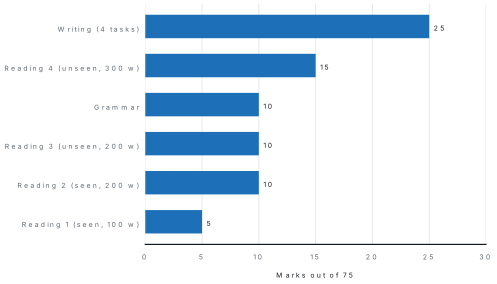
The Curriculum Development Centre (CDC) specification grid for Grade 10 English (2080 curriculum) divides the 75 marks as follows. Check the current grid on the CDC site before the examination, because boards can adjust small details such as the marks of a single task.
| Part | Marks | What is tested | Objective item types |
|---|---|---|---|
| Reading 1: seen text, about 100 words | 5 | comprehension of a textbook passage | one type, often true/false or gap-fill |
| Reading 2: seen text, about 200 words | 10 | comprehension | two types, such as multiple-choice and short answer |
| Reading 3: unseen text, about 200 words | 10 | story, notice, advertisement, letter, news story | two types |
| Reading 4: unseen text, about 300 words | 15 | essay, article, biography, review | three types, including vocabulary |
| Writing: guided and free tasks | 25 | five-to-nine-mark writing tasks | none (marked on a scale) |
| Grammar | 10 | ten one-mark items | reproduction and multiple-choice in context |
Cover the key and answer the items of one unit in five minutes. Mark them. For every error, go back to the passage in the book chapter and find the sentence that gives the answer. For objective reading items, the answer is always in the text; your own opinion earns nothing.
8.2 Reading items by unit
Each unit below tests the two textbook passages. Items marked T/F are true/false.
Unit 1: Current Affairs and Issues
- The article on driverless cars was written by Jenny Cusack foraBBC FuturebThe Himalayan TimescNaturedTime
- Mcity, the test "town" for driverless cars, belongs to the University ofaOxfordbTokyocMichigandDelhi
- The open letter of 7 August 2020 was addressed toaBan Ki-moonbAntonio GuterrescKofi AnnandGreta Thunberg
- The charity that wrote the letter asked that children under 18 be included inathe Security Councilbthe UN Youth Advisory Group on climate changecthe World Bankdthe Olympic Committee
- T/F: Waymo One is a driverless taxi service that operates in Phoenix, USA.
- T/F: The article says driverless cars have already solved the problem of human drivers.
Answers: Unit 1
1. (a) — Jenny Cusack, BBC Future, 2021.
2. (c) — Mcity is at the University of Michigan.
3. (b) — Antonio Guterres.
4. (b) — the letter asks for children's voices on climate policy.
5. True.
6. False — cars must still learn to cope with unpredictable human drivers.
Unit 2: Festivals and Celebrations
- The Carnevale di Ivrea is held inaSpainbItalycBrazildGreece
- The teams who throw oranges are calledaaranceribmatadorscgauchosdtorreros
- The red hat worn by participants is a symbol ofawarbharvestcfreedomdwealth
- Chuseok is the harvest festival ofaJapanbSouth KoreacGhanadIran
- Match: Homowo / Crop Over / Mehregan with Barbados / Iran / Ghana.
- T/F: Thanksgiving Around the World describes harvest festivals of more than one continent.
Answers: Unit 2
1. (b) Italy.
2. (a) aranceri.
3. (c) freedom.
4. (b) South Korea.
5. Homowo — Ghana; Crop Over — Barbados; Mehregan — Iran.
6. True — the USA, South Korea, Brazil, Liberia, Barbados, Ghana and Iran are covered.
Unit 3: Health and Wellness
- In "A Letter from a Patient" the writer isaa doctorba nursecthe mother of a sick babyda hospital director
- The mother felt her baby was treated as "not a priority" byaa busy nursebthe receptionistcthe cookdthe driver
- The speaker in "A Healthy Diet for a Healthy Life" calls the greatest public-health challengeasmokingbobesitycpollutiondmalaria
- Horizon 2020 is a research fund of abouta8 million eurosb80 million eurosc80 billion eurosd800 billion euros
- T/F: The speaker asks EU member states to work separately on food research.
- T/F: The mother's letter complains that a chart contained a mistake.
Answers: Unit 3
1. (c).
2. (a).
3. (b) obesity.
4. (c) about 80 billion euros.
5. False — he asks them to cooperate and to use a multidisciplinary approach.
6. True — a wrong chart is one of her complaints.
Unit 4: Work and Leisure
- In "Cabbage White" the children get workain a shopbpicking caterpillars off cabbagescin a schoolddriving a tractor
- The children destroy the field while trying toawater itbkill the butterfliescharvest itdfence it
- Leave This Chanting and Singing is poem 11 ofaGitanjalibThe GardenercCrescent MoondFruit-Gathering
- Tagore won the Nobel Prize in Literature ina1903b1913c1923d1933
- In the poem, dost meansadoesbdidcwilldshall
- T/F: The poem says God is found with those who do honest work such as the tiller and the path-maker.
Answers: Unit 4
1. (b).
2. (b).
3. (a).
4. (b) 1913.
5. (a) — dost is the old form of do with thou.
6. True — honest toil is worship.
Unit 5: Science and Experiment
- Water boils when its vapour pressure equalsaits colourbthe external pressurecits massdthe room temperature
- At higher altitude, water boils at aahigher temperatureblower temperaturecsame temperaturednegative temperature
- The poet of "The Voice of the Rain" isaWalt WhitmanbRobert FrostcAmy LowelldThomas Hardy
- The poem is written inarhyming coupletsbfree verseca sonnetdballad form
- T/F: In the poem the rain calls itself "the Poem of Earth".
- T/F: Pulling the plunger of a syringe with warm water in it raises the boiling point.
Answers: Unit 5
1. (b).
2. (b) — pressure is lower, so less heat is needed.
3. (a).
4. (b).
5. True.
6. False — pulling the plunger lowers the pressure, so the boiling point falls.
Unit 6: Food and Cuisine
- Haggis is a traditional food ofaJapanbScotlandcVietnamdFrance
- Shiokara comes fromaJapanbChinacAustraliadScotland
- The Nepali chef interviewed in the unit isaSantosh ShahbGordon RamsaycSanjeev KapoordRajesh Shrestha
- His restaurant mentioned in the interview is calledaDhaulagiribAylacAnnapurnadHimal
- The idiom a bridge too far meansaa long journeybtoo extremeca short cutda big success
- T/F: The first text says taste in food is cultural.
Answers: Unit 6
1. (b).
2. (a).
3. (a) Santosh Shah (MasterChef: The Professionals, 2020, BBC One).
4. (b) Ayla.
5. (b).
6. True.
Unit 7: Cyber Security
- In "Parents" the mother wrongly thinks the father isaa thiefba suspicious strangerca teacherda policeman
- The main theme of "Parents" isathe generation gap and online safetybsportscfarmingda festival
- How many pieces of advice does the internet-safety text give?afourbsixceightdten
- Two-factor authentication is advised toaspeed up the computerbadd a second proof of identitycsave datadclean the screen
- Match lurk withato hide and waitbto shoutcto rundto forget.
- T/F: The text advises keeping backups of your data.
Answers: Unit 7
1. (b).
2. (a).
3. (c) eight.
4. (b).
5. (a).
6. True.
Unit 8: Hobbies and Interests
- Which of these is not named as a common hobby in the text?areadingbpaintingcknittingdmountaineering
- The poem "Climbing" is byaAmy LowellbEmily DickinsoncTagoredFrost
- The child in the poem climbsaa hillban apple treeca ladderda staircase of stone
- The message of the poem is thatatrees are dangerousbdetermination can carry us to the topcchildren should stay homedlight is harmful
- T/F: The text says a hobby can become a career.
- T/F: The poem uses light imagery to describe the imagined town.
Answers: Unit 8
1. (d) — the list is reading, dancing, painting, antiques, photography, journaling and knitting.
2. (a).
3. (b).
4. (b).
5. True.
6. True — the town is "shining".
Unit 9: History and Culture
- Pratap Malla was king ofaBhaktapurbKantipurcLalitpurdGorkha
- He took the titleaKabindrabMahendracNarendradSurendra
- Which structure is linked with Pratap Malla?aRani PokharibNyatapolacDharaharadNarayanhiti
- In Russian flower etiquette, the red carnation stands forapatriotismbbad luckchealingdbreak-up
- Chamomile is associated withahealingbwarcwealthdluck
- T/F: Yellow flowers are thought to signal a break-up.
Answers: Unit 9
1. (b).
2. (a).
3. (a).
4. (a).
5. (a).
6. True.
Unit 10: Games and Sports
- The ancient Olympic Games began at Olympia ina776 BCEb1896 CEc500 BCEd1000 CE
- The modern Games began in Athens ina1876b1896c1906d1936
- In the myth, Pelops won Hippodamia byaa chariot raceba wrestling matchca foot raceda riddle
- Basketball was invented byaNaismithbPelopscTantalusdOlympia
- The Olympic torch is lit fromaa candlebthe sun's raysca gas stovedlightning
- T/F: Football and basketball need costly equipment.
Answers: Unit 10
1. (a).
2. (b).
3. (a) — the king's chariot wheel pins were replaced by wax.
4. (a).
5. (b).
6. False — they need cheap equipment, which is why they are so popular.
Unit 11: Ethics and Morality
- In "Wisdom of Little Girls" the quarrel begins withaa splash in a puddleba stolen cowca lost purseda broken window
- The calm in the end is brought byathe policebthe grandmothercthe priestdthe king
- The story is a version of a tale byaTolstoybDickenscChekhovdPoe
- In "World Record" Albert stands in hot soup fora7 h 2 minb7 h 3 minc3 h 7 mind2 h 7 min
- Albert's rival record to beat isa7 h 2 minb7 h 3 minc8 hd6 h
- T/F: The play makes fun of the craze for setting records.
Answers: Unit 11
1. (a).
2. (b).
3. (a).
4. (a).
5. (b) — he stands 7 h 2 min against a record of 7 h 3 min.
6. True — it is a satire.
Unit 12: Nature and Development
- The Fast Track runs from Khokana toaNijgadhbBirgunjcButwaldHetauda
- Its length is abouta52.5 kmb62.5 kmc72.5 kmd92.5 km
- Wordsworth's sonnet was written ina1792b1802c1812d1822
- The sestet of a Petrarchan sonnet has the rhymeaabbaabbabcdcdcdcaabbccdabab
- "Mighty heart" is aasimilebmetaphorchyperboledirony
- T/F: The text lists environmental damage as a challenge of the Fast Track.
Answers: Unit 12
1. (a).
2. (c).
3. (b).
4. (b) — the octave is abbaabba.
5. (b) — the city is not literally a heart.
6. True.
Unit 13: Population and Migration
- World population in 1950 was just overa1 billionb2.5 billionc4 billiond6 billion
- The fastest growth was about 2.1% a year in thea1930sb1960sc1990sd2010s
- The text expects about 9.7 billion people bya2030b2040c2050d2100
- The peak of about 10.4 billion is expected in thea2030sb2050sc2080sd2100s
- Birds are not said to migrate forafoodbbreedingcclimatedexaminations
- T/F: Sub-Saharan Africa is described as a fast-growing region.
Answers: Unit 13
1. (b).
2. (b).
3. (c).
4. (c).
5. (d).
6. True.
Unit 14: Travel and Adventure
- In "Expect the Unexpected" the town known for paragliding and the Sarangkot sunrise isaPokharabChitwancJanakpurdDharan
- Chitwan is described as suitable foraactive travellers who like a jeep safari and canoeingbskierscdeep-sea diversdonly pilgrims
- "Weathers" was written byaThomas HardybWordsworthcKiplingdTennyson
- The refrain of each stanza isa"And so do I"b"Nevermore"c"Come away"d"So it goes"
- In the poem, the weather shunned by the speaker isaspring weatherbwinter weathercthe weather of Junednone
- T/F: The text says Pashupatinath and the Durbar squares are World Heritage Sites.
Answers: Unit 14
1. (a).
2. (a).
3. (a).
4. (a).
5. (b) — winter weather is shunned and spring weather is liked.
6. True.
Unit 15: People and Places
- Jhamak Ghimire's autobiography isaJiwan Kada Ki PhoolbMuna MadancSumnimadBasain
- She writes with heraright handbleft footcmouthdright foot
- The book won the Madan Puraskar ina2000b2005c2010d2015
- Sugarloaf Mountain stands at the entrance toaGuanabara BaybHudson BaycBay of BengaldBotany Bay
- Its height is abouta196 mb396 mc896 md1,396 m
- T/F: Two cable cars take visitors up Sugarloaf Mountain, via Morro da Urca.
Answers: Unit 15
1. (a).
2. (b) — she writes with her left foot.
3. (c) 2010.
4. (a).
5. (b).
6. True.
Unit 16: Success and Celebration
- Walt Disney's first successful character, created in 1928, wasaDonald DuckbMickey MousecGoofydPluto
- Snow White appeared ina1928b1937c1955d1966
- Disneyland opened ina1937b1950c1955d1965
- Kipling's poem "If" was published ina1810b1910c1930d1950
- The poem ends with the promisea"you'll be a Man, my son!"b"and so do I"c"we shall overcome"d"all is well"
- T/F: The text says Walt Disney's first company went bankrupt.
Answers: Unit 16
1. (b).
2. (b).
3. (c).
4. (b).
5. (a).
6. True.
Unit 17: Countries and Towns
- The rivers of London and Paris areathe Thames and the Seinebthe Rhine and the Danubecthe Nile and the Congodthe Tiber and the Po
- Which city is almost fifteen times larger?(a) London(b) Paris
- London has abouta24 museumsb240 museumsc2,400 museumsd40 museums
- In the fable the country mouse finally choosesathe feast in the citybplain food in peaceca palaceda ship
- The moral of the fable is thatapeace is worth more than luxurybcities are bestcmice are cleverdfood is cheap
- T/F: The text says Paris is better for food and slightly cheaper.
Answers: Unit 17
1. (a).
2. (a) London.
3. (b).
4. (b).
5. (a).
6. True.
Unit 18: Media and Entertainment
- Hachi: A Dog's Tale was directed byaLasse HallströmbSteven SpielbergcAng LeedRidley Scott
- The leading actor isaRichard GerebTom HankscBrad PittdWill Smith
- The film is based on the true story of Hachikō ofaOsakabTokyocKyotodSeoul
- The social-media account We Rate Dogs raised abouta700 US dollars for a wheelchairb7 US dollarsc7,000 poundsdnothing
- The New York hawk was rescued throughaTwitterbradioca newspaperda letter
- T/F: The review praises the bond between the dog and his master.
Answers: Unit 18
1. (a).
2. (a).
3. (b).
4. (a).
5. (a).
6. True.
8.3 Vocabulary items
The long unseen passage (Reading 4) always carries a vocabulary item; the seen passages test words from the book. Choose the best meaning or fill the gap.
A. Choose the word closest in meaning to the underlined word (1 mark each)
- The mountain village has a calm serene atmosphere.anoisybpeacefulccrowdedddirty
- She was obsessed with her phone.abored bybunable to stop thinking aboutcafraid ofdangry with
- Dark clouds began to lurk above the hills.ahide and waitbdisappearcsingdfall
- The altitude of Kathmandu is about 1,400 m.awidthbheight above sea levelctemperaturedpopulation
- The shopkeeper swerved to avoid the cow.astoppedbturned suddenly asidecshouteddjumped
- The rice was scarce after the flood.aplentifulbhard to findccheapdtasty
B. Choose the opposite (1 mark each)
- ancientaoldbmoderncruineddvaluable
- expandagrowbshrinkcshoutdcover
- generousakindbselfishcrichdbright
- brightadullbshinyccleverdwarm
C. Fill the gap with the best word from the box (1 mark each)
Box: determination, valuable, humble, peaceful, perseverance
- His ____ helped him to keep working after he failed three times.
- In spite of fame, the chef remained ____ and thanked his teachers.
- Walt Disney's ____ is a good lesson for every student.
- The ____ countryside is a pleasant escape from the noisy city.
D. Prefixes, suffixes and compounds (1 mark each)
- Add a prefix to make the opposite of possible. 16. Add a suffix to care to mean "without care". 17. Make an adjective from danger. 18. Write the compound word from Unit 9 that means "the act of giving presents". 19. The word cardboard is made of two nouns. Write them.
Answers: vocabulary
1. (b) peaceful.
2. (b).
3. (a).
4. (b).
5. (b).
6. (b).
7. (b) modern.
8. (b) shrink.
9. (b) selfish.
10. (a) dull.
11. determination (or perseverance).
12. humble.
13. perseverance (or determination).
14. peaceful.
15. impossible.
16. careless.
17. dangerous.
18. gift-giving.
19. card + board.
The SEE checks compound items against the words in the book: gift-giving, heart-warming, cardboard, flower etiquette, break-up, fortune-telling, newly-wed. Learn them as a list.
8.4 Grammar items by unit
The CDC grid asks ten one-mark grammar items covering articles, prepositions, tenses, connectives, question tags, reported speech, voice, conditionals, subject-verb agreement, relative clauses and causatives. Practise by unit; the sets below follow the book's order.
Reported speech: statements, questions, commands (Units 1 to 3)
Change into reported speech (1 mark each).
- "I am tired," said Ram. 2. "We will go to Pokhara tomorrow," said the girls. 3. "Did you finish the work?" the teacher asked Sita. 4. "Where do you live?" he asked me. 5. "Please close the door," she said to him. 6. "Don't touch the wire," the mother told the child. 7. "The earth moves round the sun," the teacher said. 8. "I have lost my pen," said Hari.
Answers: reported speech
1. Ram said that he was tired.
2. The girls said that they would go to Pokhara the next day.
3. The teacher asked Sita if (whether) she had finished the work.
4. He asked me where I lived.
5. She requested him to close the door.
6. The mother told the child not to touch the wire.
7. The teacher said that the earth moves round the sun. (no backshift for a universal truth)
8. Hari said that he had lost his pen.
Modals and imperatives (Unit 4)
Choose the correct word (1 mark each).
- You ____ wear a helmet; it is the law.acanbmustcmaydmight
- "____ I borrow your pen?"aMaybMustcWoulddShall to
- He ____ have missed the bus; he is not here.amustbcancshoulddwill
- You look pale. You ____ see a doctor.ashouldbcan'tcuseddshall
- ____ you help me with this bag?aCouldbMight tocOughtdDare
- She ____ to get up early when she was a child.ahasbhadcmustdwould be
Answers: modals
1. (b) must — legal compulsion.
2. (a) May — permission.
3. (a) must — certainty.
4. (a) should — advice.
5. (a) Could — polite request.
6. (b) had — had to is the past of have to.
Conditionals (Unit 5)
Fill in with the correct form (1 mark each).
- If you heat ice, it _ (melt). 2. If it rains tomorrow, we (stay) at home. 3. If I _ (be) a bird, I would fly to Lukla. 4. If she had studied, she (pass). 5. _ you hurry, you will miss the bus. (unless/if) 6. I will lend you the book provided you (return) it. 7. If he _ (leave) earlier, he would have caught the bus. 8. I known, I would have come. (inverted)
Answers: conditionals
1. melts (zero conditional).
2. will stay.
3. were (second conditional uses were for all persons).
4. would have passed.
5. Unless — Unless you hurry means If you do not hurry, and the result is that you miss the bus.
6. return (present after provided).
7. had left.
8. Had.
Present continuous and reasons (Unit 6)
Choose the correct word (1 mark each).
- Look! The chef ____ the soup.astirsbis stirringcstirreddhas stirring
- We ____ to Pokhara next week; the tickets are booked.agobare goingcwentdhave gone
- He stayed at home ____ he was ill.abecausebbecause ofcin spite ofdso
- He stayed at home ____ his illness.abecausebbecause ofcalthoughdbut
- She went to the market ____ buy vegetables.aforbin order tocsodbecause
- They are saving money ____ they can buy a house.aso thatbin ordercalthoughdto
Answers: reasons
1. (b) — action happening now.
2. (b) — planned future.
3. (a) — because + clause.
4. (b) — because of + noun.
5. (b) — purpose with the base verb.
6. (a) — so that + clause.
Articles and advice (Unit 7)
Fill in with a, an, the or X for no article (1 mark each).
- He is _ honest boy. 2. She works at university in Kathmandu. 3. _ Sun rises in the east. 4. Ram plays football every evening. 5. I saw _ one-eyed man. 6. Himalayas are in the north of Nepal. 7. You _ keep your password secret. (should/must not) 8. You share your password with strangers. (must not/should)
Answers: articles
1. an (honest begins with a vowel sound).
2. a (university begins with a consonant sound, /j/).
3. The (unique).
4. X (games take no article).
5. a (one begins with /w/).
6. The (mountain range).
7. should (advice).
8. must not (prohibition).
Passive voice (Units 8 and 10)
Change into the passive voice (1 mark each).
- Sita writes a letter. 2. The farmers are planting rice. 3. They built a bridge last year. 4. The teacher has corrected the exercise books. 5. Who wrote this poem? 6. Someone will finish the work tomorrow. 7. The committee should have decided the matter. 8. They are showing a film tonight.
Answers: passive
1. A letter is written by Sita.
2. Rice is being planted by the farmers.
3. A bridge was built last year.
4. The exercise books have been corrected by the teacher.
5. By whom was this poem written? (or: Who was this poem written by?)
6. The work will be finished by someone tomorrow. (or: The work will be finished tomorrow.)
7. The matter should have been decided by the committee.
8. A film is being shown tonight.
Present perfect and agreement (Units 10 and 11)
Choose the correct word (1 mark each).
- I ____ here since 2020.alivebhave livedcam livingdlived
- She has been waiting ____ two hours.asincebforcfromdby
- A number of students ____ absent today.aisbarecwasdhas been
- The number of students ____ increasing.aarebiscweredhave
- Neither the teacher nor the students ____ present.awasbwerecisdhas
- Each of the boys ____ a ticket.ahavebhascaredwere
- He doesn't know, _? (tag) 8. Nobody came, _ they?
Answers: perfect and agreement
1. (b) — since + point in time takes the present perfect.
2. (b) — for + period.
3. (b) — a number of is plural.
4. (b) — the number of is singular.
5. (b) — verb agrees with the nearer subject (students).
6. (b) — each is singular.
7. does he.
8. did — nobody makes the clause negative, so the tag is positive; the pronoun is they.
Future forms and connectives (Units 12 and 13)
Choose the correct word (1 mark each).
- The train ____ at 6 a.m. tomorrow (timetable).aleavesbis leavingcwill have leftdleft
- Look at those clouds. It ____ rain.awillbis going tocshalldis raining
- By next year I ____ my SEE.awill passbwill have passedcpassdam passing
- ____ it was raining, we played football.aBecausebAlthoughcSodUnless
- ____ the heavy rain, the match went on.aAlthoughbDespitecThoughdEven though
- The road is useful. ____, it harms the environment.aHoweverbBecausecAlthoughdDespite
Answers: future and connectives
1. (a) timetable.
2. (b) — plan or prediction from evidence.
3. (b) — completed before a future time.
4. (b).
5. (b) — despite is followed by a noun phrase.
6. (a) — however takes a comma and starts a new sentence. Never use although … but together.
Question tags and relative clauses (Units 14 and 15)
Add a question tag or fill in the relative word (1 mark each).
- You are a student, _? 2. Let's go home, ? 3. Open the window, _? 4. I am late, ? 5. The girl _ won the prize is my cousin. 6. This is the pen I bought yesterday. 7. The man _ car was stolen called the police. 8. Pokhara, is a lake city, attracts tourists. 9. He never lies, ____?
Answers: tags and relatives
1. aren't you.
2. shall we.
3. will you.
4. aren't I.
5. who.
6. which (or that).
7. whose.
8. which (non-defining; that is not allowed).
9. does he — never is negative in sense, so the tag is positive.
Prepositions (Units 15 and 16)
Fill in with the correct preposition (1 mark each).
- The class starts _ 10 a.m. 2. He was born Monday. 3. They came to Nepal _ 2015. 4. She is afraid dogs. 5. I am good _ mathematics. 6. He divided the money his two sons. 7. We stayed _ Friday Sunday. (from … to) 8. The book is ____ the table.
Answers: prepositions
1. at (clock time).
2. on (day).
3. in (year).
4. of (afraid of).
5. at (good at).
6. between (two persons).
7. from … to.
8. on (surface).
Adverbs, comparison and causatives (Units 17 and 18)
Choose the correct word (1 mark each).
- She sings ____.abeautifulbbeautifullycbeautydmore beauty
- He is the ____ boy in the class.atallerbtallestcmore talldmost tall
- This book is ____ than that one.agoodbbettercbestdmore good
- She ____ the barber cut her hair.ahadbmade tocwasdgot to
- He ____ his car repaired yesterday.ahadbmadecletdtold
- The teacher ____ us write an essay.amadebgotcwas madedforced to
Answers: adverbs and causatives
1. (b) — adverb of manner.
2. (b) — superlative of a short adjective.
3. (b) — irregular good, better, best.
4. (a) — have + person + base verb.
5. (a) — have + thing + past participle.
6. (a) — make + person + base verb.
Chapter summary
- The paper is 75 marks in 3 hours: Reading 40 (5 + 10 + 10 + 15), Writing 25 and Grammar 10. Objective and short-answer items fill most of the reading part.
- Answer reading items from the text. Read the question first, then find the line.
- Tag questions reverse polarity: aren't I, shall we (after let's), will you (after commands), they (after nobody, everyone).
- Reported speech steps the tense back after a past reporting verb but not for universal truths; commands take to or not to.
- Conditionals: zero (present, present), first (present, will), second (past, would), third (past perfect, would have). Unless means if not.
- A number of is plural; the number of is singular; each, everyone are singular; with neither … nor the verb agrees with the nearer subject.
- Passive is be + past participle in the tense of the active verb; use by + agent only when it matters.
Practice questions
Reading items (1 mark each)
- Who wrote the open letter that asks for children to be heard on climate change? [1]aSave the ChildrenbThe BBCcWaymodOxbotica
- Which poem uses the refrain "And so do I"? [1]aWeathersbIfcClimbingdThe Voice of the Rain
- True or false: In "World Record", Albert stands in soup for more than the existing record. [1]
- Jhamak Ghimire writes with her ____. [1]
Answers to Reading items
1. (a) — the letter is from Save the Children.
2. (a) — Hardy's "Weathers".
3. False — he stands 7 h 2 min against a record of 7 h 3 min.
4. left foot.
Grammar items (1 mark each)
- Report: "Where do you live?" he asked me. [1]
- Passive: They are building a road. [1]
- Add a tag: Let's go, ____? [1]
- Fill in: If I ____ you, I would apologise. [1]
- Choose: She stayed at home ____ her illness. (because / because of) [1]
Answers to Grammar items
1. He asked me where I lived.
2. A road is being built.
3. shall we.
4. were.
5. because of — a noun phrase follows.