Question bank · 25 min read
Compulsory English: Unit-wise Subjective Question Bank
The subjective part of the Grade 10 English paper is everything that needs a sentence or a paragraph rather than a tick: the short-answer questions on the reading passages, and the four writing tasks that make up 25 of the 75 marks. This chapter gives, unit by unit, the short-answer questions that the 36 texts of the Grade 10 book can produce, with model answers, and then a model for each writing form named in the CDC specification grid. It ends with two unseen passages with answers.
Write your own answer first. Then compare points, not words. A short answer (1 or 2 marks) needs one or two complete sentences taken from, or built on, the text. A writing task is marked on organisation, coherence and cohesion, subject matter, correctness, range of vocabulary and layout, so a correct layout alone earns marks. Every answer here is original practice material based on this series' book chapters; none is a copy of a board answer.
9.1 The subjective questions in the grid
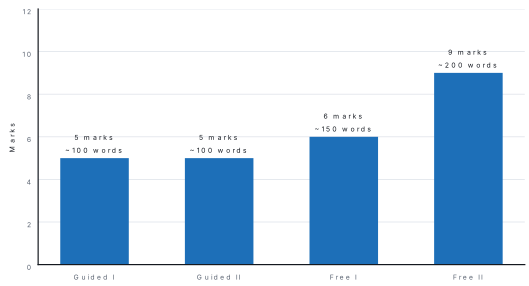
| Task | Marks | Forms the CDC grid names | About |
|---|---|---|---|
| Guided writing I | 5 | paragraph, description of tables or charts, instructions, recipe, advertisement, notice, rules | 100 words |
| Guided writing II | 5 | news story, skeleton story, condolence or congratulation message, invitation, thank-you letter, biography | 100 words |
| Free writing I | 6 | paragraph (view, opinion, experience), leave or job application, dialogue | 150 words |
| Free writing II | 9 | personal or official letter, letter to the editor, email, short essay | 200 words |
The marks and word counts above follow the CDC grid as published for the 2080 curriculum; the total of the four tasks is 25. Confirm the figures for a single task against the grid your school gives you, because boards sometimes publish them slightly differently.
9.2 Short-answer questions on the textbook units
Unit 1: Current Affairs and Issues
How Driverless Cars Will Change Our World
- Name two experts quoted in the article. [2]
- What problem must driverless cars still solve? [2]
Open Letter to UN Secretary-General Antonio Guterres
- Why did Save the Children write the letter? [2]
- Which young people does the letter mention as examples? [2]
Model answers: Unit 1
1. Camilla Fowler and David Hynd of TRL are quoted. (Richard Jinks of Oxbotica is also named.)
2. They must learn to cope with human drivers who break rules, and the law must settle who is liable after an accident.
3. The charity wrote to ask the Secretary-General to include children under 18 in the UN Youth Advisory Group on climate change.
4. It mentions Greta Thunberg and a young person from Peru named Fabrizio as examples of children who care about climate change.
Unit 2: Festivals and Celebrations
Battle of the Oranges
- What is the red hat a symbol of? [2]
- How did the narrator feel when she first saw the fight? [2]
Thanksgiving Around the World
- Name two festivals described besides the American Thanksgiving. [2]
- Why do people hold harvest thanksgivings? [2]
Model answers: Unit 2
1. The red hat is a symbol of freedom.
2. She was shocked: she wondered whether the red on the people was blood or the juice of blood oranges.
3. Chuseok (South Korea) and Homowo (Ghana). (Crop Over, Mehregan and others are also correct.)
4. They thank nature and God for the harvest and celebrate with family, food and community.
Unit 3: Health and Wellness
A Letter from a Patient
- What was the mother's main complaint? [2]
- How does the writer keep her tone polite? [2]
A Healthy Diet for a Healthy Life
- Why does the speaker call obesity a challenge? [2]
- What does he ask the member states to do? [2]
Model answers: Unit 3
1. She complained that staff bad-mouthed each other, that a busy nurse made her baby feel "not a priority", that she was asked the same questions again and again and that a wrong chart was used.
2. She states her complaints calmly and respectfully, with facts, instead of attacking the staff.
3. He calls it the greatest public-health challenge because it is a widespread threat to health that is linked to what people eat.
4. He asks them to cooperate on research and use funds such as Horizon 2020 in a multidisciplinary way.
Unit 4: Work and Leisure
Cabbage White
- How did Sarah and Jamie ruin the field? [2]
- What lesson does the story teach? [2]
Leave This Chanting and Singing
- Whom does the poet say God is with? [2]
- What does "Come out of thy meditations" suggest about worship? [2]
Model answers: Unit 4
1. While trying to kill the butterflies they destroyed the cabbage field, and then they slipped away.
2. Shortcuts and rash plans backfire; real work needs patience and care.
3. He says God is with the tiller of the hard ground and the path-maker who breaks stones.
4. It suggests that worship is not only prayer and chanting in a closed room; honest labour is also a way of serving God.
Unit 5: Science and Experiment
Yes, You Can Boil Water at Room Temperature
- When does water boil? [2]
- How can water boil at room temperature? [2]
The Voice of the Rain
- What does the rain call itself? [2]
- Which poetic devices does Whitman use? [2]
Model answers: Unit 5
1. Water boils when its vapour pressure equals the pressure of the surroundings.
2. If the external pressure is lowered, for example in a vacuum or by pulling the plunger of a syringe, the water boils at a lower temperature, even at room temperature.
3. The rain calls itself "the Poem of Earth".
4. Personification (the rain speaks), metaphor (the rain is a poem or song), free verse and antithesis.
Unit 6: Food and Cuisine
Strange Food from Around the World
- Name two unusual foods and their countries. [2]
- What does the text suggest about taste? [2]
You Inspire Others by Learning, Not by Teaching
- Which competition did Santosh Shah take part in? [2]
- What is his ambition? [2]
Model answers: Unit 6
1. Haggis from Scotland and shiokara from Japan.
2. Taste is cultural: what seems strange to one people is normal and tasty to another, so food is an adventure.
3. MasterChef: The Professionals (BBC One, 2020).
4. He hopes to win a Michelin star for his restaurant Ayla and to make Nepali food proud.
Unit 7: Cyber Security
Parents
- Why is the father anxious? [2]
- What is funny about the ending? [2]
Cyber Security: Basic Internet Safety Tips
- Give two tips for passwords or logins. [2]
- Why should a person keep a backup? [2]
Model answers: Unit 7
1. He is anxious about his daughter's safety because she has a secret online identity.
2. The mother mistakes the father for a suspicious stranger. This irony shows the generation gap and the confusion about online life.
3. Use strong passwords and turn on two-factor authentication.
4. A backup keeps data safe if a device is lost, damaged or locked by a virus.
Unit 8: Hobbies and Interests
Common Hobbies
- Name three hobbies from the text. [2]
- How can a hobby help a person? [2]
Climbing
- What does the child climb in the poem? [2]
- What is the message of the poem? [2]
Model answers: Unit 8
1. Reading, painting and photography (also dancing, antiques, journaling, knitting).
2. A hobby relaxes us, builds skills and can even become a career.
3. The child climbs an apple tree whose branches are like a staircase.
4. Determination can carry us to the top; imagination makes the climb a journey to a shining town.
Unit 9: History and Culture
Pratap Malla
- How did Pratap Malla keep his kingdom safe? [2]
- Why is he remembered as a patron of arts and literature? [2]
Flowers in Russian Culture
- What does a red carnation mean? [2]
- Why should a person not give yellow flowers to a friend? [2]
Model answers: Unit 9
1. He used diplomacy between Lalitpur and Bhaktapur and gained wealth from Tibet–India trade, so Kantipur stayed safe and prosperous.
2. He wrote in many languages, took the title Kabindra, and built and repaired temples and palaces such as Hanuman Dhoka and Rani Pokhari.
3. A red carnation stands for patriotism.
4. In Russian flower etiquette yellow flowers can signal a break-up, so they may hurt the receiver.
Unit 10: Games and Sports
The First Olympic Games
- Why was Tantalus punished? [2]
- How did Pelops win the race? [2]
Popularity of Different Sports
- Why are football and basketball so popular? [2]
- Who invented basketball? [2]
Model answers: Unit 10
1. Tantalus offended the gods, so they punished him; Pelops was later revived.
2. The wheel pins of the king's chariot were replaced by wax, so the king's chariot broke in the race and Pelops won Hippodamia.
3. They need cheap equipment, so almost anyone can play.
4. Naismith invented basketball.
Unit 11: Ethics and Morality
Wisdom of Little Girls
- What started the quarrel? [2]
- What is the moral? [2]
World Record
- What was Albert trying to do? [2]
- What does the play make fun of? [2]
Model answers: Unit 11
1. A splash of water from a puddle between two little girls led to angry words and then a street fight among adults.
2. Forgive and forget, and avoid pride.
3. Albert was trying to stand in hot soup on one leg for 7 hours 2 minutes to beat the record of 7 hours 3 minutes.
4. It makes fun of the craze for setting world records, even silly and painful ones.
Unit 12: Nature and Development
The Kathmandu–Terai/Madhesh Fast Track
- State two benefits of the Fast Track. [2]
- What challenges does it face? [2]
Composed upon Westminster Bridge
- Which simile does Wordsworth use? [2]
- What is the theme of the sonnet? [2]
Model answers: Unit 12
1. It shortens travel time and saves fuel; it also helps trade and tourism and regional development.
2. Link roads and technology are needed, and the road may damage the environment.
3. The city wears the morning beauty "like a garment".
4. The beauty of a calm city at dawn and the harmony of man and nature.
Unit 13: Population and Migration
World population
- How fast did world population grow in the 1960s? [2]
- What will decide future change? [2]
Bird migration
- Why do birds migrate? [2]
- What is partial migration? [2]
Model answers: Unit 13
1. At its fastest, about 2.1% a year.
2. Fertility and mortality decide whether the population grows or falls.
3. They migrate in search of food, to breed and to escape the climate.
4. In partial migration only some birds of a species migrate while others stay.
Unit 14: Travel and Adventure
Expect the Unexpected
- What can a traveller do in Pokhara? [2]
- How do Nepalis see death, according to the writer? [2]
Weathers
- Which weather does the speaker like? [2]
- What does weather symbolise in the poem? [2]
Model answers: Unit 14
1. A traveller can go paragliding and trekking and see the sunrise at Sarangkot.
2. The writer says Nepalis see death as an everyday part of life.
3. The speaker likes spring weather, with the cuckoo, the nightingale and chestnut showers.
4. Weather symbolises the bright and dark sides of life; the speaker welcomes the bright and shuns the dark.
Unit 15: People and Places
Me at the Beginning of Life
- How does Jhamak Ghimire write? [2]
- Whom does she compare herself with? [2]
Sugarloaf Mountain
- Where is Sugarloaf Mountain? [2]
- How can visitors reach the top? [2]
Model answers: Unit 15
1. She writes with her left foot.
2. She compares herself with Ostrovsky and Helen Keller.
3. It stands about 396 m high at the entrance to Guanabara Bay in Rio de Janeiro.
4. They can take two cable cars via Morro da Urca or follow one of the climbing routes.
Unit 16: Success and Celebration
Walt Disney
- Name two difficulties in Walt Disney's life. [2]
- Which quality made him succeed? [2]
If
- What advice does the father give about success and failure? [2]
- What is the promise at the end? [2]
Model answers: Unit 16
1. He had a poor childhood under a domineering father, and his first company went bankrupt (he also lost Oswald and had a breakdown).
2. Determination and perseverance.
3. Treat the two impostors, success and failure, alike and keep calm and humble.
4. "You'll be a Man, my son!"
Unit 17: Countries and Towns
London vs Paris
- How do London and Paris differ in size? [2]
- Which city is better for food? [2]
The Country Mouse and the City Mouse
- Why does the country mouse leave the city? [2]
- What is the moral? [2]
Model answers: Unit 17
1. London is almost fifteen times larger, while Paris is compact.
2. Paris is better for food and is slightly cheaper.
3. He is frightened by danger in the city and prefers plain food in peace.
4. Peace and contentment are worth more than luxury.
Unit 18: Media and Entertainment
Hachi: A Dog's Tale
- What is the film about? [2]
- What are the review's weaknesses? [2]
Interesting Social Media Stories
- How did We Rate Dogs help? [2]
- What do the stories show about social media? [2]
Model answers: Unit 18
1. It is based on the true story of the dog Hachikō in Tokyo, who waited for his master (1923–1935), and shows love, devotion and loyalty.
2. The review lists the kissing and champagne scenes as weaknesses.
3. The account raised about 700 US dollars for a wheelchair.
4. They show that social media can do good, for example by rescuing a hawk in New York through Twitter.
9.3 Guided writing I (5 marks)
A description of a chart
Task. The table shows the number of students of a school who joined clubs in 2080. Write a paragraph of about 100 words describing it.
| Club | Students |
|---|---|
| Sports | 120 |
| Music | 80 |
| Science | 60 |
| Art | 40 |
Model answer
The table shows how many students of the school joined four clubs in 2080. The sports club was the most popular, with 120 students. Music came second with 80 students, while the science club attracted 60. The art club was the least popular, with only 40 members. Sports had three times as many members as art, and music had twice as many as art. In total, 300 students joined clubs. The table shows that students prefer activity and creative clubs to science, so the school should plan more science events.
A notice
Task. You are the secretary of the Eco Club. Write a notice for a tree-plantation programme.
Model answer
Eco Club, Shree Janta Secondary School, Pokhara NOTICE 15 Shrawan 2082
Tree-plantation programme
All students of Grades 9 and 10 are informed that the Eco Club will hold a tree-plantation programme on Saturday, 20 Shrawan, at 8 a.m. in the school ground. Interested students should bring a spade and a water bottle and report to the club room by 7:45 a.m. Names should be given to the club teacher by Thursday.
Sunita Rai Secretary, Eco Club
Instructions or a recipe
Task. Write instructions for making milk tea.
Model answer
How to make milk tea You need: one cup of water, one cup of milk, two teaspoons of tea leaves, sugar and ginger. 1. Boil the water in a pan. 2. Add the tea leaves, sugar and a little crushed ginger. 3. Let the mixture boil for two minutes. 4. Pour in the milk and boil again. 5. Strain the tea into cups and serve hot.
9.4 Guided writing II (5 marks)
A news story
Task. Write a news story from these clues: Flood — Rapti river — 20 houses — Dang — Sunday night — people shifted to school — help sent.
Model answer
Flood sweeps 20 houses in Dang
Dang, 12 Bhadra. Twenty houses were swept away when the Rapti river overflowed on Sunday night. The flood entered the village while people were asleep. Local youths and police rescued the families and shifted them to a nearby school. The district office has sent food, tents and medicines. Officials said the water level is now falling, but people living near the river have been asked to remain careful.
A message of condolence
Task. Write a message of condolence to a friend whose grandfather has died.
Model answer
Dear Bikash,
I was deeply sorry to hear of the death of your grandfather. He was a kind and wise man, and I will always remember the stories he told us. Please accept my sincere sympathy for you and your family. May his soul rest in peace, and may you find strength in the love around you.
Your friend, Anil
A story from a skeleton
Task. Complete the story: A boy found a purse on the road — he was poor — took it to the police — the owner came — gave a reward — the boy used it for school fees. Give it a title.
Model answer
Honesty is the best policy
Ramesh was a poor boy who lived near Butwal. One morning he found a purse on the road. It was full of money. Although he needed money badly, he took it to the police station. The police found the owner, a trader, who came happily to collect it. The trader thanked Ramesh and gave him a reward. Ramesh used it to pay his school fees. Moral: honesty always brings good fortune.
9.5 Free writing I (6 marks)
A leave application
Task. Write an application to your head teacher asking for three days' leave because you are ill.
Model answer
15 Ashwin 2082
The Head Teacher Shree Janta Secondary School Pokhara
Subject: Application for three days' leave
Sir,
I am a student of Grade 10. I have a high fever and the doctor has advised me to rest for three days. So I cannot attend school from 15 to 17 Ashwin. I request you to grant me leave for these days.
Yours obediently, Suman Gurung Grade 10, Roll No. 12
A job application
Task. Write an application for the post of a library assistant advertised in a newspaper.
Model answer
Kathmandu 3 Magh 2082
The Manager City Public Library Kathmandu
Subject: Application for the post of Library Assistant
Dear Sir or Madam,
I have read your advertisement in The Rising Nepal of 1 Magh and I wish to apply for the post of Library Assistant. I passed the SEE with a good grade and have completed a computer course. I like books and I am careful with records. I am enclosing copies of my certificates and a photograph. I hope you will give me an interview.
Yours faithfully, Mina Thapa
A dialogue
Task. Write a short dialogue between two friends about the habit of reading.
Model answer
Asha: Do you read in your free time? Binod: Not much. I prefer my phone. And you? Asha: I read for an hour every night. It relaxes me and improves my English. Binod: But books are expensive. Asha: Not at all. Our school library lends them free. Shall I take you there tomorrow? Binod: Yes, please. I will try one book a month.
9.6 Free writing II (9 marks)
A letter to the editor
Task. Write a letter to the editor about the problem of garbage on the street of your town.
Model answer
Butwal 10 Chaitra 2082
The Editor The Kathmandu Post Kathmandu
Subject: Garbage on our streets
Sir,
Through your newspaper I want to draw the attention of the municipality to the heaps of garbage in our town. Rubbish is piled along the main road and no one collects it for days. The bad smell and flies spread disease, especially in the rainy season, and the waste blocks the drains.
The municipality should place bins at every corner and collect waste each day. People should separate waste into biodegradable and plastic. Schools and clubs can run awareness campaigns. A clean town makes everyone healthy and proud.
I hope you will publish this letter.
Yours faithfully, Santosh Sharma
An essay
Task. Write an essay of about 200 words on The Advantages and Disadvantages of Social Media.
Model answer
The Advantages and Disadvantages of Social Media
Social media such as Facebook and TikTok has become part of daily life, and it has both good and bad effects.
Its first advantage is communication: we can talk to family abroad at no cost. It also spreads news quickly, helps students find study materials and lets small businesses reach customers. Some stories show it can even do good, for example when a post on Twitter helped to rescue a hawk in New York.
However, it has disadvantages too. Many students waste hours on it, lose sleep and read less. False news spreads fast and may cause panic. There are also risks of cyberbullying and of strangers misusing personal data.
In my view, social media is useful if we control it. We should limit screen time, check facts before sharing and keep our accounts private. Used wisely, it is a good servant; used carelessly, it is a bad master.
An email invitation
Task. Write an email inviting your friend to your birthday party.
Model answer
To: rajan@example.com Subject: Invitation to my birthday party
Dear Rajan,
I am turning sixteen on Saturday, 25 Kartik, and I am having a small party at my house at 4 p.m. Our classmates will come, and my mother is making momo. It would be lovely if you could join us. Please tell me by Thursday whether you can come.
Yours, Prem
9.7 Unseen reading with answers
Reading 3: a notice (10 marks)
Rastriya Youth Library, Dhangadhi Summer Reading Camp The library will hold a reading camp for students of Grades 6 to 10 from 5 to 12 Jestha. The camp will run from 7 a.m. to 9 a.m. every morning except Saturday. Entry is free, but students must register at the front desk by 3 Jestha. Each student will receive a membership card and may borrow two books a week. Parents are welcome to join the reading hour on the last day.
A. True or false (1 mark each) 1. The camp is held every day including Saturday. 2. Registration is free. 3. Students of Grade 4 may join.
B. Answer the questions (2 marks each) 4. Until when must students register? 5. What will each student receive? 6. When can parents join?
C. Fill in the gap (1 mark) 7. The camp starts every morning at ____ a.m.
Answers
1. False — it is held every morning except Saturday.
2. True — entry is free.
3. False — it is for Grades 6 to 10.
4. Until 3 Jestha, at the front desk of the library.
5. A membership card; each student may also borrow two books a week.
6. On the last day, at the reading hour (12 Jestha).
7. 7 (the camp runs from 7 a.m. to 9 a.m.).
Reading 4: an article (15 marks)
Nepal's mountain villages are fighting a new kind of problem: empty houses. Every year, thousands of young people leave for cities or foreign countries in search of work, and old people are left behind. In some villages of the hill districts, half the houses are locked.
Yet a few villages are changing the story. In one hill village, a group of returnees started a homestay programme that brings tourists to stay with local families. The village now earns money from guests, and the young people who joined the programme say they no longer feel the need to leave. A local cooperative has also begun to make honey and herbal tea for sale. "We do not want to depend only on remittances," said a villager. "We want to build a life here."
Experts say such programmes will succeed only if roads, electricity and the internet reach the villages. Without them, young people will always choose the city.
A. Choose the best answer (1 mark each) 1. The main problem described is (a) too many tourists (b) empty houses in villages (c) floods (d) poor harvests 2. The returnees started (a) a school (b) a homestay programme (c) a factory (d) a bank
B. Answer briefly (2 marks each) 3. Why do young people leave the villages? 4. What does the cooperative make? 5. What do experts say is necessary for success?
C. Vocabulary (1 mark each) 6. Find a word in the first paragraph that means "people who are not young". 7. What does depend on mean in the second paragraph? (a) trust and need (b) refuse (c) watch (d) escape
D. Give your opinion (3 marks) 8. Do you think tourism can stop migration from villages? Give two reasons.
Answers
1. (b).
2. (b).
3. They go to cities or abroad in search of work.
4. It makes honey and herbal tea.
5. Roads, electricity and the internet must reach the villages.
6. old people (the passage says "old people are left behind").
7. (a).
8. Sample: Tourism can reduce migration only partly. It brings income, so young people can earn at home; homestays also give them pride in local culture. But it needs roads and the internet, and it is seasonal, so other jobs such as farming cooperatives are also needed.
Chapter summary
- The subjective part of English is the short answers on four reading passages and 25 marks of writing in four tasks (guided I and II, free I and II).
- A short answer is one or two complete sentences; give the fact first, then the point.
- Writing is marked on organisation, coherence and cohesion, content, correctness, vocabulary and layout.
- A formal letter needs the sender's address, date, receiver, subject line, salutation, body and closing; a notice has an issuer, heading, date, details and writer's name and post.
- A news story has a headline, a dateline and the answers to who, what, when, where, why and how.
- An essay has an introduction, body paragraphs and a conclusion; keep to the word limit.
- For unseen passages find the answer line first and copy no more than you need.
Practice questions
Short answer (2 marks each)
- Why did Save the Children write to the UN Secretary-General? [2]
- How did the wax help Pelops? [2]
- What does the refrain "And so do I" show about the speaker of "Weathers"? [2]
- Why does the country mouse prefer to go home? [2]
Answers to Short answer
1. To ask that children under 18 be included in the UN Youth Advisory Group on climate change.
2. The wheel pins of the king's chariot were replaced by wax, so the wheels came off and Pelops won the race.
3. It shows that he likes the bright spring weather and that, like most people, he prefers the cheerful side of life.
4. He feels safe at home and prefers plain food in peace to a feast in fear.
Writing (5 to 9 marks)
- Write a notice for a science exhibition in your school. [5]
- Write a letter to the editor about noise pollution near your school. [9]
Answers to Writing
1. Use the notice model in section 9.3: issuer, heading, date, event, date and time, place, how to take part, name and post of the writer.
2. Use the letter-to-the-editor model in section 9.6: address, date, the editor, subject, the problem and its effects, solutions and a closing line.