Question bank · 26 min read
Compulsory English: Model Question Sets and Predicted Questions
The SEE English paper is one of the most regular papers a student sits: the same four reading passages, four writing tasks and ten grammar items appear in the same order every year. This chapter sets out the grid, gives two complete model papers with answers, and ends with a ranked list of predicted questions. The ranking rests on one fact only: the grid fixes the question types and the syllabus fixes the texts. Nothing here is a forecast of what will appear, and no question is copied from a past paper.
| Part | Marks | Task |
|---|---|---|
| Reading 1 | 5 | seen text (about 100 words), one question type |
| Reading 2 | 10 | seen text (about 200 words), two question types |
| Reading 3 | 10 | unseen text (about 200 words), two types |
| Reading 4 | 15 | unseen text (about 300 words), three types incl. vocabulary |
| Guided writing I | 5 | paragraph, chart, instructions, notice, advertisement |
| Guided writing II | 5 | news story, skeleton story, message, biography |
| Free writing I | 6 | paragraph, application, dialogue |
| Free writing II | 9 | letter, email, essay |
| Grammar | 10 | 5 reproduction items and 5 multiple-choice items in a passage |
The figures follow the CDC specification grid for the 2080 curriculum as I could verify it. The split of the ten grammar marks and the marks of the single writing tasks should be checked against the grid your school gives you.
10.1 Pattern analysis
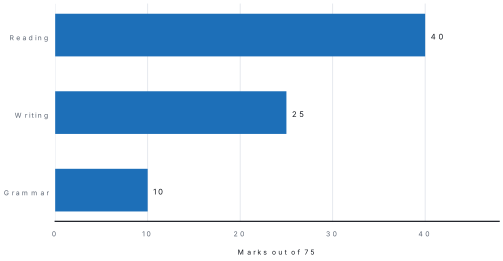
| Skill | Marks | Share of 75 | Where marks are lost |
|---|---|---|---|
| Reading (R1 to R4) | 40 | 53% | copying half a sentence; skipping the vocabulary item |
| Writing (four tasks) | 25 | 33% | wrong layout, no paragraphs, off the topic |
| Grammar | 10 | 13% | tag questions, backshift in reported speech, passive forms of perfect tenses |
Reading 1 and 2: 25 minutes. Reading 3 and 4: 40 minutes. Grammar: 15 minutes (do it early; it is ten sure marks). Writing: 80 minutes (15 + 15 + 20 + 30). Check: 20 minutes.
10.2 Model Set 1
Time: 3 hours. Full marks: 75. Attempt all questions. In a real paper the seen texts are printed in the paper; here the textbook texts are named.
Question paper
Reading 1. Seen text: "Climbing" (Amy Lowell), Unit 8. Write true or false. [5 x 1 = 5]
- The child in the poem climbs a hill. 2. The branches are compared to a staircase. 3. The poet imagines a town at the top. 4. The poem is written in free verse with no rhyme. 5. The poem is about the power of determination.
Reading 2. Seen text: "Pratap Malla", Unit 9. [10]
A. Choose the best answer. [5 x 1 = 5] 1. Pratap Malla ruled (a) Lalitpur (b) Bhaktapur (c) Kantipur (d) Patan 2. He took the title (a) Kabindra (b) Narendra (c) Shahendra (d) Mahendra 3. His wealth came mainly from (a) farming (b) Tibet–India trade (c) tourism (d) gold mines 4. He kept his state safe by (a) war (b) diplomacy (c) building walls (d) hiding 5. Which place is linked with him? (a) Rani Pokhari (b) Ranipauwa (c) Ranighat (d) Rani Mahal
B. Answer the questions. [5 x 1 = 5] 6. When did he rule? 7. Name one language he wrote in. 8. How did he show his interest in religion and art? 9. Which palace is linked with him? 10. What does the text show about him as a ruler?
Reading 3. Unseen text (advertisement). [10]
HIMALAYAN COMPUTER TRAINING CENTRE, Butwal Three-month Basic Computer Course starts on 1 Baisakh. Classes run from 6 a.m. to 8 a.m. every day except Saturday. Course fee: Rs 6,000 (Rs 5,000 for SEE graduates who register before 20 Chaitra). Only 20 seats. Certificate and free practice hours. Call 071-555123 or visit our office near the bus park.
A. True or false. [5 x 1 = 5] 1. The course lasts three months. 2. Classes are held on Saturdays. 3. SEE graduates can get a discount. 4. The centre has unlimited seats. 5. The office is near the airport.
B. Answer briefly. [5 x 1 = 5] 6. When do the classes start? 7. How much is the fee for a SEE graduate who registers early? 8. How many seats are there? 9. What will the students receive at the end? 10. How can a person contact the centre?
Reading 4. Unseen text. [15]
Nepal is rich in water, yet many towns face water shortage every spring. Rivers fall from the Himalayas, but towns lie far from rivers, and old pipes leak much of the water before it reaches homes. In some cities people queue at taps or buy water from tankers, which costs more than piped water.
Experts say that saving water begins at home. A tap that drips all night can waste many litres, and a washing machine used for half a load wastes both water and electricity. Schools can help by teaching children to turn off taps and to collect rainwater. Some communities in the hills have built small ponds to catch rain, and their springs have started to flow again after years.
The government has also begun to repair old pipes and to build long water-supply schemes. But the shortage will end only when every citizen sees water as a shared and limited resource, not as a free gift that never ends.
A. Choose the best answer. [5 x 1 = 5] 1. Towns face a water shortage because (a) rivers have dried up (b) towns are far from rivers and pipes leak (c) there is no rain (d) people drink too much 2. Water bought from tankers is (a) cheaper than piped water (b) costlier than piped water (c) free (d) cleaner than spring water 3. Which action is advised for schools? (a) cut pipes (b) turn off taps and collect rainwater (c) buy tankers (d) build roads 4. Hill communities built (a) ponds to catch rain (b) dams (c) wells (d) canals 5. The writer's main point is that (a) water is unlimited (b) citizens must see water as a limited shared resource (c) only the government can help (d) tankers are best
B. Answer the questions. [5 x 1 = 5] 6. What happens to water in old pipes? 7. Name one way to save water at home. 8. What did the ponds do for the springs? 9. What is the government doing? 10. Why is water not a "free gift that never ends"?
C. Vocabulary. Find words in the passage that mean: [5 x 1 = 5] 11. a situation in which there is not enough of something 12. to gather and keep (rainwater) 13. a plan to supply something, as for water 14. to let a liquid escape through a hole 15. something useful, such as water, that people use
Guided writing I. [5] The table shows the number of books borrowed from a school library in three months: Shrawan 210, Bhadra 150, Ashwin 90. Write a paragraph of about 100 words describing it.
Guided writing II. [5] Write a news story from these clues: Fire — Dharan bazaar — 8 shops — midnight — firefighters — no one hurt.
Free writing I. [6] Write an application to the head teacher asking to be excused from school fees because your father has lost his job. (about 150 words)
Free writing II. [9] Write an essay of about 200 words on The Importance of Reading Books.
Grammar. [10]
A. Reproduction. [5 x 1 = 5] 1. (Tense) She _ (teach) English for ten years now. 2. (Question tag) Nobody called, _? 3. (Reported speech) "I am going to Pokhara," said Nisha. 4. (Voice) The students are cleaning the classroom. 5. (Negation) Everyone enjoyed the film. (Make it negative with No one.)
B. Choose the correct word. [5 x 1 = 5] Last winter I went (6) _ a village (7) the hills. The village (8) _ I stayed was small. (9) it was cold, the people were warm. If I (10) ____ more time, I would stay longer. 6. (a) in (b) to (c) at (d) by 7. (a) of (b) in (c) at (d) on 8. (a) who (b) where (c) whose (d) whom 9. (a) Although (b) Despite (c) Because (d) So 10. (a) have (b) had had (c) had (d) would have
Answers to Model Set 1
R1. 1. False — an apple tree. 2. True. 3. True. 4. False — the poem has rhyming couplets. 5. True. R2 A. 1. (c) 2. (a) 3. (b) 4. (b) 5. (a). R2 B. 6. About 1641–1674. 7. Any one language of the many he wrote in (the text says he wrote in many languages). 8. He built and repaired temples and palaces, which showed his devotion and his love of art. 9. Hanuman Dhoka. 10. That he was a wise, cultured ruler who used diplomacy, trade and the arts.
A. 1. True. 2. False — every day except Saturday. 3. True. 4. False — only 20 seats. 5. False — near the bus park. B. 6. On 1 Baisakh. 7. Rs 5,000. 8. Twenty. 9. A certificate. 10. By calling 071-555123 or visiting the office near the bus park.
A. 1. (b) 2. (b) 3. (b) 4. (a) 5. (b). B. 6. Much of it leaks out before it reaches homes. 7. Turn off dripping taps (or use a full load in the washing machine). 8. They made the springs flow again after years. 9. It is repairing old pipes and building long water-supply schemes. 10. Because the supply is limited and shared; careless use will end the shortage only if people change. C. 11. shortage. 12. collect. 13. scheme. 14. leak. 15. resource.
The table shows how many books pupils borrowed from the school library in three months. Borrowing was highest in Shrawan, when 210 books were taken. In Bhadra it fell to 150, and it fell again to 90 in Ashwin, the lowest figure. So the number in Ashwin was less than half of that in Shrawan. The decline may be due to examinations or festival holidays. The library should therefore hold reading events in Ashwin to encourage students to borrow more books.
Fire destroys eight shops in Dharan
Dharan, 18 Magh. Eight shops were burnt down in a fire that broke out in Dharan bazaar at midnight. Firefighters arrived within twenty minutes and brought the blaze under control by dawn. No one was hurt, because the shops were closed. The cause of the fire is not yet known and police are investigating. Traders have asked the municipality for help.
15 Magh 2082
The Head Teacher Shree Mahendra Secondary School Biratnagar
Subject: Request for a fee waiver
Sir,
I am a student of Grade 10. My father lost his job two months ago and our family is finding it hard to pay my fees. I have always been regular and have passed every examination with good marks. I request you to excuse me from the school fees for this year. I will study hard and keep the honour of the school. I am attaching a letter from my ward office.
Yours obediently, Roshan Karki Grade 10, Roll No. 7
The Importance of Reading Books
Books are the oldest and best friends of mankind. In this age of phones and videos, reading is still one of the most useful habits a student can have.
First, reading improves language. A person who reads widely learns new words and how sentences are built, and writes better. Second, books give knowledge: a single book can carry the experience of a lifetime. Third, reading relaxes the mind; a good story takes us away from worry. It also trains concentration, which students need for study.
Yet many young people read nothing but their textbooks. Libraries are empty while screens are busy. Schools should therefore hold reading hours and give prizes to readers. Parents should buy books as gifts.
In conclusion, a person who reads is never alone and never ignorant. We should read at least a little every day.
A. 1. has been teaching (or has taught) — for ten years shows a period up to now. 2. did they — nobody makes the clause negative, so the tag is positive. 3. Nisha said that she was going to Pokhara. 4. The classroom is being cleaned by the students. 5. No one enjoyed the film. B. 6. (b) to. 7. (b) in. 8. (b) where. 9. (a) Although. 10. (c) had — second conditional: if + past, would + base verb.
10.3 Model Set 2
Time: 3 hours. Full marks: 75.
Question paper
Reading 1. Seen text: "Weathers" (Thomas Hardy), Unit 14. Fill in the gaps. [5 x 1 = 5]
- The poem was written by _. 2. The refrain of each stanza is "And so do ." 3. The speaker likes _ weather. 4. The weather he shuns is weather. 5. Each stanza has ____ lines.
Reading 2. Seen text: "Strange Food from Around the World", Unit 6. [10]
A. Match the food with its country. [5 x 1 = 5]
| Food | Country |
|---|---|
| 1. haggis | (a) France |
| 2. shiokara | (b) Scotland |
| 3. bún riêu | (c) Japan |
| 4. snails | (d) Vietnam |
| 5. jellyfish | (e) China |
B. Answer the questions. [5 x 1 = 5] 6. What does the idiom a bridge too far mean? 7. Why is some food "strange"? 8. Name one food eaten as bush food in Australia. 9. Name one Vietnamese food mentioned in the text. 10. What is the writer's attitude to strange foods?
Reading 3. Unseen text (diary entry). [10]
Tuesday, 14 Kartik. Today was the most tiring day of my life, but also the happiest. We left Pokhara at five in the morning for the Sarangkot sunrise. The road was dark and my sister felt sick in the bus, so we stopped twice. At the top, nobody spoke when the first light touched Machhapuchhre; the whole range turned gold. On the way down, we lost the path and walked for an hour before we found a tea shop. The owner gave us hot lemon tea and would not take any money. I am writing this with sore legs, but I know I will remember this day forever.
A. Choose the best answer. [5 x 1 = 5] 1. They left Pokhara at (a) 4 a.m. (b) 5 a.m. (c) 6 a.m. (d) 7 a.m. 2. The bus stopped twice because (a) it broke down (b) the writer's sister felt sick (c) of rain (d) of a landslide 3. The mountain turned gold when (a) the first light touched it (b) the moon rose (c) it snowed (d) it rained 4. They found (a) a hotel (b) a tea shop (c) a temple (d) a police post 5. The writer felt (a) tired but happy (b) angry (c) bored (d) afraid
B. Answer briefly. [5 x 1 = 5] 6. Why did they go to Sarangkot? 7. What did the group do when the light came? 8. How did they get lost? 9. What did the tea-shop owner do? 10. Why does the writer say the day was both tiring and happy?
Reading 4. Unseen text. [15]
Online learning has grown quickly in Nepal in the last few years. During the lockdowns of 2020, schools that had never used a computer began to teach through mobile phones, radio and television. Some children in remote villages learned from radio lessons because there was no internet at all.
Teachers report that online classes have clear benefits. Students can watch a lesson again and again, and a good teacher in the capital can reach a classroom in Humla. Study material is cheaper and easier to share. But there are problems as well. Many homes do not have a smartphone, and where they do, the signal is weak. Younger children lose attention in front of a screen, and a student cannot ask questions as easily as in a classroom.
Most educators now believe that the best way is a mixture: ordinary classes supported by online material. That way each method fills the gaps of the other.
A. Choose the best answer. [5 x 1 = 5] 1. During the lockdowns some children learned from (a) newspapers only (b) radio lessons (c) letters (d) nothing 2. A benefit of online classes is that (a) students can replay lessons (b) the signal is strong (c) there are no teachers (d) they cost more 3. A problem mentioned is that (a) every home has a computer (b) younger children lose attention (c) teachers are lazy (d) lessons are too short 4. Most educators prefer (a) only online classes (b) only classroom classes (c) a mixture of both (d) no classes 5. The passage is mainly about (a) the benefits and problems of online learning (b) radio (c) lockdowns (d) teachers in Humla
B. Answer the questions. [5 x 1 = 5] 6. What did schools use to teach during the lockdowns? 7. How can a village class benefit from a teacher in the capital? 8. Why is it hard for students to ask questions online? 9. Why do many homes find it hard to use online lessons? 10. What do educators now believe is the best way?
C. Vocabulary: match the words (1 mark each) [5] 11. remote 12. benefit 13. signal 14. mixture 15. educator (a) a combination (b) far from towns (c) an advantage (d) a teacher (e) a sign sent by wave
Guided writing I. [5] Write instructions for making a paper boat.
Guided writing II. [5] Complete the story: A shepherd boy — cried "wolf" for fun — villagers came — no wolf — a real wolf came — no one believed him. Give a moral.
Free writing I. [6] Write a dialogue between a shopkeeper and a customer who wants to return a faulty phone. (about 150 words)
Free writing II. [9] Write a letter to your friend telling him or her about a trip you took with your class. (about 200 words)
Grammar. [10]
A. Reproduction. [5 x 1 = 5] 1. (Tense) By next April I _ (finish) my SEE. 2. (Question tag) I am late, _? 3. (Reported speech) "Where do you live?" the officer asked me. 4. (Voice) Someone has stolen my bicycle. 5. (Interrogation) She goes to school by bus. (Make it a question beginning How.)
B. Choose the correct word. [5 x 1 = 5] The number of visitors (6) _ increasing. A number of them (7) in homestays. They (8) _ the guide to take them to the village. (9) it was raining, they went out. If it (10) ____ tomorrow, they will stay. 6. (a) are (b) is (c) were (d) have 7. (a) stays (b) stay (c) is staying (d) has stayed 8. (a) had (b) got (c) let (d) made 9. (a) Despite (b) Although (c) Because (d) So 10. (a) rains (b) will rain (c) rained (d) would rain
Answers to Model Set 2
R1. 1. Thomas Hardy. 2. I. 3. spring. 4. winter. 5. nine. R2 A. 1. (b) 2. (c) 3. (d) 4. (a) 5. (e). R2 B. 6. Too extreme. 7. It is strange because it is unfamiliar to people of another culture, although it is normal for the people who eat it. 8. Any bush food named in the text. 9. bún riêu. 10. The writer treats strange foods as an adventure and says taste is cultural.
A. 1. (b) 2. (b) 3. (a) 4. (b) 5. (a). B. 6. To see the sunrise (over Machhapuchhre). 7. Nobody spoke; they watched the whole range turn gold. 8. They lost the path on the way down and walked for an hour. 9. He gave them hot lemon tea and would not take any money. 10. It was tiring because of the early start, the sickness and the long walk, but it was happy because of the beautiful sunrise and the kind tea-shop owner.
A. 1. (b) 2. (a) 3. (b) 4. (c) 5. (a). B. 6. Mobile phones, radio and television. 7. A good teacher in the capital can reach the classroom through a recorded or live lesson. 8. They cannot ask questions as easily as in a classroom. 9. Many homes have no smartphone and the signal is weak. 10. A mixture of ordinary classes and online material. C. 11. (b). 12. (c). 13. (e). 14. (a). 15. (d).
How to make a paper boat You need: one rectangular sheet of paper. 1. Fold the sheet in half along its length, then open it to leave a centre line. 2. Fold the top corners down to the centre line to make a triangle at the top. 3. Fold the lower strips up on both sides over the triangle. 4. Open the folded paper and flatten it into a diamond. 5. Fold the lower corners up and open again to form a boat. 6. Pull the two tips gently apart and set the boat on water.
The shepherd boy and the wolf
A shepherd boy looked after sheep near a village. One day he was bored, so he cried, "Wolf! Wolf!" The villagers ran to help, but found no wolf, and the boy laughed. He played the same trick again. One evening a real wolf came. The boy cried for help, but no one believed him, and the wolf scattered the flock. Moral: a liar is not believed even when he tells the truth.
Customer: Good morning. I bought this phone from you last week, but the screen flickers. Shopkeeper: I am sorry to hear that. May I see the bill? Customer: Here it is. I have also brought the box and the charger. Shopkeeper: Thank you. Has the phone been dropped? Customer: No, it has not. The fault started on the second day. Shopkeeper: In that case it is covered by the warranty. I can replace it today or send it for repair. Customer: I would like a replacement, please. Shopkeeper: Certainly. Please wait for a few minutes while I get a new one. Customer: Thank you for your help.
Kathmandu 20 Poush 2082
Dear Sapana,
I hope you are well. I am writing to tell you about the trip I took with my class last week. We went to Chitwan for three days. We left at six in the morning and reached by noon after a long, noisy bus ride. In the afternoon we visited the elephant breeding centre.
The next morning we went on a jeep safari. We saw deer, a rhinoceros and many birds. In the evening we watched a Tharu stick dance and tried to join in. Our teacher joked that I would never be a dancer!
On the last day we took a canoe ride on the river. Everyone was tired but happy. I wish you had come. Please write to me soon and tell me about your holiday.
Yours lovingly, Pratima
A. 1. will have finished (finished before a point in the future). 2. aren't I. 3. The officer asked me where I lived. 4. My bicycle has been stolen. 5. How does she go to school? B. 6. (b) is — the number of is singular. 7. (b) stay — a number of is plural. 8. (b) got — get + person + to + verb; had, let and made take the bare infinitive. 9. (b) Although. 10. (a) rains — present tense after if in a first conditional.
10.4 Predicted questions
These are not forecasts. Ranks follow two reasons: how often a task type is asked (every paper has all four reading passages, four writing tasks and ten grammar items) and how much of the syllabus a text or task can carry. A text ranked low is not unimportant. A text that has just appeared in a past paper is not "used up" either; examiners do not follow a rotation that anyone outside the board knows.
Tier A: practise before anything else
| Rank | Question | Reason |
|---|---|---|
| 1 | A formal or personal letter (Free writing II) | The largest writing slot (9 marks); a letter is the commonest form |
| 2 | An essay on a social or educational topic | The other half of the same slot |
| 3 | An application (leave or job) | Free writing I names both |
| 4 | A notice, an advertisement or a chart description | Guided writing I names them |
| 5 | A news story or a story from a skeleton | Guided writing II names them |
| 6 | Reading 4 on an essay or article, with a vocabulary item | 15 marks, the largest single reading task |
| 7 | Grammar: reported speech, passive, tense, tag, conditional | Five reproduction items |
| 8 | The seen texts of Units 8 to 11 | Short texts; true/false and matching items are easy to set |
Tier B: likely second line
| Rank | Question | Reason |
|---|---|---|
| 9 | "Climbing", "Weathers", "If" | The poems are short and fit the 100-word seen slot |
| 10 | "Pratap Malla" and "Flowers in Russian Culture" | Facts and dates make good MCQs and gap-fills |
| 11 | "Expect the Unexpected" and "Sugarloaf Mountain" | Place descriptions give facts for matching |
| 12 | "Hachi: A Dog's Tale" and "Interesting Social Media Stories" | Review and article give MCQs |
| 13 | An email or a dialogue | Free writing I and II name them |
| 14 | A biography or a condolence message | Guided writing II names them |
| 15 | Grammar MCQs: articles, prepositions, connectives, agreement | Five MCQ items |
Tier C: smaller but still in the syllabus
| Rank | Question | Reason |
|---|---|---|
| 16 | "Cabbage White" and "Parents" | Stories; short-answer on plot or irony |
| 17 | "Population" and "bird migration" | Figures give gap-fill items |
| 18 | "Wisdom of Little Girls" and "World Record" | Moral and satire |
| 19 | Instructions or a recipe | Guided writing I names them |
| 20 | Causatives and relative clauses | Smaller grammar topics |
Week 1: write one letter, one application, one essay, one notice and one news story and mark each against the models. Week 2: re-read two seen texts a day, write five true/false items for each, then do a full model set in three hours.
Chapter summary
- The paper is Reading 40 (5 + 10 + 10 + 15), Writing 25 (5 + 5 + 6 + 9) and Grammar 10 = 75 marks in 3 hours.
- Seen-text items are answered from the book; unseen items from the passage in front of you.
- Writing is marked on format and organisation first: a letter needs an address, date, subject line and closing; a news story needs a headline and a dateline.
- Grammar: nobody gets a positive tag, aren't I, the number of is singular, a number of is plural, if + present → will.
- The ranking above comes from the grid and the syllabus, not from any knowledge of the paper.
Practice questions
Short questions (1 mark each)
- Who wrote "Weathers"? [1]
- In which year was the modern Olympic Games first held? [1]
- Add a question tag: Nobody came, ____? [1]
- Change into the passive: They are building a road. [1]
Answers to Short questions
1. Thomas Hardy.
2. 1896, in Athens.
3. did they.
4. A road is being built.
Writing (5 to 9 marks)
- Write a news story from these clues: Bus accident — Mugling — Monday morning — 12 injured — hospital. [5]
- Write an essay of about 200 words on The Role of Teachers in Society. [9]
Answers to Writing
1. Use the news-story model in Chapter 9, section 9.4: headline, dateline, who, what, when, where, why and one closing line.
2. Use the essay model in section 9.6 of the previous chapter: introduction, three body points with examples, a conclusion.