Unit 1 · Algebra · 8 teaching hours · 30 min read
Logic and Set
What the syllabus asks for 3
- Statements; logical connectives
- Truth tables
- Theorems based on set operations
Every theorem you will meet this year has the same shape: given something, therefore something else. Logic is the study of that word "therefore" — the rules that let you move from one true statement to the next without error. Sets are the language those statements are written in. This unit is short on computation and heavy on precision, so read the definitions slowly: a single misplaced "or" changes the answer.
Three things recur in every paper: (i) build a truth table and name the result (tautology / contradiction), (ii) prove a set identity either by element-chasing or by Venn diagram, and (iii) a survey word problem using n(A \cup B) or the three-set formula. Group A usually takes one mark from truth values and one from cardinality.
1.1 Statements; logical connectives
A statement is a declarative sentence which is either true or false, but not both. Whether it is true or false is called its truth value, written T or F.
Commands, questions, exclamations and opinions are not statements. Neither is a sentence containing an unknown, because its truth depends on the unknown.
| Sentence | Statement? | Why |
|---|---|---|
| Kathmandu is the capital of Nepal. | Yes (T) | Definitely true |
| 3 + 4 = 9 | Yes (F) | Definitely false |
| Every prime number is odd. | Yes (F) | 2 is an even prime |
| Close the door. | No | A command |
| Where do you live? | No | A question |
| x + 2 = 5 | No | Truth value depends on x |
| Mathematics is beautiful. | No | An opinion |
A sentence like x + 2 = 5 is called an open sentence. The set of values that make it true — here \{3\} — is its truth set.
A statement carrying no connective is simple; statements joined by connectives are compound. Simple statements are labelled p, q, r, \dots
| Name | Symbol | Read as | Called |
|---|---|---|---|
| Negation | \sim p | "not p" | — |
| Conjunction | p \wedge q | "p and q" | conjuncts |
| Disjunction | p \vee q | "p or q" (inclusive) | disjuncts |
| Conditional | p \rightarrow q | "if p then q" | p antecedent, q consequent |
| Biconditional | p \leftrightarrow q | "p if and only if q" | — |
The mathematical "or" is inclusive: p \vee q is true when p is true, when q is true, and when both are true. Everyday Nepali and English often mean "or" exclusively ("tea or coffee"); mathematics never does.
The conditional p \rightarrow q is the one students find strange. It claims only that q cannot fail while p holds. So it is false in exactly one case: p true and q false. If p is false the whole conditional is automatically true (the promise was never tested). The statement "if 2 = 3 then the moon is square" is true.
Related conditionals
From p \rightarrow q three further conditionals are formed.
| Name | Form |
|---|---|
| Converse | q \rightarrow p |
| Inverse | \sim p \rightarrow \sim q |
| Contrapositive | \sim q \rightarrow \sim p |
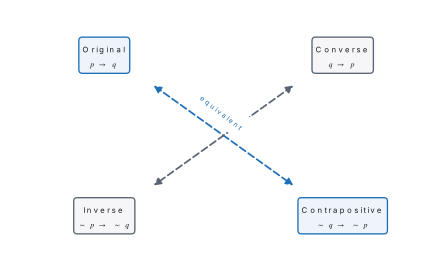
"If a number is divisible by 6, then it is divisible by 3" is true. Its converse, "if a number is divisible by 3 then it is divisible by 6", is false (9 is a counter-example). Only the contrapositive always has the same truth value as the original — which is why proof by contrapositive is legal and "proof by converse" is not.
Quantifiers
- Universal quantifier \forall — "for all". \forall x \in \mathbb{R},\ x^2 \geq 0.
- Existential quantifier \exists — "there exists". \exists x \in \mathbb{R} such that x^2 = 4.
Negation swaps them: \sim(\forall x,\ p(x)) \equiv \exists x,\ \sim p(x) and \sim(\exists x,\ p(x)) \equiv \forall x,\ \sim p(x). "Not every student passed" means "some student failed".
Problem. Let p: "Sita is a doctor" and q: "Sita is a singer". Write in symbols: (a) Sita is a doctor but not a singer. (b) If Sita is not a doctor then she is a singer. (c) Sita is neither a doctor nor a singer.
Solution.
(a) "but" is just and, so this is p \wedge \sim q.
(b) The antecedent is "\sim p" and the consequent is "q": \sim p \rightarrow q.
(c) "Neither A nor B" means "not A and not B": \sim p \wedge \sim q. By De Morgan's law this is the same as \sim(p \vee q).
Problem. Write the converse, inverse and contrapositive of: "If a triangle is equilateral, then it is isosceles." State the truth value of each.
Solution. Let p: the triangle is equilateral; q: the triangle is isosceles. The given statement is p \rightarrow q, which is true (all three sides equal implies at least two equal).
- Converse (q \rightarrow p): "If a triangle is isosceles, then it is equilateral." False — a triangle with sides 5, 5, 8 is isosceles but not equilateral.
- Inverse (\sim p \rightarrow \sim q): "If a triangle is not equilateral, then it is not isosceles." False — same counter-example.
- Contrapositive (\sim q \rightarrow \sim p): "If a triangle is not isosceles, then it is not equilateral." True, as it must be, being equivalent to the original.
1.2 Truth tables
A truth table lists every possible combination of truth values of the simple statements and works out the truth value of the compound statement in each case. With n simple statements there are 2^n rows: 2 rows for one letter, 4 for two, 8 for three. Fill the input columns in a fixed order so you never miss a row.
| p | q | \sim p | p \wedge q | p \vee q | p \rightarrow q | p \leftrightarrow q |
|---|---|---|---|---|---|---|
| T | T | F | T | T | T | T |
| T | F | F | F | T | F | F |
| F | T | T | F | T | T | F |
| F | F | T | F | F | T | T |
p \wedge q is true only in row 1. p \vee q is false only in row 4. p \rightarrow q is false only in row 2. p \leftrightarrow q is true exactly when the two truth values agree.
A compound statement whose last column is all T is a tautology; all F is a contradiction; a mixture is a contingency. Two statements are logically equivalent (written \equiv) when their final columns are identical, i.e. when the biconditional between them is a tautology.
Example table 1 — a tautology. (p \wedge q) \rightarrow p
| p | q | p \wedge q | (p \wedge q) \rightarrow p |
|---|---|---|---|
| T | T | T | T |
| T | F | F | T |
| F | T | F | T |
| F | F | F | T |
Every entry in the last column is T, so it is a tautology.
Example table 2 — a contradiction. p \wedge \sim p
| p | \sim p | p \wedge \sim p |
|---|---|---|
| T | F | F |
| F | T | F |
Example table 3 — the conditional rewritten. p \rightarrow q \equiv \sim p \vee q
| p | q | \sim p | p \rightarrow q | \sim p \vee q |
|---|---|---|---|---|
| T | T | F | T | T |
| T | F | F | F | F |
| F | T | T | T | T |
| F | F | T | T | T |
The last two columns agree in all four rows, so the two statements are equivalent. This is how a conditional is removed when simplifying.
Example table 4 — contrapositive, converse and inverse.
| p | q | \sim p | \sim q | p \rightarrow q | \sim q \rightarrow \sim p | q \rightarrow p | \sim p \rightarrow \sim q |
|---|---|---|---|---|---|---|---|
| T | T | F | F | T | T | T | T |
| T | F | F | T | F | F | T | T |
| F | T | T | F | T | T | F | F |
| F | F | T | T | T | T | T | T |
Columns 5 and 6 are identical: a conditional is equivalent to its contrapositive. Columns 7 and 8 are identical: the converse is equivalent to the inverse. Columns 5 and 7 differ in rows 2 and 3, so a conditional is not equivalent to its converse.
Problem. Using a truth table, prove De Morgan's law \sim(p \vee q) \equiv \sim p \wedge \sim q.
Solution. Two letters, so four rows.
| p | q | p \vee q | \sim(p \vee q) | \sim p | \sim q | \sim p \wedge \sim q |
|---|---|---|---|---|---|---|
| T | T | T | F | F | F | F |
| T | F | T | F | F | T | F |
| F | T | T | F | T | F | F |
| F | F | F | T | T | T | T |
Column 4 and column 7 are identical (F, F, F, T), so the two statements are logically equivalent. Hence \sim(p \vee q) \leftrightarrow (\sim p \wedge \sim q) is a tautology.
Problem. Construct the truth table for p \vee (q \wedge r) and for (p \vee q) \wedge (p \vee r), and hence verify the distributive law.
Solution. Three letters, so 2^3 = 8 rows.
| p | q | r | q \wedge r | p \vee (q \wedge r) | p \vee q | p \vee r | (p \vee q) \wedge (p \vee r) |
|---|---|---|---|---|---|---|---|
| T | T | T | T | T | T | T | T |
| T | T | F | F | T | T | T | T |
| T | F | T | F | T | T | T | T |
| T | F | F | F | T | T | T | T |
| F | T | T | T | T | T | T | T |
| F | T | F | F | F | T | F | F |
| F | F | T | F | F | F | T | F |
| F | F | F | F | F | F | F | F |
Columns 5 and 8 agree row by row (T,T,T,T,T,F,F,F), so p \vee (q \wedge r) \equiv (p \vee q) \wedge (p \vee r).
Problem. Test whether (p \rightarrow q) \wedge (q \rightarrow p) is equivalent to p \leftrightarrow q.
Solution.
| p | q | p \rightarrow q | q \rightarrow p | (p \rightarrow q) \wedge (q \rightarrow p) | p \leftrightarrow q |
|---|---|---|---|---|---|
| T | T | T | T | T | T |
| T | F | F | T | F | F |
| F | T | T | F | F | F |
| F | F | T | T | T | T |
The last two columns are identical, so the two are equivalent. This is why proving "if and only if" means proving both directions.
With t a tautology and c a contradiction:
- Idempotent: p \vee p \equiv p, p \wedge p \equiv p
- Commutative: p \vee q \equiv q \vee p, p \wedge q \equiv q \wedge p
- Associative: (p \vee q) \vee r \equiv p \vee (q \vee r)
- Distributive: p \wedge (q \vee r) \equiv (p \wedge q) \vee (p \wedge r)
- De Morgan: \sim(p \vee q) \equiv \sim p \wedge \sim q, \sim(p \wedge q) \equiv \sim p \vee \sim q
- Identity: p \vee c \equiv p, p \wedge t \equiv p
- Complement: p \vee \sim p \equiv t, p \wedge \sim p \equiv c, \sim(\sim p) \equiv p
- Conditional: p \rightarrow q \equiv \sim p \vee q \equiv \sim q \rightarrow \sim p
1.3 Theorems based on set operations
A set is a well-defined collection of distinct objects, its elements. Written in roster form A = \{2, 3, 5, 7\} or set-builder form A = \{x : x \text{ is a prime} , x < 10\}. Write x \in A if x belongs to A and x \notin A otherwise. The number of elements of a finite set A is its cardinal number n(A).
| Term | Meaning |
|---|---|
| Empty set \emptyset | the set with no element; n(\emptyset) = 0 |
| Subset A \subseteq B | every element of A is in B |
| Proper subset A \subset B | A \subseteq B and A \ne B |
| Equal sets A = B | A \subseteq B and B \subseteq A |
| Universal set U | the set of all elements under discussion |
| Power set P(A) | the set of all subsets of A; n(P(A)) = 2^{n(A)} |
For subsets A, B of a universal set U:
A and B are disjoint when A \cap B = \emptyset. The symmetric difference is A \triangle B = (A - B) \cup (B - A).
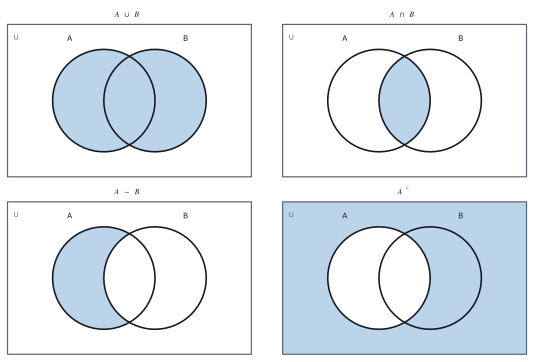
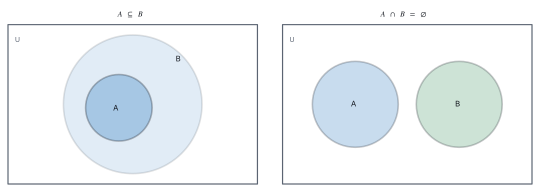
For any subsets A, B, C of a universal set U:
| Law | Union form | Intersection form |
|---|---|---|
| Idempotent | A \cup A = A | A \cap A = A |
| Identity | A \cup \emptyset = A | A \cap U = A |
| Domination | A \cup U = U | A \cap \emptyset = \emptyset |
| Commutative | A \cup B = B \cup A | A \cap B = B \cap A |
| Associative | (A \cup B) \cup C = A \cup (B \cup C) | (A \cap B) \cap C = A \cap (B \cap C) |
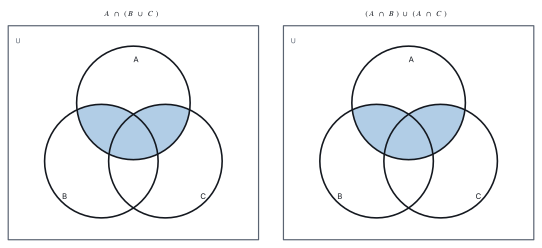
| Distributive | A \cup (B \cap C) = (A \cup B) \cap (A \cup C) | A \cap (B \cup C) = (A \cap B) \cup (A \cap C) |
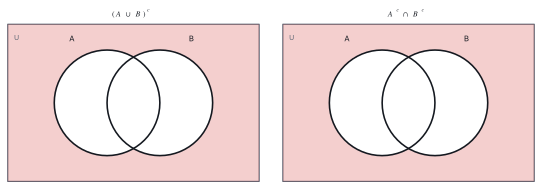
| De Morgan | (A \cup B)^c = A^c \cap B^c | (A \cap B)^c = A^c \cup B^c |
| Complement | A \cup A^c = U | A \cap A^c = \emptyset |
Also (A^c)^c = A, A - B = A \cap B^c, and A \subseteq B \Leftrightarrow A \cup B = B \Leftrightarrow A \cap B = A.
Proving a set identity
There are two accepted methods, and NEB awards marks for either.
- Element-chasing. Show x \in \text{LHS} \Rightarrow x \in \text{RHS}, then the reverse. Two inclusions give equality.
- Venn diagram. Shade both sides and show the shaded regions coincide.
Method 1 is a proof; method 2 is a verification, so use method 1 when the question says "prove" and method 2 when it says "verify" or "illustrate".
Step 1 — LHS \subseteq RHS. Let x \in A \cap (B \cup C). Then x \in A and x \in B \cup C, i.e. x \in A, and (x \in B or x \in C).
- If x \in B: then x \in A and x \in B, so x \in A \cap B.
- If x \in C: then x \in A and x \in C, so x \in A \cap C.
In either case x \in (A \cap B) \cup (A \cap C). Hence A \cap (B \cup C) \subseteq (A \cap B) \cup (A \cap C).
Step 2 — RHS \subseteq LHS. Let x \in (A \cap B) \cup (A \cap C). Then x \in A \cap B or x \in A \cap C. Either way x \in A; and either x \in B or x \in C, so x \in B \cup C. Hence x \in A \cap (B \cup C), giving (A \cap B) \cup (A \cap C) \subseteq A \cap (B \cup C).
Step 3. Both inclusions hold, therefore the two sets are equal. \blacksquare
Let x \in (A \cup B)^c. Then x \in U and x \notin A \cup B. If x belonged to A it would belong to A \cup B, so x \notin A; likewise x \notin B. Hence x \in A^c and x \in B^c, i.e. x \in A^c \cap B^c. So (A \cup B)^c \subseteq A^c \cap B^c.
Conversely let x \in A^c \cap B^c. Then x \notin A and x \notin B, so x is in neither set and therefore x \notin A \cup B. Since x \in U, x \in (A \cup B)^c. So A^c \cap B^c \subseteq (A \cup B)^c.
Both inclusions hold, hence (A \cup B)^c = A^c \cap B^c. \blacksquare
Replacing A by A^c and B by B^c and taking complements gives the second form, (A \cap B)^c = A^c \cup B^c.
Problem. If A = \{a, b, c\}, write down P(A) and verify n(P(A)) = 2^{n(A)}.
Solution. List subsets by size:
- size 0: \emptyset
- size 1: \{a\}, \{b\}, \{c\}
- size 2: \{a,b\}, \{a,c\}, \{b,c\}
- size 3: \{a,b,c\}
So n(P(A)) = 1+3+3+1 = 8 and 2^{n(A)} = 2^3 = 8. They agree. (The count is 2^n because each of the n elements is independently either in or out of a subset.)
Problem. Let A = \{1,2,3,4,5\}, B = \{2,4,6,8\} and C = \{3,4,5,6\}. Verify A \cap (B \cup C) = (A \cap B) \cup (A \cap C).
Solution. Left side. B \cup C = \{2,3,4,5,6,8\}, so
Right side. A \cap B = \{2,4\} and A \cap C = \{3,4,5\}, so
The two sides are equal, which verifies the law for these sets.
Problem. Let U = \{1,2,\dots,10\}, A = \{1,2,3,4,5\} and B = \{4,5,6,7\}. Verify both De Morgan laws.
Solution. First the complements: A^c = \{6,7,8,9,10\} and B^c = \{1,2,3,8,9,10\}.
First law. A \cup B = \{1,2,3,4,5,6,7\}, so (A \cup B)^c = \{8,9,10\}. And A^c \cap B^c = \{6,7,8,9,10\} \cap \{1,2,3,8,9,10\} = \{8,9,10\}. Equal.
Second law. A \cap B = \{4,5\}, so (A \cap B)^c = \{1,2,3,6,7,8,9,10\}. And A^c \cup B^c = \{6,7,8,9,10\} \cup \{1,2,3,8,9,10\} = \{1,2,3,6,7,8,9,10\}. Equal.
Cardinality of a union
Adding n(A) and n(B) counts every element of A \cap B twice — once in each set. Subtracting the overlap once restores the correct count:
For three sets, n(A)+n(B)+n(C) double-counts each pairwise overlap and triple-counts A \cap B \cap C. Subtracting the three pairwise overlaps removes the double counting but also removes the triple overlap three times, having added it three times — so it must be added back once:
For elements outside every set, n\!\left((A \cup B)^c\right) = n(U) - n(A \cup B).
Problem. In a group of 60 students of a school in Butwal, 35 like mathematics, 28 like physics and 10 like neither subject. How many like (a) both subjects, (b) exactly one subject, (c) mathematics only?
Solution. Let M and P be the sets of students who like mathematics and physics. Given n(U) = 60, n(M) = 35, n(P) = 28, n\!\left((M \cup P)^c\right) = 10.
(a) Those who like at least one subject are n(M \cup P) = 60 - 10 = 50. From the two-set formula,
(b) Exactly one = n(M \cup P) - n(M \cap P) = 50 - 13 = 37.
(c) n(M - P) = n(M) - n(M \cap P) = 35 - 13 = 22.
Check: 22 + 13 + (28-13) + 10 = 22+13+15+10 = 60. Correct.
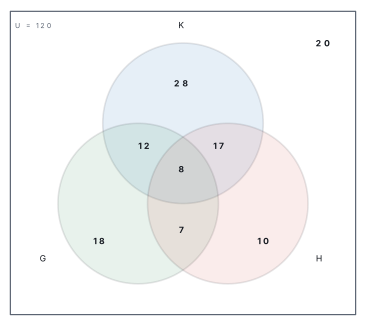
Problem. Of 120 readers surveyed in Pokhara, 65 read Kantipur, 45 read Gorkhapatra, 42 read The Himalayan Times, 20 read both Kantipur and Gorkhapatra, 25 read Kantipur and The Himalayan Times, 15 read Gorkhapatra and The Himalayan Times, and 8 read all three. Find how many read (a) at least one paper, (b) no paper, (c) exactly one paper, (d) exactly two papers.
Solution. Write K, G, H for the three sets.
(a) By the three-set formula,
(b) None = n(U) - n(K \cup G \cup H) = 120 - 100 = 20.
(c) Work outwards from the centre. Kantipur only is K minus the two overlaps, with the centre added back because it was removed twice:
Exactly one = 28 + 18 + 10 = 56.
(d) Exactly two = (20-8)+(25-8)+(15-8) = 12+17+7 = 36.
Check: 56 + 36 + 8 = 100 = n(K \cup G \cup H), and 100 + 20 = 120. Correct.
In survey questions the phrase "20 read both K and G" means n(K \cap G) = 20 — the 8 who read all three are inside that 20. Only when a question says "exactly two" or "only K and G" do you subtract the centre. Reading this wrongly is the single biggest source of lost marks in this unit.
Problem. Prove that A - (B \cup C) = (A - B) \cap (A - C).
Solution. Convert differences to intersections with complements and use De Morgan:
Since A \cap A = A, we may write A \cap B^c \cap C^c = (A \cap B^c) \cap (A \cap C^c), which is (A - B) \cap (A - C). Each step is an equality, so the result follows.
Justification of the middle step. x \in A \cap B^c \cap C^c means x \in A, x \notin B, x \notin C. That is exactly the condition "x \in A and x \notin B" and "x \in A and x \notin C", i.e. x \in (A-B) \cap (A-C). \blacksquare
Problem. If n(A) = 18, n(B) = 24 and n(A \cup B) = 32, find n(A \cap B), n(A - B) and n(A \triangle B).
Solution. From n(A \cup B) = n(A)+n(B)-n(A \cap B),
Then n(A-B) = n(A) - n(A \cap B) = 18 - 10 = 8 and n(B-A) = 24 - 10 = 14, so
Equivalently n(A \triangle B) = n(A \cup B) - n(A \cap B) = 32 - 10 = 22.
Chapter summary
- A statement has exactly one truth value, T or F. Open sentences are not statements.
- p \wedge q is true only when both are true; p \vee q is false only when both are false; p \rightarrow q is false only when p is T and q is F.
- p \rightarrow q \equiv \sim p \vee q \equiv \sim q \rightarrow \sim p. The converse q \rightarrow p is equivalent to the inverse, not to the original.
- A truth table on n letters has 2^n rows. All T = tautology, all F = contradiction, identical final columns = logical equivalence.
- De Morgan, in logic and in sets: \sim(p \vee q) \equiv \sim p \wedge \sim q and (A \cup B)^c = A^c \cap B^c; (A \cap B)^c = A^c \cup B^c.
- A - B = A \cap B^c; n(P(A)) = 2^{n(A)}; A = B is proved by the two inclusions A \subseteq B and B \subseteq A.
- n(A \cup B) = n(A)+n(B)-n(A \cap B) and n(A \cup B \cup C) = \sum n(A) - \sum n(A \cap B) + n(A \cap B \cap C).
Practice questions
Group A — Multiple choice (1 mark each)
- Which of the following is a statement? [1]aShut the window.bx - 1 = 0c7 is an even number.dHow old are you?
- The statement p \rightarrow q is false only when [1]ap is F, q is Tbp is T, q is Fcboth are Tdboth are F
- p \rightarrow q is logically equivalent to [1]aq \rightarrow pb\sim p \rightarrow \sim qc\sim q \rightarrow \sim pdp \wedge \sim q
- If n(A) = 5, the number of subsets of A is [1]a10b25c32d31
- (A \cap B)^c equals [1]aA^c \cap B^cbA^c \cup B^ccA \cup Bd(A \cup B)^c
- If n(A) = 12, n(B) = 9 and n(A \cap B) = 4, then n(A \cup B) is [1]a25b21c17d13
- A - B is the same as [1]aA \cap B^cbA^c \cap BcA \cup B^cdB - A
Answers to Group A
1. (c) — it is a declarative sentence with a definite truth value (false). (a) is a command, (d) a question, (b) an open sentence.
2. (b) — a conditional fails only when a true antecedent leads to a false consequent.
3. (c) — a conditional is equivalent to its contrapositive; the converse (a) and inverse (b) are not.
4. (c) — n(P(A)) = 2^{5} = 32.
5. (b) — De Morgan's second law: complement turns \cap into \cup.
6. (c) — 12 + 9 - 4 = 17.
7. (a) — "in A and not in B" is A \cap B^c.
Group B — Short answer (5 marks each)
- Define a statement and a tautology. Construct the truth table of (p \wedge \sim q) \vee q and state whether it is a tautology, a contradiction or neither. [5]
- Write the converse, inverse and contrapositive of "If x is divisible by 10, then x is divisible by 5", and state the truth value of each with a reason. [5]
- Using a truth table, prove that \sim(p \wedge q) \equiv \sim p \vee \sim q. [5]
- Prove that (A \cap B)^c = A^c \cup B^c by the element-chasing method. [5]
- In a class of 80 students, 45 play football, 30 play volleyball and 12 play both. How many play(a) at least one game,(b) neither game,(c) exactly one game? [5]
- If A = \{x : x \in \mathbb{N} , x \le 8\}, B = \{2,4,6,8,10\} and C = \{1,3,5,7,9\} with U = \{1,2,\dots,10\}, find (A \cup B)^c, A - (B \cup C) and n(A \triangle B). [5]
Answers to Group B
1. A statement is a declarative sentence with exactly one truth value, T or F. A tautology is a compound statement that is true for every assignment of truth values.
| p | q | \sim q | p \wedge \sim q | (p \wedge \sim q) \vee q |
|---|---|---|---|---|
| T | T | F | F | T |
| T | F | T | T | T |
| F | T | F | F | T |
| F | F | T | F | F |
The last column is T, T, T, F — not all T and not all F, so it is neither a tautology nor a contradiction (it is a contingency). In fact it is equivalent to p \vee q.
2. Let p: x is divisible by 10; q: x is divisible by 5. The original p \rightarrow q is true, since x = 10k = 5(2k).
- Converse q \rightarrow p: "If x is divisible by 5 then x is divisible by 10." False — x = 15 is divisible by 5 but not by 10.
- Inverse \sim p \rightarrow \sim q: "If x is not divisible by 10 then x is not divisible by 5." False — same counter-example x = 15.
- Contrapositive \sim q \rightarrow \sim p: "If x is not divisible by 5 then x is not divisible by 10." True, being equivalent to the original.
3.
| p | q | p \wedge q | \sim(p \wedge q) | \sim p | \sim q | \sim p \vee \sim q |
|---|---|---|---|---|---|---|
| T | T | T | F | F | F | F |
| T | F | F | T | F | T | T |
| F | T | F | T | T | F | T |
| F | F | F | T | T | T | T |
Column 4 and column 7 are both F, T, T, T. Identical columns, so the statements are logically equivalent.
4. Let x \in (A \cap B)^c. Then x \in U and x \notin A \cap B, so x fails to be in at least one of A, B — that is, x \notin A or x \notin B, i.e. x \in A^c or x \in B^c, i.e. x \in A^c \cup B^c. Hence (A \cap B)^c \subseteq A^c \cup B^c.
Conversely let x \in A^c \cup B^c. Then x \notin A or x \notin B. In either case x cannot be in both A and B, so x \notin A \cap B, and since x \in U we get x \in (A \cap B)^c. Hence A^c \cup B^c \subseteq (A \cap B)^c.
Both inclusions hold, so (A \cap B)^c = A^c \cup B^c.
5. n(U) = 80, n(F) = 45, n(V) = 30, n(F \cap V) = 12.
(a) n(F \cup V) = 45 + 30 - 12 = 63.
(b) Neither = 80 - 63 = 17.
(c) Exactly one = 63 - 12 = 51 (football only 45-12 = 33, volleyball only 30-12 = 18, and 33+18 = 51).
6. A = \{1,2,3,4,5,6,7,8\}.
A \cup B = \{1,2,3,4,5,6,7,8,10\}, so (A \cup B)^c = \{9\}.
B \cup C = \{1,2,3,4,5,6,7,8,9,10\} = U, so A - (B \cup C) = \emptyset.
A \cap B = \{2,4,6,8\}, so A - B = \{1,3,5,7\} and B - A = \{10\}. Hence A \triangle B = \{1,3,5,7,10\} and n(A \triangle B) = 5.
Group C — Long answer (8 marks each)
- (a) Construct the truth table of p \vee (q \wedge r) and of (p \vee q) \wedge (p \vee r), and hence state the law verified. [5](b) Show with a truth table that (p \rightarrow q) \wedge (q \rightarrow r) \rightarrow (p \rightarrow r) is a tautology. [3]
- In a survey of 200 households in Biratnagar, 120 own a television, 90 own a refrigerator, 70 own a motorcycle, 50 own a television and a refrigerator, 40 own a television and a motorcycle, 30 own a refrigerator and a motorcycle, and 20 own all three. [8] Using a Venn diagram find how many households ownaat least one of the three,bnone of the three,cexactly one item,dexactly two items.
Answers to Group C
1. (a) See Worked example 1.4 for the full eight-row table. Both final columns read T, T, T, T, T, F, F, F, so p \vee (q \wedge r) \equiv (p \vee q) \wedge (p \vee r) — the distributive law of disjunction over conjunction.
1. (b) Write S = (p \rightarrow q) \wedge (q \rightarrow r) and T = p \rightarrow r.
| p | q | r | p \rightarrow q | q \rightarrow r | S | T | S \rightarrow T |
|---|---|---|---|---|---|---|---|
| T | T | T | T | T | T | T | T |
| T | T | F | T | F | F | F | T |
| T | F | T | F | T | F | T | T |
| T | F | F | F | T | F | F | T |
| F | T | T | T | T | T | T | T |
| F | T | F | T | F | F | T | T |
| F | F | T | T | T | T | T | T |
| F | F | F | T | T | T | T | T |
The last column is T in all eight rows, so the statement is a tautology. (This is the law of syllogism, the rule that lets you chain implications in a proof.)
2. Let T, R, M be the sets of television, refrigerator and motorcycle owners. Given n(U) = 200, n(T) = 120, n(R) = 90, n(M) = 70, n(T \cap R) = 50, n(T \cap M) = 40, n(R \cap M) = 30, n(T \cap R \cap M) = 20.
(a) n(T \cup R \cup M) = 120+90+70-50-40-30+20 = 280 - 120 + 20 = 180.
(b) None = 200 - 180 = 20.
(c) Filling the Venn diagram from the centre outwards:
Exactly one = 50+30+20 = 100.
(d) Exactly two = (50-20)+(40-20)+(30-20) = 30+20+10 = 60.
Check: 100 + 60 + 20 = 180, and 180 + 20 = 200. Consistent.
Practise more: Mathematics question bank