Unit 3 · Algebra · 7 teaching hours · 25 min read
Functions
What the syllabus asks for 4
- Domain and range
- Inverse function; composite function
- Algebraic functions: linear, quadratic, cubic
- Transcendental functions: trigonometric, exponential, logarithmic
A function is a rule that turns each input into exactly one output. That one sentence carries the whole unit: limits, derivatives and integrals in the Calculus area are all operations on functions, so everything later depends on being fluent here. The work divides into four jobs — say which inputs are allowed (domain) and which outputs occur (range), chain functions together (composition), undo them (inverse), and recognise the standard families by their graphs.
Group A takes a mark from domain, range or f^{-1}. Group B almost always asks either "find f \circ g and g \circ f and show they are unequal" or "find the inverse of \frac{ax+b}{cx+d}". Group C combines a domain/range question with sketches of the standard curves. Always state domain and range as sets or intervals, never as a sentence.
3.1 Domain and range
Let A and B be non-empty sets. A function f : A \rightarrow B is a rule that assigns to each element x \in A exactly one element f(x) \in B.
- A is the domain, B is the co-domain.
- f(x) is the image of x; x is a pre-image of f(x).
- The range is the set of images actually attained, f(A) = \{f(x) : x \in A\} \subseteq B.
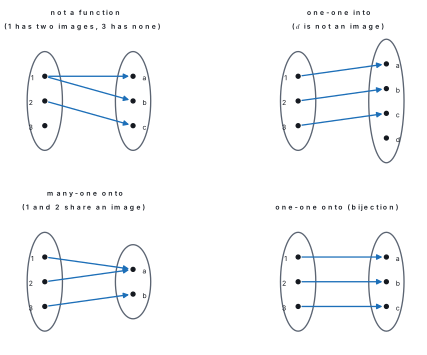
Two conditions must hold: every element of A must be used, and none may have two images. A relation failing either is not a function. On a graph this is the vertical line test: a curve is the graph of a function only if no vertical line meets it more than once.
- f is one-one (injective) if different inputs give different outputs: f(x_1) = f(x_2) \Rightarrow x_1 = x_2. Otherwise it is many-one.
- f is onto (surjective) if the range equals the co-domain, f(A) = B. If f(A) \subset B (some element of B is left out), f is into.
- f is a bijection (one-one onto) if it is both. Only a bijection has an inverse.
Finding the domain
When a function is given only by a formula, its domain is the largest set of real numbers for which the formula makes sense. Three rules cover almost every exam question.
- Never divide by zero. For \frac{p(x)}{q(x)}, exclude the roots of q(x) = 0.
- Never take an even root of a negative. For \sqrt{g(x)}, require g(x) \ge 0.
- Never take a logarithm of a non-positive number. For \log g(x), require g(x) > 0.
If two rules apply, take the intersection of the sets they allow.
Problem. Which of these are functions from A = \{1,2,3\} to B = \{4,5,6,7\}? (a) \{(1,4),(2,5),(3,6)\} (b) \{(1,4),(1,5),(2,6),(3,7)\} (c) \{(1,4),(2,4)\}
Solution.
(a) Yes. All three elements of A appear once each, with one image apiece. It is one-one and into (7 is not an image).
(b) No. The element 1 has two images, 4 and 5, so the "exactly one" condition fails.
(c) No. The element 3 has no image, so the "each element" condition fails.
Problem. Find the domain and range of (a) f(x) = \dfrac{1}{x-3}, (b) g(x) = \sqrt{x-2}.
Solution.
(a) The denominator vanishes at x = 3, so
For the range, set y = \frac{1}{x-3} and solve for x: x - 3 = \frac{1}{y}, so x = 3 + \frac{1}{y}. This is defined for every y except y = 0. Hence
(Indeed \frac{1}{x-3} can never equal 0, since a fraction with numerator 1 is never zero.)
(b) Need x - 2 \ge 0, i.e. x \ge 2, so the domain is [2, \infty). As x runs over [2,\infty), x-2 runs over [0,\infty) and its square root runs over [0,\infty). Range = [0, \infty).
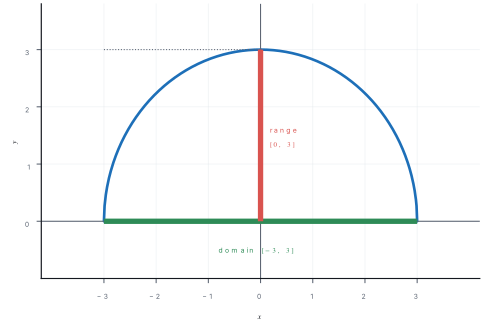
Problem. Find the domain and range of h(x) = \sqrt{9 - x^{2}}.
Solution. Domain. Require 9 - x^{2} \ge 0, i.e. x^{2} \le 9, i.e. |x| \le 3:
Range. On this domain x^{2} takes every value in [0, 9], so 9 - x^2 takes every value in [0, 9] and its non-negative square root takes every value in [0, 3]:
The graph is the upper half of the circle x^2 + y^2 = 9 — the lower half is excluded because \sqrt{\ } is never negative.
Problem. Find the range of f(x) = x^{2} - 4x + 7, x \in \mathbb{R}, and say whether f is one-one.
Solution. Complete the square:
Since (x-2)^{2} \ge 0 for all real x, with equality only at x = 2,
f is not one-one: for example f(1) = 1-4+7 = 4 and f(3) = 9-12+7 = 4, so two different inputs share an image. (The graph is a parabola, and a horizontal line cuts it twice.)
Problem. Find the domain and range of f(x) = \dfrac{x+1}{x-2}.
Solution. Domain. x - 2 \ne 0, so domain = \mathbb{R} - \{2\}.
Range. Put y = \frac{x+1}{x-2} and make x the subject:
This gives a valid x for every y except y = 1, so
Sense check: \frac{x+1}{x-2} = 1 would force x+1 = x-2, i.e. 1 = -2, impossible.
"f : \mathbb{R} \rightarrow \mathbb{R}, f(x) = x^2" has co-domain \mathbb{R} but range [0,\infty), so it is into, not onto. Change the co-domain to [0,\infty) and the same rule becomes onto. Whether a function is onto depends on the co-domain you were given — read the question.
3.2 Inverse function; composite function
If f : A \rightarrow B and g : B \rightarrow C, the composite g \circ f is the function A \rightarrow C defined by
Apply f first, then g — read the symbol from right to left. The domain of g \circ f is the set of x in the domain of f for which f(x) lies in the domain of g.
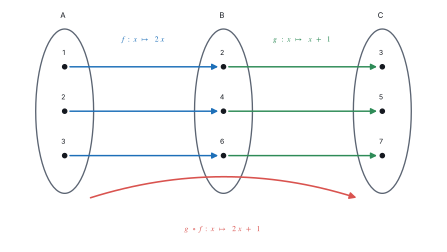
f \circ g and g \circ f are different functions in general. With f(x) = 2x+3 and g(x) = x^2: (f \circ g)(1) = f(1) = 5 while (g \circ f)(1) = g(5) = 25. Writing f \circ g when you mean g \circ f loses every mark in the question.
Problem. If f(x) = 2x + 3 and g(x) = x^{2}, find f \circ g, g \circ f and f \circ f. Verify that f \circ g \ne g \circ f.
Solution.
The two composites differ (they are not even the same shape of polynomial), so f \circ g \ne g \circ f. A single value settles it: at x=1, f \circ g gives 5 while g \circ f gives 25.
Problem. If f(x) = \sqrt{x} and g(x) = x - 4, find f \circ g and g \circ f together with their domains.
Solution.
(f \circ g)(x) = f(x-4) = \sqrt{x-4}. This needs x - 4 \ge 0, so the domain is [4, \infty).
(g \circ f)(x) = g(\sqrt{x}) = \sqrt{x} - 4. Here \sqrt{x} needs x \ge 0, and subtracting 4 adds no restriction, so the domain is [0, \infty).
The two composites have different rules and different domains.
If f : A \rightarrow B is a bijection, its inverse f^{-1} : B \rightarrow A is the function satisfying
so that f^{-1}\!\left(f(x)\right) = x for all x \in A and f\!\left(f^{-1}(y)\right) = y for all y \in B. The domain of f^{-1} is the range of f, and the range of f^{-1} is the domain of f.
- Write y = f(x).
- Make x the subject.
- Interchange the letters: replace y by x to get f^{-1}(x).
Then check by computing f\!\left(f^{-1}(x)\right); it must simplify to x.
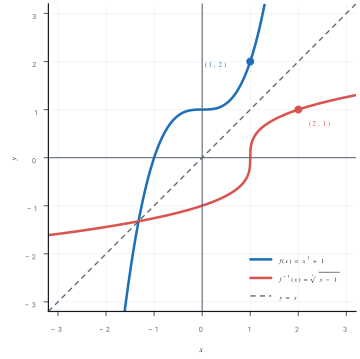
Because y = f(x) and x = f^{-1}(y) describe the same pairs with the coordinates swapped, the graph of f^{-1} is the mirror image of the graph of f in the line y = x.
Problem. Find f^{-1} for f(x) = 3x - 5 and verify your answer.
Solution. Step 1: y = 3x - 5. Step 2: 3x = y + 5, so x = \frac{y+5}{3}. Step 3: interchange letters,
Check. f\!\left(f^{-1}(x)\right) = 3 \cdot \frac{x+5}{3} - 5 = (x+5) - 5 = x ✓ and f^{-1}\!\left(f(x)\right) = \frac{(3x-5)+5}{3} = x ✓
Problem. If f(x) = \dfrac{2x+3}{x-1}, find f^{-1}(x) and state the domain and range of both f and f^{-1}.
Solution. Put y = \frac{2x+3}{x-1} and clear the fraction:
Collect the x terms on one side:
Interchanging letters,
Domains and ranges. f has domain \mathbb{R} - \{1\} and, from the expression for x, range \mathbb{R} - \{2\}. These swap for the inverse: f^{-1} has domain \mathbb{R}-\{2\} and range \mathbb{R}-\{1\}.
Check. f(3) = \frac{9}{2}, and f^{-1}\!\left(\frac{9}{2}\right) = \frac{9/2+3}{9/2-2} = \frac{15/2}{5/2} = 3 ✓
Problem. Let f(x) = 2x and g(x) = x+3. Verify that (f \circ g)^{-1} = g^{-1} \circ f^{-1}.
Solution. First the left side. (f \circ g)(x) = f(x+3) = 2(x+3) = 2x + 6. Setting y = 2x+6 gives x = \frac{y-6}{2}, so
Now the right side. From y = 2x, f^{-1}(x) = \frac{x}{2}; from y = x+3, g^{-1}(x) = x - 3. Hence
The two agree, confirming the reversal law (f \circ g)^{-1} = g^{-1} \circ f^{-1} (undo the last operation first — like taking off shoes before socks).
3.3 Algebraic functions: linear, quadratic, cubic
A polynomial function has the form f(x) = a_nx^n + a_{n-1}x^{n-1} + \dots + a_1x + a_0 with real coefficients and a_n \ne 0; n is its degree. Its domain is always \mathbb{R}. An algebraic function is one built from polynomials by +, -, \times, \div and roots — for example \frac{x+1}{x-2} and \sqrt{9-x^2}.
| Degree | Name | Standard form | Graph | Domain | Range |
|---|---|---|---|---|---|
| 0 | constant | y = c | horizontal line | \mathbb{R} | \{c\} |
| 1 | linear | y = mx + c | straight line, slope m | \mathbb{R} | \mathbb{R} |
| 2 | quadratic | y = ax^2+bx+c | parabola | \mathbb{R} | [k,\infty) or (-\infty,k] |
| 3 | cubic | y = ax^3+bx^2+cx+d | S-shaped curve | \mathbb{R} | \mathbb{R} |
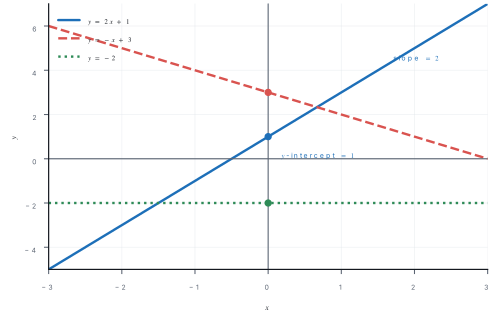
Completing the square gives
- Vertex at x = -\dfrac{b}{2a}, with y = c - \dfrac{b^{2}}{4a}.
- Axis of symmetry: the vertical line x = -\dfrac{b}{2a}.
- Opens upward if a > 0 (vertex is a minimum), downward if a < 0 (maximum).
- x-intercepts are the roots of ax^2+bx+c = 0; there are two, one or none according as the discriminant b^{2}-4ac is positive, zero or negative. The y-intercept is c.
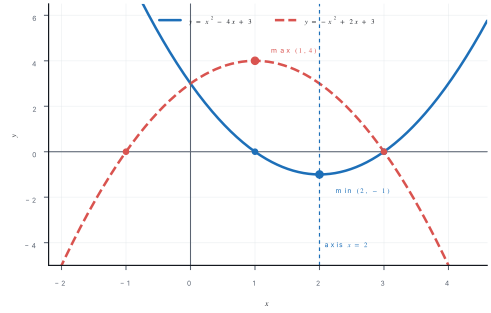
Problem. Sketch y = x^{2} - 4x + 3, giving the intercepts, vertex, axis of symmetry and range.
Solution.
Intercepts. Put y = 0: x^{2}-4x+3 = (x-1)(x-3) = 0, so the curve crosses the x-axis at x = 1 and x = 3. Put x = 0: y = 3.
Vertex. Complete the square:
So the vertex is (2, -1) and the axis of symmetry is x = 2. (Check with x = -\frac{b}{2a} = \frac{4}{2} = 2, then y = 4 - 8 + 3 = -1 ✓.)
Shape and range. a = 1 > 0, so the parabola opens upward and (2,-1) is a minimum. Range = [-1, \infty).
Problem. For y = -x^{2} + 2x + 3, find the roots, the vertex and the maximum value.
Solution. Roots. -x^2+2x+3 = 0 \Rightarrow x^2 - 2x - 3 = 0 \Rightarrow (x-3)(x+1) = 0, so x = -1 and x = 3.
Vertex. x = -\frac{b}{2a} = -\frac{2}{2(-1)} = 1, and y = -(1)^2 + 2(1) + 3 = 4. Vertex (1, 4).
Since a = -1 < 0 the parabola opens downward, so 4 is the maximum value and the range is (-\infty, 4].
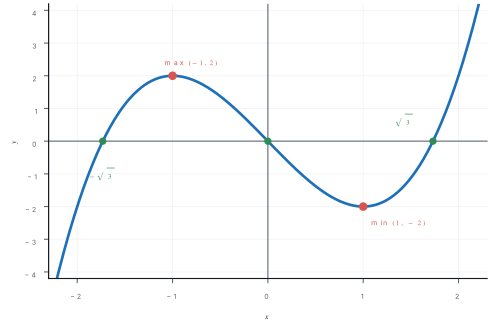
Problem. Sketch y = x^{3} - 3x, stating its intercepts, symmetry and range.
Solution. Intercepts. x^3 - 3x = x(x^2-3) = 0 gives x = 0, \pm\sqrt{3}. The y-intercept is 0.
Symmetry. Replacing x by -x: (-x)^3 - 3(-x) = -x^3+3x = -y. So f(-x) = -f(x), an odd function — the graph is symmetric about the origin.
Behaviour. For large positive x the x^3 term dominates, so y \rightarrow \infty; for large negative x, y \rightarrow -\infty. Between them the curve turns twice, at (-1, 2) and (1, -2) (check: (-1)^3-3(-1) = -1+3 = 2, 1 - 3 = -2).
Range. A cubic with non-zero leading coefficient takes every real value, so the range is \mathbb{R}.
3.4 Transcendental functions: trigonometric, exponential, logarithmic
A function that is not algebraic is called transcendental. The three families in the syllabus are the trigonometric, exponential and logarithmic functions.
Trigonometric functions
| Function | Domain | Range | Period |
|---|---|---|---|
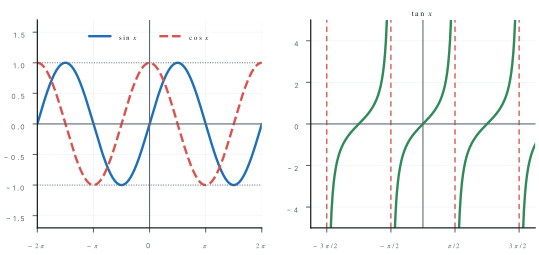
| \sin x | \mathbb{R} | [-1, 1] | 2\pi |
| \cos x | \mathbb{R} | [-1, 1] | 2\pi |
| \tan x | \mathbb{R} - \{(2n+1)\frac{\pi}{2}\} | \mathbb{R} | \pi |
| \csc x | \mathbb{R} - \{n\pi\} | (-\infty,-1] \cup [1,\infty) | 2\pi |
| \sec x | \mathbb{R} - \{(2n+1)\frac{\pi}{2}\} | (-\infty,-1] \cup [1,\infty) | 2\pi |
| \cot x | \mathbb{R} - \{n\pi\} | \mathbb{R} | \pi |
Here n is any integer. Note that \sin and \cos are bounded but \tan is not, and that \tan repeats twice as fast as \sin.
Exponential and logarithmic functions
For a fixed base a > 0, a \ne 1:
- the exponential function is f(x) = a^{x}, with domain \mathbb{R} and range (0, \infty); its graph always passes through (0, 1);
- the logarithmic function is g(x) = \log_a x, with domain (0, \infty) and range \mathbb{R}; its graph always passes through (1, 0).
They are inverses of each other: \log_a(a^{x}) = x and a^{\log_a x} = x. The natural base is e = 2.71828\dots, and \log_e x is written \ln x.
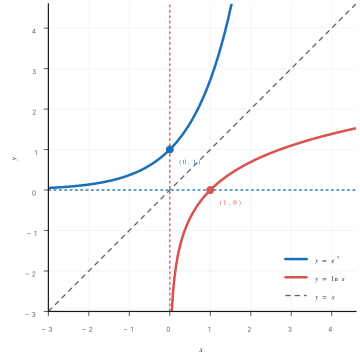
If a > 1 both functions are increasing; if 0 < a < 1 both are decreasing. The exponential curve has the x-axis (y = 0) as a horizontal asymptote, and the logarithmic curve has the y-axis (x = 0) as a vertical asymptote — exactly what you expect from reflecting one in y = x.
For a, b > 0 with a, b \ne 1, and m, n > 0:
Problem. Find the domain of (a) f(x) = \log(x^{2} - 5x + 6), and (b) g(x) = \ln(x-1) + \sqrt{4-x}.
Solution.
(a) Require x^{2} - 5x + 6 > 0, i.e. (x-2)(x-3) > 0. A product of two factors is positive when both are positive or both are negative:
- both positive: x > 3;
- both negative: x < 2.
Domain = (-\infty, 2) \cup (3, \infty).
(b) Two conditions must hold together: x - 1 > 0 gives x > 1, and 4 - x \ge 0 gives x \le 4. Intersecting,
Problem. Solve (a) 2^{x+1} = 8^{x-1}, (b) \log_2 x + \log_2(x-2) = 3.
Solution.
(a) Write both sides to the same base: 8 = 2^{3}, so 8^{x-1} = 2^{3(x-1)}. Equal powers of the same base force equal exponents:
Check: 2^{3} = 8 and 8^{1} = 8 ✓
(b) Combine the logarithms with \log m + \log n = \log(mn):
Reject x = -2: the original expression needs x > 0 and x - 2 > 0, i.e. x > 2. So x = 4. Check: \log_2 4 + \log_2 2 = 2 + 1 = 3 ✓
Always check logarithmic solutions
Combining logarithms widens the domain, so an algebraically correct root can be invalid for the original equation. After solving, substitute back and discard any root that makes an argument zero or negative.
Problem. State the domain, range and period of y = 3\sin 2x, and the value of x in [0, \pi] at which it first attains its maximum.
Solution. The domain is \mathbb{R}, since \sin accepts any real input.
Since -1 \le \sin 2x \le 1, multiplying by 3 gives -3 \le 3\sin 2x \le 3, so the range is [-3, 3]; the amplitude is 3.
The period of \sin bx is \frac{2\pi}{|b|}, so here it is \frac{2\pi}{2} = \pi.
The maximum occurs when \sin 2x = 1, i.e. 2x = \frac{\pi}{2}, so x = \frac{\pi}{4}.
Chapter summary
- f : A \rightarrow B assigns exactly one image to each element of A; the range f(A) may be a proper subset of the co-domain B.
- One-one means distinct inputs have distinct images; onto means range = co-domain; a bijection is both, and only a bijection is invertible.
- Domain rules: no division by zero, no even root of a negative, no log of a non-positive number; take the intersection when several apply.
- (g \circ f)(x) = g(f(x)) — apply f first. In general f \circ g \ne g \circ f, and (f \circ g)^{-1} = g^{-1} \circ f^{-1}.
- To invert: write y = f(x), make x the subject, swap letters. Domain and range swap, and the graph of f^{-1} is the reflection of that of f in y = x.
- Quadratic y = ax^2+bx+c: vertex at x = -\frac{b}{2a}, opens up if a>0; the number of x-intercepts is decided by b^2-4ac.
- \sin x, \cos x: domain \mathbb{R}, range [-1,1], period 2\pi; \tan x: range \mathbb{R}, period \pi.
- a^x: domain \mathbb{R}, range (0,\infty), through (0,1). \log_a x: domain (0,\infty), range \mathbb{R}, through (1,0). They are mutual inverses.
Practice questions
Group A — Multiple choice (1 mark each)
- The domain of f(x) = \dfrac{1}{x^{2}-4} is [1]a\mathbb{R}b\mathbb{R} - \{2\}c\mathbb{R} - \{-2, 2\}d[-2,2]
- The range of f(x) = x^{2} + 1, x \in \mathbb{R}, is [1]a\mathbb{R}b[1, \infty)c(1, \infty)d[0, \infty)
- If f(x) = 2x+1 and g(x) = x^{2}, then (g \circ f)(2) is [1]a9b25c11d5
- If f(x) = 5x - 2, then f^{-1}(x) is [1]a\frac{x-2}{5}b\frac{x+2}{5}c\frac{1}{5x-2}d5x+2
- The period of y = 2\cos 3x is [1]a2\pib\frac{2\pi}{3}c3\pid\pi
- The domain of y = \ln(x - 4) is [1]a[4, \infty)b(4, \infty)c(-\infty, 4)d\mathbb{R} - \{4\}
- The graph of f^{-1} is obtained from that of f by reflecting in [1]athe x-axisbthe y-axiscthe line y = xdthe origin
Answers to Group A
1. (c) — the denominator vanishes at x = \pm 2, and both must be excluded.
2. (b) — x^2 \ge 0, so x^2+1 \ge 1, and the value 1 is attained at x = 0.
3. (b) — f(2) = 5, then g(5) = 25. (Applying g first would give 9, the wrong order.)
4. (b) — from y = 5x-2, x = \frac{y+2}{5}.
5. (b) — period of \cos bx is \frac{2\pi}{|b|} = \frac{2\pi}{3}; the amplitude 2 does not affect it.
6. (b) — need x-4 > 0; \ln 0 is undefined, so 4 itself is excluded.
7. (c) — swapping x and y reflects a point in the line y = x.
Group B — Short answer (5 marks each)
- Define domain, co-domain and range of a function. Find the domain and range of f(x) = \dfrac{1}{x-3} and of g(x) = \sqrt{16 - x^{2}}. [5]
- If f(x) = 3x - 2 and g(x) = x^{2}+1, find f \circ g, g \circ f and (f \circ g)(2), and show that f \circ g \ne g \circ f. [5]
- Find the inverse of f(x) = \dfrac{3x+1}{x-2}, stating its domain and range, and verify that f\!\left(f^{-1}(x)\right) = x. [5]
- Sketch y = x^{2} - 6x + 5, showing the intercepts, the vertex, the axis of symmetry and the range. [5]
- Find the domain of f(x) = \sqrt{x+2} + \log(5 - x). [5]
- State the amplitude, period and range of y = 4\sin\frac{x}{2}, and sketch one complete cycle. [5]
Answers to Group B
1. The domain is the set of allowed inputs; the co-domain is the set the outputs are declared to lie in; the range is the set of outputs actually attained, always a subset of the co-domain.
f(x) = \frac{1}{x-3}: denominator zero at x=3, so domain = \mathbb{R}-\{3\}. Setting y = \frac{1}{x-3} gives x = 3 + \frac{1}{y}, valid for all y \ne 0, so range = \mathbb{R}-\{0\}.
g(x) = \sqrt{16-x^2}: need 16 - x^2 \ge 0, i.e. |x| \le 4, so domain = [-4,4]. On that interval 16-x^2 ranges over [0,16], so g ranges over [0,4].
2. (f \circ g)(x) = f(x^2+1) = 3(x^2+1) - 2 = 3x^2 + 1.
(g \circ f)(x) = g(3x-2) = (3x-2)^2 + 1 = 9x^2 - 12x + 5.
(f \circ g)(2) = 3(4) + 1 = 13. (Check directly: g(2) = 5, f(5) = 13 ✓)
They are different — for instance (g \circ f)(2) = 9(4)-24+5 = 17 \ne 13. Hence f \circ g \ne g \circ f.
3. Put y = \frac{3x+1}{x-2}. Then y(x-2) = 3x+1, so xy - 2y = 3x + 1 and x(y-3) = 2y+1, giving x = \frac{2y+1}{y-3}. Hence
f has domain \mathbb{R}-\{2\} and range \mathbb{R}-\{3\}, so f^{-1} has domain \mathbb{R}-\{3\} and range \mathbb{R}-\{2\}.
Verification.
4. y = x^2-6x+5 = (x-1)(x-5), so the x-intercepts are 1 and 5; the y-intercept is 5.
Completing the square, y = (x-3)^2 - 4, so the vertex is (3,-4) and the axis of symmetry is x = 3. Since a = 1 > 0 the parabola opens upward, the minimum value is -4, and the range is [-4, \infty). The sketch is a U through (1,0), (5,0), (0,5) with its lowest point at (3,-4).
5. Two conditions: x + 2 \ge 0 gives x \ge -2, and 5 - x > 0 gives x < 5. Intersecting,
6. For y = a\sin bx with a = 4 and b = \frac{1}{2}:
amplitude = |a| = 4; period = \frac{2\pi}{|b|} = \frac{2\pi}{1/2} = 4\pi; range = [-4, 4].
One complete cycle runs from x = 0 to x = 4\pi: it starts at 0, rises to the maximum 4 at x = \pi, returns to 0 at x = 2\pi, falls to the minimum -4 at x = 3\pi and comes back to 0 at x = 4\pi.
Group C — Long answer (8 marks each)
- (a) Define one-one, onto and bijective functions, illustrating each with an arrow diagram. [3](b) If f(x) = \dfrac{x+2}{x-1}, find f^{-1}(x), state the domain and range of f and f^{-1}, and verify f^{-1}\!\left(f(x)\right) = x. [5]
- (a) Sketch, on the same axes, y = e^{x} and y = \ln x, marking the asymptotes, the points (0,1) and (1,0), and the line of symmetry. State the domain and range of each. [4](b) Solve \log_3(x+6) + \log_3(x-2) = 2. [4]
Answers to Group C
1. (a) A function f: A \rightarrow B is:
- one-one (injective) if f(x_1) = f(x_2) forces x_1 = x_2 — in an arrow diagram, no two arrows land on the same dot;
- onto (surjective) if every element of B is an image — no dot in B is left without an arrow;
- bijective if both hold — the arrows pair up the two sets exactly, one to one.
For example f(x) = 2x+1 on \mathbb{R} is bijective; f(x) = x^2 on \mathbb{R} is neither (many-one, and into since negatives are never attained).
1. (b) Put y = \frac{x+2}{x-1}. Then y(x-1) = x+2, so xy - y = x + 2 and x(y-1) = y+2, giving x = \frac{y+2}{y-1}. Interchanging letters,
so this f is its own inverse (a self-inverse or involution). Its domain is \mathbb{R}-\{1\} and its range is \mathbb{R}-\{1\}; the same pair serves for f^{-1}.
Verification.
2. (a) y = e^{x} is increasing, passes through (0,1), lies entirely above the x-axis and approaches the horizontal asymptote y = 0 as x \rightarrow -\infty; its domain is \mathbb{R} and range (0,\infty).
y = \ln x is increasing, passes through (1,0), exists only for x > 0 and approaches the vertical asymptote x = 0 as x \rightarrow 0^{+}; its domain is (0,\infty) and range \mathbb{R}.
The two curves are reflections of each other in the line y = x, which is therefore the line of symmetry of the pair. (See the figure in section 3.4.)
2. (b) Combine the logarithms:
So x = -7 or x = 3. The original equation needs x + 6 > 0 and x - 2 > 0, i.e. x > 2, so reject x = -7.
x = 3. Check: \log_3 9 + \log_3 1 = 2 + 0 = 2 ✓
Practise more: Mathematics question bank