Unit 4 · Algebra · 5 teaching hours · 24 min read
Curve Sketching
What the syllabus asks for 4
- Odd and even functions; periodicity
- Symmetry about origin, X-axis and Y-axis; monotonicity
- Graphs of quadratic, cubic, rational function of form 1/(ax+b)
- Graphs of a sin bx, a cos bx, e^x, ln x
Sketching a curve is not plotting fifty points and joining them. It is deducing the shape from the equation: where the curve crosses the axes, whether it is symmetric, where it rises and falls, and what happens far away or near a forbidden value. Four or five deductions fix the picture, and the picture then answers questions about roots, ranges and maxima at a glance. This unit builds the checklist and applies it to the five curves the syllabus names.
Group A takes a mark from parity (odd/even), period or an asymptote. Group B is almost always "sketch this quadratic / this \frac{1}{ax+b} / this a\sin bx, stating its main features". Marks are awarded for the stated features — intercepts, vertex, asymptotes, amplitude, period — not for the neatness of the curve, so always label them.
4.1 Odd and even functions; periodicity
A function f whose domain is symmetric about 0 is
- even if f(-x) = f(x) for every x in the domain;
- odd if f(-x) = -f(x) for every x in the domain.
A function may be even, odd, or neither. The only function that is both is f(x) = 0.
To test parity, replace x by -x and simplify. If the result is the original expression, it is even; if it is the original with every sign reversed, it is odd; if it is neither, the function has no parity.
| Even | Odd | Neither |
|---|---|---|
| x^{2},\ x^{4},\ x^{6} | x,\ x^{3},\ x^{5} | x^{2}+x |
| \cos x,\ \sec x | \sin x,\ \tan x,\ \csc x,\ \cot x | x + \cos x |
| |x| | x\,|x| | e^{x} |
| \frac{1}{2}(e^{x}+e^{-x}) | \frac{1}{2}(e^{x}-e^{-x}) | \ln x (domain not symmetric) |
- even \pm even = even; odd \pm odd = odd; even \pm odd = neither (in general)
- even \times even = even; odd \times odd = even; even \times odd = odd
A polynomial is even when all its powers are even, and odd when all are odd; a mixture of even and odd powers gives neither. A non-zero constant term counts as an even power (x^{0}).
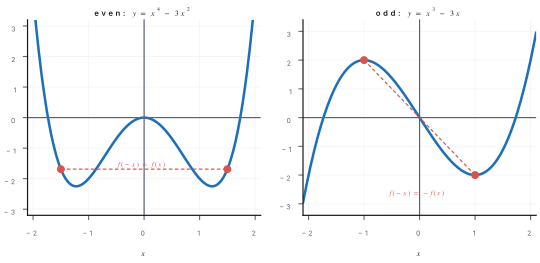
Problem. Determine whether each function is even, odd or neither: (a) f(x) = x^{4} - 3x^{2} + 1, (b) g(x) = x^{3} - x, (c) h(x) = x^{2} + x.
Solution.
(a) f(-x) = (-x)^{4} - 3(-x)^{2} + 1 = x^{4} - 3x^{2} + 1 = f(x). Even — all powers present (4, 2, 0) are even.
(b) g(-x) = (-x)^{3} - (-x) = -x^{3} + x = -(x^{3}-x) = -g(x). Odd — all powers (3, 1) are odd.
(c) h(-x) = (-x)^{2} + (-x) = x^{2} - x. This is neither h(x) = x^2+x nor -h(x) = -x^2-x, so h is neither. (It mixes an even power with an odd one.)
Problem. Show that f(x) = \dfrac{e^{x} + e^{-x}}{2} is even and g(x) = x\,|x| is odd.
Solution.
so f is even. (This function is \cosh x, and its graph is the shape of a hanging cable.)
For g, use |-x| = |x|:
so g is odd.
Periodicity
A function f is periodic if there is a positive number T with
The smallest such T is the fundamental period (usually just "the period"). The graph of a periodic function repeats the same block of width T forever.
| Function | Period |
|---|---|
| \sin x, \cos x, \csc x, \sec x | 2\pi |
| \tan x, \cot x | \pi |
| a\sin bx, a\cos bx | \dfrac{2\pi}{|b|} |
| a\tan bx | \dfrac{\pi}{|b|} |
| \sin^{2}x, \cos^{2}x | \pi |
The amplitude a never changes the period; only the coefficient b of x does. A larger |b| squeezes the graph horizontally, giving a shorter period.
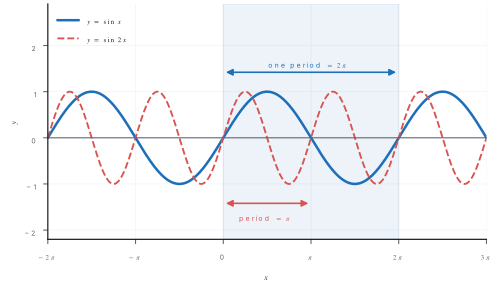
Problem. Find the period of (a) \sin 3x, (b) \cos\frac{x}{2}, (c) \tan 4x, (d) 2 + 3\sin(\pi x).
Solution. Use period = \frac{2\pi}{|b|} for sine and cosine, \frac{\pi}{|b|} for tangent.
(a) b = 3, so period = \frac{2\pi}{3}.
(b) b = \frac{1}{2}, so period = \frac{2\pi}{1/2} = 4\pi.
(c) Tangent: period = \frac{\pi}{4}.
(d) Adding 2 shifts the graph up and multiplying by 3 stretches it vertically; neither affects the period. With b = \pi, period = \frac{2\pi}{\pi} = 2.
4.2 Symmetry about origin, X-axis and Y-axis; monotonicity
Parity is a statement about functions. Symmetry is the same idea applied to any equation in x and y, including curves such as y^{2} = 4x that are not functions.
Take the equation of the curve and substitute:
| Replace | Equation unchanged means | Example |
|---|---|---|
| x by -x | symmetric about the Y-axis | y = x^{4} - 2x^{2} |
| y by -y | symmetric about the X-axis | y^{2} = 4x |
| x by -x and y by -y | symmetric about the origin | y = x^{3}, xy = 6 |
If a curve has any two of these symmetries it automatically has the third. A curve symmetric about the X-axis (other than a piece of the x-axis itself) is never the graph of a function, since a vertical line meets it twice.
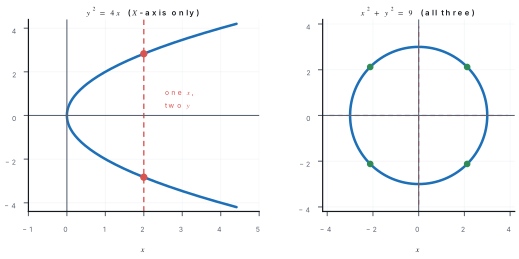
Problem. Discuss the symmetry of (a) y = x^{4} - 2x^{2}, (b) y^{2} = 8x, (c) xy = 6, (d) x^{2} + y^{2} = 25.
Solution.
(a) Replace x by -x: (-x)^4 - 2(-x)^2 = x^4 - 2x^2, unchanged. Symmetric about the Y-axis only. (Replacing y by -y gives -y = x^4-2x^2, a different curve.)
(b) Replace y by -y: (-y)^{2} = y^{2}, unchanged. Symmetric about the X-axis only — replacing x by -x gives y^2 = -8x, a different parabola.
(c) Replace x by -x and y by -y: (-x)(-y) = xy = 6, unchanged. Symmetric about the origin only.
(d) All three substitutions leave x^2+y^2 = 25 unchanged, so the circle is symmetric about both axes and the origin — as expected.
Monotonicity
Let f be defined on an interval I and let x_1, x_2 \in I.
- f is strictly increasing on I if x_1 < x_2 \Rightarrow f(x_1) < f(x_2).
- f is strictly decreasing on I if x_1 < x_2 \Rightarrow f(x_1) > f(x_2).
A function that is one or the other throughout I is called monotonic on I. Monotonicity is always stated on an interval, never at a single point.
The standard method is to take x_1 < x_2 and examine the sign of f(x_2) - f(x_1). In Unit 18 you will meet the quicker test: f'(x) > 0 on I makes f increasing there, and f'(x) < 0 makes it decreasing.
Problem. Show that f(x) = 3x + 2 is strictly increasing on \mathbb{R}, and that g(x) = -2x + 7 is strictly decreasing on \mathbb{R}.
Solution. Let x_1 < x_2.
Since x_2 - x_1 > 0, this is positive, so f(x_2) > f(x_1). Hence f is strictly increasing.
Since x_2 - x_1 > 0, this is negative, so g(x_2) < g(x_1) and g is strictly decreasing. In general y = mx+c increases when m > 0 and decreases when m < 0.
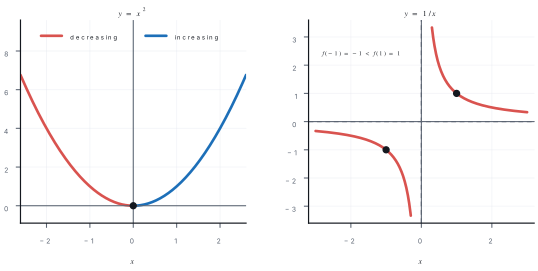
Problem. Show that f(x) = x^{2} is decreasing on (-\infty, 0] and increasing on [0, \infty).
Solution. For any x_1 < x_2,
The first factor x_2 - x_1 is positive. The sign therefore follows the sign of x_1 + x_2.
- If x_1 < x_2 \le 0 then x_1 + x_2 < 0, so f(x_2) < f(x_1): decreasing.
- If 0 \le x_1 < x_2 then x_1 + x_2 > 0, so f(x_2) > f(x_1): increasing.
So x = 0 is the turning point, which matches the vertex of the parabola.
f(x) = \frac{1}{x} is strictly decreasing on (-\infty,0) and strictly decreasing on (0,\infty), but it is not decreasing on \mathbb{R}-\{0\}: taking x_1 = -1 and x_2 = 1 gives f(x_1) = -1 < 1 = f(x_2). Monotonicity may only be claimed on an interval, and \mathbb{R}-\{0\} is not one.
4.3 Graphs of quadratic, cubic, rational function of form 1/(ax+b)
- Domain — which x are allowed?
- Intercepts — put y = 0 for x-intercepts, x = 0 for the y-intercept.
- Symmetry — apply the three tests.
- Asymptotes — vertical where a denominator vanishes; horizontal from the behaviour as x \rightarrow \pm\infty.
- Turning points / monotonic intervals.
- End behaviour — what happens as x \rightarrow \pm\infty.
Then plot the special points found and join them smoothly.
Quadratic
y = ax^{2}+bx+c is a parabola with vertex at x = -\frac{b}{2a} and axis of symmetry x = -\frac{b}{2a}; it opens upward if a > 0 and downward if a < 0.
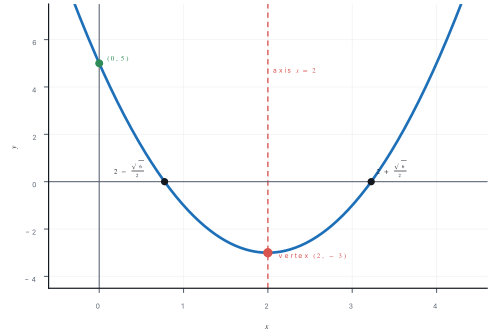
Problem. Sketch y = 2x^{2} - 8x + 5, stating the vertex, axis of symmetry, intercepts, range and monotonic intervals.
Solution.
Step 1 — shape. a = 2 > 0, so the parabola opens upward.
Step 2 — vertex. x = -\frac{b}{2a} = \frac{8}{4} = 2, and
Vertex (2,-3); axis of symmetry x = 2.
Step 3 — y-intercept. x = 0 gives y = 5.
Step 4 — x-intercepts. Solve 2x^2-8x+5 = 0 with the quadratic formula:
Numerically x \approx 0.78 and x \approx 3.22 (the discriminant 24 > 0, so there are two distinct roots).
Step 5 — range and monotonicity. The minimum value is -3, so the range is [-3, \infty). The curve decreases on (-\infty, 2] and increases on [2, \infty).
Cubic
A cubic y = ax^{3}+bx^{2}+cx+d with a > 0 runs from -\infty to +\infty; it has either two turning points or none, and always at least one real root.
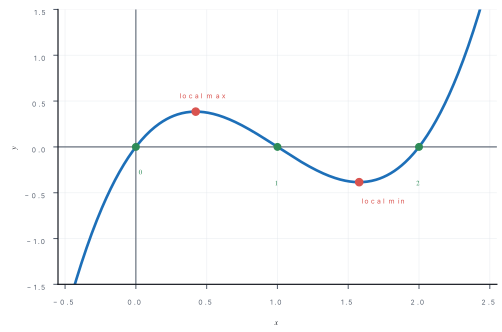
Problem. Sketch y = x^{3} - 3x^{2} + 2x, stating intercepts, symmetry, sign and end behaviour.
Solution.
Factorise. y = x(x^{2}-3x+2) = x(x-1)(x-2), so the x-intercepts are x = 0, 1, 2. Putting x = 0 gives y = 0, so the curve passes through the origin.
Symmetry. f(-x) = -x^3 - 3x^2 - 2x, which equals neither f(x) nor -f(x), so there is no symmetry about the axes or the origin.
Sign. Test one point in each interval cut off by the roots:
| Interval | test x | y | sign |
|---|---|---|---|
| x < 0 | -1 | (-1)(-2)(-3) = -6 | negative |
| 0 < x < 1 | 0.5 | (0.5)(-0.5)(-1.5) = 0.375 | positive |
| 1 < x < 2 | 1.5 | (1.5)(0.5)(-0.5) = -0.375 | negative |
| x > 2 | 3 | (3)(2)(1) = 6 | positive |
End behaviour. As x \rightarrow \infty, y \rightarrow \infty; as x \rightarrow -\infty, y \rightarrow -\infty.
So the curve rises from the bottom left, crosses at 0, peaks, dips through 1, bottoms out, and rises through 2 to the top right. The turning points are at x = 1 \pm \frac{1}{\sqrt{3}}, i.e. x \approx 0.42 and 1.58, where y \approx \pm 0.38.
The rational function y = \dfrac{1}{ax+b}
- Domain: \mathbb{R} - \left\{-\frac{b}{a}\right\}.
- Vertical asymptote: x = -\dfrac{b}{a}, where the denominator vanishes. As x approaches it, |y| \rightarrow \infty.
- Horizontal asymptote: y = 0, since \frac{1}{ax+b} \rightarrow 0 as x \rightarrow \pm\infty.
- No x-intercept — a fraction with numerator 1 is never zero. The y-intercept is \frac{1}{b} (provided b \ne 0).
- Two branches, one on each side of the vertical asymptote. Each branch is strictly decreasing if a > 0 and strictly increasing if a < 0.
- Range: \mathbb{R} - \{0\}.
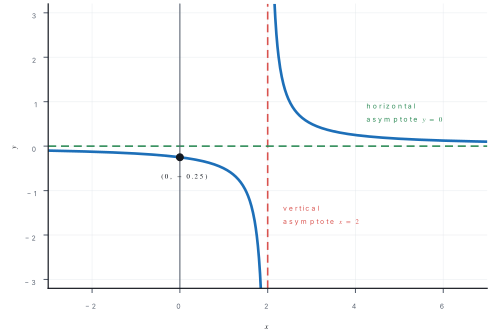
Problem. Sketch y = \dfrac{1}{2x-4}, giving the domain, asymptotes, intercepts, range and monotonicity.
Solution.
Domain. 2x - 4 \ne 0, so x \ne 2: domain = \mathbb{R} - \{2\}.
Vertical asymptote. x = 2. Approaching from the right (x = 2.1) gives y = \frac{1}{0.2} = 5, large and positive; from the left (x = 1.9) gives y = \frac{1}{-0.2} = -5, large and negative.
Horizontal asymptote. As x \rightarrow \pm\infty the denominator grows without bound, so y \rightarrow 0. The line y = 0 is a horizontal asymptote.
Intercepts. Setting y = 0 gives 1 = 0, impossible — there is no x-intercept. Setting x = 0 gives y = \frac{1}{-4} = -0.25.
Range. y takes every value except 0: range = \mathbb{R} - \{0\}.
Monotonicity. Writing y = (2x-4)^{-1}, an increase in x increases 2x-4; on each branch the reciprocal then decreases. So the curve is strictly decreasing on (-\infty, 2) and strictly decreasing on (2, \infty) — but not on the whole domain.
A vertical asymptote sits at an x excluded from the domain, so the curve cannot reach it. A horizontal asymptote only describes behaviour far away; some curves do cross theirs closer in. For y = \frac{1}{ax+b} neither is crossed.
4.4 Graphs of a\sin bx, a\cos bx, e^{x}, \ln x
- Amplitude = |a|; the curve oscillates between -|a| and +|a|, so the range is [-|a|,\ |a|].
- Period = \dfrac{2\pi}{|b|}; the graph completes |b| full waves in the interval of length 2\pi.
- a\sin bx starts at 0 when x = 0 and its zeros are at x = \frac{n\pi}{b}.
- a\cos bx starts at its maximum a when x = 0 (for a>0), and its zeros are at x = \frac{(2n+1)\pi}{2b}.
- A negative a turns the whole graph upside down.
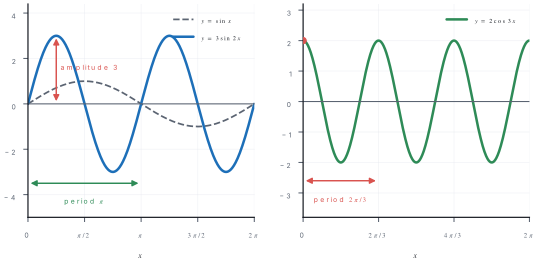
Problem. Sketch y = 3\sin 2x for 0 \le x \le 2\pi, giving amplitude, period, range, zeros and the coordinates of the maxima and minima.
Solution.
Amplitude = |3| = 3; period = \frac{2\pi}{2} = \pi; range = [-3, 3].
Zeros. 3\sin 2x = 0 when 2x = 0, \pi, 2\pi, 3\pi, 4\pi, i.e.
Maxima. \sin 2x = 1 when 2x = \frac{\pi}{2}, \frac{5\pi}{2}, so x = \frac{\pi}{4}, \frac{5\pi}{4}, giving the points \left(\frac{\pi}{4}, 3\right) and \left(\frac{5\pi}{4}, 3\right).
Minima. \sin 2x = -1 when 2x = \frac{3\pi}{2}, \frac{7\pi}{2}, so x = \frac{3\pi}{4}, \frac{7\pi}{4}, giving \left(\frac{3\pi}{4}, -3\right) and \left(\frac{7\pi}{4}, -3\right).
Two complete waves fit into [0, 2\pi], as the period \pi demands.
Problem. Sketch y = 2\cos 3x for 0 \le x \le 2\pi, giving amplitude, period and the first maximum and minimum.
Solution. Amplitude = 2, period = \frac{2\pi}{3}, range = [-2, 2].
A cosine starts at its maximum: at x = 0, y = 2\cos 0 = 2.
The first minimum is where 3x = \pi, i.e. x = \frac{\pi}{3}, giving y = -2.
Zeros occur where 3x = \frac{\pi}{2}, \frac{3\pi}{2}, \dots, i.e. x = \frac{\pi}{6}, \frac{\pi}{2}, \frac{5\pi}{6}, \dots
Since 2\pi \div \frac{2\pi}{3} = 3, exactly three complete waves fit into [0, 2\pi].
| y = e^{x} | y = \ln x | |
|---|---|---|
| Domain | \mathbb{R} | (0, \infty) |
| Range | (0, \infty) | \mathbb{R} |
| Passes through | (0,1) | (1,0) |
| Asymptote | horizontal y = 0 (as x \rightarrow -\infty) | vertical x = 0 (as x \rightarrow 0^{+}) |
| Monotonicity | strictly increasing | strictly increasing |
| Symmetry | none | none |
y = e^{-x} is the mirror image of y = e^{x} in the Y-axis: it is strictly decreasing, still passes through (0,1), and still has y = 0 as an asymptote.
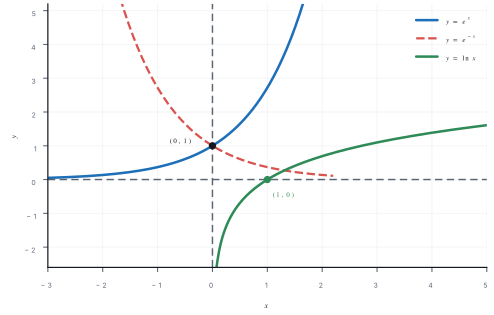
Problem. Sketch y = e^{x} and y = \ln x on the same axes and state, for each, the domain, range, intercept and asymptote. Hence say how many solutions e^{x} = \ln x has.
Solution.
| e^{x} | \ln x | |
|---|---|---|
| Domain | \mathbb{R} | (0,\infty) |
| Range | (0,\infty) | \mathbb{R} |
| Intercept | (0,1) on the y-axis | (1,0) on the x-axis |
| Asymptote | y = 0 | x = 0 |
Both are increasing, and each is the reflection of the other in y = x.
For x > 0, e^{x} > 1 while \ln x < x; in fact e^{x} lies entirely above the line y = x and \ln x lies entirely below it. So the two curves never meet, and e^{x} = \ln x has no solution.
Chapter summary
- f is even if f(-x) = f(x) (graph symmetric about the Y-axis) and odd if f(-x) = -f(x) (symmetric about the origin). odd \times odd = even.
- f is periodic with period T if f(x+T) = f(x); a\sin bx and a\cos bx have period \frac{2\pi}{|b|}, and a\tan bx has period \frac{\pi}{|b|}.
- Symmetry tests: x \rightarrow -x unchanged gives Y-axis symmetry; y \rightarrow -y gives X-axis symmetry; both together give origin symmetry.
- f is increasing on I if x_1 < x_2 \Rightarrow f(x_1) < f(x_2); prove it from the sign of f(x_2)-f(x_1). Monotonicity is claimed on an interval, never pointwise.
- Quadratic: vertex at x = -\frac{b}{2a}, opens up if a>0; number of x-intercepts from the discriminant b^2-4ac.
- y = \frac{1}{ax+b}: vertical asymptote x = -\frac{b}{a}, horizontal asymptote y = 0, y-intercept \frac{1}{b}, no x-intercept, two decreasing branches when a>0, range \mathbb{R}-\{0\}.
- y = a\sin bx: amplitude |a|, period \frac{2\pi}{|b|}, range [-|a|,|a|]; a\cos bx is the same curve starting at its maximum.
- e^{x}: domain \mathbb{R}, range (0,\infty), through (0,1), asymptote y=0. \ln x: domain (0,\infty), range \mathbb{R}, through (1,0), asymptote x=0.
Practice questions
Group A — Multiple choice (1 mark each)
- The function f(x) = x^{3} + x is [1]aevenboddcneitherdperiodic
- The period of y = 5\cos 4x is [1]a\frac{\pi}{2}b\frac{\pi}{4}c2\pid8\pi
- The curve y^{2} = 4x is symmetric about [1]athe Y-axisbthe X-axiscthe origin onlydboth axes
- The vertical asymptote of y = \dfrac{1}{3x-6} is [1]ax = 6bx = -2cx = 2dy = 0
- The amplitude of y = -4\sin 3x is [1]a-4b4c3d12
- The range of y = e^{x} is [1]a\mathbb{R}b[0, \infty)c(0, \infty)d(-\infty, 0)
- The function y = x^{2} is decreasing on [1]a\mathbb{R}b[0,\infty)c(-\infty,0]dnowhere
Answers to Group A
1. (b) — both powers, 3 and 1, are odd, so f(-x) = -x^3-x = -f(x).
2. (a) — period = \frac{2\pi}{|b|} = \frac{2\pi}{4} = \frac{\pi}{2}; the amplitude 5 is irrelevant.
3. (b) — replacing y by -y leaves y^2 = 4x unchanged; replacing x by -x does not.
4. (c) — the denominator vanishes when 3x-6 = 0, i.e. x = 2.
5. (b) — amplitude is |a| = |-4| = 4; the minus sign only flips the graph.
6. (c) — e^{x} is always strictly positive and takes every positive value; 0 itself is never attained.
7. (c) — to the left of the vertex the parabola falls; to the right it rises.
Group B — Short answer (5 marks each)
- Define even and odd functions. Test whether each of f(x) = x^{4} - 3x^{2} + 2, g(x) = x^{3} + x and h(x) = x^{3} + x^{2} is even, odd or neither. [5]
- Find the period of(a) \sin 4x,(b) \cos\frac{2x}{3},(c) \tan 3x,(d) 2\sin\frac{x}{3}. [5]
- Discuss the symmetry of (i) y^{2} = 8x, (ii) x^{2}+y^{2} = 16, (iii) y = x^{5}-x. [5]
- Show from the definition that f(x) = 5x - 3 is strictly increasing on \mathbb{R} and that g(x) = 4 - 3x is strictly decreasing on \mathbb{R}. [5]
- Sketch y = -2x^{2} + 4x + 6, stating the vertex, axis of symmetry, intercepts and range. [5]
- Sketch y = \dfrac{1}{x+1}, stating the domain, asymptotes, intercepts, range and monotonicity. [5]
Answers to Group B
1. f is even if f(-x) = f(x) for all x in a domain symmetric about 0, and odd if f(-x) = -f(x).
f(-x) = x^{4} - 3x^{2} + 2 = f(x) — even (all powers 4, 2, 0 are even).
g(-x) = -x^{3} - x = -(x^3+x) = -g(x) — odd (all powers odd).
h(-x) = -x^{3} + x^{2}, which is neither h(x) = x^3+x^2 nor -h(x) = -x^3-x^2 — neither (it mixes an odd and an even power).
2. (a) \frac{2\pi}{4} = \frac{\pi}{2}.
(b) b = \frac{2}{3}, so period = \frac{2\pi}{2/3} = 3\pi.
(c) Tangent: \frac{\pi}{3}.
(d) b = \frac{1}{3}, so period = \frac{2\pi}{1/3} = 6\pi (the amplitude 2 is irrelevant).
3. (i) Replacing y by -y: (-y)^2 = 8x is the same equation, so the curve is symmetric about the X-axis. Replacing x by -x gives y^2 = -8x, a different curve, so there is no Y-axis symmetry (and hence none about the origin).
(ii) All three substitutions leave x^2+y^2 = 16 unchanged, so the circle is symmetric about both axes and the origin.
(iii) y = x^5 - x. Replacing x by -x and y by -y: -y = -x^5 + x, i.e. y = x^5 - x, unchanged. Symmetric about the origin only (it is an odd function).
4. Let x_1 < x_2, so x_2 - x_1 > 0.
so f(x_1) < f(x_2) and f is strictly increasing.
so g(x_1) > g(x_2) and g is strictly decreasing.
5. a = -2 < 0, so the parabola opens downward.
Vertex: x = -\frac{b}{2a} = -\frac{4}{-4} = 1, and y = -2(1)+4(1)+6 = 8. Vertex (1, 8); axis of symmetry x = 1.
x-intercepts: -2x^2+4x+6 = 0 \Rightarrow x^2-2x-3 = 0 \Rightarrow (x-3)(x+1) = 0, so x = -1 and x = 3. y-intercept: x = 0 gives y = 6.
Maximum value 8, so the range is (-\infty, 8]. The curve increases on (-\infty,1] and decreases on [1,\infty).
6. Here a = 1, b = 1, so:
Domain = \mathbb{R} - \{-1\}. Vertical asymptote x = -1; horizontal asymptote y = 0.
y-intercept: x = 0 gives y = 1. There is no x-intercept, since \frac{1}{x+1} is never zero.
Range = \mathbb{R} - \{0\}.
Since a = 1 > 0, the curve is strictly decreasing on (-\infty,-1) and strictly decreasing on (-1,\infty) — two separate branches, the left one below the x-axis and the right one above it.
Group C — Long answer (8 marks each)
- (a) Define even, odd and periodic functions, and prove that the product of two odd functions is even. [3](b) Sketch y = 3\cos 2x for 0 \le x \le 2\pi, stating the amplitude, period, range and the coordinates of all maxima, minima and zeros in that interval. [5]
- (a) Sketch y = x^{3} - 3x^{2} + 2x, showing the intercepts, the sign in each interval and the behaviour as x \rightarrow \pm\infty. [4](b) Sketch y = \dfrac{1}{2x-6}, showing the asymptotes, the intercept and the monotonic intervals. [4]
Answers to Group C
1. (a) f is even if f(-x) = f(x), odd if f(-x) = -f(x), and periodic with period T > 0 if f(x+T) = f(x) for every x in the domain, T being the smallest such number.
Proof. Let f and g both be odd and put h(x) = f(x)\,g(x). Then
so h is even. (Example: x \cdot x^{3} = x^{4}, indeed even.)
1. (b) For y = 3\cos 2x: amplitude = 3, period = \frac{2\pi}{2} = \pi, range = [-3, 3].
Maxima (\cos 2x = 1): 2x = 0, 2\pi, 4\pi, so x = 0, \pi, 2\pi, giving (0,3), (\pi,3) and (2\pi,3).
Minima (\cos 2x = -1): 2x = \pi, 3\pi, so x = \frac{\pi}{2}, \frac{3\pi}{2}, giving \left(\frac{\pi}{2},-3\right) and \left(\frac{3\pi}{2},-3\right).
Zeros (\cos 2x = 0): 2x = \frac{\pi}{2}, \frac{3\pi}{2}, \frac{5\pi}{2}, \frac{7\pi}{2}, so
The sketch shows two complete cosine waves in [0, 2\pi], starting and ending at the maximum height 3.
2. (a) y = x(x-1)(x-2), so the x-intercepts are 0, 1, 2 and the y-intercept is 0.
Sign: negative for x<0, positive for 0<x<1, negative for 1<x<2, positive for x>2 (test x = -1, 0.5, 1.5, 3 giving -6, 0.375, -0.375, 6).
As x \rightarrow \infty, y \rightarrow \infty; as x \rightarrow -\infty, y \rightarrow -\infty. There is no symmetry. The turning points are at x = 1 \pm \frac{1}{\sqrt{3}} with y \approx \pm 0.38 — a local maximum near (0.42, 0.38) and a local minimum near (1.58, -0.38).
2. (b) y = \frac{1}{2x-6}. The denominator vanishes at 2x - 6 = 0, i.e. x = 3, so:
- Domain \mathbb{R}-\{3\}; vertical asymptote x = 3.
- As x \rightarrow \pm\infty, y \rightarrow 0: horizontal asymptote y = 0.
- y-intercept: x = 0 gives y = \frac{1}{-6} = -\frac{1}{6}. No x-intercept.
- Range \mathbb{R}-\{0\}.
- Since a = 2 > 0, the curve is strictly decreasing on (-\infty,3) and strictly decreasing on (3,\infty).
The left branch lies below the x-axis, rising from just below 0 and plunging to -\infty as x \rightarrow 3^{-}; the right branch comes down from +\infty at x \rightarrow 3^{+} and approaches 0 from above.
Practise more: Mathematics question bank