Unit 10 · Trigonometry · 6 teaching hours · 13 min read
Trigonometric Equations and General Values
What the syllabus asks for 2
- Solution of trigonometric equations
- General values
An equation such as 2\sin\theta = 1 is unlike a polynomial equation: because \sin\theta repeats every 2\pi, it has infinitely many roots. The task is therefore not to find a root but to write all roots in one compact formula — the general value of \theta. This unit gives the three master formulae that do that, and the standard techniques for reducing any exam equation to one of the three basic forms \sin\theta=\sin\alpha, \cos\theta=\cos\alpha or \tan\theta=\tan\alpha.
The shape of every answer
Every solution ends in one of three patterns: \theta = n\pi+(-1)^{n}\alpha, \theta = 2n\pi\pm\alpha, or \theta = n\pi+\alpha, where n \in \mathbb{Z}. Getting to that pattern is the work; writing "n\in\mathbb{Z}" at the end is a mark.
10.1 Solution of trigonometric equations
Roots, principal value and general value
An equation involving trigonometric ratios of an unknown angle that is true only for particular values of that angle is a trigonometric equation. A value of the angle satisfying it is a root or solution. The numerically smallest root is the principal solution; the formula covering all roots is the general solution (or general value).
An identity such as \sin^{2}\theta+\cos^{2}\theta=1 holds for every \theta; an equation such as \sin\theta = \frac{1}{2} holds only for some. Do not confuse the two.
Deciding the quadrant
The first step in every problem is to find one angle \alpha — usually an angle from the standard table — and then to decide which quadrants can contain solutions. The sign of the ratio settles it.
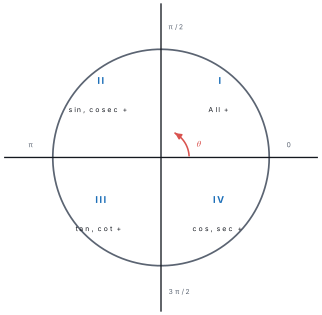
Quadrant I All positive, II Sine (and cosec), III Tangent (and cot), IV Cosine (and sec). Anything not listed is negative in that quadrant.
Worked example 10.1 — solutions in a given interval
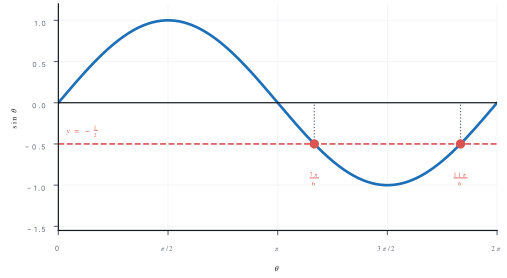
Problem. Solve 2\sin\theta+1 = 0 for 0 \le \theta < 2\pi.
Solution. Rearranging, \sin\theta = -\dfrac12.
The related acute angle is \alpha with \sin\alpha = \frac12, i.e. \alpha = \dfrac{\pi}{6}.
Since \sin\theta is negative, \theta lies in quadrant III or IV.
So \theta = \dfrac{7\pi}{6}, \dfrac{11\pi}{6}. (The principal solution, the numerically smallest root, is -\dfrac{\pi}{6}.)
The four standard techniques
| If the equation… | do this |
|---|---|
| is quadratic in one ratio | factorise, then solve each factor |
| mixes \sin^{2} and \cos (or \cos^{2} and \sin) | use \sin^{2}\theta = 1-\cos^{2}\theta to get one ratio only |
| is a\cos\theta+b\sin\theta=c | write it as r\cos(\theta-\alpha)=c with r=\sqrt{a^{2}+b^{2}} |
| is a sum of sines or cosines | use the sum-to-product formulae and factorise |
From \sin\theta\cos\theta = \sin\theta do not cancel \sin\theta — that throws away every root with \sin\theta = 0. Move everything to one side and factorise: \sin\theta(\cos\theta-1)=0.
Problem. Solve 2\cos^{2}\theta-3\cos\theta+1 = 0.
Solution. Put c = \cos\theta, so 2c^{2}-3c+1=0, i.e. (2c-1)(c-1)=0.
Hence \cos\theta = \dfrac12 or \cos\theta = 1.
\cos\theta = \frac12 = \cos\frac{\pi}{3} gives \theta = 2n\pi\pm\dfrac{\pi}{3}.
\cos\theta = 1 = \cos 0 gives \theta = 2n\pi.
(The general-value formulae used here are proved in §10.2.)
Problem. Solve 2\sin^{2}\theta+\sqrt{3}\cos\theta+1 = 0.
Solution. Replace \sin^{2}\theta by 1-\cos^{2}\theta:
With c=\cos\theta, the quadratic formula gives
so c = \sqrt{3} (impossible, since |\cos\theta|\le 1) or c = -\dfrac{2\sqrt{3}}{4} = -\dfrac{\sqrt{3}}{2}.
Now \cos\theta = -\frac{\sqrt{3}}{2} = \cos\frac{5\pi}{6}, so \theta = 2n\pi\pm\dfrac{5\pi}{6}.
Problem. Solve \tan\theta+\cot\theta = 2.
Solution. Write \cot\theta = \dfrac{1}{\tan\theta} and put t=\tan\theta (note t\ne 0):
So \tan\theta = 1 = \tan\dfrac{\pi}{4}, giving \theta = n\pi+\dfrac{\pi}{4}.
10.2 General values
The three master formulae
Move everything to one side and use the sum-to-product identity \sin C-\sin D = 2\cos\frac{C+D}{2}\sin\frac{C-D}{2}:
A product is zero when a factor is zero, so either
or
The first family is "odd multiple of \pi, minus \alpha"; the second is "even multiple of \pi, plus \alpha". Both are captured by the single formula
because (-1)^{n}=+1 for even n and -1 for odd n.
Cosine. Using \cos C-\cos D = -2\sin\frac{C+D}{2}\sin\frac{C-D}{2},
giving \frac{\theta+\alpha}{2} = m\pi or \frac{\theta-\alpha}{2} = m\pi, i.e. \theta = 2m\pi-\alpha or \theta = 2m\pi+\alpha. Together,
Tangent. \tan\theta = \tan\alpha means \dfrac{\sin\theta}{\cos\theta} = \dfrac{\sin\alpha}{\cos\alpha}, so \sin\theta\cos\alpha-\cos\theta\sin\alpha = 0, that is \sin(\theta-\alpha)=0. Hence \theta-\alpha = n\pi and
Squared forms (all three give the same pattern):
Special zero cases:
In every case n is an integer.
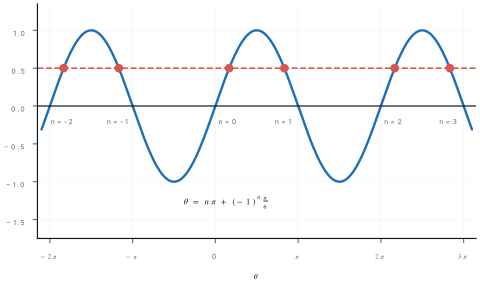
Notice the geometry behind each formula. For the sine the two roots in a period are reflections in the vertical line \theta = \pi/2, which is why the sign alternates. For the cosine they are reflections in the \theta-axis direction — that is, they come as the symmetric pair \pm\alpha about each multiple of 2\pi.
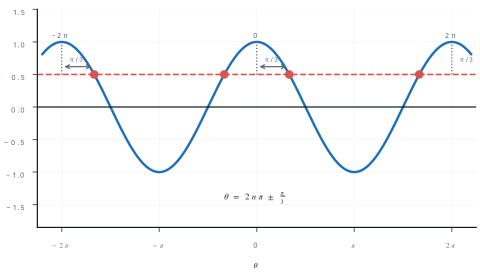
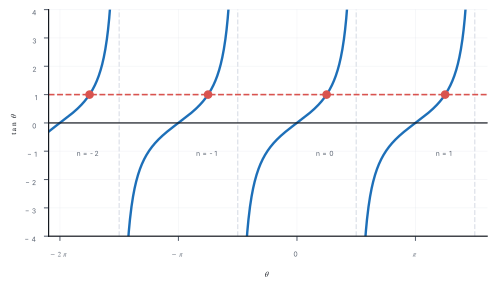
If the last line you reach is a sine equation use n\pi+(-1)^n\alpha, if it is a cosine equation use 2n\pi\pm\alpha, if tangent use n\pi+\alpha. Converting a sine equation into a cosine one (or the reverse) is allowed and often tidier, but then you must use the matching formula.
Problem. Find the general values of \theta if (a) \sin\theta = \frac{\sqrt{3}}{2}, (b) \cos\theta = -\frac{1}{\sqrt{2}}, (c) \tan\theta = -\sqrt{3}.
Solution.
(a) \frac{\sqrt{3}}{2} = \sin\frac{\pi}{3}, so \theta = n\pi+(-1)^{n}\dfrac{\pi}{3}.
(b) The cosine is negative, so take \alpha in the second quadrant: -\frac{1}{\sqrt{2}} = \cos\left(\pi-\frac{\pi}{4}\right) = \cos\frac{3\pi}{4}. Hence \theta = 2n\pi\pm\dfrac{3\pi}{4}.
(c) \tan\frac{\pi}{3} = \sqrt{3} and tangent is odd, so -\sqrt{3} = \tan\left(-\frac{\pi}{3}\right) and \theta = n\pi-\dfrac{\pi}{3}.
Problem. Solve 4\sin^{2}\theta = 3.
Solution. \sin^{2}\theta = \dfrac34 = \left(\dfrac{\sqrt{3}}{2}\right)^{2} = \sin^{2}\dfrac{\pi}{3}.
For a squared equation both signs of the ratio are allowed, so the two families n\pi+(-1)^n\frac{\pi}{3} and n\pi-(-1)^n\frac{\pi}{3} merge into
Equations of the form a\cos\theta+b\sin\theta = c
Divide nothing; instead set a = r\cos\alpha and b = r\sin\alpha, so that r = \sqrt{a^{2}+b^{2}} and \tan\alpha = b/a. Then
and the equation becomes \cos(\theta-\alpha) = c/r. A solution exists only if |c| \le r = \sqrt{a^{2}+b^{2}}.
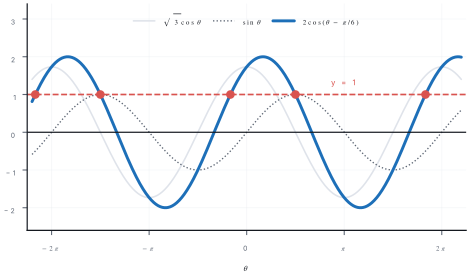
Problem. Solve \sqrt{3}\cos\theta+\sin\theta = 1.
Solution. Here a=\sqrt{3}, b=1, so r = \sqrt{3+1} = 2 and \tan\alpha = \dfrac{1}{\sqrt{3}}, giving \alpha = \dfrac{\pi}{6} (both a and b positive, so \alpha is in quadrant I). The equation becomes
Taking the two signs separately,
Check. \theta=\frac{\pi}{2}: \sqrt{3}(0)+1 = 1 ✓. \theta=-\frac{\pi}{6}: \sqrt{3}\cdot\frac{\sqrt{3}}{2}+\left(-\frac12\right) = \frac32-\frac12 = 1 ✓.
Sums of sines and cosines
Problem. Solve \sin\theta+\sin 3\theta+\sin 5\theta = 0.
Solution. Group the outer two and use \sin C+\sin D = 2\sin\frac{C+D}{2}\cos\frac{C-D}{2}:
so the equation becomes
Either \sin 3\theta = 0 \Rightarrow 3\theta = n\pi \Rightarrow \theta = \dfrac{n\pi}{3},
or \cos 2\theta = -\dfrac12 = \cos\dfrac{2\pi}{3} \Rightarrow 2\theta = 2n\pi\pm\dfrac{2\pi}{3} \Rightarrow \theta = n\pi\pm\dfrac{\pi}{3}.
Problem. Solve \cos\theta+\cos 2\theta+\cos 3\theta = 0.
Solution. Group the first and third: \cos\theta+\cos 3\theta = 2\cos 2\theta\cos\theta. Hence
Either \cos 2\theta = 0 \Rightarrow 2\theta = (2n+1)\dfrac{\pi}{2} \Rightarrow \theta = (2n+1)\dfrac{\pi}{4},
or \cos\theta = -\dfrac12 = \cos\dfrac{2\pi}{3} \Rightarrow \theta = 2n\pi\pm\dfrac{2\pi}{3}.
Problem. Solve \sin 2\theta = \cos 3\theta.
Solution. Convert the sine into a cosine using \sin x = \cos\left(\frac{\pi}{2}-x\right):
By the cosine rule for general values, 3\theta = 2n\pi\pm\left(\dfrac{\pi}{2}-2\theta\right).
Plus sign: 3\theta = 2n\pi+\dfrac{\pi}{2}-2\theta \Rightarrow 5\theta = 2n\pi+\dfrac{\pi}{2} \Rightarrow \theta = \dfrac{(4n+1)\pi}{10}.
Minus sign: 3\theta = 2n\pi-\dfrac{\pi}{2}+2\theta \Rightarrow \theta = 2n\pi-\dfrac{\pi}{2}.
Check. n=0 in the first family gives \theta = \frac{\pi}{10}: \sin\frac{\pi}{5} = 0.5878 and \cos\frac{3\pi}{10} = 0.5878 ✓.
Problem. Solve \tan\theta+\tan 2\theta+\tan 3\theta = \tan\theta\,\tan 2\theta\,\tan 3\theta.
Solution. Collect the \tan 3\theta terms:
Provided 1-\tan\theta\tan 2\theta \ne 0, divide by it:
The left side is \tan(\theta+2\theta) = \tan 3\theta, so \tan 3\theta = -\tan 3\theta, i.e. 2\tan 3\theta = 0.
Hence \tan 3\theta = 0 \Rightarrow 3\theta = n\pi \Rightarrow \theta = \dfrac{n\pi}{3}.
Check. \theta = \frac{\pi}{3}: \tan\frac{\pi}{3}+\tan\frac{2\pi}{3}+\tan\pi = \sqrt{3}-\sqrt{3}+0 = 0, and the product is also 0 ✓.
Problem. Solve \sin 2\theta = \sin\theta.
Solution. Write \sin 2\theta = 2\sin\theta\cos\theta and bring everything to one side:
Either \sin\theta = 0 \Rightarrow \theta = n\pi, or \cos\theta = \dfrac12 \Rightarrow \theta = 2n\pi\pm\dfrac{\pi}{3}.
Cancelling \sin\theta at the start would have lost the entire family \theta = n\pi — a guaranteed loss of marks.
Chapter summary
- A trigonometric equation has infinitely many roots; the answer required is the general value, with n\in\mathbb{Z} stated.
- \sin\theta=\sin\alpha \Rightarrow \theta = n\pi+(-1)^{n}\alpha; \cos\theta=\cos\alpha \Rightarrow \theta = 2n\pi\pm\alpha; \tan\theta=\tan\alpha \Rightarrow \theta = n\pi+\alpha.
- Squared equations \sin^{2}\theta=\sin^{2}\alpha (and the \cos^2, \tan^2 versions) all give \theta = n\pi\pm\alpha.
- Zero cases: \sin\theta=0 \Rightarrow \theta=n\pi; \cos\theta=0 \Rightarrow \theta=(2n+1)\frac{\pi}{2}; \tan\theta=0 \Rightarrow \theta=n\pi.
- Quadratics in one ratio: factorise. Mixed \sin^{2}/\cos: substitute \sin^{2}\theta = 1-\cos^{2}\theta. Sums of sines or cosines: use sum-to-product, then factorise.
- a\cos\theta+b\sin\theta = c becomes r\cos(\theta-\alpha)=c with r=\sqrt{a^{2}+b^{2}}, \tan\alpha = b/a; solvable only if |c|\le r.
- Never cancel a common trigonometric factor — factorise and set each factor to zero. Always reject roots that need |\sin\theta|>1 or |\cos\theta|>1.
Practice questions
Group A — Multiple choice (1 mark each)
- The general solution of \cos\theta = 0 is [1]an\pib2n\pic(2n+1)\frac{\pi}{2}dn\pi+\frac{\pi}{4}
- If \tan\theta = \tan\alpha then \theta equals [1]a2n\pi\pm\alphabn\pi+\alphacn\pi+(-1)^{n}\alphad2n\pi+\alpha
- The number of roots of \sin\theta = \frac{1}{2} in [0,2\pi) is [1]a1b2c3dinfinitely many
- The equation 3\cos\theta+4\sin\theta = 6 has [1]atwo rootsbone rootcno rootdinfinitely many roots
- The general solution of \tan^{2}\theta = 1 is [1]an\pi+\frac{\pi}{4}bn\pi\pm\frac{\pi}{4}c2n\pi\pm\frac{\pi}{4}dn\pi
- The principal solution of \sin\theta = -\frac{1}{\sqrt{2}} is [1]a\frac{5\pi}{4}b\frac{7\pi}{4}c-\frac{\pi}{4}d\frac{3\pi}{4}
Answers to Group A
1. (c) — the cosine vanishes at every odd multiple of \frac{\pi}{2}.
2. (b) — tangent has period \pi.
3. (b) — \frac{\pi}{6} and \frac{5\pi}{6}; one root per half-period in [0,2\pi).
4. (c) — r=\sqrt{9+16}=5 and 6>5, so no solution exists.
5. (b) — squared equations give \theta = n\pi\pm\alpha with \alpha = \frac{\pi}{4}.
6. (c) — the numerically smallest root; \sin\left(-\frac{\pi}{4}\right) = -\frac{1}{\sqrt{2}}.
Group B — Short answer (5 marks each)
- Prove that if \sin\theta = \sin\alpha then \theta = n\pi+(-1)^{n}\alpha, n\in\mathbb{Z}. [5]
- Solve 2\cos^{2}\theta+\sin\theta-1 = 0. [5]
- Solve \cos\theta+\cos 3\theta = 2\cos 2\theta. [5]
- Solve \cos\theta-\sqrt{3}\sin\theta = 1. [5]
- Find all values of \theta in 0^{\circ}\le\theta\le 360^{\circ} satisfying \tan\theta+\sqrt{3} = 0. [5]
Answers to Group B
1. \sin\theta-\sin\alpha = 2\cos\frac{\theta+\alpha}{2}\sin\frac{\theta-\alpha}{2} = 0. Either \cos\frac{\theta+\alpha}{2}=0, giving \frac{\theta+\alpha}{2}=(2m+1)\frac{\pi}{2} and so \theta = (2m+1)\pi-\alpha; or \sin\frac{\theta-\alpha}{2}=0, giving \frac{\theta-\alpha}{2}=m\pi and so \theta = 2m\pi+\alpha. The first family is \theta = (\text{odd }n)\pi-\alpha and the second \theta = (\text{even }n)\pi+\alpha, both of which are \theta = n\pi+(-1)^{n}\alpha.
2. Substitute \cos^{2}\theta = 1-\sin^{2}\theta: 2-2\sin^{2}\theta+\sin\theta-1=0, i.e. 2\sin^{2}\theta-\sin\theta-1=0. Factorising, (2\sin\theta+1)(\sin\theta-1)=0. If \sin\theta = 1 = \sin\frac{\pi}{2} then \theta = n\pi+(-1)^{n}\frac{\pi}{2}. If \sin\theta = -\frac12 = \sin\left(-\frac{\pi}{6}\right) then \theta = n\pi+(-1)^{n}\left(-\frac{\pi}{6}\right) = n\pi-(-1)^{n}\frac{\pi}{6}.
3. \cos\theta+\cos 3\theta = 2\cos 2\theta\cos\theta, so the equation is 2\cos 2\theta\cos\theta = 2\cos 2\theta, i.e. 2\cos 2\theta(\cos\theta-1)=0. Either \cos 2\theta = 0 \Rightarrow 2\theta = (2n+1)\frac{\pi}{2} \Rightarrow \theta = (2n+1)\frac{\pi}{4}; or \cos\theta = 1 \Rightarrow \theta = 2n\pi.
4. r = \sqrt{1^{2}+(-\sqrt{3})^{2}} = 2, and with a=1, b=-\sqrt{3} we have \tan\alpha = -\sqrt{3} with \cos\alpha>0, so \alpha = -\frac{\pi}{3}. Then 2\cos\left(\theta+\frac{\pi}{3}\right) = 1, i.e. \cos\left(\theta+\frac{\pi}{3}\right) = \frac12 = \cos\frac{\pi}{3}. So \theta+\frac{\pi}{3} = 2n\pi\pm\frac{\pi}{3}, giving \theta = 2n\pi or \theta = 2n\pi-\frac{2\pi}{3}. Check \theta = -\frac{2\pi}{3}: \cos = -\frac12, \sin = -\frac{\sqrt{3}}{2}, so LHS = -\frac12+\frac{3}{2} = 1 ✓.
5. \tan\theta = -\sqrt{3} = \tan(-60^{\circ}), so the general value is \theta = n\cdot 180^{\circ}-60^{\circ}. Taking n=1 and n=2 gives the values in range: \theta = 120^{\circ} and \theta = 300^{\circ}. (Tangent is negative in quadrants II and IV, which is exactly where these lie.)
Group C — Long answer (8 marks each)
- (a) Derive the general solution of \cos\theta = \cos\alpha. [4](b) Hence solve \cos\theta+\cos 2\theta+\cos 3\theta = 0. [4]
- (a) Show that a\cos\theta+b\sin\theta can be written as r\cos(\theta-\alpha) and state the condition for a\cos\theta+b\sin\theta = c to be solvable. [3](b) Solve \sin\theta+\sin 2\theta+\sin 3\theta = 0. [5]
Answers to Group C
1. (a) \cos\theta-\cos\alpha = -2\sin\frac{\theta+\alpha}{2}\sin\frac{\theta-\alpha}{2} = 0. So \sin\frac{\theta+\alpha}{2}=0, giving \frac{\theta+\alpha}{2}=m\pi and \theta = 2m\pi-\alpha; or \sin\frac{\theta-\alpha}{2}=0, giving \theta = 2m\pi+\alpha. Combining the two, \theta = 2n\pi\pm\alpha, n\in\mathbb{Z}.
(b) \cos\theta+\cos 3\theta = 2\cos 2\theta\cos\theta, so the equation is \cos 2\theta(2\cos\theta+1)=0. Either \cos 2\theta = 0 \Rightarrow \theta = (2n+1)\frac{\pi}{4}, or \cos\theta = -\frac12 = \cos\frac{2\pi}{3} \Rightarrow \theta = 2n\pi\pm\frac{2\pi}{3}.
2. (a) Choose r>0 and \alpha with a = r\cos\alpha and b = r\sin\alpha. Squaring and adding, a^{2}+b^{2} = r^{2}, so r=\sqrt{a^{2}+b^{2}}; dividing, \tan\alpha = b/a. Then a\cos\theta+b\sin\theta = r(\cos\alpha\cos\theta+\sin\alpha\sin\theta) = r\cos(\theta-\alpha). Since |\cos(\theta-\alpha)|\le 1, the equation r\cos(\theta-\alpha)=c has a solution only when |c|\le\sqrt{a^{2}+b^{2}}.
(b) \sin\theta+\sin 3\theta = 2\sin 2\theta\cos\theta, so 2\sin 2\theta\cos\theta+\sin 2\theta = 0, i.e. \sin 2\theta(2\cos\theta+1)=0. Either \sin 2\theta = 0 \Rightarrow 2\theta = n\pi \Rightarrow \theta = \frac{n\pi}{2}, or \cos\theta = -\frac12 \Rightarrow \theta = 2n\pi\pm\frac{2\pi}{3}. Check \theta = \frac{\pi}{2}: 1+0-1 = 0 ✓; check \theta = \frac{2\pi}{3}: \frac{\sqrt{3}}{2}-\frac{\sqrt{3}}{2}+0 = 0 ✓.
Practise more: Mathematics question bank