Unit 19 · Calculus · 16 teaching hours · 42 min read
Anti-derivatives
What the syllabus asks for 5
- Basic (standard) integrals
- Integration by substitution
- Integration by parts
- Definite integral
- Area under a curve; area between two curves
Differentiation takes a function and produces its rate of change. Anti-differentiation runs the machine backwards: you are given the rate of change and must recover the function. That single idea — reversing the derivative — turns out to compute areas, volumes, distances travelled from a velocity, and the total from a rate. At 16 hours this is the largest chapter of Grade 11 Mathematics, and it carries the most marks in the calculus area of the paper.
Almost every question is of one of five kinds: use a standard form, substitute, integrate by parts, evaluate a definite integral (often using a property), or find an area. Learn to recognise which of the five a question is, and the rest is routine algebra. Marks are given per step — always write the substitution you are making and the form you are reducing to.
19.1 Basic (standard) integrals
The anti-derivative
A function F(x) is an anti-derivative of f(x) on an interval if F'(x) = f(x) for every x in that interval. The collection of all anti-derivatives of f is written
and is called the indefinite integral of f. Here f(x) is the integrand, x is the variable of integration, dx says which variable, and C is the constant of integration.
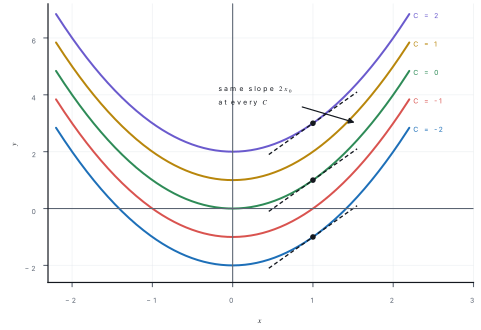
Why a constant? Because \frac{d}{dx}(C) = 0, so if F'(x) = f(x) then (F(x)+C)' = f(x) too. Two anti-derivatives of the same function can differ only by a constant, so F(x)+C is the complete answer, not just one answer.
Geometrically, the anti-derivatives of f form a family of curves, each a vertical translate of the others. At any fixed x_0 every curve in the family has the same gradient f(x_0).
Two rules that do all the splitting
There is no product rule and no quotient rule for integration. A product must be turned into something integrable — by multiplying out, by a trigonometric identity, by substitution, or by parts.
The standard integrals
Every one of these is just a derivative read backwards. Add +\,C to each.
| No. | Integral | Result |
|---|---|---|
| 1 | \int x^n\,dx | \frac{x^{n+1}}{n+1}, n \neq -1 |
| 2 | \int \frac{dx}{x} | \ln|x| |
| 3 | \int e^{x}\,dx | e^{x} |
| 4 | \int a^{x}\,dx | \frac{a^{x}}{\ln a}, a>0,\ a \neq 1 |
| 5 | \int \sin x\,dx | -\cos x |
| 6 | \int \cos x\,dx | \sin x |
| 7 | \int \sec^{2} x\,dx | \tan x |
| 8 | \int \csc^{2} x\,dx | -\cot x |
| 9 | \int \sec x\tan x\,dx | \sec x |
| 10 | \int \csc x\cot x\,dx | -\csc x |
| 11 | \int \tan x\,dx | \ln|\sec x| |
| 12 | \int \cot x\,dx | \ln|\sin x| |
| 13 | \int \sec x\,dx | \ln|\sec x + \tan x| |
| 14 | \int \csc x\,dx | \ln|\csc x - \cot x| |
| 15 | \int \frac{dx}{\sqrt{a^{2}-x^{2}}} | \sin^{-1}\frac{x}{a} |
| 16 | \int \frac{dx}{a^{2}+x^{2}} | \frac{1}{a}\tan^{-1}\frac{x}{a} |
| 17 | \int \frac{dx}{x\sqrt{x^{2}-a^{2}}} | \frac{1}{a}\sec^{-1}\frac{x}{a} |
| 18 | \int \frac{dx}{x^{2}-a^{2}} | \frac{1}{2a}\ln\frac{|x-a|}{|x+a|} |
| 19 | \int \frac{dx}{a^{2}-x^{2}} | \frac{1}{2a}\ln\frac{|a+x|}{|a-x|} |
| 20 | \int \frac{dx}{\sqrt{x^{2}+a^{2}}} | \ln|x+\sqrt{x^{2}+a^{2}}| |
| 21 | \int \frac{dx}{\sqrt{x^{2}-a^{2}}} | \ln|x+\sqrt{x^{2}-a^{2}}| |
| 22 | \int \sqrt{a^{2}-x^{2}}\,dx | \frac{x}{2}\sqrt{a^{2}-x^{2}} + \frac{a^{2}}{2}\sin^{-1}\frac{x}{a} |
| 23 | \int \sqrt{x^{2}+a^{2}}\,dx | \frac{x}{2}\sqrt{x^{2}+a^{2}} + \frac{a^{2}}{2}\ln|x+\sqrt{x^{2}+a^{2}}| |
| 24 | \int \sqrt{x^{2}-a^{2}}\,dx | \frac{x}{2}\sqrt{x^{2}-a^{2}} - \frac{a^{2}}{2}\ln|x+\sqrt{x^{2}-a^{2}}| |
| 25 | \int \frac{f'(x)}{f(x)}\,dx | \ln|f(x)| |
| 26 | \int [f(x)]^{n}f'(x)\,dx | \frac{[f(x)]^{n+1}}{n+1}, n \neq -1 |
| 27 | \int e^{x}[f(x)+f'(x)]\,dx | e^{x}f(x) |
Two generalisations follow at once from the chain rule. For any constants a \neq 0 and b,
so, for example, \int \cos(3x+1)\,dx = \frac{1}{3}\sin(3x+1)+C and \int (2x-5)^{7}dx = \frac{(2x-5)^{8}}{16}+C.
\int (2x-5)^7 dx = \frac{(2x-5)^8}{16}+C is right because the inside is linear. But \int (x^2-5)^7 dx \neq \frac{(x^2-5)^8}{16x} — dividing by 2x is illegal, because 2x is not a constant and cannot be moved through the integral sign.
Problem. Evaluate \int \left(3x^{4} - \frac{5}{x^{2}} + 2\sqrt{x} - 7\right)dx.
Solution. Split the integral and write every term as a power of x:
Apply rule 1 to each term (n = 4,\,-2,\,\tfrac12,\,0):
Check. Differentiating gives back 3x^4 - 5x^{-2} + 2x^{1/2} - 7. Always spend five seconds on this check; it costs nothing and catches sign slips.
Problem. Evaluate \int \left(\sqrt{x} + \frac{1}{\sqrt{x}}\right)^{2}dx.
Solution. There is no product rule, so expand first:
Now every term is standard:
Problem. Evaluate \int \tan^{2}x\,dx and \int \frac{dx}{1+\cos x}.
Solution. Neither integrand is in the table, so convert with an identity.
(a) Using \sec^2 x = 1 + \tan^2 x, so \tan^2 x = \sec^2 x - 1:
(b) Using 1+\cos x = 2\cos^{2}\frac{x}{2}:
Problem. Evaluate \int \left(e^{x} + 2^{x} + \frac{3}{1+x^{2}}\right)dx.
Solution. Standard forms 3, 4 and 16 (with a=1):
Why integration is harder than differentiation
Differentiation is mechanical. Given any combination of the standard functions, the product, quotient and chain rules will grind out the derivative in a finite number of steps, and there is never any doubt about what to do next. Integration has no such algorithm. There is no rule for the integral of a product, and there are perfectly ordinary-looking functions — e^{-x^{2}}, \frac{\sin x}{x}, \sqrt{1+x^{3}} — whose anti-derivatives cannot be written down in terms of the functions you know at all. So integration is a matter of pattern recognition: you learn a table of standard forms, and you learn three or four manoeuvres (substitution, parts, partial fractions, trigonometric identities) for pushing an unfamiliar integral into that table. When you meet a new integral, the first question is never "what is the rule?" but "which standard form is this trying to be?".
Finding one particular anti-derivative
An indefinite integral gives the whole family F(x)+C. In an applied problem one extra piece of information — the value of the function at one point, called an initial condition or boundary condition — pins down C and selects one member of the family. This is the pattern for every "given the rate, find the quantity" question in the paper.
Problem. A curve passes through the point (1,4) and its gradient at every point is \frac{dy}{dx} = 3x^{2}-2x+1. Find the equation of the curve.
Solution. Integrate the gradient to recover y:
Now use the condition that the curve passes through (1,4), so y = 4 when x=1:
Hence the curve is y = x^{3}-x^{2}+x+3. Only one curve of the family fits, because only one vertical translate passes through the given point.
Problem. A particle moves in a straight line with velocity v = 3t^{2}-4t+2 (in m s⁻¹) at time t seconds, and is at s = 5 m from the origin when t=0. Find its displacement at t = 3 s.
Solution. Velocity is the rate of change of displacement, so displacement is the anti-derivative of velocity:
At t=0, s=5, so C = 5 and s = t^{3}-2t^{2}+2t+5. At t = 3 s,
19.2 Integration by substitution
Substitution is the chain rule reversed. If x = g(t) is a differentiable function with dx = g'(t)\,dt, then
In practice you go the other way: you spot a function u = g(x) inside the integrand whose derivative g'(x) is also present (up to a constant), put du = g'(x)dx, and the integral collapses to a standard form in u.
Look for the inner function of a composition — what is under a root, inside a bracket raised to a power, in an exponent, or in a denominator. Call it u. The substitution works if du uses up the rest of the integrand apart from a constant.
The two workhorse forms
Problem. Evaluate (a) \int \frac{x\,dx}{x^{2}+1} (b) \int x^{2}\sqrt{x^{3}+2}\ dx.
Solution.
(a) Put u = x^{2}+1, so du = 2x\,dx, i.e. x\,dx = \tfrac12 du:
(The modulus can be dropped because x^2+1 > 0 always.)
(b) Put u = x^{3}+2, so du = 3x^{2}dx, i.e. x^{2}dx = \tfrac13 du:
Problem. Prove that \int \tan x\,dx = \ln|\sec x| + C, and evaluate \int \frac{e^{\sqrt{x}}}{\sqrt{x}}\,dx.
Solution. \int\tan x\,dx = \int\frac{\sin x}{\cos x}dx. Put u = \cos x, so du = -\sin x\,dx:
For the second integral put u = \sqrt{x}, so du = \frac{dx}{2\sqrt{x}}, i.e. \frac{dx}{\sqrt{x}} = 2\,du:
A substitution that needs the inverse
Sometimes the substitution does not clear out the whole integrand in one stroke and you must also express the leftover x in terms of u. That is allowed, and it is often the neatest route when a linear expression sits under a root.
Problem. Evaluate \int \frac{x\,dx}{\sqrt{x+1}}.
Solution. Put u = x+1, so du = dx and, rearranging, x = u-1:
This looks like a trick, but it is the standard NEB derivation and is worth memorising. Multiply top and bottom by \sec x + \tan x:
The numerator is now exactly the derivative of the denominator, because \frac{d}{dx}(\sec x+\tan x) = \sec x\tan x + \sec^{2}x. So by form 25,
The same device with \csc x - \cot x gives \int\csc x\,dx = \ln|\csc x - \cot x| + C.
Deriving the standard forms 18, 16 and 15
These three appear in the table, but NEB regularly asks you to derive them.
(i) Split into partial fractions: \frac{1}{x^{2}-a^{2}} = \frac{1}{(x-a)(x+a)} = \frac{1}{2a}\left(\frac{1}{x-a}-\frac{1}{x+a}\right). Integrating each term with form 25,
(ii) Put x = a\tan\theta, so dx = a\sec^{2}\theta\,d\theta and a^{2}+x^{2} = a^{2}\sec^{2}\theta:
(iii) Put x = a\sin\theta, so dx = a\cos\theta\,d\theta and \sqrt{a^{2}-x^{2}} = a\cos\theta:
The substitutions used in (ii) and (iii) are the trigonometric substitutions. Choose them from the shape of the surd, and read the other sides off a right-angled triangle when you have to convert back to x.
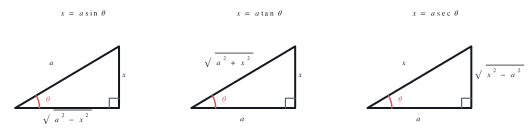
| Expression in the integrand | Substitution | It becomes |
|---|---|---|
| \sqrt{a^{2}-x^{2}} or a^2-x^2 | x = a\sin\theta | a\cos\theta |
| \sqrt{a^{2}+x^{2}} or a^2+x^2 | x = a\tan\theta | a\sec\theta |
| \sqrt{x^{2}-a^{2}} or x^2-a^2 | x = a\sec\theta | a\tan\theta |
| \sqrt{\frac{a-x}{a+x}} | x = a\cos 2\theta | \tan\theta form |
Problem. Evaluate (a) \int\frac{dx}{x^{2}-9} (b) \int\frac{dx}{\sqrt{4-9x^{2}}}.
Solution.
(a) This is form 18 with a = 3:
(b) Take the 9 out of the surd: \sqrt{4-9x^{2}} = 3\sqrt{\frac{4}{9}-x^{2}}, so with a = \frac{2}{3},
Problem. Evaluate \int\sqrt{9-x^{2}}\,dx by trigonometric substitution.
Solution. Put x = 3\sin\theta, dx = 3\cos\theta\,d\theta; then \sqrt{9-x^{2}} = 3\cos\theta.
Back-substitute using the first triangle: \sin\theta = \frac{x}{3}, \cos\theta = \frac{\sqrt{9-x^{2}}}{3}, \theta = \sin^{-1}\frac{x}{3}:
which is entry 22 of the table with a = 3.
Quadratics in the denominator: complete the square
Any ax^{2}+bx+c can be written as a\left[(x+\frac{b}{2a})^{2} + \frac{4ac-b^2}{4a^2}\right]. After the shift u = x + \frac{b}{2a}, the integral is one of forms 15, 16, 18, 19, 20 or 21.
Problem. Evaluate (a) \int\frac{dx}{x^{2}+4x+13} (b) \int\frac{dx}{\sqrt{x^{2}+6x+5}}.
Solution.
(a) x^{2}+4x+13 = (x+2)^{2}+9. With u = x+2, du = dx, and a = 3 in form 16:
(b) x^{2}+6x+5 = (x+3)^{2}-4. With u = x+3 and a = 2 in form 21:
The form \frac{px+q}{ax^{2}+bx+c}
Write the numerator as (a multiple of the derivative of the denominator) + (a constant):
The \lambda part integrates by form 25 to a logarithm; the \mu part is handled by completing the square as above. The same split works with the denominator under a square root.
Problem. Evaluate \int\frac{x+2}{x^{2}+2x+5}\,dx.
Solution. The derivative of the denominator is 2x+2. Write
so the integral splits as
The first is form 25; the second needs x^{2}+2x+5 = (x+1)^{2}+4:
Rational functions: partial fractions
If the integrand is \frac{P(x)}{Q(x)} with P,Q polynomials, first make it a proper fraction (degree of P less than degree of Q) by dividing out. Then split \frac{P}{Q} into partial fractions using the four denominator cases.
| Factor in Q(x) | Contributes |
|---|---|
| distinct linear (x-a) | \frac{A}{x-a} |
| repeated linear (x-a)^{k} | \frac{A_1}{x-a}+\frac{A_2}{(x-a)^{2}}+\cdots+\frac{A_k}{(x-a)^{k}} |
| distinct quadratic (x^{2}+px+q) | \frac{Ax+B}{x^{2}+px+q} |
| repeated quadratic (x^{2}+px+q)^{k} | \frac{A_1x+B_1}{x^{2}+px+q}+\cdots+\frac{A_kx+B_k}{(x^{2}+px+q)^{k}} |
Partial fractions always work on a rational function, because every polynomial with real coefficients factorises into linear factors and irreducible quadratic factors. Those are precisely the two kinds of piece we know how to integrate: a linear denominator gives a logarithm, and an irreducible quadratic gives a logarithm plus an inverse tangent after completing the square. So a rational function can always, in principle, be integrated — which is not true of most other families of functions.
Problem. Evaluate \int\frac{3x-1}{(x-1)(x-2)}\,dx.
Solution. Write \frac{3x-1}{(x-1)(x-2)} = \frac{A}{x-1}+\frac{B}{x-2}, so
Put x = 1: \ 2 = -A, so A = -2. Put x = 2: \ 5 = B. Hence
Problem. Evaluate \int\frac{dx}{x(x+1)^{2}}.
Solution. Set \frac{1}{x(x+1)^{2}} = \frac{A}{x}+\frac{B}{x+1}+\frac{D}{(x+1)^{2}}, so
Put x = 0: A = 1. Put x = -1: 1 = -D, so D = -1. Comparing coefficients of x^{2}: A + B = 0, so B = -1. Therefore
Problem. Evaluate \int\frac{dx}{(x+1)(x^{2}+1)}.
Solution. Set \frac{1}{(x+1)(x^{2}+1)} = \frac{A}{x+1}+\frac{Bx+D}{x^{2}+1}, so
Put x = -1: 1 = 2A, so A = \frac12. Coefficient of x^{2}: A+B = 0, so B = -\frac12. Constant term: A + D = 1, so D = \frac12. Hence
Problem. Evaluate \int\frac{dx}{x(x^{2}+1)^{2}}.
Solution. Set \frac{1}{x(x^{2}+1)^{2}} = \frac{A}{x}+\frac{Bx+D}{x^{2}+1}+\frac{Ex+F}{(x^{2}+1)^{2}}, so
Put x = 0: A = 1. Comparing coefficients: x^{4} gives A+B = 0 so B=-1; x^{3} gives D = 0; x^{2} gives 2A+B+E = 0 so E = -1; x^{1} gives D+F = 0 so F = 0. The integral becomes
Each of the last two yields to u = x^{2}+1, du = 2x\,dx:
\int\frac{x^{2}+1}{x^{2}-1}dx cannot go straight to partial fractions — the top and bottom have the same degree. Divide first: \frac{x^{2}+1}{x^{2}-1} = 1 + \frac{2}{x^{2}-1}, giving x + \ln\frac{|x-1|}{|x+1|} + C by form 18 with a=1.
19.3 Integration by parts
Integrate the product rule \frac{d}{dx}(uv) = u\frac{dv}{dx} + v\frac{du}{dx} over x:
Rearranging gives the rule.
In the shorthand \int u\,dv = uv - \int v\,du: "integral of (first \times second) = first \times integral of second - integral of (derivative of first \times integral of second)."
The whole skill is choosing which factor is u (to be differentiated) and which is dv (to be integrated). Choose u to be whichever comes first in this list:
| Letter | Type of function | Example |
|---|---|---|
| I | Inverse trigonometric | \sin^{-1}x, \tan^{-1}x |
| L | Logarithmic | \ln x, \log_{10}x |
| A | Algebraic | x, x^{2}, 3x-1 |
| T | Trigonometric | \sin x, \cos x |
| E | Exponential | e^{x}, 2^{x} |
The function earlier in ILATE becomes u; the other becomes dv. The reason is simple: I and L get simpler when differentiated but are painful to integrate, while T and E integrate as easily as they differentiate.
Problem. Evaluate \int x e^{x}\,dx.
Solution. Algebraic (A) beats exponential (E), so u = x and dv = e^{x}dx. Then du = dx and v = e^{x}.
Had we chosen the other way round (u = e^x), the remaining integral would be \int \frac{x^2}{2}e^x dx — worse than what we started with. That is what ILATE protects you from.
Problem. Evaluate (a) \int \ln x\,dx (b) \int \tan^{-1}x\,dx.
Solution. Both have only one visible factor; supply a second factor of 1.
(a) u = \ln x (L), dv = 1\cdot dx, so du = \frac{dx}{x} and v = x:
(b) u = \tan^{-1}x (I), dv = dx, so du = \frac{dx}{1+x^{2}} and v = x:
Problem. Evaluate \int x\ln x\,dx.
Solution. L comes before A, so u = \ln x and dv = x\,dx; then du = \frac{dx}{x} and v = \frac{x^{2}}{2}:
Repeated parts
If the algebraic factor is x^{n}, apply the rule n times.
Problem. Evaluate \int x^{2}e^{2x}dx.
Solution. First application: u = x^{2}, dv = e^{2x}dx, v = \frac{e^{2x}}{2}:
Second application on \int xe^{2x}dx with u = x, v = \frac{e^{2x}}{2}:
Putting the pieces together,
Problem. Evaluate \int x^{2}\sin x\,dx.
Solution. A beats T, so u = x^{2} and dv = \sin x\,dx, giving v = -\cos x:
Apply parts again to \int x\cos x\,dx with u = x and v = \sin x:
Therefore
Notice the pattern: each application lowers the power of x by one, so a factor x^{n} needs exactly n applications.
The e^{x}[f(x)+f'(x)] form
Integration by parts produces one standard form so often that it is quicker to recognise it than to derive it each time.
Split the integral and apply parts to the first piece with u = f(x), dv = e^{x}dx:
Adding \int e^{x}f'(x)dx to both sides,
To use it, look for an expression of the form e^x times (something plus its own derivative). For example, in \int e^{x}\left(\frac{1}{x}-\frac{1}{x^{2}}\right)dx take f(x)=\frac1x, since f'(x) = -\frac{1}{x^{2}}; the answer is \frac{e^{x}}{x}+C.
The cyclic case
When both factors are of type T or E, two applications bring back the original integral. Treat it as an unknown and solve for it algebraically.
Problem. Evaluate I = \int e^{x}\sin x\,dx.
Solution. Take u = \sin x, dv = e^{x}dx:
Apply parts again to the new integral, with u = \cos x, dv = e^{x}dx:
Substituting back,
In the cyclic case, if the second application swaps the roles (taking u = e^x instead of the trigonometric factor) you simply undo the first step and get the useless identity I = I. Stay consistent: trigonometric as u both times, or exponential as u both times.
A result worth memorising, which follows from the same trick:
Problem. Evaluate \int x\sec^{2}x\,dx.
Solution. A before T, so u = x, dv = \sec^{2}x\,dx, giving v = \tan x:
which can also be written x\tan x + \ln|\cos x| + C.
Work down this list and stop at the first line that matches.
- Is it already a standard form? Check the table, including forms 25, 26 and 27. Allow for a linear inner function ax+b (divide by a at the end).
- Can algebra or a trigonometric identity simplify it first? Expand brackets, divide out an improper fraction, use \sec^2 = 1+\tan^2, \sin^2 = \frac{1-\cos2x}{2}, 2\sin A\cos B = \sin(A+B)+\sin(A-B).
- Is there an inner function whose derivative is also present? Substitute. A surd \sqrt{a^2 \pm x^2} or \sqrt{x^2-a^2} asks for a trigonometric substitution; a quadratic denominator asks you to complete the square.
- Is it a quotient of polynomials? Divide if improper, then partial fractions.
- Is it a product of two unrelated types of function? Integrate by parts, choosing u by ILATE.
If none of these fits, you have probably copied the question down wrongly.
19.4 Definite integral
Definition as the limit of a sum
Divide [a,b] into n equal sub-intervals of width h = \frac{b-a}{n}. On each sub-interval build a rectangle whose height is the value of f at the right-hand end. The total rectangle area is \sum_{r=1}^{n} f(a+rh)\,h. As n grows the rectangles hug the curve better and better.
a is the lower limit, b the upper limit. The result is a number, not a family of functions, so no constant of integration appears.
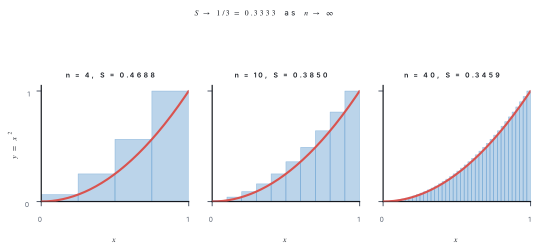
Problem. Evaluate \int_{0}^{1}x^{2}dx as the limit of a sum.
Solution. Here a=0, b=1, h = \frac{1}{n} and f(x) = x^{2}, so
Using \sum_{r=1}^{n}r^{2} = \frac{n(n+1)(2n+1)}{6},
The two kinds of integral are different objects and are marked differently, so keep them apart.
| Indefinite integral | Definite integral | |
|---|---|---|
| Written | \int f(x)\,dx | \int_{a}^{b}f(x)\,dx |
| Result is | a family of functions | a single number |
| Constant C | compulsory | cancels, so omitted |
| Means | all anti-derivatives of f | signed area from a to b |
| On substituting | change back to x at the end | change the limits instead |
The fundamental theorem of calculus
Computing every definite integral from the definition would be unbearable. The fundamental theorem converts it into an anti-derivative evaluation.
If F is any anti-derivative of a continuous f on [a,b], then
The constant of integration cancels: (F(b)+C)-(F(a)+C) = F(b)-F(a), so you may drop C in a definite integral.
Define the area function A(x) = \int_{a}^{x}f(t)\,dt, the signed area from the fixed left end a up to a movable right end x. Increasing x by a small amount h adds a thin strip of width h and height roughly f(x), so A(x+h) - A(x) \approx f(x)\,h. Dividing by h and letting h \to 0,
So the area function is itself an anti-derivative of f. If F is any other anti-derivative then A(x) = F(x) + C for some constant. Putting x = a gives 0 = F(a)+C, so C = -F(a), and putting x = b gives
This is the link between the two halves of calculus: area (a limit of a sum) is computed by anti-differentiation.
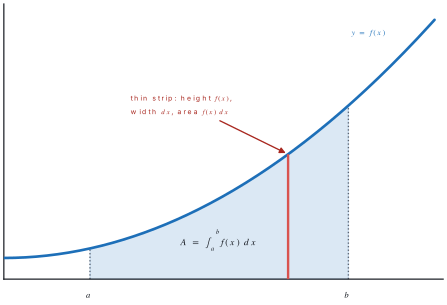
Geometrically \int_a^b f(x)\,dx is the signed area between the curve and the x-axis from x=a to x=b: the limit of the thin strips of height f(x) and width dx.
\int_{-1}^{1}\frac{dx}{x^{2}} is not \left[-\frac1x\right]_{-1}^{1} = -2. An area cannot be negative when the integrand \frac{1}{x^2} is positive everywhere, and the "answer" is meaningless because the integrand blows up at x=0, which lies inside the interval. The fundamental theorem requires f to be continuous on the whole of [a,b]. Before writing down F(b)-F(a), check that the integrand has no infinity between the limits.
Properties of the definite integral
| # | Property | Note |
|---|---|---|
| P1 | \int_{a}^{b}f(x)dx = -\int_{b}^{a}f(x)dx | swapping limits changes the sign |
| P2 | \int_{a}^{a}f(x)dx = 0 | zero width |
| P3 | \int_{a}^{b}f(x)dx = \int_{a}^{c}f(x)dx + \int_{c}^{b}f(x)dx | split at any c |
| P4 | \int_{a}^{b}f(x)dx = \int_{a}^{b}f(t)dt | the variable is a dummy |
| P5 | \int_{0}^{a}f(x)dx = \int_{0}^{a}f(a-x)dx | reflect in the midpoint |
| P6 | \int_{a}^{b}f(x)dx = \int_{a}^{b}f(a+b-x)dx | general reflection |
| P7 | \int_{-a}^{a}f(x)dx = 2\int_{0}^{a}f(x)dx if f is even | f(-x)=f(x) |
| P8 | \int_{-a}^{a}f(x)dx = 0 if f is odd | f(-x)=-f(x) |
| P9 | \int_{0}^{2a}f(x)dx = \int_{0}^{a}f(x)dx + \int_{0}^{a}f(2a-x)dx | split at a, then P5 |
P5. In \int_0^a f(x)dx substitute x = a-t, so dx = -dt; when x=0, t=a, and when x=a, t=0. Then
and renaming the dummy variable t back to x (property P4) gives the result.
P7 and P8. Split at 0 using P3: \int_{-a}^{a}f = \int_{-a}^{0}f + \int_{0}^{a}f. In the first piece put x = -t, dx = -dt, which turns it into \int_{0}^{a}f(-t)\,dt. So
If f is even, f(-x)=f(x) and the bracket is 2f(x), giving P7. If f is odd, f(-x)=-f(x) and the bracket is zero, giving P8.
Problem. Evaluate \int_{0}^{\pi/2}\sin^{2}x\,dx.
Solution. Powers of sine and cosine are always reduced with the double-angle identity before integrating; \sin^2 x is not a standard form but \cos 2x is. Using \sin^{2}x = \frac{1-\cos 2x}{2},
Problem. Evaluate (a) \int_{0}^{1}xe^{x}dx (b) \int_{1}^{e}\ln x\,dx.
Solution. In a definite integral by parts, evaluate the uv term at the limits as you go: \int_{a}^{b}u\,dv = \left[uv\right]_{a}^{b} - \int_{a}^{b}v\,du.
(a) With u = x, dv = e^{x}dx:
(b) With u = \ln x, dv = dx:
If a definite integral over [0,\frac{\pi}{2}] has \sin and \cos appearing symmetrically, apply P5 with a = \frac{\pi}{2} (which turns \sin x into \cos x), add the two versions, and the messy part cancels. The answer is usually \frac{\pi}{4}.
Problem. Evaluate \int_{1}^{2}\left(x^{2}+\frac{1}{x^{2}}\right)dx.
Solution.
Problem. Evaluate \int_{0}^{1}\frac{x\,dx}{x^{2}+1}.
Solution. Put u = x^{2}+1, du = 2x\,dx. Change the limits too: when x=0, u=1; when x=1, u=2.
This is the single most common error in Group B. Either change the limits with the variable (as above), or integrate back to x first and then apply the original limits. Never mix: \frac12[\ln(x^2+1)]_1^2 is wrong.
Problem. Evaluate I = \int_{0}^{\pi/2}\frac{dx}{1+\tan x}.
Solution. Write the integrand in terms of sine and cosine:
By P5 with a = \frac{\pi}{2}, replacing x by \frac{\pi}{2}-x turns \cos x into \sin x and \sin x into \cos x:
Adding the two expressions for I,
Problem. Evaluate \int_{-2}^{2}(x^{3}+x)\,dx and \int_{-2}^{2}(x^{2}+1)\,dx.
Solution. For the first, f(-x) = -x^{3}-x = -f(x), so f is odd and by P8 the integral is 0 — the area below the axis on [-2,0] exactly cancels the area above it on [0,2].
For the second, f(-x) = x^{2}+1 = f(x), so f is even and by P7
19.5 Area under a curve; area between two curves
Signed area and true area
The definite integral counts area below the x-axis as negative. That is exactly what you want for a displacement, and exactly what you do not want when a question asks for "the area of the region".
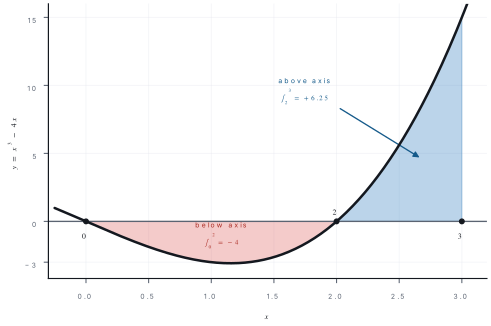
- Find where the curve crosses the x-axis inside the interval.
- Integrate separately over each piece.
- Take the modulus of each piece, then add.
Area with respect to the x-axis
The area bounded by y = f(x), the x-axis and the ordinates x=a, x=b is
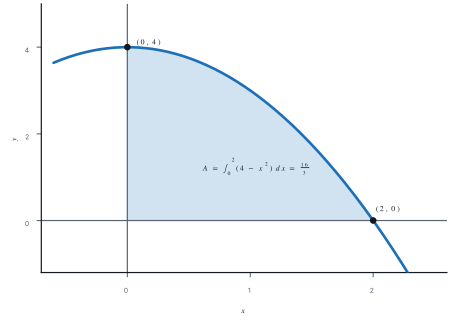
Problem. Find the area bounded by the parabola y = 4x - x^{2} and the x-axis.
Solution. The curve meets the axis where 4x - x^{2} = 0, i.e. x(4-x)=0, so at x = 0 and x = 4. Between these the parabola is above the axis, so
Problem. Find the area enclosed between the curve y = x^{3}-4x, the x-axis and the lines x = 0 and x = 3.
Solution. The curve cuts the axis where x(x^{2}-4)=0, i.e. at x = 0 and x = 2 inside the interval. Split there.
Total area = |-4| + \frac{25}{4} = 4 + 6.25 = 10.25 square units. (The definite integral \int_0^3 would give only 2.25 — a different question with a different answer.)
Area with respect to the y-axis
When the region is bounded by the y-axis and horizontal lines, use horizontal strips of length x and width dy:
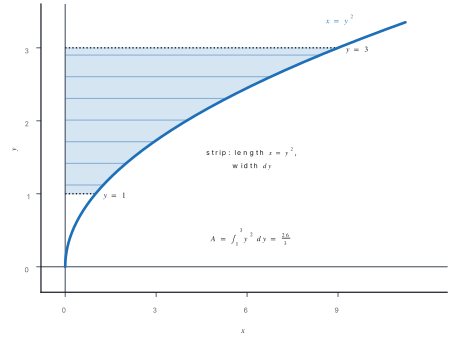
Problem. Find the area of the region bounded by the curve x = y^{2}, the y-axis and the lines y = 1 and y = 3.
Solution. Horizontal strips run from the y-axis (x=0) out to x = y^{2}, so
Area between two curves
If y = f(x) lies above y = g(x) on [a,b], a vertical strip has height f(x)-g(x), so
The limits a and b are the x-coordinates of the points of intersection, found by solving f(x) = g(x).
This formula does not care where the x-axis is. Even if part of the region lies below the axis, the height of a strip is still (top curve) minus (bottom curve), and the negative parts cancel correctly on their own. That is why you do not split an "area between two curves" question at the x-axis — you split it only where the two curves cross each other, because that is where "top" and "bottom" swap over.
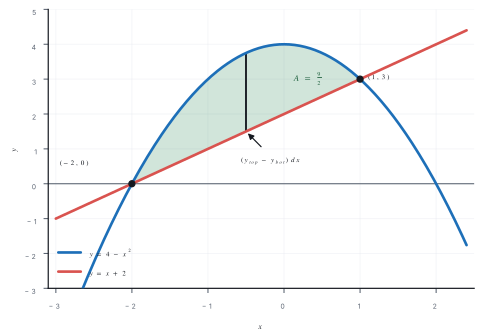
Problem. Find the area enclosed between the parabola y = 4-x^{2} and the line y = x+2.
Solution. The curves meet where 4-x^{2} = x+2, i.e. x^{2}+x-2 = 0, i.e. (x+2)(x-1)=0, so x = -2 and x = 1. Between these the parabola is the upper curve, so
Problem. Find the area of the region bounded by the parabola y^{2} = 4x and the line y = x.
Solution. Solving y^2 = 4x with y = x gives x^{2} = 4x, so x = 0 or x = 4. For 0 \le x \le 4 the parabola y = 2\sqrt{x} lies above the line, so
Problem. Find the area of the region in the first quadrant bounded by the circle x^{2}+y^{2} = 9 and the two axes, and hence state the area of the whole circle.
Solution. In the first quadrant y = \sqrt{9-x^{2}}, and the region runs from x=0 to x=3:
using entry 22 of the table with a=3. At x=3 the first term vanishes and \sin^{-1}1 = \frac{\pi}{2}; at x=0 both terms vanish. So
By symmetry the whole circle has area 4 \times \frac{9\pi}{4} = 9\pi, which agrees with \pi r^{2} for r = 3. That agreement is a useful check on the method.
Problem. Find the area enclosed between the curve y = \sin x and the x-axis from x = 0 to x = 2\pi.
Solution. The sine curve is above the axis on [0,\pi] and below it on [\pi,2\pi], so the two pieces must be handled separately.
Total area = |2| + |-2| = 4 square units, although \int_{0}^{2\pi}\sin x\,dx = 0. The integral being zero says the positive and negative signed areas balance; it does not say there is no region.
Where areas are used
The area idea is the reason integration appears everywhere outside mathematics. If a graph plots a rate against time, the area under it is the total: the area under a velocity-time graph is the distance travelled, the area under a force-displacement graph is the work done, the area under a current-time graph is the charge that has flowed, and the area under a discharge-time graph for a river such as the Bagmati is the total volume of water carried. In each case the units of the area are (units of the y-axis) \times (units of the x-axis), which is a quick way to check that you have set up the right integral.
Substitute a single convenient x strictly between the two intersection points into both functions; the larger value is the top curve. One test point settles it — never guess from a rough sketch alone.
An area question without a sketch is a guess. The sketch tells you three things the algebra alone will not: which curve is on top, where the region actually closes up, and whether the curve crosses the x-axis inside the interval so that the integral must be split. A rough sketch showing the intercepts, the general shape and the shaded region takes thirty seconds and is usually worth a mark of its own in Group C. If the two curves cross between the stated limits, the upper curve changes partway across, and you must split the integral at the crossing point and add the moduli of the pieces — exactly as you do when a single curve crosses the axis.
Chapter summary
- \int f(x)dx = F(x)+C means F'(x)=f(x). The constant C is compulsory in an indefinite integral and cancels in a definite one.
- Integration is linear: constants come out, sums split. There is no product or quotient rule.
- Standard forms to know cold: \int x^n dx = \frac{x^{n+1}}{n+1} (n\neq-1), \int\frac{dx}{x}=\ln|x|, \int\frac{dx}{a^2+x^2}=\frac1a\tan^{-1}\frac{x}{a}, \int\frac{dx}{\sqrt{a^2-x^2}}=\sin^{-1}\frac{x}{a}, \int\frac{dx}{x^2-a^2}=\frac{1}{2a}\ln\frac{|x-a|}{|x+a|}.
- Substitution: u=g(x), du=g'(x)dx. Two workhorses: \int\frac{f'}{f}dx=\ln|f|+C and \int f^n f'dx = \frac{f^{n+1}}{n+1}+C. Surds \sqrt{a^2-x^2}, \sqrt{a^2+x^2}, \sqrt{x^2-a^2} call for x=a\sin\theta, a\tan\theta, a\sec\theta.
- Quadratic denominators: complete the square; for \frac{px+q}{ax^2+bx+c} write px+q=\lambda(2ax+b)+\mu. Rational functions: divide if improper, then split into partial fractions by the four denominator cases.
- By parts: \int u\,dv = uv - \int v\,du, choosing u by ILATE. Apply twice for x^2 factors; for \int e^{ax}\sin bx\,dx apply twice and solve for I.
- \int_a^b f(x)dx = \lim_{n\to\infty}h\sum_{r=1}^{n}f(a+rh) with h=\frac{b-a}{n}, and equals F(b)-F(a) by the fundamental theorem. Change the limits whenever you change the variable.
- Useful properties: \int_0^a f(x)dx=\int_0^a f(a-x)dx; \int_{-a}^{a}f=2\int_0^a f for even f and 0 for odd f.
- Area under a curve is \int_a^b y\,dx (or \int_c^d x\,dy for horizontal strips); area between curves is \int_a^b (y_{top}-y_{bot})dx. Split at every crossing of the axis and take moduli before adding.
Practice questions
Group A — Multiple choice (1 mark each)
- \int \frac{dx}{x} equals [1]a-x^{-2}+Cb\ln|x|+Cc\frac{x^{0}}{0}+Cdx\ln x+C
- \int_{0}^{\pi/2}\cos x\,dx equals [1]a0b\frac{1}{2}c1d\frac{\pi}{2}
- \int \frac{dx}{4+x^{2}} equals [1]a\tan^{-1}\frac{x}{2}+Cb\frac{1}{2}\tan^{-1}\frac{x}{2}+Cc\frac{1}{4}\tan^{-1}\frac{x}{4}+Cd\ln(4+x^{2})+C
- The area bounded by y = x^{2}, the x-axis and x = 3 is [1]a3b6c9d27
- \int e^{x}(\sin x + \cos x)\,dx equals [1]ae^{x}\cos x+Cbe^{x}\sin x+Cce^{x}(\sin x-\cos x)+Cd2e^{x}\sin x+C
- \int_{-1}^{1} x^{3}\,dx equals [1]a\frac{1}{2}b\frac{1}{4}c2d0
- In \int x\ln x\,dx, ILATE says u should be [1]axb\ln xceitherdx\ln x
- \int \frac{2x}{x^{2}+5}\,dx equals [1]a\ln(x^{2}+5)+Cb\frac{1}{2}\ln(x^{2}+5)+Cc2\tan^{-1}\frac{x}{5}+Cd\frac{x^{2}}{x^{2}+5}+C
- The value of \int_{2}^{2}(x^{5}+7x)\,dx is [1]a1b0c36dundefined
- \int \frac{dx}{\sqrt{9-x^{2}}} equals [1]a\sin^{-1}\frac{x}{9}+Cb\frac{1}{3}\sin^{-1}\frac{x}{3}+Cc\sin^{-1}\frac{x}{3}+Cd\ln|x+\sqrt{9-x^{2}}|+C
- The area between y = f(x) and y = g(x) from x=a to x=b, where f \ge g throughout, is [1]a\int_a^b [f(x)+g(x)]dxb\int_a^b [f(x)-g(x)]dxc\int_a^b f(x)g(x)dxd\int_a^b \frac{f(x)}{g(x)}dx
Answers to Group A
1. (b) — rule 1 fails for n=-1; the derivative of \ln|x| is 1/x.
2. (c) — [\sin x]_0^{\pi/2} = 1-0 = 1.
3. (b) — form 16 with a=2 gives the factor \frac1a = \frac12.
4. (c) — \int_0^3 x^2dx = [x^3/3]_0^3 = 9.
5. (b) — form 27 with f(x)=\sin x, since f'(x)=\cos x.
6. (d) — x^3 is odd and the limits are symmetric, so by P8 the value is 0.
7. (b) — L comes before A in ILATE.
8. (a) — the numerator is exactly the derivative of the denominator, so form 25 applies with no extra factor.
9. (b) — the limits are equal, so by P2 the integral is zero whatever the integrand.
10. (c) — form 15 with a=3; there is no \frac1a factor in the inverse sine form.
11. (b) — a vertical strip has height (top curve) minus (bottom curve).
Group B — Short answer (5 marks each)
- Evaluate \int \frac{x+1}{(x+2)(x+3)}\,dx. [5]
- Evaluate \int x\cos x\,dx and state which factor you took as u and why. [5]
- Evaluate \int \frac{dx}{x^{2}+6x+13}. [5]
- Show that \int_{0}^{\pi/2}\frac{\sin x}{\sin x + \cos x}\,dx = \frac{\pi}{4}. [5]
- Find the area bounded by the curve y = x^{2}, the x-axis and the lines x=1 and x=3. [5]
- Evaluate \int e^{2x}\cos x\,dx. [5]
- Evaluate \int \sqrt{4-x^{2}}\,dx using a trigonometric substitution. [5]
- Evaluate \int \sin^{-1}x\,dx. [5]
Answers to Group B
1. Put \frac{x+1}{(x+2)(x+3)} = \frac{A}{x+2}+\frac{B}{x+3}, so x+1 = A(x+3)+B(x+2). At x=-2: -1 = A. At x=-3: -2 = -B, so B = 2. Hence the integral is
2. A (algebraic) comes before T (trigonometric) in ILATE, so u = x and dv = \cos x\,dx, giving du = dx and v = \sin x:
Choosing u=\cos x instead would leave \int\frac{x^2}{2}\sin x\,dx, which is worse.
3. Complete the square: x^{2}+6x+13 = (x+3)^{2}+4. With u=x+3 and a=2 in form 16,
4. Let I = \int_0^{\pi/2}\frac{\sin x}{\sin x+\cos x}dx. By P5 with a=\frac{\pi}{2}, replacing x by \frac{\pi}{2}-x swaps \sin and \cos: I = \int_0^{\pi/2}\frac{\cos x}{\cos x+\sin x}dx. Adding,
so I = \frac{\pi}{4}.
5. The curve is above the axis on [1,3], so
6. Let I = \int e^{2x}\cos x\,dx. Take u = \cos x, dv = e^{2x}dx, so v = \frac{e^{2x}}{2}:
Apply parts again to the new integral with u = \sin x: \int e^{2x}\sin x\,dx = \frac{e^{2x}\sin x}{2} - \frac{1}{2}I. Substituting,
so I = \frac{e^{2x}(2\cos x+\sin x)}{5}+C.
7. Put x = 2\sin\theta, dx = 2\cos\theta\,d\theta, \sqrt{4-x^2}=2\cos\theta:
Since \sin\theta = \frac{x}{2} and \cos\theta = \frac{\sqrt{4-x^{2}}}{2},
8. There is only one factor, so supply a second factor of 1. By ILATE the inverse trigonometric function is u: take u = \sin^{-1}x and dv = dx, so du = \frac{dx}{\sqrt{1-x^{2}}} and v = x:
For the remaining integral put t = 1-x^{2}, dt = -2x\,dx:
Hence \int\sin^{-1}x\,dx = x\sin^{-1}x + \sqrt{1-x^{2}} + C.
Group C — Long answer (8 marks each)
- (a) Derive the formula for integration by parts from the product rule. [3](b) Hence evaluate \int x^{2}\ln x\,dx. [5]
- Evaluate \int\frac{2x+1}{(x-1)(x^{2}+1)}\,dx by partial fractions, stating the form of the decomposition and justifying it. [8]
- (a) Evaluate \int_{1}^{3}(x^{2}+1)\,dx from first principles, as the limit of a sum. [5](b) Verify your answer using the fundamental theorem of calculus. [3]
- Find the area of the region enclosed by the parabola y^{2}=4x and the line y = 2x-4. [8]
- (a) Evaluate \int_{0}^{\pi/2}x\sin x\,dx. [4](b) Find the area of the region bounded by the curve y = 2x - x^{2} and the x-axis. [4]
Answers to Group C
1. (a) From the product rule, \frac{d}{dx}(uv) = u\frac{dv}{dx}+v\frac{du}{dx}. Integrating both sides with respect to x gives uv = \int u\frac{dv}{dx}dx + \int v\frac{du}{dx}dx, and rearranging,
(b) By ILATE take u = \ln x and dv = x^{2}dx, so du = \frac{dx}{x} and v = \frac{x^{3}}{3}:
2. The denominator has one distinct linear factor and one non-repeated irreducible quadratic factor, so the decomposition is
(a quadratic factor needs a linear numerator, because the numerator must be allowed one degree less than the factor). Clearing denominators,
At x=1: 3 = 2A, so A = \frac32. Coefficient of x^{2}: A+B = 0, so B = -\frac32. Constant term: A - D = 1, so D = \frac12. Therefore
3. (a) Here a=1, b=3, h = \frac{2}{n} and f(x) = x^{2}+1, so f(1+rh) = (1+rh)^{2}+1 = 2 + 2rh + r^{2}h^{2} and
With h = 2/n this is
(b) \int_1^3 (x^2+1)dx = \left[\frac{x^{3}}{3}+x\right]_1^3 = (9+3) - \left(\frac13+1\right) = 12 - \frac43 = \frac{32}{3}. The two agree.
4. Solve the two equations together. From the line, x = \frac{y+4}{2}; from the parabola, x = \frac{y^{2}}{4}. Equating,
so y = -2 and y = 4 (the points (1,-2) and (4,4)). Horizontal strips are easier here, because a vertical strip would change its lower boundary partway across. For -2 < y < 4 the line lies to the right of the parabola, so
5. (a) By ILATE take u = x and dv = \sin x\,dx, so v = -\cos x:
The bracket is zero at both limits, since \cos\frac{\pi}{2}=0 and x=0 at the lower limit. So the value is \left[\sin x\right]_{0}^{\pi/2} = 1.
(b) The curve meets the x-axis where x(2-x)=0, i.e. at x=0 and x=2, and it lies above the axis between them. Hence
Practise more: Mathematics question bank