Unit 11 · Analytic Geometry · 7 teaching hours · 16 min read
Straight Line
What the syllabus asks for 2
- Length of perpendicular from a given point to a given line
- Bisectors of the angles between two straight lines
Coordinate geometry turns a picture into an equation, so that a question about shape becomes a question about algebra. This unit completes the study of the straight line begun in Grade 10 with the two results that carry almost all the marks: how far a point is from a line, and where the bisectors of the angle between two lines lie. Both follow from one idea — that the perpendicular distance is the shortest distance from a point to a line.
The distance formula d = \dfrac{|ax_1+by_1+c|}{\sqrt{a^{2}+b^{2}}} and the bisector pair \dfrac{a_1x+b_1y+c_1}{\sqrt{a_1^{2}+b_1^{2}}} = \pm\dfrac{a_2x+b_2y+c_2}{\sqrt{a_2^{2}+b_2^{2}}} are the two formulae to know cold. Group C usually asks for the derivation of the first and an identification (which bisector is the acute one, which contains the origin) for the second.
11.1 Length of perpendicular from a given point to a given line
Revision — the standard forms of a straight line
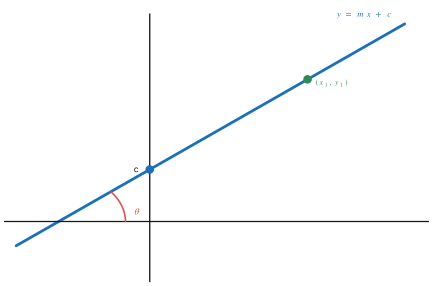
Every straight line in the plane has the equation ax+by+c=0 with a, b not both zero; this is the general form. It can be rewritten in whichever special form the data suggests.
| Form | Equation | Use when you know |
|---|---|---|
| Slope–intercept | y = mx+c | slope and y-intercept |
| Point–slope | y-y_1 = m(x-x_1) | slope and one point |
| Two-point | y-y_1 = \dfrac{y_2-y_1}{x_2-x_1}(x-x_1) | two points |
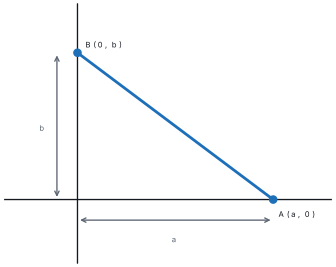
| Intercept | \dfrac{x}{a}+\dfrac{y}{b} = 1 | both intercepts |
| Normal | x\cos\alpha+y\sin\alpha = p | perpendicular from origin |
Here m = \tan\theta, where \theta is the inclination: the angle the line makes with the positive x-axis, measured anticlockwise, 0^{\circ}\le\theta<180^{\circ}.
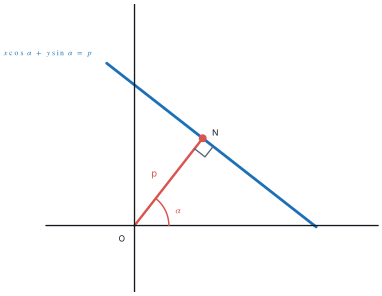
Let ON be the perpendicular from the origin to the line, of length p>0, making an angle \alpha with the positive x-axis. The foot of the perpendicular is
The slope of ON is \tan\alpha, so the line, being perpendicular to ON, has slope -\cot\alpha = -\dfrac{\cos\alpha}{\sin\alpha}. Using point–slope form at N:
Multiply through by \sin\alpha:
To put a general equation into normal form, move the constant to the right so it is positive, then divide by \sqrt{a^{2}+b^{2}}.
Problem. Reduce x+\sqrt{3}\,y-8 = 0 to normal form and state p and \alpha.
Solution. Write it as x+\sqrt{3}y = 8 (right side already positive). Here \sqrt{a^{2}+b^{2}} = \sqrt{1+3} = 2. Dividing by 2:
Comparing with x\cos\alpha+y\sin\alpha = p gives \cos\alpha = \frac12, \sin\alpha = \frac{\sqrt{3}}{2}, so \alpha = 60^{\circ} and p = 4.
Angle between two lines
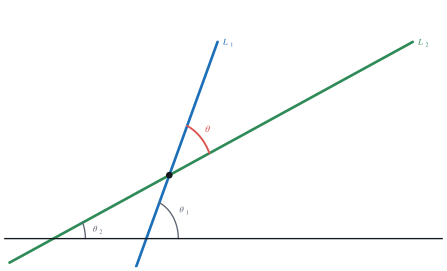
Let the lines have inclinations \theta_1 and \theta_2, so their slopes are m_1 = \tan\theta_1 and m_2 = \tan\theta_2. In the triangle formed with the x-axis, the exterior-angle theorem gives the angle \theta between the lines as
Taking tangents and using the compound-angle formula,
The two lines cut at two supplementary angles; taking the modulus selects the acute one:
- Parallel: \theta = 0, so m_1 = m_2. In general form, \dfrac{a_1}{a_2} = \dfrac{b_1}{b_2}.
- Perpendicular: \theta = 90^{\circ}, so the denominator vanishes: 1+m_1m_2 = 0, i.e. m_1m_2 = -1. In general form, a_1a_2+b_1b_2 = 0.
Problem. Find the acute angle between 3x+y-5=0 and x+2y-3=0.
Solution. Rewrite in slope form: y = -3x+5 gives m_1 = -3; y = -\frac12x+\frac32 gives m_2 = -\frac12.
So \theta = 45^{\circ}.
The perpendicular distance from a point to a line
Let the line meet the axes at A\left(-\dfrac{c}{a},0\right) and B\left(0,-\dfrac{c}{b}\right), and let PM be the perpendicular from P(x_1,y_1) to the line, of length d.
Step 1 — area of \triangle PAB two ways. Using the coordinate formula,
Step 2 — the same area as base \times height. Taking AB as base and PM as height,
Step 3 — equate and solve for d.
The factor \dfrac{|c|}{2|ab|} cancels from both sides, leaving
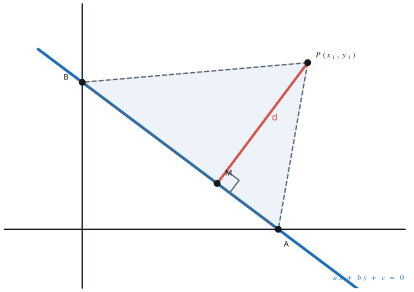
The formula needs the line in the form ax+by+c=0 — everything on one side. For 3x = 4y+7 you must first write 3x-4y-7=0. And the denominator is \sqrt{a^{2}+b^{2}}, never a+b.
Putting (x_1,y_1) = (0,0) gives the distance of the line from the origin:
which is exactly the p of the normal form.
Problem. Find the length of the perpendicular from (3,-5) to the line 3x-4y-26 = 0, and from the origin to 12x-5y+26=0.
Solution. For the first, a=3, b=-4, c=-26 and \sqrt{a^{2}+b^{2}} = \sqrt{9+16} = 5:
For the second, \sqrt{144+25} = 13 and the point is the origin:
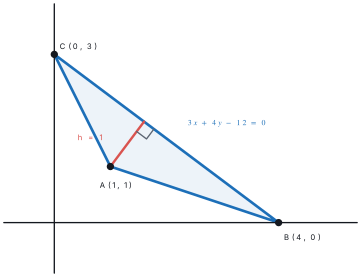
Problem. The vertices of a triangle are A(1,1), B(4,0) and C(0,3). Find the length of the altitude from A to BC, and hence the area of the triangle.
Solution. B and C are the x- and y-intercepts of BC, so the intercept form gives \dfrac{x}{4}+\dfrac{y}{3} = 1, i.e.
The altitude from A is the perpendicular distance from A(1,1) to this line:
The base is BC = \sqrt{(4-0)^{2}+(0-3)^{2}} = \sqrt{16+9} = 5 units, so
Distance between two parallel lines
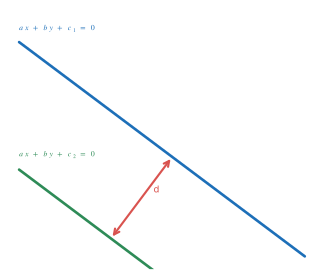
Parallel lines have the same a and b, so write them as ax+by+c_1=0 and ax+by+c_2=0. Take any point on the first, for instance \left(-\frac{c_1}{a},0\right), and find its distance from the second:
3x+4y-9=0 and 6x+8y-15=0 are parallel but you cannot subtract the constants yet. Divide the second by 2 to get 3x+4y-7.5=0; only then is d = \dfrac{|-7.5+9|}{5} = \dfrac{1.5}{5} = 0.3.
Problem. Find the points on the line x+y = 4 that are at a distance of 1 unit from the line 4x+3y-10 = 0.
Solution. Any point on x+y=4 can be written P(t,\,4-t). Its distance from the second line is
Setting this equal to 1 gives |t+2| = 5, so t+2 = 5 or t+2 = -5, i.e. t = 3 or t = -7.
The points are (3,\,1) and (-7,\,11) — one on each side of the line.
Problem. Find the foot of the perpendicular from P(1,2) to the line 3x+4y-1=0, and the image of P in that line.
Solution. The perpendicular from P has slope \frac{4}{3} (the negative reciprocal of -\frac34), so its equation is
Solving 3x+4y = 1 and 4x-3y = -2 simultaneously: multiplying the first by 3 and the second by 4 and adding gives 9x+16x = 3-8, so 25x = -5 and x = -\frac15. Then y = \frac{1-3\left(-\frac15\right)}{4} = \frac{1+\frac35}{4} = \frac25.
Foot M = \left(-\dfrac15,\ \dfrac25\right).
The image P' is such that M is the midpoint of PP', so
Check. The distance from P to the line is \frac{|3+8-1|}{5} = 2, and PM = \sqrt{\left(1+\frac15\right)^{2}+\left(2-\frac25\right)^{2}} = \sqrt{\frac{36}{25}+\frac{64}{25}} = 2 ✓.
11.2 Bisectors of the angles between two straight lines
The pair of bisectors
Two intersecting lines create two pairs of vertically opposite angles, and therefore two bisectors. They are always perpendicular to each other.
A point lies on an angle bisector exactly when it is equidistant from the two arms. So let P(x,y) be a point on a bisector of the angles between
Equating the two perpendicular distances,
Removing the modulus signs introduces a \pm, and the locus splits into the two straight lines
Both pass through the point of intersection of L_1 and L_2, since there both numerators vanish.
First rewrite both equations so that the constant terms c_1 and c_2 are positive. Then:
- The + sign gives the bisector of the angle containing the origin.
- The - sign gives the bisector of the other angle.
- If a_1a_2+b_1b_2 < 0 the origin lies in the acute angle, so the + bisector is the acute-angle bisector. If a_1a_2+b_1b_2 > 0 the origin lies in the obtuse angle and the - bisector is the acute one.
An independent check that never fails: find the angle \theta between one original line and a candidate bisector. If \tan\theta < 1 (i.e. \theta<45^{\circ}) that candidate bisects the acute angle.
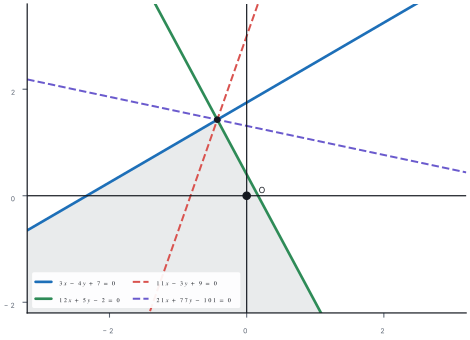
Problem. Find the equations of the bisectors of the angles between 3x-4y+7 = 0 and 12x+5y-2 = 0, and state which bisects the angle containing the origin.
Solution. Here \sqrt{9+16} = 5 and \sqrt{144+25} = 13, so the bisectors are
Cross-multiplying, 13(3x-4y+7) = \pm 5(12x+5y-2), i.e. 39x-52y+91 = \pm(60x+25y-10).
Taking +: 39x-52y+91-60x-25y+10 = 0, giving
Taking -: 39x-52y+91+60x+25y-10 = 0, giving
Which contains the origin? Rewrite both lines with positive constants: 3x-4y+7=0 (already) and -12x-5y+2=0. Now the + combination is
So 11x-3y+9=0 bisects the angle containing the origin, and 21x+77y-101=0 bisects the other.
Check. Their slopes are \frac{11}{3} and -\frac{21}{77} = -\frac{3}{11}; the product is -1, so the two bisectors are perpendicular, as they must be.
Problem. Find the bisectors of the angles between 4x+3y-6 = 0 and 5x+12y+9 = 0, and identify the bisector of the acute angle.
Solution. Make both constants positive: -4x-3y+6 = 0 and 5x+12y+9 = 0. Then \sqrt{16+9} = 5 and \sqrt{25+144} = 13, and the bisectors are
Origin bisector (+): 13(-4x-3y+6) = 5(5x+12y+9), so -52x-39y+78 = 25x+60y+45, giving 77x+99y-33 = 0, i.e.
Other bisector (-): -52x-39y+78 = -25x-60y-45, giving -27x+21y+123 = 0, i.e.
Acute or obtuse? With the positive-constant forms, a_1a_2+b_1b_2 = (-4)(5)+(-3)(12) = -56 < 0, so the origin lies in the acute angle. Hence 7x+9y-3=0 is the acute-angle bisector.
Independent check. The slope of 4x+3y-6=0 is -\frac43 and of 7x+9y-3=0 is -\frac79. Then
Since \frac{3}{11} < 1, the angle is less than 45^{\circ} — it really is the acute bisector ✓.
Problem. Find the locus of a point that moves so that it is equidistant from the lines x+2y-3 = 0 and 2x-y+5 = 0.
Solution. Let the point be P(x,y). Both denominators are \sqrt{1+4} = \sqrt{5}, so the condition is
Hence x+2y-3 = \pm(2x-y+5).
Plus: x+2y-3 = 2x-y+5 \Rightarrow x-3y+8 = 0.
Minus: x+2y-3 = -2x+y-5 \Rightarrow 3x+y+2 = 0.
The locus is the pair of perpendicular bisectors x-3y+8=0 and 3x+y+2=0 (slopes \frac13 and -3, product -1 ✓). Note that the two original lines are themselves perpendicular, so the bisectors make 45^{\circ} with each of them.
The commonest bisector error is forgetting to make c_1 and c_2 positive before choosing the sign. If you only need both bisector equations, the sign arrangement does not matter; it matters only when the question asks which bisector contains the origin or bisects the acute angle.
Chapter summary
- General form ax+by+c=0; slope m = -a/b = \tan\theta where \theta is the inclination. Forms: y=mx+c, y-y_1=m(x-x_1), x/a+y/b=1, x\cos\alpha+y\sin\alpha=p.
- Angle between two lines: \tan\theta = |\dfrac{m_1-m_2}{1+m_1m_2}|; parallel if m_1=m_2, perpendicular if m_1m_2=-1 or a_1a_2+b_1b_2=0.
- Perpendicular distance from (x_1,y_1) to ax+by+c=0: d = \dfrac{|ax_1+by_1+c|}{\sqrt{a^{2}+b^{2}}}; from the origin, d = \dfrac{|c|}{\sqrt{a^{2}+b^{2}}} = p.
- Distance between the parallel lines ax+by+c_1=0 and ax+by+c_2=0 is \dfrac{|c_1-c_2|}{\sqrt{a^{2}+b^{2}}}, after making a and b identical.
- The bisectors of the angles between two lines are \dfrac{a_1x+b_1y+c_1}{\sqrt{a_1^{2}+b_1^{2}}} = \pm\dfrac{a_2x+b_2y+c_2}{\sqrt{a_2^{2}+b_2^{2}}}, and they are perpendicular to each other.
- With c_1,c_2>0: the + sign gives the bisector of the angle containing the origin; that angle is acute when a_1a_2+b_1b_2<0.
- A bisector can always be identified by testing whether \tan\theta<1 for the angle it makes with one of the original lines.
Practice questions
Group A — Multiple choice (1 mark each)
- The distance of the point (1,2) from the line 3x+4y-5 = 0 is [1]a\frac{6}{5}b\frac{5}{6}c6d\frac{6}{7}
- The lines 2x+3y-1=0 and 3x-2y+5=0 are [1]aparallelbperpendicularccoincidentdinclined at 45^{\circ}
- The perpendicular distance of the line 4x-3y+10=0 from the origin is [1]a10b2c\frac{10}{7}d5
- The number of bisectors of the angles between two intersecting lines is [1]a1b2c3dinfinitely many
- In the normal form x\cos\alpha+y\sin\alpha = p, the quantity p is always [1]anegativebzerocpositivedequal to the slope
- The two bisectors of the angles between two lines always [1]aare parallelbare perpendicularcpass through the origindcoincide
Answers to Group A
1. (a) — \frac{|3+8-5|}{\sqrt{9+16}} = \frac{6}{5}.
2. (b) — a_1a_2+b_1b_2 = 6-6 = 0.
3. (b) — \frac{|10|}{\sqrt{16+9}} = 2.
4. (b) — one for each pair of vertically opposite angles.
5. (c) — p is a length, taken positive by definition.
6. (b) — the two bisected angles are supplementary, so the bisectors differ by 90^{\circ}.
Group B — Short answer (5 marks each)
- Derive the formula for the length of the perpendicular from the point (x_1,y_1) to the line ax+by+c=0. [5]
- Find the distance between the parallel lines 4x-3y+5 = 0 and 8x-6y-13 = 0. [5]
- Find the length of the perpendicular drawn from the point (4,1) to the line joining (2,-1) and (6,5). [5]
- Find the equations of the bisectors of the angles between x+2y-11=0 and 3x-6y-5=0. [5]
- Reduce \sqrt{3}\,x+y-10 = 0 to the normal form and hence find the length of the perpendicular from the origin and its inclination. [5]
Answers to Group B
1. Let the line meet the axes at A\left(-\frac{c}{a},0\right) and B\left(0,-\frac{c}{b}\right) and let d be the length of the perpendicular PM. The coordinate formula gives \text{area}(\triangle PAB) = \frac12|\frac{c}{ab}||ax_1+by_1+c|, while \text{area} = \frac12 AB\cdot d with AB = \frac{|c|\sqrt{a^{2}+b^{2}}}{|ab|}. Equating and cancelling \frac{|c|}{2|ab|} gives d = \dfrac{|ax_1+by_1+c|}{\sqrt{a^{2}+b^{2}}}.
2. Divide the second equation by 2: 4x-3y-6.5 = 0. Now the coefficients match, and \sqrt{16+9} = 5, so d = \dfrac{|5-(-6.5)|}{5} = \dfrac{11.5}{5} = 2.3 units.
3. The line through (2,-1) and (6,5) has slope \frac{5+1}{6-2} = \frac32, so y+1 = \frac32(x-2), i.e. 3x-2y-8 = 0. Then d = \dfrac{|3(4)-2(1)-8|}{\sqrt{9+4}} = \dfrac{2}{\sqrt{13}} units \approx 0.555 units.
4. \sqrt{1+4} = \sqrt{5} and \sqrt{9+36} = \sqrt{45} = 3\sqrt{5}. The bisectors are \dfrac{x+2y-11}{\sqrt{5}} = \pm\dfrac{3x-6y-5}{3\sqrt{5}}, i.e. 3(x+2y-11) = \pm(3x-6y-5). Plus: 3x+6y-33 = 3x-6y-5 \Rightarrow 12y = 28 \Rightarrow y = \frac73, i.e. 3y-7 = 0. Minus: 3x+6y-33 = -3x+6y+5 \Rightarrow 6x = 38 \Rightarrow 3x-19 = 0. The bisectors are 3y-7=0 and 3x-19=0 — a horizontal and a vertical line, so perpendicular ✓.
5. \sqrt{3}x+y = 10 with \sqrt{3+1} = 2. Dividing by 2: \frac{\sqrt{3}}{2}x+\frac12 y = 5. Comparing with x\cos\alpha+y\sin\alpha = p, \cos\alpha = \frac{\sqrt{3}}{2} and \sin\alpha = \frac12, so \alpha = 30^{\circ} and p = 5 units.
Group C — Long answer (8 marks each)
- (a) Derive the equations of the bisectors of the angles between the lines a_1x+b_1y+c_1 = 0 and a_2x+b_2y+c_2 = 0. [4](b) Hence find the bisectors of the angles between 3x+4y+7 = 0 and 12x-5y-8 = 0, and identify the one that bisects the angle containing the origin. [4]
- The vertices of a triangle are A(2,1), B(8,1) and C(2,9).(a) Find the equation of BC. [3](b) Find the length of the perpendicular from A to BC and hence the area of the triangle. [5]
Answers to Group C
1. (a) A point P(x,y) lies on a bisector precisely when it is equidistant from the two lines, so \dfrac{|a_1x+b_1y+c_1|}{\sqrt{a_1^{2}+b_1^{2}}} = \dfrac{|a_2x+b_2y+c_2|}{\sqrt{a_2^{2}+b_2^{2}}}. Dropping the modulus signs gives the \pm, so the locus is the pair of lines \dfrac{a_1x+b_1y+c_1}{\sqrt{a_1^{2}+b_1^{2}}} = \pm\dfrac{a_2x+b_2y+c_2}{\sqrt{a_2^{2}+b_2^{2}}}. Both pass through the intersection of the given lines.
(b) \sqrt{9+16} = 5, \sqrt{144+25} = 13, so \dfrac{3x+4y+7}{5} = \pm\dfrac{12x-5y-8}{13}, i.e. 13(3x+4y+7) = \pm 5(12x-5y-8). Plus: 39x+52y+91 = 60x-25y-40 \Rightarrow 21x-77y-131 = 0. Minus: 39x+52y+91 = -60x+25y+40 \Rightarrow 99x+27y+51 = 0 \Rightarrow 33x+9y+17 = 0. For the origin: with positive constants the lines are 3x+4y+7=0 and -12x+5y+8=0, and the + combination gives 13(3x+4y+7) = 5(-12x+5y+8), i.e. 39x+52y+91 = -60x+25y+40, which is 99x+27y+51 = 0, i.e. 33x+9y+17 = 0. So 33x+9y+17=0 bisects the angle containing the origin. (Slopes \frac{21}{77} = \frac{3}{11} and -\frac{33}{9} = -\frac{11}{3}; their product is -1 ✓.)
2. (a) B(8,1) and C(2,9) give slope \dfrac{9-1}{2-8} = -\dfrac{8}{6} = -\dfrac43. Using point–slope at B: y-1 = -\frac43(x-8), so 3y-3 = -4x+32, i.e.
(b) The perpendicular from A(2,1) has length d = \dfrac{|4(2)+3(1)-35|}{\sqrt{16+9}} = \dfrac{|-24|}{5} = 4.8 units. BC = \sqrt{(2-8)^{2}+(9-1)^{2}} = \sqrt{36+64} = 10 units, so \text{area} = \frac12\times 10\times 4.8 = 24 square units. Check with the determinant formula: \frac12|2(1-9)+8(9-1)+2(1-1)| = \frac12|-16+64| = 24 ✓.
Practise more: Mathematics question bank