Unit 20 · Computational Methods OR Mechanics · 12 teaching hours · 31 min read
Computational Methods
What the syllabus asks for 4
- Roots of algebraic and transcendental equations: bisection method
- Roots by Newton-Raphson method
- Numerical integration: trapezoidal rule
- Numerical integration: Simpson's rule
Most equations you meet outside the textbook cannot be solved by a formula, and most integrals cannot be evaluated by anti-differentiation. Computational methods give up on exact answers and instead build a sequence of numbers that closes in on the true value, stopping when the answer is accurate enough for the job. This unit is the first place in your course where "accurate enough" is made precise. Note that the CDC syllabus offers Mechanics (Unit 21) as the alternative to this unit for the same 12 hours; you study one of the two, and Mechanics is covered in the next chapter.
Four things, and they repeat almost unchanged every year: bisect an interval to find a root to a stated number of decimal places, run Newton-Raphson for three or four iterations from a given starting value, apply the trapezoidal rule with a given number of sub-intervals, and apply Simpson's rule to the same kind of integral. Set the work out as a table. Marks are awarded for the ordinate table and for the substitution into the formula, not only for the final number. Keep at least six decimal places in the working and round only at the very end.
20.1 Roots of algebraic and transcendental equations: bisection method
An algebraic equation is one built from powers of x, such as x^{3}-x-1=0. A transcendental equation involves trigonometric, exponential or logarithmic functions, such as \cos x = x or xe^{x} = 1. A number \alpha with f(\alpha)=0 is a root of f(x)=0. Beyond the quadratic (and the rarely used cubic) formula there is no algebraic recipe for the roots, so we locate them numerically.
Locating a root
Every method starts by trapping the root inside an interval.
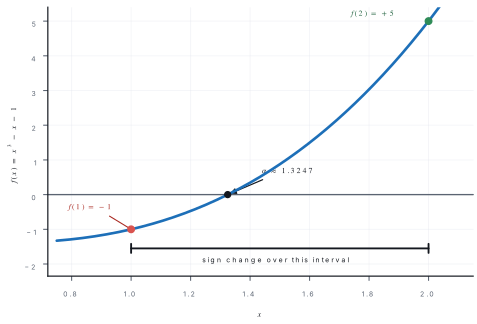
If f is continuous on [a,b] and f(a) and f(b) have opposite signs — that is, f(a)\cdot f(b) < 0 — then f(x)=0 has at least one root between a and b.
To find such an interval, tabulate f at convenient integers and look for a change of sign. For f(x) = x^{3}-x-1:
| x | 0 | 1 | 2 |
|---|---|---|---|
| f(x) | -1 | -1 | +5 |
The sign changes between x=1 and x=2, so a root lies in [1,2].
The method
Given [a,b] with f(a)\,f(b)<0, repeat:
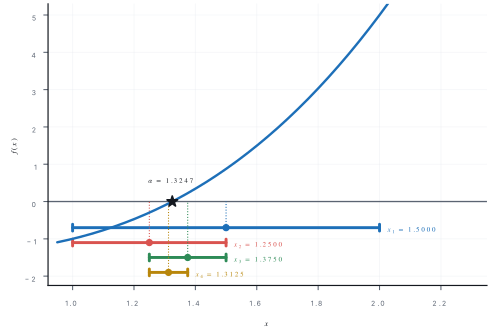
- Compute the midpoint c = \frac{a+b}{2} and the value f(c).
- If f(c) = 0, then c is the root — stop.
- If f(a)\,f(c) < 0, the root lies in [a,c]: replace b by c. Otherwise the root lies in [c,b]: replace a by c.
Each pass halves the interval containing the root.
Because the root always stays inside the current interval, the midpoint after n steps differs from the true root by at most half the current interval width:
This is the great virtue of bisection — it cannot fail, and it tells you in advance how many steps you need. To guarantee an error below \varepsilon, solve
Problem. Find a root of x^{3}-x-1=0 correct to three decimal places by the bisection method.
Solution. Let f(x) = x^{3}-x-1. Since f(1) = -1 < 0 and f(2) = 5 > 0, a root lies in [1,2]. To be sure of three decimal places we need the error below 0.0005; since \frac{1}{2^{n}} < 0.0005 needs n > \frac{\ln 2000}{\ln 2} = 10.97, eleven iterations will certainly do. Tabulating:
| n | a | b | c=\frac{a+b}{2} | f(c) | sign | error bound |
|---|---|---|---|---|---|---|
| 1 | 1.000000 | 2.000000 | 1.500000 | +0.875000 | + | 0.500000 |
| 2 | 1.000000 | 1.500000 | 1.250000 | -0.296875 | - | 0.250000 |
| 3 | 1.250000 | 1.500000 | 1.375000 | +0.224609 | + | 0.125000 |
| 4 | 1.250000 | 1.375000 | 1.312500 | -0.051514 | - | 0.062500 |
| 5 | 1.312500 | 1.375000 | 1.343750 | +0.082611 | + | 0.031250 |
| 6 | 1.312500 | 1.343750 | 1.328125 | +0.014576 | + | 0.015625 |
| 7 | 1.312500 | 1.328125 | 1.320313 | -0.018711 | - | 0.007813 |
| 8 | 1.320313 | 1.328125 | 1.324219 | -0.002128 | - | 0.003906 |
| 9 | 1.324219 | 1.328125 | 1.326172 | +0.006209 | + | 0.001953 |
| 10 | 1.324219 | 1.326172 | 1.325195 | +0.002037 | + | 0.000977 |
| 11 | 1.324219 | 1.325195 | 1.324707 | -0.000047 | - | 0.000488 |
The last error bound is 0.000488 < 0.0005, so the root is
The true root is 1.3247180, so the actual error is about 0.00001 — better than the guarantee, as usually happens.
Problem. Find the root of x^{3}-2x-5=0 lying between 2 and 3, correct to two decimal places.
Solution. f(2) = 8-4-5 = -1 < 0 and f(3) = 27-6-5 = 16 > 0, so the root is in [2,3]. For two decimal places we need the error below 0.005, and \frac{1}{2^{n}} < 0.005 needs n > 7.6, so eight iterations suffice.
| n | a | b | c | f(c) | error bound |
|---|---|---|---|---|---|
| 1 | 2.000000 | 3.000000 | 2.500000 | +5.625000 | 0.500000 |
| 2 | 2.000000 | 2.500000 | 2.250000 | +1.890625 | 0.250000 |
| 3 | 2.000000 | 2.250000 | 2.125000 | +0.345703 | 0.125000 |
| 4 | 2.000000 | 2.125000 | 2.062500 | -0.351318 | 0.062500 |
| 5 | 2.062500 | 2.125000 | 2.093750 | -0.008942 | 0.031250 |
| 6 | 2.093750 | 2.125000 | 2.109375 | +0.166836 | 0.015625 |
| 7 | 2.093750 | 2.109375 | 2.101563 | +0.078562 | 0.007813 |
| 8 | 2.093750 | 2.101563 | 2.097656 | +0.034714 | 0.003906 |
Hence \alpha \approx 2.10 to two decimal places. (The true root is 2.0945515; continuing to eleven iterations would give 2.095 to three places.)
Problem. Solve \cos x = x (with x in radians) correct to two decimal places, by bisection.
Solution. Write it as f(x) = \cos x - x = 0. Then f(0) = 1 > 0 and f(1) = \cos 1 - 1 = 0.5403 - 1 = -0.4597 < 0, so a root lies in [0,1].
| n | a | b | c | f(c) = \cos c - c | error bound |
|---|---|---|---|---|---|
| 1 | 0.000000 | 1.000000 | 0.500000 | +0.377583 | 0.500000 |
| 2 | 0.500000 | 1.000000 | 0.750000 | -0.018311 | 0.250000 |
| 3 | 0.500000 | 0.750000 | 0.625000 | +0.185963 | 0.125000 |
| 4 | 0.625000 | 0.750000 | 0.687500 | +0.085335 | 0.062500 |
| 5 | 0.687500 | 0.750000 | 0.718750 | +0.033879 | 0.031250 |
| 6 | 0.718750 | 0.750000 | 0.734375 | +0.007875 | 0.015625 |
| 7 | 0.734375 | 0.750000 | 0.742188 | -0.005196 | 0.007813 |
| 8 | 0.734375 | 0.742188 | 0.738281 | +0.001345 | 0.003906 |
So \alpha \approx 0.74 to two decimal places (the true value is 0.7390851).
In every calculus and numerical-methods question the trigonometric functions take radians. If your calculator is in degree mode, \cos 0.5 reads as 0.99996 instead of 0.87758 and every row of the table is wrong. Check the mode before you begin, and sanity-check with \cos 1 = 0.5403.
20.2 Roots by Newton-Raphson method
Bisection is safe but slow: each step buys only one bit of accuracy. Newton-Raphson uses the gradient as well as the value of f, and converges dramatically faster.
Let x_{n} be an approximation to the root and let h be the correction needed, so that f(x_{n}+h) = 0. Expanding by Taylor's theorem and keeping only the first two terms (valid when h is small),
so the improved approximation x_{n+1} = x_{n}+h is
Geometrically, x_{n+1} is the point where the tangent to y=f(x) at (x_{n}, f(x_{n})) meets the x-axis. Replacing the curve by its tangent is a good approximation near the root, so each new point lands much closer than the last.
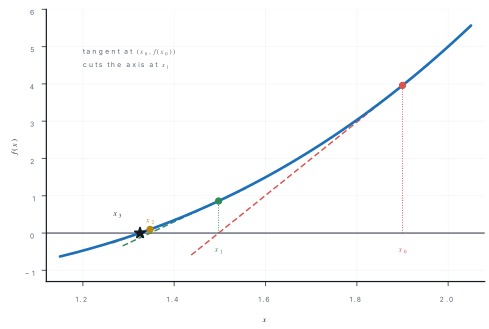
Problem. Use the Newton-Raphson method to find a root of x^{3}-x-1=0 correct to five decimal places, taking x_{0} = 1.5.
Solution. Here f(x) = x^{3}-x-1 and f'(x) = 3x^{2}-1, so the iteration is
| n | x_{n} | f(x_{n}) | f'(x_{n}) | x_{n+1} |
|---|---|---|---|---|
| 0 | 1.50000000 | +0.87500000 | 5.75000000 | 1.34782609 |
| 1 | 1.34782609 | +0.10068217 | 4.44990548 | 1.32520040 |
| 2 | 1.32520040 | +0.00205836 | 4.26846829 | 1.32471817 |
| 3 | 1.32471817 | +0.00000092 | 4.26463472 | 1.32471796 |
Two successive values agree to five decimal places, so
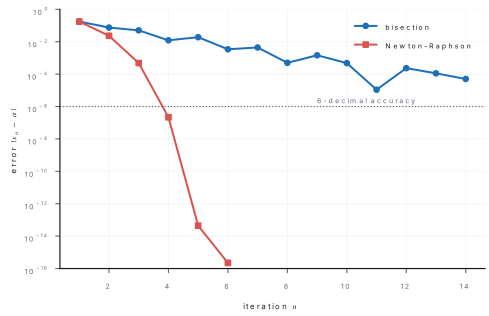
Compare with Worked example 20.1: bisection needed eleven steps for three decimal places; Newton-Raphson has produced eight correct places in four.
Algebra first saves arithmetic. For f(x) = x^{3}-x-1,
which is one keystroke sequence per row instead of three.
Newton-Raphson for roots and reciprocals
Setting f(x) = x^{2}-N gives x_{n+1} = \frac{1}{2}\left(x_{n}+\frac{N}{x_{n}}\right), the classical square-root algorithm; f(x) = x^{3}-N gives x_{n+1} = \frac{1}{3}\left(2x_{n}+\frac{N}{x_{n}^{2}}\right). These are how calculators actually compute roots.
Problem. Compute \sqrt{13} correct to six decimal places, taking x_{0}=3.5.
Solution. Let f(x) = x^{2}-13, so f'(x) = 2x and
| n | x_{n} | f(x_{n}) = x_n^2-13 | x_{n+1} |
|---|---|---|---|
| 0 | 3.50000000 | -0.75000000 | 3.60714286 |
| 1 | 3.60714286 | +0.01147959 | 3.60555163 |
| 2 | 3.60555163 | +0.00000253 | 3.60555128 |
Hence \sqrt{13} \approx 3.605551 to six decimal places.
Problem. Find \sqrt[3]{30} correct to five decimal places, taking x_{0} = 3.
Solution. Let f(x) = x^{3}-30, f'(x) = 3x^{2}:
| n | x_{n} | f(x_{n}) | f'(x_{n}) | x_{n+1} |
|---|---|---|---|---|
| 0 | 3.00000000 | -3.00000000 | 27.00000000 | 3.11111111 |
| 1 | 3.11111111 | +0.11248285 | 29.03703704 | 3.10723734 |
| 2 | 3.10723734 | +0.00014000 | 28.96477165 | 3.10723251 |
So \sqrt[3]{30} \approx 3.10723. Check: 3.10723^{3} = 29.99999.
Problem. Find the root of \cos x = x correct to six decimal places by the Newton-Raphson method, taking x_{0} = \frac{\pi}{4} = 0.7854 radians.
Solution. With f(x) = \cos x - x we get f'(x) = -\sin x - 1, so
| n | x_{n} | f(x_{n}) | f'(x_{n}) | x_{n+1} |
|---|---|---|---|---|
| 0 | 0.78540000 | -0.07829452 | -1.70710808 | 0.73953617 |
| 1 | 0.73953617 | -0.00075493 | -1.67394531 | 0.73908518 |
| 2 | 0.73908518 | -0.00000008 | -1.67361206 | 0.73908513 |
Hence \alpha \approx 0.739085. Bisection in Worked example 20.3 needed eight iterations to reach two decimal places; here three iterations give eight.
Problem. Solve x\log_{10}x = 1.2 correct to four decimal places, taking x_{0} = 2.5.
Solution. Let f(x) = x\log_{10}x - 1.2. Since \log_{10}x = \frac{\ln x}{\ln 10}, the product rule gives
| n | x_{n} | f(x_{n}) | f'(x_{n}) | x_{n+1} |
|---|---|---|---|---|
| 0 | 2.50000000 | -0.20514998 | 0.83223449 | 2.74650502 |
| 1 | 2.74650502 | +0.00511256 | 0.87307488 | 2.74064921 |
| 2 | 2.74064921 | +0.00000271 | 0.87214793 | 2.74064610 |
Hence x \approx 2.7406 to four decimal places.
How fast, and when it fails
Newton-Raphson converges quadratically: near a simple root the error is roughly squared at each step, so the number of correct decimal places doubles every iteration. That is why three or four rows are normally enough, and why you should carry eight decimals in the working.
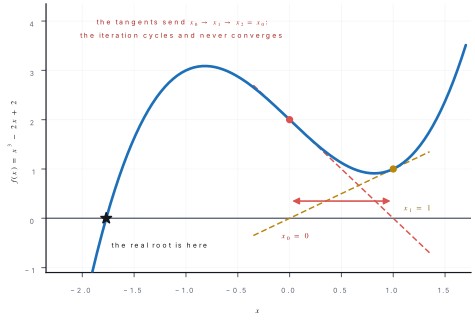
The price of the speed is that Newton-Raphson can fail. It breaks down if f'(x_{n}) = 0 (the tangent is horizontal and never meets the axis), it can be thrown far away if the starting value is poor, and it can fall into a cycle.
| Bisection | Newton-Raphson | |
|---|---|---|
| Needs | an interval with a sign change | one starting value and f'(x) |
| Always converges? | yes | no |
| Speed | slow (linear) | fast (quadratic) |
| Error known in advance? | yes, \frac{b-a}{2^{n}} | no |
| Stop when | interval < tolerance | two successive values agree |
Take x_{0} to be the end of the bracketing interval at which f and f'' have the same sign — in practice, the end where the curve is steeper. A common exam instruction is simply "take x_{0} = 1.5"; use what you are given. If two successive iterates start moving apart, stop and restart from a better x_{0}.
20.3 Numerical integration: trapezoidal rule
When an integrand has no elementary anti-derivative — \sqrt{1+x^{3}}, e^{-x^{2}}, \frac{\sin x}{x} — or when f is known only as a table of measured values, we approximate the area directly.
Divide [a,b] into n equal strips of width h = \frac{b-a}{n} with ordinates
The trapezoidal rule replaces the curve over each strip by the chord joining its two endpoints, so each strip becomes a trapezium of area \frac{h}{2}(y_{r}+y_{r+1}). Adding all n of them, every interior ordinate is counted twice.
"half the width times (first + last + twice all the rest)". Any number of strips n \ge 1 may be used.
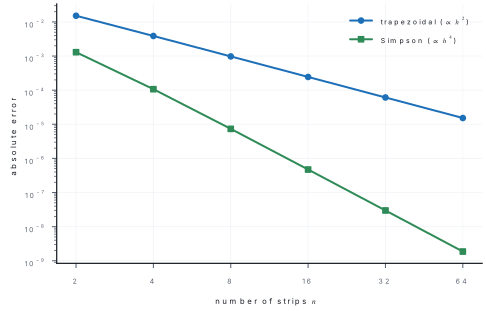
Error bound: |E_{T}| \le \frac{(b-a)h^{2}}{12}\,M_{2}, where M_{2} is the greatest value of |f''(x)| on [a,b]. The error is proportional to h^{2}, so halving h divides the error by about four.
Problem. Evaluate \int_{1}^{2}\frac{dx}{x} by the trapezoidal rule with five sub-intervals, correct to six decimal places, and estimate the error.
Solution. Here a=1, b=2, n=5, so h = \frac{2-1}{5} = 0.2.
| r | x_{r} | y_{r} = 1/x_{r} | end / interior |
|---|---|---|---|
| 0 | 1.0 | 1.000000 | end |
| 1 | 1.2 | 0.833333 | interior |
| 2 | 1.4 | 0.714286 | interior |
| 3 | 1.6 | 0.625000 | interior |
| 4 | 1.8 | 0.555556 | interior |
| 5 | 2.0 | 0.500000 | end |
Ends: y_{0}+y_{5} = 1.500000. Interiors: y_{1}+y_{2}+y_{3}+y_{4} = 2.728175. Therefore
Error estimate. f(x) = x^{-1} gives f''(x) = \frac{2}{x^{3}}, whose greatest value on [1,2] is M_{2} = 2 (at x=1). So
The exact value is \ln 2 = 0.693147, so the actual error is 0.002488 — comfortably inside the bound, as it must be.
Problem. Use the trapezoidal rule with six sub-intervals to evaluate \int_{0}^{1}\frac{dx}{1+x^{2}} to six decimal places, and compare with the exact value.
Solution. h = \frac{1-0}{6} = \frac{1}{6} = 0.166667.
| r | x_{r} | y_{r} = \frac{1}{1+x_{r}^{2}} |
|---|---|---|
| 0 | 0.000000 | 1.000000 |
| 1 | 0.166667 | 0.972973 |
| 2 | 0.333333 | 0.900000 |
| 3 | 0.500000 | 0.800000 |
| 4 | 0.666667 | 0.692308 |
| 5 | 0.833333 | 0.590164 |
| 6 | 1.000000 | 0.500000 |
Ends: 1.500000. Interiors: 0.972973+0.900000+0.800000+0.692308+0.590164 = 3.955445. Hence
The exact value is \left[\tan^{-1}x\right]_{0}^{1} = \frac{\pi}{4} = 0.785398, so the error is 0.001157.
For a curve that is concave up (like y = 1/x) every chord lies above the curve, so the trapezoidal rule always overestimates the integral. For a concave-down curve it always underestimates. Do not expect errors to cancel — they accumulate in one direction, which is exactly why Simpson's rule is worth the extra work.
20.4 Numerical integration: Simpson's rule
Instead of joining the endpoints of each strip by a straight line, Simpson's rule fits a parabola through three consecutive points. A parabola bends, so it tracks a curve far better than a chord does.
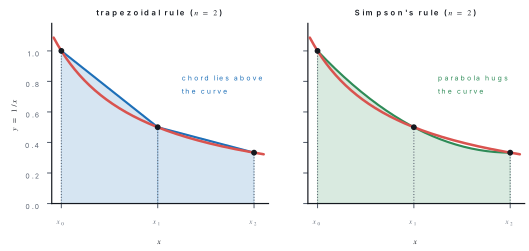
Because three points are needed for one parabola, the strips are consumed in pairs, so n must be even. Over the pair [x_{0},x_{2}] the area under the fitted parabola works out to \frac{h}{3}(y_{0}+4y_{1}+y_{2}); adding all such pairs gives the alternating pattern of coefficients 4,2,4,2,\ldots,4.
For an even number n of sub-intervals of width h = \frac{b-a}{n},
"one third of the width times (first + last + 4 times the odd ordinates + 2 times the even ordinates)".
Error bound: |E_{S}| \le \frac{(b-a)h^{4}}{180}\,M_{4}, where M_{4} is the greatest value of |f^{(4)}(x)| on [a,b]. The error goes like h^{4}, so halving h divides it by about sixteen.
| Ordinate | y_0 | y_1 | y_2 | y_3 | y_4 | ... | y_n |
|---|---|---|---|---|---|---|---|
| Coefficient | 1 | 4 | 2 | 4 | 2 | ... | 1 |
Odd subscript \to 4, even subscript \to 2, with the two end ordinates always 1. Check your coefficients add to 3n before multiplying: for n=4 they are 1+4+2+4+1 = 12 = 3\times 4.
Problem. Evaluate \int_{1}^{2}\frac{dx}{x} by Simpson's rule with four sub-intervals, estimate the error, and hence give a value of \ln 2.
Solution. h = \frac{2-1}{4} = 0.25.
| r | x_{r} | y_{r}=1/x_{r} | coefficient |
|---|---|---|---|
| 0 | 1.00 | 1.000000 | 1 |
| 1 | 1.25 | 0.800000 | 4 |
| 2 | 1.50 | 0.666667 | 2 |
| 3 | 1.75 | 0.571429 | 4 |
| 4 | 2.00 | 0.500000 | 1 |
Ends: y_{0}+y_{4} = 1.500000. Odd: y_{1}+y_{3} = 1.371429. Even: y_{2} = 0.666667. Therefore
Error estimate. f(x) = x^{-1} gives f^{(4)}(x) = \frac{24}{x^{5}}, so M_{4} = 24 at x = 1 and
So \ln 2 \approx 0.6933, correct to three decimal places (the true value is 0.693147, an actual error of only 0.000107). The trapezoidal rule in Worked example 20.9 used more ordinates and was twenty times less accurate.
Problem. Use Simpson's rule with six sub-intervals on \int_{0}^{1}\frac{dx}{1+x^{2}} to estimate \pi correct to five decimal places.
Solution. Take the ordinate table from Worked example 20.10, with h = 0.166667.
| r | x_{r} | y_{r} | coefficient |
|---|---|---|---|
| 0 | 0.000000 | 1.000000 | 1 |
| 1 | 0.166667 | 0.972973 | 4 |
| 2 | 0.333333 | 0.900000 | 2 |
| 3 | 0.500000 | 0.800000 | 4 |
| 4 | 0.666667 | 0.692308 | 2 |
| 5 | 0.833333 | 0.590164 | 4 |
| 6 | 1.000000 | 0.500000 | 1 |
Ends: 1.500000. Odd: 0.972973+0.800000+0.590164 = 2.363137. Even: 0.900000+0.692308 = 1.592308.
Since \int_{0}^{1}\frac{dx}{1+x^{2}} = \frac{\pi}{4},
which is correct to all five decimal places shown.
Problem. Evaluate \int_{0}^{\pi/2}\sin x\,dx by (a) the trapezoidal rule and (b) Simpson's rule, each with four sub-intervals, and compare with the exact value.
Solution. h = \frac{\pi/2 - 0}{4} = \frac{\pi}{8} = 0.392699 radians.
| r | x_{r} | y_{r} = \sin x_{r} |
|---|---|---|
| 0 | 0.000000 | 0.000000 |
| 1 | 0.392699 | 0.382683 |
| 2 | 0.785398 | 0.707107 |
| 3 | 1.178097 | 0.923880 |
| 4 | 1.570796 | 1.000000 |
(a) Ends = 1.000000; interiors = 0.382683+0.707107+0.923880 = 2.013670:
(b) Odd = 0.382683+0.923880 = 1.306563; even = 0.707107:
The exact value is \left[-\cos x\right]_{0}^{\pi/2} = 1. The trapezoidal error is 0.012884; Simpson's error is 0.000135, about a hundred times smaller from the same five ordinates.
Problem. Evaluate \int_{0}^{6}\frac{dx}{1+x} using Simpson's three-eighths rule with six sub-intervals.
Solution. When n is a multiple of three, fitting a cubic through four points at a time gives
Here h = \frac{6-0}{6} = 1.
| r | x_{r} | y_{r} = \frac{1}{1+x_{r}} | coefficient |
|---|---|---|---|
| 0 | 0 | 1.000000 | 1 |
| 1 | 1 | 0.500000 | 3 |
| 2 | 2 | 0.333333 | 3 |
| 3 | 3 | 0.250000 | 2 |
| 4 | 4 | 0.200000 | 3 |
| 5 | 5 | 0.166667 | 3 |
| 6 | 6 | 0.142857 | 1 |
The exact value is \ln 7 = 1.945910. (For comparison, the one-third rule on the same ordinates gives 1.958730 and the trapezoidal rule gives 2.021429: with a strip width as coarse as h=1, none of them is very accurate.)
| Trapezoidal rule | Simpson's one-third rule | |
|---|---|---|
| Curve replaced by | straight chords | parabolic arcs |
| Restriction on n | none | must be even |
| Coefficients | 1,2,2,\ldots,2,1 | 1,4,2,4,\ldots,4,1 |
| Multiplier | \frac{h}{2} | \frac{h}{3} |
| Error | \propto h^{2} | \propto h^{4} |
| Exact for | linear f | cubic f and below |
Set out an ordinate table with a coefficient column every time, even when you can see the answer. Write h, the ordinates to six decimals, the three sub-totals (ends, odds, evens) and only then the substitution. If you slip on one ordinate you still earn the method marks. A last check: all coefficients in Simpson's rule sum to 3n, and in the trapezoidal rule to 2n.
20.5 Extension: linear programming by the graphical method
Optimising a linear quantity subject to linear constraints is the other classical computational method of school mathematics, and it uses the same "compute, tabulate, compare" discipline. A linear programming problem asks you to maximise or minimise an objective function Z = ax+by subject to linear inequalities called constraints, together with the non-negativity conditions x \ge 0, y \ge 0.
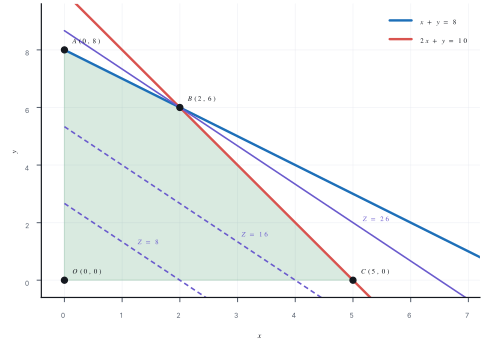
Each inequality shades a half-plane; their intersection is the feasible region. Because Z is linear, its level curves ax+by = k form a family of parallel lines, and sliding that line across the feasible region shows that the optimum is always reached at a corner point (vertex) of the region. So the method is: draw the region, find its vertices, evaluate Z at each, and pick the best.
Problem. Maximise Z = 4x+3y subject to x+y \le 8, 2x+y \le 10, x \ge 0, y \ge 0.
Solution. Draw the boundary lines. x+y=8 passes through (8,0) and (0,8); 2x+y=10 passes through (5,0) and (0,10). Testing the origin in each inequality gives 0 \le 8 and 0 \le 10, both true, so the feasible region is the side of each line containing the origin.
The two lines meet where x+y=8 and 2x+y=10; subtracting, x=2, so y=6. The vertices of the region are O(0,0), C(5,0), B(2,6) and A(0,8). Evaluate the objective function at each:
| Vertex | (x,y) | Z = 4x+3y |
|---|---|---|
| O | (0,0) | 0 |
| C | (5,0) | 20 |
| B | (2,6) | \mathbf{26} |
| A | (0,8) | 24 |
The maximum is Z = 26, attained at x = 2, y = 6.
Chapter summary
- A root of f(x)=0 is bracketed whenever f(a) \,f(b) < 0 and f is continuous on [a,b].
- Bisection: repeatedly take c = \frac{a+b}{2} and keep the half in which the sign change lies. It always converges, and |x_{n}-\alpha| \le \frac{b-a}{2^{n}}, so n > \frac{\ln((b-a)/\varepsilon)}{\ln 2} iterations guarantee accuracy \varepsilon.
- Newton-Raphson: x_{n+1} = x_{n} - \frac{f(x_{n})}{f'(x_{n})}, obtained by replacing the curve with its tangent. Convergence is quadratic (correct digits double each step) but is not guaranteed; it fails when f'(x_{n}) is zero or the start is poor.
- Special cases: x_{n+1} = \frac12\left(x_{n}+\frac{N}{x_{n}}\right) for \sqrt{N}, and x_{n+1} = \frac{1}{3}\left(2x_{n}+\frac{N}{x_{n}^{2}}\right) for \sqrt[3]{N}.
- Trapezoidal rule with h = \frac{b-a}{n}: \int_{a}^{b}f\,dx \approx \frac{h}{2}\left[(y_{0}+y_{n})+2(y_{1}+\cdots+y_{n-1})\right], with |E_{T}| \le \frac{(b-a)h^{2}}{12}M_{2}. Any n is allowed.
- Simpson's one-third rule (n even): \int_{a}^{b}f\,dx \approx \frac{h}{3}\left[(y_{0}+y_{n})+4(\text{odd }y)+2(\text{even }y)\right], with |E_{S}| \le \frac{(b-a)h^{4}}{180}M_{4}. Simpson's three-eighths rule uses \frac{3h}{8} with coefficients 1,3,3,2,3,3,\ldots,1 and needs n a multiple of three.
- Simpson's rule is exact for any cubic; the trapezoidal rule is exact only for a straight line and always errs to the same side of a curve of fixed concavity.
- In a linear programming problem the optimum of Z = ax+by occurs at a corner of the feasible region, so evaluate Z at every vertex and compare.
- Round only at the end, keep six decimals throughout, and always state the accuracy claimed and the error estimate when the question asks for one.
Practice questions
Group A — Multiple choice (1 mark each)
- The bisection method can be started on [a,b] only if [1]af(a) = fb (b) f(a)\,f(b) < 0cf(a)\,f(b) > 0df'(a)=0
- After n bisections of [a,b] the error in the midpoint is at most [1]a\frac{b-a}{n}b\frac{b-a}{2n}c\frac{b-a}{2^{n}}d\frac{b-a}{n^{2}}
- The Newton-Raphson iteration formula is [1]ax_{n+1}=x_{n}+\frac{f(x_{n})}{f'(x_{n})}bx_{n+1}=x_{n}-\frac{f(x_{n})}{f'(x_{n})}cx_{n+1}=x_{n}-\frac{f'(x_{n})}{f(x_{n})}dx_{n+1}=\frac{x_{n}}{f'(x_{n})}
- Newton-Raphson fails at x_{n} when [1]af(x_{n})=0bf'(x_{n})=0cx_{n}>0df''(x_{n})=0
- In Simpson's one-third rule the number of sub-intervals must be [1]aoddbevenca multiple of 3da prime
- In the trapezoidal rule the multiplier outside the bracket is [1]ahb\frac{h}{2}c\frac{h}{3}d\frac{3h}{8}
- Simpson's one-third rule integrates exactly every polynomial of degree at most [1]a1b2c3d4
- Which equation is transcendental? [1]ax^{5}-3x+1=0b2x^{2}-7=0cxe^{x}-1=0dx^{3}=8
- Using f(x)=x^{2}-5 with x_{0}=2, the first Newton-Raphson iterate is [1]a2.2500b2.2361c2.5000d2.0000
- The error of the trapezoidal rule is proportional to [1]ahbh^{2}ch^{3}dh^{4}
- In a linear programming problem the optimal value of the objective function occurs [1]aat the origin alwaysbat a corner point of the feasible regioncat the centre of the regiondoutside the region
Answers to Group A
1. (b) — opposite signs guarantee a crossing by the location theorem.
2. (c) — the interval halves every step, so its width is \frac{b-a}{2^{n}}.
3. (b) — subtract \frac{f}{f'}; this is the tangent meeting the x-axis.
4. (b) — a zero derivative means a horizontal tangent, which never meets the axis, and the formula divides by zero.
5. (b) — strips are used in pairs, one parabola per pair.
6. (b) — each trapezium has area \frac{h}{2}(y_r+y_{r+1}).
7. (c) — the cubic terms cancel in the error analysis, so Simpson's rule is exact for cubics.
8. (c) — it contains e^{x}; the others are polynomial equations.
9. (a) — x_1 = 2 - \frac{4-5}{4} = 2.25.
10. (b) — |E_T| \le \frac{(b-a)h^{2}}{12}M_2.
11. (b) — the level lines of a linear Z are parallel, so the extreme is pushed to a vertex.
Group B — Short answer (5 marks each)
- Show that the equation x^{3}-x-1=0 has a root between 1 and 2, and find it correct to one decimal place by the bisection method. [5]
- Find a root of xe^{x} = 1 correct to two decimal places using the bisection method on [0,1]. [5]
- Derive the Newton-Raphson iteration formula from Taylor's theorem, and state two circumstances in which it fails. [5]
- Use the Newton-Raphson method with x_{0}=2 to find the root of x^{3}-2x-5=0 correct to five decimal places. [5]
- Evaluate \int_{0}^{1}e^{x}dx by the trapezoidal rule with four sub-intervals and compare with the exact value. [5]
- Evaluate \int_{1}^{2}\ln x\,dx by Simpson's rule with four sub-intervals, giving your answer to five decimal places. [5]
- Show that Simpson's rule gives the exact value of \int_{0}^{2}x^{3}dx with n=4, and explain why. [5]
- Use x_{n+1} = \frac{1}{5}\left(4x_{n}+\frac{32}{x_{n}^{4}}\right), obtained from Newton-Raphson applied to x^{5}-32=0, with x_{0}=2.1 to compute \sqrt[5]{32} to five decimal places. [5]
Answers to Group B
1. f(1) = 1-1-1 = -1 < 0 and f(2) = 8-2-1 = 5 > 0, so by the location theorem a root lies in [1,2]. Bisecting:
| n | a | b | c | f(c) |
|---|---|---|---|---|
| 1 | 1.0000 | 2.0000 | 1.5000 | +0.8750 |
| 2 | 1.0000 | 1.5000 | 1.2500 | -0.2969 |
| 3 | 1.2500 | 1.5000 | 1.3750 | +0.2246 |
| 4 | 1.2500 | 1.3750 | 1.3125 | -0.0515 |
| 5 | 1.3125 | 1.3750 | 1.3438 | +0.0826 |
| 6 | 1.3125 | 1.3438 | 1.3281 | +0.0146 |
| 7 | 1.3125 | 1.3281 | 1.3203 | -0.0187 |
The error bound is now \frac{1}{2^{7}} = 0.0078 < 0.05, so \alpha \approx 1.3 to one decimal place.
2. Let f(x) = xe^{x}-1. Then f(0) = -1 < 0 and f(1) = e-1 = 1.7183 > 0, so a root lies in [0,1].
| n | a | b | c | f(c) = ce^{c}-1 |
|---|---|---|---|---|
| 1 | 0.0000 | 1.0000 | 0.5000 | -0.1756 |
| 2 | 0.5000 | 1.0000 | 0.7500 | +0.5878 |
| 3 | 0.5000 | 0.7500 | 0.6250 | +0.1677 |
| 4 | 0.5000 | 0.6250 | 0.5625 | -0.0128 |
| 5 | 0.5625 | 0.6250 | 0.5938 | +0.0751 |
| 6 | 0.5625 | 0.5938 | 0.5781 | +0.0306 |
| 7 | 0.5625 | 0.5781 | 0.5703 | +0.0088 |
| 8 | 0.5625 | 0.5703 | 0.5664 | -0.0020 |
The bound is \frac{1}{2^{8}} = 0.0039 < 0.005, so \alpha \approx 0.57 to two decimal places (true value 0.567143).
3. Let x_{n} approximate the root and let h satisfy f(x_{n}+h) = 0. By Taylor's theorem, f(x_{n}+h) = f(x_{n}) + hf'(x_{n}) + \ldots; neglecting the terms in h^{2} and higher because h is small,
so x_{n+1} = x_{n} - \frac{f(x_{n})}{f'(x_{n})}. It fails (i) when f'(x_{n}) = 0, since the tangent is then parallel to the x-axis and the formula divides by zero, and (ii) when the starting value is far from the root, in which case the iterates may diverge or cycle (for example x^{3}-2x+2=0 with x_{0}=0 oscillates between 0 and 1).
4. f(x) = x^{3}-2x-5, f'(x) = 3x^{2}-2, so x_{n+1} = \frac{2x_{n}^{3}+5}{3x_{n}^{2}-2}.
| n | x_{n} | f(x_{n}) | f'(x_{n}) | x_{n+1} |
|---|---|---|---|---|
| 0 | 2.00000000 | -1.00000000 | 10.00000000 | 2.10000000 |
| 1 | 2.10000000 | +0.06100000 | 11.23000000 | 2.09456812 |
| 2 | 2.09456812 | +0.00018572 | 11.16164684 | 2.09455148 |
Hence \alpha \approx 2.09455.
5. h = 0.25; ordinates y_r = e^{x_r}:
| r | x_{r} | y_{r} |
|---|---|---|
| 0 | 0.00 | 1.000000 |
| 1 | 0.25 | 1.284025 |
| 2 | 0.50 | 1.648721 |
| 3 | 0.75 | 2.117000 |
| 4 | 1.00 | 2.718282 |
Ends = 3.718282; interiors = 5.049746. So
The exact value is \left[e^{x}\right]_{0}^{1} = e-1 = 1.718282, so the trapezoidal rule overestimates by 0.008940 — as expected, since y=e^{x} is concave up.
6. h = 0.25; ordinates y_r = \ln x_r:
| r | x_{r} | y_{r} | coefficient |
|---|---|---|---|
| 0 | 1.00 | 0.000000 | 1 |
| 1 | 1.25 | 0.223144 | 4 |
| 2 | 1.50 | 0.405465 | 2 |
| 3 | 1.75 | 0.559616 | 4 |
| 4 | 2.00 | 0.693147 | 1 |
Ends = 0.693147; odd = 0.782760; even = 0.405465.
So \int_{1}^{2}\ln x\,dx \approx 0.38626 (exact value 2\ln 2 - 1 = 0.386294).
7. With a=0, b=2, n=4 we get h = 0.5 and ordinates y = 0,\ 0.125,\ 1,\ 3.375,\ 8. Ends = 8; odd = 0.125+3.375 = 3.5; even = 1.
The exact value is \left[\frac{x^{4}}{4}\right]_{0}^{2} = 4. They agree because Simpson's error term involves the fourth derivative, and f^{(4)}(x) = 0 for a cubic, so the rule is exact for every polynomial of degree three or less.
8. With x_{0}=2.1:
| n | x_{n} | x_{n+1} = \frac{1}{5}\left(4x_{n}+\frac{32}{x_{n}^{4}}\right) |
|---|---|---|
| 0 | 2.10000000 | 2.00908099 |
| 1 | 2.00908099 | 2.00008172 |
| 2 | 2.00008172 | 2.00000001 |
So \sqrt[5]{32} \approx 2.00000, which is right, since 2^{5} = 32.
Group C — Long answer (8 marks each)
- (a) State the location theorem and use it to show that \cos x = x has a root between 0 and 1 radian. [2](b) Find that root correct to two decimal places by the bisection method, showing the error bound at each stage. [6]
- (a) Derive the trapezoidal rule for n sub-intervals. [3](b) Hence evaluate \int_{0}^{1}\sqrt{1+x^{3}}\,dx with four sub-intervals, and also apply Simpson's rule to the same ordinates. State which answer you trust more and why. [5]
- (a) Obtain the Newton-Raphson formula for \sqrt{N} and use it to find \sqrt{13} correct to six decimal places starting from x_{0}=3.5. [5](b) Compare the bisection and Newton-Raphson methods under the headings reliability, speed and information required. [3]
- A cottage industry in Bhaktapur makes two products. Maximise Z = 4x+3y subject to x+y \le 8, 2x+y \le 10, x \ge 0, y \ge 0, by the graphical method, listing all corner points and the value of Z at each. [8]
Answers to Group C
1. (a) Location theorem: if f is continuous on [a,b] and f(a)\,f(b) < 0, then f(x) = 0 has at least one root in (a,b). Put f(x) = \cos x - x, which is continuous. Then f(0) = 1 - 0 = +1 and f(1) = 0.540302 - 1 = -0.459698. The signs are opposite, so a root lies in (0,1).
(b)
| n | a | b | c | f(c) | error bound \frac{1}{2^{n}} |
|---|---|---|---|---|---|
| 1 | 0.000000 | 1.000000 | 0.500000 | +0.377583 | 0.500000 |
| 2 | 0.500000 | 1.000000 | 0.750000 | -0.018311 | 0.250000 |
| 3 | 0.500000 | 0.750000 | 0.625000 | +0.185963 | 0.125000 |
| 4 | 0.625000 | 0.750000 | 0.687500 | +0.085335 | 0.062500 |
| 5 | 0.687500 | 0.750000 | 0.718750 | +0.033879 | 0.031250 |
| 6 | 0.718750 | 0.750000 | 0.734375 | +0.007875 | 0.015625 |
| 7 | 0.734375 | 0.750000 | 0.742188 | -0.005196 | 0.007813 |
| 8 | 0.734375 | 0.742188 | 0.738281 | +0.001345 | 0.003906 |
The bound 0.003906 is below 0.005, so the root is 0.74 correct to two decimal places.
2. (a) Divide [a,b] into n strips of width h = \frac{b-a}{n} with ordinates y_{0},y_{1},\ldots,y_{n}. Replacing the curve over the r-th strip by the chord makes it a trapezium of parallel sides y_{r} and y_{r+1} and width h, so its area is \frac{h}{2}(y_{r}+y_{r+1}). Summing from r=0 to n-1, each interior ordinate appears in two trapezia and each end ordinate in one:
(b) h = 0.25 and y_r = \sqrt{1+x_r^{3}}:
| r | x_{r} | y_{r} |
|---|---|---|
| 0 | 0.00 | 1.000000 |
| 1 | 0.25 | 1.007782 |
| 2 | 0.50 | 1.060660 |
| 3 | 0.75 | 1.192424 |
| 4 | 1.00 | 1.414214 |
Trapezoidal: ends = 2.414214, interiors = 3.260866, so
Simpson: odd = 1.007782+1.192424 = 2.200206, even = 1.060660, so
Simpson's value is the more reliable, because its error is of order h^{4} against h^{2} for the trapezoidal rule. (The true value is 1.111448, so Simpson is out by 0.000085 and the trapezoidal rule by 0.005545.)
3. (a) Put f(x) = x^{2}-N, so f'(x) = 2x. Then
With N=13 and x_{0}=3.5:
| n | x_{n} | x_{n+1} |
|---|---|---|
| 0 | 3.50000000 | 3.60714286 |
| 1 | 3.60714286 | 3.60555163 |
| 2 | 3.60555163 | 3.60555128 |
Hence \sqrt{13} \approx 3.605551.
(b) Reliability: bisection always converges provided the initial interval brackets a root; Newton-Raphson may diverge or cycle. Speed: bisection gains about one binary digit per iteration (linear convergence), whereas Newton-Raphson roughly doubles the number of correct digits each iteration (quadratic convergence), so it typically needs three or four steps against ten or more. Information required: bisection needs only values of f and a sign change; Newton-Raphson needs the derivative f' and a good starting value, but no bracketing interval.
4. Draw x+y=8 through (8,0) and (0,8), and 2x+y=10 through (5,0) and (0,10). Substituting the origin into each constraint gives 0 \le 8 and 0 \le 10, both true, so the feasible region lies on the origin side of both lines, in the first quadrant. Solving the two boundary equations simultaneously: subtracting x+y=8 from 2x+y=10 gives x=2, hence y=6. The corner points are therefore O(0,0), C(5,0), B(2,6) and A(0,8).
| Corner point | Z = 4x+3y |
|---|---|
| O(0,0) | 0 |
| C(5,0) | 20 + 0 = 20 |
| B(2,6) | 8 + 18 = 26 |
| A(0,8) | 0 + 24 = 24 |
The feasible region is a closed bounded polygon, so the maximum is attained at a corner. The greatest value is Z = 26, at x = 2 and y = 6.
Practise more: Mathematics question bank