Unit 7 · Algebra · 4 teaching hours · 18 min read
Quadratic Equation
What the syllabus asks for 4
- Nature of roots
- Relation between roots and coefficients
- Formation of quadratic equation
- Symmetric roots; one or both roots common
A quadratic equation is any equation that can be written ax^{2} + bx + c = 0 with a \ne 0. You have solved these since Grade 9. What is new here is that you will answer questions about the roots without finding them: how many real roots there are, what they add up to, what they multiply to, and how to build an equation backwards from its roots. One expression — the discriminant — controls almost all of it.
For ax^{2}+bx+c = 0 with roots \alpha and \beta,
Almost every question is solved by writing down the sum, the product and the discriminant before doing anything else.
7.1 Nature of roots
Completing the square on ax^{2}+bx+c = 0 gives the quadratic formula.
Divide by a (allowed, since a \ne 0) and move the constant across:
Add \left(\dfrac{b}{2a}\right)^{2} to both sides to complete the square:
Taking square roots and rearranging,
Everything about the kind of roots sits under the square-root sign.
is the discriminant of ax^{2}+bx+c = 0. It discriminates — it decides — between the possible kinds of roots.
Assume a, b, c are real.
| Discriminant | Nature of the roots | The graph y = ax^{2}+bx+c |
|---|---|---|
| D > 0, a perfect square | real, distinct, rational | cuts the x-axis at two rational points |
| D > 0, not a perfect square | real, distinct, irrational (a conjugate surd pair) | cuts the x-axis at two points |
| D = 0 | real and equal, both = -b/2a | touches the x-axis at one point |
| D < 0 | no real roots; a conjugate complex pair | does not meet the x-axis |
The last two rows of the table assume a, b, c are rational; irrational and complex roots of a rational quadratic always come in conjugate pairs, so you can never have exactly one irrational root.
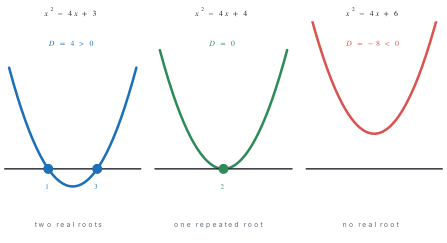
When D < 0 the equation still has two roots — they are just not real. Write "the roots are imaginary (complex conjugates)", never "there are no roots".
Problem. Discuss the nature of the roots of 2x^{2} - 7x + 3 = 0, then solve it.
Solution. Here a = 2, b = -7, c = 3.
D > 0 and 25 = 5^{2} is a perfect square, so the roots are real, distinct and rational.
Problem. Find the values of k for which x^{2} + 2(k+1)x + 9k - 5 = 0 has equal roots.
Solution. Equal roots means D = 0. With a = 1, b = 2(k+1), c = 9k-5,
Check k = 1: the equation is x^{2}+4x+4 = 0, i.e. (x+2)^{2} = 0 — equal roots. Check k = 6: x^{2}+14x+49 = 0, i.e. (x+7)^{2} = 0. Both work.
Problem. For what value of m does (m+1)x^{2} + 2(m+3)x + (m+8) = 0 have equal roots?
Solution. Set D = 0:
Note m = \tfrac13 keeps m+1 \ne 0, so the equation really is quadratic. (Had the answer been m = -1 we would have had to reject it.)
In a question with a parameter in the x^{2} coefficient, a value that makes that coefficient zero must be rejected — the equation stops being quadratic.
7.2 Relation between roots and coefficients
If \alpha and \beta are the roots of ax^{2}+bx+c = 0, then ax^{2}+bx+c factorises as a(x-\alpha)(x-\beta). Expanding,
Comparing coefficients with ax^{2}+bx+c:
From these two, every symmetric expression in \alpha and \beta can be found without ever solving the equation. Write s = \alpha+\beta and p = \alpha\beta.
Note that (\alpha-\beta)^{2} = s^{2}-4p = \dfrac{b^{2}-4ac}{a^{2}} = \dfrac{D}{a^{2}} — the discriminant appears again, which is why D = 0 means the roots coincide.
The sum and product also read off the graph: the axis of symmetry of y = ax^{2}+bx+c sits at x = -b/2a, exactly halfway between the roots.
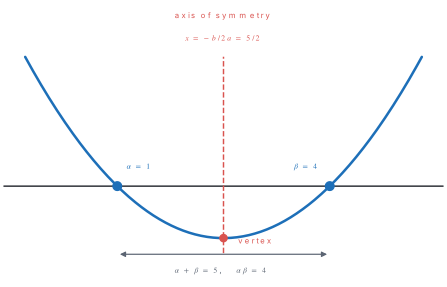
Problem. If \alpha and \beta are the roots of 2x^{2}-5x+3 = 0, find (a) \alpha^{2}+\beta^{2}, (b) \alpha^{3}+\beta^{3}, (c) \dfrac{1}{\alpha}+\dfrac{1}{\beta}, (d) \alpha-\beta — all without solving.
Solution. s = \alpha+\beta = -\dfrac{-5}{2} = \dfrac52 and p = \alpha\beta = \dfrac32.
(a) \;\alpha^{2}+\beta^{2} = s^{2}-2p = \dfrac{25}{4} - 3 = \dfrac{13}{4}
(b) \;\alpha^{3}+\beta^{3} = s^{3} - 3ps = \dfrac{125}{8} - 3\left(\dfrac32\right)\left(\dfrac52\right) = \dfrac{125}{8} - \dfrac{45}{4} = \dfrac{125-90}{8} = \dfrac{35}{8}
(c) \;\dfrac{1}{\alpha}+\dfrac{1}{\beta} = \dfrac{s}{p} = \dfrac{5/2}{3/2} = \dfrac53
(d) \;(\alpha-\beta)^{2} = s^{2}-4p = \dfrac{25}{4} - 6 = \dfrac14, so \alpha-\beta = \pm\dfrac12
Check. The roots really are \tfrac32 and 1; their sum is \tfrac52, their difference \tfrac12, and \left(\tfrac32\right)^{2}+1^{2} = \tfrac{13}{4}.
Problem. If one root of x^{2}+px+q = 0 is double the other, show that 2p^{2} = 9q.
Solution. Let the roots be \alpha and 2\alpha.
Substituting the first into the second,
7.3 Formation of quadratic equation
Reverse the relation. If a quadratic with leading coefficient 1 has roots \alpha and \beta, then
Find the sum and the product of the required roots, substitute, and clear fractions at the end. Never find the actual roots unless you have to.
Problem. Form the quadratic equation whose roots are 2+\sqrt{3} and 2-\sqrt{3}.
Solution.
Notice the surds cancel — that is the point of conjugate pairs, and it is why an equation with rational coefficients cannot have just one surd root.
Problem. If \alpha, \beta are the roots of x^{2}-6x+8 = 0, form the equation whose roots are \alpha^{2} and \beta^{2}.
Solution. s = 6, p = 8. For the new roots:
Check. The original roots are 2 and 4, so the new roots should be 4 and 16: 4+16 = 20 and 4 \times 16 = 64. Correct.
Problem. If \alpha, \beta are the roots of x^{2}+px+q = 0, form the equation whose roots are \dfrac{\alpha}{\beta} and \dfrac{\beta}{\alpha}.
Solution. Here s = -p and \alpha\beta = q.
7.4 Symmetric roots; one or both roots common
Symmetric functions of the roots
An expression in \alpha and \beta is symmetric if swapping \alpha and \beta leaves it unchanged — for example \alpha^{2}+\beta^{2}, \alpha^{3}\beta^{3}, or \dfrac{1}{\alpha}+\dfrac{1}{\beta}. Every symmetric expression can be written in terms of s and p alone, so it can be evaluated straight from the coefficients. That is exactly what §7.2 and §7.3 exploit.
\alpha - \beta is not symmetric (swapping gives \beta-\alpha), which is why we can only ever pin down (\alpha-\beta)^{2} and are left with a \pm.
One root common
Suppose a_1x^{2}+b_1x+c_1 = 0 and a_2x^{2}+b_2x+c_2 = 0 share exactly one root \alpha. In an exam you usually have numbers, and the fastest route is direct:
- Solve whichever equation factorises.
- Substitute each of its roots into the other equation.
- Whichever value of the unknown makes it true is the answer.
There is also a general condition. Substituting x = \alpha in both and eliminating \alpha between them (by cross-multiplication) gives
and the common root itself is
Both roots common
If both roots are common, the two quadratics are the same equation up to a constant multiple, so their coefficients are proportional:
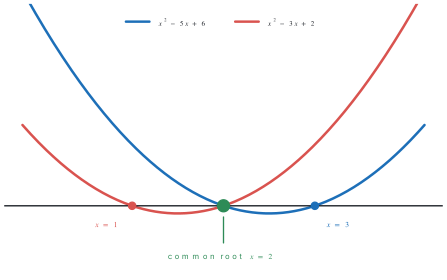
Problem. Find the value of k for which x^{2}-5x+6 = 0 and x^{2}-3x+k = 0 have a common root.
Solution. The first equation factorises: (x-2)(x-3) = 0, so its roots are 2 and 3. One of these must satisfy the second equation.
If the common root is 2: \;4 - 6 + k = 0 \Rightarrow k = 2.
If the common root is 3: \;9 - 9 + k = 0 \Rightarrow k = 0.
So k = 2 or k = 0.
Check k = 2: x^{2}-3x+2 = (x-1)(x-2), roots 1 and 2 — shares 2. Check k = 0: x^{2}-3x = x(x-3), roots 0 and 3 — shares 3. Both valid.
Problem. The equations 2x^{2}+3x+5 = 0 and ax^{2}+bx+c = 0 have both roots in common. If a = 6, find b and c.
Solution. Both roots common means the coefficients are proportional:
With a = 6 the common ratio is \dfrac{6}{2} = 3, so
The second equation is 6x^{2}+9x+15 = 0, which is just 3 times the first — so of course the roots are identical.
Problem. Find the value of k for which the roots of kx^{2} - 2(1+2k)x + 3(2+k) = 0 are equal.
Solution. Set D = 0 with a = k, b = -2(1+2k), c = 3(2+k):
Since k = 1 \ne 0, the equation is genuinely quadratic. Check: at k=1 the equation is x^{2}-6x+9 = 0, i.e. (x-3)^{2} = 0 — equal roots x = 3.
Problem. If the equations x^{2}+bx+c = 0 and x^{2}+cx+b = 0 (b \ne c) have a common root, find that root and the relation between b and c.
Solution. Let \alpha be the common root. Then
Subtracting the second from the first removes \alpha^{2}:
Since b \ne c we may divide by b-c, giving \alpha = 1.
Putting \alpha = 1 back into the first equation:
So the common root is 1 and b+c+1 = 0. (Subtracting the two equations is the standard first move whenever both are monic — it turns a pair of quadratics into one linear equation.)
Chapter summary
- ax^{2}+bx+c = 0 has roots x = \dfrac{-b\pm\sqrt{b^{2}-4ac}}{2a}.
- Discriminant D = b^{2}-4ac: D > 0 real distinct (D a perfect square makes them rational), D = 0 real and equal, D < 0 a conjugate complex pair.
- \alpha+\beta = -b/a and \alpha\beta = c/a; and (\alpha-\beta)^{2} = D/a^{2}.
- Useful identities: \alpha^{2}+\beta^{2} = s^{2}-2p, \alpha^{3}+\beta^{3} = s^{3}-3ps, \dfrac{1}{\alpha}+\dfrac{1}{\beta} = \dfrac{s}{p}.
- To form an equation: x^{2} - (\text{sum})x + (\text{product}) = 0.
- Symmetric expressions in the roots can always be written in s and p; \alpha-\beta cannot, so it carries a \pm.
- One root common: substitute the known roots of one equation into the other; in general (c_1a_2-c_2a_1)^{2} = (a_1b_2-a_2b_1)(b_1c_2-b_2c_1).
- Both roots common: \dfrac{a_1}{a_2} = \dfrac{b_1}{b_2} = \dfrac{c_1}{c_2}.
Practice questions
Group A — Multiple choice (1 mark each)
- The roots of x^{2}-5x+6 = 0 are [1]a-2, -3b2, 3c1, 6d-1, -6
- The roots of ax^{2}+bx+c = 0 are real and equal if [1]ab^{2}-4ac > 0bb^{2}-4ac = 0cb^{2}-4ac < 0db^{2} = 4a
- If \alpha, \beta are the roots of x^{2}-3x+2 = 0, then \alpha+\beta is [1]a-3b2c3d-2
- The quadratic equation whose roots are 3 and -2 is [1]ax^{2}-x-6 = 0bx^{2}+x-6 = 0cx^{2}-x+6 = 0dx^{2}+5x+6 = 0
- If the roots of ax^{2}+bx+c = 0 are reciprocals of each other, then [1]aa = bbb = cca = cda+b+c = 0
- If D < 0 for a quadratic with real coefficients, the graph of y = ax^{2}+bx+c [1]acuts the x-axis twicebtouches the x-axiscnever meets the x-axisdis a straight line
Answers to Group A
1. (b) — (x-2)(x-3) = 0.
2. (b) — D = 0 makes the \pm\sqrt{D} term vanish.
3. (c) — \alpha+\beta = -b/a = 3.
4. (a) — sum = 1, product = -6, so x^{2}-x-6 = 0.
5. (c) — if the roots are \alpha and 1/\alpha then the product c/a = 1, so a = c.
6. (c) — no real root means no real x with y = 0.
Group B — Short answer (5 marks each)
- Discuss the nature of the roots of 3x^{2}-2x+1 = 0 and of 4x^{2}-12x+9 = 0. [5]
- Find the values of k for which x^{2} - 2(1+3k)x + 7(3+2k) = 0 has equal roots. [5]
- If \alpha, \beta are the roots of 2x^{2}+3x-4 = 0, find \alpha^{2}+\beta^{2} and \dfrac{1}{\alpha^{2}}+\dfrac{1}{\beta^{2}}. [5]
- If \alpha, \beta are the roots of 3x^{2}-5x+2 = 0, form the equation whose roots are \dfrac{1}{\alpha} and \dfrac{1}{\beta}. [5]
- Find the value of k if x^{2}-7x+12 = 0 and x^{2}-8x+k = 0 have a common root. [5]
- If one root of x^{2}+px+q = 0 is three times the other, show that 3p^{2} = 16q. [5]
Answers to Group B
1. For 3x^{2}-2x+1 = 0: D = (-2)^{2}-4(3)(1) = 4-12 = -8 < 0, so the roots are imaginary, a conjugate complex pair.
For 4x^{2}-12x+9 = 0: D = 144 - 4(4)(9) = 144-144 = 0, so the roots are real and equal, both x = -b/2a = 12/8 = \tfrac32. (Indeed 4x^{2}-12x+9 = (2x-3)^{2}.)
2. D = 0 gives 4(1+3k)^{2} - 28(3+2k) = 0, i.e. (1+3k)^{2} - 7(3+2k) = 0.
3. s = -\tfrac32, p = -2.
4. For 3x^{2}-5x+2 = 0, s = \tfrac53 and p = \tfrac23. The new roots have
(Sensible: reversing the coefficients of a quadratic inverts its roots. The original roots are \tfrac23 and 1; the new ones are \tfrac32 and 1.)
5. x^{2}-7x+12 = (x-3)(x-4), so its roots are 3 and 4.
If the common root is 3: 9 - 24 + k = 0 \Rightarrow k = 15. If the common root is 4: 16 - 32 + k = 0 \Rightarrow k = 16.
So k = 15 or k = 16.
6. Let the roots be \alpha and 3\alpha. Then 4\alpha = -p, so \alpha = -p/4; and 3\alpha^{2} = q. Substituting,
Group C — Long answer (8 marks each)
- (a) Derive the quadratic formula by completing the square. [4](b) Define the discriminant and describe the nature of the roots in each of its three cases, giving one numerical example of each. [4]
- (a) If \alpha, \beta are the roots of ax^{2}+bx+c = 0, prove that \alpha+\beta = -\dfrac{b}{a} and \alpha\beta = \dfrac{c}{a}. [3](b) If \alpha, \beta are the roots of x^{2}-6x+8 = 0, form the equation whose roots are \alpha+\dfrac{1}{\beta} and \beta+\dfrac{1}{\alpha}. [5]
- (a) Show that if the two equations a_1x^{2}+b_1x+c_1 = 0 and a_2x^{2}+b_2x+c_2 = 0 have both roots common then \dfrac{a_1}{a_2} = \dfrac{b_1}{b_2} = \dfrac{c_1}{c_2}. [4](b) Find k so that x^{2}-5x+6=0 and x^{2}-3x+k=0 have a common root, and in each case state the common root. [4]
Answers to Group C
1. (a) See the derivation in §7.1: divide by a, complete the square by adding (b/2a)^{2}, and take square roots to get x = \dfrac{-b\pm\sqrt{b^{2}-4ac}}{2a}.
(b) D = b^{2}-4ac. D > 0: real and distinct — e.g. x^{2}-5x+6 = 0 with D = 1, roots 2, 3. D = 0: real and equal — e.g. x^{2}-4x+4 = 0, double root 2. D < 0: a conjugate complex pair — e.g. x^{2}+x+1 = 0 with D = -3.
2. (a) Since \alpha, \beta are the roots, ax^{2}+bx+c \equiv a(x-\alpha)(x-\beta) = ax^{2} - a(\alpha+\beta)x + a\alpha\beta. Comparing the coefficients of x and the constants gives \alpha+\beta = -b/a and \alpha\beta = c/a.
(b) For x^{2}-6x+8=0: s = 6, p = 8 (the roots are 2 and 4).
Check. The new roots are 2+\tfrac14 = \tfrac94 and 4+\tfrac12 = \tfrac92; their sum is \tfrac{27}{4} and product \tfrac{81}{8}. Correct.
3. (a) Let the common roots be \alpha and \beta. Then a_1x^{2}+b_1x+c_1 = a_1(x-\alpha)(x-\beta) and a_2x^{2}+b_2x+c_2 = a_2(x-\alpha)(x-\beta). Dividing one identity by the other,
for all x, so the two quadratics are proportional term by term: \dfrac{a_1}{a_2} = \dfrac{b_1}{b_2} = \dfrac{c_1}{c_2}.
(b) Roots of the first are 2 and 3. Putting x = 2 in the second: 4-6+k = 0, so k = 2 (common root 2). Putting x = 3: 9-9+k = 0, so k = 0 (common root 3).
Practise more: Mathematics question bank