Unit 9 · Trigonometry · 6 teaching hours · 15 min read
Inverse Circular Functions
What the syllabus asks for 2
- Definition, domain and range of inverse circular functions
- Formulae and identities of inverse circular functions
The sine function turns an angle into a ratio. This unit runs the machine backwards: given the ratio, find the angle. Because \sin\theta repeats every 2\pi, "the angle whose sine is 1/2" has infinitely many answers, so before we can speak of the inverse we must cut the domain down to a piece on which the function is one-to-one. That single idea — restrict, then invert — controls every domain, range and identity in this chapter.
Three question types cover almost everything: (i) state or evaluate a principal value, (ii) prove an identity such as \tan^{-1}x+\tan^{-1}y=\tan^{-1}\frac{x+y}{1-xy}, and (iii) solve an equation in inverse functions. Every proof is worth marks line by line, so write the substitution ("let \tan^{-1}x = A") explicitly.
9.1 Definition, domain and range of inverse circular functions
Why a restriction is needed
A function has an inverse only if it is one-to-one (each output comes from exactly one input). Over its natural domain \mathbb{R} the sine function is not one-to-one: the horizontal line y = 1/2 cuts y=\sin x infinitely often. But on the single branch -\pi/2 \le x \le \pi/2 the sine rises steadily from -1 to +1 and meets every horizontal line y=k, -1\le k\le 1, exactly once. That branch is called the principal branch.
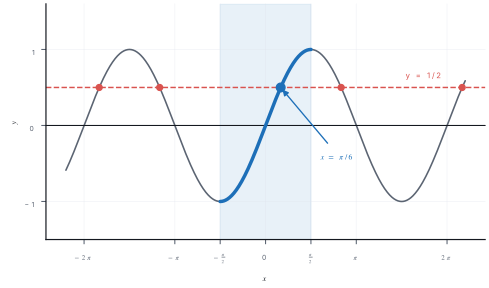
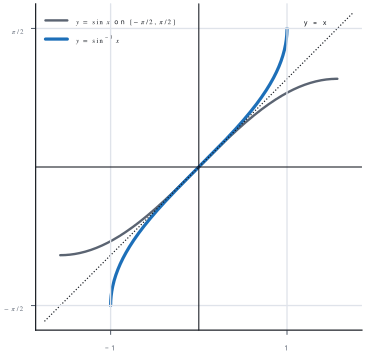
Restricting the domain to the principal branch makes the inverse a genuine function. Its graph is the mirror image of the branch in the line y=x, because reflecting in y=x interchanges the roles of input and output.
For -1 \le x \le 1, \sin^{-1}x (read "arc sine x") is the unique angle y with -\dfrac{\pi}{2} \le y \le \dfrac{\pi}{2} such that \sin y = x. That unique value is called the principal value.
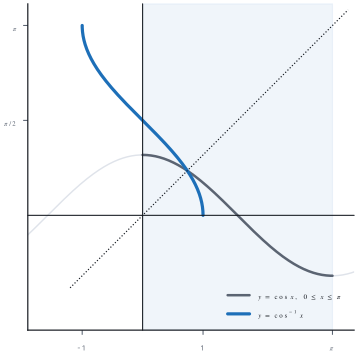
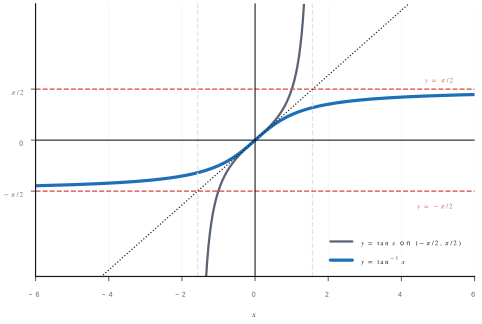
The same programme is carried out for the other five functions. For cosine the chosen branch is 0 \le x \le \pi (on [-\pi/2,\pi/2] the cosine is not one-to-one, since \cos(-x)=\cos x). For tangent it is the open interval -\pi/2 < x < \pi/2, on which \tan x sweeps once through all of \mathbb{R}.
The six inverse circular functions
| Function | Domain | Range (principal values) |
|---|---|---|
| \sin^{-1}x | -1 \le x \le 1 | -\frac{\pi}{2} \le y \le \frac{\pi}{2} |
| \cos^{-1}x | -1 \le x \le 1 | 0 \le y \le \pi |
| \tan^{-1}x | x \in \mathbb{R} | -\frac{\pi}{2} < y < \frac{\pi}{2} |
| \cot^{-1}x | x \in \mathbb{R} | 0 < y < \pi |
| \sec^{-1}x | |x| \ge 1 | 0 \le y \le \pi, y \ne \frac{\pi}{2} |
| \csc^{-1}x | |x| \ge 1 | -\frac{\pi}{2} \le y \le \frac{\pi}{2}, y \ne 0 |
Two patterns make this table easy to remember.
- Sine family (\sin^{-1}, \csc^{-1}, \tan^{-1}): range centred on 0, from -\pi/2 to \pi/2. Negative inputs give negative answers.
- Cosine family (\cos^{-1}, \sec^{-1}, \cot^{-1}): range from 0 to \pi. Negative inputs give answers in the second quadrant.
- \sin^{-1}x is an angle, not \dfrac{1}{\sin x}. The reciprocal is \csc x. Write (\sin x)^{-1} if you mean the reciprocal.
- \sin^{-1}x is undefined for |x|>1: "\sin^{-1}2" does not exist.
- \sin^{-1}(\sin x) = x only when -\pi/2 \le x \le \pi/2. Outside that interval you must first replace x by an angle inside the range with the same sine.
Problem. Find the principal values of (a) \sin^{-1}\left(-\frac{1}{2}\right), (b) \cos^{-1}\left(-\frac{\sqrt{3}}{2}\right), (c) \tan^{-1}(-1), (d) \cot^{-1}(-1), (e) \sec^{-1}(-2).
Solution.
(a) We need y with \sin y = -\frac12 and -\frac{\pi}{2}\le y\le\frac{\pi}{2}. Since \sin\frac{\pi}{6}=\frac12, oddness gives \sin\left(-\frac{\pi}{6}\right)=-\frac12. So \sin^{-1}\left(-\frac12\right) = -\dfrac{\pi}{6}.
(b) Here y must lie in [0,\pi], so y is in the second quadrant. \cos\frac{\pi}{6}=\frac{\sqrt{3}}{2}, and \cos\left(\pi-\frac{\pi}{6}\right)=-\frac{\sqrt{3}}{2}. Hence \cos^{-1}\left(-\frac{\sqrt{3}}{2}\right) = \dfrac{5\pi}{6}.
(c) \tan^{-1} has range \left(-\frac{\pi}{2},\frac{\pi}{2}\right) and \tan\left(-\frac{\pi}{4}\right)=-1, so \tan^{-1}(-1) = -\dfrac{\pi}{4}.
(d) \cot^{-1} has range (0,\pi), so the answer is in the second quadrant: \cot\frac{3\pi}{4} = -1, giving \cot^{-1}(-1) = \dfrac{3\pi}{4}.
(e) \sec^{-1}(-2) = \cos^{-1}\left(-\frac12\right) = \dfrac{2\pi}{3}.
Problem. Find the domain of (a) f(x) = \sin^{-1}(2x-1) and (b) g(x) = \cos^{-1}(3-2x).
Solution.
(a) The input of \sin^{-1} must lie in [-1,1]:
Domain = [0,1].
(b) Similarly -1 \le 3-2x \le 1. Subtract 3: -4 \le -2x \le -2. Divide by -2 and reverse the inequalities: 1 \le x \le 2. Domain =[1,2].
Problem. Evaluate (a) \sin^{-1}\left(\sin\frac{5\pi}{6}\right), (b) \cos^{-1}\left(\cos\frac{7\pi}{6}\right), (c) \tan^{-1}\left(\tan\frac{3\pi}{4}\right).
Solution.
(a) \frac{5\pi}{6} \notin \left[-\frac{\pi}{2},\frac{\pi}{2}\right], so we cannot cancel. Instead \sin\frac{5\pi}{6}=\sin\left(\pi-\frac{5\pi}{6}\right)=\sin\frac{\pi}{6}, and \frac{\pi}{6} is in the range. Answer \dfrac{\pi}{6}.
(b) \frac{7\pi}{6} \notin [0,\pi]. Use \cos\frac{7\pi}{6}=\cos\left(2\pi-\frac{7\pi}{6}\right)=\cos\frac{5\pi}{6}, and \frac{5\pi}{6}\in[0,\pi]. Answer \dfrac{5\pi}{6}.
(c) \tan\frac{3\pi}{4} = \tan\left(\frac{3\pi}{4}-\pi\right) = \tan\left(-\frac{\pi}{4}\right), and -\frac{\pi}{4} is in the range. Answer -\dfrac{\pi}{4}.
The right-triangle picture
Almost every evaluation question becomes trivial with one sketch. If \theta = \sin^{-1}x with 0\le x\le 1, draw a right triangle with hypotenuse 1 and opposite side x; Pythagoras gives the adjacent side \sqrt{1-x^2}, and then every ratio of \theta can be read off.
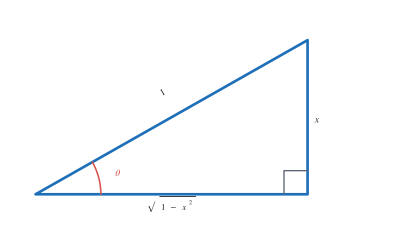
Problem. Evaluate (a) \cos\left(\sin^{-1}\frac{3}{5}\right), (b) \tan\left(\sin^{-1}\frac{3}{5}+\cot^{-1}\frac{3}{2}\right).
Solution.
(a) Let A = \sin^{-1}\frac35, so \sin A = \frac35 with A in the first quadrant. Then \cos A = \sqrt{1-\frac{9}{25}} = \frac45 (positive, because A\in\left[0,\frac{\pi}{2}\right]). So the value is \dfrac{4}{5}.
(b) With A as above, \tan A = \dfrac{3/5}{4/5} = \dfrac34. Let B = \cot^{-1}\frac32, so \cot B = \frac32 and \tan B = \frac23. Then
9.2 Formulae and identities of inverse circular functions
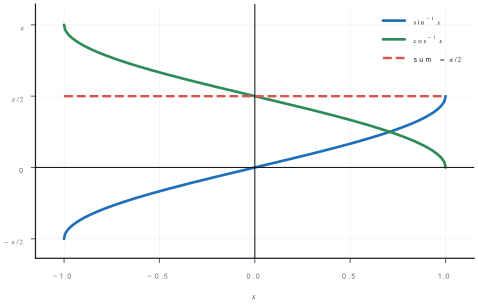
Complementary pairs
Let \sin^{-1}x = \theta. Then \sin\theta = x and -\dfrac{\pi}{2}\le\theta\le\dfrac{\pi}{2}.
Using \cos\left(\dfrac{\pi}{2}-\theta\right) = \sin\theta = x,
Now check the range: from -\frac{\pi}{2}\le\theta\le\frac{\pi}{2} we get 0 \le \dfrac{\pi}{2}-\theta \le \pi, which is exactly the range of \cos^{-1}. Therefore \dfrac{\pi}{2}-\theta is the principal value:
The identical argument with \tan/\cot and \sec/\csc gives the other two.
Negative arguments and reciprocals
| Sine family (odd) | Cosine family |
|---|---|
| \sin^{-1}(-x) = -\sin^{-1}x | \cos^{-1}(-x) = \pi-\cos^{-1}x |
| \tan^{-1}(-x) = -\tan^{-1}x | \cot^{-1}(-x) = \pi-\cot^{-1}x |
| \csc^{-1}(-x) = -\csc^{-1}x | \sec^{-1}(-x) = \pi-\sec^{-1}x |
And the reciprocal rules, valid for x>0:
Addition formulae for \tan^{-1}
Put A = \tan^{-1}x and B = \tan^{-1}y, so \tan A = x, \tan B = y and both A,B \in\left(-\frac{\pi}{2},\frac{\pi}{2}\right). By the compound-angle formula,
so A+B is an angle whose tangent is \dfrac{x+y}{1-xy}. It is the principal value only if A+B itself lies in \left(-\frac{\pi}{2},\frac{\pi}{2}\right), and that happens exactly when xy<1. Hence
If xy>1 the sum has overshot the principal range by \pi, so a correction term is needed:
Replacing y by -y gives the subtraction rule \tan^{-1}x-\tan^{-1}y = \tan^{-1}\dfrac{x-y}{1+xy}, valid when xy>-1.
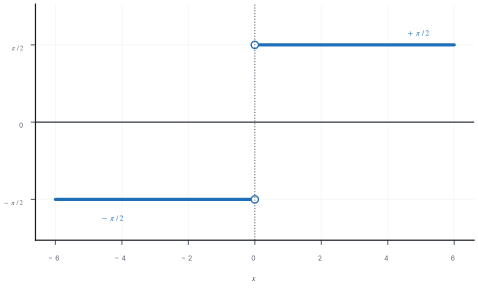
Writing \tan^{-1}2+\tan^{-1}3 = \tan^{-1}\frac{5}{1-6} = \tan^{-1}(-1) = -\frac{\pi}{4} is wrong: two positive angles cannot add to a negative one. Here xy = 6 > 1, so the answer is \pi-\frac{\pi}{4} = \frac{3\pi}{4}. Always test xy against 1.
The special case y = 1/x shows the same effect starkly: for x>0 the sum is +\pi/2, but for x<0 it is -\pi/2.
Sums for \sin^{-1} and \cos^{-1}, and the double-angle forms
Conversions for 0\le x\le 1:
The 2\tan^{-1}x chain comes straight from the t-formulae with t=\tan\theta: if \theta=\tan^{-1}x then \sin 2\theta = \dfrac{2x}{1+x^2} and \cos 2\theta = \dfrac{1-x^2}{1+x^2}.
Problem. Prove that \tan^{-1}\dfrac12+\tan^{-1}\dfrac13 = \dfrac{\pi}{4}.
Solution. Here x=\frac12, y=\frac13, so xy = \frac16 < 1 and the plain formula applies.
Problem. Prove that \tan^{-1}1+\tan^{-1}2+\tan^{-1}3 = \pi.
Solution. Take the last two first. With x=2, y=3 we have xy=6>1 and both are positive, so the correction +\pi is needed:
Adding \tan^{-1}1 = \dfrac{\pi}{4} gives \dfrac{\pi}{4}+\dfrac{3\pi}{4} = \pi.
Problem. Show that \tan^{-1}\dfrac12+\tan^{-1}\dfrac15+\tan^{-1}\dfrac18 = \dfrac{\pi}{4}.
Solution. Combine the first two (xy = \frac{1}{10} < 1):
Now add \tan^{-1}\frac18 (product \frac{7}{72}<1):
Problem. Prove that \sin^{-1}\dfrac35+\sin^{-1}\dfrac{8}{17} = \sin^{-1}\dfrac{77}{85}.
Solution. Let A=\sin^{-1}\frac35 and B=\sin^{-1}\frac{8}{17}, both in the first quadrant. Then \cos A = \sqrt{1-\frac{9}{25}} = \frac45 and \cos B = \sqrt{1-\frac{64}{289}} = \frac{15}{17}.
Since \sin A = \frac35 < \frac{1}{\sqrt{2}} and \sin B = \frac{8}{17}<\frac{1}{\sqrt{2}}, both A and B are less than \frac{\pi}{4}, so A+B<\frac{\pi}{2} and A+B is a principal value. Hence A+B = \sin^{-1}\dfrac{77}{85}.
Problem. Prove that \cos^{-1}\dfrac45+\cos^{-1}\dfrac{12}{13} = \cos^{-1}\dfrac{33}{65}.
Solution. Let A=\cos^{-1}\frac45, B=\cos^{-1}\frac{12}{13}; then \sin A = \frac35 and \sin B = \frac{5}{13} (both positive, first quadrant).
A+B is a sum of two first-quadrant angles with \cos(A+B)>0, so 0<A+B<\frac{\pi}{2}\subset[0,\pi], and therefore A+B = \cos^{-1}\dfrac{33}{65}.
Problem. Show that 2\tan^{-1}\dfrac13 = \tan^{-1}\dfrac34, and evaluate \sin\left(2\tan^{-1}\frac13\right) and \cos\left(2\sin^{-1}\frac35\right).
Solution. With x=\frac13 (so |x|<1):
Next, \sin\left(2\tan^{-1}x\right) = \dfrac{2x}{1+x^{2}} = \dfrac{2/3}{1+1/9} = \dfrac{2/3}{10/9} = \dfrac35.
Finally, if \theta=\sin^{-1}\frac35 then \cos 2\theta = 1-2\sin^{2}\theta = 1-2\cdot\frac{9}{25} = \dfrac{7}{25}.
Problem. Solve \tan^{-1}2x+\tan^{-1}3x = \dfrac{\pi}{4}.
Solution. Assume first that (2x)(3x) = 6x^{2} < 1, so the plain formula holds:
so x = \frac16 or x = -1.
Check. x=\frac16: 6x^{2} = \frac16 < 1 and \tan^{-1}\frac13+\tan^{-1}\frac12 = \frac{\pi}{4} by Example 9.5 — valid. x=-1: then \tan^{-1}(-2)+\tan^{-1}(-3) is a sum of two negative angles, which cannot equal +\frac{\pi}{4} — reject.
Problem. Solve (a) \cos^{-1}x-\sin^{-1}x = \dfrac{\pi}{6} and (b) \sin^{-1}(1-x)-2\sin^{-1}x = \dfrac{\pi}{2}.
Solution.
(a) Add the known identity \sin^{-1}x+\cos^{-1}x = \frac{\pi}{2} to the given equation:
(b) Write \sin^{-1}x = \theta, so x=\sin\theta and the equation becomes \sin^{-1}(1-x) = \frac{\pi}{2}+2\theta. Taking sine of both sides,
so 2x^{2} = x, i.e. x(2x-1) = 0, giving x=0 or x=\frac12.
Check. x=0: LHS =\sin^{-1}1-0 = \frac{\pi}{2} — valid. x=\frac12: LHS =\sin^{-1}\frac12-2\sin^{-1}\frac12 = -\frac{\pi}{6}\ne\frac{\pi}{2} — reject. Hence x=0.
Taking \sin or \tan of both sides can create extra roots, because those functions are many-to-one. Substituting each root back into the original equation is part of the solution, and examiners award a mark for it.
Chapter summary
- Inverse circular functions exist only after the domain is restricted to a one-to-one principal branch; the graph of the inverse is the reflection of that branch in y=x.
- Ranges: \sin^{-1}, \csc^{-1} \in\left[-\frac{\pi}{2},\frac{\pi}{2}\right]; \tan^{-1}\in\left(-\frac{\pi}{2},\frac{\pi}{2}\right); \cos^{-1}, \sec^{-1}\in[0,\pi]; \cot^{-1}\in(0,\pi).
- \sin^{-1}x+\cos^{-1}x = \tan^{-1}x+\cot^{-1}x = \sec^{-1}x+\csc^{-1}x = \frac{\pi}{2}.
- \sin^{-1}(-x)=-\sin^{-1}x and \tan^{-1}(-x)=-\tan^{-1}x, but \cos^{-1}(-x)=\pi-\cos^{-1}x and \cot^{-1}(-x)=\pi-\cot^{-1}x.
- \tan^{-1}x+\tan^{-1}y = \tan^{-1}\frac{x+y}{1-xy} if xy<1; add \pi if x,y>0 with xy>1 and subtract \pi if x,y<0 with xy>1.
- \sin^{-1}x+\sin^{-1}y = \sin^{-1}\left(x\sqrt{1-y^2}+y\sqrt{1-x^2}\right) and \cos^{-1}x+\cos^{-1}y = \cos^{-1}\left(xy-\sqrt{1-x^2}\sqrt{1-y^2}\right).
- 2\tan^{-1}x = \tan^{-1}\frac{2x}{1-x^2} = \sin^{-1}\frac{2x}{1+x^2} = \cos^{-1}\frac{1-x^2}{1+x^2}.
- \sin^{-1}(\sin x)=x only for x\in\left[-\frac{\pi}{2},\frac{\pi}{2}\right]; otherwise shift the angle into the range first.
Practice questions
Group A — Multiple choice (1 mark each)
- The range of \cos^{-1}x is [1]a\left[-\frac{\pi}{2},\frac{\pi}{2}\right]b[0,\pi]c(0,\pi)d\mathbb{R}
- The principal value of \sin^{-1}\left(-\frac{\sqrt{3}}{2}\right) is [1]a\frac{4\pi}{3}b\frac{2\pi}{3}c-\frac{\pi}{3}d-\frac{\pi}{6}
- The domain of \sin^{-1}(3x) is [1]a[-1,1]b\left[-\frac13,\frac13\right]c[-3,3]d\mathbb{R}
- \tan^{-1}x+\cot^{-1}x equals [1]a0b\frac{\pi}{4}c\frac{\pi}{2}d\pi
- \cos^{-1}\left(\cos\frac{5\pi}{3}\right) equals [1]a\frac{5\pi}{3}b\frac{\pi}{3}c-\frac{\pi}{3}d\frac{2\pi}{3}
- \tan^{-1}2+\tan^{-1}3 equals [1]a\frac{\pi}{4}b\frac{3\pi}{4}c-\frac{\pi}{4}d\frac{\pi}{2}
Answers to Group A
1. (b) — the principal branch of \cos is [0,\pi].
2. (c) — \sin^{-1} is odd and \sin\frac{\pi}{3} = \frac{\sqrt{3}}{2}.
3. (b) — need -1\le 3x\le 1.
4. (c) — complementary identity.
5. (b) — \cos\frac{5\pi}{3} = \cos\left(2\pi-\frac{5\pi}{3}\right)=\cos\frac{\pi}{3}, and \frac{\pi}{3}\in[0,\pi].
6. (b) — xy=6>1 with both positive, so the value is \pi+\tan^{-1}\frac{5}{-5}=\pi-\frac{\pi}{4}=\frac{3\pi}{4}.
Group B — Short answer (5 marks each)
- Define the inverse sine function and state the domain and range of all six inverse circular functions. [5]
- Prove that \sin^{-1}x+\cos^{-1}x = \dfrac{\pi}{2} for |x|\le 1. [5]
- Prove that \tan^{-1}\dfrac{1}{3}+\tan^{-1}\dfrac{1}{5}+\tan^{-1}\dfrac{1}{7}+\tan^{-1}\dfrac{1}{8} = \dfrac{\pi}{4}. [5]
- Evaluate \sin\left(\cos^{-1}\dfrac{4}{5}+\tan^{-1}\dfrac{5}{12}\right). [5]
- Solve \tan^{-1}(x+1)+\tan^{-1}(x-1) = \tan^{-1}\dfrac{8}{31}. [5]
Answers to Group B
1. \sin^{-1}x is the unique y\in\left[-\frac{\pi}{2},\frac{\pi}{2}\right] with \sin y = x, defined for -1\le x\le 1. The full table is the one in §9.1: \sin^{-1},\csc^{-1} have range \left[-\frac{\pi}{2},\frac{\pi}{2}\right] (excluding 0 for \csc^{-1}), \tan^{-1} has \left(-\frac{\pi}{2},\frac{\pi}{2}\right), \cos^{-1},\sec^{-1} have [0,\pi] (excluding \frac{\pi}{2} for \sec^{-1}), and \cot^{-1} has (0,\pi). Domains: [-1,1] for \sin^{-1},\cos^{-1}; |x|\ge 1 for \sec^{-1},\csc^{-1}; \mathbb{R} for \tan^{-1},\cot^{-1}.
2. Let \sin^{-1}x=\theta, so \sin\theta=x and -\frac{\pi}{2}\le\theta\le\frac{\pi}{2}. Then \cos\left(\frac{\pi}{2}-\theta\right)=\sin\theta=x. Since 0\le\frac{\pi}{2}-\theta\le\pi, the angle \frac{\pi}{2}-\theta lies in the range of \cos^{-1}, so \cos^{-1}x = \frac{\pi}{2}-\theta = \frac{\pi}{2}-\sin^{-1}x, which rearranges to the result.
3. Pair them off. First pair (xy=\frac{1}{15}<1): \tan^{-1}\frac13+\tan^{-1}\frac15 = \tan^{-1}\dfrac{\frac13+\frac15}{1-\frac{1}{15}} = \tan^{-1}\dfrac{8/15}{14/15} = \tan^{-1}\frac47. Second pair (xy=\frac{1}{56}<1): \tan^{-1}\frac17+\tan^{-1}\frac18 = \tan^{-1}\dfrac{\frac17+\frac18}{1-\frac{1}{56}} = \tan^{-1}\dfrac{15/56}{55/56} = \tan^{-1}\frac{3}{11}. Now combine (xy = \frac{12}{77}<1): \tan^{-1}\frac47+\tan^{-1}\frac{3}{11} = \tan^{-1}\dfrac{\frac47+\frac{3}{11}}{1-\frac{12}{77}} = \tan^{-1}\dfrac{65/77}{65/77} = \tan^{-1}1 = \frac{\pi}{4}.
4. Let A=\cos^{-1}\frac45, so \sin A=\frac35, \cos A=\frac45. Let B=\tan^{-1}\frac{5}{12}, so \sin B=\frac{5}{13}, \cos B=\frac{12}{13} (from the 5,12,13 triangle). Then \sin(A+B)=\sin A\cos B+\cos A\sin B = \frac35\cdot\frac{12}{13}+\frac45\cdot\frac{5}{13} = \dfrac{36+20}{65} = \dfrac{56}{65}.
5. Product (x+1)(x-1) = x^{2}-1. Assuming x^2-1<1, \tan^{-1}\dfrac{(x+1)+(x-1)}{1-(x^{2}-1)} = \tan^{-1}\dfrac{8}{31}, so \dfrac{2x}{2-x^{2}} = \dfrac{8}{31}. Cross-multiplying: 62x = 16-8x^{2}, i.e. 8x^{2}+62x-16=0, or 4x^{2}+31x-8=0. Factorising, (4x-1)(x+8)=0, so x=\frac14 or x=-8. Check: x=\frac14 gives x^2-1 = -\frac{15}{16}<1 and a small positive left-hand side — valid. x=-8 makes the left side negative while \tan^{-1}\frac{8}{31}>0 — reject. Hence x=\dfrac14.
Group C — Long answer (8 marks each)
- (a) Explain why the sine function must be restricted before it can be inverted, and sketch y=\sin^{-1}x stating its domain and range. [3](b) Prove that \tan^{-1}x+\tan^{-1}y = \tan^{-1}\dfrac{x+y}{1-xy} when xy<1, and state the modification needed when xy>1. [3](c) Hence prove \tan^{-1}1+\tan^{-1}2+\tan^{-1}3 = \pi. [2]
- (a) Prove that 2\tan^{-1}x = \sin^{-1}\dfrac{2x}{1+x^{2}} for |x|\le 1. [4](b) Solve \sin^{-1}\dfrac{5}{x}+\sin^{-1}\dfrac{12}{x} = \dfrac{\pi}{2}. [4]
Answers to Group C
1. (a) \sin x is many-to-one on \mathbb{R} (the line y=k cuts it infinitely often), so no inverse function exists. On the principal branch \left[-\frac{\pi}{2},\frac{\pi}{2}\right] the sine is strictly increasing from -1 to 1, hence one-to-one and onto [-1,1]. Reflecting that branch in y=x gives y=\sin^{-1}x, with domain [-1,1] and range \left[-\frac{\pi}{2},\frac{\pi}{2}\right] (Figure 2).
(b) Let A=\tan^{-1}x, B=\tan^{-1}y. Then \tan(A+B) = \dfrac{x+y}{1-xy}. The sum A+B lies in \left(-\frac{\pi}{2},\frac{\pi}{2}\right) precisely when xy<1, in which case A+B is the principal value and equals \tan^{-1}\frac{x+y}{1-xy}. If xy>1 with x,y>0 then A+B\in\left(\frac{\pi}{2},\pi\right), so A+B = \pi+\tan^{-1}\frac{x+y}{1-xy}; with x,y<0 the correction is -\pi.
(c) \tan^{-1}2+\tan^{-1}3: xy=6>1 and both positive, so it equals \pi+\tan^{-1}\frac{5}{-5} = \pi-\frac{\pi}{4} = \frac{3\pi}{4}. Adding \tan^{-1}1=\frac{\pi}{4} gives \pi.
2. (a) Let \theta = \tan^{-1}x, so \tan\theta = x and -\frac{\pi}{4}\le\theta\le\frac{\pi}{4} when |x|\le 1. Then \sin 2\theta = \dfrac{2\tan\theta}{1+\tan^{2}\theta} = \dfrac{2x}{1+x^{2}}. Because -\frac{\pi}{2}\le 2\theta\le\frac{\pi}{2}, the angle 2\theta lies in the range of \sin^{-1}, so 2\theta = \sin^{-1}\dfrac{2x}{1+x^{2}}, i.e. 2\tan^{-1}x = \sin^{-1}\dfrac{2x}{1+x^{2}}.
(b) Rewrite as \sin^{-1}\frac{5}{x} = \frac{\pi}{2}-\sin^{-1}\frac{12}{x} = \cos^{-1}\frac{12}{x}. Taking sine, \dfrac{5}{x} = \sin\left(\cos^{-1}\frac{12}{x}\right) = \sqrt{1-\dfrac{144}{x^{2}}} = \dfrac{\sqrt{x^{2}-144}}{|x|}. For x>0 this gives 5 = \sqrt{x^{2}-144}, so x^{2} = 169 and x = 13. Check: \sin^{-1}\frac{5}{13}+\sin^{-1}\frac{12}{13} — the two angles of a 5,12,13 right triangle — add to \frac{\pi}{2}. Valid. (x=-13 makes both terms negative, so it is rejected.) Hence x=13.
Practise more: Mathematics question bank