Unit 6 · Algebra · 6 teaching hours · 24 min read
Matrices and Determinants
What the syllabus asks for 4
- Transpose of a matrix and its properties
- Minors and cofactors
- Adjoint and inverse of a matrix
- Determinant and its properties (without proof)
A matrix is a rectangular array of numbers, and a determinant is a single number that a square matrix carries with it. Together they turn a system of linear equations into a single equation AX = B that can be solved by a recipe — no guessing which variable to eliminate first. This unit builds that recipe: transpose, minors and cofactors, the adjoint, the inverse, and the properties of determinants that make large ones quick to evaluate.
Skipping the transpose is the single commonest reason students lose marks in this unit. And no inverse exists at all unless |A| \ne 0 — always compute |A| first.
6.1 Transpose of a matrix and its properties
The operations you already have
A matrix with m rows and n columns has order m \times n. The entry in row i and column j is a_{ij}, so a 3\times3 matrix has entries a_{11}, a_{12}, a_{13} in its first row, and so on down to a_{33}.
- Equality. A = B only if they have the same order and a_{ij} = b_{ij} for every i and j.
- Addition and subtraction work entry by entry, and are defined only for matrices of the same order.
- Scalar multiplication: kA multiplies every entry by k.
- Multiplication: AB exists only when the number of columns of A equals the number of rows of B. If A is m\times n and B is n\times p, then AB is m \times p, and
That is: row i of A against column j of B, multiplying in pairs and adding.
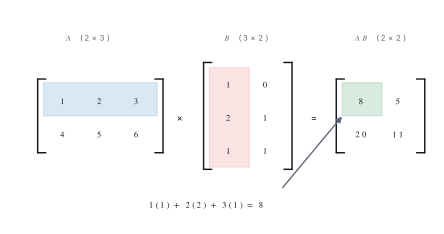
Matrix multiplication is not commutative. Usually AB \ne BA; often one of them does not even exist. Also, AB = O does not force A = O or B = O.
The transpose
The transpose of an m\times n matrix A, written A^{T} (or A'), is the n\times m matrix obtained by interchanging the rows and columns: the entry in row i, column j of A^{T} is a_{ji}.
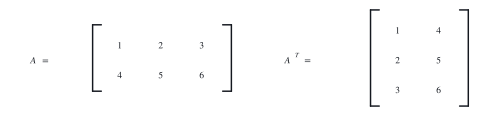
The properties below are the examinable ones. All are proved by comparing the (i,j) entry of the two sides.
| Property | Statement |
|---|---|
| Involution | \left(A^{T}\right)^{T} = A |
| Sum | (A+B)^{T} = A^{T} + B^{T} |
| Scalar | (kA)^{T} = kA^{T} |
| Reversal law | (AB)^{T} = B^{T}A^{T} |
| Determinant | |A^{T}| = |A| |
(AB)^{T} = B^{T}A^{T}, not A^{T}B^{T}. The order flips. You can see why from the orders alone: if A is 2\times3 and B is 3\times2 then A^{T}B^{T} is (3\times2)(2\times3) — a different size from (AB)^{T}, which is 2\times2.
A square matrix is symmetric if A^{T} = A (so a_{ij} = a_{ji}) and skew-symmetric if A^{T} = -A (so a_{ij} = -a_{ji}, which forces every diagonal entry to be zero). Every square matrix splits into one of each:
The first bracket is symmetric (transposing it gives itself) and the second is skew-symmetric (transposing it changes every sign).

Problem. With A the 2\times3 matrix whose rows are (1,2,3) and (4,5,6), and B the 3\times2 matrix whose rows are (1,0), (2,1) and (1,1), verify that (AB)^{T} = B^{T}A^{T}.
Solution. First AB, row against column:
So AB has rows (8,5) and (20,11), and therefore (AB)^{T} has rows (8,20) and (5,11).
Now the other side. B^{T} is 2\times3 with rows (1,2,1) and (0,1,1); A^{T} is 3\times2 with rows (1,4), (2,5), (3,6). Multiplying,
The rows are (8,20) and (5,11) — identical to (AB)^{T}. Verified.
Problem. Express the matrix A with rows (2,3) and (7,4) as the sum of a symmetric and a skew-symmetric matrix.
Solution. A^{T} has rows (2,7) and (3,4).
P^{T} = P, so P is symmetric; Q^{T} = -Q, so Q is skew-symmetric. Adding, P+Q has rows (2,3) and (7,4), which is A. (See the figure above.)
6.2 Minors and cofactors
Every square matrix carries a single number called its determinant, written |A| or \det A. For a second-order (that is, 2\times2) matrix it is
— the product along the leading diagonal minus the product along the other diagonal. Third-order determinants are reduced to second-order ones using minors.
The minor M_{ij} of the entry a_{ij} is the determinant of the smaller matrix left after deleting row i and column j.
The cofactor is the minor with a sign attached:
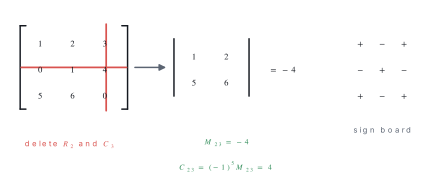
With cofactors, the determinant can be expanded along any row or any column:
Every choice gives the same answer, which is why you should always expand along the row or column containing the most zeros.
The signs alternate like a chessboard starting with + at the top-left. For a 3\times3 you never need (-1)^{i+j} arithmetic — just read the board.
Problem. For the matrix A with rows (1,2,3), (0,1,4), (5,6,0), find all nine minors and cofactors, and hence |A|.
Solution. Delete the relevant row and column each time.
| j=1 | j=2 | j=3 | |
|---|---|---|---|
| i=1: minor | 1(0)-4(6) = -24 | 0(0)-4(5) = -20 | 0(6)-1(5) = -5 |
| i=1: cofactor | -24 | +20 | -5 |
| i=2: minor | 2(0)-3(6) = -18 | 1(0)-3(5) = -15 | 1(6)-2(5) = -4 |
| i=2: cofactor | +18 | -15 | +4 |
| i=3: minor | 2(4)-3(1) = 5 | 1(4)-3(0) = 4 | 1(1)-2(0) = 1 |
| i=3: cofactor | +5 | -4 | +1 |
Expanding along the first row:
Check by expanding along the second row (which contains a zero):
Same answer, as it must be. So |A| = 1.
Problem. Evaluate the determinant of the matrix with rows (2,3,1), (4,7,3) and (6,8,5).
Solution. Expand along the first row.
6.3 Adjoint and inverse of a matrix
The adjoint of a square matrix A, written \mathrm{adj}\,A, is the transpose of the matrix of cofactors:
Take the (i,j) entry of the product A\,(\mathrm{adj}\,A). By the definition of the adjoint it equals
If i = j this is exactly the cofactor expansion of |A| along row i, so every diagonal entry is |A|.
If i \ne j we are multiplying the entries of row i by the cofactors of a different row j. That sum is the cofactor expansion of a determinant whose row j has been replaced by a copy of row i — a determinant with two identical rows, which is zero. So every off-diagonal entry is 0.
A matrix with |A| down the diagonal and zeros elsewhere is |A|\,I. Hence
Divide by |A| — legal only when |A| \ne 0 — and you have the inverse.
A square matrix with |A| \ne 0 is called non-singular and has exactly one inverse; if |A| = 0 it is singular and has no inverse at all. Also AA^{-1} = A^{-1}A = I, (A^{-1})^{-1} = A and (AB)^{-1} = B^{-1}A^{-1}.
For a 2\times2 matrix the recipe collapses to something worth memorising.

For a 3\times3 matrix you must do the full job. Using the cofactors already found in Worked example 6.3:


Solving linear equations with the inverse
Three equations in three unknowns,
can be written as the single matrix equation AX = B, where A is the 3\times3 matrix of coefficients, X is the column of unknowns and B is the column of constants. If |A| \ne 0, multiply on the left by A^{-1}:

Matrix multiplication is not commutative, so from AX = B you may write X = A^{-1}B but never X = BA^{-1} — the second product usually does not even exist.
Problem. Find the inverse of the matrix A with rows (3,5) and (1,2), and verify your answer.
Solution. |A| = 3(2) - 5(1) = 6 - 5 = 1 \ne 0, so A^{-1} exists.
Using the 2\times2 shortcut — swap 3 and 2, negate 5 and 1 —
so A^{-1} has rows (2,-5) and (-1,3).
Check. \;(AA^{-1})_{11} = 3(2)+5(-1) = 1, (AA^{-1})_{12} = 3(-5)+5(3) = 0, (AA^{-1})_{21} = 1(2)+2(-1) = 0, (AA^{-1})_{22} = 1(-5)+2(3) = 1. That is I.
Problem. Find the inverse of the matrix A with rows (1,2,3), (0,1,4), (5,6,0).
Solution. From Worked example 6.3, |A| = 1 \ne 0, and the cofactor matrix C has rows (-24, 20, -5), (18, -15, 4) and (5, -4, 1).
Transposing C gives
Since |A| = 1,
Check one entry. Row 1 of A times column 1 of A^{-1} is 1(-24) + 2(20) + 3(-5) = -24 + 40 - 15 = 1, the correct diagonal entry; and row 1 times column 2 is 1(18) + 2(-15) + 3(4) = 18 - 30 + 12 = 0, as required.
Problem. Solve by the matrix-inverse method: \;2x + 3y = 8, \;x + 2y = 5.
Solution. A has rows (2,3) and (1,2); B is the column (8,5).
so A^{-1} has rows (2,-3) and (-1,2). Then
So x = 1, y = 2. Check: 2(1)+3(2) = 8 and 1 + 2(2) = 5. Correct.
Problem. Solve by the matrix-inverse method:
Solution. The coefficient matrix is exactly the A of Worked example 6.6, with |A| = 1 and A^{-1} of rows (-24,18,5), (20,-15,-4), (-5,4,1). The constant column is B = (6,5,11).
So x = y = z = 1. Check in the third equation: 5(1) + 6(1) = 11. Correct.
6.4 Determinant and its properties (without proof)
These properties are stated without proof in the NEB syllabus, but you are expected to use them to shorten a calculation. Throughout, "row" may be replaced by "column".
| No. | Property |
|---|---|
| P1 | |A^{T}| = |A| — a determinant is unchanged by transposing. |
| P2 | Interchanging two rows changes the sign of the determinant. |
| P3 | If two rows are identical (or proportional), the determinant is 0. |
| P4 | If every entry of one row is multiplied by k, the determinant is multiplied by k. Hence for an n\times n matrix, |kA| = k^{n}|A|. |
| P5 | If a row is all zeros, the determinant is 0. |
| P6 | Row operation: adding a multiple of one row to another leaves the determinant unchanged. |
| P7 | If one row is a sum, the determinant splits into the sum of two determinants. |
| P8 | |AB| = |A|\,|B|, and if A^{-1} exists, |A^{-1}| = 1/|A|. |
Use P6 to manufacture zeros, then expand along the row or column that now has them. A 3\times3 with two zeros in a column costs you one 2\times2 determinant instead of three.
Problem. Evaluate the determinant of the matrix with rows (2,3,1), (4,7,3), (6,8,5) again, this time using row operations.
Solution. Apply R_2 \rightarrow R_2 - 2R_1 and R_3 \rightarrow R_3 - 3R_1. By P6 neither changes the value. The rows become
Now expand along the first column, which has two zeros — only one term survives:
This matches Worked example 6.4, with far less arithmetic.
Problem. Show that the determinant with rows (1,1,1), (a,b,c), (a^{2},b^{2},c^{2}) equals (a-b)(b-c)(c-a).
Solution. Use column operations C_1 \rightarrow C_1 - C_2 and C_2 \rightarrow C_2 - C_3 (P6). The rows become
Take out the factor (a-b) from column 1 and (b-c) from column 2 (P4):
Expand along the first row — only the (1,3) entry is non-zero, and its cofactor sign is +:
Problem. Verify |AB| = |A||B| for A with rows (1,2), (3,4) and B with rows (2,0), (1,3).
Solution. |A| = 1(4)-2(3) = -2 and |B| = 2(3)-0(1) = 6, so |A||B| = -12.
AB has entries (AB)_{11} = 1(2)+2(1) = 4, (AB)_{12} = 1(0)+2(3) = 6, (AB)_{21} = 3(2)+4(1) = 10, (AB)_{22} = 3(0)+4(3) = 12.
The two agree.
Cramer's rule
For AX = B with |A| = D \ne 0, replace the column of coefficients of one unknown by the constant column and take the determinant. Writing D_x, D_y, D_z for those three determinants,
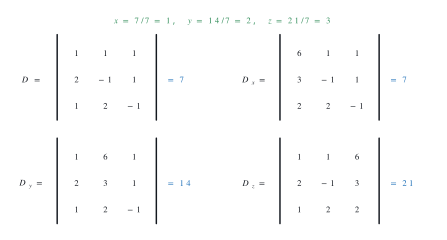
Problem. Solve by Cramer's rule: \;x+y+z = 6, \;2x-y+z = 3, \;x+2y-z = 2.
Solution. Expanding each determinant along its first row (see the figure):
Hence x = \dfrac{7}{7} = 1, y = \dfrac{14}{7} = 2, z = \dfrac{21}{7} = 3.
Check in the second equation: 2(1) - 2 + 3 = 3. Correct.
If D = 0 the rule gives nothing. The system then has either no solution (inconsistent) or infinitely many — decide which by row-reducing, not by dividing by zero.
Row-equivalent matrices and Gauss elimination
Two matrices are row-equivalent if one can be turned into the other by elementary row operations: swapping two rows, multiplying a row by a non-zero constant, or adding a multiple of one row to another. Row-equivalent augmented matrices represent systems with exactly the same solutions.
Gauss elimination uses these operations to drive the coefficient block into upper-triangular form, after which the unknowns drop out one at a time by back substitution.
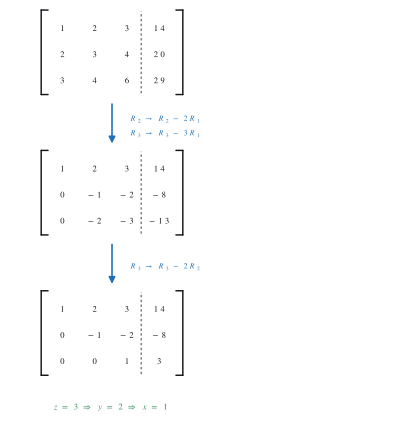
Problem. Solve by Gauss elimination:
Solution. Write the augmented matrix with rows (1,2,3\,|\,14), (2,3,4\,|\,20), (3,4,6\,|\,29).
R_2 \rightarrow R_2 - 2R_1 gives (0,-1,-2\,|\,-8), i.e. -y - 2z = -8. R_3 \rightarrow R_3 - 3R_1 gives (0,-2,-3\,|\,-13).
R_3 \rightarrow R_3 - 2R_2 gives (0,0,1\,|\,3), i.e. z = 3.
Back-substituting into -y-2z = -8: \;-y - 6 = -8, so y = 2. Then from the first row, x + 4 + 9 = 14, so x = 1.
Solution: x = 1, y = 2, z = 3. Check in the third equation: 3 + 8 + 18 = 29. Correct.
Problem. For what value of k is the matrix with rows (2,4) and (3,k) singular? What happens to the system 2x+4y = 5, 3x + ky = 7 at that value?
Solution. Singular means |A| = 0:
At k = 6 the second equation is 3x + 6y = 7, i.e. x + 2y = \tfrac73, while the first is x + 2y = \tfrac52. The same expression cannot equal two different numbers, so the system is inconsistent — no solution. Geometrically the two lines are parallel, which is exactly what a zero determinant detects.
Chapter summary
- (AB)_{ij} is row i of A against column j of B; AB needs (columns of A) = (rows of B), and AB \ne BA in general.
- Transpose swaps rows and columns: (A^{T})^{T} = A, (A+B)^{T} = A^{T}+B^{T}, (kA)^{T} = kA^{T}, and the reversal law (AB)^{T} = B^{T}A^{T}.
- Symmetric: A^{T} = A. Skew-symmetric: A^{T} = -A (zero diagonal). Every square A = \frac12(A+A^{T}) + \frac12(A-A^{T}).
- Minor M_{ij} = determinant after deleting row i and column j; cofactor C_{ij} = (-1)^{i+j}M_{ij}. Expand |A| along the row or column with most zeros.
- \mathrm{adj}\,A = transpose of the cofactor matrix, and A(\mathrm{adj}\,A) = (\mathrm{adj}\,A)A = |A|I.
- A^{-1} = \dfrac{\mathrm{adj}\,A}{|A|} exists iff |A| \ne 0; (AB)^{-1} = B^{-1}A^{-1} and |A^{-1}| = 1/|A|.
- Determinant properties: |A^{T}| = |A|; a row swap flips the sign; equal or proportional rows give 0; |kA| = k^{n}|A|; adding a multiple of one row to another changes nothing; |AB| = |A||B|.
- Systems: AX = B gives X = A^{-1}B; Cramer's rule gives x = D_x/D etc. for D \ne 0; Gauss elimination row-reduces the augmented matrix to upper-triangular form and back-substitutes.
Practice questions
Group A — Multiple choice (1 mark each)
- If A is of order 3 \times 2, then A^{T} is of order [1]a3\times2b2\times3c3\times3d2\times2
- (AB)^{T} equals [1]aA^{T}B^{T}bB^{T}A^{T}cABdBA
- The determinant of the matrix with rows (2,3) and (4,5) is [1]a22b2c-2d-22
- A square matrix A has an inverse if and only if [1]a|A| = 0b|A| \ne 0cA = A^{T}dA is of order 2
- A\,(\mathrm{adj}\,A) equals [1]aIbA^{-1}c|A|\,IdO
- Every diagonal entry of a skew-symmetric matrix is [1]a1b0cequal to |A|dnegative
Answers to Group A
1. (b) — transposing swaps the two numbers in the order.
2. (b) — the reversal law.
3. (c) — 2(5) - 3(4) = 10 - 12 = -2.
4. (b) — A^{-1} = \mathrm{adj}\,A/|A| requires division by |A|.
5. (c) — proved in §6.3.
6. (b) — a_{ii} = -a_{ii} forces a_{ii} = 0.
Group B — Short answer (5 marks each)
- Define the transpose of a matrix. For A with rows (1,2), (3,4) and B with rows (2,0), (1,3), verify that (AB)^{T} = B^{T}A^{T}. [5]
- Find the adjoint and the inverse of the matrix with rows (2,1) and (7,4), and verify that AA^{-1} = I. [5]
- Solve by Cramer's rule: \;2x + 3y = 13, \;3x - y = 3. [5]
- Using properties of determinants, show that the determinant with rows (1,a,a^{2}), (1,b,b^{2}), (1,c,c^{2}) equals (a-b)(b-c)(c-a). [5]
- Express the matrix with rows (3,5) and (1,7) as the sum of a symmetric and a skew-symmetric matrix. [5]
- If A is a non-singular matrix of order 3 with |A| = 5, find |\mathrm{adj}\,A| and |A^{-1}|. [5]
Answers to Group B
1. The transpose A^{T} is obtained by interchanging rows and columns, so (A^{T})_{ij} = a_{ji}.
AB has entries 1(2)+2(1) = 4, 1(0)+2(3) = 6, 3(2)+4(1) = 10, 3(0)+4(3) = 12; so AB has rows (4,6), (10,12) and (AB)^{T} has rows (4,10), (6,12).
B^{T} has rows (2,1), (0,3); A^{T} has rows (1,3), (2,4). Then B^{T}A^{T} has entries 2(1)+1(2) = 4, 2(3)+1(4) = 10, 0(1)+3(2) = 6, 0(3)+3(4) = 12 — rows (4,10) and (6,12). The two agree.
2. |A| = 2(4) - 1(7) = 1. The cofactors are C_{11} = 4, C_{12} = -7, C_{21} = -1, C_{22} = 2, so the cofactor matrix has rows (4,-7), (-1,2) and \mathrm{adj}\,A (its transpose) has rows (4,-1), (-7,2).
Since |A| = 1, A^{-1} = \mathrm{adj}\,A, with rows (4,-1) and (-7,2).
Check: (AA^{-1})_{11} = 2(4)+1(-7) = 1, (AA^{-1})_{12} = 2(-1)+1(2) = 0, (AA^{-1})_{21} = 7(4)+4(-7) = 0, (AA^{-1})_{22} = 7(-1)+4(2) = 1. So AA^{-1} = I.
3. D = 2(-1) - 3(3) = -11 \ne 0.
Check: 2(2)+3(3) = 13 and 3(2) - 3 = 3. Correct.
4. The determinant is the transpose of the one in Worked example 6.10, and by P1 transposing does not change the value, so it is (a-b)(b-c)(c-a). (Directly: R_1 \rightarrow R_1 - R_2 and R_2 \rightarrow R_2 - R_3, take out (a-b) and (b-c), then expand.)
5. A^{T} has rows (3,1), (5,7). Then \frac12(A+A^{T}) has rows (3,3) and (3,7) — symmetric; and \frac12(A-A^{T}) has rows (0,2) and (-2,0) — skew-symmetric. Their sum has rows (3,5), (1,7), which is A.
6. Take determinants of A(\mathrm{adj}\,A) = |A|I. By P8 and P4 (with n = 3),
And from AA^{-1} = I, |A||A^{-1}| = 1, so |A^{-1}| = \dfrac15.
Group C — Long answer (8 marks each)
- (a) Define the minor and the cofactor of an element of a square matrix, and state how the adjoint is built from them. [3](b) Find the inverse of the matrix A with rows (3,-3,4), (2,-3,4), (0,-1,1) by the adjoint method, and verify that AA^{-1} = I. [5]
- (a) State any four properties of determinants. [3](b) Solve the system \;x+2y+3z = 14, \;2x+3y+4z = 20, \;3x+4y+6z = 29 by Gauss elimination. [5]
- (a) Show that A(\mathrm{adj}\,A) = |A|\,I and deduce the formula for A^{-1}. [4](b) Solve \;x+y+z = 6, \;2x-y+z = 3, \;x+2y-z = 2 by Cramer's rule. [4]
Answers to Group C
1. (a) The minor M_{ij} is the determinant left after deleting row i and column j; the cofactor is C_{ij} = (-1)^{i+j}M_{ij}; the adjoint is the transpose of the matrix of cofactors.
(b) Expanding along the third row, |A| = 0 - (-1)\left[3(4)-4(2)\right] + 1\left[3(-3)-(-3)(2)\right] = 4 + (-3) = 1.
The cofactors are C_{11} = (-3)(1) - 4(-1) = 1, C_{12} = -\left[2(1)-4(0)\right] = -2, C_{13} = 2(-1) - (-3)(0) = -2; C_{21} = -\left[(-3)(1) - 4(-1)\right] = -1, C_{22} = 3(1)-4(0) = 3, C_{23} = -\left[3(-1) - (-3)(0)\right] = 3; C_{31} = (-3)(4) - 4(-3) = 0, C_{32} = -\left[3(4)-4(2)\right] = -4, C_{33} = 3(-3) - (-3)(2) = -3.
So the cofactor matrix has rows (1,-2,-2), (-1,3,3), (0,-4,-3), and \mathrm{adj}\,A = C^{T} has rows (1,-1,0), (-2,3,-4), (-2,3,-3). Since |A| = 1, A^{-1} = \mathrm{adj}\,A.
Check the first row of AA^{-1}: 3(1)+(-3)(-2)+4(-2) = 3+6-8 = 1; 3(-1)+(-3)(3)+4(3) = -3-9+12 = 0; 3(0)+(-3)(-4)+4(-3) = 12-12 = 0. So the first row of AA^{-1} is (1,0,0), as required.
2. (a) Any four of P1–P8 in the table above, for example: |A^{T}| = |A|; interchanging two rows changes the sign; two identical rows give zero; adding a multiple of one row to another leaves the value unchanged.
(b) See Worked example 6.13: the augmented matrix row-reduces to rows (1,2,3\,|\,14), (0,-1,-2\,|\,-8), (0,0,1\,|\,3), giving z = 3, then y = 2, then x = 1.
3. (a) The (i,j) entry of A(\mathrm{adj}\,A) is \sum_k a_{ik}C_{jk}. For i = j this is the cofactor expansion of |A| along row i; for i \ne j it is the expansion of a determinant with row j replaced by row i — two identical rows — so it is 0. Hence A(\mathrm{adj}\,A) = |A|I, and dividing by |A| \ne 0 gives A^{-1} = \mathrm{adj}\,A / |A|.
(b) See Worked example 6.12: D = 7, D_x = 7, D_y = 14, D_z = 21, so x = 1, y = 2, z = 3.
Practise more: Mathematics question bank