Unit 5 · Algebra · 6 teaching hours · 21 min read
Sequence and Series
What the syllabus asks for 3
- Arithmetic, geometric and harmonic sequences and series
- A.M., G.M., H.M. and their relations
- Sum of infinite geometric series
A sequence is a list of numbers written in a definite order; a series is what you get when you add the terms of a sequence. Three patterns cover almost all of school mathematics: adding a fixed number each time (arithmetic), multiplying by a fixed number each time (geometric), and taking reciprocals of an arithmetic pattern (harmonic). This unit gives you the n^{\text{th}} term and the sum for each, the three means that sit between two numbers, and the surprising fact that an endless sum of numbers can still be finite.
Almost every question is one of four shapes: find a term, find a sum, insert means, or given two facts about a sequence find the sequence. The last shape — two equations in a and d (or a and r) — is the commonest Group B item. Learn to set up and divide the two equations.
5.1 Arithmetic, geometric and harmonic sequences and series
Arithmetic progression (AP)
A sequence is an arithmetic progression if each term after the first is got by adding a fixed number d, the common difference, to the one before it. With first term a,
so the n^{\text{th}} term (also written t_n or a_n) is
The test for an AP is that t_{n} - t_{n-1} is the same for every n.
Write the sum forwards and then backwards, where l = a+(n-1)d is the last term:
Add the two lines term by term. Every one of the n pairs adds up to a+l:
Putting l = a+(n-1)d gives the working form
Two small results follow and are worth knowing: t_n = S_n - S_{n-1}, and if a, b, c are in AP then 2b = a+c.
Geometric progression (GP)
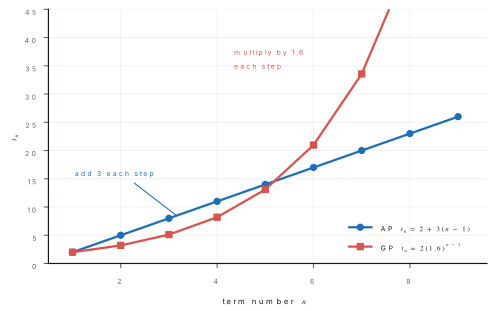
A sequence is a geometric progression if each term after the first is got by multiplying the one before it by a fixed non-zero number r, the common ratio:
The test for a GP is that t_n / t_{n-1} is the same for every n.
Multiply throughout by r:
Subtract the second line from the first. Everything in the middle cancels:
The two forms are identical; use the first when r < 1 and the second when r > 1 so that you never handle negative numerators. If r = 1 the sequence is a, a, a, \ldots and S_n = na.
If a, b, c are in GP then b^{2} = ac.
Harmonic progression (HP)
A sequence of non-zero numbers is a harmonic progression if the reciprocals of its terms form an AP. So \tfrac{1}{3}, \tfrac{1}{7}, \tfrac{1}{11}, \ldots is an HP because 3, 7, 11, \ldots is an AP.
Turn the terms upside down, work with the resulting AP, and invert the answer at the very end. There is no separate formula worth memorising; the n^{\text{th}} term of an HP whose reciprocals have first term a and common difference d is
There is no elementary formula for the sum of an HP — NEB never asks for one.
| AP | GP | HP | |
|---|---|---|---|
| Built by | adding d | multiplying by r | reciprocals form an AP |
| n^{\text{th}} term | a+(n-1)d | ar^{\,n-1} | 1/[a+(n-1)d] |
| Test on three terms | 2b = a+c | b^{2} = ac | b = 2ac/(a+c) |
| Sum of n terms | \frac{n}{2}[2a+(n-1)d] | \frac{a(r^{n}-1)}{r-1} | no simple formula |
Problem. Which term of the arithmetic progression 7, 11, 15, \ldots is 179?
Solution. Here a = 7 and d = 11 - 7 = 4. Set t_n = 179:
Subtract 7: \;4(n-1) = 172, so n - 1 = 43 and n = 44.
The 44^{\text{th}} term is 179.
Problem. The sum of the first 10 terms of an AP is 175 and the sum of the first 20 terms is 650. Find the progression.
Solution. Use S_n = \frac{n}{2}[2a+(n-1)d] twice.
Subtracting the first from the second eliminates a: \;10d = 30, so d = 3. Then 2a = 35 - 9(3) = 8, giving a = 4.
The progression is 4,\ 7,\ 10,\ 13,\ \ldots
Problem. The third term of a GP is 12 and the sixth term is 96. Find the first term, the common ratio and the sum of the first eight terms.
Solution. From t_n = ar^{\,n-1},
Divide the second equation by the first — this is the standard move, because a cancels:
Then a(2)^{2} = 12 gives a = 3. Since r > 1,
Problem. (a) Find the 8^{\text{th}} term of the HP \tfrac{1}{3}, \tfrac{1}{7}, \tfrac{1}{11}, \ldots (b) Which term of the HP \tfrac{1}{2}, \tfrac{1}{5}, \tfrac{1}{8}, \ldots equals \tfrac{1}{98}?
Solution. (a) Invert: the reciprocals 3, 7, 11, \ldots form an AP with a = 3, d = 4. Its eighth term is 3 + 7(4) = 31. Inverting back, the 8^{\text{th}} term of the HP is \dfrac{1}{31}.
(b) Invert: 2, 5, 8, \ldots is an AP with a = 2, d = 3, and we need the term equal to 98:
So \tfrac{1}{98} is the 33^{\text{rd}} term.
Problem. A shopkeeper in Birgunj saves Rs 2000 in the first month of a savings scheme and increases the amount by Rs 250 every month. How much has she saved at the end of two years?
Solution. The monthly amounts form an AP with a = 2000, d = 250 and n = 24 months.
She has saved Rs 1,17,000.
If solving for n gives a fraction or a negative value, the number you were given is simply not a term of that sequence — say so. Do not round n to the nearest integer.
5.2 A.M., G.M., H.M. and their relations
The three means of two numbers
For two numbers a and b (positive, unless stated otherwise):
- The arithmetic mean A is the number that makes a, A, b an AP: 2A = a+b, so A = \dfrac{a+b}{2}.
- The geometric mean G makes a, G, b a GP: G^{2} = ab, so G = \sqrt{ab}.
- The harmonic mean H makes a, H, b an HP, i.e. \dfrac1a, \dfrac1H, \dfrac1b is an AP: \dfrac{2}{H} = \dfrac1a + \dfrac1b, so H = \dfrac{2ab}{a+b}.
Each definition is just "the middle term of the corresponding progression".
Inserting n means between two numbers
To insert n arithmetic means between a and b is to build an AP with n+2 terms in which a is the first and b is the last. So b = a + (n+1)d, giving
For n geometric means we need a GP of n+2 terms, so b = ar^{\,n+1} and
For n harmonic means, insert n arithmetic means between 1/a and 1/b and invert every one of them at the end.
The commonest slip is writing b = a+nd. Inserting n means makes n+2 terms, so the last term is the (n+2)^{\text{th}}, which is a+(n+1)d.
The relation A \ge G \ge H and G^{2} = AH
The product relation. Multiply A and H:
So A, G, H are themselves in geometric progression. This is the single most useful identity in the section: given any two of the three means you get the third at once.
The inequality. For positive a, b,
because a square is never negative. Hence A \ge G, with equality only when \sqrt{a} = \sqrt{b}, i.e. a = b. Now from G^{2} = AH we get H = G^{2}/A, so
since G > 0, A > 0 and A - G \ge 0. Therefore
with all three equal exactly when a = b.
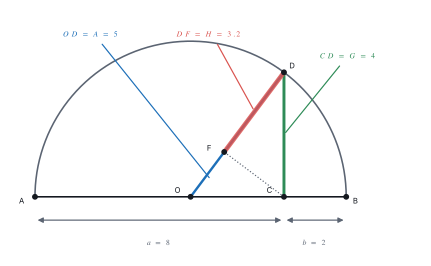
The inequality has a clean picture. Draw a semicircle on a diameter of length a+b; then the radius is A, the perpendicular half-chord is G, and a second perpendicular inside the triangle is H.
Problem. Insert four arithmetic means between 3 and 23, and three geometric means between 2 and 32.
Solution. Arithmetic. Four means give 4+2 = 6 terms, so 23 is the sixth term:
The means are 7,\ 11,\ 15,\ 19.
Geometric. Three means give 5 terms, so 32 is the fifth term:
With r = 2 the means are 4,\ 8,\ 16; with r = -2 they are -4,\ 8,\ -16. Both sets are valid geometric means.
Problem. The arithmetic mean of two positive numbers is 10 and their geometric mean is 8. Find the numbers and their harmonic mean.
Solution. From A = 10: \;a + b = 20. From G = 8: \;ab = 64.
Two numbers with known sum and product are the roots of x^{2} - (\text{sum})x + (\text{product}) = 0:
So the numbers are 4 and 16.
Check with G^{2} = AH: \;AH = 10 \times 6.4 = 64 = 8^{2}. Correct, and 10 > 8 > 6.4 as the inequality requires.
Problem. Three numbers in geometric progression have sum 21 and product 216. Find them.
Solution. When a product is given, choose the terms symmetrically as \dfrac{a}{r},\ a,\ ar — the r then cancels in the product.
Now use the sum:
Multiply by 2r: \;2 + 2r^{2} = 5r, i.e. 2r^{2} - 5r + 2 = 0, so (2r-1)(r-2) = 0 and r = 2 or r = \tfrac12.
Either way the numbers are 3,\ 6,\ 12 (in one order or the reverse).
5.3 Sum of infinite geometric series
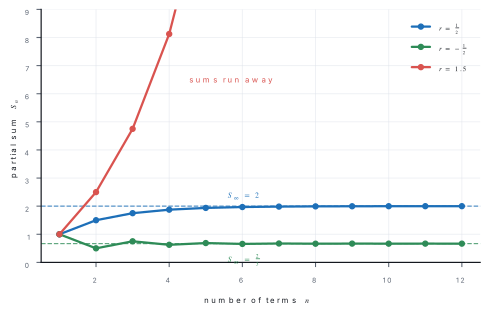
Add more and more terms of a GP and watch S_n. For r = \tfrac12 and a = 1 the partial sums are 1, 1.5, 1.75, 1.875, \ldots — climbing, but never reaching 2. For r = 2 they are 1, 3, 7, 15, \ldots — running away. The difference is entirely the size of r.
Start from the finite sum, written so the r^{n} is isolated:
If |r| < 1, repeated multiplication by r shrinks the number towards zero, so r^{n} \to 0 as n \to \infty. The second term vanishes and
If |r| \ge 1 then r^{n} does not tend to zero — the partial sums grow without limit (or oscillate, when r \le -1) and the series has no sum.
Always state the condition. Examiners award a mark for it, and a "sum to infinity" asked about r = 3 has the answer the series does not converge, not a number.
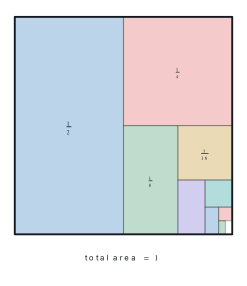
Why does an endless sum stay finite? Because the terms shrink fast enough that they can be packed inside a region of finite size. Take a = \tfrac12, r = \tfrac12: the terms \tfrac12, \tfrac14, \tfrac18, \ldots tile a unit square exactly, leaving nothing over.
The same story told with numbers: plot S_n against n and the convergent cases flatten onto a horizontal line while the divergent case escapes.
Problem. Find the sum to infinity of \;9 - 6 + 4 - \dfrac{8}{3} + \cdots
Solution. The ratio is r = \dfrac{-6}{9} = -\dfrac{2}{3}; check it with the next pair, \dfrac{4}{-6} = -\dfrac{2}{3}. Since |r| = \tfrac23 < 1 the sum exists. With a = 9,
Problem. Express the recurring decimal 0.\overline{45} = 0.454545\ldots as a fraction in lowest terms.
Solution. Split the decimal into blocks of two digits:
This is a GP with a = \dfrac{45}{100} and r = \dfrac{1}{100}, and |r| < 1, so
Dividing confirms it: 5 \div 11 = 0.4545\ldots
Problem. The sum of an infinite geometric series is 15 and the sum of the squares of its terms is 45. Find the series.
Solution. Squaring every term of a GP with ratio r gives a GP with first term a^{2} and ratio r^{2}. So we have two equations:
From (1), a = 15(1-r). Substitute into (2), using 1-r^{2} = (1-r)(1+r):
Then a = 15\left(1-\tfrac23\right) = 5. The series is
Check. Sum of squares = \dfrac{25}{1-\frac49} = \dfrac{25}{\frac59} = 45. Correct.
In the last example the second series has ratio r^{2}, so its denominator is 1 - r^{2}, not 1-r. Writing a^{2}/(1-r) is the standard error here.
Chapter summary
- AP: t_n = a+(n-1)d and S_n = \frac{n}{2}[2a+(n-1)d] = \frac{n}{2}(a+l). Three terms are in AP if 2b = a+c.
- GP: t_n = ar^{\,n-1} and S_n = \dfrac{a(r^{n}-1)}{r-1} = \dfrac{a(1-r^{n})}{1-r} for r \ne 1. Three terms are in GP if b^{2} = ac.
- HP: reciprocals form an AP, so t_n = 1/[a+(n-1)d]. Invert, solve as an AP, invert back. There is no elementary sum formula.
- Means of a and b: A = \dfrac{a+b}{2}, G = \sqrt{ab}, H = \dfrac{2ab}{a+b}.
- G^{2} = AH (so A, G, H are in GP) and A \ge G \ge H, with equality only when a = b.
- Inserting n means makes n+2 terms: d = \dfrac{b-a}{n+1}, r = (b/a)^{1/(n+1)}.
- Sum to infinity: S_{\infty} = \dfrac{a}{1-r} if and only if |r| < 1.
- Two given facts about a sequence give two equations: subtract them for an AP, divide them for a GP.
Practice questions
Group A — Multiple choice (1 mark each)
- The 10^{\text{th}} term of the AP 2, 5, 8, \ldots is [1]a27b29c31d32
- If the arithmetic mean of two numbers is 9 and their geometric mean is 6, their harmonic mean is [1]a3b4c5d7.5
- The sum of the infinite series 1 + \frac{1}{3} + \frac{1}{9} + \cdots is [1]a\frac{2}{3}b\frac{4}{3}c\frac{3}{2}d2
- An infinite geometric series has a finite sum if and only if [1]ar > 1br < 0c|r| < 1d|r| \ge 1
- The harmonic mean between 3 and 6 is [1]a4b4.5c\sqrt{18}d9
- If 2, x, 8 are in geometric progression, then x equals [1]a4 onlyb5c\pm 4d\pm 5
Answers to Group A
1. (b) — t_{10} = 2 + 9(3) = 29.
2. (b) — G^{2} = AH gives 36 = 9H, so H = 4.
3. (c) — a = 1, r = \tfrac13, so S_{\infty} = 1/(1-\tfrac13) = \tfrac32.
4. (c) — only then does r^{n} \to 0.
5. (a) — H = 2(3)(6)/(3+6) = 36/9 = 4.
6. (c) — x^{2} = 2 \times 8 = 16, so x = \pm 4; both make a valid GP (2,4,8 with r=2, and 2,-4,8 with r=-2).
Group B — Short answer (5 marks each)
- Derive the formula for the sum of the first n terms of an arithmetic series, and hence find the sum of the first 30 odd natural numbers. [5]
- The fourth term of a geometric progression is 24 and the seventh term is 192. Find the first term, the common ratio and the sum of the first 10 terms. [5]
- If a, b, c are in harmonic progression, show that b = \dfrac{2ac}{a+c}. Hence find the harmonic mean of 4 and 12. [5]
- Insert four harmonic means between \dfrac{1}{2} and \dfrac{1}{12}. [5]
- The first term of an infinite geometric series is 3 and its sum is 4. Find the common ratio and the fourth term. [5]
- Express 0.3\overline{7} = 0.3777\ldots as a fraction in lowest terms. [5]
Answers to Group B
1. Write S_n = a + (a+d) + \cdots + l and again in reverse order; adding the two lines pairs every term to give a+l, and there are n pairs, so 2S_n = n(a+l) and S_n = \frac{n}{2}(a+l) = \frac{n}{2}[2a+(n-1)d].
For the odd numbers 1, 3, 5, \ldots: a = 1, d = 2, n = 30, so S_{30} = 15[2 + 29(2)] = 15(60) = 900. (Indeed the sum of the first n odd numbers is always n^{2} = 30^{2} = 900.)
2. ar^{3} = 24 and ar^{6} = 192. Dividing, r^{3} = 8, so r = 2; then 8a = 24 gives a = 3.
3. a, b, c in HP means \frac1a, \frac1b, \frac1c are in AP, so \frac{2}{b} = \frac1a + \frac1c = \frac{a+c}{ac}. Cross-multiplying gives b = \dfrac{2ac}{a+c}.
For 4 and 12: H = \dfrac{2(4)(12)}{16} = \dfrac{96}{16} = 6.
4. Work with the reciprocals 2 and 12. Four means give six terms, so 12 = 2 + 5d, i.e. d = 2. The AP is 2, 4, 6, 8, 10, 12, so the four harmonic means are \dfrac14,\ \dfrac16,\ \dfrac18,\ \dfrac{1}{10}.
5. \dfrac{3}{1-r} = 4 gives 3 = 4 - 4r, so r = \dfrac14 (and |r| < 1, so the sum is legitimate). Fourth term = ar^{3} = 3\left(\tfrac14\right)^{3} = \dfrac{3}{64}.
6. Only the 7 recurs, so separate the non-recurring part:
The bracket is a GP with a = \frac{7}{100}, r = \frac{1}{10}, summing to \dfrac{7/100}{9/10} = \dfrac{7}{90}. So the value is \dfrac{3}{10} + \dfrac{7}{90} = \dfrac{27+7}{90} = \dfrac{34}{90} = \dfrac{17}{45}. Check: 17 \div 45 = 0.3777\ldots
Group C — Long answer (8 marks each)
- (a) Define a geometric progression and derive the formula for the sum of its first n terms. [4](b) The sum of three numbers in geometric progression is 21 and their product is 216. Find the numbers. [4]
- (a) For two positive numbers, prove that G^{2} = AH and that A \ge G \ge H. [4](b) The arithmetic mean of two numbers is \dfrac{25}{4} and their harmonic mean is 4. Find the numbers. [4]
- (a) State the condition under which an infinite geometric series has a sum, and derive the formula for that sum. [4](b) A ball is dropped from a height of 12\ \text{m} and on each bounce rises to \dfrac{2}{3} of the previous height. Find the total vertical distance it travels before coming to rest. [4]
Answers to Group C
1. (a) See the derivation in §5.1: multiply S_n by r, subtract, and the middle terms cancel to leave S_n(1-r) = a(1-r^{n}), so S_n = \dfrac{a(1-r^{n})}{1-r} for r \ne 1.
(b) Take the numbers as \dfrac{a}{r}, a, ar. The product gives a^{3} = 216, so a = 6. The sum gives \dfrac6r + 6 + 6r = 21, i.e. r + \dfrac1r = \dfrac52, so 2r^{2} - 5r + 2 = 0 and r = 2 or \tfrac12. The numbers are 3, 6, 12.
2. (a) AH = \dfrac{a+b}{2}\cdot\dfrac{2ab}{a+b} = ab = G^{2}. Next, A - G = \dfrac{(\sqrt{a} - \sqrt{b})^{2}}{2} \ge 0, so A \ge G; and G - H = G - \dfrac{G^{2}}{A} = \dfrac{G(A-G)}{A} \ge 0, so G \ge H. Equality throughout only if a = b.
(b) G^{2} = AH = \dfrac{25}{4}\times 4 = 25, so ab = 25. Also a+b = 2A = \dfrac{25}{2}. The numbers are the roots of
So the numbers are 10 and 2.5. Check: A = 12.5/2 = 6.25 = \tfrac{25}{4} and H = 2(25)/12.5 = 4. Correct.
3. (a) S_n = \dfrac{a}{1-r} - \dfrac{ar^{n}}{1-r}. If |r| < 1 then r^{n} \to 0 as n \to \infty, leaving S_{\infty} = \dfrac{a}{1-r}. If |r| \ge 1, r^{n} does not tend to zero and no sum exists.
(b) The ball falls 12\ \text{m}, then rises and falls 12\left(\tfrac23\right), then rises and falls 12\left(\tfrac23\right)^{2}, and so on. Total distance
The bracket is a GP with a = 8, r = \tfrac23, so its sum is \dfrac{8}{1-\frac23} = 24. Total distance = 12 + 2(24) = 60\ \text{m}.
Practise more: Mathematics question bank