Unit 14 · Vectors · 12 teaching hours · 26 min read
Vectors
What the syllabus asks for 4
- Collinear and non-collinear vectors
- Coplanar and non-coplanar vectors
- Linear combination of vectors
- Linearly dependent and independent vectors
A vector is a quantity that needs a direction as well as a size before it means anything. Once you can add vectors, resolve them into components and write one vector in terms of others, a large part of coordinate geometry and mechanics becomes ordinary algebra. This unit builds that algebra: collinearity, coplanarity, linear combinations, linear dependence, and the scalar product that measures the angle between two vectors.
Almost every vector question reduces to one of three sentences. "Two vectors are parallel" means \vec{a} = k\vec{b}. "Three vectors are coplanar" means one is a linear combination of the other two. "Two vectors are perpendicular" means \vec{a}\cdot\vec{b} = 0. Learn to recognise which sentence a question is asking you to write down, and the working is short.
14.1 Collinear and non-collinear vectors
Notation, magnitude and unit vectors
A scalar has magnitude only (mass, time, temperature). A vector has magnitude and direction (displacement, velocity, force). A vector is drawn as a directed line segment: the length of the segment is the magnitude, the arrowhead gives the direction. The vector from A to B is written \vec{AB}, or by a single letter \vec{a}. Its magnitude is |\vec{AB}| or |\vec{a}|, a non-negative scalar.
| Type of vector | Meaning |
|---|---|
| Zero (null) vector \vec{0} | magnitude 0, direction undefined |
| Unit vector \hat{a} | magnitude exactly 1 |
| Equal vectors | same magnitude and same direction |
| Negative vector -\vec{a} | same magnitude, opposite direction |
| Like vectors | parallel, same sense |
| Unlike vectors | parallel, opposite sense |
| Position vector | vector from a fixed origin O to a point |
In space we fix three mutually perpendicular unit vectors \hat{i}, \hat{j}, \hat{k} along OX, OY, OZ. Every vector can then be written in component form:
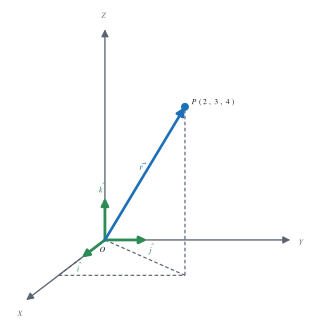
The unit vector along \vec{a} is
If \vec{a} = x\hat{i}+y\hat{j}+z\hat{k} makes angles \alpha,\beta,\gamma with the axes, its direction cosines are l = x/|\vec{a}|, m = y/|\vec{a}|, n = z/|\vec{a}|, and they satisfy l^{2}+m^{2}+n^{2} = 1.
Problem. For \vec{a} = 2\hat{i} - 3\hat{j} + 6\hat{k}, find |\vec{a}|, the unit vector along \vec{a}, and its direction cosines.
Solution. Magnitude first, from the components:
Divide the vector by its magnitude to get the unit vector:
The components of \hat{a} are the direction cosines, so l = 2/7, m = -3/7, n = 6/7. Check: \frac{4}{49} + \frac{9}{49} + \frac{36}{49} = \frac{49}{49} = 1. ✔
Adding vectors: triangle and parallelogram laws
Vectors are added head to tail, not by adding magnitudes.
Triangle law. If two vectors are represented by two sides of a triangle taken in order, their sum is represented by the third side taken in the opposite order: \vec{AB} + \vec{BC} = \vec{AC}.
Parallelogram law. If two vectors act at a point and are represented by two adjacent sides of a parallelogram, their sum is the diagonal through that point.
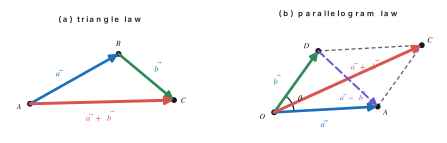
Let |\vec{a}| = a, |\vec{b}| = b and let \theta be the angle between them, as in the parallelogram figure. Drop a perpendicular from C to the line OA extended, meeting it at N. In the right triangle ANC, AN = b\cos\theta and CN = b\sin\theta.
Apply Pythagoras to the right triangle ONC:
Expanding and using \cos^{2}\theta + \sin^{2}\theta = 1:
If the resultant makes an angle \alpha with \vec{a}, then from the same triangle \tan\alpha = CN/ON, so
Problem. Two vectors of magnitudes 5 and 3 units act at a point with 60^{\circ} between them. Find the magnitude of their resultant and the angle it makes with the larger vector.
Solution. Here a = 5, b = 3, \theta = 60^{\circ}, so \cos 60^{\circ} = 0.5 and \sin 60^{\circ} = 0.8660.
For the direction,
so \alpha = \tan^{-1}(0.3997) = 21.79^{\circ} from the 5-unit vector.
|\vec{a}+\vec{b}| = |\vec{a}| + |\vec{b}| only when the two vectors are like parallel vectors (\theta = 0^{\circ}). In general |\vec{a}+\vec{b}| \leq |\vec{a}| + |\vec{b}|. Writing 5 + 3 = 8 for the example above instead of 7 is the single commonest slip in this chapter.
Position vectors
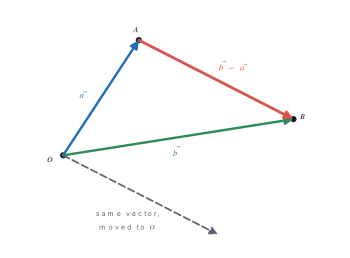
Fix an origin O. The position vector of a point A is \vec{OA}, usually written \vec{a}. For any two points A and B, the triangle law on O, A, B gives \vec{OA} + \vec{AB} = \vec{OB}, so
In words: the vector joining two points is the position vector of the head minus the position vector of the tail. Everything else in this chapter is built on this one line.
Collinear and non-collinear vectors
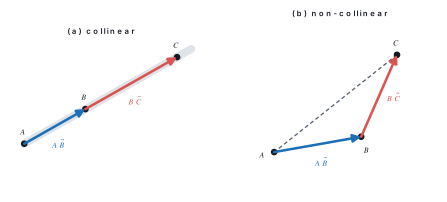
Two or more vectors are collinear (or parallel) if they lie along the same line or along parallel lines, so that each is a scalar multiple of the other. Vectors that are not collinear are non-collinear.
The scalar k carries the information: k > 0 means like vectors (same sense), k < 0 means unlike vectors, and |k| is the ratio of the magnitudes.
In component form, \vec{a} = a_1\hat{i}+a_2\hat{j}+a_3\hat{k} and \vec{b} = b_1\hat{i}+b_2\hat{j}+b_3\hat{k} are collinear when their components are proportional:
Collinear points. Three points A, B, C are collinear if the vectors \vec{AB} and \vec{BC} are collinear, i.e. \vec{BC} = k\,\vec{AB}. Because they share the point B, the two parallel segments must lie on one straight line.
Problem. Show that the points A(2,-1,3), B(4,3,-1) and C(7,9,-7) are collinear.
Solution. Write the position vectors and take differences (head minus tail).
Now test whether one is a scalar multiple of the other:
So \vec{BC} is collinear with \vec{AB}, and since both contain the point B, the three points lie on one straight line. Hence A, B, C are collinear, and BC : AB = 3 : 2.
The section formula
Let P divide the join of A and B internally in the ratio m:n, so that AP : PB = m : n. Then \vec{AP} and \vec{PB} point the same way, and
Writing each as head minus tail with position vectors \vec{a}, \vec{b}, \vec{r}:
For external division the ratio is AP:PB = m:(-n), so replace n by -n:
Putting m = n = 1 in the internal formula gives the midpoint: \vec{r} = \dfrac{\vec{a}+\vec{b}}{2}.
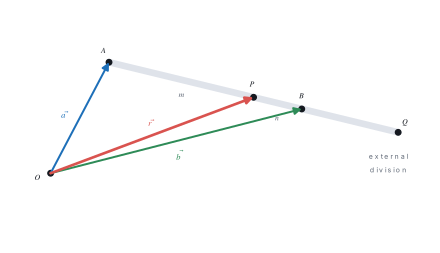
Problem. Find the position vector of the point that divides the join of A(1,2,3) and B(6,7,8) in the ratio 2:3 (a) internally, (b) externally.
Solution. Here \vec{a} = \hat{i}+2\hat{j}+3\hat{k}, \vec{b} = 6\hat{i}+7\hat{j}+8\hat{k}, m = 2, n = 3.
(a) Internal division:
so the point is (3,4,5).
(b) External division: replace +n by -n and m+n by m-n = -1:
so the point is (-9,-8,-7). Note that it lies outside the segment AB, on the side of A, as it must when m < n.
In \vec{r} = \dfrac{m\vec{b}+n\vec{a}}{m+n} the coefficient of \vec{b} is m — the part of the ratio furthest from B. Swapping m and n is the usual error. Check your answer: the point must lie between A and B for internal division.
Problem. P, Q, R, S are the midpoints of the sides AB, BC, CD, DA of a quadrilateral ABCD. Prove by vectors that PQRS is a parallelogram.
Solution. Take any origin O and let the position vectors of A,B,C,D be \vec{a},\vec{b},\vec{c},\vec{d}. By the midpoint formula,
Now compute two opposite sides, head minus tail:
So \vec{PQ} = \vec{SR}: the sides PQ and SR are equal in length and parallel. A quadrilateral with one pair of opposite sides equal and parallel is a parallelogram. Hence PQRS is a parallelogram, and each of its sides is half the diagonal AC or BD of the original quadrilateral.
14.2 Coplanar and non-coplanar vectors
Vectors are coplanar if, when drawn from a common point, they all lie in one plane. Otherwise they are non-coplanar.
Two facts settle most questions:
- Any two vectors are always coplanar. Drawn from a common point, two lines always determine a plane. You need at least three vectors before non-coplanarity is even possible.
- Three vectors \vec{a}, \vec{b}, \vec{c} (with \vec{a}, \vec{b} non-collinear) are coplanar if and only if \vec{c} can be written as
for some scalars x, y.
The reason is short. If \vec{c} = x\vec{a}+y\vec{b}, then \vec{c} is built entirely out of steps taken along \vec{a} and \vec{b}, and every such step stays in the plane of \vec{a} and \vec{b}. Conversely, if \vec{c} lies in that plane, complete a parallelogram in the plane with sides along \vec{a} and \vec{b} and diagonal \vec{c}; the side lengths give x and y.
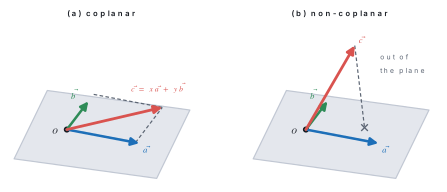
A consequence worth remembering: any three points are always coplanar (three points determine a plane), so "prove these points are coplanar" only becomes a real question for four points A,B,C,D — and then the test is whether \vec{AD} is a linear combination of \vec{AB} and \vec{AC}.
Problem. Show that the vectors \vec{a} = \hat{i}+2\hat{j}-\hat{k}, \vec{b} = 2\hat{i}-\hat{j}+3\hat{k} and \vec{c} = 4\hat{i}+3\hat{j}+\hat{k} are coplanar, and find the scalars involved.
Solution. \vec{a} and \vec{b} are not parallel (their components are not proportional: 1/2 \ne 2/(-1)), so we test whether \vec{c} = x\vec{a} + y\vec{b}.
Comparing components of \hat{i}, \hat{j}, \hat{k} gives three equations:
Solve the first two. From the first, x = 4 - 2y; substituting into the second,
These values must also satisfy the third equation, and they do: -2 + 3(1) = 1. ✔
Since \vec{c} = 2\vec{a} + \vec{b}, the vector \vec{c} lies in the plane of \vec{a} and \vec{b}. The three vectors are coplanar.
Three components give three equations but there are only two unknowns. Solving two of them always produces some x and y; the vectors are coplanar only if those values also satisfy the third equation. Skipping that check turns a proof into a guess.
Problem. Find the value of \lambda for which the vectors \vec{a} = \hat{i}+2\hat{j}+3\hat{k}, \vec{b} = 2\hat{i}-\hat{j}+4\hat{k} and \vec{c} = 3\hat{i}+\lambda\hat{j}+7\hat{k} are coplanar.
Solution. Coplanar means \vec{c} = x\vec{a} + y\vec{b}. Comparing components:
Use the two equations that do not contain \lambda. From the first, x = 3 - 2y, so
Substituting into the remaining equation gives \lambda = 2(1) - 1 = 1.
So \lambda = 1, and then \vec{c} = \vec{a} + \vec{b} — which you can check directly: (1+2)\hat{i}+(2-1)\hat{j}+(3+4)\hat{k} = 3\hat{i}+\hat{j}+7\hat{k}. ✔
14.3 Linear combination of vectors
If \vec{a}_1, \vec{a}_2, \ldots, \vec{a}_n are vectors and c_1, c_2, \ldots, c_n are scalars, the vector
is called a linear combination of \vec{a}_1, \ldots, \vec{a}_n with coefficients c_1,\ldots,c_n.
The whole of component form is one example: \vec{r} = x\hat{i}+y\hat{j}+z\hat{k} is a linear combination of \hat{i}, \hat{j}, \hat{k}.
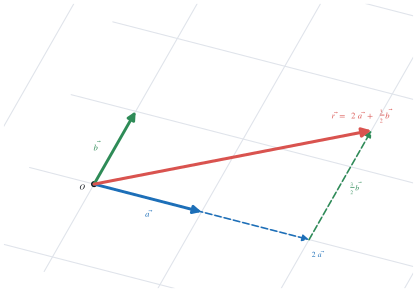
Let \vec{a} and \vec{b} be non-collinear, and suppose the same vector \vec{r} can be written in two ways,
Subtracting,
If x_1 \ne x_2 we could divide by (x_1-x_2) and get
which says \vec{a} is a scalar multiple of \vec{b} — i.e. they are collinear, contradicting our assumption. Hence x_1 = x_2, and then (y_1-y_2)\vec{b} = \vec{0} with \vec{b} \ne \vec{0} forces y_1 = y_2.
Conclusion. Two non-collinear vectors form a basis for their plane: every vector in the plane is a linear combination of them in exactly one way. Likewise three non-coplanar vectors form a basis for space.
Problem. Express \vec{c} = 8\hat{i}+7\hat{j} as a linear combination of \vec{a} = 2\hat{i}+3\hat{j} and \vec{b} = \hat{i}-\hat{j}.
Solution. Let \vec{c} = x\vec{a} + y\vec{b}. Then
Equate the coefficients of \hat{i} and of \hat{j} separately:
Adding the two equations eliminates y: 5x = 15, so x = 3, and then y = 8 - 2(3) = 2.
Check: 3(2\hat{i}+3\hat{j}) + 2(\hat{i}-\hat{j}) = 8\hat{i}+7\hat{j}. ✔ Because \vec{a} and \vec{b} are non-collinear, this is the only possible answer.
14.4 Linearly dependent and independent vectors
The vectors \vec{a}_1,\ldots,\vec{a}_n are linearly dependent if there exist scalars c_1,\ldots,c_n, not all zero, such that
If the only way to make the sum \vec{0} is c_1 = c_2 = \cdots = c_n = 0, the vectors are linearly independent.
The definition looks abstract but says something concrete: a dependent set has at least one vector that is redundant, because it can be built from the others. If c_1 \ne 0, divide through by c_1:
This links the idea straight back to the last two sections:
| Number of vectors | Linearly dependent means | Linearly independent means |
|---|---|---|
| 2 | collinear (parallel) | non-collinear |
| 3 | coplanar | non-coplanar |
| 4 or more in space | always dependent | impossible |
| any set containing \vec{0} | always dependent | — |
To test \vec{a},\vec{b},\vec{c} for independence, set x\vec{a}+y\vec{b}+z\vec{c} = \vec{0}, compare the \hat{i}, \hat{j}, \hat{k} components to get three homogeneous equations, and solve. If the only solution is x=y=z=0, the vectors are independent; if a non-zero solution exists, they are dependent and that solution is the relation between them.
Problem. Show that \vec{a} = \hat{i}+\hat{j}, \vec{b} = \hat{j}+\hat{k} and \vec{c} = \hat{k}+\hat{i} are linearly independent.
Solution. Suppose x\vec{a} + y\vec{b} + z\vec{c} = \vec{0}. Collecting terms,
Since \hat{i},\hat{j},\hat{k} are themselves independent, each bracket is zero:
Add all three equations: 2(x+y+z) = 0, so x+y+z = 0. Subtracting each of the three equations from this in turn,
The only solution is the trivial one, so the three vectors are linearly independent — equivalently, they are non-coplanar, and they form a basis of space.
Problem. Show that \vec{a} = \hat{i}+2\hat{j}-\hat{k}, \vec{b} = 3\hat{i}-\hat{j}+2\hat{k} and \vec{c} = 5\hat{i}+3\hat{j} are linearly dependent, and write down the relation connecting them.
Solution. Try to build \vec{c} from the other two: let \vec{c} = x\vec{a}+y\vec{b}. Comparing components,
From the third equation, x = 2y. Substituting into the first, 2y + 3y = 5, so y = 1 and x = 2. Check the second equation: 2(2) - 1 = 3. ✔
Therefore \vec{c} = 2\vec{a} + \vec{b}, i.e.
The coefficients 2, 1, -1 are not all zero, so the three vectors are linearly dependent (and hence coplanar).
14.5 The scalar product and the angle between two vectors
The three tests above are all about parallelism. To measure angles — and in particular perpendicularity — we need one more operation.
For vectors \vec{a}, \vec{b} with angle \theta (0 \leq \theta \leq 180^{\circ}) between them,
The result is a scalar, not a vector.
Applying this to the base vectors, \hat{i}\cdot\hat{i} = \hat{j}\cdot\hat{j} = \hat{k}\cdot\hat{k} = 1 (angle 0^{\circ}) and \hat{i}\cdot\hat{j} = \hat{j}\cdot\hat{k} = \hat{k}\cdot\hat{i} = 0 (angle 90^{\circ}). Expanding (a_1\hat{i}+a_2\hat{j}+a_3\hat{k})\cdot(b_1\hat{i}+b_2\hat{j}+b_3\hat{k}) term by term, all the cross terms vanish and
Putting the two expressions together gives the working formula for the angle:
- \vec{a}\cdot\vec{b} = \vec{b}\cdot\vec{a} (commutative) and \vec{a}\cdot(\vec{b}+\vec{c}) = \vec{a}\cdot\vec{b} + \vec{a}\cdot\vec{c} (distributive).
- \vec{a}\cdot\vec{a} = |\vec{a}|^{2}.
- \vec{a} \perp \vec{b} \Leftrightarrow \vec{a}\cdot\vec{b} = 0 (for non-zero vectors).
- Projection of \vec{b} on \vec{a} is \dfrac{\vec{a}\cdot\vec{b}}{|\vec{a}|} = \vec{b}\cdot\hat{a}.
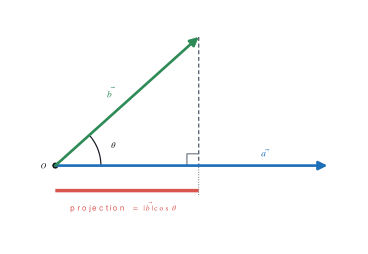
Problem. Find the angle between \vec{a} = \hat{i}+\hat{j} and \vec{b} = \hat{i}+\hat{k}.
Solution. In components \vec{a} = (1,1,0) and \vec{b} = (1,0,1), so
Hence \theta = 60^{\circ}.
Problem. (a) Find the projection of \vec{b} = 2\hat{i}+3\hat{j}+2\hat{k} on \vec{a} = \hat{i}+2\hat{j}+2\hat{k}. (b) Find \lambda if 2\hat{i}+\lambda\hat{j}+\hat{k} is perpendicular to \hat{i}-2\hat{j}+3\hat{k}.
Solution.
(a) \vec{a}\cdot\vec{b} = (1)(2)+(2)(3)+(2)(2) = 2+6+4 = 12 and |\vec{a}| = \sqrt{1+4+4} = 3, so
(b) Perpendicular means the dot product is zero:
Let OABC be a rhombus with \vec{OA} = \vec{a} and \vec{OC} = \vec{b}. All sides are equal, so |\vec{a}| = |\vec{b}|.
The diagonals are \vec{OB} = \vec{a}+\vec{b} and \vec{CA} = \vec{a}-\vec{b}. Take their dot product and expand using the distributive law:
The two middle terms cancel because the dot product is commutative, leaving
A zero dot product between two non-zero vectors means they are perpendicular. Hence the diagonals of a rhombus cut at right angles. (The same calculation run backwards shows that if the diagonals of a parallelogram are perpendicular, it must be a rhombus.)
Chapter summary
- A vector needs magnitude and direction; in components \vec{r} = x\hat{i}+y\hat{j}+z\hat{k} with |\vec{r}| = \sqrt{x^{2}+y^{2}+z^{2}}, unit vector \hat{r} = \vec{r}/|\vec{r}|, and direction cosines satisfying l^{2}+m^{2}+n^{2} = 1.
- Triangle law: \vec{AB}+\vec{BC} = \vec{AC}. For two vectors at angle \theta, R = \sqrt{a^{2}+b^{2}+2ab\cos\theta} and \tan\alpha = \dfrac{b\sin\theta}{a+b\cos\theta}.
- \vec{AB} = \vec{b}-\vec{a} (head minus tail) — the key to every proof.
- Collinear: \vec{a} = k\vec{b}; points A,B,C collinear if \vec{BC} = k\,\vec{AB}.
- Section formula: internal \vec{r} = \dfrac{m\vec{b}+n\vec{a}}{m+n}, external \vec{r} = \dfrac{m\vec{b}-n\vec{a}}{m-n}, midpoint \dfrac{\vec{a}+\vec{b}}{2}.
- Coplanar: \vec{c} = x\vec{a}+y\vec{b}; two non-collinear vectors span a plane and three non-coplanar vectors span space, with unique coefficients.
- Linearly dependent means c_1\vec{a}_1+\cdots+c_n\vec{a}_n = \vec{0} with the c_i not all zero. Two vectors: dependent = collinear. Three: dependent = coplanar.
- \vec{a}\cdot\vec{b} = |\vec{a}||\vec{b}|\cos\theta = a_1b_1+a_2b_2+a_3b_3; \vec{a}\cdot\vec{b} = 0 \Leftrightarrow perpendicular; projection of \vec{b} on \vec{a} is \vec{a}\cdot\vec{b}/|\vec{a}|.
Practice questions
Group A — Multiple choice (1 mark each)
- Two non-zero vectors \vec{a} and \vec{b} are collinear if [1]a\vec{a}\cdot\vec{b} = 0b\vec{a} = k\vec{b}c|\vec{a}| = |\vec{b}|d\vec{a}+\vec{b} = \vec{0}
- The position vector of the midpoint of the join of A(\vec{a}) and B(\vec{b}) is [1]a\vec{b}-\vec{a}b\dfrac{\vec{a}+\vec{b}}{2}c\dfrac{\vec{b}-\vec{a}}{2}d\vec{a}+\vec{b}
- The vectors \hat{i}+\hat{j}, \hat{j}+\hat{k}, \hat{k}+\hat{i} are [1]acollinearbcoplanarclinearly dependentdlinearly independent
- A unit vector along 3\hat{i}-4\hat{j} is [1]a\dfrac{3\hat{i}-4\hat{j}}{5}b\dfrac{3\hat{i}-4\hat{j}}{7}c3\hat{i}-4\hat{j}d\dfrac{3\hat{i}-4\hat{j}}{25}
- If \vec{a}\cdot\vec{b} = 0 and neither vector is \vec{0}, then the angle between them is [1]a0^{\circ}b45^{\circ}c90^{\circ}d180^{\circ}
- Any four vectors in three-dimensional space are [1]aalways linearly independentbalways linearly dependentcalways collineardnever coplanar
Answers to Group A
1. (b) — parallel vectors are scalar multiples of one another.
2. (b) — put m = n = 1 in the section formula.
3. (d) — Worked example 14.9 showed the only solution of x\vec{a}+y\vec{b}+z\vec{c}=\vec{0} is x=y=z=0.
4. (a) — |3\hat{i}-4\hat{j}| = \sqrt{9+16} = 5, and \hat{a} = \vec{a}/|\vec{a}|.
5. (c) — \cos\theta = 0 gives \theta = 90^{\circ}.
6. (b) — space has dimension 3, so three vectors at most can be independent; a fourth is always a combination of the others.
Group B — Short answer (5 marks each)
- Define collinear vectors. Prove that the points A(-2,3,5), B(1,2,3) and C(7,0,-1) are collinear, and find the ratio AB:BC. [5]
- Find the position vector of the point P which divides the join of A(2,-1,4) and B(7,4,-1) internally in the ratio 3:2. [5]
- Express \vec{c} = 7\hat{i}+4\hat{j} as a linear combination of \vec{a} = \hat{i}+2\hat{j} and \vec{b} = 2\hat{i}-\hat{j}, and explain why the answer is unique. [5]
- Show that the vectors \hat{i}-2\hat{j}+3\hat{k}, -2\hat{i}+3\hat{j}-4\hat{k} and \hat{i}-3\hat{j}+5\hat{k} are coplanar. [5]
- If \vec{a} = 2\hat{i}+\lambda\hat{j}+\hat{k} is perpendicular to \vec{b} = \hat{i}-2\hat{j}+3\hat{k}, find \lambda. Hence find the projection of \vec{b} on \hat{i}-2\hat{j}+2\hat{k}. [5]
- Two vectors of magnitudes 7 and 8 units act at a point at 60^{\circ} to each other. Find the magnitude of the resultant and the angle it makes with the 8-unit vector. [5]
Answers to Group B
1. Collinear vectors lie on the same or parallel lines, so each is a scalar multiple of the other. Here \vec{AB} = (1+2)\hat{i}+(2-3)\hat{j}+(3-5)\hat{k} = 3\hat{i}-\hat{j}-2\hat{k} and \vec{BC} = (7-1)\hat{i}+(0-2)\hat{j}+(-1-3)\hat{k} = 6\hat{i}-2\hat{j}-4\hat{k}. Since \vec{BC} = 2\,\vec{AB}, the vectors are collinear; they share B, so A, B, C lie on one line. Also AB:BC = 1:2.
2. With m = 3, n = 2: \vec{r} = \dfrac{3(7\hat{i}+4\hat{j}-\hat{k}) + 2(2\hat{i}-\hat{j}+4\hat{k})}{5} = \dfrac{(21+4)\hat{i}+(12-2)\hat{j}+(-3+8)\hat{k}}{5} = \dfrac{25\hat{i}+10\hat{j}+5\hat{k}}{5} = 5\hat{i}+2\hat{j}+\hat{k}, i.e. P(5,2,1). It lies between A and B, as required.
3. Let \vec{c} = x\vec{a}+y\vec{b}. Then x+2y = 7 and 2x-y = 4. From the second, y = 2x-4; substituting, x + 4x - 8 = 7, so 5x = 15, x = 3 and y = 2. Hence \vec{c} = 3\vec{a}+2\vec{b} (check: 3\hat{i}+6\hat{j}+4\hat{i}-2\hat{j} = 7\hat{i}+4\hat{j} ✔). It is unique because \vec{a} and \vec{b} are non-collinear, so they form a basis of the plane (uniqueness proof in §14.3).
4. Let \vec{c} = x\vec{a}+y\vec{b} with \vec{a} = (1,-2,3), \vec{b} = (-2,3,-4), \vec{c} = (1,-3,5). The equations are x-2y = 1, -2x+3y = -3, 3x-4y = 5. From the first, x = 1+2y; the second gives -2-4y+3y = -3, so y = 1 and x = 3. The third is satisfied: 3(3)-4(1) = 5 ✔. Therefore \vec{c} = 3\vec{a}+\vec{b} and the vectors are coplanar.
5. Perpendicularity gives 2(1)+\lambda(-2)+1(3) = 0, so 5 = 2\lambda and \lambda = 5/2. For the projection, \vec{b}\cdot(\hat{i}-2\hat{j}+2\hat{k}) = 1+4+6 = 11 and |\hat{i}-2\hat{j}+2\hat{k}| = \sqrt{1+4+4} = 3, so the projection is 11/3 = 3.67 units.
6. R = \sqrt{8^{2}+7^{2}+2(8)(7)\cos 60^{\circ}} = \sqrt{64+49+56} = \sqrt{169} = 13 units. Measuring \alpha from the 8-unit vector, \tan\alpha = \dfrac{7\sin 60^{\circ}}{8+7\cos 60^{\circ}} = \dfrac{6.062}{11.5} = 0.5272, so \alpha = 27.80^{\circ}.
Group C — Long answer (8 marks each)
- (a) State and prove the section formula for the internal division of a line segment in the ratio m:n, and deduce the midpoint formula. [4](b) Find the points dividing the join of A(1,-2,3) and B(4,7,-6) in the ratio 2:1 internally and externally. [4]
- (a) Define a linear combination of vectors, and linearly dependent and linearly independent vectors. [3](b) Show that \hat{i}+\hat{j}, \hat{j}+\hat{k} and \hat{k}+\hat{i} are linearly independent, and express 3\hat{i}+5\hat{j}+4\hat{k} as a linear combination of them. [5]
- (a) Prove by vector methods that the diagonals of a parallelogram bisect each other. [4](b) Prove by vector methods that the line joining the midpoints of two sides of a triangle is parallel to the third side and half its length. [4]
Answers to Group C
1. (a) See the derivation in §14.1: from AP:PB = m:n we get n\,\vec{AP} = m\,\vec{PB}, i.e. n(\vec{r}-\vec{a}) = m(\vec{b}-\vec{r}), which rearranges to \vec{r} = \dfrac{m\vec{b}+n\vec{a}}{m+n}. Putting m = n = 1 gives the midpoint \dfrac{\vec{a}+\vec{b}}{2}.
(b) With \vec{a} = \hat{i}-2\hat{j}+3\hat{k}, \vec{b} = 4\hat{i}+7\hat{j}-6\hat{k}, m = 2, n = 1:
Internal: \vec{r} = \dfrac{2\vec{b}+\vec{a}}{3} = \dfrac{(8+1)\hat{i}+(14-2)\hat{j}+(-12+3)\hat{k}}{3} = \dfrac{9\hat{i}+12\hat{j}-9\hat{k}}{3} = 3\hat{i}+4\hat{j}-3\hat{k}, i.e. (3,4,-3).
External: \vec{r} = \dfrac{2\vec{b}-\vec{a}}{2-1} = (8-1)\hat{i}+(14+2)\hat{j}+(-12-3)\hat{k} = 7\hat{i}+16\hat{j}-15\hat{k}, i.e. (7,16,-15).
2. (a) Definitions as in §14.3 and §14.4.
(b) Independence: from x(\hat{i}+\hat{j})+y(\hat{j}+\hat{k})+z(\hat{k}+\hat{i}) = \vec{0} we get x+z = 0, x+y = 0, y+z = 0. Adding gives x+y+z = 0, and subtracting each equation in turn gives y = 0, z = 0, x = 0. Only the trivial solution exists, so the vectors are linearly independent.
For the combination, let x(\hat{i}+\hat{j})+y(\hat{j}+\hat{k})+z(\hat{k}+\hat{i}) = 3\hat{i}+5\hat{j}+4\hat{k}. Then
Adding, 2(x+y+z) = 12, so x+y+z = 6. Subtracting each equation from this: y = 6-3 = 3, z = 6-5 = 1, x = 6-4 = 2. Hence 3\hat{i}+5\hat{j}+4\hat{k} = 2(\hat{i}+\hat{j}) + 3(\hat{j}+\hat{k}) + (\hat{k}+\hat{i}), which checks out componentwise.
3. (a) Let OACB be a parallelogram with \vec{OA} = \vec{a}, \vec{OB} = \vec{b}, so \vec{OC} = \vec{a}+\vec{b}. The midpoint of the diagonal OC has position vector \dfrac{\vec{a}+\vec{b}}{2}. The midpoint of the other diagonal AB has position vector \dfrac{\vec{a}+\vec{b}}{2} as well. The two midpoints coincide, so each diagonal bisects the other.
(b) In triangle OAB let \vec{OA} = \vec{a}, \vec{OB} = \vec{b}, and let M, N be the midpoints of OA and OB, so \vec{m} = \vec{a}/2 and \vec{n} = \vec{b}/2. Then
Since \vec{MN} is a scalar multiple of \vec{AB}, the two are parallel, and taking magnitudes, MN = \frac{1}{2}AB.
Practise more: Mathematics question bank