Unit 21 · Computational Methods OR Mechanics · 12 teaching hours · 39 min read
Mechanics (alternative to Unit 20)
What the syllabus asks for 4
- Statics: forces and resultant forces; parallelogram law of forces
- Composition and resolution of forces; resultant of coplanar forces acting on a point
- Dynamics: motion of a particle in a straight line; motion with uniform acceleration
- Motion under gravity; motion down a smooth inclined plane
Mechanics is the part of mathematics that describes how bodies push, pull and move. It is the oldest application of the algebra and calculus you have already learned, and it is the reason those subjects were invented. In this unit a force is a vector, so every rule from Unit 7 (Vectors) applies unchanged: forces add by the parallelogram law, they resolve into components, and a body stays still only when the vector sum of the forces on it is zero. Motion is described by three quantities — displacement, velocity, acceleration — and velocity is the derivative of displacement, acceleration the derivative of velocity, exactly as in Unit 18.
Mechanics splits into two halves, and this unit follows that split.
- Statics studies bodies at rest. The question is always: what combination of forces leaves the body in equilibrium?
- Dynamics studies bodies in motion. The question is always: given the forces (or the acceleration they produce), where is the body and how fast is it going?
Throughout, forces are measured in newtons (N), lengths in metres (m), time in seconds (s), and the acceleration due to gravity is taken as g = 9.8\ \text{m/s}^2 unless a question says otherwise. Some board questions use g = 10\ \text{m/s}^2 to keep the arithmetic short; always use the value printed in the question.
The syllabus offers Computational Methods (Unit 20) or Mechanics (Unit 21) as alternatives worth 12 teaching hours. In the examination the two appear as alternative questions: you attempt the set for the option your school taught. Do not split your revision across both.
21.1 Statics: forces and resultant forces; parallelogram law of forces
What a force is
A force is a push or a pull. To describe it completely you need three things: its magnitude (how hard, in newtons), its direction, and its point of application. Magnitude and direction together make a force a vector, so we write it as \vec{F} and draw it as an arrow whose length is proportional to the magnitude.
Because forces are vectors, two forces acting at the same point can be replaced by a single force with the same effect. That single force is the resultant. Conversely, any force can be replaced by two or more forces whose resultant is the original; those are its components. Replacing several forces by one is composition; replacing one by several is resolution. Both are used constantly, and §21.2 treats them in detail.
The resultant of a set of forces acting at a point is the single force that has the same effect as the whole set. If the resultant is the zero vector, the forces are in equilibrium and a body at rest under them stays at rest.
Forces acting at a single point are called concurrent; forces all lying in one plane are coplanar. Everything in this unit deals with coplanar concurrent forces, which is what the syllabus requires.
The parallelogram law of forces
Two forces acting at a point are combined by the same construction used for vectors.
If two forces acting at a point are represented in magnitude and direction by the two adjacent sides of a parallelogram drawn from that point, their resultant is represented in magnitude and direction by the diagonal of the parallelogram through that point.
Put the law into symbols. Let two forces of magnitudes P and Q act at the point O with angle \theta between them, and let the resultant R make angle \alpha with P.
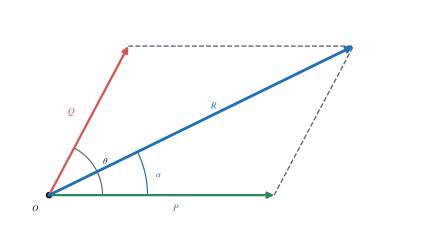
Drop a perpendicular from the tip of the resultant to the line of P extended. The horizontal side of the right triangle so formed is P + Q\cos\theta and the vertical side is Q\sin\theta. Pythagoras and the tangent ratio give the two working formulas.
For forces P and Q with angle \theta between them,
where \alpha is the angle the resultant makes with the force P.
Place O at the origin with P along the x-axis. Then \vec{P} = (P,\,0) and \vec{Q} = (Q\cos\theta,\ Q\sin\theta).
Adding the vectors, the resultant is
Its magnitude is the square root of the sum of the squares of the components:
Expanding the first bracket,
Now use \cos^2\theta + \sin^2\theta = 1 on the last two terms:
The direction follows from the right triangle, since \tan\alpha is the vertical component over the horizontal component:
Three special cases are worth memorising because they appear in multiple-choice questions.
| Angle between the forces | Resultant R | Direction |
|---|---|---|
| \theta = 0^\circ (same direction) | P + Q — the maximum possible | along both forces |
| \theta = 90^\circ (perpendicular) | \sqrt{P^2+Q^2} | \tan\alpha = Q/P |
| \theta = 180^\circ (opposite) | |P - Q| — the minimum possible | along the larger force |
So the resultant of two forces always lies between |P-Q| and P+Q. If a question claims two forces of 3 N and 4 N have a resultant of 9 N, it is wrong: the largest possible resultant is 7 N.
Two forces of 5 N and 12 N act at a point at right angles to each other. Find the magnitude of the resultant and the angle it makes with the 12 N force.
Solution. Here P = 12, Q = 5, \theta = 90^\circ, so \cos\theta = 0.
Substituting into the magnitude formula:
For the direction, with \cos 90^\circ = 0 and \sin 90^\circ = 1:
Taking the inverse tangent:
The resultant is 13 N at 22^\circ 37' to the 12 N force.
Forces of 3 N and 5 N act at a point with 60^\circ between them. Find the resultant completely.
Solution. Take P = 3, Q = 5, \theta = 60^\circ, so \cos 60^\circ = \tfrac{1}{2} and \sin 60^\circ = \tfrac{\sqrt{3}}{2}.
Magnitude first:
Now the direction, measured from the 3 N force:
Hence
The resultant is 7 N at 38^\circ 13' to the 3 N force, and therefore at 60^\circ - 38^\circ 13' = 21^\circ 47' to the 5 N force.
The resultant of two forces of 7 N and 8 N is 13 N. Find the angle between the forces.
Solution. Substitute the three magnitudes into R^2 = P^2+Q^2+2PQ\cos\theta:
Evaluating the squares:
Rearranging for the cosine:
Therefore \theta = 60^\circ.
Check the answer for plausibility: 13 N lies between |8-7| = 1 N and 8+7 = 15 N, so a solution must exist — and it does.
Two equal forces of magnitude P act at a point and their resultant is also P. Find the angle between them.
Solution. Put Q = P and R = P in the magnitude formula:
Cancel P^2 throughout (it is non-zero):
Solving for the cosine:
The two forces are inclined at 120^\circ. By symmetry the resultant bisects the angle, so it makes 60^\circ with each force.
Triangle law and Lami's theorem
The parallelogram law has an equivalent form that is often quicker to use.
If two forces acting at a point are represented in magnitude and direction by two sides of a triangle taken in order, their resultant is represented by the third side taken in the reverse order.
Turning that around gives the condition for three forces to be in equilibrium: if three concurrent forces are in equilibrium, they can be represented by the three sides of a triangle taken in order. Applying the sine rule to that triangle gives a result that solves most statics problems in one line.
If three coplanar concurrent forces P, Q, S are in equilibrium, then
where \alpha is the angle between the other two forces Q and S, and similarly for \beta and \gamma. Note \alpha + \beta + \gamma = 360^\circ.
A body of weight 20 N hangs at rest from two light strings. One string makes 30^\circ with the vertical and the other 60^\circ with the vertical, on opposite sides. Find the tension in each string.
Solution. Three forces act at the knot: the tensions T_1 and T_2 along the strings, and the weight 20 N vertically downwards. They are in equilibrium, so Lami's theorem applies. First find the angle opposite each force.
The two strings make 30^\circ + 60^\circ = 90^\circ with each other, so the angle between T_1 and T_2 is 90^\circ; this is the angle opposite the weight. The angle between T_2 and the downward weight is 180^\circ - 60^\circ = 120^\circ, which is opposite T_1. Likewise the angle opposite T_2 is 180^\circ - 30^\circ = 150^\circ.
By Lami's theorem,
The last ratio equals 20, since \sin 90^\circ = 1. Hence
and
The tensions are 17.32 N (in the string nearer the vertical) and 10 N. As a check, the vertical components must carry the weight: 17.32\cos 30^\circ + 10\cos 60^\circ = 15 + 5 = 20 N. Correct.
21.2 Composition and resolution of forces; resultant of coplanar forces acting on a point
Resolving a force into components
Composition replaces many forces by one. Resolution is the reverse operation and is the more useful of the two, because once every force is written in components the whole problem becomes arithmetic with no geometry at all.
A force F making an angle \theta with the x-axis has components
and conversely F = \sqrt{F_x^2 + F_y^2} with \tan\theta = F_y/F_x.
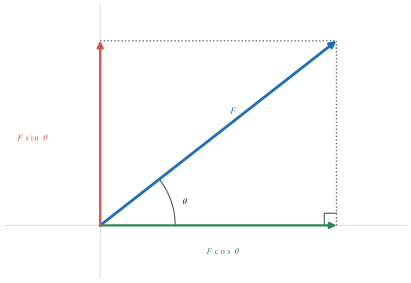
Two remarks make resolution safe in the examination.
- The direction matters for the sign. A force pointing left has a negative x-component; one pointing down has a negative y-component. Choose east and north as positive once, at the start, and keep that choice.
- You may resolve along any two perpendicular directions, not only horizontal and vertical. On an inclined plane it is almost always better to resolve along and perpendicular to the plane, as §21.4 does.
Resultant of any number of coplanar concurrent forces
Because components simply add, the method extends to as many forces as you like.
For forces F_1, F_2, \dots, F_n acting at a point at angles \theta_1, \theta_2, \dots, \theta_n to the x-axis, let
Then the resultant has magnitude and direction
and the forces are in equilibrium if and only if X = 0 and Y = 0.
A calculator returns \tan^{-1}(Y/X) between -90^\circ and 90^\circ, so it cannot tell you the quadrant. Read the signs of X and Y and place the resultant yourself: X>0, Y>0 first quadrant; X<0, Y>0 second; X<0, Y<0 third; X>0, Y<0 fourth. Always sketch.
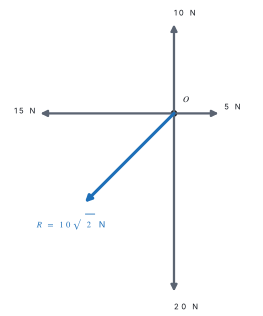
Forces of 5 N, 10 N, 15 N and 20 N act at a point in the directions east, north, west and south respectively. Find their resultant.
Solution. Take east as the positive x-direction and north as positive y. The four forces are along 0^\circ, 90^\circ, 180^\circ, 270^\circ.
Sum the x-components. Only the east and west forces contribute:
Sum the y-components. Only the north and south forces contribute:
The magnitude of the resultant is
For the direction, \tan\theta = (-10)/(-10) = 1, and since both X and Y are negative the resultant lies in the third quadrant, i.e. it points south-west:
The resultant is 10\sqrt{2} \approx 14.14 N towards the south-west, making 45^\circ with both the south and the west directions.
Three forces of 4 N, 3 N and 2 N act at a point, in directions making 0^\circ, 60^\circ and 150^\circ with the positive x-axis. Find the resultant.
Solution. Work out each component separately, to four decimal places, and only round at the end.
For the x-components:
For the y-components:
The magnitude of the resultant is
Since both components are positive the resultant is in the first quadrant:
The resultant is 5.21 N at 43^\circ 41' to the x-axis.
Three forces, each of magnitude 10 N, act at a point in directions making 0^\circ, 120^\circ and 240^\circ with the x-axis. Show that they are in equilibrium.
Solution. Compute the two component sums.
Horizontally, using \cos 120^\circ = \cos 240^\circ = -\tfrac{1}{2}:
Vertically, using \sin 120^\circ = \tfrac{\sqrt{3}}{2} and \sin 240^\circ = -\tfrac{\sqrt{3}}{2}:
Both sums vanish, so R = 0 and the three forces are in equilibrium. Geometrically they form a closed equilateral triangle when drawn head to tail, which is the triangle law in action.
A particle is in equilibrium under three forces. Two of them are 6 N due east and 8 N due north. Find the third force.
Solution. For equilibrium the sum of all three forces is zero, so the third force is the equal and opposite of the resultant of the first two.
The resultant of the given pair, which are perpendicular, is
Its direction from east is
so this resultant is 10 N at 53^\circ 8' north of east. The third force must therefore be 10 N at 53^\circ 8' south of west, i.e. along the bearing 233^\circ 8' measured from the positive x-axis. Such a balancing force is called the equilibrant of the other two.
The equilibrant of a set of forces is equal in magnitude to their resultant but opposite in direction. Every equilibrium question is a resultant question with a minus sign, so learn one method and you have both.
21.3 Dynamics: motion of a particle in a straight line; motion with uniform acceleration
The three quantities, and how calculus links them
A particle is a body small enough that its size can be ignored. Restrict it to a straight line and take a fixed point O on that line as origin. Then a single number describes where the particle is.
Displacement s is the directed distance from O, positive one way and negative the other. Velocity is the rate of change of displacement and acceleration is the rate of change of velocity:
Distance and displacement are not the same. A particle that goes 5 m forward and 5 m back has travelled a distance of 10 m but has displacement 0. Likewise speed is the magnitude of velocity: velocity can be negative, speed never is.
Because v = ds/dt, everything from Unit 18 transfers directly. The particle is momentarily at rest when v = 0; it reverses direction where v changes sign; its velocity is greatest where a = 0 and changes from positive to negative.
A particle moves along a straight line so that its displacement after t seconds is s = t^3 - 6t^2 + 9t metres. Find its velocity and acceleration, the times at which it is momentarily at rest, and the total distance travelled in the first 4 seconds.
Solution. Differentiate once for the velocity:
Differentiate again for the acceleration:
The particle is at rest when v = 0:
so t = 1\ \text{s} and t = 3\ \text{s}. At those instants a = 6(1) - 12 = -6\ \text{m/s}^2 and a = 6(3) - 12 = +6\ \text{m/s}^2.
For the distance, the particle turns round at t = 1 and t = 3, so compute the displacement at each of t = 0, 1, 3, 4:
Add the magnitudes of the three legs:
The total distance travelled is 12 m, although the displacement after 4 s is only 4 m.
The equations of uniformly accelerated motion
If the acceleration is constant, the calculus can be done once and for all. Let u be the velocity at t = 0, v the velocity at time t, a the constant acceleration, and s the displacement in that time.
Distance travelled in the n-th second: \ s_n = u + \dfrac{a(2n-1)}{2}.
Start from a = dv/dt with a constant and integrate with respect to t:
At t = 0 the velocity is u, so C = u and
which is the first equation. Now write v = ds/dt and integrate again:
Measuring s from the starting point makes s = 0 at t = 0, so C_1 = 0 and
For the third equation, eliminate t. From the first equation t = (v-u)/a. Substituting into the second,
Multiply through by 2a and expand the square:
Hence v^2 = u^2 + 2as.
These four equations are valid only for uniform acceleration. If the acceleration varies with time, go back to v = ds/dt and a = dv/dt and use calculus, as in Worked example 21.10. Also keep the signs consistent: if you take the direction of motion as positive, a retardation of 2\ \text{m/s}^2 enters the equations as a = -2\ \text{m/s}^2.
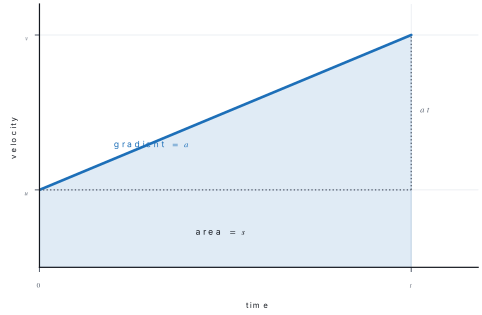
The velocity-time graph makes the equations visible. For constant acceleration it is a straight line of gradient a and intercept u; the area under it between two times is the displacement, and for a trapezium that area is \tfrac{1}{2}(u+v)t — the fourth equation.
A car starts from rest and accelerates uniformly at 2\ \text{m/s}^2. Find its velocity after 10 s and the distance covered in that time.
Solution. Here u = 0, a = 2\ \text{m/s}^2, t = 10\ \text{s}.
From v = u + at:
From s = ut + \tfrac{1}{2}at^2:
The car reaches 20 m/s and covers 100 m. Check with the third equation: v^2 = 0 + 2(2)(100) = 400, so v = 20 m/s. Consistent.
A train moving at 72\ \text{km/h} is brought to rest in 200 m by a uniform retardation. Find the retardation and the time taken.
Solution. Convert the speed to SI units first, multiplying by \tfrac{5}{18}:
The train stops, so v = 0 and s = 200 m. Use v^2 = u^2 + 2as:
Solving for a:
The negative sign means deceleration, so the retardation is 1\ \text{m/s}^2. For the time use v = u + at:
The retardation is 1\ \text{m/s}^2 and the train takes 20 s to stop.
A particle starts with velocity 5\ \text{m/s} and moves with uniform acceleration 2\ \text{m/s}^2. Find the distance it covers during the 4th second.
Solution. Use the n-th second formula with u = 5, a = 2, n = 4:
The particle covers 12 m during the 4th second.
The formula is just a difference of two displacements. Checking directly, s(4) = 5(4) + \tfrac{1}{2}(2)(16) = 36 m and s(3) = 5(3) + \tfrac{1}{2}(2)(9) = 24 m, and 36 - 24 = 12 m. Same answer.
21.4 Motion under gravity; motion down a smooth inclined plane
Free vertical motion
Near the surface of the earth every body, whatever its mass, falls with the same constant acceleration g = 9.8\ \text{m/s}^2 directed downwards, provided air resistance is ignored. Constant acceleration means the four equations of §21.3 apply with a = \pm g; only the sign needs care.
Choose one positive direction and keep it.
- Taking upwards positive: a = -g for the whole flight, up and down.
- Taking downwards positive (convenient for a body simply dropped): a = +g.
A body dropped has u = 0; a body thrown has u \neq 0. At the highest point the velocity is zero but the acceleration is still g downwards.
Two standard results follow from taking upwards as positive with a = -g. At the greatest height v = 0, so 0 = u^2 - 2gH gives the maximum height H = u^2/(2g); and putting s = 0 in s = ut - \tfrac{1}{2}gt^2 gives t(u - \tfrac{1}{2}gt) = 0, so the total time of flight back to the starting level is t = 2u/g, exactly twice the time to rise.
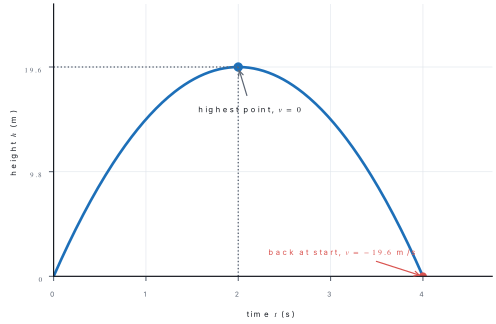
A stone is thrown vertically upwards with a velocity of 19.6\ \text{m/s}. Find the time to reach the greatest height, the greatest height, and the total time before it returns to the thrower's hand. Take g = 9.8\ \text{m/s}^2.
Solution. Take upwards as positive, so u = 19.6\ \text{m/s} and a = -9.8\ \text{m/s}^2.
At the greatest height v = 0, so from v = u + at:
For the greatest height use v^2 = u^2 + 2as with v = 0:
The upward and downward journeys take equal times, so the total time of flight is
The stone rises 19.6 m in 2 s and is back after 4 s, arriving with speed 19.6 m/s downwards.
A ball is dropped from the top of a tower 78.4 m high. Find the time it takes to reach the ground and its velocity on striking the ground.
Solution. The ball is dropped, so u = 0. Take downwards as positive, giving a = +9.8\ \text{m/s}^2 and s = 78.4 m.
From s = ut + \tfrac{1}{2}at^2:
Solving for t:
From v = u + at:
The ball lands after 4 s at 39.2 m/s. (Check with v^2 = 2gs: v = \sqrt{2(9.8)(78.4)} = \sqrt{1536.6} = 39.2 m/s.)
Motion down a smooth inclined plane
Let a particle of mass m rest on a plane inclined at angle \theta to the horizontal. Two forces act on it: its weight mg vertically downwards, and the normal reaction N perpendicular to the plane. Smooth means there is no friction, so no force acts along the plane except the component of the weight.
Resolve the weight along and perpendicular to the plane — not horizontally and vertically. The component along the plane, pointing down the slope, is mg\sin\theta; the component pressing into the plane is mg\cos\theta.
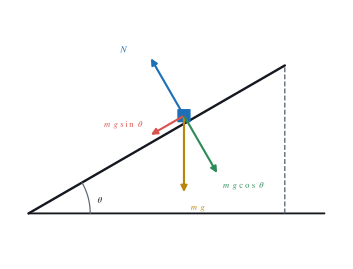
Perpendicular to the plane the particle does not move, so N = mg\cos\theta. Along the plane the only force is mg\sin\theta, so by Newton's second law ma = mg\sin\theta, and the mass cancels.
A particle sliding freely on a smooth plane of inclination \theta has acceleration
down the slope, independent of its mass. Starting from rest and sliding a distance l along the plane,
Since l\sin\theta = h, the vertical drop, this gives v = \sqrt{2gh} — the same speed as a free fall through the same height.
When \theta = 90^\circ the plane is vertical and a = g\sin 90^\circ = g, free fall. When \theta = 0^\circ the plane is horizontal and a = 0, no motion. Any formula for an inclined plane that fails these two checks is wrong.
A body slides from rest down a smooth plane inclined at 30^\circ to the horizontal. Find its acceleration, and its speed and the time taken after sliding 20 m along the plane. Take g = 9.8\ \text{m/s}^2.
Solution. The acceleration down the slope is
With u = 0 and s = 20 m, use v^2 = u^2 + 2as:
For the time use v = u + at:
The acceleration is 4.9\ \text{m/s}^2, the speed after 20 m is 14 m/s, and it takes 2.86 s. Notice the mass was never needed.
A smooth plane of inclination 30^\circ has vertical height 4.9 m. A particle slides from rest at the top. Find the length of the slope, the time of descent and the speed at the bottom.
Solution. The length l of the slope satisfies h = l\sin\theta, so
The acceleration is a = g\sin 30^\circ = 4.9\ \text{m/s}^2. With u = 0, from l = \tfrac{1}{2}at^2:
The speed at the bottom follows from v = u + at:
The slope is 9.8 m long, the descent takes 2 s, and the particle arrives at 9.8 m/s. As predicted, \sqrt{2gh} = \sqrt{2(9.8)(4.9)} = \sqrt{96.04} = 9.8 m/s — the same speed as falling 4.9 m freely, but reached in 2 s instead of 1 s.
A particle slides 9.8 m from rest down a smooth inclined plane in 2 s. Find the inclination of the plane.
Solution. Let the inclination be \theta, so a = g\sin\theta = 9.8\sin\theta. With u = 0, s = 9.8 m and t = 2 s, use s = \tfrac{1}{2}at^2:
Solving for the sine:
The plane is inclined at 30^\circ to the horizontal.
- Two forces: R^2 = P^2+Q^2+2PQ\cos\theta, \ \tan\alpha = \dfrac{Q\sin\theta}{P+Q\cos\theta}
- Many forces: R = \sqrt{X^2+Y^2}; equilibrium means X = 0 and Y = 0
- Lami: each force over the sine of the angle between the other two
- Calculus: v = \dfrac{ds}{dt}, \ a = \dfrac{dv}{dt}
- Uniform a: v = u+at, \ s = ut+\tfrac{1}{2}at^2, \ v^2 = u^2+2as
- Gravity a = \pm g; smooth incline a = g\sin\theta, \ N = mg\cos\theta
Chapter summary
- A force is a vector: magnitude, direction, point of application. Forces at a point are concurrent; forces in one plane are coplanar.
- Parallelogram law: two forces P, Q at angle \theta have resultant R = \sqrt{P^2+Q^2+2PQ\cos\theta} making angle \alpha = \tan^{-1}\dfrac{Q\sin\theta}{P+Q\cos\theta} with P.
- The resultant always lies between |P-Q| and P+Q; it equals P+Q at \theta = 0^\circ, \sqrt{P^2+Q^2} at 90^\circ, |P-Q| at 180^\circ.
- Resolution: F_x = F\cos\theta, F_y = F\sin\theta. Any number of coplanar concurrent forces combine as X = \sum F\cos\theta, Y = \sum F\sin\theta, R = \sqrt{X^2+Y^2}, \tan\theta = Y/X; read the quadrant from the signs.
- Equilibrium \Leftrightarrow X = 0 and Y = 0. For three forces use Lami's theorem: each force divided by the sine of the angle between the other two is the same. The equilibrant is minus the resultant.
- Kinematics: v = ds/dt, a = dv/dt = d^2s/dt^2. Distance is not displacement; reverse of direction happens where v changes sign.
- Uniform acceleration only: v = u+at, s = ut+\tfrac12 at^2, v^2 = u^2+2as, s = \tfrac12(u+v)t, and s_n = u + \tfrac{a(2n-1)}{2}. On a v–t graph the gradient is a and the area is s.
- Gravity: a = -g upwards positive, a = +g downwards positive, with g = 9.8\ \text{m/s}^2. Maximum height u^2/2g, time of flight 2u/g.
- Smooth inclined plane: a = g\sin\theta down the slope (mass cancels) and N = mg\cos\theta. Speed after a vertical drop h is \sqrt{2gh}, the same as in free fall.
Practice questions
Group A — Multiple choice (1 mark each)
- The greatest possible resultant of two forces of 8 N and 6 N is [1]a2 Nb10 Nc14 Nd48 N
- Two forces, each of 5 N, act at a point at 120^\circ. Their resultant is [1]a0b5 Nc5\sqrt{3} Nd10 N
- Coplanar concurrent forces are in equilibrium if and only if [1]aX = 0 onlybY = 0 onlycX = 0 and Y = 0dX = Y
- In Lami's theorem each force is divided by the sine of the angle [1]ait makes with the verticalbbetween the other two forcescbetween it and the next forcedof 90^\circ
- A body dropped from rest falls, in the first second, a distance of (take g = 9.8\ \text{m/s}^2) [1]a4.9 mb9.8 mc19.6 md2.45 m
- If s = 4t^2, the velocity at t = 3 s is [1]a12 m/sb24 m/sc36 m/sd8 m/s
- At the highest point of the path of a stone thrown vertically upwards [1]av = 0 and a = 0bv = 0 and a = g downwardscv = g and a = 0dboth v and a are upwards
- The acceleration of a particle sliding freely down a smooth plane inclined at 30^\circ is [1]a9.8\ \text{m/s}^2b4.9\ \text{m/s}^2c8.49\ \text{m/s}^2dit depends on the mass
Answers to Group A
1. (c) — the resultant is greatest when \theta = 0^\circ, giving 8 + 6 = 14 N.
2. (b) — R = \sqrt{25+25+2(25)\cos 120^\circ} = \sqrt{50-25} = 5 N.
3. (c) — the resultant \sqrt{X^2+Y^2} vanishes only when both component sums vanish.
4. (b) — that is the statement of the theorem; the angles used sum to 360^\circ.
5. (a) — s = \tfrac12 gt^2 = \tfrac12(9.8)(1)^2 = 4.9 m.
6. (b) — v = ds/dt = 8t, so v(3) = 24 m/s.
7. (b) — the velocity is momentarily zero but gravity never switches off.
8. (b) — a = g\sin 30^\circ = 9.8 \times 0.5 = 4.9\ \text{m/s}^2, independent of mass.
Group B — Short answer (5 marks each)
- Forces of 4 N and 7 N act at a point with 60^\circ between them. Find the magnitude and direction of the resultant. [5]
- The resultant of two forces P and 2P acting at a point is perpendicular to P. Find the angle between the forces and the magnitude of the resultant. [5]
- Three forces of 5 N, 10 N and 15 N act at a point in directions making 0^\circ, 120^\circ and 240^\circ with the x-axis. Find their resultant. [5]
- A particle moves so that s = 2t^3 - 9t^2 + 12t metres. Find when it is at rest, and the total distance it travels in the first 3 seconds. [5]
- A ball is thrown vertically upwards with velocity 24.5\ \text{m/s}. Find the greatest height reached and the total time of flight. (g = 9.8\ \text{m/s}^2) [5]
- A particle slides from rest down a smooth plane of inclination 45^\circ and length 10 m. Find the acceleration, the speed at the bottom and the time taken. [5]
Solutions to Group B
1. With P = 4, Q = 7, \theta = 60^\circ:
For the direction from the 4 N force,
so \alpha = 38.95^\circ = 38^\circ 57'. The resultant is 9.64 N at 38^\circ 57' to the 4 N force.
2. Take P along the x-axis. The resultant is perpendicular to P exactly when its x-component is zero:
The resultant is then purely the y-component,
So the angle is 120^\circ and R = \sqrt{3}P.
3. Components, using \cos 120^\circ = \cos 240^\circ = -\tfrac12, \sin 120^\circ = \tfrac{\sqrt{3}}{2}, \sin 240^\circ = -\tfrac{\sqrt{3}}{2}:
Hence
and \tan\theta = (-4.330)/(-7.5) = 0.5774 with both components negative, so the resultant lies in the third quadrant: \theta = 180^\circ + 30^\circ = 210^\circ. The resultant is 5\sqrt{3} N at 210^\circ to the x-axis.
4. Differentiating, v = 6t^2 - 18t + 12 = 6(t-1)(t-2), so the particle is at rest at t = 1 s and t = 2 s. The displacements at the turning times and the end points are
Adding the magnitudes of the three legs,
Total distance = 11 m (while the displacement is only 9 m).
5. Upwards positive: u = 24.5, a = -9.8. At the top v = 0, so from v^2 = u^2 + 2as,
The time of flight is
Greatest height 30.63 m, time of flight 5 s (rising for 2.5 s).
6. The acceleration down the slope is
With u = 0 and s = 10 m, from v^2 = 2as,
and from v = at,
Group C — Long answer (8 marks each)
- State the parallelogram law of forces and derive expressions for the magnitude and the direction of the resultant of two forces P and Q inclined at an angle \theta. Hence find two forces whose magnitudes are in the ratio 3:5, act at 60^\circ to each other and have a resultant of 35 N. [8]
- Starting from the definitions v = ds/dt and a = dv/dt, derive the equations v = u+at, s = ut+\tfrac12 at^2 and v^2 = u^2+2as for constant acceleration. A train starts from rest, accelerates uniformly at 1\ \text{m/s}^2 for 20 s, runs at constant speed for 60 s, and is then brought to rest by a uniform retardation of 2\ \text{m/s}^2. Find the total distance travelled. [8]
- Show that a particle sliding freely on a smooth plane of inclination \theta has acceleration g\sin\theta down the plane and that the normal reaction is mg\cos\theta. A body slides from rest down a smooth plane of inclination 30^\circ whose vertical height is 10 m. Find the speed at the bottom and the time taken, and compare the speed with that of a body falling freely through 10 m. [8]
Solutions to Group C
1. Statement. If two forces acting at a point are represented in magnitude and direction by the two adjacent sides of a parallelogram drawn from that point, their resultant is represented by the diagonal of the parallelogram through that point.
Derivation. Put O at the origin with P along the x-axis, so \vec P = (P, 0) and \vec Q = (Q\cos\theta,\ Q\sin\theta). Adding,
Squaring and adding the components,
so, using \cos^2\theta+\sin^2\theta = 1,
and the angle \alpha the resultant makes with P satisfies
Application. Let the forces be 3k and 5k. Then with \theta = 60^\circ,
so R = 7k. Given R = 35 N,
The forces are 3(5) = 15 N and 5(5) = 25 N.
2. Derivation. With a constant, integrating a = dv/dt gives v = at + C, and v = u at t = 0 forces C = u, so
Integrating v = ds/dt next,
and measuring s from the start gives C_1 = 0, so s = ut + \tfrac12 at^2. Eliminating t = (v-u)/a from this,
hence v^2 = u^2 + 2as.
Application. Phase 1 (u = 0, a = 1, t = 20):
Phase 2 (constant 20 m/s for 60 s):
Phase 3 (u = 20, v = 0, a = -2): from v^2 = u^2+2as,
Total distance
3. Derivation. The particle of mass m has only two forces on it: the weight mg vertically down and the normal reaction N perpendicular to the plane (the plane is smooth, so there is no friction). Resolve the weight along and perpendicular to the plane: the components are mg\sin\theta down the slope and mg\cos\theta into the plane.
Perpendicular to the plane there is no motion, so those forces balance:
Along the plane the only force is mg\sin\theta, so Newton's second law gives
The mass cancels, so the acceleration is independent of the mass.
Application. The length of the slope is
and the acceleration is a = 9.8\sin 30^\circ = 4.9\ \text{m/s}^2. With u = 0,
For free fall through the same height,
The two speeds are equal: the slope does not change the final speed, only the time taken to acquire it (2.86 s on the plane against 14/9.8 = 1.43 s in free fall).
Practise more: Mathematics question bank