Unit 17 · Calculus · 10 teaching hours · 23 min read
Limits and Continuity
What the syllabus asks for 3
- Concept of limit; limits of algebraic and transcendental functions
- Indeterminate forms
- Continuity and discontinuity of a function
Calculus begins with one question: what happens to f(x) when x gets very close to a number a, without ever being equal to it? The answer is the limit. From it come the derivative (Unit 18) and the integral (Unit 19), so nothing later in the course works until this idea is secure. This chapter builds the limit from an intuitive table of values up to the formal \varepsilon–\delta statement, lists the standard limits you must know by heart, shows how to break every indeterminate form, and ends with continuity — the property that a graph can be drawn without lifting the pen.
Group A almost always carries one or two limit evaluations and one continuity question. Group B favours (i) evaluating a 0/0 limit by factorisation or rationalisation, (ii) a trigonometric or exponential limit built on a standard result, and (iii) "find the value of k so that f is continuous at x = a". Memorise the standard limits in §17.1 — half the marks in this unit come straight off that list.
17.1 Concept of limit; limits of algebraic and transcendental functions
The idea of approaching
Consider
At x = 2 the formula gives 0/0, which is meaningless, so f(2) does not exist. But that is not the question. The question is: what does f(x) do as x approaches 2?
| x | 1.9 | 1.99 | 1.999 | 2 | 2.001 | 2.01 | 2.1 |
|---|---|---|---|---|---|---|---|
| f(x) | 3.9 | 3.99 | 3.999 | undefined | 4.001 | 4.01 | 4.1 |
From both sides the values crowd in on 4. We write
and read it "the limit of f(x) as x tends to 2 is 4". Nothing here depends on f(2). Indeed for every x \ne 2 we may cancel:
and x+2 \to 4. The cancellation is legal precisely because x \ne 2 in a limit.
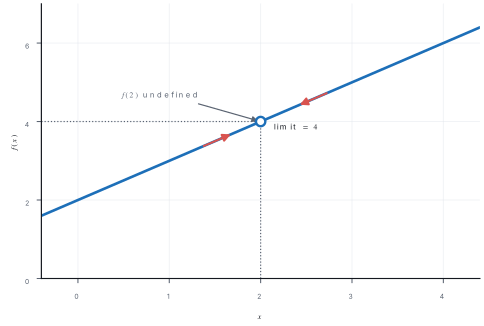
A number L is the limit of f(x) as x tends to a, written \lim_{x \to a} f(x) = L, if f(x) can be made as close to L as we please by taking x sufficiently close to a but not equal to a.
Left-hand and right-hand limits
On the real line x can approach a from two directions. Approaching through values less than a gives the left-hand limit (LHL), approaching through values greater than a gives the right-hand limit (RHL):
Rewriting one-sided limits with a positive h in this way is the standard NEB technique: it turns a one-sided limit into an ordinary limit.
\lim_{x \to a} f(x) exists if and only if the left-hand and right-hand limits both exist, are finite, and are equal:
If they differ, the limit simply does not exist. It is not "two limits".
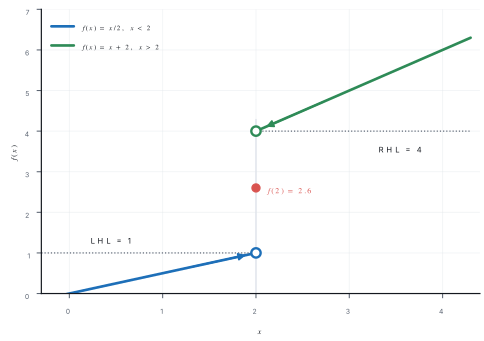
Problem. Show that \lim_{x \to 2}\dfrac{|x-2|}{x-2} does not exist.
Solution. Recall |u| = u if u \ge 0 and |u| = -u if u < 0.
Left-hand limit. Put x = 2-h with h > 0. Then x - 2 = -h < 0, so |x-2| = h and
Right-hand limit. Put x = 2+h with h > 0. Then x-2 = h > 0, so |x-2| = h and
Since -1 \ne 1, the two one-sided limits disagree and the limit does not exist.
The precise (\varepsilon–\delta) definition
"As close as we please" is made exact by two Greek letters. \varepsilon (epsilon) is the tolerance demanded on the output; \delta (delta) is the closeness we must impose on the input to meet it.
\lim_{x \to a} f(x) = L means: for every \varepsilon > 0 there exists a \delta > 0 such that
The condition 0 < |x-a| excludes x = a itself — again, the value f(a) is irrelevant.
Geometrically: draw a horizontal band of half-width \varepsilon about y = L. The definition says we can always find a vertical band of half-width \delta about x = a so narrow that the piece of curve inside it stays trapped in the horizontal band.
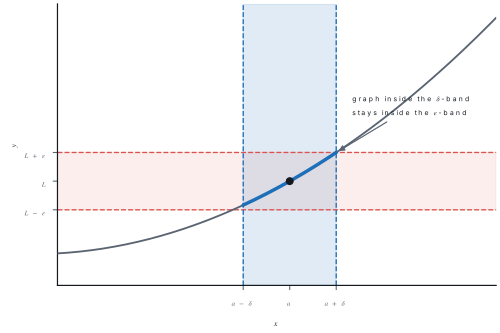
Problem. Using the \varepsilon–\delta definition, prove \lim_{x \to 3}(2x+1) = 7.
Solution. Let \varepsilon > 0 be given. We need |(2x+1)-7| < \varepsilon.
So |(2x+1)-7| < \varepsilon is the same as |x-3| < \varepsilon/2.
Choose \delta = \varepsilon/2. Then whenever 0 < |x-3| < \delta,
Since a suitable \delta exists for every \varepsilon > 0, the limit is 7.
Algebra of limits
If \lim_{x\to a}f(x) = L and \lim_{x\to a}g(x) = M (both finite), then:
| Rule | Statement |
|---|---|
| Sum / difference | \lim (f \pm g) = L \pm M |
| Constant multiple | \lim\, cf = cL |
| Product | \lim (fg) = LM |
| Quotient | \lim (f/g) = L/M, provided M \ne 0 |
| Power | \lim [f(x)]^{n} = L^{n} |
| Root | \lim \sqrt[n]{f(x)} = \sqrt[n]{L}, when the root is defined |
| Composite | \lim g(f(x)) = g(L) if g is continuous at L |
For a polynomial P, direct substitution always works: \lim_{x\to a}P(x) = P(a). For a rational function P/Q, substitution works whenever Q(a) \ne 0. Only when substitution produces a meaningless symbol do we need the machinery of §17.2.
Limits of algebraic functions
The workhorse result is:
For any rational index n and a > 0,
Proof for positive integer n. Use the identity
There are exactly n terms in the second bracket. Cancelling (x-a), which is allowed since x \ne a,
Now let x \to a. Each of the n terms tends to a^{n-1}, so the sum tends to n\,a^{n-1}.
Problem. Evaluate \displaystyle\lim_{x\to1}\frac{x^{5}-1}{x^{2}-1}.
Solution. Direct substitution gives 0/0. Divide numerator and denominator by (x-1) — that is, write each as a standard form with a = 1:
Taking the limit of the top and bottom separately (the bottom limit is 2 \ne 0):
Check by factorisation. x^5-1=(x-1)(x^4+x^3+x^2+x+1) and x^2-1=(x-1)(x+1), so the ratio is (x^4+x^3+x^2+x+1)/(x+1) \to 5/2. ✓
Problem. Evaluate \displaystyle\lim_{x\to0}\frac{\sqrt{1+x}-\sqrt{1-x}}{x}.
Solution. Substitution gives 0/0. Multiply top and bottom by the conjugate \sqrt{1+x}+\sqrt{1-x}:
The numerator is 2x, and x \ne 0 so it cancels:
Limits at infinity
\lim_{x\to\infty}f(x) = L means f(x) can be brought arbitrarily close to L by taking x large enough. The fundamental case is
For a rational function, divide every term by the highest power of x in the denominator. Comparing degrees then gives a rule worth memorising.
For f(x) = \dfrac{a_mx^{m}+\cdots}{b_nx^{n}+\cdots} as x \to \infty:
- m < n (bottom heavier) \Rightarrow limit is 0
- m = n (equal) \Rightarrow limit is a_m/b_n, the ratio of leading coefficients
- m > n (top heavier) \Rightarrow limit is \infty (does not exist finitely)
"Bottom heavy, zero; balanced, ratio; top heavy, blows up."
When \lim_{x\to\infty}f(x) = L is finite, the line y = L is a horizontal asymptote of the graph.
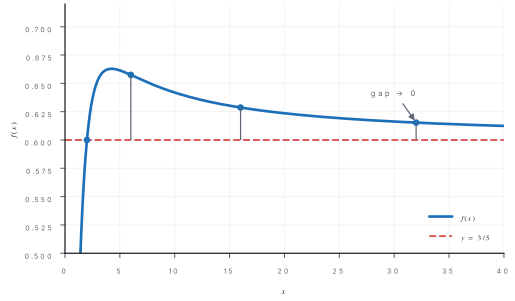
Problem. Evaluate as x \to \infty: (a) \dfrac{3x^{2}+2x-1}{5x^{2}-x+7}, (b) \dfrac{2x^{2}+3x+1}{x^{3}-2x+5}, (c) \dfrac{3x^{3}-2x}{4x^{2}+1}.
Solution. (a) Divide top and bottom by x^{2}:
(b) Divide by x^{3}: numerator \to 0, denominator \to 1, so the limit is 0 (bottom heavier).
(c) Divide by x^{2}: \dfrac{3x-\frac{2}{x}}{4+\frac{1}{x^{2}}}. The numerator grows without bound, so the limit is \infty; the limit does not exist finitely.
Limits of trigonometric functions
Take 0 < x < \pi/2 and a unit circle with centre O. Let A be on the circle, \angle AOB = x, with B on the horizontal radius. Comparing three areas — triangle OAB, sector OAB, and the right triangle with the tangent at B —
Divide throughout by \tfrac{1}{2}\sin x, which is positive:
As x \to 0^{+}, \cos x \to 1, so by the sandwich (squeeze) theorem \sin x / x \to 1. Since \sin(-x)/(-x) = \sin x / x, the function is even and the left-hand limit is also 1. Hence the limit is 1.
\lim_{x\to0}\frac{\sin x}{x} = 1 is true only in radians. In degrees the limit is \pi/180 \approx 0.01745, because \sin x^{\circ} = \sin(\pi x/180). If a question writes \sin 30^{\circ} inside a limit, convert to radians first.
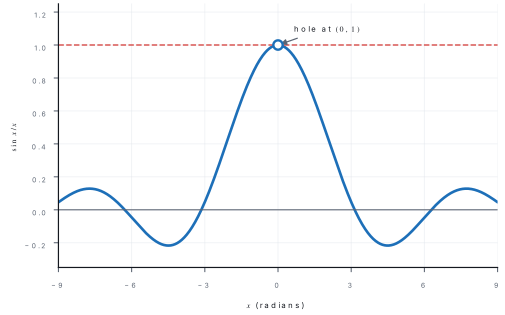
Two companions follow immediately. Since \tan x = \sin x/\cos x,
and using 1-\cos x = 2\sin^{2}(x/2),
Problem. Evaluate (a) \displaystyle\lim_{x\to0}\frac{\sin 5x}{\tan 3x} and (b) \displaystyle\lim_{x\to0}\frac{1-\cos 4x}{x^{2}}.
Solution. (a) Force each ratio to have matching angle on top and bottom:
As x \to 0 the first factor \to 1, the second \to 1, and the third is the constant 5/3. Hence the limit is \dfrac{5}{3}.
(b) Write 1-\cos4x = 2\sin^{2}2x:
Limits of exponential and logarithmic functions
The number e is defined by a limit:
From it come the exponential and logarithmic standard limits:
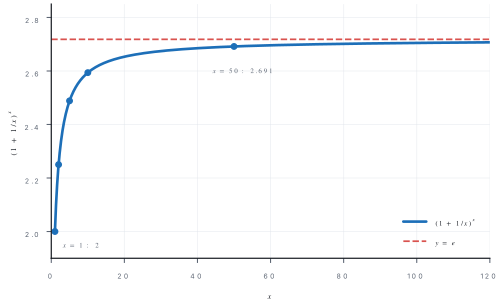
Problem. Evaluate (a) \displaystyle\lim_{x\to0}\frac{e^{3x}-1}{x}, (b) \displaystyle\lim_{x\to0}\frac{5^{x}-3^{x}}{x}, and (c) \displaystyle\lim_{x\to\infty}\left(1+\frac{3}{x}\right)^{2x}.
Solution. (a) Multiply and divide by 3 so the exponent matches the denominator:
(b) Subtract and add 1 to split the fraction:
(c) Put y = x/3, so x \to \infty gives y \to \infty and 2x = 6y:
Every one of these is examinable and every one is used later. Learn them.
17.2 Indeterminate forms
Substituting x = a sometimes produces a symbol that carries no information. Such a symbol is called an indeterminate form: the limit may be any number, or may not exist, and only further work decides which.
| Indeterminate | Typical source | Standard attack |
|---|---|---|
| \dfrac{0}{0} | common factor, surd, trig at 0 | factorise, rationalise, or use a standard limit |
| \dfrac{\infty}{\infty} | rational function as x\to\infty | divide by the highest power of x |
| \infty-\infty | difference of surds or of fractions | rationalise, or combine over a common denominator |
| 0 \times \infty | product of a vanishing and a blowing-up factor | rewrite as \frac{0}{0} or \frac{\infty}{\infty} |
| 1^{\infty} | powers of (1+\text{small}) | force the form (1+u)^{1/u} and use e |
| 0^{0}, \infty^{0} | variable base and exponent | take logarithms first |
\dfrac{k}{0} with k \ne 0 is not indeterminate — it means the function is unbounded, so the (two-sided) limit does not exist, though a one-sided limit may be +\infty or -\infty. Likewise \dfrac{0}{k} = 0 and k^{\infty} for k>1 is \infty. Only the six forms in the table need extra work.
Problem. Evaluate \displaystyle\lim_{x\to\infty}\left(\sqrt{x^{2}+x}-x\right).
Solution. Both terms tend to \infty: the form is \infty-\infty. Rationalise by multiplying by the conjugate:
Now divide top and bottom by x (positive, so \sqrt{x^{2}} = x):
Problem. Evaluate \displaystyle\lim_{x\to1}\left(\frac{1}{x-1}-\frac{2}{x^{2}-1}\right).
Solution. Each fraction blows up, so combine them over the common denominator x^{2}-1 = (x-1)(x+1):
Cancel (x-1), legal because x \ne 1:
Problem. Evaluate \displaystyle\lim_{x\to0}(1+2x)^{1/3x}.
Solution. The base \to 1 and the exponent \to \infty: the form is 1^{\infty}. Rewrite the exponent so that (1+2x)^{1/2x} appears:
As x \to 0, 2x \to 0, so the inner bracket \to e. Therefore the limit is e^{2/3}.
Look at what caused the trouble. A common factor means factorise. A surd means multiply by the conjugate. Two fractions means a common denominator. x\to\infty in a rational function means divide by the highest power. Powers of (1 + \text{small}) means force the e form. Trigonometric or exponential pieces mean insert the matching standard limit. Very few NEB questions need anything else.
17.3 Continuity and discontinuity of a function
Continuity at a point
A function f is continuous at x = a if all three conditions hold:
- f(a) is defined (i.e. a is in the domain of f);
- \lim_{x\to a}f(x) exists, i.e. \lim_{x\to a^{-}}f(x) = \lim_{x\to a^{+}}f(x);
- \lim_{x\to a}f(x) = f(a).
Compactly: \lim_{x\to a^{-}}f(x) = \lim_{x\to a^{+}}f(x) = f(a). If any one condition fails, f is discontinuous at a.
Informally, f is continuous on an interval if its graph over that interval can be drawn in one stroke without lifting the pen.
Which functions are continuous
| Family | Continuous on |
|---|---|
| Polynomials | all of \mathbb{R} |
| Rational P(x)/Q(x) | all x with Q(x) \ne 0 |
| \sin x, \cos x | all of \mathbb{R} |
| \tan x, \sec x | all x \ne (2n+1)\pi/2 |
| e^{x}, a^{x} | all of \mathbb{R} |
| \ln x | x > 0 |
| \sqrt{x} | x \ge 0 |
| |x| | all of \mathbb{R} |
If f and g are continuous at a, so are f \pm g, cf, fg, and f/g (provided g(a) \ne 0), and so is the composite g \circ f when g is continuous at f(a). Trouble therefore arises only at three kinds of place: where a denominator vanishes, where a piecewise rule changes, and where the formula itself is undefined.
The three types of discontinuity
- Removable. LHL = RHL but f(a) is missing or has the wrong value. A single point can be redefined to repair it — hence "removable".
- Jump (finite / ordinary). LHL and RHL both exist and are finite but are unequal. The size of the jump is |\text{RHL}-\text{LHL}|.
- Infinite. At least one one-sided limit is \pm\infty; the line x = a is a vertical asymptote.
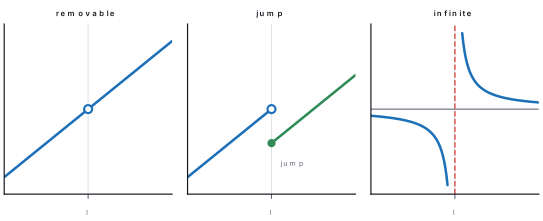
Worked continuity problems
Problem. Classify the discontinuity of each function at the given point.
(a) f(x) = \dfrac{x^{2}-9}{x-3} at x = 3; (b) g(x) = \dfrac{|x-2|}{x-2} at x = 2; (c) h(x) = \dfrac{1}{x-1} at x = 1.
Solution.
(a) f(3) is 0/0, undefined, so condition 1 fails. But for x \ne 3, f(x) = x+3, so LHL = RHL = 6. The limit exists while f(3) does not: this is a removable discontinuity. Defining f(3) = 6 repairs it.
(b) From Worked example 17.1, LHL = -1 and RHL = +1. Both are finite but unequal, so this is a jump discontinuity of size |1-(-1)| = 2.
(c) As x \to 1^{-}, x-1 \to 0^{-} so h \to -\infty; as x\to1^{+}, h \to +\infty. This is an infinite discontinuity, and x = 1 is a vertical asymptote.
Problem. The function
is continuous at x = 1. Find k.
Solution. For x \ne 1, \dfrac{x^{2}-1}{x-1} = \dfrac{(x-1)(x+1)}{x-1} = x+1. Hence
Continuity at x=1 requires \lim_{x\to1}f(x) = f(1), i.e. k = 2.
Problem. A function is defined by f(x) = 3x+a for x<2, f(2)=7, and f(x) = bx^{2}-1 for x>2. Find a and b so that f is continuous at x=2.
Solution. Apply the three conditions at x = 2.
LHL: \lim_{x\to2^{-}}(3x+a) = 6+a. RHL: \lim_{x\to2^{+}}(bx^{2}-1) = 4b-1. Value: f(2) = 7.
Continuity needs LHL = RHL = f(2):
So a = 1, b = 2.
Students check only that LHL = RHL and stop. Continuity needs the third equality too: the common limit must equal f(a). A function with LHL = RHL but a wrongly placed dot at x=a is still discontinuous there (removable type).
Continuity on an interval, and one useful theorem
f is continuous on the open interval (a,b) if it is continuous at every point inside. On the closed interval [a,b] we additionally require continuity from the right at a (\lim_{x\to a^{+}}f(x) = f(a)) and from the left at b.
If f is continuous on [a,b] and N is any number between f(a) and f(b), then there is at least one c in (a,b) with f(c) = N.
In particular, if f(a) and f(b) have opposite signs, then f has a root between a and b. This is exactly the fact the bisection method of Unit 20 relies on.
For example f(x) = x^{3}-x-1 is a polynomial, hence continuous. Since f(1) = -1 < 0 and f(2) = 5 > 0, a root lies between 1 and 2.
Chapter summary
- \lim_{x\to a}f(x) = L describes the behaviour of f near a, never at a; the value f(a) is irrelevant to the limit.
- The limit exists iff LHL = RHL = L, finite. Use x = a \mp h, h>0, to compute one-sided limits.
- Formally: for every \varepsilon>0 there is \delta>0 with 0<|x-a|<\delta \Rightarrow |f(x)-L|<\varepsilon.
- Standard limits: \frac{x^n-a^n}{x-a}\to na^{n-1}; \frac{\sin x}{x}\to1; \frac{\tan x}{x}\to1; \frac{1-\cos x}{x^{2}}\to\frac12; (1+x)^{1/x}\to e; \frac{a^{x}-1}{x}\to\ln a; \frac{\ln(1+x)}{x}\to1; \frac{1}{x^{n}}\to0 as x\to\infty.
- The six indeterminate forms are \frac00, \frac{\infty}{\infty}, \infty-\infty, 0\times\infty, 1^{\infty}, 0^{0} (with \infty^{0}). Factorise, rationalise, divide by the highest power, or force the e form.
- For a rational function as x\to\infty: bottom heavier \Rightarrow 0; equal degrees \Rightarrow ratio of leading coefficients; top heavier \Rightarrow\infty.
- f is continuous at a iff \lim_{x\to a^{-}}f = \lim_{x\to a^{+}}f = f(a).
- Discontinuities are removable (limit exists, value wrong or missing), jump (finite unequal one-sided limits) or infinite (a one-sided limit is \pm\infty, giving a vertical asymptote).
Practice questions
Group A — Multiple choice (1 mark each)
- \displaystyle\lim_{x\to2}\frac{x^{3}-8}{x^{2}-4} equals [1]a2b3c4d6
- \displaystyle\lim_{x\to0}\frac{\sin 7x}{x} equals [1]a0b1c7d1/7
- \displaystyle\lim_{x\to\infty}\frac{5x^{2}+3}{2x^{2}-x} equals [1]a0b5/2c2/5d\infty
- Which of the following is not an indeterminate form? [1]a0/0b\infty-\inftyc1^{\infty}d0/5
- f(x) = \dfrac{|x|}{x} has, at x=0, a discontinuity of type [1]aremovablebjumpcinfinitednone — f is continuous
- \displaystyle\lim_{x\to0}\frac{e^{x}-1}{x} equals [1]a0b1ceddoes not exist
- If f(x) = \dfrac{x^{2}-25}{x-5} for x\ne5, the value of f(5) that makes f continuous is [1]a0b5c10d25
- \displaystyle\lim_{x\to\infty}\left(1+\frac{4}{x}\right)^{x} equals [1]aeb4ece^{4}d1
Answers to Group A
1. (b) — \dfrac{(x-2)(x^2+2x+4)}{(x-2)(x+2)} \to \dfrac{12}{4} = 3.
2. (c) — \dfrac{\sin7x}{x} = 7\cdot\dfrac{\sin7x}{7x} \to 7.
3. (b) — equal degrees, so the limit is the ratio of leading coefficients 5/2.
4. (d) — 0/5 = 0 exactly; nothing is indeterminate about it.
5. (b) — LHL =-1, RHL =+1: finite but unequal.
6. (b) — a standard limit, \lim_{x\to0}(a^{x}-1)/x = \ln a with a = e.
7. (c) — f(x) = x+5 for x\ne5, whose limit at 5 is 10.
8. (c) — \lim(1+a/x)^{x} = e^{a} with a = 4.
Group B — Short answer (5 marks each)
- Evaluate \displaystyle\lim_{x\to1}\frac{x^{5}-1}{x^{2}-1} and state clearly which standard limit you have used. [5]
- Evaluate \displaystyle\lim_{x\to5}\frac{\sqrt{x+4}-3}{x-5}. [5]
- Prove that \displaystyle\lim_{x\to0}\frac{\sin x}{x} = 1 and hence evaluate \displaystyle\lim_{x\to0}\frac{1-\cos x}{x^{2}}. [5]
- Evaluate \displaystyle\lim_{x\to\infty}\left(\sqrt{x^{2}+3x}-x\right). [5]
- A function is defined by f(x) = 2x+3 for x \le 1 and f(x) = kx^{2}+1 for x > 1. Find k so that f is continuous at x=1. [5]
- Using the \varepsilon–\delta definition, prove that \displaystyle\lim_{x\to4}(3x-5) = 7. [5]
Answers to Group B
1. Write both as standard forms about a=1: \dfrac{x^{5}-1}{x^{2}-1} = \dfrac{(x^{5}-1)/(x-1)}{(x^{2}-1)/(x-1)}. Using \lim_{x\to a}\frac{x^{n}-a^{n}}{x-a} = na^{n-1} with a=1, the numerator tends to 5(1)^{4} = 5 and the denominator to 2(1)^{1} = 2. Hence the limit is \boxed{5/2}.
2. Form 0/0. Multiply by the conjugate \sqrt{x+4}+3:
Cancel (x-5) since x \ne 5, leaving \dfrac{1}{\sqrt{x+4}+3} \to \dfrac{1}{3+3} = \dfrac{1}{6}.
3. Proof. For 0 < x < \pi/2, comparing the areas of triangle OAB, sector OAB and the tangent triangle in a unit circle gives \frac12\sin x < \frac12 x < \frac12\tan x. Dividing by \frac12\sin x > 0 gives 1 < x/\sin x < 1/\cos x, i.e. \cos x < \frac{\sin x}{x} < 1. As x\to0^{+}, \cos x \to 1, so by the squeeze theorem \frac{\sin x}{x}\to1. The function is even, so the left-hand limit is 1 too.
Hence. 1-\cos x = 2\sin^{2}(x/2), so
4. Form \infty-\infty. Rationalise:
Divide top and bottom by x>0: \dfrac{3}{\sqrt{1+3/x}+1} \to \dfrac{3}{1+1} = \dfrac{3}{2}.
5. LHL = \lim_{x\to1^{-}}(2x+3) = 5, and f(1) = 2(1)+3 = 5. RHL = \lim_{x\to1^{+}}(kx^{2}+1) = k+1. Continuity requires k+1 = 5, so k = 4.
6. Let \varepsilon>0. Then |(3x-5)-7| = |3x-12| = 3|x-4|, which is less than \varepsilon exactly when |x-4| < \varepsilon/3. Choose \delta = \varepsilon/3; then 0<|x-4|<\delta \Rightarrow |(3x-5)-7| = 3|x-4| < 3\delta = \varepsilon. Since \delta exists for every \varepsilon, the limit is 7.
Group C — Long answer (8 marks each)
- (a) State the three conditions for a function to be continuous at x = a, and describe the three types of discontinuity with a sketch of each. [4](b) Discuss the continuity of
at x = 1, classify the discontinuity, and state how (if at all) it can be removed. [4] 2. (a) Define an indeterminate form and list the six standard ones. [2] (b) Evaluate \displaystyle\lim_{x\to0}\frac{5^{x}-3^{x}}{x}, \displaystyle\lim_{x\to0}\frac{\sin 5x}{\tan 3x} and \displaystyle\lim_{x\to0}(1+2x)^{1/3x}, naming the form in each case. [6]
Answers to Group C
1. (a) f is continuous at a iff (i) f(a) is defined, (ii) \lim_{x\to a}f(x) exists (LHL = RHL), (iii) that limit equals f(a). Removable: LHL = RHL but f(a) missing or different — a hole in the graph. Jump: LHL and RHL finite but unequal — a step. Infinite: a one-sided limit is \pm\infty — a vertical asymptote. (See the three-panel figure in §17.3.)
(b) LHL = \lim_{x\to1^{-}}\dfrac{(x-1)(x+1)}{x-1} = \lim_{x\to1^{-}}(x+1) = 2. RHL = \lim_{x\to1^{+}}2x = 2. So the limit exists and equals 2. But f(1) = 3 \ne 2, so condition (iii) fails and f is discontinuous at x=1. Because the limit exists and is finite, the discontinuity is removable; redefining f(1) = 2 makes f continuous at 1.
2. (a) An indeterminate form is an expression obtained by direct substitution whose value is not determined by the limits of its parts — the limit may be any number or may fail to exist. The six are \frac00, \frac{\infty}{\infty}, \infty-\infty, 0\times\infty, 1^{\infty} and 0^{0} (with \infty^{0} a seventh variant of the last).
(b) First (\frac00): split as \dfrac{(5^{x}-1)-(3^{x}-1)}{x} = \dfrac{5^{x}-1}{x}-\dfrac{3^{x}-1}{x} \to \ln 5 - \ln 3 = \ln(5/3).
Second (\frac00): \dfrac{\sin5x}{\tan3x} = \dfrac{\sin5x}{5x}\cdot\dfrac{3x}{\tan3x}\cdot\dfrac{5}{3} \to 1\cdot1\cdot\dfrac53 = \dfrac53.
Third (1^{\infty}): (1+2x)^{1/3x} = \left[(1+2x)^{1/2x}\right]^{2/3} \to e^{2/3}.
Practise more: Mathematics question bank