Unit 18 · Calculus · 22 teaching hours · 50 min read
Derivatives
What the syllabus asks for 8
- Derivative by first principle (definition)
- Rules of differentiation
- Derivatives of parametric and implicit functions
- Higher order derivatives
- Geometric interpretation of derivative
- Monotonicity of a function; intervals of increase and decrease
- Extreme values (maxima and minima)
- Concavity and points of inflection
This is the longest unit in Grade 11 Mathematics, and the one that pays back most. A derivative measures how fast a quantity changes — the slope of a curve, the velocity of a body, the marginal cost of a shirt. Once you can differentiate, you can find tangents and normals, decide where a graph rises or falls, locate its highest and lowest points, and describe how it bends. Everything in this chapter grows from a single limit, the one in §18.1, so learn that definition before anything else.
Derivatives carry more marks than any other single unit. Expect: two or three Group A items (a quick derivative, a tangent slope, a maximum); a Group B question asking for a derivative by first principle — this appears almost every year; a Group B question on implicit, parametric or logarithmic differentiation; and a full Group C question on maxima and minima or on tangent, normal and monotonicity. The standard-derivative table in §18.2 must be in your memory, not in your notes.
18.1 Derivative by first principle (definition)
From average rate to instantaneous rate
Take a curve y = f(x) and two points on it, P(x,\,f(x)) and Q(x+h,\,f(x+h)). The straight line PQ is a secant (a chord). Its slope is the average rate of change of f over the interval of width h:
Now slide Q down the curve towards P by letting h \to 0. The secant pivots about P and settles onto the tangent at P. The limiting slope is the derivative.
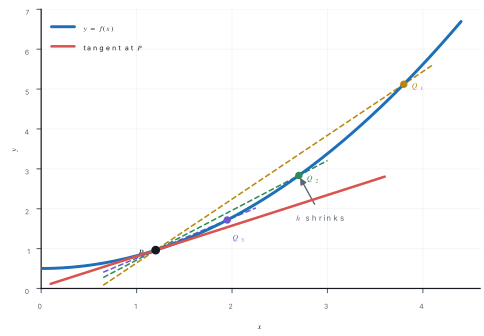
The derivative of f at x is
provided this limit exists and is finite. Finding a derivative straight from this limit is called differentiation from first principles (or ab initio, or by the delta method). An equivalent form used at a particular point x=a is
Notations for the same thing: f'(x), \dfrac{dy}{dx}, y', y_1, \dfrac{d}{dx}f(x), Df(x).
The four-step procedure
Every first-principle question is answered by the same four steps. Write them out every time — examiners give a mark for each.
- Write down f(x+h), replacing every x in the formula by x+h.
- Form the difference f(x+h)-f(x) and simplify it as far as possible.
- Divide by h — the simplification in step 2 must make one factor of h cancel.
- Take the limit as h \to 0.
The only real skill is step 2: you must find the trick that exposes a factor of h. For polynomials it is expansion; for surds it is the conjugate; for fractions it is a common denominator; for trigonometric functions it is the sum-to-product formula; for exponentials and logarithms it is a standard limit from Unit 17.
Put z = x+h. As h \to 0 we have z \to x, and h = z-x, so
This is exactly the standard algebraic limit of Unit 17, whose value is n\,x^{n-1}. Hence
valid for every real index n. In particular \dfrac{d}{dx}(x) = 1 and \dfrac{d}{dx}(c) = 0 for a constant c, since c = cx^{0}.
Step 2 gives 0 over 0, so multiply above and below by the conjugate \sqrt{x+h}+\sqrt{x}:
Cancel h — legal because h \ne 0 in a limit — and then let h \to 0:
This agrees with the power rule: \sqrt{x} = x^{1/2} gives \tfrac12 x^{-1/2} = 1/(2\sqrt{x}).
Use the sum-to-product identity \sin C - \sin D = 2\cos\dfrac{C+D}{2}\sin\dfrac{C-D}{2} with C = x+h, D = x:
So
As h \to 0 the first factor tends to \cos x and the second to 1 by the standard limit \lim_{u\to0}\frac{\sin u}{u} = 1. Hence
The same argument with \cos C - \cos D = -2\sin\dfrac{C+D}{2}\sin\dfrac{C-D}{2} gives \dfrac{d}{dx}(\cos x) = -\sin x.
The factor a^{x} does not involve h, so it comes outside the limit. The remaining limit is the standard exponential limit of Unit 17, equal to \ln a. Hence
since \ln e = 1. The exponential function e^{x} is the only function equal to its own derivative.
Put u = h/x, so h = ux and u \to 0 as h \to 0:
using the standard limit \lim_{u\to0}\frac{\ln(1+u)}{u} = 1. Hence
Combine the two tangents over a common denominator:
The numerator is \sin\left[(x+h)-x\right] = \sin h. Therefore
Problem. Differentiate f(x) = x^{3}+2x from first principles.
Solution.
Step 1. f(x+h) = (x+h)^{3}+2(x+h) = x^{3}+3x^{2}h+3xh^{2}+h^{3}+2x+2h.
Step 2. Subtract f(x) = x^{3}+2x; the terms without h cancel:
Step 3. Divide by h (allowed, h \ne 0):
Step 4. Let h \to 0: every term containing h vanishes, leaving
Problem. Find \dfrac{dy}{dx} from first principles if y = \sqrt{2x+3}.
Solution.
Step 1. y+\delta y = \sqrt{2(x+h)+3} = \sqrt{2x+2h+3}.
Step 2 and 3. Form the difference quotient and rationalise the numerator:
The numerator is 2h, so after cancelling h,
Step 4. Let h \to 0:
Problem. Differentiate f(x) = \dfrac{1}{x+1} from first principles.
Solution.
Put the bracket over the common denominator (x+h+1)(x+1):
Letting h \to 0,
Problem. Find the derivative of y = \sin 2x from first principles.
Solution.
Apply \sin C-\sin D = 2\cos\frac{C+D}{2}\sin\frac{C-D}{2} with C = 2x+2h and D = 2x, so \frac{C+D}{2} = 2x+h and \frac{C-D}{2} = h:
Problem. Differentiate y = e^{2x} from first principles.
Solution.
Take the constant factor e^{2x} outside and adjust the fraction so the exponent matches the denominator:
using \lim_{u\to0}\dfrac{e^{u}-1}{u} = 1 with u = 2h.
Differentiability and continuity
If f is differentiable at a then f is continuous at a. The converse is false: f(x) = |x| is continuous at 0 but not differentiable there, because
The left-hand derivative and right-hand derivative disagree, so f'(0) does not exist. The graph has a corner there.
A derivative fails to exist at a point for exactly one of four reasons: a corner (one-sided derivatives differ), a vertical tangent (the limit is \pm\infty, as for y = x^{1/3} at 0), a discontinuity, or an endpoint of the domain.
Problem. Show that f(x) = |x-2| is continuous at x = 2 but not differentiable there.
Solution. Continuity. For x<2, f(x) = 2-x, so \lim_{x\to2^{-}}f(x) = 0. For x>2, f(x) = x-2, so \lim_{x\to2^{+}}f(x) = 0. Also f(2) = |2-2| = 0. Since LHL = RHL = f(2) = 0, f is continuous at x = 2.
Differentiability. Compute the two one-sided derivatives from the definition.
Left-hand derivative, with h<0 so that 2+h<2 and f(2+h) = -h:
Right-hand derivative, with h>0 so that f(2+h) = h:
Since Lf'(2) \ne Rf'(2), the limit defining f'(2) does not exist, so f is not differentiable at x = 2 even though it is continuous there.
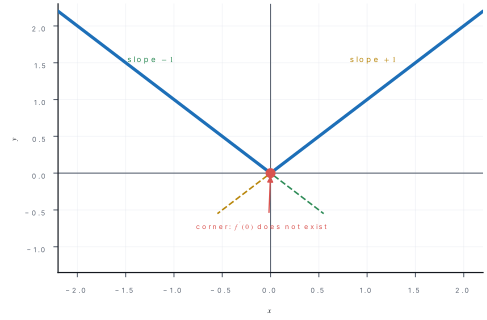
A question that asks you to show f is continuous but not differentiable at a point is asking for two separate calculations: LHL = RHL = f(a) for continuity, and then the left-hand and right-hand derivatives from the definition. Showing only continuity earns half the marks.
18.2 Rules of differentiation
Differentiating everything from first principles would be unbearable. The rules below do the work instead; each is proved once from the definition and then used for ever.
Sum, difference and constant multiple
If u and v are differentiable functions of x and c is a constant,
These follow directly from the corresponding limit laws. Differentiation is therefore linear: differentiate a long sum term by term.
The power rule
Before using it, rewrite roots and reciprocals as powers: \sqrt{x} = x^{1/2}, \dfrac{1}{x^{3}} = x^{-3}, \dfrac{1}{\sqrt[3]{x}} = x^{-1/3}.
Problem. Differentiate y = 3x^{4}-\dfrac{5}{x^{2}}+2\sqrt{x}-7.
Solution. First convert every term to a power of x:
Differentiate term by term, using \frac{d}{dx}x^{n} = nx^{n-1} on each:
Note the double negative in the second term: -5 \times (-2) = +10. This sign is the commonest slip in the whole unit.
The product rule
Let y = uv where u = u(x) and v = v(x). Give x an increment h, so u becomes u+\delta u and v becomes v+\delta v. Then
Divide by h:
As h \to 0 we have \delta u \to 0 (because u is continuous), while \delta u/h \to du/dx and \delta v/h \to dv/dx. The last term therefore tends to 0 \times dv/dx = 0, and
In words: first times derivative of second, plus second times derivative of first. For three factors the pattern extends: (uvw)' = u'vw+uv'w+uvw'.
Problem. Differentiate y = x^{3}\sin x.
Solution. Take u = x^{3} and v = \sin x, so u' = 3x^{2} and v' = \cos x. By the product rule,
The quotient rule
Let y = \dfrac{u}{v} with v \ne 0. With increments as before,
Divide by h and let h \to 0; then \delta v \to 0, so v+\delta v \to v:
The order matters here: it is denominator times derivative of numerator, minus numerator times derivative of denominator, all over the denominator squared. Reverse the subtraction and every sign in your answer is wrong.
Problem. Differentiate y = \dfrac{2x+3}{3x-2}.
Solution. Take u = 2x+3 (u' = 2) and v = 3x-2 (v' = 3):
The derivative is negative for every x \ne 2/3, so this curve is decreasing on each of its two branches.
Problem. Differentiate y = \dfrac{\sin x}{1+\cos x}.
Solution. With u = \sin x and v = 1+\cos x,
Now use \sin^{2}x+\cos^{2}x = 1:
Always look for a Pythagorean identity in the numerator before writing the final line — the tidy form is what the marker wants.
The chain rule
If y is a function of u and u is a function of x, then
This is the single most used rule in the chapter. For a composite y = f(g(x)) it reads y' = f'(g(x))\cdot g'(x): differentiate the outside function, keep the inside unchanged, then multiply by the derivative of the inside.
Peel the function like an onion, outermost layer first, multiplying as you go. For y = \sin^{3}(2x+1) the layers are: cube \to sine \to linear, so y' = 3[\sin(2x+1)]^{2}\times\cos(2x+1)\times 2.
Problem. Differentiate y = (3x^{2}+5)^{7}.
Solution. Put u = 3x^{2}+5, so y = u^{7}. Then
Expanding the bracket first would take a page and gain no marks.
Problem. Differentiate y = \sin^{3}(2x+1).
Solution. Write y = \left[\sin(2x+1)\right]^{3} and peel:
Outer layer (cube): 3\left[\sin(2x+1)\right]^{2}. Middle layer (sine): multiply by \cos(2x+1). Inner layer (linear): multiply by 2.
Problem. Differentiate y = \tan\sqrt{x}.
Solution. Put u = \sqrt{x} = x^{1/2}, so y = \tan u and
Problem. Differentiate y = \dfrac{x}{\sqrt{1+x^{2}}}.
Solution. It is quicker to write the surd as a power and use the product rule than to use the quotient rule:
Differentiate, applying the chain rule to the second factor:
Take out the lower power \left(1+x^{2}\right)^{-3/2} as a common factor:
Factorising out the most negative power is the standard way to tidy answers of this kind; it is expected in the marking scheme.
Derivatives of trigonometric functions
\sin x and \cos x were differentiated from first principles above; the other four follow by the quotient rule. For example, with \sec x = 1/\cos x,
| y | \sin x | \cos x | \tan x | \cot x | \sec x | \csc x |
|---|---|---|---|---|---|---|
| dy/dx | \cos x | -\sin x | \sec^{2}x | -\csc^{2}x | \sec x\tan x | -\csc x\cot x |
Every function whose name begins with co- (\cos, \cot, \csc) has a minus sign in its derivative. The other three do not.
Derivatives of inverse trigonometric functions
Let y = \sin^{-1}x, so x = \sin y with -\pi/2 \le y \le \pi/2. Differentiate x = \sin y with respect to y:
Therefore \dfrac{dy}{dx} = \dfrac{1}{\cos y}. On the principal range \cos y \ge 0, so
The same method gives all six. Note that \cos^{-1}x = \pi/2-\sin^{-1}x, which explains at once why its derivative is the negative of the one above.
| y | \sin^{-1}x | \cos^{-1}x | \tan^{-1}x | \cot^{-1}x | \sec^{-1}x | \csc^{-1}x |
|---|---|---|---|---|---|---|
| dy/dx | \dfrac{1}{\sqrt{1-x^{2}}} | \dfrac{-1}{\sqrt{1-x^{2}}} | \dfrac{1}{1+x^{2}} | \dfrac{-1}{1+x^{2}} | \dfrac{1}{|x|\sqrt{x^{2}-1}} | \dfrac{-1}{|x|\sqrt{x^{2}-1}} |
Inverse-trigonometric questions in NEB papers are usually designed to collapse after a substitution such as x = \tan\theta or x = \sin\theta. Look for the patterns \dfrac{2x}{1-x^{2}} (= \tan2\theta), 2x\sqrt{1-x^{2}} (= \sin2\theta) and \dfrac{1+x}{1-x} (= \tan(\pi/4+\theta)). One line of trigonometry saves ten lines of algebra.
Problem. Differentiate y = \tan^{-1}\dfrac{1+x}{1-x}.
Solution. Put x = \tan\theta, so \theta = \tan^{-1}x. Then
Hence y = \dfrac{\pi}{4}+\theta = \dfrac{\pi}{4}+\tan^{-1}x, and differentiating,
The quotient-plus-chain route gives the same answer after half a page of algebra.
Problem. Differentiate y = \sin^{-1}\left(2x\sqrt{1-x^{2}}\right) for |x| < \dfrac{1}{\sqrt{2}}.
Solution. Put x = \sin\theta with -\pi/4 < \theta < \pi/4. Then \sqrt{1-x^{2}} = \cos\theta and
Because -\pi/2 < 2\theta < \pi/2, we may write y = \sin^{-1}(\sin2\theta) = 2\theta, that is y = 2\sin^{-1}x. Therefore
The restriction on x matters: outside |x|<1/\sqrt{2} the simplification \sin^{-1}(\sin2\theta) = 2\theta fails and the sign of the answer changes.
Derivatives of exponential and logarithmic functions
The last follows from the change of base \log_a x = \dfrac{\ln x}{\ln a}, in which \ln a is only a constant. Combined with the chain rule:
Problem. Differentiate y = e^{x^{2}}\tan x.
Solution. Product rule with u = e^{x^{2}} and v = \tan x. By the chain rule u' = e^{x^{2}}\cdot 2x, and v' = \sec^{2}x. So
Problem. Show that \dfrac{d}{dx}\ln(\sec x+\tan x) = \sec x.
Solution. Using \dfrac{d}{dx}\ln f = \dfrac{f'}{f} with f = \sec x+\tan x,
Therefore
The bracket cancels completely — which is why this particular logarithm appears so often in integration (Unit 19).
Differentiating one function with respect to another
NEB papers often ask for \dfrac{du}{dv} where both u and v are given functions of x. Treat x as a parameter, exactly as in §18.3:
Problem. (a) Differentiate x^{2} with respect to x^{3}. (b) Differentiate \sin^{-1}\dfrac{2x}{1+x^{2}} with respect to \tan^{-1}x for |x|<1.
Solution. (a) Let u = x^{2} and v = x^{3}. Then \dfrac{du}{dx} = 2x and \dfrac{dv}{dx} = 3x^{2}, so
(b) Simplify first. Put x = \tan\theta with -\dfrac{\pi}{4}<\theta<\dfrac{\pi}{4}; then \dfrac{2x}{1+x^{2}} = \dfrac{2\tan\theta}{1+\tan^{2}\theta} = \sin2\theta, so
Hence \dfrac{du}{dx} = \dfrac{2}{1+x^{2}}, \dfrac{dv}{dx} = \dfrac{1}{1+x^{2}}, and
Logarithmic differentiation
When the variable appears in the exponent, or when a function is a long product and quotient of powers, take natural logarithms of both sides first.
Use logarithmic differentiation if you see either (i) [f(x)]^{g(x)} — a variable base and a variable index, where neither the power rule nor the exponential rule applies on its own; or (ii) a product/quotient of four or more factors, where \ln turns multiplication into addition.
Problem. Differentiate y = x^{\sin x}, x>0.
Solution. Take natural logarithms of both sides:
Differentiate both sides with respect to x. On the left, \ln y is a function of y which is a function of x, so the chain rule gives \dfrac{1}{y}\dfrac{dy}{dx}. On the right use the product rule:
Multiply through by y and substitute y = x^{\sin x}:
Problem. Differentiate y = x^{x}+(\sin x)^{x}.
Solution. A sum must be split: you cannot take the logarithm of a sum. Put u = x^{x} and v = (\sin x)^{x}, so y = u+v and y' = u'+v'.
For u: \ln u = x\ln x, so \dfrac{1}{u}\dfrac{du}{dx} = x\cdot\dfrac1x+\ln x = 1+\ln x, giving
For v: \ln v = x\ln(\sin x), so
Adding,
Writing \dfrac{d}{dx}x^{x} = x\cdot x^{x-1} (power rule) or x^{x}\ln x (exponential rule) are both wrong. The power rule needs a constant index; the exponential rule needs a constant base. When both vary, only logarithmic differentiation works.
| y | \dfrac{dy}{dx} | y | \dfrac{dy}{dx} |
|---|---|---|---|
| c (constant) | 0 | \sin^{-1}x | \dfrac{1}{\sqrt{1-x^{2}}} |
| x^{n} | nx^{n-1} | \cos^{-1}x | \dfrac{-1}{\sqrt{1-x^{2}}} |
| \sqrt{x} | \dfrac{1}{2\sqrt{x}} | \tan^{-1}x | \dfrac{1}{1+x^{2}} |
| \dfrac{1}{x} | -\dfrac{1}{x^{2}} | \cot^{-1}x | \dfrac{-1}{1+x^{2}} |
| e^{x} | e^{x} | \sec^{-1}x | \dfrac{1}{|x|\sqrt{x^{2}-1}} |
| a^{x} | a^{x}\ln a | \csc^{-1}x | \dfrac{-1}{|x|\sqrt{x^{2}-1}} |
| \ln x | \dfrac{1}{x} | \sin x | \cos x |
| \log_{a}x | \dfrac{1}{x\ln a} | \cos x | -\sin x |
| \tan x | \sec^{2}x | \cot x | -\csc^{2}x |
| \sec x | \sec x\tan x | \csc x | -\csc x\cot x |
And the four rules:
18.3 Derivatives of parametric and implicit functions
So far y has been given by an explicit formula y = f(x). Two other descriptions are just as common, and each has its own technique.
Implicit differentiation
A relation such as x^{2}+y^{2} = 25 or x^{3}+y^{3} = 3axy defines y in terms of x without being solved for y. Such a relation is called implicit. We can still find dy/dx without solving, by differentiating every term of the equation with respect to x and treating y as a function of x.
Whenever you differentiate a term containing y, apply the chain rule and multiply by \dfrac{dy}{dx}:
Then collect all the \dfrac{dy}{dx} terms on one side and factor.
Problem. If x^{3}+y^{3} = 3axy, find \dfrac{dy}{dx}.
Solution. Differentiate each term with respect to x. The right-hand side needs the product rule on xy:
Divide by 3 and gather the dy/dx terms on the left, the rest on the right:
The answer contains both x and y; that is normal and expected for an implicit curve.
Problem. Find the equations of the tangent and normal to the circle x^{2}+y^{2} = 25 at the point (3,4).
Solution. Differentiate implicitly:
At (3,4) the slope of the tangent is m = -\dfrac{3}{4}.
Tangent: y-4 = -\dfrac34(x-3), i.e. 4y-16 = -3x+9, so
Normal: its slope is -1/m = \dfrac43, so y-4 = \dfrac43(x-3), giving 3y-12 = 4x-12, i.e.
As expected for a circle, the normal passes through the centre (0,0).
Parametric differentiation
Sometimes both coordinates are given in terms of a third variable, the parameter: x = f(t), y = g(t). Here the chain rule gives
Differentiate y with respect to the parameter, differentiate x with respect to the parameter, then divide. Do not try to eliminate the parameter first unless it is very easy; that is usually the longest route.
Problem. If x = a\cos^{3}\theta and y = a\sin^{3}\theta, find \dfrac{dy}{dx}.
Solution. Differentiate each coordinate with respect to \theta, using the chain rule on the cubes:
Divide:
Everything cancels except one ratio — a good sign that you have differentiated correctly.
The second derivative of a parametric curve
The first derivative divides, but the second does not. You must differentiate dy/dx with respect to t and then divide by dx/dt again:
Problem. For x = at^{2}, y = 2at, find \dfrac{dy}{dx} and \dfrac{d^{2}y}{dx^{2}}.
Solution. First derivatives with respect to t:
For the second derivative, differentiate 1/t with respect to t and then divide by dx/dt:
(The common wrong answer, \ddot y/\ddot x = 0/2a = 0, would say the parabola is a straight line.)
18.4 Higher order derivatives
Differentiating f' gives the second derivative f'', differentiating again gives the third, and so on. The standard notations are
or y', y'', y''', y^{(4)}, \ldots, y^{(n)}, or y_1, y_2, y_3, \ldots, y_n — the last is the form NEB papers most often use.
The physical meaning is familiar from Physics: if s(t) is displacement, then s_1 = ds/dt is velocity and s_2 = d^{2}s/dt^{2} is acceleration. In §18.8 the second derivative will tell us how a curve bends.
n-th derivatives of standard functions
Differentiate repeatedly and the pattern appears:
| y | y_n |
|---|---|
| x^{m} | m(m-1)(m-2)\cdots(m-n+1)\,x^{m-n} |
| x^{n} | n! |
| e^{ax} | a^{n}e^{ax} |
| \ln x | \dfrac{(-1)^{n-1}(n-1)!}{x^{n}} |
| \dfrac{1}{x+a} | \dfrac{(-1)^{n}\,n!}{(x+a)^{n+1}} |
| \sin(ax+b) | a^{n}\sin\left(ax+b+\dfrac{n\pi}{2}\right) |
| \cos(ax+b) | a^{n}\cos\left(ax+b+\dfrac{n\pi}{2}\right) |
The trigonometric entries work because each differentiation advances the angle by a right angle: \cos u = \sin\left(u+\frac{\pi}{2}\right).
Problem. If y = x^{3}\ln x, find y_3.
Solution. Differentiate three times, using the product rule each time.
Problem. If y = e^{ax}\sin bx, show that y_2-2ay_1+\left(a^{2}+b^{2}\right)y = 0.
Solution. Differentiate once by the product rule:
Differentiate again, product rule once more:
Now substitute into the left-hand side, writing s = \sin bx and c = \cos bx:
The c terms give 2abc-2abc = 0; the s terms give a^{2}-b^{2}-2a^{2}+a^{2}+b^{2} = 0. Hence the whole expression is zero, as required.
Problem. If y = A\sin mx+B\cos mx, prove that y_2+m^{2}y = 0.
Solution.
Therefore y_2+m^{2}y = 0. This is the equation of simple harmonic motion, which is why \sin and \cos describe every oscillation in Physics.
Problem. If y = \dfrac{1}{3x+2}, find y_n.
Solution. Write y = (3x+2)^{-1} and differentiate repeatedly, using the chain rule each time (the inner derivative is always 3):
Each step contributes one more factor of 3, one more factor from the falling index, and one more sign change. The pattern is therefore
Check with n=4: the formula gives 4!\,3^{4}/(3x+2)^{5} = 1944/(3x+2)^{5}, which is what a fourth direct differentiation produces.
18.5 Geometric interpretation of derivative
Slope of the tangent
From §18.1, f'(a) is the limit of the secant slopes at x = a, that is:
f'(a) is the gradient (slope) of the tangent to the curve y = f(x) at the point where x = a. Equivalently, f'(a) = \tan\psi, where \psi is the angle the tangent makes with the positive x-axis.
The normal at a point is the line through that point perpendicular to the tangent. Perpendicular lines have slopes whose product is -1, so
Equations of tangent and normal
At the point \left(x_1, y_1\right) on the curve, with m = f'(x_1):
Special cases: if f'(x_1) = 0 the tangent is horizontal (y = y_1) and the normal is vertical (x = x_1); if f'(x_1) is infinite the tangent is vertical and the normal horizontal.
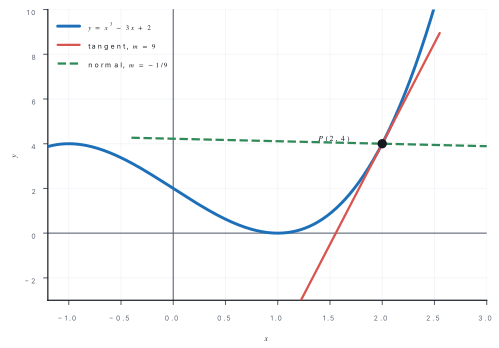
Problem. Find the equations of the tangent and the normal to the curve y = x^{3}-3x+2 at the point where x = 2.
Solution. Point. y = 2^{3}-3(2)+2 = 8-6+2 = 4, so P is (2,4).
Slope. \dfrac{dy}{dx} = 3x^{2}-3, so m = 3(4)-3 = 9.
Tangent. y-4 = 9(x-2), i.e.
Normal. Slope = -\dfrac19, so y-4 = -\dfrac19(x-2). Multiplying by 9, 9y-36 = -x+2, i.e.
Angle between two curves
The angle between two curves at a common point is the angle between their tangents there. If the slopes are m_1 and m_2,
The curves are orthogonal (perpendicular) if m_1m_2 = -1, and touch each other if m_1 = m_2.
Problem. Find the angle between the curves y = x^{2} and y^{2} = x at the point (1,1).
Solution. First curve. y = x^{2} gives \dfrac{dy}{dx} = 2x, so m_1 = 2 at (1,1).
Second curve. y^{2} = x; differentiating implicitly, 2y\dfrac{dy}{dx} = 1, so \dfrac{dy}{dx} = \dfrac{1}{2y} and m_2 = \dfrac12 at (1,1).
The derivative as a rate of change
The tangent picture is geometric, but the same limit has a physical reading. If y depends on x, then \dfrac{dy}{dx} is the rate at which y changes per unit change in x, measured at that instant. A positive value means y grows as x grows; a large magnitude means it grows quickly.
This is why the derivative appears everywhere outside mathematics: with s(t) a displacement, \dfrac{ds}{dt} is velocity and \dfrac{d^{2}s}{dt^{2}} is acceleration; with C(x) a total cost, \dfrac{dC}{dx} is the marginal cost of one more unit; with A(r) an area, \dfrac{dA}{dr} tells how the area responds to a change in radius. Chaining two such rates gives \dfrac{dA}{dt} = \dfrac{dA}{dr}\cdot\dfrac{dr}{dt}.
Problem. A particle moves along a straight line so that its displacement after t seconds is s = t^{3}-6t^{2}+9t+4 metres. Find its velocity and acceleration at time t, the times at which it is momentarily at rest, and its acceleration at each of those times.
Solution. Velocity is the first derivative and acceleration the second:
The particle is at rest when v = 0, i.e. at t = 1\ \text{s} and t = 3\ \text{s}.
At t = 1: a = 6(1-2) = -6\ \text{m s}^{-2} (it is about to move backwards). At t = 3: a = 6(3-2) = +6\ \text{m s}^{-2} (it is about to move forwards).
The displacements there are s(1) = 8\ \text{m} and s(3) = 4\ \text{m} — the particle advances, reverses, then advances again.
Problem. Oil spilled on the Koshi river spreads in a circle whose radius grows at 2\ \text{cm s}^{-1}. How fast is the area of the slick increasing at the moment when the radius is 10\ \text{cm}?
Solution. The area of a circle is A = \pi r^{2}, and r itself changes with time, so by the chain rule
Substituting r = 10\ \text{cm} and \dfrac{dr}{dt} = 2\ \text{cm s}^{-1},
Reading f' off the graph of f
Because f' is the slope, the sign of f' and the shape of f are locked together: where the curve climbs, f' is above the axis; where it falls, f' is below; at a turning point the curve is momentarily flat and f' crosses zero.
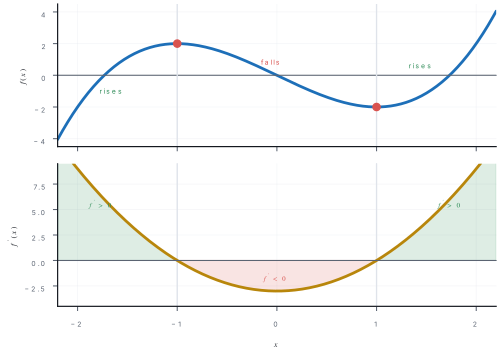
Reading a graph question backwards is a standard Group A trick: you are shown the graph of f' and asked about f. Remember only this: f' above the axis means f is going up; f' crossing the axis means f has a turning point; f' itself increasing means f bends upwards (§18.8).
18.6 Monotonicity of a function; intervals of increase and decrease
A function is monotonic on an interval if it moves in only one direction there — always up, or always down.
Let f be defined on an interval I and let x_1 < x_2 be any two points of I.
- f is increasing on I if f(x_1) \le f(x_2), and strictly increasing if f(x_1) < f(x_2).
- f is decreasing on I if f(x_1) \ge f(x_2), and strictly decreasing if f(x_1) > f(x_2).
Since f' is the slope of the tangent, the test is immediate.
Let f be differentiable on an interval I. Then on that interval:
The procedure
- Compute f'(x) and factorise it completely.
- Solve f'(x) = 0; add any point where f' is undefined. These are the critical points; mark them on a number line.
- The critical points cut the line into open intervals. Test the sign of f' in each interval, using one convenient value or the sign of each factor.
- Report: increasing where f' > 0, decreasing where f' < 0.
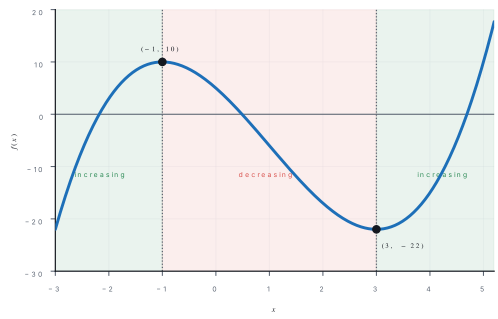
Problem. Find the intervals in which f(x) = x^{3}-3x^{2}-9x+5 is increasing and in which it is decreasing.
Solution. Step 1. Differentiate and factorise:
Step 2. f'(x) = 0 at x = -1 and x = 3. These cut the real line into three intervals.
Step 3. Test the sign of each factor:
| Interval | (x+1) | (x-3) | f'(x) | Behaviour |
|---|---|---|---|---|
| x < -1 | - | - | + | increasing |
| -1 < x < 3 | + | - | - | decreasing |
| x > 3 | + | + | + | increasing |
Step 4. f is increasing on (-\infty,-1) and on (3,\infty), and decreasing on (-1,3).
A quick numerical check: f'(0) = -9 < 0, which confirms the middle row.
Problem. Show that f(x) = \sin x is strictly increasing on \left(-\dfrac{\pi}{2},\dfrac{\pi}{2}\right) and strictly decreasing on \left(\dfrac{\pi}{2},\dfrac{3\pi}{2}\right).
Solution. f'(x) = \cos x.
On \left(-\dfrac{\pi}{2},\dfrac{\pi}{2}\right) the cosine is positive, so f' > 0 and \sin x is strictly increasing there.
On \left(\dfrac{\pi}{2},\dfrac{3\pi}{2}\right) the cosine is negative, so f' < 0 and \sin x is strictly decreasing there.
This is exactly why \sin^{-1} is defined with the principal range \left[-\dfrac{\pi}{2},\dfrac{\pi}{2}\right]: that is the largest interval on which \sin is one-to-one.
f(x) = x^{3} has f'(0) = 0, yet f is strictly increasing on all of \mathbb{R}, because f' = 3x^{2} > 0 everywhere else. "Increasing" concerns an interval, not a single point, so do not break an interval at a point where f' touches zero without changing sign.
18.7 Extreme values (maxima and minima)
Critical points
f has a local (relative) maximum at x = c if f(c) \ge f(x) for all x in some open interval around c; a local minimum if f(c) \le f(x) there. The value f(c) is the extreme value; the point \left(c, f(c)\right) is a turning point.
A point c where f'(c) = 0 or where f'(c) does not exist is called a critical point (or stationary point when f'(c) = 0).
If f has a local extreme at an interior point c and f'(c) exists, then f'(c) = 0.
The converse is false. f'(c) = 0 only makes c a candidate: for f(x) = x^{3} we have f'(0) = 0, but 0 is neither a maximum nor a minimum — it is a point of inflection. A test is always needed.
The first derivative test
Examine how the sign of f' changes as x passes through the critical point c, moving from left to right:
| Sign change of f' at c | Conclusion |
|---|---|
| + to - | local maximum at c |
| - to + | local minimum at c |
| no change (+,+ or -,-) | neither — a point of inflection |
The picture is easy to remember: the curve goes up then down over a hill (maximum), or down then up through a valley (minimum).
The second derivative test
Often faster, when f'' is easy to compute.
Suppose f'(c) = 0. Then
Memory hook: f'' < 0 means the curve is bending downwards like a frown, so the stationary point is a peak; f'' > 0 bends upwards like a smile, so it is a valley.
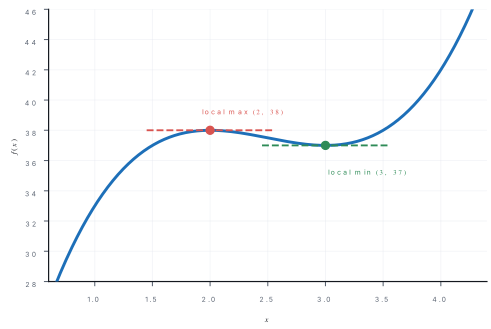
Problem. Find the maximum and minimum values of f(x) = 2x^{3}-15x^{2}+36x+10.
Solution. Stationary points.
Setting f'(x) = 0 gives x = 2 and x = 3.
Second derivative test.
At x = 2: f''(2) = 24-30 = -6 < 0, so there is a local maximum. At x = 3: f''(3) = 36-30 = 6 > 0, so there is a local minimum.
Extreme values.
So the maximum value is 38 at x = 2 and the minimum value is 37 at x = 3.
Note that the local maximum value 38 exceeds the local minimum value 37, as it must for a cubic — but neither is a global extreme, since f \to \pm\infty as x \to \pm\infty.
Absolute extremes on a closed interval
On a closed interval [a,b] a continuous function always attains a greatest and a least value. To find them, evaluate f at every critical point inside the interval and at both endpoints, then pick the largest and smallest of those numbers. The endpoints are the step students forget.
Problem. Find the absolute maximum and minimum of f(x) = x^{3}-3x on [-2,3].
Solution. f'(x) = 3x^{2}-3 = 3(x-1)(x+1), zero at x = \pm1; both lie in [-2,3].
Evaluate at the two critical points and the two endpoints:
| x | -2 | -1 | 1 | 3 |
|---|---|---|---|---|
| f(x) | -2 | 2 | -2 | 18 |
The absolute maximum is 18, at the endpoint x = 3; the absolute minimum is -2, attained twice, at x = -2 and at x = 1.
Applied maxima and minima
- Draw a figure and name the variables.
- Write the quantity to be optimised as a formula.
- Use the given constraint to reduce it to one variable, and state that variable's physical range.
- Differentiate, set the derivative to zero, solve.
- Confirm maximum or minimum with the second derivative test.
- Answer the question actually asked, with units.
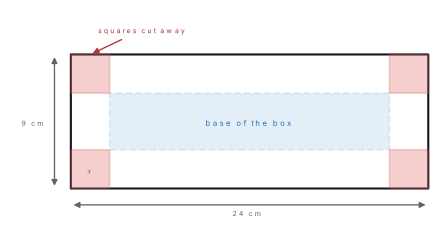
Problem. From each corner of a rectangular sheet of tin 24\ \text{cm} by 9\ \text{cm}, a square of side x is cut away and the flaps are folded up to make an open box. Find x so that the volume is greatest, and find that volume.
Solution. After cutting, the base measures (24-2x) by (9-2x) and the height is x, so
with 0 < x < 4.5 (the shorter side must stay positive).
Differentiate:
Setting dV/dx = 0 gives x = 2 or x = 9. Only x = 2 lies in the allowed range.
Check. \dfrac{d^{2}V}{dx^{2}} = 24x-132, and at x = 2 this is 48-132 = -84 < 0, so the volume is a maximum.
Answer. x = 2\ \text{cm}, and
Problem. A farmer in Chitwan has 100\ \text{m} of fencing and wants to enclose a rectangular plot against a long straight wall, which needs no fence. What dimensions give the greatest area?
Solution. Let the two sides perpendicular to the wall be x metres each; the side parallel to the wall is then 100-2x metres. The area is
So the plot is 25\ \text{m} by 50\ \text{m}, with maximum area A = 25 \times 50 = 1250\ \text{m}^{2}.
Optimisation questions usually ask for the maximum value, or for the dimensions, not for the value of x that produces it. Finish the arithmetic and attach the unit — cm³, m², rupees. Marks are lost here every year.
18.8 Concavity and points of inflection
The first derivative says whether a curve is going up or down. The second derivative says which way it bends.
A curve is concave upward (convex) on an interval if it lies above all of its tangents there — it holds water, like a smile. It is concave downward if it lies below its tangents — like a frown.
The reason is simple: f'' > 0 means f' (the slope) is increasing, so the tangent keeps turning anticlockwise and the curve bends upwards.
A point of inflection is a point on the curve at which the concavity changes — from upward to downward or the reverse.
At such a point f''(x) = 0 (or f'' fails to exist), and f'' must change sign there. The condition f''(c) = 0 alone is not enough: for f(x) = x^{4} we have f''(0) = 0, yet f'' = 12x^{2} \ge 0 on both sides, so the curve is concave upward throughout and (0,0) is not an inflection point.
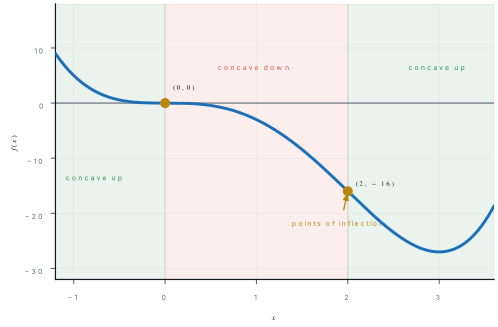
Problem. Find the intervals of concavity and the points of inflection of f(x) = x^{4}-4x^{3}.
Solution.
f''(x) = 0 at x = 0 and x = 2. Test the sign of f'' in the three intervals:
| Interval | 12x | (x-2) | f'' | Concavity |
|---|---|---|---|---|
| x < 0 | - | - | + | upward |
| 0 < x < 2 | + | - | - | downward |
| x > 2 | + | + | + | upward |
The sign of f'' changes at both x = 0 and x = 2, so both give points of inflection. Their coordinates:
Inflection points: (0,0) and (2,-16). The curve is concave upward on (-\infty,0) and (2,\infty), concave downward on (0,2).
Note that x = 0 is also a stationary point, since f'(0) = 0, yet it is not a turning point: f' = 4x^{2}(x-3) is negative on both sides of 0. This is precisely the case where the second derivative test fails and the first derivative test rescues you.
Problem. For f(x) = x^{3}-6x^{2}+9x+1, find the intervals of increase and decrease, the local extreme values, and the point of inflection.
Solution. Derivatives.
Monotonicity. f' > 0 for x < 1 and for x > 3; f' < 0 for 1 < x < 3. So f increases on (-\infty,1) and (3,\infty) and decreases on (1,3).
Extremes. f''(1) = -6 < 0, so x = 1 gives a local maximum f(1) = 1-6+9+1 = 5. And f''(3) = 6 > 0, so x = 3 gives a local minimum f(3) = 27-54+27+1 = 1.
Inflection. f''(x) = 0 at x = 2, and f'' changes from negative to positive there, so (2, f(2)) = (2,3) is a point of inflection. Notice that it sits exactly midway between the two turning points — true for every cubic.
Examiners often bundle §18.6–§18.8 into one Group C question. Answer in this order and you cannot leave anything out: (1) intercepts, (2) f' factorised, (3) intervals of increase/decrease, (4) turning points with the second derivative test, (5) f'' and intervals of concavity, (6) points of inflection. Then sketch.
Chapter summary
- First principle: f'(x) = \lim_{h\to0}\dfrac{f(x+h)-f(x)}{h}. Four steps — form f(x+h), subtract, divide by h, take the limit. The trick in step 2 is expansion (polynomials), the conjugate (surds), a common denominator (fractions), sum-to-product (trigonometric) or a standard limit (exponential and logarithmic).
- Differentiable \Rightarrow continuous, but not the reverse: |x| has a corner at 0 where the left and right derivatives are -1 and +1.
- Rules: (u\pm v)' = u'\pm v'; (uv)' = uv'+vu'; \left(\frac uv\right)' = \frac{vu'-uv'}{v^{2}}; chain rule \frac{dy}{dx} = \frac{dy}{du}\cdot\frac{du}{dx}.
- Standard derivatives: x^{n} \to nx^{n-1}; e^{x} \to e^{x}; a^{x} \to a^{x}\ln a; \ln x \to 1/x; \sin x \to \cos x; \cos x \to -\sin x; \tan x \to \sec^{2}x; \sin^{-1}x \to 1/\sqrt{1-x^{2}}; \tan^{-1}x \to 1/(1+x^{2}). Every "co-" function carries a minus sign.
- Logarithmic differentiation for [f(x)]^{g(x)} and for long products/quotients: take \ln of both sides, then differentiate, remembering \frac{d}{dx}\ln y = \frac1y\frac{dy}{dx}.
- Implicit: differentiate every term in x, attaching \frac{dy}{dx} to each y-term, then collect and factor. Parametric: \frac{dy}{dx} = \dfrac{dy/dt}{dx/dt}, and \frac{d^{2}y}{dx^{2}} = \dfrac{\frac{d}{dt}\left(\frac{dy}{dx}\right)}{dx/dt} — never \ddot y/\ddot x.
- Geometry: f'(a) is the slope of the tangent at x=a; the normal has slope -1/f'(a); the angle between curves is \tan\theta = \left|\dfrac{m_1-m_2}{1+m_1m_2}\right|.
- Monotonicity: f' > 0 increasing, f' < 0 decreasing. Extremes: solve f' = 0, then use the sign change of f' or the sign of f'' (f''<0 maximum, f''>0 minimum). On a closed interval, test the endpoints too.
- Concavity: f'' > 0 concave up, f'' < 0 concave down; an inflection point needs f'' = 0 and a change of sign.
Practice questions
Group A — Multiple choice (1 mark each)
- By first principle, \dfrac{d}{dx}\sqrt{x} equals [1]a\dfrac{1}{\sqrt{x}}b\dfrac{1}{2\sqrt{x}}c2\sqrt{x}d\dfrac{\sqrt{x}}{2}
- \dfrac{d}{dx}(\sin 3x) equals [1]a\cos 3xb-3\cos 3xc3\cos 3xd3\sin 3x
- If y = x^{x} then \dfrac{dy}{dx} equals [1]ax\,x^{x-1}bx^{x}\ln xcx^{x}(1+\ln x)dx^{x}
- The slope of the tangent to y = x^{2}-4x+3 at x = 3 is [1]a0b2c-2d6
- \dfrac{d}{dx}\left(\tan^{-1}x\right) equals [1]a\dfrac{1}{\sqrt{1-x^{2}}}b\dfrac{-1}{1+x^{2}}c\dfrac{1}{1+x^{2}}d\sec^{2}x
- If x = at^{2} and y = 2at, then \dfrac{dy}{dx} equals [1]atb\dfrac{1}{t}c\dfrac{1}{2t}d2at
- The function f(x) = x^{3}-3x is decreasing on [1]a(-\infty,-1)b(-1,1)c(1,\infty)dall of \mathbb{R}
- If f'(c) = 0 and f''(c) > 0, then f has at x = c a [1]alocal maximumblocal minimumcpoint of inflectiondcorner
- \dfrac{d}{dx}\left(e^{2x}\right) equals [1]ae^{2x}b2e^{2x}c2xe^{2x-1}de^{2}
- The n-th derivative of e^{3x} is [1]a3e^{3x}b3^{n}e^{3x}cn^{3}e^{3x}de^{3x}
- The point of inflection of y = x^{3}-3x^{2}+2 is [1]a(0,2)b(1,0)c(2,-2)d(3,2)
Answers to Group A
1. (b) — rationalising the numerator gives 1/\left(\sqrt{x+h}+\sqrt{x}\right) \to 1/(2\sqrt{x}).
2. (c) — chain rule: outer derivative \cos 3x, inner derivative 3.
3. (c) — logarithmic differentiation: \ln y = x\ln x, so y'/y = 1+\ln x.
4. (b) — \dfrac{dy}{dx} = 2x-4, which is 6-4 = 2 at x=3.
5. (c) — a standard derivative.
6. (b) — \dfrac{dy/dt}{dx/dt} = \dfrac{2a}{2at} = \dfrac1t.
7. (b) — f' = 3(x-1)(x+1) is negative exactly on (-1,1).
8. (b) — f''>0 means the curve is concave up (a "smile"), so the stationary point is a valley.
9. (b) — chain rule: e^{2x}\times 2.
10. (b) — each differentiation multiplies by 3, so n of them give 3^{n}.
11. (b) — y'' = 6x-6 = 0 gives x=1, and y(1) = 1-3+2 = 0; y'' changes sign there.
Group B — Short answer (5 marks each)
- Find, from first principles, the derivative of y = \sqrt{2x+3}. [5]
- Find the derivative of \tan x from first principles. [5]
- Differentiate y = \left(x^{2}+1\right)^{3}(2x-1)^{4} using logarithmic differentiation. [5]
- Differentiate y = \ln\dfrac{1+x}{1-x} with respect to x. [5]
- If x = a(t-\sin t) and y = a(1-\cos t), find \dfrac{dy}{dx}. [5]
- If y = \sin^{-1}x, prove that \left(1-x^{2}\right)y_2-x\,y_1 = 0. [5]
- Find the equations of the tangent and the normal to the curve y = x^{2}-4x+3 at the point where it meets the x-axis at x = 3. [5]
- Find the intervals in which f(x) = 2x^{3}-3x^{2}-12x+5 is increasing and decreasing. [5]
Answers to Group B
1. \dfrac{dy}{dx} = \lim_{h\to0}\dfrac{\sqrt{2x+2h+3}-\sqrt{2x+3}}{h}. Multiply above and below by the conjugate \sqrt{2x+2h+3}+\sqrt{2x+3}:
Cancel h and let h \to 0: \dfrac{dy}{dx} = \dfrac{2}{2\sqrt{2x+3}} = \dfrac{1}{\sqrt{2x+3}}.
2. \dfrac{d}{dx}\tan x = \lim_{h\to0}\dfrac{\tan(x+h)-\tan x}{h}. Writing each tangent as sine over cosine and using a common denominator,
because the numerator is \sin[(x+h)-x]. Hence
3. Take logarithms: \ln y = 3\ln\left(x^{2}+1\right)+4\ln(2x-1). Differentiate both sides:
Combining over a common denominator gives the tidy form \dfrac{dy}{dx} = 2\left(x^{2}+1\right)^{2}(2x-1)^{3}\left(10x^{2}-3x+4\right).
4. First use the log law to split the quotient: y = \ln(1+x)-\ln(1-x). Then
5. \dfrac{dx}{dt} = a(1-\cos t) and \dfrac{dy}{dt} = a\sin t. Hence
Using \sin t = 2\sin\frac t2\cos\frac t2 and 1-\cos t = 2\sin^{2}\frac t2,
6. y = \sin^{-1}x gives y_1 = \dfrac{1}{\sqrt{1-x^{2}}}, so \left(1-x^{2}\right)y_1^{2} = 1. Differentiate this equation with respect to x, using the product rule on the left:
Divide throughout by 2y_1, which is non-zero:
7. Point. At x = 3, y = 9-12+3 = 0, so the point is (3,0). Slope. \dfrac{dy}{dx} = 2x-4 = 2 at x = 3. Tangent. y-0 = 2(x-3), i.e. 2x-y-6 = 0. Normal. Slope = -\dfrac12, so y = -\dfrac12(x-3), i.e. x+2y-3 = 0.
8. f'(x) = 6x^{2}-6x-12 = 6\left(x^{2}-x-2\right) = 6(x-2)(x+1), which is zero at x = -1 and x = 2.
| Interval | (x+1) | (x-2) | f' | Behaviour |
|---|---|---|---|---|
| x<-1 | - | - | + | increasing |
| -1<x<2 | + | - | - | decreasing |
| x>2 | + | + | + | increasing |
So f increases on (-\infty,-1) and (2,\infty) and decreases on (-1,2).
Group C — Long answer (8 marks each)
- (a) Define the derivative of a function from first principle, and hence find the derivative of \cos x from first principle. [4](b) If y = \tan^{-1}\dfrac{2x}{1-x^{2}}, show that \dfrac{dy}{dx} = \dfrac{2}{1+x^{2}} for |x| < 1. [4]
- For the function f(x) = 2x^{3}-3x^{2}-12x+5, find the intervals of increase and decrease, the local maximum and minimum values, the intervals of concavity and the point of inflection. Hence sketch the curve. [8]
- (a) State the second derivative test for maxima and minima. [2](b) An open box with a square base is to be made from 108\ \text{cm}^{2} of sheet metal. Find the dimensions that give the greatest volume, and state that volume. [6]
Answers to Group C
1. (a) Definition. The derivative of f at x is f'(x) = \lim_{h\to0}\dfrac{f(x+h)-f(x)}{h}, when this limit exists.
Application to \cos x.
Use \cos C-\cos D = -2\sin\dfrac{C+D}{2}\sin\dfrac{C-D}{2} with C = x+h and D = x:
(b) Put x = \tan\theta, so \theta = \tan^{-1}x and, since |x|<1, -\dfrac{\pi}{4} < \theta < \dfrac{\pi}{4}. Then
Because -\dfrac{\pi}{2} < 2\theta < \dfrac{\pi}{2}, we may write y = \tan^{-1}(\tan2\theta) = 2\theta = 2\tan^{-1}x. Differentiating,
2. Derivatives.
Increase and decrease. f' = 0 at x = -1, 2. From the sign table (Group B, question 8) f increases on (-\infty,-1) and (2,\infty), and decreases on (-1,2).
Local extremes. f''(-1) = -18 < 0, so x = -1 gives a local maximum,
f''(2) = 18 > 0, so x = 2 gives a local minimum,
Concavity. f'' < 0 for x < \dfrac12 (concave down) and f'' > 0 for x > \dfrac12 (concave up).
Inflection. f'' = 0 at x = \dfrac12, where the sign changes, and
so the point of inflection is \left(\dfrac12,\,-\dfrac32\right) — midway between the two turning points, as it must be for a cubic.
Sketch. Rising to the peak (-1,12), falling through the inflection \left(\frac12,-\frac32\right) to the valley (2,-15), then rising again; f(0) = 5 is the y-intercept.
3. (a) If f'(c) = 0, then: f''(c) < 0 implies a local maximum at c; f''(c) > 0 implies a local minimum at c; and if f''(c) = 0 the test gives no information, so the first derivative test (sign change of f') must be used.
(b) Let the square base have side x cm and the height be h cm. The box is open, so the sheet covers the base and four sides:
The volume is
so x = 6 gives a maximum. Then
The box is 6\ \text{cm}\times6\ \text{cm}\times3\ \text{cm}, with greatest volume
Practise more: Mathematics question bank