Unit 16 · Statistics and Probability · 6 teaching hours · 21 min read
Probability
What the syllabus asks for 3
- Independent cases
- Mathematical and empirical definition of probability
- Two basic laws of probability (without proof)
Probability is the mathematics of uncertainty: it attaches a number between 0 and 1 to an event, measuring how likely that event is. The whole subject rests on carefully counting the possible outcomes of an experiment, and then on two laws — one for "or", one for "and" — that let you build complicated probabilities out of simple ones.
Nearly every question is one of three kinds: count the favourable cases and divide (mathematical definition), use the addition law when the question says "or", or use the multiplication law when it says "and" / "both" / "one after another". The hard part is never the arithmetic — it is deciding whether the events are mutually exclusive, and whether they are independent.
16.1 Independent cases
Before any formula, the vocabulary. A random experiment is one whose result cannot be predicted in advance, although all its possible results are known — for example tossing a coin or rolling a die. One performance of the experiment is a trial, each possible result is an outcome or a case, the set of all outcomes is the sample space S, and any subset of S is an event.
For a single roll of a die, S = \{1,2,3,4,5,6\} with n(S) = 6; the event "an even number appears" is A = \{2,4,6\} with n(A) = 3.
For a random experiment:
- Exhaustive cases: all the possible outcomes taken together. Rolling a die has 6 exhaustive cases; rolling two dice has 6\times6 = 36.
- Favourable cases for an event A: the outcomes in which A happens.
- Equally likely cases: no outcome has any preference over another (a fair coin, an unbiased die).
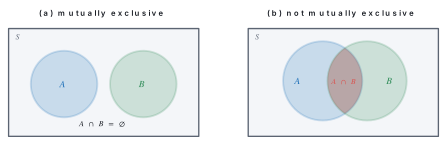
- Mutually exclusive (disjoint) cases: two events that cannot happen in the same trial — A \cap B = \varnothing.
- Independent cases: two events such that the occurrence of one does not affect the probability of the other.
- Complementary event \bar{A}: the event that A does not happen.
Independence is a statement about two different experiments or stages, or about sampling with replacement. Drawing a card, replacing it, and drawing again gives two independent draws; drawing two cards without replacement does not, because the first draw changes what is left in the pack.
These two words describe opposite situations and students swap them constantly. Mutually exclusive events cannot occur together, so if one happens the other certainly does not — that is the strongest possible dependence. Independent events, by contrast, can happily occur together; knowing about one simply tells you nothing about the other. In symbols: mutually exclusive means P(A \cap B) = 0; independent means P(A\cap B) = P(A)P(B).
Problem. Two coins are tossed together. (a) Write the sample space and n(S). (b) List the favourable cases for A = "exactly one head" and B = "at least one tail". (c) Are A and B mutually exclusive?
Solution.
(a) Each coin can fall H or T, so S = \{HH, HT, TH, TT\} and n(S) = 4. All four are equally likely.
(b) A = \{HT, TH\}, so n(A) = 2. B = \{HT, TH, TT\}, so n(B) = 3.
(c) A \cap B = \{HT, TH\} \ne \varnothing, so the two events can occur together (for instance the outcome HT). They are not mutually exclusive.
16.2 Mathematical and empirical definition of probability
If a random experiment has n exhaustive, mutually exclusive and equally likely cases, of which m are favourable to an event A, then
Three consequences follow immediately:
- 0 \leq P(A) \leq 1; P(A) = 0 for an impossible event and P(A) = 1 for a certain event.
- The probability that A does not happen is P(\bar{A}) = \dfrac{n-m}{n} = 1 - P(A).
- Odds. The odds in favour of A are m : (n-m) and the odds against A are (n-m) : m. If the odds in favour are a:b then P(A) = \dfrac{a}{a+b}.
The classical formula is only valid when the cases are equally likely. "It either rains tomorrow or it does not, so P(\text{rain}) = 1/2" is wrong, because those two cases are not equally likely. For such situations we need the empirical definition below.
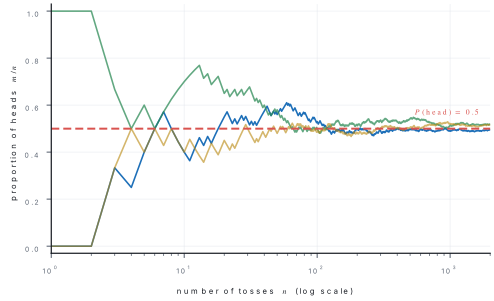
If an experiment is repeated n times under identical conditions and the event A occurs m times, the empirical probability of A is the limit of the relative frequency:
In practice m/n for a large n is taken as an estimate of P(A).
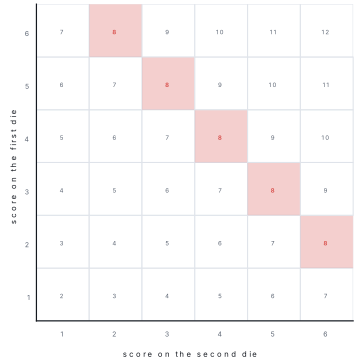
Problem. Two fair dice are rolled together. Find the probability that (a) the sum is 8, (b) the sum is at least 10, (c) a doublet appears.
Solution. Each die has 6 faces, so n(S) = 6\times6 = 36 equally likely ordered pairs (see the grid above).
(a) Sum 8: (2,6),(3,5),(4,4),(5,3),(6,2) — that is 5 cases.
(b) Sum at least 10 means sum = 10, 11 or 12: (4,6),(5,5),(6,4); (5,6),(6,5); (6,6) — that is 3+2+1 = 6 cases.
(c) A doublet is (1,1),(2,2),\ldots,(6,6) — 6 cases.
Problem. One card is drawn at random from a well-shuffled pack of 52 playing cards. Find the probability that it is (a) a king, (b) a face card, (c) not a spade. Also state the odds against drawing a king.
Solution. n(S) = 52 and every card is equally likely.
(a) There are 4 kings: P(K) = \dfrac{4}{52} = \dfrac{1}{13}.
(b) Face cards are the jack, queen and king of each of the 4 suits, so 4\times3 = 12 cards: P(F) = \dfrac{12}{52} = \dfrac{3}{13}.
(c) There are 13 spades, so using the complement,
Odds against a king = (unfavourable) : (favourable) = 48 : 4 = 12 : 1.
Problem. (a) In a quality check on 1000 bulbs made at a factory in Balaju, 25 were found defective. Estimate the probability that a bulb picked at random from the day's production is defective. (b) The odds in favour of a football team winning a match are 3:5. Find the probability that it wins, and the probability that it does not.
Solution.
(a) This is an empirical probability, from observed frequencies:
so about 2.5\% of the production is expected to be defective.
(b) Odds in favour a:b = 3:5 means 3 favourable cases to 5 unfavourable, a total of 8:
16.3 Two basic laws of probability
The addition law — for "or"
For any two events A and B of the same sample space,
If A and B are mutually exclusive then A \cap B = \varnothing, so P(A\cap B) = 0 and the law reduces to
For three events, P(A\cup B\cup C) = P(A)+P(B)+P(C)-P(A\cap B)-P(B\cap C)-P(C\cap A)+P(A\cap B\cap C).
The subtraction is easy to see on a Venn diagram: adding P(A) and P(B) counts the overlap twice, so it must be removed once.
Problem. A card is drawn from a pack of 52. Find the probability that it is (a) a king or a queen, (b) a king or a heart.
Solution.
(a) A card cannot be a king and a queen at once, so these events are mutually exclusive:
(b) A card can be both a king and a heart — the king of hearts — so the events are not mutually exclusive and the overlap must be subtracted:
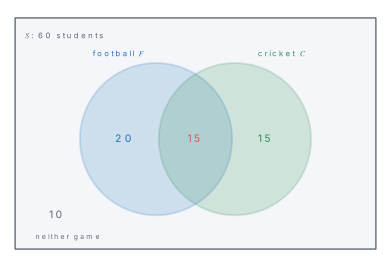
Problem. In a class of 60 students, 35 play football, 30 play cricket and 15 play both. A student is chosen at random. Find the probability that the student (a) plays at least one of the two games, (b) plays neither, (c) plays football only.
Solution. Let F and C be the two events. Then P(F) = 35/60, P(C) = 30/60, P(F\cap C) = 15/60.
(a) By the addition law,
(b) "Neither" is the complement of "at least one":
(c) Football only means F but not C: 35 - 15 = 20 students, so P = \dfrac{20}{60} = \dfrac{1}{3}.
The multiplication law — for "and"
For any two events,
where P(B|A) is the conditional probability of B given that A has already happened. If A and B are independent then P(B|A) = P(B) and the law reduces to
Rearranging the first form gives the working formula for conditional probability:
| The question says | You need |
|---|---|
| "or", "at least one of" | addition law |
| "and", "both", "in succession" | multiplication law |
| "with replacement", "two different people" | independent: multiply the plain probabilities |
| "without replacement", "one after another from the same box" | dependent: the second probability changes |
| "at least one" | often easiest as 1 - P(\text{none}) |
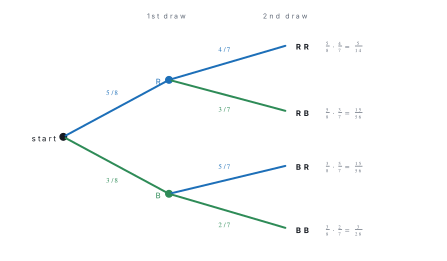
Problem. A bag contains 5 red and 3 black balls. Two balls are drawn one after another without replacement. Find the probability that (a) both are red, (b) both are black, (c) one is of each colour.
Solution. The draws are dependent: after the first ball is taken out only 7 balls remain.
(a) P(\text{red first}) = \dfrac{5}{8}, and then 4 red remain out of 7:
(b) P(BB) = \dfrac{3}{8}\times\dfrac{2}{7} = \dfrac{6}{56} = \dfrac{3}{28}
(c) "One of each" happens two ways, RB or BR, and these are mutually exclusive, so add them:
Check: \dfrac{5}{14} + \dfrac{3}{28} + \dfrac{15}{28} = \dfrac{10 + 3 + 15}{28} = 1 ✔
Problem. The probability that Sita solves a problem is \frac{1}{2} and that Gopal solves it is \frac{1}{3}. They try independently. Find the probability that (a) both solve it, (b) neither solves it, (c) the problem is solved, (d) exactly one of them solves it.
Solution. Let A and B be the events that Sita and Gopal solve it. They are independent, so P(\bar{A}) = \frac{1}{2} and P(\bar{B}) = \frac{2}{3}.
(a) P(A\cap B) = P(A)P(B) = \dfrac{1}{2}\times\dfrac{1}{3} = \dfrac{1}{6}
(b) P(\bar{A}\cap\bar{B}) = \dfrac{1}{2}\times\dfrac{2}{3} = \dfrac{1}{3}
(c) "Solved" means at least one succeeds — the complement of (b):
(The addition law gives the same thing: \frac{1}{2}+\frac{1}{3}-\frac{1}{6} = \frac{2}{3} ✔)
(d) Exactly one means (A and not B) or (not A and B):
For n independent events, P(\text{at least one occurs}) = 1 - P(\text{none occurs}). Listing all the ways of getting "at least one" wastes time and loses marks to arithmetic slips; one subtraction does the whole job.
Problem. A fair coin is tossed three times. Find the probability of getting at least one head.
Solution. The tosses are independent and P(\text{tail}) = \frac{1}{2} each time, so
(Counting directly, n(S) = 2^{3} = 8 and only TTT has no head — the same 7/8.)
Problem. The result of an examination in a school of 100 students is:
| Passed | Failed | Total | |
|---|---|---|---|
| Boys | 45 | 15 | 60 |
| Girls | 35 | 5 | 40 |
| Total | 80 | 20 | 100 |
A student is chosen at random. Find (a) P(\text{pass}), (b) the probability that the student passed given that she is a girl, (c) are "being a girl" and "passing" independent?
Solution.
(a) P(\text{pass}) = \dfrac{80}{100} = 0.8
(b) Restrict attention to the 40 girls, of whom 35 passed:
The same answer from the formula: P(\text{pass}|\text{girl}) = \dfrac{P(\text{pass}\cap\text{girl})}{P(\text{girl})} = \dfrac{35/100}{40/100} = \dfrac{35}{40}.
(c) Independence would require P(\text{pass}|\text{girl}) = P(\text{pass}). Here 0.875 \ne 0.8, so the two events are not independent: being a girl in this school raises the chance of passing.
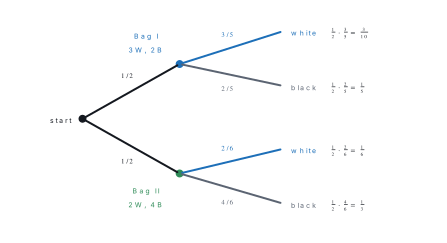
Problem. Bag I contains 3 white and 2 black balls; bag II contains 2 white and 4 black balls. A bag is chosen at random and one ball is drawn from it. Find the probability that the ball is white.
Solution. Each bag is equally likely, so P(\text{I}) = P(\text{II}) = \frac{1}{2}. Use the multiplication law along each path and then add the paths (they are mutually exclusive).
Problem. A and B are independent events with P(A) = 0.4 and P(B) = 0.5. Find (a) P(A\cap B), (b) P(A\cup B), (c) P(A|B).
Solution.
(a) Independence lets us multiply: P(A\cap B) = 0.4\times0.5 = 0.2.
(b) By the addition law,
(c) P(A|B) = \dfrac{P(A\cap B)}{P(B)} = \dfrac{0.2}{0.5} = 0.4 = P(A) — exactly what independence means: knowing B happened does not change the chance of A.
Chapter summary
- A random experiment has a sample space S; an event is a subset of S. Cases may be exhaustive, equally likely, mutually exclusive (A\cap B = \varnothing) or independent (one does not affect the other).
- Mathematical definition: P(A) = \dfrac{n(A)}{n(S)} = \dfrac{m}{n}, valid only for equally likely cases. 0 \leq P(A) \leq 1 and P(\bar{A}) = 1 - P(A).
- Empirical definition: P(A) = \lim_{n\to\infty} \dfrac{m}{n}, the limiting relative frequency in repeated trials.
- Odds in favour a:b \Longleftrightarrow P(A) = \dfrac{a}{a+b}.
- Addition law: P(A\cup B) = P(A)+P(B)-P(A\cap B); for mutually exclusive events P(A\cup B) = P(A)+P(B).
- Multiplication law: P(A\cap B) = P(A)P(B|A); for independent events P(A\cap B) = P(A)P(B). Conditional probability P(B|A) = \dfrac{P(A\cap B)}{P(A)}.
- For two dice n(S) = 36; for n coins n(S) = 2^{n}; for a pack of cards n(S) = 52 with 4 suits of 13, 12 face cards and 26 red.
- "At least one" = 1 - P(\text{none}). Draw a tree for multi-stage problems: multiply along a branch, add across branches.
Practice questions
Group A — Multiple choice (1 mark each)
- The probability of a sure event is [1]a0b0.5c1d\infty
- Two dice are thrown. The probability that the sum is 7 is [1]a\dfrac{1}{12}b\dfrac{1}{6}c\dfrac{5}{36}d\dfrac{7}{36}
- If A and B are independent, then P(A\cap B) equals [1]aP(A)+P(B)bP(A)\,P(B)c0dP(A)-P(B)
- If the odds in favour of an event are 4:3, its probability is [1]a\dfrac{4}{3}b\dfrac{3}{7}c\dfrac{4}{7}d\dfrac{3}{4}
- For mutually exclusive events A and B, P(A\cup B) equals [1]aP(A)P(B)bP(A)+P(B)cP(A)+P(B)-P(A)P(B)d1
- A card is drawn from a well-shuffled pack. The probability that it is a face card is [1]a\dfrac{1}{13}b\dfrac{3}{13}c\dfrac{1}{4}d\dfrac{4}{13}
Answers to Group A
1. (c) — a sure event contains every outcome, so m = n.
2. (b) — the 6 pairs (1,6),\ldots,(6,1) out of 36 give 6/36 = 1/6.
3. (b) — that is the definition of independence.
4. (c) — P = a/(a+b) = 4/7.
5. (b) — the overlap term P(A\cap B) is zero.
6. (b) — 12 face cards out of 52 gives 3/13.
Group B — Short answer (5 marks each)
- Define the mathematical and the empirical definitions of probability, giving one example of each, and state why the mathematical definition fails for the event "it will rain in Pokhara tomorrow". [5]
- Two fair dice are thrown together. Find the probability that(a) the sum is 9,(b) the sum is at most 4,(c) both numbers are even. [5]
- A bag contains 4 white, 5 black and 3 red balls. Two balls are drawn at random without replacement. Find the probability that(a) both are white,(b) one is white and one is black,(c) neither is red. [5]
- A and B are independent events with P(A) = 0.3 and P(B) = 0.6. Find P(A\cup B), the probability that exactly one of them occurs, and the probability that neither occurs. [5]
- A card is drawn at random from a pack of 52 cards. Find the probability that it is an ace or a red card. State clearly whether the two events are mutually exclusive. [5]
- In a class of 40 students, 25 like mathematics, 20 like science and 10 like both. Find the probability that a student chosen at random likes(a) at least one subject,(b) neither,(c) mathematics only. [5]
Answers to Group B
1. Mathematical (classical): P(A) = m/n, the ratio of favourable to total equally likely cases — e.g. P(\text{head}) = 1/2 for a fair coin. Empirical: P(A) = \lim_{n\to\infty} m/n, the limiting relative frequency in repeated trials — e.g. if 25 of 1000 bulbs are defective, P \approx 0.025. The mathematical definition fails for rain because the two cases "rain" and "no rain" are not equally likely, so dividing by 2 has no justification; only past records (an empirical estimate) can give a number.
2. n(S) = 36. (a) Sum 9: (3,6),(4,5),(5,4),(6,3) — 4 cases, so P = 4/36 = 1/9. (b) Sum at most 4: (1,1),(1,2),(2,1),(1,3),(3,1),(2,2) — 6 cases, so P = 6/36 = 1/6. (c) Both even: each die has 3 even faces, so 3\times3 = 9 cases and P = 9/36 = 1/4.
3. Total = 12 balls, drawn without replacement. (a) P(WW) = \dfrac{4}{12}\times\dfrac{3}{11} = \dfrac{12}{132} = \dfrac{1}{11}. (b) One white one black, in either order: 2\times\dfrac{4}{12}\times\dfrac{5}{11} = \dfrac{40}{132} = \dfrac{10}{33}. (c) Neither red means both come from the 9 non-red balls: \dfrac{9}{12}\times\dfrac{8}{11} = \dfrac{72}{132} = \dfrac{6}{11}.
4. P(A\cap B) = 0.3\times0.6 = 0.18, so P(A\cup B) = 0.3+0.6-0.18 = 0.72. Exactly one: P(A)P(\bar{B}) + P(\bar{A})P(B) = 0.3(0.4) + 0.7(0.6) = 0.12+0.42 = 0.54. Neither: P(\bar{A})P(\bar{B}) = 0.7\times0.4 = 0.28 (which also equals 1 - 0.72 ✔).
5. A card can be both an ace and red (the ace of hearts, the ace of diamonds), so the events are not mutually exclusive. P(\text{ace} \cup \text{red}) = \dfrac{4}{52} + \dfrac{26}{52} - \dfrac{2}{52} = \dfrac{28}{52} = \dfrac{7}{13}.
6. With M and S the two events, n(M) = 25, n(S) = 20, n(M\cap S) = 10. (a) n(M\cup S) = 25+20-10 = 35, so P = 35/40 = 7/8. (b) Neither = 1 - 7/8 = 1/8 (i.e. 5 students). (c) Mathematics only = 25-10 = 15 students, so P = 15/40 = 3/8.
Group C — Long answer (8 marks each)
- (a) State the addition law of probability for two events and illustrate it with a Venn diagram, writing down the special form for mutually exclusive events. [3](b) A box contains 6 red and 4 blue balls. Three balls are drawn one after another without replacement. Find the probability that (i) all three are red, (ii) at least one is blue. [5]
- (a) State the multiplication law of probability, and explain the difference between independent and dependent events with one example of each. [3](b) Three students A, B, C try to solve a problem independently with probabilities \frac{1}{2}, \frac{1}{3} and \frac{1}{4}. Find the probability that (i) none of them solves it, (ii) the problem is solved, (iii) exactly one of them solves it. [5]
Answers to Group C
1. (a) P(A\cup B) = P(A)+P(B)-P(A\cap B). On a Venn diagram the two circles overlap in A\cap B; adding the two circles counts that overlap twice, so it is subtracted once. If the events are mutually exclusive the circles are disjoint, P(A\cap B) = 0, and P(A\cup B) = P(A)+P(B).
(b) There are 10 balls, and the draws are dependent.
(i) P(\text{all red}) = \dfrac{6}{10}\times\dfrac{5}{9}\times\dfrac{4}{8} = \dfrac{120}{720} = \dfrac{1}{6}
(ii) "At least one blue" is the complement of "all red":
2. (a) P(A\cap B) = P(A)\,P(B|A); if the events are independent this becomes P(A\cap B) = P(A)P(B). Independent: two tosses of a coin — the first result does not change the second. Dependent: two cards drawn from a pack without replacement — the first draw changes the composition of the pack, so P(\text{second is an ace}) depends on what the first card was.
(b) The three are independent, with P(\bar{A}) = \frac{1}{2}, P(\bar{B}) = \frac{2}{3}, P(\bar{C}) = \frac{3}{4}.
(i) P(\text{none}) = \dfrac{1}{2}\times\dfrac{2}{3}\times\dfrac{3}{4} = \dfrac{6}{24} = \dfrac{1}{4}
(ii) P(\text{solved}) = 1 - P(\text{none}) = 1 - \dfrac{1}{4} = \dfrac{3}{4}
(iii) Exactly one means A only, or B only, or C only:
Practise more: Mathematics question bank