Unit 2 · Computer Fundamentals · 32 min read
History of Computer
What the syllabus asks for 5
- Early calculating devices: abacus, Napier's bones and the slide rule
- Mechanical calculators: Pascaline, Leibniz's stepped reckoner and the Jacquard loom
- Charles Babbage's Difference Engine and Analytical Engine; Ada Lovelace
- Electromechanical and electronic machines: Hollerith's tabulating machine, Mark I, ABC, ENIAC, EDVAC and UNIVAC
- Computers in Nepal: from the census of 2028 BS to today
People needed to count long before they had computers: shepherds counted sheep with pebbles, traders kept accounts with knots in a rope, and tax officers added long columns of figures by hand. Every machine in this lesson was built to make counting and calculating faster and more accurate, from the bead frame of an abacus to ENIAC, which filled a large room. Following them in order shows how each inventor borrowed an idea from the one before — and how Nepal took its first computer in 2028 BS to count its people.
Questions here are about who invented what, when, and why it mattered. Learn the table in section 2.4 by heart: machine, inventor, year and one key feature. Expect "match the inventor with the machine", full forms (ENIAC, EDVAC, UNIVAC, ABC), short notes on the abacus or Napier's bones, "why is Babbage called the father of the computer?", the parts of the Analytical Engine, and the history of computers in Nepal with BS dates.
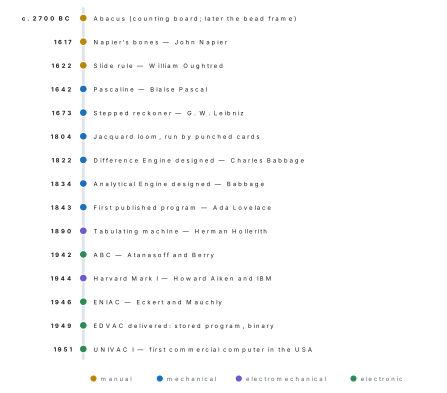
2.1 Early calculating devices: abacus, Napier's bones and the slide rule
Before any machine, people counted on their fingers, with pebbles and sticks, by cutting notches in wood or by tying knots in a rope. These work for small numbers but are slow and easily lost track of. The first true calculating devices were all worked by hand; they are called manual devices.
The abacus
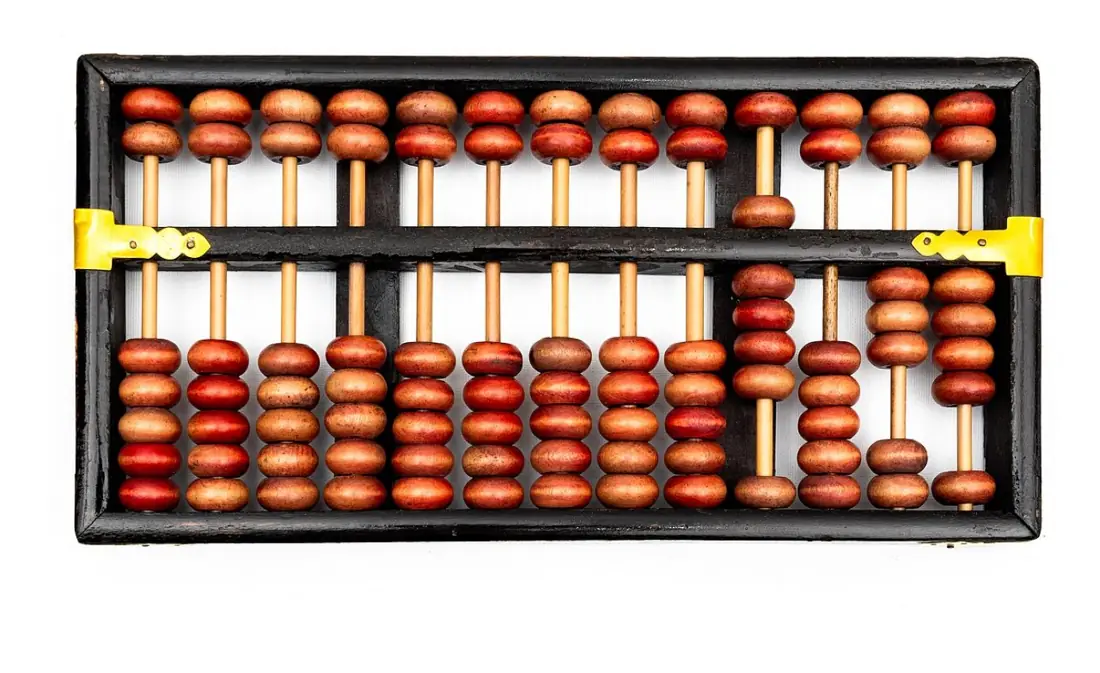
An abacus is a hand-operated counting device made of a frame holding rods (or wires) on which beads slide. The position of the beads shows a number, and moving them up and down performs addition and subtraction.
The idea is very old. People in Mesopotamia (present-day Iraq) were calculating on lined counting boards about 2700–2300 BC; the word abacus comes from the Greek abax, a board. The bead frame best known today is the Chinese suanpan, used by traders for centuries and still sold in Nepal for teaching mental arithmetic. The Japanese soroban is a lighter version.
The suanpan is divided by a wooden beam (bar) into two decks:
- the upper deck, called heaven, has 2 beads on each rod, each worth 5;
- the lower deck, called earth, has 5 beads on each rod, each worth 1.
A bead counts only when it is pushed towards the beam. The rods stand for place values: from the right, ones, tens, hundreds, thousands and so on.
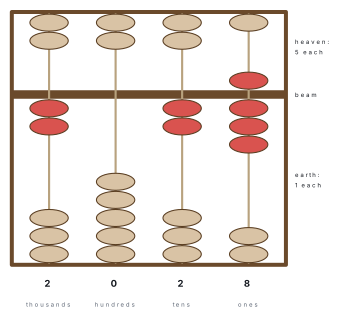
Problem. (a) Read the number shown in the figure above. (b) How would you show 1975 on four rods? How many heaven beads and how many earth beads touch the beam?
Solution. (a) Thousands rod: 2 earth beads = 2. Hundreds: none = 0. Tens: 2 earth beads = 2. Ones: 1 heaven bead + 3 earth beads = 5 + 3 = 8. The number is 2028.
(b) Write each digit as fives and ones: 1 = one earth bead; 9 = 5 + 4, one heaven and four earth beads; 7 = 5 + 2, one heaven and two earth beads; 5 = one heaven bead. Heaven beads at the beam: 0 + 1 + 1 + 1 = 3. Earth beads at the beam: 1 + 4 + 2 + 0 = 7.
Napier's bones
John Napier (1550–1617) was a Scottish mathematician who also invented logarithms (1614). In 1617 he described a set of numbered rods, which became known as Napier's bones because the best sets were cut from bone or ivory.
Napier's bones are a set of rods, one for each digit 0 to 9, each marked with the multiples of its digit (1 to 9 times) in squares divided by a diagonal. Placing the rods side by side turns a multiplication into a few easy additions. They can also help with division and square roots.
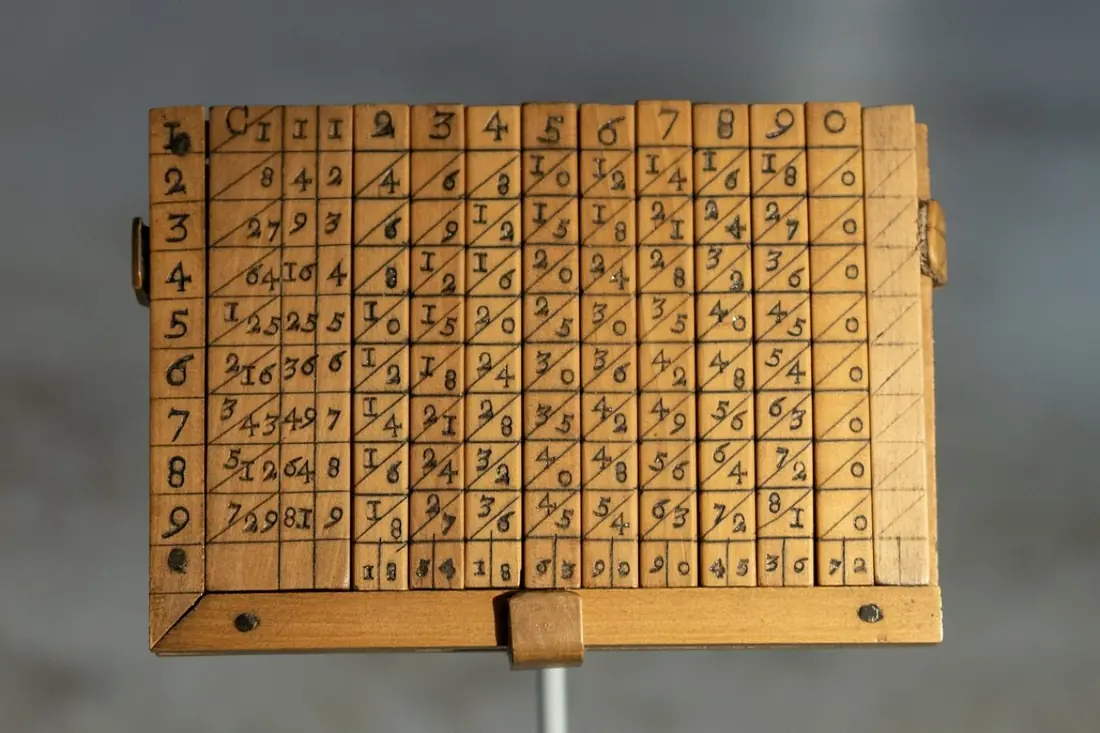
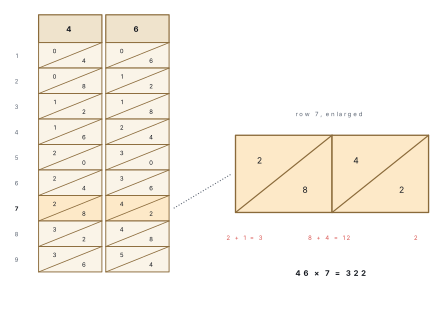
Problem. Use Napier's bones to find (a) 46 × 7 and (b) 365 × 4.
Solution. (a) Place bones 4 and 6 side by side. Row 7 reads 2|8 on bone 4 and 4|2 on bone 6. Add along the diagonals from the right: units: 2; next diagonal: 8 + 4 = 12, write 2 and carry 1; last: 2 + 1 = 3. So 46 × 7 = 322.
(b) Place bones 3, 6 and 5 side by side. Row 4 reads 1|2, 2|4 and 2|0. From the right: 0; 2 + 4 = 6; 2 + 2 = 4; and 1. So 365 × 4 = 1460. Check: 365 × 4 = 1,460. ✓
The slide rule
Napier's logarithms turn multiplication into addition of lengths. In 1620 Edmund Gunter drew numbers on a ruler spaced according to their logarithms. About 1622 the English mathematician William Oughtred placed two such scales side by side so that one could slide along the other. This was the slide rule.
A slide rule is a hand-held calculating device with two logarithmic scales, one fixed and one sliding, and usually a clear cursor with a hairline. Sliding one scale along the other adds or subtracts lengths, which multiplies or divides the numbers marked on them.
A slide rule shows its answer as a position on a scale, not as separate digits, so it is an analog device (Lesson 4 explains analog and digital). It gives an answer to about three figures — accurate enough for engineers, who used slide rules for about 350 years, until pocket electronic calculators replaced them in the 1970s.
| Device | Inventor and date | Used for | Type |
|---|---|---|---|
| Abacus | Mesopotamia, c. 2700 BC; Chinese suanpan later | addition and subtraction | manual, digital |
| Napier's bones | John Napier, 1617 | multiplication (and division) | manual, digital |
| Slide rule | William Oughtred, c. 1622 | multiplication, division, roots | manual, analog |
2.2 Mechanical calculators: Pascaline, Leibniz's stepped reckoner and the Jacquard loom
A mechanical calculator does the arithmetic with gears and wheels. The user still turns a handle or a dial, but the machine itself carries tens from one column to the next.
The Pascaline
The French mathematician Blaise Pascal (1623–1662) built his calculating machine in 1642, at the age of about 19, to help his father, a tax official, add long columns of money. It is called the Pascaline (or Pascal's calculator), and it was one of the first mechanical calculators; about fifty were made.
- It had a row of toothed wheels (dials), one for each place value, each marked 0 to 9.
- When a wheel turned past 9 back to 0, it pushed the next wheel on by one step. This automatic carry is the Pascaline's great idea.
- It could add and subtract directly; it multiplied only by repeated addition.
The same idea works today in the odometer of a motorbike and the old meters at a petrol pump: when the right-hand wheel passes 9, the next wheel moves on by one.
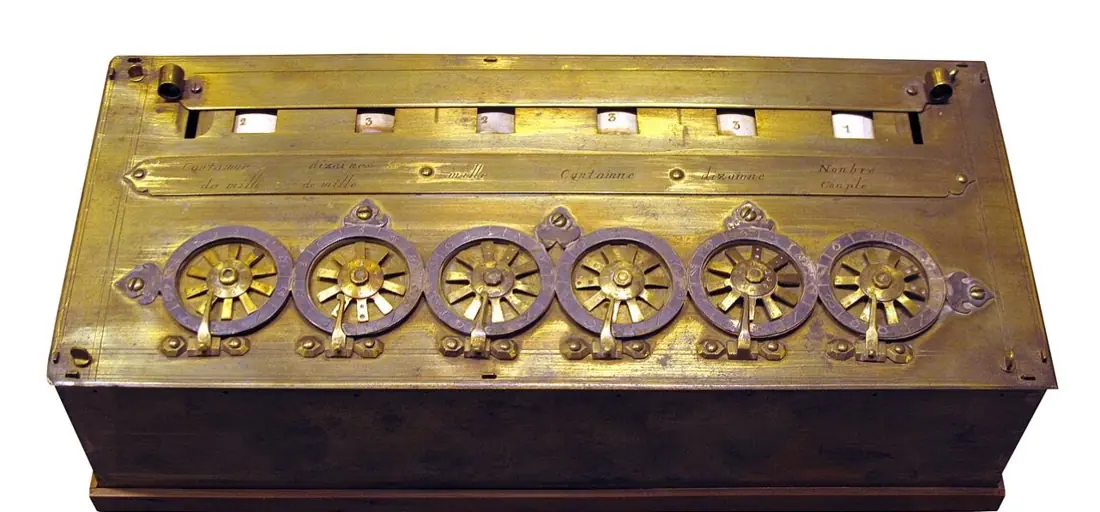
Problem. The windows of a Pascaline show 0 0 7 9 6. The ones wheel is turned on by 8 steps. Explain what happens and give the new reading.
Solution. The ones wheel moves 6 → 7 → 8 → 9 → 0 → 1 → 2 → 3 → 4. As it passes from 9 to 0 it carries 1 to the tens wheel. The tens wheel is at 9, so it also passes from 9 to 0 and carries 1 to the hundreds wheel, which moves from 7 to 8. The new reading is 0 0 8 0 4, that is 796 + 8 = 804.
Leibniz's stepped reckoner
The German mathematician Gottfried Wilhelm Leibniz (1646–1716) improved Pascal's design. His stepped reckoner, shown to the Royal Society in London in 1673, used a drum with teeth of nine different lengths, called the stepped drum or Leibniz wheel, turned by a handle (crank).
- It could add, subtract, multiply and divide.
- Multiplication was done by turning the crank once for each unit of the multiplier and shifting a carriage for each place.
- The stepped drum was used in mechanical calculators for nearly 300 years.
Leibniz also studied the binary number system, which uses only 0 and 1, and published it in 1703. Every modern computer works in binary.
The Jacquard loom
In 1804 the French weaver Joseph Marie Jacquard fitted a loom with a chain of punched cards. Each card had holes in a pattern: where there was a hole, a hook passed through and lifted a thread; where there was no hole, it did not. The chain of cards controlled the pattern woven into the cloth.
The loom is not a calculator, but its idea changed computing: instructions can be stored as holes in cards, and changing the cards changes the work without changing the machine. Babbage borrowed punched cards for his Analytical Engine, Hollerith used them to count the American census, and computers read programs from punched cards until the 1970s.
| Machine | Inventor, country | Year | Could do | Key idea |
|---|---|---|---|---|
| Pascaline | Blaise Pascal, France | 1642 | + and − | wheels 0–9 with automatic carry |
| Stepped reckoner | G. W. Leibniz, Germany | 1673 | +, −, ×, ÷ | stepped drum turned by a crank |
| Jacquard loom | J. M. Jacquard, France | 1804 | weaves patterns | punched cards as instructions |
2.3 Charles Babbage's Difference Engine and Analytical Engine; Ada Lovelace
Charles Babbage (1791–1871) was an English mathematician and professor at Cambridge. In his time, ships, banks and engineers used printed tables of numbers — logarithms, interest and tides — calculated by hand and full of mistakes. Babbage wanted a machine that would calculate and print the tables with no human error.
The Difference Engine
In 1822 Babbage proposed the Difference Engine, a machine that calculates a table of values of a polynomial using the method of differences, which needs only addition. The British government paid for it, but after ten years of work and a quarrel with his engineer, building stopped in 1833. Only a small working section was ever finished.
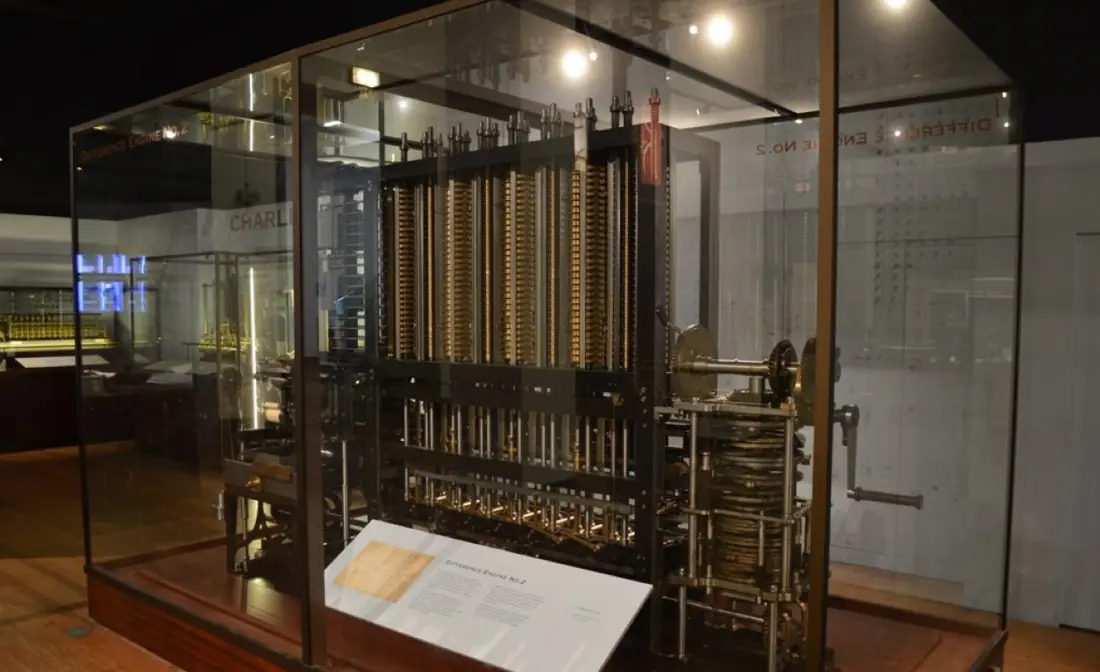
From 1847 to 1849 Babbage designed an improved Difference Engine No. 2. He never built it either. To find out whether his design worked, the Science Museum in London built it from his drawings, finishing the calculating section in 1991, two hundred years after his birth, and adding the printer in 2002. It has about 8,000 parts, weighs 5 tonnes and calculates perfectly, proving that Babbage was right.
The Analytical Engine
While working on the Difference Engine, Babbage had a far bigger idea. From 1834 he designed the Analytical Engine, a machine that could do any calculation, not just one kind, by following instructions on punched cards. It was to be driven by a steam engine and had four parts that every modern computer still has:
| Part of the Analytical Engine | What it did | Modern name |
|---|---|---|
| Input: punched cards | gave numbers and operations to the engine (Jacquard's idea) | input devices, program |
| Mill | did the arithmetic | CPU (processor) |
| Store | held 1,000 numbers of up to 40 digits | memory |
| Output: printer, curve plotter, bell | gave out the results | output devices |
It could also make decisions (do one thing or another depending on a result) and repeat a set of steps — the same ideas found in every program you will write. The Analytical Engine was never completed: it needed money and precision engineering that the 1800s could not supply.
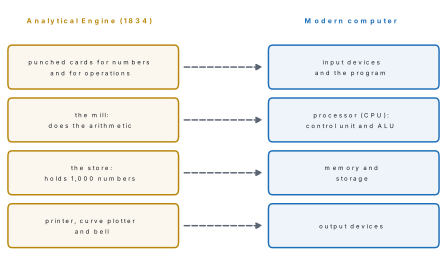
Charles Babbage is called the father of the computer because his Analytical Engine was the first design for a general-purpose, programmable computer, with separate units for input, processing (the mill), storage (the store) and output — the same plan that every computer follows today.
Ada Lovelace, the first programmer
Augusta Ada King, Countess of Lovelace (1815–1852), the daughter of the poet Lord Byron, was a gifted mathematician and a friend of Babbage. In 1843 she translated an Italian engineer's article about the Analytical Engine into English and added her own notes, three times longer than the article. In the last of them, Note G, she wrote out step by step how the engine would calculate a series of numbers called Bernoulli numbers. This is regarded as the first published computer program, so Ada Lovelace is called the first computer programmer.
She also saw further than Babbage himself: she wrote that such a machine could work with any symbols, not only numbers, and might one day compose music. The programming language Ada, made for the United States Department of Defense in 1980, is named after her.
Some guides say that Ada Lovelace suggested binary numbers for the Analytical Engine. That is not true: Babbage's engines counted in decimal, with wheels marked 0 to 9. Binary was described by Leibniz (published 1703) and first used in electronic computers such as the ABC and EDVAC. Do not mix up the two.
2.4 Electromechanical and electronic machines
An electromechanical machine uses electricity to drive moving parts: motors, relays (electrically operated switches), gears and rotating shafts. An electronic computer calculates with no moving parts, using vacuum tubes (and later transistors and chips) that switch electric current on and off thousands of times faster.
Hollerith's tabulating machine (1890)
The United States counts its people every ten years. Counting the 1880 census by hand took about eight years, and the population was growing fast. Herman Hollerith (1860–1929), who worked for the Census Office, built an electric tabulating machine to count the 1890 census.
- Each person's details were punched as holes in a punched card, an idea taken from the Jacquard loom.
- The machine pressed spring pins onto the card; wherever there was a hole, a pin passed through into a cup of mercury, completed an electric circuit and moved a counting dial on by one.
- With his machines the population count was ready in about six months and the full tables in about two years, saving the government about five million dollars.
Hollerith started the Tabulating Machine Company in 1896. In 1911 it joined three other firms, and in 1924 the new company was renamed International Business Machines — IBM.
Mark I (1944)
The Harvard Mark I (its official name was the Automatic Sequence Controlled Calculator) was designed by Howard Aiken of Harvard University and built by IBM. It was completed in 1944.
- It was electromechanical: thousands of relays and switches turned by a long rotating shaft, and it made a loud clicking noise as it worked.
- It was about 15.5 m (51 feet) long, 2.4 m (8 feet) high, weighed about 4.3 tonnes, had about 765,000 parts and 800 km of wire.
- It read its instructions from punched paper tape and worked automatically, so it is often called the first automatic (programmable) calculator in the USA.
- It was slow: about 3 additions per second and 6 seconds for one multiplication. Grace Hopper, later a famous programmer, was one of its operators.
ABC, the Atanasoff–Berry Computer (1942)
John Vincent Atanasoff, a physics professor at Iowa State College, and his student Clifford Berry built the ABC between 1939 and 1942.
- It was the first electronic digital computer: it calculated with about 300 vacuum tubes.
- It used binary numbers and stored them as electric charges on capacitors fixed to two rotating drums, a memory of 3,000 bits.
- It was not programmable: it was built only to solve sets of linear equations (up to 29 at a time).
In 1973 a United States court ruled that Atanasoff, not the makers of ENIAC, had invented the electronic digital computer.
ENIAC (1946)
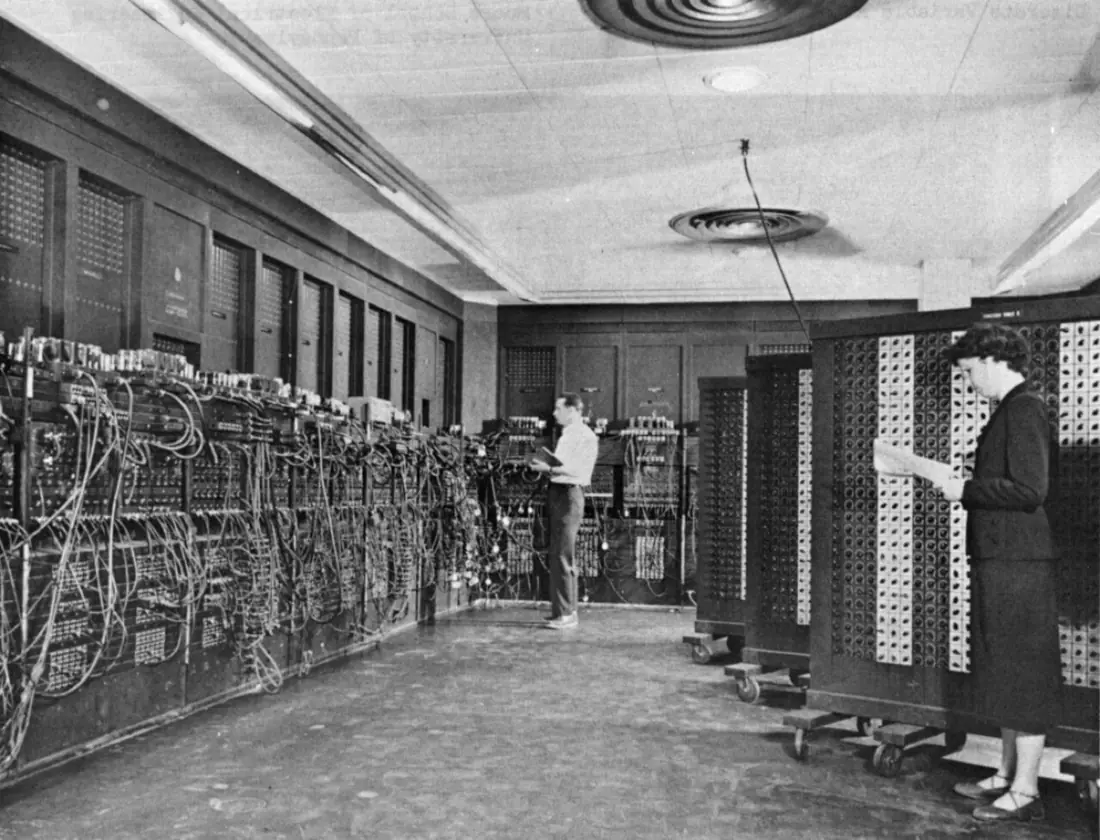
ENIAC — Electronic Numerical Integrator and Computer — was built at the University of Pennsylvania by J. Presper Eckert and John Mauchly for the United States Army, to calculate tables for aiming artillery guns. It was finished at the end of 1945 and shown to the public in February 1946.
- It was the first general-purpose electronic digital computer: it could be set up to solve many kinds of problems.
- It used about 17,468 vacuum tubes, 70,000 resistors, 10,000 capacitors, 1,500 relays and thousands of switches.
- It weighed about 27 tonnes, filled about 167 m² (1,800 square feet) and used 150 kW of electricity; vacuum tubes burned out often and had to be replaced.
- It did about 5,000 additions per second — a thousand times faster than any machine before it — but it worked in decimal, not binary.
- It had no stored program. To change the problem, operators re-plugged hundreds of cables and set switches, which took days. Its first programmers were six women: Kay McNulty, Betty Jennings, Betty Snyder, Marlyn Wescoff, Fran Bilas and Ruth Lichterman.
Problem. Mark I did 3 additions per second and ENIAC 5,000. How long would each take to do one million additions? A laptop does about one thousand million (10⁹) simple additions per second; how long would it take?
Solution. Time = number of additions ÷ additions per second. Mark I: 1,000,000 ÷ 3 ≈ 333,333 s ≈ 333,333 ÷ 86,400 ≈ 3.9 days. ENIAC: 1,000,000 ÷ 5,000 = 200 s = 3 minutes 20 seconds. Laptop: 1,000,000 ÷ 1,000,000,000 = 0.001 s, one thousandth of a second. ENIAC was about 5,000 ÷ 3 ≈ 1,700 times faster than Mark I.
EDVAC and the stored-program idea
Setting up ENIAC by hand was so slow that its builders wanted the program itself to be kept in memory, just like the data. In 1945 the mathematician John von Neumann wrote a famous report describing such a machine.
The stored-program concept is the idea that a computer's instructions are stored in its memory together with the data, so the computer can fetch and carry them out one after another, and a new program can be loaded without rewiring the machine. It was described by John von Neumann in 1945.
EDVAC — Electronic Discrete Variable Automatic Computer — was designed by Eckert and Mauchly on this plan. It worked in binary, used about 6,000 vacuum tubes, and stored 1,000 numbers in tubes of mercury. It was delivered in 1949 and worked regularly from 1951. In Britain, Maurice Wilkes's EDSAC (Electronic Delay Storage Automatic Calculator) at Cambridge ran its first stored program on 6 May 1949 and became the first stored-program computer in regular use.
UNIVAC I (1951)
UNIVAC I — Universal Automatic Computer — was built by Eckert and Mauchly's company (later part of Remington Rand). The first one was accepted by the US Census Bureau on 31 March 1951.
- It was the first commercial computer made in the USA: it was sold to businesses and offices, not built for one army or university.
- It used about 5,200 vacuum tubes, weighed about 13 tonnes, and stored data on magnetic tape instead of punched cards. Forty-six were built.
- In 1952 a UNIVAC correctly predicted, on television, that Eisenhower would win the American presidential election, from early results alone.
| Machine | Year | Built by | Type | Remember it for |
|---|---|---|---|---|
| Tabulating machine | 1890 | Herman Hollerith | electromechanical | punched cards for the US census; led to IBM |
| ABC | 1942 | Atanasoff and Berry | electronic | first electronic digital computer; binary; not programmable |
| Mark I | 1944 | Howard Aiken and IBM | electromechanical | automatic, read paper tape; 3 additions per second |
| ENIAC | 1946 | Eckert and Mauchly | electronic | first general-purpose electronic computer; 17,468 tubes; 27 t |
| EDVAC | 1949 | Eckert and Mauchly (von Neumann's plan) | electronic | stored program; binary |
| UNIVAC I | 1951 | Eckert and Mauchly | electronic | first commercial computer in the USA; magnetic tape |
ABC — Atanasoff–Berry Computer. ENIAC — Electronic Numerical Integrator and Computer. EDVAC — Electronic Discrete Variable Automatic Computer. EDSAC — Electronic Delay Storage Automatic Calculator. UNIVAC — Universal Automatic Computer. IBM — International Business Machines.
Each machine is the first of something different. The ABC was the first electronic digital computer but could not be programmed. Mark I was an automatic electromechanical calculator. ENIAC was the first general-purpose electronic computer. EDSAC and EDVAC were early stored-program computers. UNIVAC I was the first commercial computer in the USA. Write the exact "first" the question asks for.
2.5 Computers in Nepal: from the census of 2028 BS to today
Nepal's story begins, like Hollerith's, with a census. Counting a growing population by hand had become too slow, so for the census of 2028 BS (1971 AD) the government brought in the country's first computer.
| Year | Event |
|---|---|
| 2028 BS (1971 AD) | IBM 1401, a second-generation (transistor) computer, is brought to Nepal on rent at Rs 1,25,000 a month to process the census of 2028 BS, which counted 1,15,55,983 people. It is installed at the Central Bureau of Statistics; processing takes about a year and a half. |
| 2031 BS (1974 AD) | The Electronic Data Processing Centre (यान्त्रिक सारिणीकरण केन्द्र) is set up to run the government's computer work. It later becomes the National Computer Centre (NCC), which also trains people in programming and data processing. |
| 2038 BS (1981 AD) | The ICL 2950/10, a mainframe from Britain costing about 2 million US dollars and supported by UNDP and UNFPA, arrives for the census of 2038 BS. It has 64 terminals, so many people can use it at once. |
| 2039–2040 BS (early 1980s) | Microcomputers such as Apple, Vector and Sirius are imported by private companies. Computer training institutes and private firms begin to use them. |
| 2052 BS (1995 AD) | Mercantile Communications starts the first commercial internet service in Nepal. |
| 2057 BS (2000 AD) | Nepal's first Information Technology Policy. |
| 2063 BS | The Electronic Transactions Act gives legal value to electronic records and signatures and punishes computer crimes (Lesson 12). |
| 2073 BS (2017 AD) | Nepal Telecom launches 4G mobile internet; Ncell follows in 2074 BS. |
| 2077–2078 BS (2021 AD) | The Nagarik App is launched; the first e-passport is issued; the census of 2078 BS uses tablets in some areas and counts 2,91,64,578 people. |
Today computers are used in every bank, ministry, school and hospital, the government runs its own data centre, and Nepali software companies build apps for customers at home and abroad. Nepali can be typed in Unicode, so websites, phones and apps work in Nepali as well as English.
Problem. The IBM 1401 was rented for Rs 1,25,000 a month. (a) What was the rent for one year? (b) What was the rent for 19 months, about the time the census processing took? (c) How many years separate the census of 2028 BS from the census of 2078 BS?
Solution. (a) 1,25,000 × 12 = Rs 15,00,000 (fifteen lakh) a year. (b) 1,25,000 × 19 = Rs 23,75,000. (c) 2078 − 2028 = 50 years. In that time the population grew from 1,15,55,983 to 2,91,64,578, about 2.5 times — and the computers used to count it went from one rented machine to tablets in the enumerators' hands.
Work in groups. Make a wall chart of the history of computers with three columns: device, inventor and year, and one feature. Draw or paste a picture of each device. Add a fourth row of the chart for Nepal, from the IBM 1401 to the Nagarik App. Then ask an older family member when they first used a computer or a mobile phone, and add their story to the chart.
Answering "history" questions
A short note on a device should have four points: who invented it, when, how it worked and why it mattered. For example: "Pascaline — Blaise Pascal, 1642; toothed wheels marked 0–9 with automatic carry; could add and subtract; first step towards mechanical calculation."
Chapter summary
- Manual devices: abacus (c. 2700 BC; suanpan: heaven beads 5, earth beads 1), Napier's bones (John Napier, 1617; multiplication), slide rule (William Oughtred, c. 1622; analog).
- Mechanical calculators: Pascaline (Blaise Pascal, 1642; add and subtract, automatic carry), stepped reckoner (Leibniz, 1673; all four operations), Jacquard loom (1804; punched cards as instructions).
- Charles Babbage, father of the computer: Difference Engine (1822) and Analytical Engine (1834) with input cards, mill, store and output. Ada Lovelace wrote the first published program (1843).
- Electromechanical: Hollerith's tabulator (1890 census; IBM, 1924), Harvard Mark I (Aiken and IBM, 1944).
- Electronic: ABC (1942, first electronic digital), ENIAC (1946, first general-purpose; 17,468 tubes), EDVAC (stored program, binary), UNIVAC I (1951, first commercial in the USA).
- Nepal: IBM 1401 rented in 2028 BS for the census; EDPC 2031 BS (later NCC); ICL 2950/10 in 2038 BS; microcomputers from 2039 BS.
Practice questions
Group A — Objective (1 mark each)
- On a Chinese abacus, each bead above the beam is worth [1]a1b5c10d2
- Napier's bones were mainly used for [1]aadditionbsubtractioncmultiplicationdstoring data
- Which of these is an analog calculating device? [1]aabacusbslide rulecNapier's bonesdPascaline
- The Pascaline was invented by [1]aLeibnizbBlaise PascalcCharles BabbagedNapier
- The first machine controlled by punched cards was the [1]aJacquard loombPascalinecslide ruledMark I
- In Babbage's Analytical Engine, the part that did the arithmetic was the [1]astorebmillcprinterdcard reader
- The first computer programmer is considered to be [1]aAda LovelacebGrace HoppercBetty SnyderdHerman Hollerith
- Hollerith's tabulating machine was first used to count the census of [1]aNepalbBritaincthe USAdIndia
- Mark I was [1]aa mechanical calculatorban electromechanical machineca fully electronic computerda microcomputer
- The ABC was built by [1]aEckert and MauchlybAtanasoff and BerrycAiken and IBMdBabbage and Lovelace
- ENIAC stands for [1]aElectronic Numerical Integrator and ComputerbElectrical Number Integrating Automatic ComputercElectronic Numeric Input and CalculatordEarly Numerical Integrated Analog Computer
- The first computer brought to Nepal was [1]aICL 2950/10bIBM 1401cUNIVAC IdApple II
- The stored-program concept was given by [1]aJohn von NeumannbCharles BabbagecBlaise PascaldJohn Napier
Answers to Group A
1. (b) — heaven beads are worth 5; earth beads 1.
2. (c) — a row of the bones turns a multiplication into additions.
3. (b) — it shows the answer as a position on a scale.
4. (b) — Pascal, 1642.
5. (a) — Jacquard's loom, 1804.
6. (b) — the mill was the processor; the store was the memory.
7. (a) — her Note G of 1843 is the first published program.
8. (c) — the US census of 1890.
9. (b) — relays and rotating shafts driven by electricity.
10. (b) — Atanasoff and Berry at Iowa State College.
11. (a) — Electronic Numerical Integrator and Computer.
12. (b) — rented in 2028 BS for the census.
13. (a) — von Neumann's report of 1945.
Group B — Short answer (2 marks each)
- What is an abacus? Write the value of a heaven bead and an earth bead on a suanpan. [2]
- Show how Napier's bones give 46 × 7. [2]
- Write two features of the Pascaline. [2]
- Why is Charles Babbage called the father of the computer? [2]
- Why is Ada Lovelace called the first programmer? [2]
- How did the Jacquard loom influence the development of computers? [2]
- Write the full forms of EDVAC, UNIVAC, ABC and EDSAC. [2]
- Write any two features of ENIAC. [2]
- What is the stored-program concept? Why was it an improvement on ENIAC? [2]
- Write a short note on the IBM 1401 in Nepal. [2]
Answers to Group B
1. An abacus is a hand-operated counting device: a frame with rods on which beads slide, used for addition and subtraction. On a suanpan each heaven bead (above the beam) is worth 5 and each earth bead (below) is worth 1.
2. Place bones 4 and 6 side by side and read row 7: 2|8 and 4|2. Add the diagonals from the right: 2; 8 + 4 = 12, write 2 carry 1; 2 + 1 = 3. Answer: 322.
3. Any two: invented by Blaise Pascal in 1642; toothed wheels marked 0 to 9, one for each place value; automatic carry from one wheel to the next; could add and subtract directly (multiply only by repeated addition).
4. Because his Analytical Engine (1834) was the first design for a general-purpose, programmable computer, and it had input (punched cards), a mill (processor), a store (memory) and output — the same units as modern computers.
5. In 1843 she wrote notes on Babbage's Analytical Engine in which she set out step by step how the engine would calculate Bernoulli numbers. This is the first published computer program; she also foresaw that computers could work with symbols and music, not only numbers.
6. The loom (1804) was controlled by punched cards: the pattern of holes decided the woven pattern. This showed that instructions could be stored on cards and changed without changing the machine; Babbage used the idea for the Analytical Engine and Hollerith for his census tabulator.
7. EDVAC — Electronic Discrete Variable Automatic Computer; UNIVAC — Universal Automatic Computer; ABC — Atanasoff–Berry Computer; EDSAC — Electronic Delay Storage Automatic Calculator.
8. Any two: built by Eckert and Mauchly, shown in 1946; first general-purpose electronic computer; about 17,468 vacuum tubes; weighed about 27 tonnes and filled 167 m²; about 5,000 additions per second; programmed by re-plugging cables and switches.
9. The stored-program concept (von Neumann, 1945) keeps the program's instructions in memory with the data. ENIAC had to be re-wired by hand to change its program, which took days; a stored-program computer just loads new instructions.
10. The IBM 1401, a second-generation computer, was Nepal's first computer. It was brought on rent in 2028 BS (1971 AD), at Rs 1,25,000 a month, to process the census of 2028 BS at the Central Bureau of Statistics.
Group C — Long answer (4 marks each)
- Describe the abacus, Napier's bones and the slide rule. [4]
- Describe Babbage's Analytical Engine and explain why it is important. [4]
- Write short notes on(a) Mark I and(b) ENIAC. [2+2]
- Describe the history of computers in Nepal. [4]
- Match the inventors with their machines and give one feature of each: Leibniz, Hollerith, Atanasoff, Eckert and Mauchly. [4]
Answers to Group C
1. Abacus: the oldest calculating device (counting boards in Mesopotamia c. 2700 BC; the Chinese suanpan later). A frame of rods with beads; a beam divides heaven beads (worth 5) from earth beads (worth 1); beads moved to the beam are counted; used for addition and subtraction. Napier's bones: John Napier, Scotland, 1617. Rods for the digits 0–9, each carrying the multiples of its digit in squares split by a diagonal; placing rods side by side and adding along the diagonals gives a product. Slide rule: William Oughtred, c. 1622, based on Napier's logarithms. Two logarithmic scales slide past each other to multiply and divide; an analog device used by engineers until calculators replaced it in the 1970s.
2. Designed by Charles Babbage from 1834 as a general-purpose machine driven by steam. Its parts: input by punched cards (from the Jacquard loom) for numbers and operations; the mill, which did the arithmetic; the store, which held 1,000 numbers; and output by printer, curve plotter and bell. It could make decisions and repeat steps. It was never completed, for lack of money and precise engineering. Importance: it was the first design of a programmable computer, and its plan — input, processor, memory, output — is still the plan of every computer; Ada Lovelace wrote the first program for it. That is why Babbage is called the father of the computer.
3. (a) Mark I: designed by Howard Aiken of Harvard and built by IBM, completed in 1944. Electromechanical (relays, switches, rotating shaft); about 15.5 m long and 4.3 tonnes; read instructions from punched paper tape; did about 3 additions per second. (b) ENIAC: Electronic Numerical Integrator and Computer, by Eckert and Mauchly, University of Pennsylvania, shown in 1946. The first general-purpose electronic computer; about 17,468 vacuum tubes, 27 tonnes, 167 m², 150 kW; 5,000 additions per second; programmed by re-plugging cables, which took days.
4. In 2028 BS (1971 AD) the government rented an IBM 1401, a second-generation computer, at Rs 1,25,000 a month to process the census; it was installed at the Central Bureau of Statistics. In 2031 BS the Electronic Data Processing Centre was set up, later called the National Computer Centre. In 2038 BS the ICL 2950/10 mainframe, with 64 terminals, came from Britain with UNDP and UNFPA help for the census of 2038 BS. From 2039 BS private companies imported microcomputers such as Apple and Sirius. Commercial internet began in 2052 BS (1995), and today Nepal has e-governance services such as the Nagarik App and e-passports.
5. Leibniz — stepped reckoner (1673): a stepped drum turned by a crank; could add, subtract, multiply and divide. Hollerith — tabulating machine (1890): read punched cards electrically to count the US census; his company became IBM. Atanasoff (with Berry) — ABC (1942): first electronic digital computer, binary, capacitor-drum memory, not programmable. Eckert and Mauchly — ENIAC (1946), the first general-purpose electronic computer (and later EDVAC and UNIVAC I).
Practise more: Computer Science question bank