Chapter 1 · Physical Chemistry · 2 questions in the paper · 36 min read
Basic Concepts and Stoichiometry
What the syllabus asks for 4
- Atoms, molecules, valency, radicals; relative atomic and molecular mass; the atomic mass unit
- Chemical equations, empirical and molecular formulae, percentage composition
- Dalton's atomic theory, the laws of stoichiometry and Avogadro's law
- The mole concept, limiting reactant and percentage yield
This chapter is the arithmetic of chemistry. It carries about two of the seventeen Physical Chemistry questions in the paper (our estimate from the MEC topic list), but the mole concept it builds is used again in volumetric analysis, equilibrium, electrochemistry and thermodynamics questions — a slip here costs marks several times over. The questions come in three kinds: a definition or a law with its author, a one-line conversion between mass, moles, particles and gas volume, and a short stoichiometry problem (limiting reactant, percentage yield, empirical formula).
- 1 u = 1/12 of the mass of one ¹²C atom = 1.66 × 10⁻²⁴ g; relative atomic mass has no unit; average atomic mass from isotope abundances.
- Writing formulae from valencies and radicals, including the awkward ones (Hg₂²⁺, S₂O₃²⁻, Cr₂O₇²⁻, [Fe(CN)₆]⁴⁻).
- Empirical formula from percentage composition; molecular formula = n × empirical formula, with M = 2 × vapour density.
- The five laws of chemical combination, their authors and a test example for each; which of Dalton's postulates failed.
- Avogadro's law — equal volumes contain equal numbers of molecules (not atoms); 22.4 L mol⁻¹ at STP.
- The one-line conversions n = m/M = N/N_A = V/22.4.
- Limiting reactant (smallest moles ÷ coefficient) and percentage yield = actual ÷ theoretical × 100.
1.1 Atoms, molecules, valency and radicals; relative masses and the atomic mass unit
Atom, molecule and atomicity
An atom is the smallest particle of an element that takes part in a chemical reaction; it may or may not exist independently. A molecule is the smallest particle of an element or a compound that can exist independently and shows all the properties of that substance.
The number of atoms in one molecule of an element is its atomicity.
| Atomicity | Examples | Remember |
|---|---|---|
| 1 (monoatomic) | He, Ne, Ar, Kr, Xe, Rn; metal vapours (Na, Hg) | all noble gases |
| 2 (diatomic) | H₂, N₂, O₂, F₂, Cl₂, Br₂, I₂ | "the seven diatomics" |
| 3 (triatomic) | O₃ (ozone) | allotrope of oxygen |
| 4 (tetra-atomic) | P₄ (white phosphorus), As₄ | tetrahedral molecule |
| 8 (polyatomic) | S₈ (rhombic and monoclinic sulphur) | crown-shaped ring |
Valency
Valency is the combining capacity of an element: the number of hydrogen atoms (or chlorine atoms, or twice the number of oxygen atoms) that one atom of it combines with or displaces. In electronic terms it is the number of electrons an atom loses, gains or shares when it bonds (Unit 4). Several metals show variable valency; the old names use -ous for the lower and -ic for the higher valency.
| Element | Lower valency (-ous) | Higher valency (-ic) |
|---|---|---|
| Iron | Fe²⁺ ferrous | Fe³⁺ ferric |
| Copper | Cu⁺ cuprous | Cu²⁺ cupric |
| Mercury | Hg₂²⁺ mercurous (each Hg is +1) | Hg²⁺ mercuric |
| Tin | Sn²⁺ stannous | Sn⁴⁺ stannic |
| Lead | Pb²⁺ plumbous | Pb⁴⁺ plumbic |
| Gold | Au⁺ aurous | Au³⁺ auric |
Valency is a plain number with no sign. Oxidation number carries a sign and can be zero or a fraction. Carbon has valency 4 in CH₄, CH₂Cl₂ and CCl₄, but its oxidation number is −4, 0 and +4 respectively; in Fe₃O₄ the average oxidation number of iron is +8/3. Oxidation numbers are developed in Unit 5.
Radicals
A radical is an atom or a group of atoms carrying a charge that behaves as a single unit in chemical reactions. Positive radicals are basic radicals (cations); negative radicals are acid radicals (anions).
| Valency | Basic radicals | Acid radicals |
|---|---|---|
| 1 | Na⁺, K⁺, Ag⁺, Cu⁺, NH₄⁺ (ammonium), H₃O⁺ (hydronium) | Cl⁻, OH⁻, NO₃⁻ (nitrate), NO₂⁻ (nitrite), HCO₃⁻ (bicarbonate), HSO₄⁻ (bisulphate), CN⁻ (cyanide), CH₃COO⁻ (acetate), MnO₄⁻ (permanganate), ClO₃⁻ (chlorate), ClO⁻ (hypochlorite) |
| 2 | Mg²⁺, Ca²⁺, Ba²⁺, Zn²⁺, Fe²⁺, Cu²⁺, Hg²⁺, Pb²⁺, Hg₂²⁺ | O²⁻, S²⁻, SO₄²⁻, SO₃²⁻ (sulphite), CO₃²⁻, S₂O₃²⁻ (thiosulphate), CrO₄²⁻ (chromate), Cr₂O₇²⁻ (dichromate), C₂O₄²⁻ (oxalate), MnO₄²⁻ (manganate), ZnO₂²⁻ (zincate) |
| 3 | Al³⁺, Fe³⁺, Cr³⁺ | N³⁻ (nitride), PO₄³⁻ (phosphate), AsO₄³⁻ (arsenate), [Fe(CN)₆]³⁻ (ferricyanide) |
| 4 | Sn⁴⁺, Pb⁴⁺ | [Fe(CN)₆]⁴⁻ (ferrocyanide), SiO₄⁴⁻ (orthosilicate) |
Writing a formula — criss-cross. Write the basic radical first, swap the valencies into subscripts, cancel any common factor, and bracket a polyatomic radical that is taken more than once: Al³⁺ + SO₄²⁻ → Al₂(SO₄)₃; Ca²⁺ + PO₄³⁻ → Ca₃(PO₄)₂; Sn⁴⁺ + O²⁻ → Sn₂O₄ → SnO₂; K⁺ + [Fe(CN)₆]⁴⁻ → K₄[Fe(CN)₆]; NH₄⁺ + Cr₂O₇²⁻ → (NH₄)₂Cr₂O₇. Check: total positive charge = total negative charge.
Mercurous chloride (calomel) is Hg₂Cl₂, not HgCl, because mercury(I) exists as the pair Hg₂²⁺. Ferric sulphate is Fe₂(SO₄)₃ and ferrous sulphate FeSO₄. Hypo (sodium thiosulphate) is Na₂S₂O₃·5H₂O — not Na₂SO₃, which is sodium sulphite.
Relative atomic mass, molecular mass and the atomic mass unit
One atomic mass unit (u, also called the dalton, Da) is one-twelfth of the mass of one atom of carbon-12: 1 u = 1.66 × 10⁻²⁴ g = 1.66 × 10⁻²⁷ kg. The relative atomic mass of an element is the number of times one atom of the element is heavier than 1/12 of a ¹²C atom. Being a ratio, it has no unit.
- Relative molecular mass = sum of the relative atomic masses of all atoms in the formula (H₂SO₄: 2 + 32 + 64 = 98). For ionic solids, which have no molecules, the same sum is the formula mass (NaCl: 58.5).
- Gram atomic mass (one gram-atom) and gram molecular mass (one gram-molecule) are the same numbers in grams — that is, the mass of one mole.
- Standards over time: H = 1 (Dalton) → O = 16 (chemists' scale until 1961) → ¹²C = 12 exactly (IUPAC, 1961, still in use).
- Because 1 u = (1/N_A) g, 1 g = 6.02 × 10²³ u, and the mass of one particle in grams is M/N_A.
Average atomic mass. Most elements are mixtures of isotopes, so the tabulated atomic mass is the abundance-weighted average: \bar{A} = \sum (\text{fraction} \times \text{isotopic mass}). For two isotopes there is a faster form — add to the lighter mass the mass difference times the fraction of the heavier isotope.
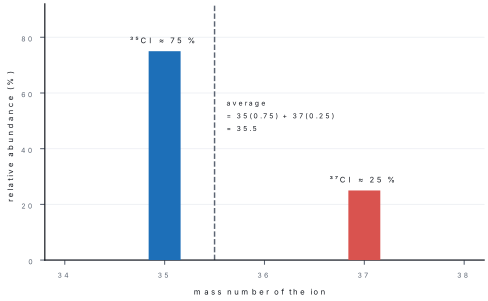
Problem. Copper is 69 % ⁶³Cu and 31 % ⁶⁵Cu. Taking the isotopic masses as 63 and 65, find the average atomic mass of copper.
Solution. Lighter mass + (difference × fraction of heavier) = 63 + 2 × 0.31 = 63 + 0.62 = 63.62 ≈ 63.6. Reverse use: if the average and the two masses are given, the fraction of the heavier isotope is (average − lighter) ÷ (heavier − lighter).
Problem. Find the mass in grams of one atom of ¹²C and of one molecule of CO₂ (N_A = 6.02 × 10²³ mol⁻¹).
Solution. Mass of one particle = M ÷ N_A. One ¹²C atom: 12 ÷ 6.02 × 10²³ = 1.99 × 10⁻²³ g (and 1/12 of this is 1.66 × 10⁻²⁴ g = 1 u). One CO₂ molecule: 44 ÷ 6.02 × 10²³ = 7.31 × 10⁻²³ g.
1.2 Chemical equations, empirical and molecular formulae, percentage composition
What an equation tells you — and what it does not
A balanced chemical equation is a statement of conservation: the same number of atoms of each element on both sides.
| A balanced equation tells | It does not tell (unless written in) |
|---|---|
| the reactants and products | the rate or time taken (that is kinetics) |
| the mole ratio of all species | the conditions — temperature, pressure, catalyst |
| the mass ratio (with molar masses) | whether the reaction is complete or reversible |
| the volume ratio of gases at the same T and P | the physical states and the concentrations |
| that atoms (and mass) are conserved | the mechanism, or whether it happens at all |
An equation is made more informative by writing states (s, l, g, aq), conditions over the arrow, ⇌ for a reversible reaction and ΔH for the heat change: N₂(g) + 3H₂(g) ⇌ 2NH₃(g), ΔH = −92 kJ (Fe catalyst, about 450 °C, 200 atm).
Balancing by inspection. Balance first the element that appears in the fewest formulae, leave H and O to the end, and balance a free element (O₂, H₂) last; clear any fraction by multiplying through. For any combustion there is a formula worth knowing:
So propane C₃H₈ needs 3 + 8/4 = 5 O₂; ethanol C₂H₆O needs 2 + 6/4 − 1/2 = 3 O₂; glucose C₆H₁₂O₆ needs 6 + 3 − 3 = 6 O₂. Redox equations are balanced in Unit 5.
Percentage composition
| Compound | M | Result worth remembering |
|---|---|---|
| H₂O | 18 | H 11.1 %, O 88.9 % (H : O = 1 : 8 by mass) |
| CO₂ | 44 | C 27.3 % |
| CH₄ | 16 | C 75 %, H 25 % |
| Glucose C₆H₁₂O₆ | 180 | C 40.0 %, H 6.7 %, O 53.3 % |
| Urea CO(NH₂)₂ | 60 | N 46.7 % — the richest common solid nitrogen fertiliser |
| NH₄NO₃ | 80 | N 35.0 % |
| (NH₄)₂SO₄ | 132 | N 21.2 % |
| CuSO₄·5H₂O | 249.5 | water of crystallisation 36.1 % |
| Na₂CO₃·10H₂O | 286 | water of crystallisation 62.9 % |
Empirical and molecular formula
The empirical formula gives the simplest whole-number ratio of the atoms in a compound. The molecular formula gives the actual number of atoms of each element in one molecule. Molecular formula = n × empirical formula, where n = molecular mass ÷ empirical-formula mass (a whole number).
Method from percentages. (1) Take 100 g, so % becomes grams. (2) Divide by the atomic mass to get relative moles. (3) Divide by the smallest. (4) If a ratio ends in .5, multiply all by 2; in .33 or .67, by 3; in .25 or .75, by 4. (5) Find n from the molar mass — for a gas or vapour, M = 2 × vapour density.
| Empirical formula | Compounds sharing it |
|---|---|
| CH | ethyne C₂H₂, benzene C₆H₆ |
| CH₂ | ethene C₂H₄, propene C₃H₆, cyclohexane C₆H₁₂ |
| CH₂O | methanal HCHO, ethanoic acid C₂H₄O₂, glucose C₆H₁₂O₆ |
| CH₃ | ethane C₂H₆ |
| HO | hydrogen peroxide H₂O₂ |
| NO₂ | dinitrogen tetroxide N₂O₄ |
Problem. A hydrocarbon contains 92.3 % C and 7.7 % H; its vapour density is 39. Find its molecular formula.
Solution. C : H = 92.3/12 : 7.7/1 = 7.69 : 7.7 = 1 : 1, so the empirical formula is CH (mass 13). M = 2 × 39 = 78, so n = 78/13 = 6. Molecular formula C₆H₆ (benzene).
Problem. 0.30 g of an organic compound containing C, H and O burns to give 0.44 g CO₂ and 0.18 g H₂O. Find its empirical formula.
Solution. Mass of C = 0.44 × 12/44 = 0.12 g; mass of H = 0.18 × 2/18 = 0.02 g; mass of O = 0.30 − 0.12 − 0.02 = 0.16 g. Moles C : H : O = 0.01 : 0.02 : 0.01 = 1 : 2 : 1. Empirical formula CH₂O.
If only C and H percentages are given and they add to less than 100, the remainder is oxygen (unless another element is named). And never round 1.5 to 2 or 1.33 to 1 — multiply the whole ratio instead: C : H = 1 : 1.5 means C₂H₃, not CH₂.
1.3 Dalton's atomic theory, the laws of stoichiometry and Avogadro's law
Dalton's atomic theory (1808) and what survived
| Postulate | Status today |
|---|---|
| Matter is made of tiny indivisible atoms | Failed — atoms contain electrons, protons and neutrons |
| Atoms can neither be created nor destroyed | Holds for chemical change; fails in nuclear reactions |
| Atoms of one element are identical in mass and properties | Failed — isotopes (¹H, ²H, ³H; ³⁵Cl, ³⁷Cl) |
| Atoms of different elements have different masses | Failed — isobars have equal mass numbers (⁴⁰Ar and ⁴⁰Ca) |
| Atoms combine in simple whole-number ratios | Whole numbers yes, but not always simple (C₁₂H₂₂O₁₁, proteins); fails for non-stoichiometric solids |
| The atom is the smallest unit taking part in a chemical reaction | Still true |
The laws of chemical combination
| Law (author) | Statement | Test example |
|---|---|---|
| Conservation of mass (Lavoisier) | In a chemical change the total mass of the products equals the total mass of the reactants | 4 g H₂ + 32 g O₂ → 36 g H₂O |
| Definite (constant) proportions (Proust) | A pure compound always contains the same elements combined in the same fixed ratio by mass, whatever its source | water from the Koshi or from a laboratory: H : O = 1 : 8 |
| Multiple proportions (Dalton) | When two elements form more than one compound, the masses of one element that combine with a fixed mass of the other are in a simple whole-number ratio | O per 28 g N in N₂O, NO, N₂O₃, NO₂, N₂O₅ = 16, 32, 48, 64, 80 → 1 : 2 : 3 : 4 : 5 |
| Reciprocal proportions (Richter) | When two elements each combine with a fixed mass of a third, the masses in which they do so are in the same ratio (or a simple multiple of it) as the ratio in which they combine with each other | 12 g C takes 4 g H (CH₄) and 32 g O (CO₂): H : O = 1 : 8, the same as in H₂O |
| Gaseous volumes (Gay-Lussac) | Gases react, and gaseous products form, in volumes bearing a simple whole-number ratio, at the same T and P | H₂ + Cl₂ → 2HCl is 1 : 1 : 2 by volume; N₂ + 3H₂ → 2NH₃ is 1 : 3 : 2 |
- Conservation of mass fails measurably only in nuclear reactions (E = mc^2); the mass change in a chemical reaction exists but is far too small to weigh.
- Definite proportions fails for non-stoichiometric (berthollide) compounds such as Fe₀.₉₅O, and when isotopes differ: H : O by mass is 1 : 8 in H₂O but 1 : 4 in D₂O.
- Gay-Lussac's law is about gas volumes only; volumes are not conserved (2 vol H₂ + 1 vol O₂ → 2 vol steam), but mass always is.
Problem. Two oxides of nitrogen contain 63.6 % and 46.7 % nitrogen by mass. Show that they obey the law of multiple proportions.
Solution. Oxygen per 1 g of nitrogen: first oxide 36.4/63.6 = 0.572 g; second oxide 53.3/46.7 = 1.141 g. Ratio 0.572 : 1.141 = 1 : 2, a simple whole-number ratio (the oxides are N₂O and NO).
Avogadro's law and its deductions
Equal volumes of all gases, measured at the same temperature and pressure, contain equal numbers of molecules.
Avogadro's law reconciled Gay-Lussac's volume ratios with atomic theory. If hydrogen and chlorine were single atoms, 1 volume + 1 volume would give only 1 volume of HCl; the observed 2 volumes require diatomic molecules: H₂ + Cl₂ → 2HCl. Its deductions are the working tools of this chapter:
- Elementary gases such as H₂, N₂, O₂ and Cl₂ are diatomic.
- M = 2 × VD. Vapour density is the mass of a volume of gas divided by the mass of the same volume of hydrogen at the same T and P. Equal volumes hold equal numbers of molecules, so VD = M(gas)/M(H₂) = M/2.
- Molar volume. One mole of any gas occupies 22.4 L at STP (273 K, 1 atm) — so the density of a gas at STP is M/22.4 g L⁻¹. (At 273 K and 1 bar the molar volume is 22.7 L; at 298 K and 1 atm it is 24.5 L. CEE problems use 22.4 L at STP unless they say otherwise.)
- Gas volumes react in the coefficient ratio. At the same T and P, volume ratio = mole ratio, so gas–gas problems need no conversion to moles at all.
Problem. 10 mL of a gaseous hydrocarbon needs exactly 30 mL of O₂ for complete combustion and gives 20 mL of CO₂, all volumes at the same T and P. Find its formula.
Solution. For CₓHᵧ, volumes are in the ratio 1 : (x + y/4) : x. CO₂: x = 20/10 = 2. O₂: x + y/4 = 30/10 = 3, so y = 4. The gas is C₂H₄ (ethene).
1 L of He and 1 L of O₃ at the same T and P contain the same number of molecules, but the ozone contains three times as many atoms and twelve times the mass (48 against 4).
1.4 The mole concept, limiting reactant and percentage yield
The mole
The mole is the amount of substance that contains exactly 6.02214076 × 10²³ elementary entities (atoms, molecules, ions, electrons…). This number is the Avogadro constant, N_A. Before 2019 the mole was defined as the number of atoms in exactly 12 g of carbon-12 — numerically the same.
The molar mass M (g mol⁻¹) has the same number as the relative molecular mass. Every conversion goes through moles:
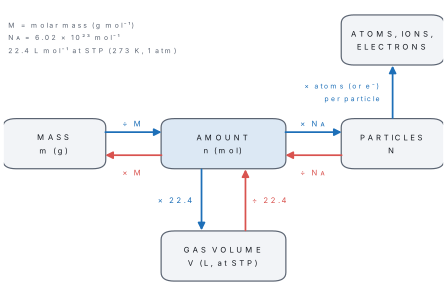
Counting what is inside. Atoms = moles of molecules × N_A × atomicity. Electrons in a molecule = sum of the atomic numbers (minus the charge for a cation, plus it for an anion). Useful ten-electron species: H₂O, NH₃, CH₄, HF, Ne, NH₄⁺, H₃O⁺, OH⁻, Na⁺, Mg²⁺. N₂ and CO each have 14 electrons and the same molar mass, 28.
Problem. For 4.4 g of CO₂ find the number of molecules, atoms and electrons (N_A = 6.02 × 10²³ mol⁻¹).
Solution. n = 4.4/44 = 0.1 mol. Molecules = 0.1 × 6.02 × 10²³ = 6.02 × 10²². Atoms = 3 × that = 1.81 × 10²³. Electrons: CO₂ has 6 + 8 + 8 = 22, so 22 × 6.02 × 10²² = 1.32 × 10²⁴.
Stoichiometry — the mole-ratio method
- Write the balanced equation.
- Convert what is given into moles.
- Multiply by the coefficient ratio (wanted ÷ given).
- Convert the answer into the unit asked for — grams, litres at STP, or particles.
For mass-to-mass problems the steps collapse into one line: mass of B = mass of A × (b × M_B)/(a × M_A), where a and b are the coefficients. From CaCO₃ → CaO + CO₂, 50 g of CaCO₃ (0.5 mol) gives 0.5 × 56 = 28 g CaO and 0.5 × 22.4 = 11.2 L CO₂ at STP. For a chain of reactions, follow one atom: in S → SO₂ → SO₃ → H₂SO₄ every sulphur atom ends up in one H₂SO₄, so 32 g of sulphur gives at most 98 g of acid (the principle of atom conservation).
Limiting reactant
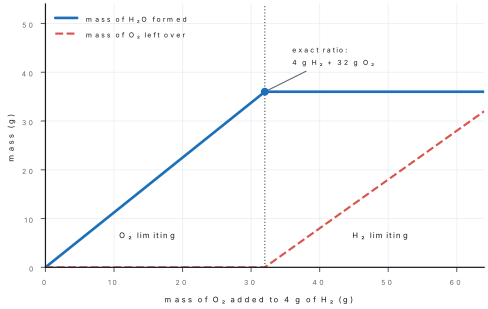
The limiting reactant is the reactant that is used up first in a reaction; it decides the maximum amount of product. The other reactants are present in excess and are partly left over.
Rule: for each reactant compute moles ÷ its coefficient; the smallest value marks the limiting reactant. All products are calculated from it.
Problem. 28 g of N₂ and 9 g of H₂ react, N₂ + 3H₂ → 2NH₃, until one of them is used up. Which reactant is limiting? What mass of NH₃ forms and what is left over?
Solution. N₂: 28/28 = 1 mol, 1/1 = 1. H₂: 9/2 = 4.5 mol, 4.5/3 = 1.5. N₂ gives the smaller value, so N₂ is limiting. NH₃ = 2 × 1 = 2 mol = 34 g. H₂ used = 3 mol; left = 1.5 mol = 3 g. Check: 28 + 9 = 34 + 3.
In the example above H₂ has the smaller mass (9 g against 28 g), yet N₂ is limiting. And with 2 mol H₂ + 2 mol O₂ (2H₂ + O₂ → 2H₂O) the moles are equal, yet H₂ is limiting because its coefficient is 2. Always divide by the coefficient.
Percentage yield and purity
The theoretical yield is what the limiting reactant would give by the equation. Real yields are lower because of side reactions, reversible or incomplete reaction and losses during separation and purification. With an impure reactant, first find the mass of the pure substance, then do the stoichiometry.
Problem. Fermentation, C₆H₁₂O₆ → 2C₂H₅OH + 2CO₂, of 90 g of glucose gives 36.8 g of ethanol. Find the percentage yield. (C = 12, H = 1, O = 16)
Solution. Glucose = 90/180 = 0.5 mol → theoretical ethanol = 1 mol = 46 g. Yield = 36.8/46 × 100 = 80 %.
Setters build the wrong options from predictable slips: using the coefficient ratio upside down, forgetting the coefficient altogether (a 1 : 1 answer), ignoring purity (the 100 % answer), or adding the masses of both reactants when one is in excess. If two options differ by exactly your coefficient ratio, recheck that step before choosing.
Formula and fact sheet
| Quantity | Relation |
|---|---|
| Atomic mass unit | 1 u = 1/12 × mass of a ¹²C atom = 1.66 × 10⁻²⁴ g; 1 g = 6.02 × 10²³ u |
| Average atomic mass | Σ (fraction × isotopic mass); two isotopes: lighter + difference × fraction of heavier |
| Mass of one particle | M / N_A grams |
| Moles | n = m/M = N/N_A = V(STP)/22.4 L |
| Gas density at STP | ρ = M/22.4 g L⁻¹ |
| Vapour density | M = 2 × VD |
| Molecular formula | n × empirical formula; n = M ÷ empirical-formula mass |
| Mass % of an element | (atoms × A_r)/M × 100 |
| Combustion analysis | m(C) = m(CO₂) × 12/44; m(H) = m(H₂O) × 2/18 |
| O₂ for burning CₓHᵧO_z | x + y/4 − z/2 mol per mol |
| Limiting reactant | smallest (moles ÷ coefficient) |
| Yield and purity | % yield = actual/theoretical × 100; % purity = pure/sample × 100 |
| Law | Author | One-line test |
|---|---|---|
| Conservation of mass | Lavoisier | mass of reactants = mass of products (fails only in nuclear change) |
| Definite proportions | Proust | fixed mass ratio whatever the source (fails: Fe₀.₉₅O, isotopes) |
| Multiple proportions | Dalton | CO/CO₂, H₂O/H₂O₂, SO₂/SO₃, Cu₂O/CuO, the five N oxides |
| Reciprocal proportions | Richter | CH₄, CO₂ and H₂O |
| Gaseous volumes | Gay-Lussac | H₂ + Cl₂ → 2HCl, 1 : 1 : 2 |
| Equal volumes, equal molecules | Avogadro | M = 2 VD; 22.4 L mol⁻¹ at STP |
Molar volumes: 22.4 L (273 K, 1 atm, the CEE value) · 22.7 L (273 K, 1 bar) · 24.5 L (298 K, 1 atm). Atomicities: noble gases 1, O₃ 3, P₄ 4, S₈ 8.
Chapter summary
- 1 u = 1/12 of the mass of a ¹²C atom = 1.66 × 10⁻²⁴ g; relative atomic and molecular masses are unitless ratios; the tabulated atomic mass is an isotope-weighted average.
- Formulae come from valencies by criss-cross; learn the radicals with their charges, and remember Hg₂²⁺ (Hg₂Cl₂), S₂O₃²⁻ and Cr₂O₇²⁻.
- Percentage of an element = (atoms × A_r)/M × 100; urea is 46.7 % N, CuSO₄·5H₂O is 36.1 % water.
- Empirical formula: % → ÷ A_r → ÷ smallest → whole numbers; molecular formula = n × empirical formula, with M = 2 × VD.
- Lavoisier (mass), Proust (definite), Dalton (multiple), Richter (reciprocal), Gay-Lussac (gas volumes), Avogadro (equal volumes, equal molecules).
- Dalton's indivisibility and identical-mass postulates failed (subatomic particles, isotopes, isobars); conservation of atoms in chemical change survives.
- One mole = 6.022 × 10²³ entities (exact since 2019) = M grams = 22.4 L of gas at STP; n = m/M = N/N_A = V/22.4.
- Limiting reactant = smallest moles ÷ coefficient; it fixes the product. % yield = actual/theoretical × 100.
Practice questions
Set A — Recall (20 questions)
- One atomic mass unit is defined asathe mass of one hydrogen atomb1/16 of the mass of one ¹⁶O atomc1/12 of the mass of one ¹²C atomdthe mass of one neutron
- The mass of 1 u expressed in grams is abouta1.66 × 10⁻²⁴ gb1.66 × 10⁻²⁷ gc6.02 × 10⁻²³ gd1.99 × 10⁻²³ g
- The law of multiple proportions was put forward byaLavoisierbProustcRichterdDalton
- Which pair of compounds illustrates the law of multiple proportions?aH₂O and D₂ObSO₂ and SO₃cNaCl and NaBrdCO₂ and CS₂
- The formula of aluminium sulphate isaAlSO₄bAl₂(SO₄)₃cAl₃(SO₄)₂dAl(SO₄)₃
- The thiosulphate ion isaSO₃²⁻bS₂O₈²⁻cS₄O₆²⁻dS₂O₃²⁻
- The empirical formula of glucose, C₆H₁₂O₆, isaCH₂ObC₂H₄O₂cCHOdC₃H₆O₃
- One mole of an ideal gas at STP (273 K and 1 atm) occupiesa11.2 Lb24.5 Lc22.4 Ld22.7 L
- Avogadro's law states that equal volumes of all gases at the same temperature and pressure contain equal numbers ofaatomsbgramscmoleculesdelectrons
- Which postulate of Dalton's atomic theory is still accepted for chemical reactions?aAtoms are neither created nor destroyedbAtoms are indivisiblecAll atoms of an element have the same massdAtoms of different elements always differ in mass
- The law of definite proportions is NOT obeyed byawater collected from any sourcebnon-stoichiometric compounds such as Fe₀.₉₅Occarbon dioxide from burning coaldcommon salt from sea water
- Since 2019 the mole has been defined by fixing the value ofathe number of atoms in 12 g of carbon-12bthe molar volume of a gas at STPcthe mass of one hydrogen atomdthe Avogadro constant
- Relative atomic mass is expressed inagramsbg mol⁻¹ckilogramsdno unit, being a ratio
- The molecular mass M of a gas and its vapour density VD are related byaM = 2 × VDbVD = 2 × McM = VDdM = 22.4 × VD
- At the same temperature and pressure, 2 volumes of hydrogen react with 1 volume of oxygen to give 2 volumes of steam. This illustratesathe law of reciprocal proportionsbGay-Lussac's law of gaseous volumescthe law of conservation of massdBoyle's law
- The atomicity of white phosphorus isa1b2c4d8
- The mercurous ion is correctly written asaHg₂²⁺bHg⁺cHg²⁺dHg₂⁺
- A balanced chemical equation does NOT tell usathe mole ratio of reactants and productsbthe masses of products from given masses of reactantscthe rate at which the reaction proceedsdthe volume ratio of gaseous reactants
- Which pair of compounds has the same empirical formula?aC₂H₄ and C₂H₆bCH₄ and C₂H₆cH₂O and H₂O₂dC₂H₂ and C₆H₆
- Pure water, whatever its source, contains hydrogen and oxygen in the mass ratioa1 : 16b1 : 8c2 : 1d8 : 1
Answers and explanations — Set A
1. (c) — The ¹²C standard has been used since 1961; (a) was Dalton's hydrogen scale and (b) the old physicists' scale (¹⁶O = 16); chemists took natural oxygen as 16 until 1961.
2. (a) — 1 u = (1/N_A) g = 1/(6.02 × 10²³) g = 1.66 × 10⁻²⁴ g. Option (b) is the same number in kilograms; (d) is the mass of a whole ¹²C atom.
3. (d) — Dalton deduced it from his atomic theory. Lavoisier: conservation of mass; Proust: definite proportions; Richter: reciprocal proportions.
4. (b) — The same two elements form both: O per 32 g of S is 32 g in SO₂ and 48 g in SO₃, ratio 2 : 3. H₂O/D₂O differ only in isotope; (c) and (d) involve three elements.
5. (b) — Al³⁺ and SO₄²⁻ criss-cross to Al₂(SO₄)₃: 2 × (+3) = 3 × (−2).
6. (d) — Thiosulphate is S₂O₃²⁻ (hypo is Na₂S₂O₃·5H₂O). SO₃²⁻ is sulphite, S₂O₈²⁻ peroxodisulphate, S₄O₆²⁻ tetrathionate (formed when thiosulphate reacts with iodine).
7. (a) — Divide every subscript by the HCF, 6. C₂H₄O₂ and C₃H₆O₃ have the same ratio but are not the simplest.
8. (c) — 22.4 L at 273 K and 1 atm. 22.7 L is the value at 1 bar, 24.5 L at 298 K, and 11.2 L is half a mole.
9. (c) — Molecules. The number of atoms differs when atomicities differ, e.g. 1 L of He against 1 L of O₃.
10. (a) — Atoms are conserved in chemical change. Indivisibility failed (subatomic particles), identical mass failed (isotopes) and (d) failed (isobars such as ⁴⁰Ar and ⁴⁰Ca).
11. (b) — Non-stoichiometric (berthollide) compounds like Fe₀.₉₅O have variable composition. Pure water, CO₂ and NaCl have fixed composition whatever their origin.
12. (d) — The 2019 SI revision fixed N_A at exactly 6.02214076 × 10²³ mol⁻¹. Option (a) was the definition used before 2019.
13. (d) — It is the ratio of two masses, so it has no unit. Atomic mass in u and molar mass in g mol⁻¹ carry the same number.
14. (a) — VD = mass of a volume of gas ÷ mass of an equal volume of H₂ = M ÷ 2, because equal volumes hold equal numbers of molecules.
15. (b) — Gas volumes react in the simple ratio 2 : 1 : 2. Note that the volume is not conserved (3 → 2) — only the mass is.
16. (c) — White phosphorus is tetrahedral P₄. S₈ has atomicity 8 and ozone 3.
17. (a) — Mercury(I) exists as the dimer Hg₂²⁺, so calomel is Hg₂Cl₂. Hg²⁺ is the mercuric ion.
18. (c) — An equation gives stoichiometry, not speed; the rate is a matter of kinetics (Unit 9).
19. (d) — Both reduce to CH. H₂O stays H₂O but H₂O₂ reduces to HO; C₂H₄ is CH₂ and C₂H₆ is CH₃.
20. (b) — 2 × 1 g of H to 16 g of O = 1 : 8 by mass (law of definite proportions). 2 : 1 is the ratio of atoms, not of masses.
Set B — Understanding (14 questions)
- Which of the following contains the largest number of atoms? (H = 1, He = 4, C = 12, O = 16)a1 g of O₂b1 g of H₂c1 g of Hed1 g of CH₄
- At the same temperature and pressure, 2 L of N₂ and 2 L of CO containaequal numbers of molecules but different massesbequal masses but different numbers of moleculescequal numbers of atoms but different massesdequal numbers of molecules and equal masses
- Equal masses of oxygen (O₂) and sulphur dioxide (SO₂) are taken. The ratio of the numbers of molecules, O₂ : SO₂, isa2 : 1b1 : 2c1 : 1d1 : 4
- A magnesium ribbon burnt in an open crucible becomes heavier. The best explanation is thataconservation of mass does not apply to combustionbthe heat absorbed has masscmagnesium has combined with oxygen taken from the airdmagnesium atoms expand on heating
- A compound with empirical formula CH₂O has a vapour density of 30. Its molecular formula isaC₂H₄O₂bCH₂OcC₃H₆O₃dC₆H₁₂O₆
- Which fertiliser contains the highest percentage of nitrogen by mass?aNH₄NO₃b(NH₄)₂SO₄cNH₄CldCO(NH₂)₂
- The mass of one molecule of water is abouta18 gb3.0 × 10⁻²³ gc1.1 × 10²⁵ gd3.0 × 10⁻²⁶ g
- 2 mol of H₂ and 2 mol of O₂ are sparked together to form water. Which statement is correct?aO₂ is the limiting reactantb4 mol of water is formedc1 mol of O₂ remains unreactedd1 mol of H₂ remains unreacted
- To explain 1 volume H₂ + 1 volume Cl₂ → 2 volumes HCl, Avogadro had to assume that hydrogen and chlorine molecules areadiatomicbmonoatomicctriatomicdionic
- Which sample has the greatest mass? (H = 1, C = 12, N = 14, O = 16)a0.5 mol of O₂b3.01 × 10²³ molecules of CO₂c11.2 L of N₂ at STPd1 mol of H₂
- The percentage of water of crystallisation in blue vitriol, CuSO₄·5H₂O, is about (Cu = 63.5, S = 32)a7.2 %b25.5 %c63.9 %d36.1 %
- Carbon has valency 4 in CH₄, CH₂Cl₂ and CCl₄. Its oxidation numbers in these three compounds are respectivelya+4, 0, −4b−4, −2, +4c−4, 0, +4d4, 4, 4
- A gas has a density of 1.25 g L⁻¹ at STP. The gas could beaN₂bO₂cCO₂dNH₃
- In the balanced equation C₃H₈ + x O₂ → 3CO₂ + 4H₂O, the value of x isa3b5c7d10
Answers and explanations — Set B
1. (b) — Atoms = (m/M) × atomicity: H₂ 0.5 × 2 = 1 mol; CH₄ (1/16) × 5 = 0.31 mol; He 0.25 mol; O₂ (1/32) × 2 = 0.06 mol.
2. (d) — Equal volumes hold equal numbers of molecules (Avogadro), and N₂ and CO both have M = 28, so the masses are equal too (both also have 14 electrons per molecule).
3. (a) — For equal masses, n ∝ 1/M: 64/32 = 2, so O₂ : SO₂ = 2 : 1.
4. (c) — 2Mg + O₂ → 2MgO: the oxide includes oxygen taken from the air. Mass is conserved for the whole system, not for the solid alone.
5. (a) — M = 2 × 30 = 60; empirical-formula mass = 30; n = 2, so C₂H₄O₂ (ethanoic acid).
6. (d) — Urea 28/60 = 46.7 %; NH₄NO₃ 28/80 = 35.0 %; NH₄Cl 14/53.5 = 26.2 %; (NH₄)₂SO₄ 28/132 = 21.2 %.
7. (b) — 18 g ÷ 6.02 × 10²³ = 2.99 × 10⁻²³ g. Option (d) is the value in kilograms; (c) comes from multiplying instead of dividing.
8. (c) — 2H₂ + O₂ → 2H₂O. Moles ÷ coefficient: H₂ 2/2 = 1, O₂ 2/1 = 2, so H₂ is limiting; it uses 1 mol O₂, leaving 1 mol, and forms 2 mol of water.
9. (a) — With diatomic molecules, H₂ + Cl₂ → 2HCl gives two volumes. Single atoms would give H + Cl → HCl, only one volume.
10. (b) — (a) 16 g; (b) 0.5 mol × 44 = 22 g; (c) 0.5 mol × 28 = 14 g; (d) 2 g.
11. (d) — M = 63.5 + 32 + 64 + 90 = 249.5; water = 90/249.5 = 36.1 %. (a) counts one H₂O, (b) is the copper %, (c) the anhydrous CuSO₄ %.
12. (c) — CH₄: x + 4 = 0, x = −4. CH₂Cl₂: x + 2 − 2 = 0, x = 0. CCl₄: x − 4 = 0, x = +4. Valency has no sign; oxidation number does.
13. (a) — M = density × 22.4 = 1.25 × 22.4 = 28 g mol⁻¹, which fits N₂. O₂ would be 1.43, CO₂ 1.96 and NH₃ 0.76 g L⁻¹.
14. (b) — x = 3 + 8/4 = 5 (three CO₂ need 6 O atoms, four H₂O need 4: 10 O atoms = 5 O₂). Option (d) counts O atoms instead of O₂ molecules.
Set C — Application (11 questions)
- 10 g of H₂ and 64 g of O₂ are exploded together until one of them is used up. The mass of water formed isa74 gb90 gc72 gd36 g
- Boron has two isotopes, ¹⁰B and ¹¹B, and an average atomic mass of 10.8. The percentage abundance of ¹¹B isa80 %b20 %c50 %d92 %
- A hydrocarbon on complete combustion gives 4.4 g of CO₂ and 2.7 g of H₂O. Its empirical formula isaCHbCH₂cCH₄dCH₃
- 25 g of limestone containing 80 % CaCO₃ is heated strongly. The volume of CO₂ released, at STP, is (Ca = 40)a5.60 Lb4.48 Lc2.24 Ld8.96 L
- The mass of KClO₃ needed to produce 6.72 L of O₂ at STP by 2KClO₃ → 2KCl + 3O₂ is (K = 39, Cl = 35.5)a24.5 gb36.75 gc12.25 gd49.0 g
- 28 g of N₂ reacts with excess H₂ and gives 17 g of NH₃. The percentage yield isa25 %b60.7 %c50 %d100 %
- Two oxides of iron contain 27.6 % and 30.0 % oxygen by mass. The masses of oxygen combined with a fixed mass of iron in the two oxides are in the ratioa1 : 2b2 : 3c3 : 4d8 : 9
- The number of neutrons in 1.8 g of ordinary water, ¹H₂¹⁶O, is (N_A = 6.02 × 10²³ mol⁻¹)a6.02 × 10²³b4.82 × 10²³c1.08 × 10²⁴d6.02 × 10²²
- A compound contains 85.7 % carbon and 14.3 % hydrogen, and its vapour density is 28. Its molecular formula isaC₂H₄bC₃H₆cC₄H₁₀dC₄H₈
- The volume of oxygen at STP needed for complete combustion of 2.8 L of ethene (C₂H₄) at STP isa8.4 Lb2.8 Lc5.6 Ld11.2 L
- A lime kiln in Hetauda heats 1.0 kg of limestone that is 90 % CaCO₃ by mass. The maximum mass of quicklime (CaO) it can produce is (Ca = 40)a560 gb396 gc504 gd450 g
Answers and explanations — Set C
1. (c) — H₂ = 5 mol (5/2 = 2.5), O₂ = 2 mol (2/1 = 2): O₂ is limiting, giving 4 mol H₂O = 72 g, with 2 g of H₂ left. (a) adds both masses, ignoring the excess; (b) wrongly takes H₂ as limiting.
2. (a) — Fraction of heavier isotope = (10.8 − 10)/(11 − 10) = 0.8, i.e. 80 % ¹¹B. Option (b) is the abundance of ¹⁰B.
3. (d) — C = 4.4/44 = 0.1 mol; H = 2 × 2.7/18 = 0.3 mol; C : H = 1 : 3, so CH₃ (the compound is ethane, C₂H₆).
4. (b) — Pure CaCO₃ = 0.8 × 25 = 20 g = 0.2 mol → 0.2 mol CO₂ = 0.2 × 22.4 = 4.48 L. Option (a) ignores the purity.
5. (a) — O₂ = 6.72/22.4 = 0.3 mol; KClO₃ = 0.3 × 2/3 = 0.2 mol = 0.2 × 122.5 = 24.5 g. Option (b) uses a 1 : 1 ratio.
6. (c) — 1 mol N₂ gives 2 mol NH₃ = 34 g in theory; yield = 17/34 × 100 = 50 %. Option (b) divides by the mass of N₂; (d) assumes 1 : 1.
7. (d) — O per 1 g Fe: 27.6/72.4 = 0.381 and 30.0/70.0 = 0.429; ratio 0.381 : 0.429 = 8 : 9 (Fe₃O₄ has O/Fe = 4/3, Fe₂O₃ has 3/2).
8. (b) — 1.8 g = 0.1 mol of H₂O; each molecule has 0 + 0 + 8 = 8 neutrons (¹H has none), so 0.8 × 6.02 × 10²³ = 4.82 × 10²³. Option (a) counts electrons or protons; (c) counts all 18 nucleons.
9. (d) — C : H = 85.7/12 : 14.3/1 = 7.14 : 14.3 = 1 : 2, so CH₂ (14). M = 2 × 28 = 56; n = 4: C₄H₈. C₄H₁₀ (58) has the wrong ratio.
10. (a) — C₂H₄ + 3O₂ → 2CO₂ + 2H₂O; at the same T and P volumes follow the coefficients: 3 × 2.8 = 8.4 L. Option (c) is the CO₂ formed.
11. (c) — CaCO₃ = 900 g = 9 mol → 9 mol CaO = 9 × 56 = 504 g. Option (b) is the CO₂ lost (9 × 44 g); (a) ignores the purity.